Physical Address
Remote team based in Bozeman, Montana.
Physical Address
Remote team based in Bozeman, Montana.
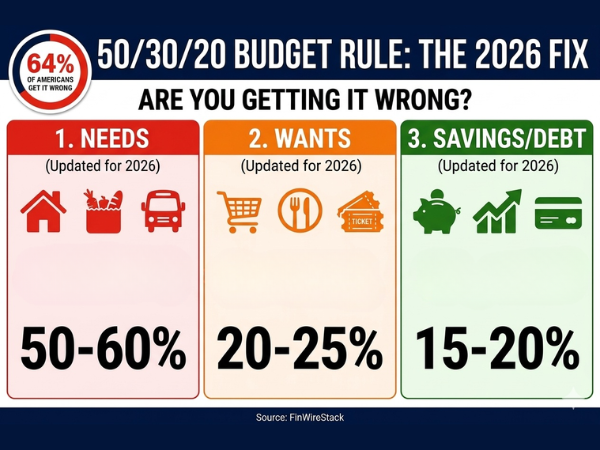
50/30/20 Budget Rule: 3 Mistakes 64% of Americans Make Revised percentages, real-life examples and a 7-day action plan to set your budget right in 2026. Read More
You have tried budgeting before. Maybe you used an app. Maybe you tried a spreadsheet. Maybe you just swore you would spend less.
And yet, according to the Federal Reserve’s 2026 Survey of Household Economics, 64% of Americans live paycheck to paycheck. Most of them have tried to budget. Most have failed.
Here is the truth they do not tell you: The 50/30/20 budget rule that 64% of Americans get wrong is not a bad rule. It is a good rule applied to the wrong reality.
The 50/30/20 rule was created in 2005 by Senator Elizabeth Warren. Back then, the average rent was $800. A gallon of gas was $2.50. A dozen eggs were $1.50.
In 2026, the average rent is $2,050. Gas is $4.50-6.00 per gallon. Eggs are $4-5 per dozen.
The 50/30/20 budget rule that 64% of Americans get wrong is not mathematically impossible. It just needs to be updated for 2026 realities.
The good news is that once you understand the three mistakes almost everyone makes, you can fix your budget in one weekend.
For understanding why you feel broke despite trying to budget, see The Silent Budget Killer: 7 Hidden Expenses Draining Your Bank Account.
For the emotional side of budgeting failure, see How to Stop Worrying About Money.
For building savings after you fix your budget, see How to Build an Emergency Fund from Scratch.
Before we fix the 50/30/20 budget rule that 64% of Americans get wrong, let us remind ourselves how it is supposed to work.
| Category | Percentage | What It Includes |
|---|---|---|
| Needs | 50% | Housing, utilities, groceries, transportation, minimum debt payments, insurance |
| Wants | 30% | Dining out, entertainment, subscriptions, hobbies, travel, shopping |
| Savings/Debt | 20% | Emergency fund, retirement, extra debt payments, investments |
| Step | Action |
|---|---|
| 1 | Calculate your monthly take-home pay (after taxes) |
| 2 | Multiply by 0.5 for your Needs budget |
| 3 | Multiply by 0.3 for your Wants budget |
| 4 | Multiply by 0.2 for your Savings/Debt budget |
| 5 | Spend within these limits |
| Expense | 2005 (Rule Created) | 2026 | Increase |
|---|---|---|---|
| Median rent | $800 | $2,050 | +156% |
| Average car payment | $300 | $740 | +147% |
| Health insurance (monthly) | $200 | $450 | +125% |
| Groceries (family of 4) | $600 | $1,200 | +100% |
| Gas (per gallon) | $2.50 | $4.50-6.00 | +80-140% |
| Cell phone bill | $50 | $120 | +140% |
The problem is not the rule. The problem is that “needs” now cost more than 50% of most people’s income.
The 50/30/20 budget rule that 64% of Americans get wrong is not broken. It just needs to be adapted.
For a complete budget template, see Best Budgeting Apps for Couples.
For tracking your spending, see The Silent Budget Killer.
The 50/30/20 budget rule that 64% of Americans get wrong fails for three specific reasons.
| Mistake | What People Do | Why It Fails |
|---|---|---|
| 1 | Categorize wants as needs | 50% becomes impossible to achieve |
| 2 | Treat debt payments as “wants.” | Minimum payments stay in needs; extra goes to wants |
| 3 | Use gross pay instead of net pay | Overestimates available money |
| Mistake | 2005 Impact | 2026 Impact |
|---|---|---|
| Wants as needs | Minor (needs were only 35-40% of income) | Major (needs are 55-65% of income) |
| Debt as wants | Minor (less consumer debt) | Major (credit card debt at 15-year high) |
| Gross vs. net | Minor (taxes were lower) | Major (taxes plus health insurance deductions) |
*The 50/30/20 budget rule that 64% of Americans get wrong* can work in 2026. You just need to avoid these three mistakes.
For understanding debt in 2026, see How to Get Out of Credit Card Debt Fast When You Have No Money.
For paycheck calculations, see How to Stop Living Paycheck to Paycheck.
The 50/30/20 budget rule that 64% of Americans get wrong starts with mis-categorization.
| Category | Need | Not a Need |
|---|---|---|
| Housing | Basic shelter (rent/mortgage) | Premium location, extra bedrooms |
| Food | Groceries, basic ingredients | Restaurants, delivery, prepared foods |
| Transportation | Reliable transportation | New car, premium gas, frequent trips |
| Utilities | Basic electricity, water, heat | Premium cable, multiple streaming services |
| Healthcare | Insurance, basic care | Elective procedures, premium plans |
| Phone | Basic service | Latest iPhone, unlimited data |
| Question | If Yes → Need | If No → Want |
|---|---|---|
| Would I be homeless without this? | Housing | Upgrades |
| Would I be hungry without this? | Basic groceries | Restaurants |
| Would I be unable to work without this? | Basic transportation | Luxury car |
| Would I be sick without this? | Healthcare | Elective |
| Expense | Common Mistake | Correct Category |
|---|---|---|
| $2,500 apartment | Need (but high) | Need (but problematic) |
| $1,500 apartment with roommate | Need | Need (better) |
| $800 car payment | Need? No. | Want a cheaper car? |
| $300 car payment (used car) | Need | Need |
| $400 grocery bill (cooking at home) | Need | Need |
| $800 grocery bill (prepared foods) | Want | Want (mostly) |
| Netflix, Hulu, Disney+ | “Need for entertainment” | Wants |
The 50/30/20 budget rule that 64% of Americans get wrong often fails because people refuse to call their luxuries what they are.
For grocery budgeting, see How to Save Money on Groceries.
For housing costs, see How to Survive the 2026 Cost of Living Crisis.
The 50/30/20 budget rule that 64% of Americans get wrong has a second critical flaw: where to put debt payments.
| Type of Debt | Where It Goes |
|---|---|
| Minimum payments | Needs (50%) |
| Extra payments | Savings/Debt (20%) |
| Problem | Explanation |
|---|---|
| High interest rates | Credit card interest at 22-29% is an emergency |
| Large balances | Minimum payments barely touch principal |
| Delayed savings | Paying interest is throwing away money |
| Debt Type | Interest Rate | Category | Action |
|---|---|---|---|
| Credit card debt | 22-29% | Emergency | Pay before savings (except 401k match) |
| Personal loan | 15-25% | High priority | Pay before wants |
| Student loan | 5-10% | Medium priority | Pay minimums + extra if possible |
| Car loan | 7-15% | Medium priority | Pay minimums |
| Mortgage | 5-7% | Low priority | Pay minimums |
| Category | Percentage | What It Includes |
|---|---|---|
| Needs | 50-60% | Housing, utilities, groceries, transportation, minimum debt payments |
| Debt Emergency | 15-20% | Extra payments on high-interest debt (over 10%) |
| Wants | 15-20% | Dining out, entertainment, subscriptions |
| Savings | 5-10% | Only after high-interest debt is gone |
The 50/30/20 budget rule that 64% of Americans get wrong must prioritize debt before savings for most people in 2026.
For prioritizing debt payments, see How to Get Out of Credit Card Debt Fast When You Have No Money.
For balance transfer options, see How to Get Out of Credit Card Debt.
For credit counseling, see How to Get Out of Credit Card Debt Fast When You Have No Money (credit counseling section).
The 50/30/20 budget rule that 64% of Americans get wrong has a third mistake: miscalculating your income.
| Term | Definition | Should You Use It? |
|---|---|---|
| Gross pay | Income before taxes and deductions | ❌ No |
| Net pay | Income after taxes and deductions | ✅ Yes |
| Monthly Gross Pay | 50% for Needs | Your Actual Net Pay | Problem |
|---|---|---|---|
| $5,000 | $2,500 | $3,800 | The needs budget exceeds the net pay. No, but tight. |
| $4,000 | $2,000 | $3,100 | The needs budget is 65% of net pay |
| $3,000 | $1,500 | $2,400 | The needs budget is 62% of net pay |
| Include | Do Not Include |
|---|---|
| Salary/wages after tax | Gross salary |
| Side hustle income (after estimated tax) | Bonuses (until received) |
| Child support | Investment gains (until realized) |
| Alimony | Gifts (unpredictable) |
| Step | Action |
|---|---|
| 1 | Look at your last paycheck |
| 2 | Find the “Net Pay” amount |
| 3 | Multiply by the number of paychecks per month |
| 4 | Add any consistent side income (after estimated tax) |
Example:
| Income Source | Amount |
|---|---|
| Net paycheck (bi-weekly $1,500) | $3,250/month (2.166 pay periods) |
| Side hustle (after tax) | $400/month |
| Total take-home pay | $3,650/month |
The 50/30/20 budget rule that 64% of Americans get wrong works when you start with the right number.
For income tracking, see Best Free Portfolio Trackers for Crypto and Stocks.
For side hustle income, see How to Get Out of Credit Card Debt Fast When You Have No Money (side hustle section).
Now that you know the three mistakes, here is how to fix the 50/30/20 budget rule that 64% of Americans get wrong.
| Category | 2026 Adjusted Percentage | What It Includes |
|---|---|---|
| Needs | 50-60% | Housing, utilities, groceries, basic transportation, minimum debt payments, and healthcare |
| Wants | 20-25% | Dining out, entertainment, subscriptions, shopping, hobbies |
| Savings/Debt | 15-20% | Emergency fund, retirement, extra debt payments, investments |
| Step | Action | Time |
|---|---|---|
| 1 | Calculate your true take-home pay (net, not gross) | 15 min |
| 2 | List every expense from last month | 30 min |
| 3 | Categorize each expense honestly (Need? Want? Debt?) | 20 min |
| 4 | Add up your Needs total | 5 min |
| 5 | If needs are > 60% of take-home pay, you must cut or increase income | 1 hour |
| 6 | Allocate remaining money: Wants (20-25%), Savings/Debt (15-20%) | 15 min |
| If Needs are… | Action |
|---|---|
| 61-65% | Cut wants aggressively; look for small housing/transportation savings |
| 66-75% | Major changes needed: roommate, cheaper car, move to a cheaper area |
| Over 75% | Income must increase (side hustle, better job, overtime) |
The 50/30/20 budget rule that 64% of Americans get wrong can be fixed. It just requires honesty about your numbers.
For cutting housing costs, see How to Survive the 2026 Cost of Living Crisis.
For increasing income, see How to Get Out of Credit Card Debt Fast When You Have No Money (side hustle section).
For automating your fixed budget, see Automated Savings Apps That Actually Work.
Let us walk through the 50/30/20 budget rule that 64% of Americans get wrong with real examples.
| Metric | Amount |
|---|---|
| Gross monthly salary | $4,167 |
| Net monthly take-home | $3,200 |
| Category | 2026 Adjusted Budget | Actual Spending | Status |
|---|---|---|---|
| Needs (55%) | $1,760 | $1,800 | ⚠️ Slightly over |
| Wants (25%) | $800 | $700 | ✅ Under |
| Savings/Debt (20%) | $640 | $700 | ✅ Over |
What this person did right: Honest categorization adjusted the needs percentage upward and kept wants in check.
| Metric | Amount |
|---|---|
| Gross combined monthly | $6,667 |
| Net combined take-home | $5,000 |
| Category | 2026 Adjusted Budget | Actual Spending | Status |
|---|---|---|---|
| Needs (60%) | $3,000 | $3,200 | ⚠️ Over |
| Debt Emergency (20%) | $1,000 | $1,000 | ✅ On track |
| Wants (20%) | $1,000 | $800 | ✅ Under |
What this couple did right: prioritized debt before savings and reduced wants to accommodate higher needs.
| Metric | Amount |
|---|---|
| Gross combined monthly | $10,000 |
| Net combined take-home | $7,200 |
| Category | 2026 Adjusted Budget | Actual Spending | Status |
|---|---|---|---|
| Needs (58%) | $4,176 | $4,200 | ⚠️ Slightly over |
| Wants (22%) | $1,584 | $1,500 | ✅ Under |
| Savings (20%) | $1,440 | $1,500 | ✅ Over |
The 50/30/20 budget rule that 64% of Americans get wrong works when you adjust percentages to your reality.
For couples budgeting, see Best Budgeting Apps for Couples.
For family budgeting, see How to Save Money on Groceries.
Here is a simple template to implement the 50/30/20 budget rule that 64% of Americans get wrong.
| Category | Your Budget | Actual | Difference |
|---|---|---|---|
| NEEDS (50-60%) | |||
| Rent/Mortgage | $_____ | $_____ | $_____ |
| Utilities | $_____ | $_____ | $_____ |
| Groceries | $_____ | $_____ | $_____ |
| Transportation | $_____ | $_____ | $_____ |
| Minimum debt payments | $_____ | $_____ | $_____ |
| Health insurance | $_____ | $_____ | $_____ |
| Total Needs | $_____ | $_____ | $_____ |
| WANTS (20-25%) | |||
| Dining out | $_____ | $_____ | $_____ |
| Entertainment | $_____ | $_____ | $_____ |
| Subscriptions | $_____ | $_____ | $_____ |
| Shopping | $_____ | $_____ | $_____ |
| Hobbies | $_____ | $_____ | $_____ |
| Total Wants | $_____ | $_____ | $_____ |
| SAVINGS/DEBT (15-20%) | |||
| Emergency fund | $_____ | $_____ | $_____ |
| Retirement | $_____ | $_____ | $_____ |
| Extra debt payments | $_____ | $_____ | $_____ |
| Investments | $_____ | $_____ | $_____ |
| Total Savings/Debt | $_____ | $_____ | $_____ |
| TOTAL SPENDING | $_____ | $_____ | $_____ |
| Take-home pay | $_____ |
For digital budgeting tools, see Best Budgeting Apps for Couples.
For automated savings, see Automated Savings Apps That Actually Work.
For emergency fund building, see How to Build an Emergency Fund from Scratch.
The 50/30/20 budget rule that 64% of Americans get wrong typically fails for three reasons: (1) you are categorizing wants as needs, inflating your needs category above 50-60%; (2) you are using gross pay instead of net pay; or (3) you are not prioritizing high-interest debt before savings. Fix these three mistakes, and the rule works.
If your needs exceed 60% of your take-home pay, you have two options: (1) reduce your needs (get a roommate, get a cheaper car, move to a cheaper area, or reduce utility usage), or (2) increase your income (side hustle, overtime, or better job). In the meantime, adjust the rule: Needs (60-70%), Wants (15-20%), and Savings/Debt (10-15%).
Minimum credit card payments go to Needs. Extra payments (above the minimum) should be prioritized in the Savings/Debt category BEFORE you save for retirement (except for a 401k match). Credit card interest at 22-29% is an emergency. Pay it off before building savings beyond a $1,000 buffer.
Always use net income (take-home pay after taxes and deductions). Using gross income overstates your available money and causes you to overspend. The 50/30/20 budget rule that 64% of Americans get wrong starts with the wrong number.
A need is something you would be homeless, hungry, unable to work, or sick without. Basic housing (not premium), basic groceries (not restaurants), basic transportation (not a luxury car), utilities, healthcare, and minimum debt payments. Premiums, upgrades, and convenience are wants.
| Step | Action |
|---|---|
| 1 | Calculate your monthly take-home pay |
| 2 | Review your last month of spending |
| 3 | Categorize every expense as need, want, or savings/debt. |
| 4 | Add up your Needs total |
| 5 | If Needs > 60%, cut wants and consider major changes |
| 6 | Allocate remaining money to wants and savings/debt. |
For more budgeting help, see Best Budgeting Apps for Couples.
For debt payoff while budgeting, see How to Get Out of Credit Card Debt Fast When You Have No Money.
For building savings, see How to Build an Emergency Fund from Scratch.
The 50/30/20 budget rule that 64% of Americans get wrong can be fixed in one week.
| Day | Action | Time |
|---|---|---|
| Day 1 | Calculate your true monthly take-home pay | 15 min |
| Day 1 | List every expense from last month | 30 min |
| Day 2 | Categorize each expense (Need? Want? Debt?) | 30 min |
| Day 2 | Add up your Needs total | 15 min |
| Day | Action | Time |
|---|---|---|
| Day 3 | If Needs > 60%, identify areas to cut | 30 min |
| Day 3 | Research cheaper alternatives (roommate, refinance, insurance) | 30 min |
| Day 4 | Create your 2026 adjusted 50/30/20 budget | 30 min |
| Day 4 | Set up automatic transfers for the Savings/Debt category | 15 min |
| Day | Action | Time |
|---|---|---|
| Day 5 | Use cash or debit for wants this week | 5 min |
| Day 6 | Track every expense for one day | 10 min |
| Day 7 | Review progress and adjust as needed | 15 min |
Sixty-four percent of Americans live paycheck to paycheck. Most have tried budgeting. Most have failed.
But the 50/30/20 budget rule that 64% of Americans get wrong is not bad. It is a good rule applied to the wrong reality.
| Fix | What to Do |
|---|---|
| Mistake #1 | Be honest about needs vs. wants in 2026 |
| Mistake #2 | Prioritize high-interest debt before savings |
| Mistake #3 | Use net pay, not gross pay |
The difference between those who make budgeting work and those who give up is not income. It is knowing the three mistakes and how to fix them.
Ready to fix your budget? Download our 50/30/20 budget template or share this guide with someone who needs it.
Reviewed by: Dennis M, FinTech Researcher
Dennis has tested over 50 digital banking apps and 25 crypto exchanges.