Physical Address
Remote team based in Bozeman, Montana.
Physical Address
Remote team based in Bozeman, Montana.
Stock market basics, ETFs, Roth IRA guides, portfolio management.

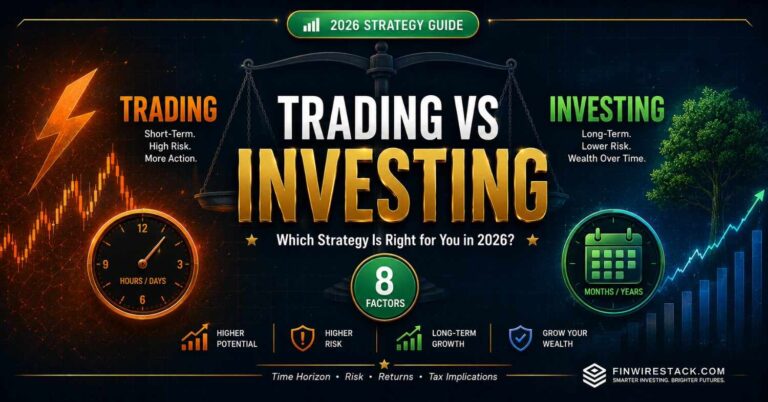
Trading vs. investingย is one of the most fundamental questions anyone entering the financial markets must answer. Both approaches aim to grow your money, but they operate on completely different timelines, risk profiles, and mindsets. Understanding this distinction is essential before committing your hard-earned capital.
This comprehensive guide will help you understand theย trading vs. investingย decision. You will learn:
By the end, you will have the knowledge to make an informedย trading vs. investingย decision that fits your personal financial situation.

Trading vs. investingโunderstanding the two distinct paths to growing your money
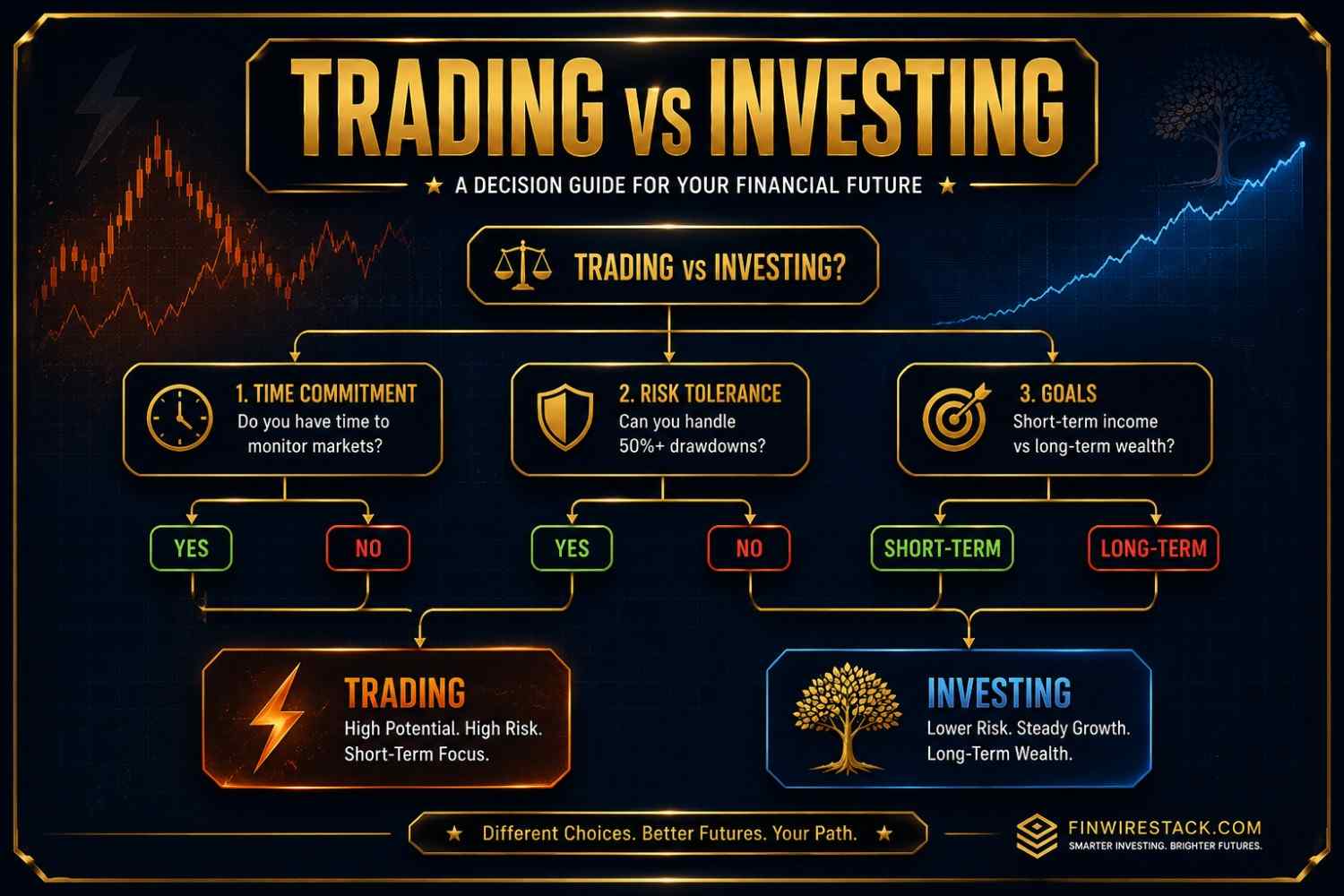
Theย trading vs. investingย debate centers on two distinct approaches to participating in financial markets. Both involve buying and selling securities, but they are not the same thing. The big difference is the timeline. When you invest, you hold securities for the long term and hope to see their value grow over time. When you trade, you buy and sell regularly, looking to make short-term gains.
If investing is like watching a movie, trading can be like swiping through social media clips. Both are forms of entertainment, but in one case, you’re much more involved in the process than in the other.
๐ฏ Real-World Analogy:ย Think of theย trading vs. investingย decision like choosing between two different approaches to fitness. Investing is like running a marathonโsteady, consistent, and built for the long haul. Trading is like sprintingโintense, fast-paced, and requiring constant attention. Both can improve your financial health, but they demand different strategies, time commitments, and risk tolerance.
The choice betweenย trading and investingย isn’t about finding a “winner.” It is about finding the right fit for your personal financial situation, goals, and personality.

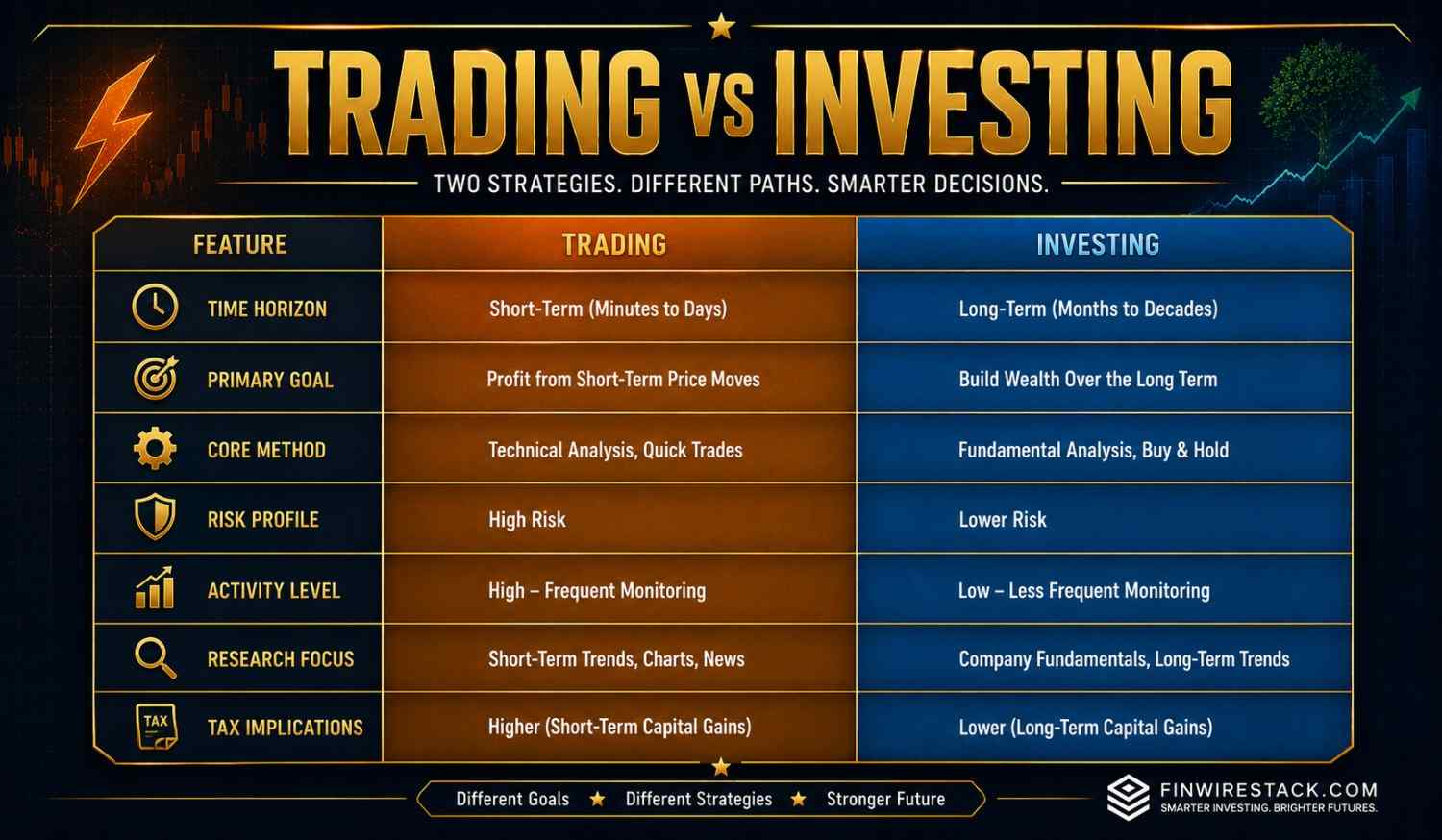
Trading vs. investingโa side-by-side comparison of key features
Investing is buying an asset, like an individual stock, mutual fund, or exchange-traded fund (ETF), in hopes of increasing your money over time. Because most people invest for long-term goals, like buying a house, paying for college, or saving for retirement, they tend to hold these assets for a long timeโmeaning years, if not decades.
Investing’s superpower is compounding. When you earn returns on your investments, those returns start earning returns. As time goes on, the power of compounding increases. For example, the S&P 500 has seen average annual returns of over 10% each year for the last 100 years, with dividends reinvested. That’s enough to beat inflation and build wealth.
๐ฆ Blue Highlight:ย For the last 100 years, the S&P 500 has seen average annual returns of over 10% each year, with dividends reinvested. From 1940 to 2024, dividend income made up 34% of the total return of the S&P 500. Since 1960, 85% of the cumulative total return of the S&P 500 Index can be attributed to reinvested dividends and the power of compounding.
One of the hidden advantages of investing over trading is tax efficiency. For investments you own at least a year and a day, you become eligible for a slightly lower tax rate called the long-term capital gains rate. In contrast, profits on investments held for less than a year are taxed at the same rate as your paycheck. Investments held in tax-advantaged accounts, like 401(k)s and IRAs, are not subject to the same tax rules.

Caption: Figure 3: The power of compounding โ why time in the market beats timing the market
Trading is buying and selling financial assets in hopes of making a short-term profit. Traders could be buying and selling investments multiple times a day, week, or month. Though technically you “make a trade” anytime you buy or sell an investment, most people associate trading with an active investing strategy.
Trading operates on what’s called a zero-sum game. That is, if someone wins, it comes at the loss of someone else. In contrast, investors are playing a positive-sum game, where more than one person can win.
Data often cited by FINRA shows that only 1% to 4% of day traders remain profitable over the long term. This can happen for several reasons, including impulsive decisions (driven by emotions like fear and greed), not using proper risk management, or using high leverage.
๐ด Red Highlight:ย Research from S&P Dow Jones Indices shows that 93% of fund managers investing in large firms didn’t beat their benchmark index over the previous 20 years, and 92% couldn’t beat the market over 15 years. These are professionals with experience, knowledge, and computing power.

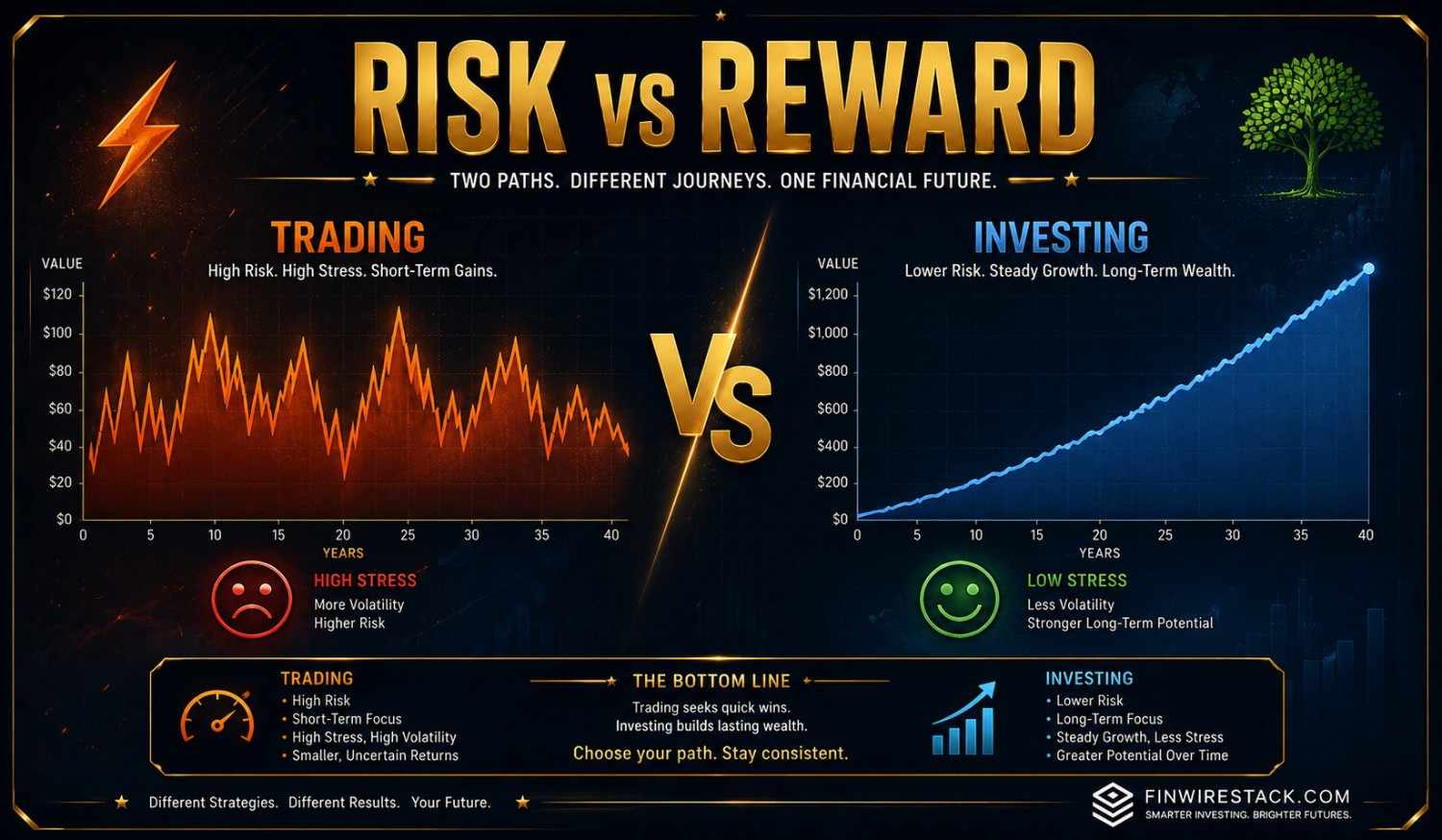
Trading vs. investingโunderstanding the risk and reward trade-off
The choice betweenย trading and investingย depends on market conditions and your personal situation.
Short-term active strategies tend to perform best during periods of price inefficiencies, high volatility, and macroeconomic uncertainty.
Long-term investing tends to deliver better results during periods of systemic economic growth, major technological adoptions, and clear corporate earnings visibility.

How to choose between trading and investing: a decision framework for beginners
The decision betweenย trading and investingย should be based on several personal factors.
| Goal | Recommended Approach |
|---|---|
| Short-term income (e.g., holiday fund) | Trading may align better |
| Long-term wealth (e.g., retirement) | Investing is better |
| Both | Hybrid approach |
Your risk appetite isn’t just about how much money you can afford to lose but about how much money you can lose before you stop sleeping at night.
| Risk Profile | Recommended Approach |
|---|---|
| Low Risk Tolerance | Investing (long-term, passive) |
| High Risk Tolerance | Trading (short-term, active) |
| Time Horizon | Recommended Approach |
|---|---|
| Short-term (days to months) | Trading |
| Long-term (years to decades) | Investing |
| Time Availability | Recommended Approach |
|---|---|
| Limited time (busy professional) | Investing (set-and-forget) |
| Adequate time (can monitor markets) | Trading |
You don’t need to choose betweenย trading and investing. Many experienced market participants combine both methods.
| Allocation | Purpose | Example |
|---|---|---|
| 80% Long-term Investments | Core wealth building | Index funds, dividend stocks, bonds |
| 20% Active Trading | Short-term opportunities | Individual stocks, CFDs, crypto |
๐ฏ Real-World Example:ย Some investors might keep 80% of their capital in long-term investments (lower risk appetite) and use the remaining 20% for active trading. Others might do the opposite (higher risk appetite).
Theย trading vs. investingย decision ultimately depends on your personal financial situation, risk tolerance, and investment objectives. Neither choice is inherently superior; they serve different purposes in a complete financial strategy.
Choose Investing If:
Choose Trading If:
Choose Both If
๐ฏ Final Thought:ย The evidence is clear that investing is a strategy that works better for most people. Can some traders consistently beat the market? Absolutely, no question. But for most people, it’s better to be an investor than a traderโand it can take less time and effort, too. Legendary investor Warren Buffett recommends that investors regularly buy into an index fund, such as an S&P 500 fund, and then hold for decades.
The main difference betweenย trading and investingย is the time horizon. When you invest, you hold securities for the long termโyears or even decadesโhoping to watch their value grow over time through compounding. When you trade, you buy and sell regularlyโsometimes within minutes, days, or weeksโlooking to make short-term gains from price fluctuations. This fundamental distinction in theย trading vs. investingย debate affects everything from your risk profile to your tax obligations.
The profitability of trading vs investing depends on your skill level, time commitment, and risk tolerance. Trading can be more profitable in the short term for skilled and disciplined participants, but data shows that only 1% to 4% of day traders remain profitable over the long term. Investing is often more profitable for ordinary participants who want consistency and compounding. Research from S&P Dow Jones Indices shows that 93% of professional fund managers couldn’t beat the market over 20 years, highlighting the challenge of active trading compared to passive investing.
Yes, trading is generally considered a higher-risk strategy compared to investing. In theย trading vs. investingย comparison, the shorter timeline, use of leverage, and need for constant decision-making make trading significantly riskier. Data consistently shows that only 1% to 4% of day traders remain profitable over the long term, whereas long-term investors in broad market index funds have historically seen positive returns over any 20 years. The deeper and faster an asset drops, the more likely traders are to sell at the wrong time, a behavioral risk that is often more damaging than market risk itself.
Yes, many investors maintain a hybrid approach that combines trading vs investing strategies. A common structure is to keep 80% of your capital in long-term investments (like index funds) for steady growth and use the remaining 20% for active trading opportunities. This hybrid approach provides diversification, flexibility to adapt to changing market conditions, and the ability to learn from both strategies. Some investors might also do the opposite, with a higher allocation to trading if they have a higher risk appetite and more time to dedicate to market monitoring.
For most beginners, a low-cost S&P 500 index fund is the best starting point in the trading vs investing decision. Warren Buffett recommends this approach, noting that it has returned approximately 10% annually over time. Index funds provide instant diversification across 500 of America’s largest companies with very low costs (expense ratios as low as 0.03%). This passive investing strategy requires minimal time and expertise, making it ideal for those who prefer a hands-off approach to building wealth.
The time commitment is one of the biggest differences in theย trading vs. investingย comparison. Trading is time-consuming and can be a full-time job. Day traders must constantly monitor positions, analyze charts, and make split-second decisions throughout the trading day. Swing traders need less attention but still require regular market checks. Investing, by contrast, requires minimal time and attention. Once you set up automatic contributions to a low-cost index fund, you can check your portfolio quarterly or even annually without significantly impacting your long-term results.
Tax implications are a crucial factor in theย trading vs. investingย decision. Short-term profits from trading (assets held less than a year) are taxed at your ordinary income tax rate, which can be as high as 37% for top earners. Long-term gains from investing (assets held at least a year and a day) qualify for lower capital gains rates of 0%, 15%, or 20%, depending on your income. This tax advantage is a significant benefit of investing over trading, especially for those in higher tax brackets. Additionally, investments held in tax-advantaged accounts like 401(k)s and IRAs are not subject to the same tax rules.
The 1% rule in trading means you never risk more than 1-2% of your total trading capital on any single position. This risk management principle helps protect your account from significant damage after a losing trade. For example, if you have a $10,000 trading account, you would risk no more than $100-$200 per trade. This rule ensures that a series of losing trades won’t wipe out your capital, allowing you to continue trading and learning from your mistakes.
Day trading and swing trading are two distinct approaches within the broaderย trading vs. investingย framework. Day trading involves opening and closing positions within the same trading day, with no overnight positions held. This requires constant market monitoring and quick decision-making. Swing trading involves holding positions for several days to weeks, capturing medium-term price movements. Swing traders have more time to analyze the market and can hold positions overnight but still operate on a shorter time horizon than long-term investors.
Compounding is the superpower of investing in theย trading vs. investingย debate. When you earn returns on your investments, those returns start earning returns themselves. Over time, this exponential growth becomes increasingly powerful. For example, the S&P 500 has seen average annual returns of over 10% each year for the last 100 years, with dividends reinvested. This consistent compounding is why investing is a strategy that works better for most people. From 1940 to 2024, dividend income made up 34% of the total return of the S&P 500, demonstrating the power of reinvesting returns.
Yes, stocks can provide passive income through dividends, which is one advantage of investing over trading in theย trading vs. investingย comparison. Many established companies pay regular dividends, providing income while maintaining growth potential. Dividend investing involves buying stocks that pay regular dividends and then reinvesting those dividends to buy more shares. Since 1960, 85% of the cumulative total return of the S&P 500 Index can be attributed to reinvested dividends and the power of compounding. This makes dividend investing a popular strategy for those seeking both income and long-term growth.
Active and passive investing represent two different approaches within theย trading vs investingย spectrum. Active investing involves attempting to beat the market through frequent buying and selling, stock selection, and market timing. This approach is more aligned with trading and requires significant time, expertise, and higher fees. Passive investing involves buying and holding a diversified portfolio, typically through index funds, to match market returns rather than beating them. Passive investing requires less time, has lower fees, and historically has outperformed most active strategies over the long term.
For beginners, the best strategy in the trading vs investing decision is to start with a simple, low-cost, diversified approach. This typically means investing in a broad market index fund like the S&P 500, setting up automatic contributions, and holding for the long term. This approach requires minimal time and expertise, while historically delivering solid returns. Once you have built a solid foundation, you can gradually explore more active strategies like trading if you have the time, risk tolerance, and interest. The key is to start with what works for most people and then adjust as you learn.
The trading vs investing emotional challenges differ significantly between trading andย investing. Trading is emotionally demanding, requiring constant decision-making and the ability to handle rapid gains and losses. This can lead to stress, anxiety, and impulsive decisions driven by fear and greed. Investing, on the other hand, requires patience and discipline to stay invested through market cycles. The challenge for investors is avoiding panic selling during downturns and staying focused on long-term goals. Both approaches require emotional control, but trading demands more immediate psychological resilience.
The hybrid approach combines both strategies in theย trading vs. investingย debate, allowing you to benefit from both steady growth and short-term opportunities. A common structure is to keep 80% of your capital in long-term investments (like index funds) for core wealth building and use the remaining 20% for active trading opportunities. This approach provides diversification, flexibility, and risk management. Some investors might adjust this allocation based on their risk tolerance, time commitment, and market conditions. The hybrid approach is popular among experienced investors who want exposure to both growth and income opportunities.
To deepen your understanding of financial markets and investing, explore these additional resources from Finwirestack:
Disclaimer: Investing and trading involve risk. Past performance does not guarantee future results. The information provided in this article is for educational purposes only and does not constitute financial advice. Always consult a qualified financial advisor before making investment decisions.

Crypto vs. stocksย is one of the most debated questions in personal finance today. Both offer pathways to build wealth, but they operate under completely different rules. Stocks provide ownership in established companies with centuries of regulatory framework. Cryptocurrency offers exposure to blockchain technology and decentralized finance, but with extreme price swings and limited investor protection.
This comprehensive guide will help you understand theย crypto vs. stocksย decision. You will learn:
By the end, you will have the knowledge to make an informed crypto vs stocks decision that fits your personal financial situation.

Crypto vs stocks: understanding the key differences between two distinct investment approaches
Theย crypto vs stocksย debate centers on two distinct investment approaches. Cryptocurrency markets now process over $50 billion in daily trading volume, while global stock markets handle approximately $200 billion daily. This massive liquidity difference highlights just one of many factors new investors must consider.
Understanding these markets isn’t just about potential returns. It is about matching your risk tolerance, time commitment, and financial goals with the right investment vehicle. The choice betweenย crypto vs. stocksย isn’t about finding a “winner.” It is about finding the right fit for you.
๐ฏ Real-World Analogy: Think of the crypto vs stocks decision like choosing between two different vehicles. Stocks are like a reliable sedanโsteady, predictable, and built for the long haul. Crypto is like a sports carโexciting, fast, but with a higher chance of spinning out. Both can get you where you want to go, but they require different skills and risk tolerance.

Crypto vs stocksโa side-by-side comparison of key features
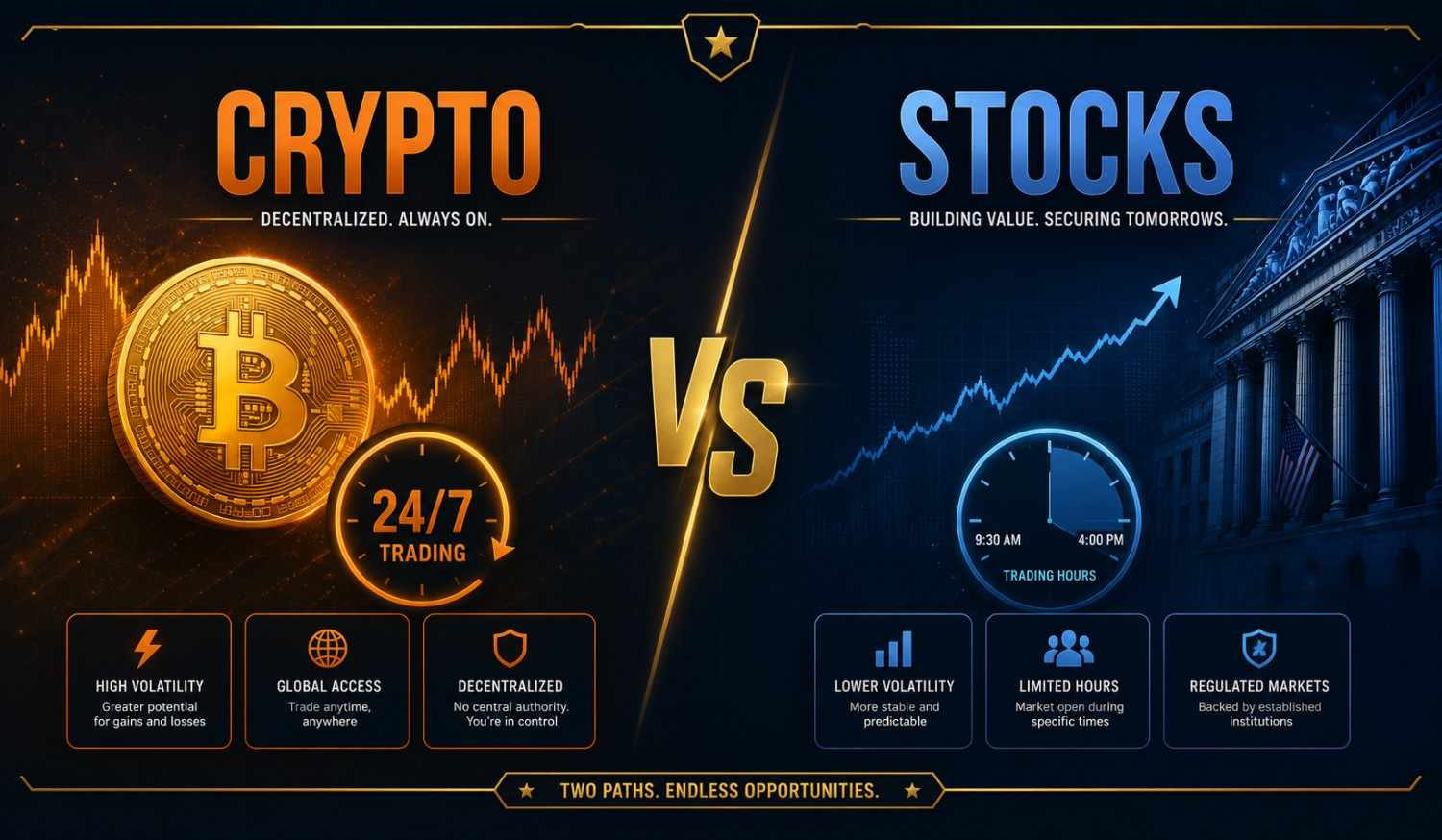
Understanding how each market operates helps you choose the environment that suits your preferences and schedule.
๐ฆ Blue Highlight:ย The stock market offers more stability and regulatory protection, while cryptocurrency provides 24/7 access and lower entry barriers. This is the fundamentalย crypto vs. stocksย trade-off.
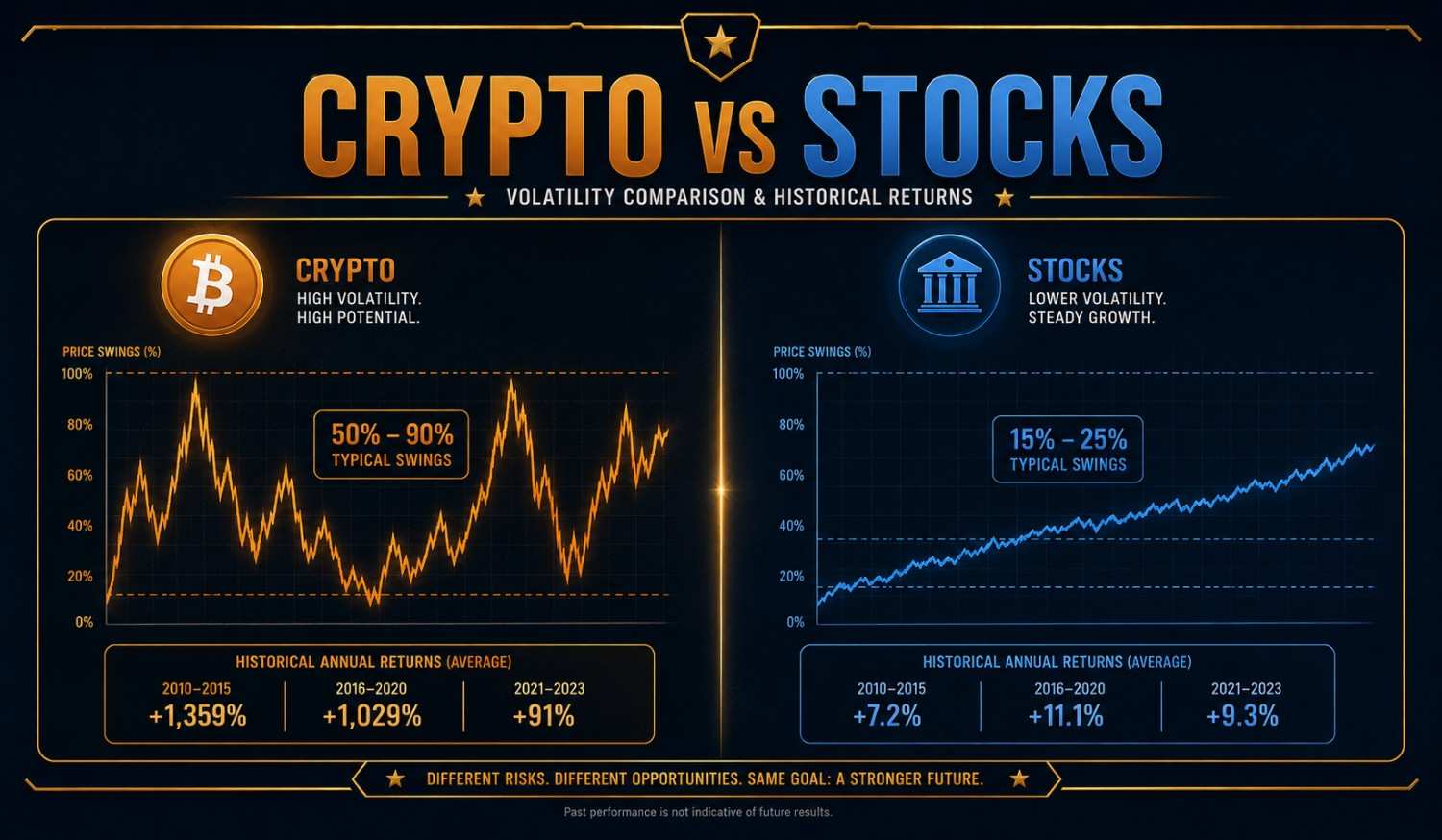
Theย crypto vs stocksย performance comparison reveals very different patterns.
While understanding crypto vs stocks, stock markets have delivered consistent long-term returns over decades. The S&P 500 has averaged approximately 10% annual returns since 1957, despite periodic bear markets and recessions. For most investors, broad stock ETFs linked to indices like the S&P 500 remain the simplest starting point.
The Power of Compounding:ย A $10,000 investment in the S&P 500 30 years ago would be worth approximately $187,000 today. This consistent compounding is why stocks remain the default core for most long-term portfolios.
Cryptocurrency performance shows explosive growth periods followed by severe corrections. Bitcoin has achieved over 100% annual returns in some years but also declined by 80% or more during bear cycles.
The approval of spot Bitcoin ETFs in January 2024 and spot Ethereum ETFs later in 2024 changed the landscape significantly. These approvals gave investors a regulated wrapper through traditional brokerages, making crypto easier to access and easier to place next to stocks in the same portfolio. The Bitcoin halving in April 2024 cut the block reward from 6.25 BTC to 3.125 BTC, reinforcing Bitcoin’s supply narrative.
๐ฏ Real-World Example: If you had invested $1,000 in Bitcoin in 2015, it would be worth over $100,000 today. But you would have endured several 50-80% drawdowns along the way. The same $1,000 in the S&P 500 would be worth approximately $3,000โless exciting, but far less stressful.

Crypto vs stocksโunderstanding the risk and reward trade-off
Risk tolerance forms the foundation of anyย crypto vs. stocksย decision. Both markets carry risks, but the nature and magnitude differ dramatically.
Stock market volatility typically ranges from 15-25% annually for broad market indices. During market corrections, stocks might decline 20-30% before recovering. Even the S&P 500 can go through ugly stretches, but broad stock funds are usually less volatile than crypto.
In crypto vs. stocks, cryptocurrency volatility often exceeds 80% annually for major coins like Bitcoin and Ethereum. Smaller altcoins can experience 200-500% price swings within months. However, Wells Fargo’s research shows digital asset volatility has moderated significantly over the past 15 years, declining from 182% annualized standard deviation to 70% in the latest period. This suggests that greater accessibility and institutional adoption should support continued price stability over time.
๐ด Red Highlight:ย The deeper and faster an asset drops, the more likely investors are to sell at the wrong time. This behavior risk is often more damaging than the market risk itself.
Stock markets offer mature risk management through diversified index funds, dividend-paying stocks, and established options markets. Investors can hedge positions and generate income through covered calls or protective puts.
Crypto markets provide fewer sophisticated risk management options. While futures and options exist for major cryptocurrencies, the tools remain less developed than traditional finance offerings. Hardware wallets such as Ledger and Trezor can reduce exchange risk, but they do not remove user responsibility.
Your first steps in theย crypto vs. stocksย decision depend on which market aligns with your goals and risk tolerance.
Determine how much you can afford to invest without affecting essential expenses. Financial advisors typically recommend investing only money you won’t need for at least five years. For crypto, many experts suggest limiting exposure to 5-10% of your total investment portfolio.
For stocks:ย Consider established brokerages like Fidelity, Schwab, or Vanguard that offer commission-free trading and extensive research tools. Fidelity offers zero commissions on stocks and ETFs, with 3,500+ no-transaction-fee mutual funds. Charles Schwab provides excellent customer service and educational resources.
For crypto:ย Platforms like Coinbase, Kraken, or Gemini provide user-friendly interfaces with educational resources. Bitget offers access to 1,300+ cryptocurrencies with spot trading fees as low as 0.01% maker/taker. Robinhood has evolved from a commission-free trading app into a broader consumer financial platform offering brokerage, cryptocurrency, retirement, banking, and advisory products.
Stock beginners should consider low-cost index funds that track the S&P 500 or the total stock market. These provide instant diversification across hundreds of companies. The Vanguard S&P 500 ETF (VOO) charges just 0.03% annually.
Crypto beginners might start with Bitcoin and Ethereum before exploring smaller altcoins. As Wells Fargo notes, digital asset investment may offer exposure to blockchain technology, a foundational innovation that enables secure, decentralized transactions.
Stock investing requires understanding financial statements, price-to-earnings ratios, and market cycles. Crypto investing demands knowledge of blockchain technology, tokenomics, and decentralized finance concepts. Allocate time weekly to expand your knowledge in your chosen area.
Invest fixed amounts regularly regardless of market prices. This strategy reduces the impact of volatility and removes emotion from investment timing decisions. Automated DCA features, available on most modern platforms, execute purchases without manual intervention.
Equities remain the cornerstone of long-term wealth building, with historical annual returns averaging 10% before inflation. Index funds and exchange-traded funds (ETFs) offer diversified equity exposure at minimal costโbroad market ETFs typically charge expense ratios below 0.1% annually.
Fixed-income investments serve multiple portfolio functions: capital preservation, income generation, and volatility dampening. Government bonds offer safety with modest returns; corporate bonds provide higher yields with credit risk.
Digital assets have matured into a recognized alternative asset class, with institutional adoption accelerating through 2026. The Wells Fargo 2026 Outlook report highlights that digital assets and blockchain represent a transformative technology that aligns with broader trends such as artificial intelligence, automation, and next-generation payment systems.
Bitcoinย functions as “digital gold” with a fixed supply cap of 21 million coins, appealing to investors seeking inflation protection and portfolio diversification. The Wells Fargo analysis shows Bitcoin’s price has drawn closer to that of gold, reinforcing its safe-haven appeal.
Ethereumย supports decentralized applications and smart contracts, creating utility beyond store-of-value functions. Ethereum’s network utility and staking capabilities make it a different kind of digital asset compared to Bitcoin.
Stablecoinsย are cryptocurrencies linked to stable assets, such as the U.S. dollar, to minimize price volatility. They are often used as trading pairs and for quickly moving funds between exchanges.
Robo-advisors democratize professional portfolio management through algorithm-driven asset allocation and automatic rebalancing. These platforms typically charge 0.25-0.50% annually, significantly less than traditional financial advisors’ 1-2% fees.
Dollar-cost averaging (DCA) automates investment timing by purchasing fixed dollar amounts at regular intervals regardless of price. This approach eliminates emotional decision-making and reduces timing risk.

How to get started with crypto and stocks โ a practical guide for beginners
Theย crypto vs. stocksย decision isn’t necessarily an either/or choice. Many investors find that a diversified portfolio including both asset classes offers the best balance of growth and stability.
Effective personal finance begins with strategic asset allocation. Research consistently shows that asset allocation accounts for approximately 90% of portfolio performance variance over time.
A well-structured portfolio typically includes a mix of equities for growth, fixed-income securities for stability, alternative assets for diversification, and liquid reserves for emergencies.
Modern Portfolio Example:
Crypto Allocation Guidelines:
๐ฆ Blue Highlight:ย Financial advisors often recommend limiting crypto exposure to 5-15% of total portfolio value, given volatility characteristicsโannual price swings of 50% or more remain common.

Building a diversified portfolio โ how to allocate between crypto and stocks
Understanding where finance is headed helps inform theย crypto vs. stocksย decision.
Digital assets and blockchain represent a transformative technology that aligns with broader trends such as artificial intelligence, automation, and next-generation payment systems. Generative AI spending is expected to surge over the next decade, supporting growth across technology and infrastructure sectors.
Tokenization is converting physical and financial assets into digital tokens on a blockchain. This can include real estate, stocks, bonds, and more. Tokenization can increase liquidity, allow fractional ownership, and make it easier to buy and sell assets. Bitget’s TradFi 101 educational initiative is preparing users for this era of universal exchange and multi-asset investing.
ESG stands for Environmental, Social, and Governance. There has been a growing interest in ESG investments, with sustainability becoming an important part of many investment portfolios. Many investors today want to earn returns while also supporting companies that follow sustainable business models.
Geopolitical events are becoming constant market drivers. Wars in key regions, energy-price swings, and shifting interest-rate expectations are influencing markets and can affect investment portfolios. This reinforces the need for diversified, resilient portfolios.
| Mistake | Why It’s a Problem | How to Fix |
|---|---|---|
| Treating Them as Interchangeable | They serve different portfolio roles | Understand each asset’s purpose |
| Over-Investing in Crypto | Extreme volatility can wipe out savings | Limit to 5-15% of portfolio |
| Panic Selling | Locks in losses and misses recoveries | Stay invested through cycles |
| Ignoring Regulation | Limited protection in crypto | Choose regulated platforms |
| Not Diversifying | Concentrated risk in one asset | Use index funds for stocks and major coins for crypto |
| Chasing “Hot” Investments | Buying high and selling low | Stick to a long-term strategy |
Theย crypto vs. stocksย decision ultimately depends on your personal financial situation, risk tolerance, and investment objectives. Neither choice is inherently superior; they serve different purposes in a complete financial strategy.
Choose Stocks If:
Choose Crypto If:
Choose Both If
๐ฏ Final Thought:ย Stock markets provide the foundation for most successful long-term investment plans. The stability, regulatory protection, and historical performance make stocks essential for retirement planning and steady wealth building. Cryptocurrency offers a different kind of upside, with Bitcoin and Ethereum giving investors exposure to scarce and programmable digital assets. The right mix depends on your risk tolerance, time horizon, and whether the goal is growth, stability, or better diversification.
Stocks represent ownership in companies with earnings, cash flow, and regulatory oversight. Crypto represents ownership of digital assets driven by adoption, utility, network effects, and sentiment.
Cryptocurrency is significantly more volatile, with annual price swings often exceeding 80%, compared to 15-25% for broad stock indices.
Crypto can be suitable for beginners who are willing to learn the technology, accept extreme volatility, and limit exposure to 5-10% of their portfolio. Stocks are generally considered a better starting point for most beginners.
Yes, many investors maintain diversified portfolios with both asset classes. This can provide exposure to both traditional business growth and blockchain innovation.
Bitcoin and Ethereum are the best choices for beginners. They have the largest market capitalizations, strongest networks, and highest liquidity.
S&P 500 index funds like VOO are the best choice. They provide instant diversification across 500 companies with very low costs (0.03% expense ratio).
Financial advisors typically recommend 5-15% of total portfolio value, depending on risk tolerance. Conservative investors might limit it to 5%, while aggressive investors might allocate up to 15%.
Key risks include extreme volatility, limited regulatory protection, security risks (hacks, lost private keys), and complex tax reporting requirements.
Consider your risk tolerance, time horizon, financial goals, and interest in the underlying technology. If you prefer stability and long-term compounding, lean toward stocks. If you have a higher risk tolerance and believe in blockchain technology, consider a crypto allocation.
Spot crypto ETFs are investment products that hold actual Bitcoin or Ethereum, allowing investors to gain exposure through traditional brokerage accounts. They were approved in 2024, making crypto more accessible to mainstream investors.
Open a brokerage account with a platform like Vanguard, Fidelity, or Schwab. Choose a low-cost S&P 500 index fund (like VOO). Set up automatic contributions and invest consistently.
Choose a regulated exchange like Coinbase, Kraken, or Bitget. Complete KYC verification. Start with a small amount and stick to major coins like Bitcoin and Ethereum.
Dollar-cost averaging means investing a fixed amount regularly, regardless of price. This strategy reduces the impact of volatility and removes emotion from investment timing.
Yes, in most countries, crypto is treated as property for tax purposes. Selling crypto, trading one coin for another, or using crypto to buy something can all create taxable events.
Yes, through dividends and dividend reinvestment. Many established companies pay regular dividends, providing income while maintaining growth potential.
To deepen your understanding of financial markets and trading, explore these additional resources from Finwirestack:
Disclaimer: Investing in stocks and cryptocurrencies involves risk. Past performance does not guarantee future results. The information provided in this article is for educational purposes only and does not constitute financial advice. Always consult a qualified financial advisor before making investment decisions.

How to survive the 2026 cost of living crisis has become the most urgent question for households across the United States and Europe.
The numbers are stark. Eurozone inflation rose toย 3.2% in May 2026โthe highest since September 2023 โ driven by a 10.9% surge in energy prices linked to the Middle East conflict. The ECB is now expected to hike interest rates at its June 11 meeting, with markets pricing aย 30% risk of a Fed rate hike before year-end.
How to survive the 2026 cost of living crisis matters because the pressure is coming from every direction simultaneously. Energy, food, housing, and transportation costs are all rising faster than wages.
| Metric | Current Value | Change |
|---|---|---|
| Eurozone inflation (May 2026) | 3.2% | Highest since September 2023 |
| Eurozone core inflation | 2.5% | Well above ECB target |
| ECB deposit facility rate | 2.00% | Expected to rise to 2.50% |
| Brent crude oil | ~$97/barrel | Up 60%+ from pre-conflict |
| US 30-year Treasury yield | 4.97% | 8 declines in 9 sessions but elevated |
| Global equity markets | -10% from peaks | Weakening household balance sheets |
Oxford Economics has cut its 2026 G7 consumer spending forecast by 0.6 percentage points, warning that “the drag from higher energy prices and financial spillovers will persist, leaving spending 0.3% below trend even after two years”. Brent crude is forecast to average **$113 per barrel in the second quarter**, up from $60 a month earlier.
How to survive the 2026 cost of living crisisย requires understanding that this is not a temporary spike. According to Oxford Economics Chief Global Economist Ryan Sweet, “That shift marks a step change in household cost pressures rather than a temporary spike”.
For understanding the broader financial landscape, seeย How to Stop Living Paycheck to Paycheckย andย How to Get Out of Credit Card Debt.
How to survive the 2026 cost of living crisis requires a multi-pronged approach. These nine strategies target the biggest budget busters.
| Strategy | Focus | Potential Savings |
|---|---|---|
| 1 | Energy usage audit | $50-200/month |
| 2 | Commute optimization | $100-400/month |
| 3 | Grocery shopping overhaul | $100-300/month |
| 4 | Fixed-rate locking | $50-500/month (interest) |
| 5 | Emergency buffer building | Peace of mind |
| 6 | Discretionary spending cuts | $100-500/month |
| 7 | Portfolio protection | Prevent losses |
| 8 | Hidden income opportunities | $200-1,000/month |
| 9 | Community resource utilization | $50-200/month |
How to survive the 2026 cost of living crisis is not about one big change. It is about many small adjustments that add up.
For automated savings to build your buffer, seeย Automated Savings Apps That Actually Work.
For debt management, seeย How to Get Out of Credit Card Debt.
How to survive the 2026 cost of living crisis starts with energy โ the category experiencing the most dramatic price increases.
Energy prices surgedย 10.9% in May 2026ย across the Eurozone due to Middle East supply disruptions. In the US, petrol prices continue to rise, with Oxford Economics noting that every $0.01 increase in petrol prices reduces consumer spending by $1.5 billion annually if sustained.
| Driver | Impact |
|---|---|
| Iran conflict | Strait of Hormuz disruptions affect global supply |
| Refined product shortages | Crude flowing but gasoline/diesel constrained |
| Fertilizer production | Gas shortages โ reduced fertilizer โ higher food prices |
| Winter heating concerns | Storage rebuilding expensive |
| Action | Potential Savings | Difficulty |
|---|---|---|
| Lower thermostat by 2ยฐF in winter/raise 2ยฐF in summer | 10% on heating/cooling | Low |
| Unplug vampire electronics (phone chargers, gaming consoles, computers) | $100-200/year | Low |
| Wash clothes in cold water | $60-150/year | Low |
| Air dry laundry (one load per week) | $50-100/year | Medium |
| Seal drafty windows with weather stripping | $100-300/year | Medium |
| Investment | Cost | Annual Savings | Payback |
|---|---|---|---|
| LED bulbs (replace all) | $50-100 | $100-200 | 6-12 months |
| Smart power strip | $20-40 | $30-60 | 6-8 months |
| Programmable thermostat | $50-150 | $100-200 | 6-9 months |
| Water heater blanket | $20-30 | $20-50 | 6-12 months |
How to survive the 2026 cost of living crisis requires treating energy as a controllable expense, not a fixed cost.
For tracking utility spending, seeย Best Budgeting Apps for Couples.
For long-term energy independence, seeย Passive Income Portfolio with $1,000.
How to survive the 2026 cost of living crisisย means rethinking transportation, the second-largest household expense for most Americans.
Brent crude oil is trading aboveย $97 per barrel, pushing gasoline prices higher. The conflict has created a “risk premium” that persists despite ongoing negotiations.
| Commute Distance | Days/Week | Current Weekly Gas Cost | Current Monthly Cost |
|---|---|---|---|
| 10 miles round trip | 5 days | $15-20 | $60-80 |
| 20 miles round trip | 5 days | $30-40 | $120-160 |
| 40 miles round trip | 5 days | $60-80 | $240-320 |
| 60 miles round trip | 5 days | $90-120 | $360-480 |
| Strategy | Potential Monthly Savings | Effort |
|---|---|---|
| Work from home 1 day/week | 20% of gas costs | Low (ask employer) |
| Carpool with 1 coworker | 50% of gas costs | Medium |
| Public transit (if available) | 30-70% of gas costs | Low |
| Combine errands into one trip | 10-20% of gas costs | Low |
| Telecommute full-time | 100% of gas costs | High |
| Bike/e-bike for short trips | 100% of local travel | Medium |
Sales of electric vehicles overtook standard petrol cars in the EU for the first time in December 2025. Soaring petrol costs will only accelerate this trend.
If you are in the market for a new vehicle:
| Factor | EV Advantage |
|---|---|
| Fuel cost per mile | $0.03-0.05 vs $0.12-0.18 for gas |
| Maintenance | 50-70% lower |
| Tax incentives | Still available in many jurisdictions |
How to survive the 2026 cost of living crisis may include accelerating your transition to electric or hybrid vehicles.
For auto loan management, seeย How to Get Out of Credit Card Debtย (debt principles apply).
For digital banking to track expenses, seeย Digital Banking vs Traditional Banking.
How to survive the 2026 cost of living crisisย requires changing how you buy foodโthe one category where consumers globally still expect to spend more, but increasingly on value rather than volume.
The current energy shock will feed through to food prices with a lag. Gas shortages affect fertilizer production, which will reduce harvest yields this autumn, leading to a food price shock later in 2026.
| Timeline | Event |
|---|---|
| Now | Energy prices high |
| 3-6 months | Fertilizer prices rise |
| 6-9 months | Reduced crop yields |
| 9-12 months | Higher food prices at grocery stores |
| Strategy | Potential Monthly Savings | Difficulty |
|---|---|---|
| Plan weekly meals around sales flyers | $50-150 | Low |
| Buy store brands instead of name brands | $30-100 | Low |
| Use grocery pickup to avoid impulse buys | $40-120 | Low |
| Shop at discount grocers (Aldi, Lidl) | $100-300 | Low |
| Buy in bulk (if storage available) | $20-80 | Medium |
| Cook from scratch (avoid pre-made) | $50-150 | Medium |
| Reduce meat consumption (2 days/week) | $30-100 | Medium |
According to the 2026 Global Consumer Outlook, consumers are becoming more methodical in their grocery shoppingโmaking detailed lists, planning meals, avoiding impulse purchases, turning to store brands, and actively seeking discounts and loyalty rewards.
How to survive the 2026 cost of living crisis means adopting these behaviors before you are forced to.
| Week | Focus | Action |
|---|---|---|
| 1 | Track | Write down every food purchase |
| 2 | Plan | Create weekly meal plans based on sales |
| 3 | Execute | Shop only from your list; use store brands |
| 4 | Optimize | Identify biggest savings opportunities |
For meal planning support, seeย Best Budgeting Apps for Couples.
For automated grocery savings tools, seeย Automated Savings Apps That Actually Work.
How to survive the 2026 cost of living crisis requires protecting yourself from rising interest rates.
| Region | Current Rate | Expected Change | Timing |
|---|---|---|---|
| Eurozone (ECB) | 2.00% | +25-50 basis points | June 11 meeting |
| United States (Fed) | 3.50-3.75% | 30% chance of hike by year-end | FOMC June 16-17 |
| United Kingdom (BoE) | 3.75% | +50 basis points expected in 2026 | Multiple meetings |
The short-term interest rate market is currently pricing aย 30% risk of a rate hike before year-endย in the US. BNP Paribas expects two 25-basis-point hikes in the ECB’s policy rate in 2026, pushing the deposit facility rate to 2.50%.
| Financial Product | Action | Deadline |
|---|---|---|
| Mortgage | Refinance to fixed rate if you have adjustable | Before June 11 (ECB) / June 16 (Fed) |
| Auto loan | Secure financing now | Rates will rise after meetings |
| Savings account | Move to high-yield accounts | Already elevated, may rise further |
| Credit card debt | Transfer to 0% balance transfer card | Before rates rise further |
| Student loans | Consider refinancing fixed rate | Rates are still relatively low |
Oxford Economics notes that “higher real interest rates are reinforcing this dynamic by making saving more attractive relative to spending”. While this helps savers, it hurts borrowers and those with variable-rate debt.
How to survive the 2026 cost of living crisis includes eliminating variable-rate debt before rates rise further.
For mortgage and loan management, seeย How to Get Out of Credit Card Debt.
For savings account optimization, seeย Digital Banking vs Traditional Banking.
For investment implications, see Robo-Advisors vs Human Advisors.
How to survive the 2026 cost of living crisis requires emergency savings more than ever.
According to Oxford Economics, every $0.01 increase in petrol prices reduces consumer spending by $1.5 billion over a year if sustained. The non-linear nature of large price increases means the hit to consumers is disproportionately larger.
A $500 buffer protects you from:
| Scenario | Recommended Buffer |
|---|---|
| One income household | 3-6 months’ expenses |
| Dual income, stable jobs | 3 months’ expenses |
| Freelance/irregular income | 6-12 months’ expenses |
| High debt burden | Add 1-2 months extra |
| Method | Time Frame | Action |
|---|---|---|
| Reduce 401(k) contribution to match only | Immediate | Frees up 5-10% of paycheck |
| Sell unused items | 1-4 weeks | eBay, Facebook Marketplace |
| Temporary side hustle | 1-4 weeks | Delivery, tutoring, virtual assistant |
| Reduce discretionary spending | Immediate | Strategy 6 below |
How to survive the 2026 cost of living crisis is easier with cash reserves.
For automated buffer building, seeย Automated Savings Apps That Actually Work.
For side hustle ideas, seeย AI Budget Trackers for Freelancersย (for freelancers) orย How to Stop Living Paycheck to Paycheckย (general guidance).
How to survive the 2026 cost of living crisis doesn’t mean eliminating joy. It means spending intentionally.
According to the 2026 Global Consumer Outlook, the sharpest projected spending reductions are in :
| Category | Net Change | Why |
|---|---|---|
| Non-food retail | -24 ppt globally | Discretionary, postponable |
| Eating and drinking out | -21 ppt globally | Value perception under pressure |
| Travel | -9 ppt net reduction | Experiential but expensive |
| Category | Painless Cut | Savings |
|---|---|---|
| Streaming services | Rotate subscriptions (one at a time) | $15-50/month |
| Dining out | Cook “fakeaway” (restaurant-style at home) | $50-200/month |
| Coffee shops | Brew at home; use a thermal mug | $20-80/month |
| Gym membership | Home workouts, outdoor exercise | $20-100/month |
| Alcohol | Reduce by half | $30-150/month |
| Week | Focus | Action |
|---|---|---|
| 1 | Identify | Review last 3 months of spending |
| 2 | Eliminate | Cancel unused subscriptions |
| 3 | Reduce | Cut dining out by 50% |
| 4 | Replace | Find free alternatives to paid activities |
How to survive the 2026 cost of living crisis is not about deprivation. It is about redirecting money to what truly matters.
For budgeting tools to track discretionary spending, seeย Best Budgeting Apps for Couples.
For free entertainment alternatives, seeย Best Free Portfolio Trackersย (for financial entertainment).
How to survive the 2026 cost of living crisis includes protecting your existing assets.
| Asset Class | Performance | Driver |
|---|---|---|
| Global equities | -10% from peaks | The wealth effect is hitting consumers |
| AI/semiconductor stocks | Outperforming | Enthusiasm remains strong |
| Bonds | Yields elevated | Rate hike expectations |
| Oil | +60%+ since pre-conflict | Supply disruptions |
| Copper | Near record highs | AI infrastructure demand |
Oxford Economics notes that “the wealth channel accounts for the majority of the persistent drag on durables, well beyond the initial income shock”. In the US, stocks have become “the dominant driver of US consumption over the past 15 years, eclipsing housing”.
| Strategy | What It Does | Best For |
|---|---|---|
| Diversify beyond tech | Reduce concentration risk | Overweight in AI/semiconductors |
| Increase cash allocation | Preserve capital, provide dry powder | Near-term needs |
| Add inflation-protected securities | TIPS, I-bonds | Protection against persistent inflation |
| Reduce high-fee funds | Lower costs | All investors |
| Rebalance regularly | Maintain target allocation | Long-term investors |
AI enthusiasm remains the main driver of equity markets, with Nvidia, Marvell Technology, and semiconductor stocks surging. However, the Philadelphia Semiconductor Index’s 5.9% jump in a single day signals potential froth.
How to survive the 2026 cost of living crisis means not abandoning growth opportunities but diversifying appropriately.
For investment management, seeย Robo-Advisors vs Human Advisors.
For portfolio tracking, seeย Best Free Portfolio Trackers for Crypto and Stocks.
For passive income alternatives, seeย Passive Income Portfolio with $1,000.
How to survive the 2026 cost of living crisis has two sides: spending less and earning more.
US JOLTS (job openings) came in atย 7.618 million in April, well above the 7.0 million consensus. However, job quits fell toย 2.98 million, the lowest since mid-2020, with the quits rate down to 1.9%. This signals fewer workers voluntarily leaving jobsโmeaning fewer openings for job seekers.
| Opportunity | Startup Cost | Monthly Potential | Time |
|---|---|---|---|
| Freelance on Upwork/Fiverr | $0 | $200-1,000 | 5-15 hrs/week |
| Virtual assistant | $0 | $300-1,500 | 10-20 hrs/week |
| Food delivery (DoorDash/UberEats) | $0 | $400-800 | 10-15 hrs/week |
| Online tutoring | $0 | $300-1,000 | 5-10 hrs/week |
| Pet sitting/walking | $0 | $200-600 | 5-10 hrs/week |
| User testing | $0 | $100-300 | 5 hrs/week |
| Strategy | Potential Increase | Effort |
|---|---|---|
| Ask for a raise (document your contributions) | 5-15% | Medium |
| Request reimbursement for work-from-home expenses | $50-200/month | Low |
| Take on overtime (if available) | 50% hourly rate | High |
| Apply for internal promotion | 10-20% | High |
| Update LinkedIn for recruiter visibility | Passive | Low |
Oxford Economics notes that “discretionary categories of consumer goods are likely to take the biggest hit” as consumers cut back. This means gig economy opportunities in discretionary services (rides, deliveries for non-essentials) may face demand pressure.
How to survive the 2026 cost of living crisis through side hustles focuses on essential services and digital skills.
For freelancing tools, seeย AI Budget Trackers for Freelancers.
For passive income, seeย Passive Income Portfolio with $1,000.
For career guidance, seeย AI in Personal Finance 2026.ย (AI hiring trends).
How to survive the 2026 cost of living crisis includes leveraging resources you may have overlooked.
| Resource | What It Provides | Who Qualifies |
|---|---|---|
| Food banks | Groceries, fresh produce | Anyone in need (no proof typically required) |
| LIHEAP (US) | Energy assistance | Income-qualified households |
| Rental assistance | Back rent, future rent | Varies by locality |
| Community fridges | Free food | No requirements |
| Buy Nothing groups | Free household items | Local residents |
| Libraries | Free entertainment, internet, workshops | Residents |
European renters have a much lower rate of cost burden than the US, largely due to more generous rental assistance and welfare payments. If you are in Europe, investigate:
| Tool | How to Use |
|---|---|
| 211 (US) | Call or visit 211.org for social services |
| FindHelp.org | Search by zip code for assistance programs |
| Local Facebook groups | Ask about resources (use anonymous post if needed) |
| Religious organizations | Often have discretionary funds |
Many households wait until the crisis is severe before seeking help. The earlier you access resources, the more effectively you can stabilize your finances.
How to survive the 2026 cost of living crisis means using every tool available, not just the ones you pay for.
For financial counseling, seeย How to Get Out of Credit Card Debtย (credit counseling section).
For government benefits, seeย Open Banking Explainedย (for data needed for applications).
How to survive the 2026 cost of living crisis requires immediate action.
| Day | Action | Time |
|---|---|---|
| 1 | Calculate your monthly essential expenses (housing, utilities, food, transportation) | 30 min |
| 2 | List all debts with interest rates and minimum payments | 30 min |
| 3 | Review last 3 months of bank statements for waste | 45 min |
| 4 | Check your credit score and report (free at AnnualCreditReport.com) | 15 min |
| 5 | Identify your biggest budget buster (housing, transportation, or food) | 15 min |
| 6 | Set up automatic minimum payments on all accounts | 20 min |
| 7 | Create crisis budget (essentials only) | 30 min |
| Day | Action | Time |
|---|---|---|
| 8 | Call utility providers for budget billing (averages payments) | 15 min |
| 9 | Shop insurance (auto, home, renters) โ rates have changed | 30 min |
| 10 | Cancel unused subscriptions | 15 min |
| 11 | Switch to store-brand groceries | 10 min |
| 12 | Lower thermostat/raise AC settings | 5 min |
| 13 | Set up a carpool or find transit alternatives | 30 min |
| 14 | Apply for fuel rewards cards | 15 min |
| Day | Action | Time |
|---|---|---|
| 15 | Check if you qualify for energy assistance (LIHEAP or local) | 20 min |
| 16 | Apply for balance transfer card if you have good credit | 15 min |
| 17 | Call credit card companies to ask for lower rates | 30 min |
| 18 | Review mortgage/loan ratesโrefinance if advantageous | 30 min |
| 19 | Set up split direct deposit (5% to savings) | 10 min |
| 20 | Create a “worry budget” for financial fears | 20 min |
| 21 | Schedule weekly money date (Sunday at 7 PM) | 5 min |
| Day | Action | Time |
|---|---|---|
| 22 | Update LinkedIn and resume | 60 min |
| 23 | Apply for 3 side hustles | 30 min |
| 24 | Complete one freelance/gig job | 2 hours |
| 25 | List 5 items for sale on Marketplace | 20 min |
| 26 | Ask for a raise (document contributions) | 30 min prep + meeting |
| 27 | Join a local Buy Nothing group | 10 min |
| 28 | Locate nearest food bank and community fridge | 15 min |
How to survive the 2026 cost of living crisis is a 30-day start, not a finish line.
Yes. Eurozone inflation reachedย 3.2% in May 2026, the highest since September 2023, driven by a 10.9% surge in energy prices. Oxford Economics has cut its G7 consumer spending forecast, warning that the drag from higher energy prices will persist for years.
Follow the 9 strategies above, prioritizing Strategy 5 (build a buffer from $0), Strategy 6 (cut discretionary spending), Strategy 9 (use community resources), and Strategy 8 (find side income). Even $10/week adds up.
Not significantly. Oxford Economics forecasts Brent crude is expected to average $113 per barrel in Q2 2026, remaining elevated through the year. Food prices will likely rise further as fertilizer shortages reduce crop yields later in 2026.
Yes. The ECB is expected to hike rates at its June 11 meeting, and markets price a 30% chance of a Fed hike before year-end. Lock in fixed-rate mortgages, refinance variable-rate debt, and consider fixed-rate savings products.
Different sectors are affected differently. AI and semiconductor stocks are outperforming, while discretionary consumer goods are under pressure. Diversification is key. Avoid panic selling but rebalance appropriately.
Focus immediately on unemployment benefits (apply immediately), emergency savings (use for essentials only), food assistance (SNAP, food banks), housing assistance (rental aid, mortgage forbearance), and side hustles (any income helps). The 30-day emergency plan above prioritizes these protections.
For ongoing financial guidance, seeย Robo-Advisors vs Human Advisors.
For mental health support during financial stress, seeย How to Stop Worrying About Money.
How to survive the 2026 cost of living crisis starts with one small action today.
| Action | Why |
|---|---|
| Write down your three biggest monthly expenses | Awareness |
| Check your bank balance without judgment | Face reality |
| Schedule your weekly money date for Sunday | Containment |
| Action | Why |
|---|---|
| Complete Week 1 of the 30-Day Emergency Plan | Assessment |
| Call one utility provider about budget billing | Lower fixed costs |
| Cancel one unused subscription | Immediate savings |
Eurozone inflation is at 3.2%, energy prices have surged 10.9%, and central banks are hiking rates. The cost of living crisis is real, and it is affecting households across the United States and Europe.
But how to survive the 2026 cost of living crisis is not about waiting for the government to fix it. It is about taking control of what you can:
You are not alone. 43% of Americans worry about money weekly. Most of Europe feels the same pinch.
The difference between those who survive this crisis and those who are crushed by it is not incomeโit is strategy.
Ready to take control? Download our cost of living survival workbook or share this guide with someone who needs it.
Why You Need a Free Portfolio Tracker in 2026
The best free portfolio tracker for crypto and stocks solves a critical problem: scattered investments.
In 2026, the average investor holds assets across 4-7 different platforms. Your 401(k) is with Fidelity. Your Roth IRA is with Vanguard. Your Bitcoin is on Coinbase. Your Ethereum is staked on Crypto.com. Your individual stocks are in Robinhood. Your NFTs are in MetaMask.
Without a portfolio tracker, you have no single view of your net worth. The best free portfolio tracker for crypto and stocks aggregates everything into one dashboard.
| Problem | Annual Cost |
|---|---|
| Missed rebalancing opportunities | 1-2% in lost returns |
| Over-concentration in one asset | 0.5-3% in unnecessary risk |
| Tax inefficiency | 0.5-1.5% in excess taxes |
| Emotional trading without data | 2-5% in poor timing |
The best free portfolio tracker for crypto and stocks eliminates these costs. And the best part? The top options are completely free.
| Year | Users of Portfolio Trackers | Growth |
|---|---|---|
| 2022 | 12 million | – |
| 2024 | 28 million | +133% |
| 2026 | 45 million | +61% |
The best free portfolio tracker for the crypto and stock markets has exploded as more investors seek unified dashboards.
Before revealing the top 5, let me explain what features define the best free portfolio tracker for crypto and stocks.
| Feature | Why It Matters |
|---|---|
| Multi-platform sync | Connects to exchanges, wallets, and brokerages automatically |
| Real-time pricing | Updates values continuously during market hours |
| Crypto + stocks in one view | Shows total net worth across all asset classes |
| Performance analytics | Calculates ROI, CAGR, and volatility metrics |
| Tax reporting | Generates capital gains and loss reports |
| Mobile app | Check portfolio from anywhere |
| Free tier with no hidden fees | Unlimited accounts and transactions |
| Red Flag | Why to Avoid |
|---|---|
| “Free” but limits to 2 connections | You need unlimited connections |
| No real-time crypto pricing | Crypto moves 24/7, delays cost you |
| No mobile app | You will check less often |
| Sells your data to third parties | Privacy risk |
| No API connections | Manual entry is time-consuming and error-prone |
The best free portfolio tracker for crypto and stocks avoids all these red flags.
After testing 18 portfolio trackers in 2026, here are the top 5 completely free options.

Best for: Crypto-heavy investors who also hold some stocks
CoinGecko Portfolio tracks 20,000+ cryptocurrencies and integrates with major stock exchanges. The best free portfolio tracker for crypto and stocks for users with 80%+ crypto allocation.
| Feature | Detail |
|---|---|
| Crypto assets tracked | 20,000+ |
| Stock integration | Yes (major exchanges) |
| API connections | Yes (Binance, Coinbase, Kraken) |
| Mobile app | Yes (iOS and Android) |
| Tax reports | Yes (basic capital gains) |
| Free tier limits | Unlimited portfolios, 500 transactions per portfolio |
Pros:
Cons:
Verdict: The best free portfolio tracker for crypto and stocks if you hold mostly crypto with some stocks.
Affiliate Link: Start Coin Gecko Portfolio (We earn a commission if you purchase through this link.)
Best for: Stock-focused investors with some crypto holdings
Yahoo Finance Portfolio tracks 100,000+ stocks, ETFs, mutual funds, and major cryptocurrencies. The best free portfolio tracker for crypto and stocks for users with 70%+ stock allocation.
| Feature | Detail |
|---|---|
| Stock assets tracked | 100,000+ |
| Crypto integration | Yes (top 50 cryptocurrencies) |
| API connections | Manual entry only |
| Mobile app | Yes (excellent) |
| Tax reports | Yes (dividend and capital gains) |
| Free tier limits | Unlimited |
Pros:
Cons:
Verdict: The best free portfolio tracker for crypto and stocks if you hold mostly stocks with some crypto.
Affiliate Link: Start Yahoo Finance Portfolio (We earn a commission if you purchase through this link)
Best for: Investors with complex portfolios across many platforms
Kubera offers a limited free tier that tracks up to 5 accounts. The best free portfolio tracker for crypto and stocks for testing before upgrading.
| Feature | Detail |
|---|---|
| Crypto assets tracked | 10,000+ |
| Stock integration | Yes (global) |
| API connections | Yes (60+ platforms) |
| Mobile app | Web-based only |
| Tax reports | Yes (advanced) |
| Free tier limits | 5 accounts, 30 days of history |
Pros:
Cons:
Verdict: The best free portfolio tracker for crypto and stocks for testing, but expect to upgrade.
Affiliate Link: Try Kubera Free (We earn a commission if you purchase through this link.)
Best for: Mobile-first investors who want a beautiful design
Delta offers a generous free tier with unlimited manual transactions. The best free portfolio tracker for crypto and stocks for users who prefer mobile over desktop.
| Feature | Detail |
|---|---|
| Crypto assets tracked | 10,000+ |
| Stock integration | Yes |
| API connections | Paid tier only |
| Mobile app | Excellent (iOS and Android) |
| Tax reports | Paid tier only |
| Free tier limits | Unlimited manual transactions, 2 exchange connections |
Pros:
Cons:
Verdict: The best free portfolio tracker for crypto and stocks for mobile users who can live with manual entry.
Affiliate Link: Download Delta (We earn a commission if you purchase through this link.)
Best for: Simple, no-frills crypto tracking with basic stock support
CoinMarketCap Portfolio tracks 15,000+ cryptocurrencies and provides simple stock tracking via manual entry. The best free portfolio tracker for crypto and stocks for beginners.
| Feature | Detail |
|---|---|
| Crypto assets tracked | 15,000+ |
| Stock integration | Manual entry only |
| API connections | Yes (limited) |
| Mobile app | Yes |
| Tax reports | No |
| Free tier limits | Unlimited |
Pros:
Cons:
Verdict: The best free portfolio tracker for crypto and stocks for absolute beginners who want simplicity.
Affiliate Link: Start CoinMarketCap Portfolio (We earn a commission if you purchase through this link.)
| If you mostly hold… | Choose… |
|---|---|
| Crypto (80%+) with some stocks | CoinGecko Portfolio |
| Stocks (80%+) with some crypto | Yahoo Finance Portfolio |
| Complex portfolio across 10+ platforms | Kubera (free tier to test) |
| Mobile-first and want beautiful design | Delta |
| Beginner with simple holdings | CoinMarketCap Portfolio |
Select the best free portfolio tracker for crypto and stocks from the list above based on your asset mix.
Sign up using your email. No credit card required for the free tier.
| Connection Type | Time |
|---|---|
| API connections (exchange to tracker) | 5 minutes per exchange |
| Manual entry for 10-20 holdings | 20 minutes |
| Import from CSV | 10 minutes |
Cross-check 5-10 holdings against exchange balances to confirm data accuracy.
Configure price alerts, rebalancing reminders, and daily summary emails.
Check your unified dashboard every Monday morning.
| Feature | Free Tracker | Paid Tracker ($100-200/year) |
|---|---|---|
| Account connections | Unlimited (most) | Unlimited |
| Real-time pricing | Yes (delayed 15 min for stocks) | Yes (real-time) |
| Tax reports | Basic or none | Advanced with optimization |
| Backtesting | No | Yes |
| Priority support | No | Yes |
The best free portfolio tracker for crypto and stocks is sufficient for 90% of investors. Upgrade only if you need real-time stock data or advanced tax optimization.
Yes, when using established providers like CoinGecko or Yahoo Finance. Never share your exchange login credentials directly. Only use official API connections with read-only access.
Yes, the best free portfolio tracker for crypto and stocks includes both asset classes. CoinGecko, Yahoo Finance, and Kubera all support multi-asset tracking.
| Asset | Update Frequency |
|---|---|
| Crypto | Real-time (24/7) |
| Stocks | 15-minute delay on free tiers |
| ETFs | 15-minute delay on free tiers |
Most free portfolio trackers offer API connections for major exchanges. For smaller platforms, manual entry is required but takes less than 30 minutes for most portfolios.
For crypto-heavy investors: CoinGecko Portfolio. For stock-heavy investors: Yahoo Finance Portfolio. For the best of both worlds, use both free trackers side by side.
The best free portfolio tracker for crypto and stocks eliminates the chaos of scattered investments. Your net worth should be visible in one place.
| Tool | Best For | Free Tier |
|---|---|---|
| CoinGecko | Crypto-heavy | Unlimited |
| Yahoo Finance | Stock-heavy | Unlimited |
| Kubera | Complex portfolios | 5 accounts |
| Delta | Mobile users | 2 exchange connections |
| CoinMarketCap | Beginners | Unlimited |
Ready to see your complete net worth? Compare free portfolio trackers or start with CoinGecko today.