Physical Address
Remote team based in Bozeman, Montana.
Physical Address
Remote team based in Bozeman, Montana.
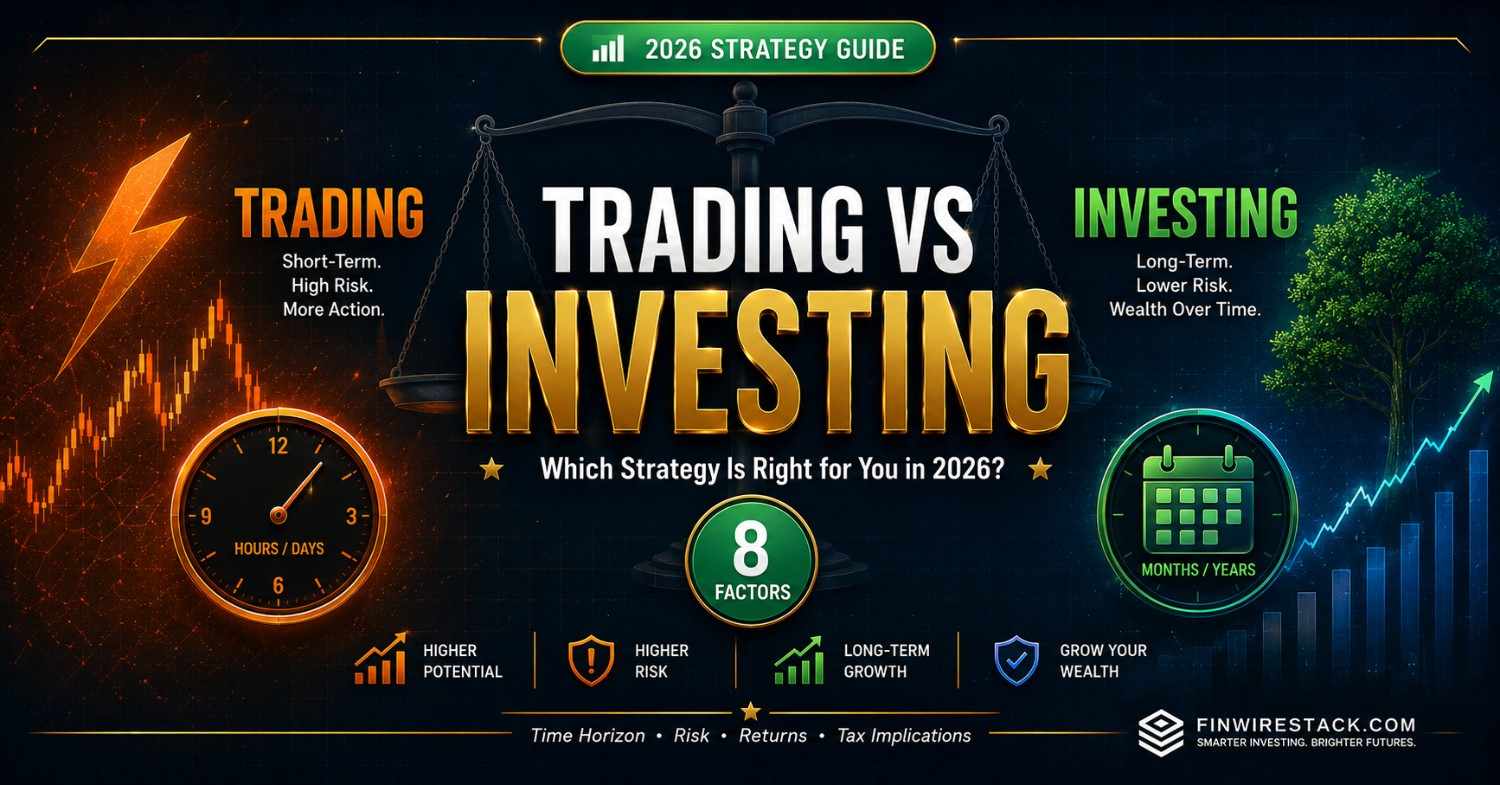
Trading vs investing: Which strategy is right for you in 2026? Compare time horizon, risk, returns, and tax implications to make the best decision for your financial goals.
Trading vs. investing is one of the most fundamental questions anyone entering the financial markets must answer. Both approaches aim to grow your money, but they operate on completely different timelines, risk profiles, and mindsets. Understanding this distinction is essential before committing your hard-earned capital.
This comprehensive guide will help you understand the trading vs. investing decision. You will learn:
By the end, you will have the knowledge to make an informed trading vs. investing decision that fits your personal financial situation.

Trading vs. investing—understanding the two distinct paths to growing your money
The trading vs. investing debate centers on two distinct approaches to participating in financial markets. Both involve buying and selling securities, but they are not the same thing. The big difference is the timeline. When you invest, you hold securities for the long term and hope to see their value grow over time. When you trade, you buy and sell regularly, looking to make short-term gains.
If investing is like watching a movie, trading can be like swiping through social media clips. Both are forms of entertainment, but in one case, you’re much more involved in the process than in the other.
🎯 Real-World Analogy: Think of the trading vs. investing decision like choosing between two different approaches to fitness. Investing is like running a marathon—steady, consistent, and built for the long haul. Trading is like sprinting—intense, fast-paced, and requiring constant attention. Both can improve your financial health, but they demand different strategies, time commitments, and risk tolerance.
The choice between trading and investing isn’t about finding a “winner.” It is about finding the right fit for your personal financial situation, goals, and personality.
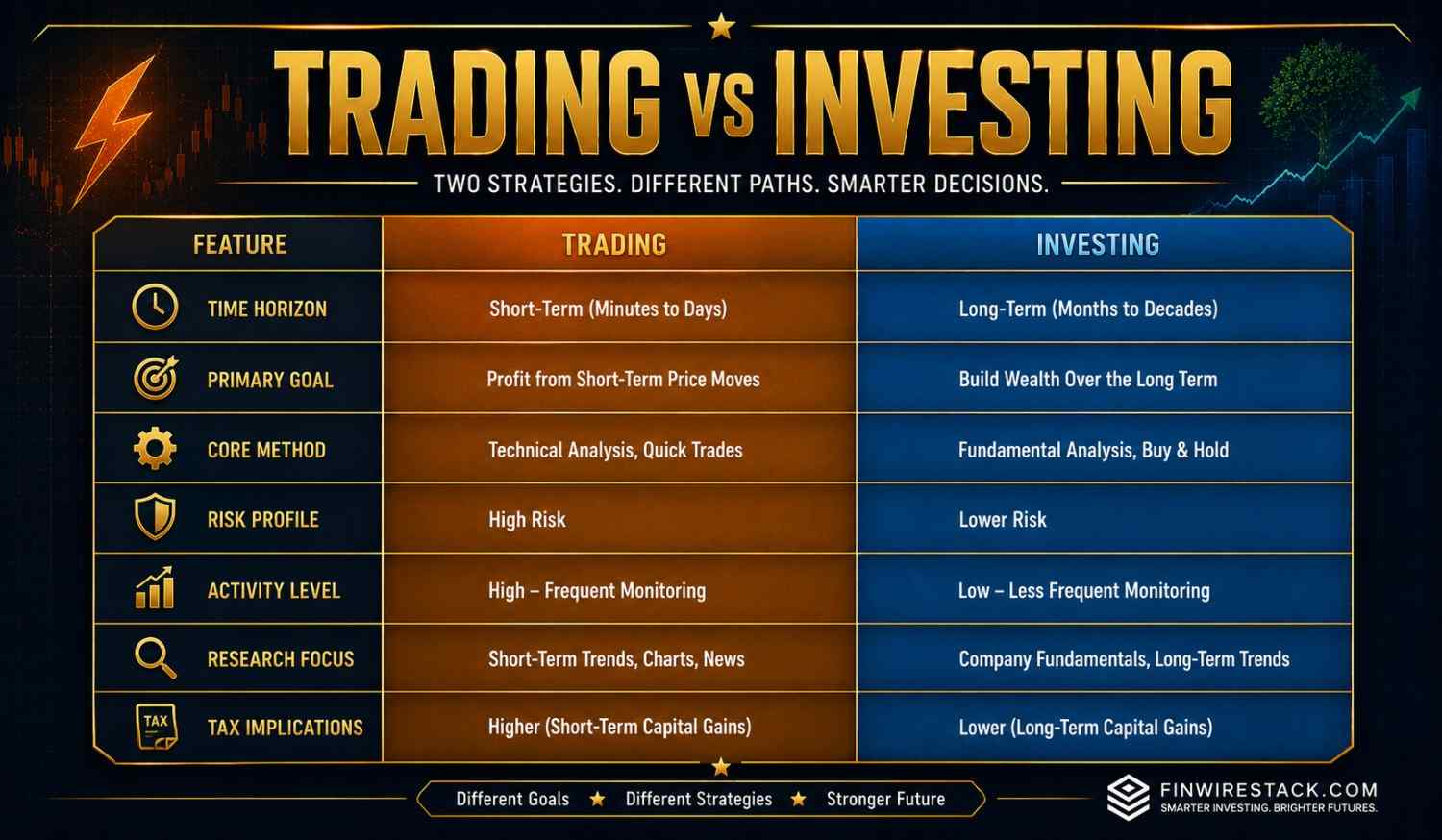
Trading vs. investing—a side-by-side comparison of key features
Investing is buying an asset, like an individual stock, mutual fund, or exchange-traded fund (ETF), in hopes of increasing your money over time. Because most people invest for long-term goals, like buying a house, paying for college, or saving for retirement, they tend to hold these assets for a long time—meaning years, if not decades.
Investing’s superpower is compounding. When you earn returns on your investments, those returns start earning returns. As time goes on, the power of compounding increases. For example, the S&P 500 has seen average annual returns of over 10% each year for the last 100 years, with dividends reinvested. That’s enough to beat inflation and build wealth.
🟦 Blue Highlight: For the last 100 years, the S&P 500 has seen average annual returns of over 10% each year, with dividends reinvested. From 1940 to 2024, dividend income made up 34% of the total return of the S&P 500. Since 1960, 85% of the cumulative total return of the S&P 500 Index can be attributed to reinvested dividends and the power of compounding.
One of the hidden advantages of investing over trading is tax efficiency. For investments you own at least a year and a day, you become eligible for a slightly lower tax rate called the long-term capital gains rate. In contrast, profits on investments held for less than a year are taxed at the same rate as your paycheck. Investments held in tax-advantaged accounts, like 401(k)s and IRAs, are not subject to the same tax rules.

Caption: Figure 3: The power of compounding — why time in the market beats timing the market
Trading is buying and selling financial assets in hopes of making a short-term profit. Traders could be buying and selling investments multiple times a day, week, or month. Though technically you “make a trade” anytime you buy or sell an investment, most people associate trading with an active investing strategy.
Trading operates on what’s called a zero-sum game. That is, if someone wins, it comes at the loss of someone else. In contrast, investors are playing a positive-sum game, where more than one person can win.
Data often cited by FINRA shows that only 1% to 4% of day traders remain profitable over the long term. This can happen for several reasons, including impulsive decisions (driven by emotions like fear and greed), not using proper risk management, or using high leverage.
🔴 Red Highlight: Research from S&P Dow Jones Indices shows that 93% of fund managers investing in large firms didn’t beat their benchmark index over the previous 20 years, and 92% couldn’t beat the market over 15 years. These are professionals with experience, knowledge, and computing power.
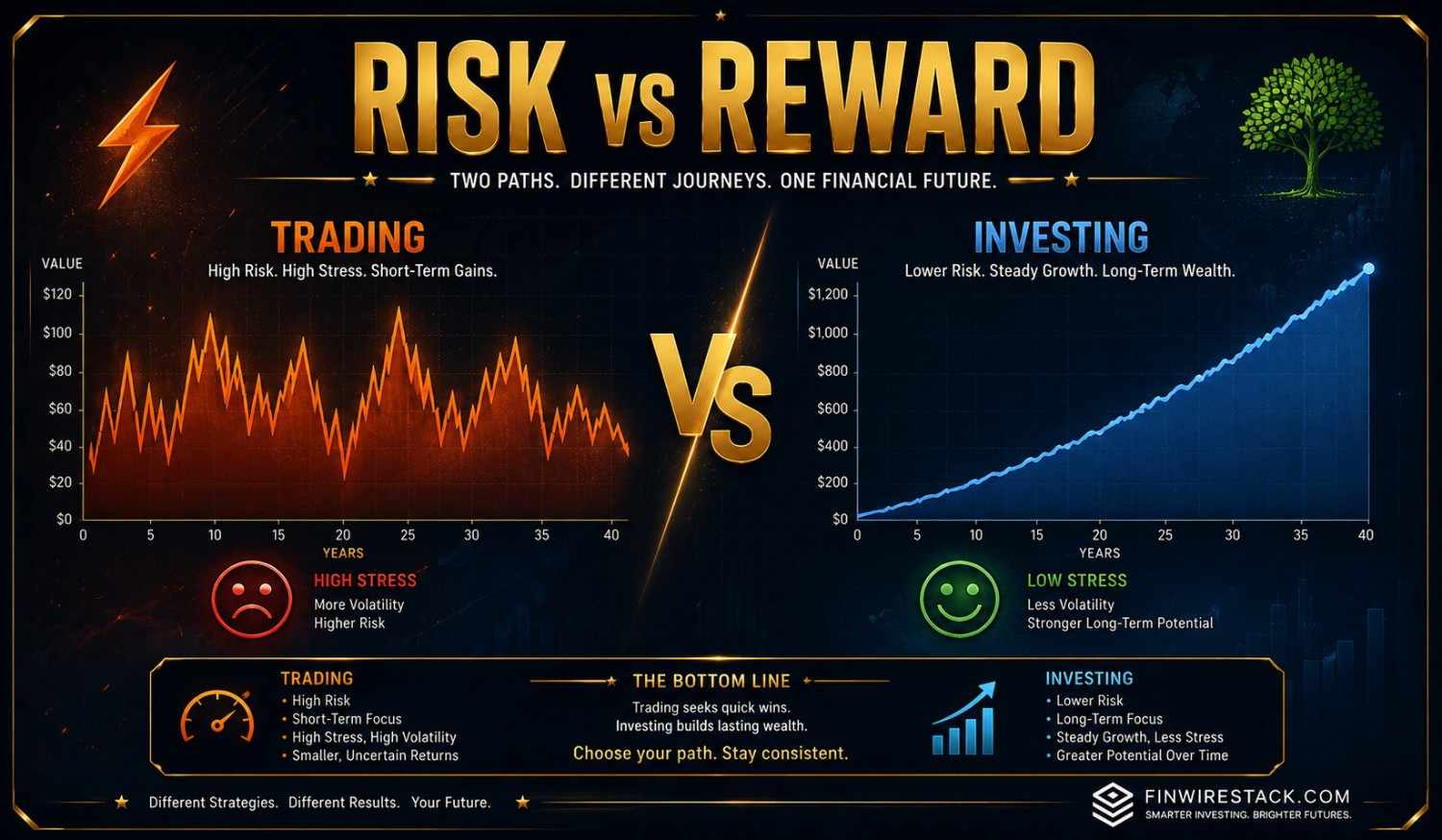
Trading vs. investing—understanding the risk and reward trade-off
The choice between trading and investing depends on market conditions and your personal situation.
Short-term active strategies tend to perform best during periods of price inefficiencies, high volatility, and macroeconomic uncertainty.
Long-term investing tends to deliver better results during periods of systemic economic growth, major technological adoptions, and clear corporate earnings visibility.
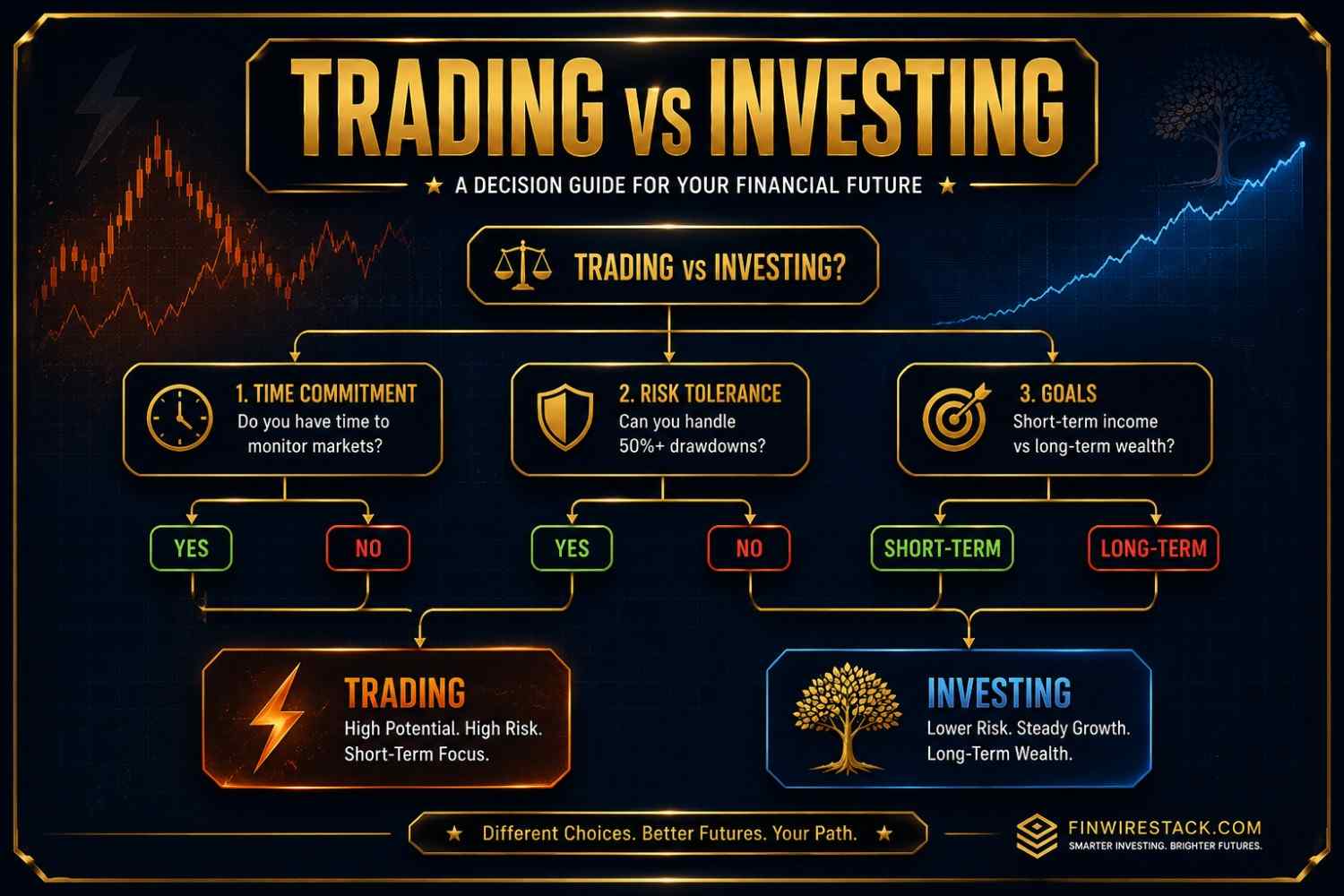
How to choose between trading and investing: a decision framework for beginners
The decision between trading and investing should be based on several personal factors.
| Goal | Recommended Approach |
|---|---|
| Short-term income (e.g., holiday fund) | Trading may align better |
| Long-term wealth (e.g., retirement) | Investing is better |
| Both | Hybrid approach |
Your risk appetite isn’t just about how much money you can afford to lose but about how much money you can lose before you stop sleeping at night.
| Risk Profile | Recommended Approach |
|---|---|
| Low Risk Tolerance | Investing (long-term, passive) |
| High Risk Tolerance | Trading (short-term, active) |
| Time Horizon | Recommended Approach |
|---|---|
| Short-term (days to months) | Trading |
| Long-term (years to decades) | Investing |
| Time Availability | Recommended Approach |
|---|---|
| Limited time (busy professional) | Investing (set-and-forget) |
| Adequate time (can monitor markets) | Trading |
You don’t need to choose between trading and investing. Many experienced market participants combine both methods.
| Allocation | Purpose | Example |
|---|---|---|
| 80% Long-term Investments | Core wealth building | Index funds, dividend stocks, bonds |
| 20% Active Trading | Short-term opportunities | Individual stocks, CFDs, crypto |
🎯 Real-World Example: Some investors might keep 80% of their capital in long-term investments (lower risk appetite) and use the remaining 20% for active trading. Others might do the opposite (higher risk appetite).
The trading vs. investing decision ultimately depends on your personal financial situation, risk tolerance, and investment objectives. Neither choice is inherently superior; they serve different purposes in a complete financial strategy.
Choose Investing If:
Choose Trading If:
Choose Both If
🎯 Final Thought: The evidence is clear that investing is a strategy that works better for most people. Can some traders consistently beat the market? Absolutely, no question. But for most people, it’s better to be an investor than a trader—and it can take less time and effort, too. Legendary investor Warren Buffett recommends that investors regularly buy into an index fund, such as an S&P 500 fund, and then hold for decades.
The main difference between trading and investing is the time horizon. When you invest, you hold securities for the long term—years or even decades—hoping to watch their value grow over time through compounding. When you trade, you buy and sell regularly—sometimes within minutes, days, or weeks—looking to make short-term gains from price fluctuations. This fundamental distinction in the trading vs. investing debate affects everything from your risk profile to your tax obligations.
The profitability of trading vs investing depends on your skill level, time commitment, and risk tolerance. Trading can be more profitable in the short term for skilled and disciplined participants, but data shows that only 1% to 4% of day traders remain profitable over the long term. Investing is often more profitable for ordinary participants who want consistency and compounding. Research from S&P Dow Jones Indices shows that 93% of professional fund managers couldn’t beat the market over 20 years, highlighting the challenge of active trading compared to passive investing.
Yes, trading is generally considered a higher-risk strategy compared to investing. In the trading vs. investing comparison, the shorter timeline, use of leverage, and need for constant decision-making make trading significantly riskier. Data consistently shows that only 1% to 4% of day traders remain profitable over the long term, whereas long-term investors in broad market index funds have historically seen positive returns over any 20 years. The deeper and faster an asset drops, the more likely traders are to sell at the wrong time, a behavioral risk that is often more damaging than market risk itself.
Yes, many investors maintain a hybrid approach that combines trading vs investing strategies. A common structure is to keep 80% of your capital in long-term investments (like index funds) for steady growth and use the remaining 20% for active trading opportunities. This hybrid approach provides diversification, flexibility to adapt to changing market conditions, and the ability to learn from both strategies. Some investors might also do the opposite, with a higher allocation to trading if they have a higher risk appetite and more time to dedicate to market monitoring.
For most beginners, a low-cost S&P 500 index fund is the best starting point in the trading vs investing decision. Warren Buffett recommends this approach, noting that it has returned approximately 10% annually over time. Index funds provide instant diversification across 500 of America’s largest companies with very low costs (expense ratios as low as 0.03%). This passive investing strategy requires minimal time and expertise, making it ideal for those who prefer a hands-off approach to building wealth.
The time commitment is one of the biggest differences in the trading vs. investing comparison. Trading is time-consuming and can be a full-time job. Day traders must constantly monitor positions, analyze charts, and make split-second decisions throughout the trading day. Swing traders need less attention but still require regular market checks. Investing, by contrast, requires minimal time and attention. Once you set up automatic contributions to a low-cost index fund, you can check your portfolio quarterly or even annually without significantly impacting your long-term results.
Tax implications are a crucial factor in the trading vs. investing decision. Short-term profits from trading (assets held less than a year) are taxed at your ordinary income tax rate, which can be as high as 37% for top earners. Long-term gains from investing (assets held at least a year and a day) qualify for lower capital gains rates of 0%, 15%, or 20%, depending on your income. This tax advantage is a significant benefit of investing over trading, especially for those in higher tax brackets. Additionally, investments held in tax-advantaged accounts like 401(k)s and IRAs are not subject to the same tax rules.
The 1% rule in trading means you never risk more than 1-2% of your total trading capital on any single position. This risk management principle helps protect your account from significant damage after a losing trade. For example, if you have a $10,000 trading account, you would risk no more than $100-$200 per trade. This rule ensures that a series of losing trades won’t wipe out your capital, allowing you to continue trading and learning from your mistakes.
Day trading and swing trading are two distinct approaches within the broader trading vs. investing framework. Day trading involves opening and closing positions within the same trading day, with no overnight positions held. This requires constant market monitoring and quick decision-making. Swing trading involves holding positions for several days to weeks, capturing medium-term price movements. Swing traders have more time to analyze the market and can hold positions overnight but still operate on a shorter time horizon than long-term investors.
Compounding is the superpower of investing in the trading vs. investing debate. When you earn returns on your investments, those returns start earning returns themselves. Over time, this exponential growth becomes increasingly powerful. For example, the S&P 500 has seen average annual returns of over 10% each year for the last 100 years, with dividends reinvested. This consistent compounding is why investing is a strategy that works better for most people. From 1940 to 2024, dividend income made up 34% of the total return of the S&P 500, demonstrating the power of reinvesting returns.
Yes, stocks can provide passive income through dividends, which is one advantage of investing over trading in the trading vs. investing comparison. Many established companies pay regular dividends, providing income while maintaining growth potential. Dividend investing involves buying stocks that pay regular dividends and then reinvesting those dividends to buy more shares. Since 1960, 85% of the cumulative total return of the S&P 500 Index can be attributed to reinvested dividends and the power of compounding. This makes dividend investing a popular strategy for those seeking both income and long-term growth.
Active and passive investing represent two different approaches within the trading vs investing spectrum. Active investing involves attempting to beat the market through frequent buying and selling, stock selection, and market timing. This approach is more aligned with trading and requires significant time, expertise, and higher fees. Passive investing involves buying and holding a diversified portfolio, typically through index funds, to match market returns rather than beating them. Passive investing requires less time, has lower fees, and historically has outperformed most active strategies over the long term.
For beginners, the best strategy in the trading vs investing decision is to start with a simple, low-cost, diversified approach. This typically means investing in a broad market index fund like the S&P 500, setting up automatic contributions, and holding for the long term. This approach requires minimal time and expertise, while historically delivering solid returns. Once you have built a solid foundation, you can gradually explore more active strategies like trading if you have the time, risk tolerance, and interest. The key is to start with what works for most people and then adjust as you learn.
The trading vs investing emotional challenges differ significantly between trading and investing. Trading is emotionally demanding, requiring constant decision-making and the ability to handle rapid gains and losses. This can lead to stress, anxiety, and impulsive decisions driven by fear and greed. Investing, on the other hand, requires patience and discipline to stay invested through market cycles. The challenge for investors is avoiding panic selling during downturns and staying focused on long-term goals. Both approaches require emotional control, but trading demands more immediate psychological resilience.
The hybrid approach combines both strategies in the trading vs. investing debate, allowing you to benefit from both steady growth and short-term opportunities. A common structure is to keep 80% of your capital in long-term investments (like index funds) for core wealth building and use the remaining 20% for active trading opportunities. This approach provides diversification, flexibility, and risk management. Some investors might adjust this allocation based on their risk tolerance, time commitment, and market conditions. The hybrid approach is popular among experienced investors who want exposure to both growth and income opportunities.
To deepen your understanding of financial markets and investing, explore these additional resources from Finwirestack:
Disclaimer: Investing and trading involve risk. Past performance does not guarantee future results. The information provided in this article is for educational purposes only and does not constitute financial advice. Always consult a qualified financial advisor before making investment decisions.