Category Investing 101

Fidelity Investments Explained: A Complete Beginner’s Guide to Investing in the U.S. in 2026

Fidelity Investments beginner guide to investing in the United States

If you have never invested before, the financial world can feel intimidating.

You hear people talking about stocks, ETFs, index funds, 401(k)s, Roth IRAs, mutual funds, dividends, capital gains, and compound interest.

Then you hear another name repeatedly:

Fidelity Investments.

But what exactly is Fidelity?

Is Fidelity a bank?

Is Fidelity a stock?

Is Fidelity an investment fund?

Can you buy stocks through Fidelity?

How much money do you need?

And, most importantly, how does a complete beginner actually use Fidelity Investments to start building wealth?

This guide answers those questions from the ground up.

By the end, you should understand what Fidelity is, what it offers, how the different accounts work, what you can invest in, what the major risks are, and what a sensible beginner investing journey could look like.

Important: Fidelity is not an investment itself. Fidelity is a financial-services company and investment platform through which eligible customers can access different financial products.


What Is Fidelity Investments?

Fidelity Investments is one of the major financial services companies serving U.S. investors.

Through its platforms, Fidelity provides access to investment accounts, stocks, ETFs, mutual funds, bonds, retirement accounts, managed investing, and other financial services. Fidelity’s current account lineup includes brokerage accounts, retirement accounts, managed solutions, cash-management products, crypto offerings, and accounts for children and education.

Think of Fidelity as a financial supermarket.

You do not go to Fidelity simply to “buy Fidelity.”

Instead, you open an appropriate account and then decide which investments belong inside that account.

For example:

Fidelity account โ†’ ETF โ†’ stocks inside the ETF

or

Fidelity IRA โ†’ mutual fund โ†’ diversified portfolio

or

Fidelity brokerage account โ†’ individual stocks

This distinction is fundamental for beginners.


Fidelity Investments in Simple Terms

Imagine you want to build a house.

You need:

  • A place to build
  • Building materials
  • Tools
  • A construction plan

Your Fidelity account is similar to the place where your investments are held.

Your stocks, ETFs, bonds and mutual funds are the building materials.

Your investment strategy is the construction plan.

Fidelity provides the platform and tools.

You still need to decide what you are building.


Why Is Fidelity Investments Getting So Much Attention?

The interest surrounding Fidelity fits into several major changes happening in U.S. investing.

AI and Technology

Artificial intelligence has become a major investment theme.

Fidelity’s own 2026 research identifies AI infrastructure as a major economic force and points to potential opportunities across semiconductor companies, utilities, energy, and other businesses supporting AI infrastructure.

Low-Cost Investing

Investors increasingly focus on fees because even small recurring costs can significantly affect long-term returns.

Fidelity currently advertises $0 online commissions for U.S. stocks and ETFs and offers zero-expense-ratio index mutual funds.

Fractional Investing

Fidelity allows eligible investors to purchase fractional shares, with its brokerage materials stating that investors can start with as little as $1.

Retirement Investing

Americans continue to use retirement accounts such as 401(k)s and IRAs to build long-term wealth.

For 2026, the IRS says the annual IRA contribution limit is $7,500, with an additional $1,100 catch-up contribution for eligible investors aged 50 and above.

Crypto

Fidelity has also expanded into digital assets.

Its current crypto offerings includes Bitcoin, Ethereum, Fidelity Digital Dollar, Litecoin, and Solana, and Fidelity also offers crypto-related exchange-traded products.

These trends help explain why understanding Fidelity Investments is increasingly relevant to people learning about modern U.S. investing.


How Does Fidelity Investments Actually Work?

The process is surprisingly simple.

Step 1: Choose an Account

You first decide what type of account you need.

Step 2: Deposit Money

You transfer money into the account.

Step 3: Select Investments

You choose stocks, ETFs, mutual funds, bonds or another eligible investment.

Step 4: Place the Investment

You purchase the investment.

Step 5: Monitor and Rebalance

You review your portfolio periodically and make adjustments when appropriate.

The biggest beginner mistake is believing that depositing money into Fidelity automatically means you are invested.

It does not.

Cash sitting inside an account is different from money invested in a security.


The Most Important Fidelity Accounts Beginners Should Understand

Fidelity Investments account types including brokerage, IRA, and Fidelity Go
1. Fidelity Brokerage Account

The standard brokerage account is one of the easiest places to start learning.

Fidelity describes its brokerage account as a multi-feature account that can provide access to stocks, ETFs, options, bonds, mutual funds, and other investments. It currently has no account minimum and allows investing from $1 through fractional shares.

Best For

A brokerage account can make sense for someone who wants:

  • Flexible investing
  • No retirement-account restrictions
  • Stock investing
  • ETF investing
  • Long-term wealth building
  • Access to taxable investments

The major disadvantage is taxation.

Investment income and realized capital gains can create tax obligations.


2. Traditional IRA

A Traditional IRA is designed primarily for retirement investing.

Depending on your circumstances, contributions may qualify for tax deductions, and investments generally grow tax-deferred.

However, withdrawal rules and tax consequences apply.

2026 IRA Contribution Limit

For 2026, the combined IRA contribution limit is:

$7,500 if under age 50

$8,600 if age 50 or older

The additional amount represents the catch-up contribution.

Always check the current IRS rules before making retirement contributions.


3. Roth IRA

A Roth IRA is another important retirement account.

The major attraction is the potential for tax-free qualified withdrawals.

However, eligibility and contribution rules apply.

For 2026, the IRS rules allow eligible individuals to contribute up to the applicable IRA limit, but higher-income taxpayers may face reduced or eliminated direct Roth IRA contribution eligibility. Fidelity’s current 2026 guidance lists income thresholds for Roth IRA eligibility.

Why Beginners Should Understand Roth IRAs

Suppose a young investor contributes consistently for decades.

The combination of:

contributions + investment growth + compounding + tax advantages

can become extremely powerful.

The right choice depends on your income, tax situation, retirement expectations, and eligibility.

But a Roth IRA is not automatically “better” than a Traditional IRA.


4. 401(k)

A 401(k) is generally an employer-sponsored retirement plan.

If your employer offers a 401(k), this deserves attention before opening additional investment accounts.

Why?

Because some employers provide a matching contribution.

For example, if an employer matches part of your contribution, not taking advantage of the available match can mean leaving part of your compensation unused.

Fidelity provides retirement-plan services to employers and employees, although the exact investments and rules available depend on the particular employer plan.


5. Fidelity Go

Not everyone wants to choose investments manually.

That is where a robo-advisor can become useful.

Fidelity Go is Fidelity’s automated investing service.

Fidelity states that Fidelity Go is available to U.S. residents aged 18 and above, and there is no minimum initial investment; once the account reaches $10, Fidelity begins investing according to the selected strategy.

This can be attractive to someone who says:

“I want to invest, but I don’t know which investments to select.”

Instead of manually selecting every security, the investor provides information about their goals and risk preferences, and the automated service manages the portfolio within its framework.


What Can You Buy Through Fidelity?

Fidelity Investments stocks ETFs index funds mutual funds bonds and crypt

This is where things become interesting.

Stocks

You can purchase shares of individual publicly traded companies.

For example, you might buy shares of companies operating in:

  • Technology
  • Healthcare
  • Financial services
  • Energy
  • Consumer products
  • Industrials

But individual stocks carry company-specific risk.

If the company performs poorly, the stock can fall significantly.


ETFs

An ETF is a basket of investments traded on an exchange.

Instead of purchasing 500 individual companies, you can buy an ETF designed to track a broad market index.

This can provide diversification with a single transaction.

Fidelity offers a broad range of ETFs and provides research tools for evaluating them.

Why Beginners Often Prefer ETFs

ETFs can provide:

Diversification

Convenience

Transparency

Low costs

Simple portfolio construction

But not every ETF is diversified.

Some ETFs concentrate heavily on one industry, theme, or asset.

Always investigate what is actually inside an ETF.


Fidelity Index Funds

Index funds attempt to track a particular market index.

One of Fidelity’s most well-known index funds is the Fidelity 500 Index Fund (FXAIX), which seeks to track the S&P 500.

The fund currently has an extremely low expense ratio, and current market reporting places its expense ratio at 0.015%.

This illustrates one reason index investing has become so popular.

Instead of trying to identify the next winning company, the investor obtains exposure to a broad group of companies.

Important

Low fees do not eliminate market risk.

An S&P 500 index fund can still decline substantially during a market downturn.


Fidelity Mutual Funds

Mutual funds pool money from multiple investors and invest according to a defined strategy.

Fidelity has a large mutual-fund lineup covering different objectives.

These can include:

  • U.S. equities
  • International equities
  • Bonds
  • Target-date funds
  • Sector funds
  • Growth funds
  • Income funds
  • Index funds

The important question is not

“Is this a Fidelity fund?”

The important questions are:

“What does this fund own?”

“What does it charge?”

“What is its objective?”

“What risks does it take?”


Fidelity Bonds and CDs

Investing does not have to mean buying stocks.

Fidelity also provides access to fixed-income investments such as bonds and CDs.

These can play a role in portfolios designed around:

  • Income
  • Capital preservation
  • Diversification
  • Retirement planning
  • Lower equity exposure

Fidelity currently lists $1 per bond or CD for secondary-market trading and free online trading for U.S. Treasuries, subject to applicable conditions and rules.


Fidelity Crypto

This is one of the most important modern developments to understand.

Fidelity now offers cryptocurrency exposure through multiple structures.

These include:

Fidelity Crypto

Crypto ETPs

Crypto IRA options

Its current direct crypto offering includes Bitcoin, Ethereum, Fidelity Digital Dollar, Litecoin, and Solana.

Fidelity also offers crypto funds such as FBTC, FETH and FSOL, which provide exposure to Bitcoin, Ether, and Solana through exchange-traded products.

But Crypto Is Different

Fidelity itself warns that cryptocurrency is highly volatile and may become illiquid.

Investors can lose their entire investment.

Crypto should therefore not automatically become the foundation of a beginner’s portfolio.


Fidelity Fractional Shares Explained

Suppose a stock costs $500 per share.

You only have $50.

With fractional investing, you may be able to purchase a portion of that share rather than waiting until you have $500.

Fidelity states that its brokerage account supports fractional shares and allows investors to get started with as little as $1.

This is particularly important for younger investors.

You no longer necessarily need thousands of dollars to begin building a diversified investment habit.


How Much Money Do You Need to Start With Fidelity?
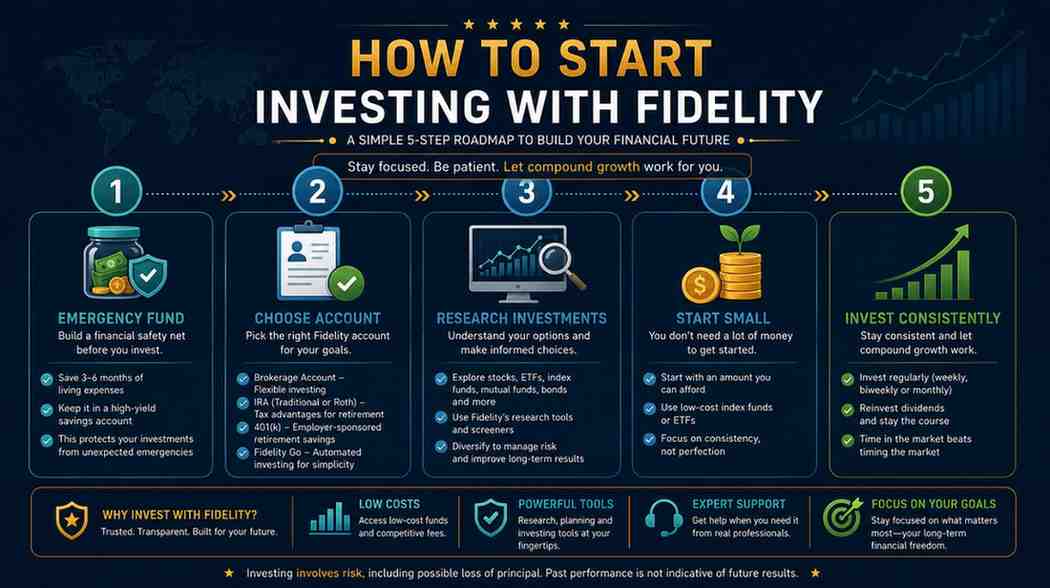
how to start investing with Fidelity Investments step by step

This is one of the most common questions for beginners.

The answer is

You do not necessarily need a large amount.

Fidelity’s standard brokerage account currently has no account minimum, and its fractional-share system allows eligible investors to start investing with $1.

But there is a difference between:

minimum required to start

and

amount needed to achieve a meaningful financial goal.

Starting with $1 teaches you how the platform works.

Building meaningful wealth requires consistent contributions over time.


Fidelity Fees: What Beginners Should Watch

One reason Fidelity attracts investors is its low-cost structure.

Fidelity currently advertises:

  • $0 online commissions for U.S. stocks
  • $0 online commissions for ETFs
  • $0 account fees for its standard brokerage account
  • Zero-expense-ratio index mutual funds

However, “$0 commission” does not mean every possible transaction is free.

Other costs can include:

  • Options contract fees
  • Certain mutual-fund transaction fees
  • Bond/CD charges
  • Advisory fees
  • Fund expense ratios
  • Margin interest
  • Other specialized service fees

Always examine the current fee schedule before investing.


The Difference Between Commission and Expense Ratio

Beginners often confuse these.

Commission

A commission is a charge associated with executing a transaction.

Expense Ratio

An expense ratio represents the annual operating expenses of a fund as a percentage of assets.

Imagine you invest $10,000 in a fund with a 0.10% expense ratio.

That is approximately

$10 per year

before considering changes in the investment value.

The lower the expense ratio, the less of the investment return is consumed by fund expenses, all else equal.

This is one reason low-cost index investing is such a major theme among long-term investors.


What Is the Best Fidelity Investment for a Beginner?

There is no universal “best Fidelity Investments.”

The right investment depends on:

  • Age
  • Income
  • Financial goals
  • Time horizon
  • Risk tolerance
  • Tax situation
  • Existing investments
  • Emergency savings
  • Debt

However, a beginner interested in long-term investing might investigate broad-market index funds or diversified ETFs before jumping into speculative individual stocks.

A Simple Beginner Framework

A hypothetical long-term investor might think in terms of:

Core portfolio

Broad-market diversified investments.

Growth allocation

Potentially higher-growth assets.

Defensive allocation

Bonds or cash-like investments depending on objectives.

Speculative allocation

Only money the investor can genuinely afford to lose.

The exact percentages should not be copied blindly from another investor.


Fidelity Investments and the AI Boom

AI is one of the biggest investment themes influencing U.S. markets in 2026.

Fidelity’s own research describes AI infrastructure spending as a major driver of U.S. economic activity and highlights potential opportunities in semiconductor companies, utilities, energy, and other infrastructure providers.

But there is an important lesson here.

Do Not Confuse a Trend With a Strategy

AI may be a powerful long-term technological transformation.

That does not mean every AI-related stock will rise.

Some companies may:

  • Become market leaders
  • Lose market share
  • Fail to monetize AI
  • Become overvalued
  • Face intense competition

A beginner should therefore investigate the business and valuation, not simply buy something because it contains the word “AI.”


Fidelity Investments and the U.S. Stock Market in 2026

Fidelity’s recent market analysis says U.S. information technology and growth stocks rebounded strongly during the second quarter of 2026, while international equities also showed broad strength.

That creates an important diversification lesson.

You do not necessarily need to put everything into U.S. technology stocks simply because they are performing strongly.

Markets rotate.

Leadership changes.

Economic conditions change.

Interest rates change.

Investor expectations change.

A diversified portfolio is designed around the possibility that you will be wrong about which asset class performs best next.


How a Beginner Could Start Investing With Fidelity

Let’s make this practical.

Step 1: Build an Emergency Fund

Before investing aggressively, consider whether you have sufficient emergency savings.

Do not invest money that you may need next month for rent, food, or an emergency.


Step 2: Eliminate Dangerous High-Interest Debt

Credit card debt with extremely high interest can work against your investment strategy.

Suppose your investment earns 8% over a particular period while your credit card balance costs you 25%.

The mathematics may not favor investing before dealing with the expensive debt.


Step 3: Define Your Goal

Ask:

Why am I investing?

Maybe your goal is:

  • Retirement
  • Buying a home
  • Children’s education
  • Financial independence
  • Long-term wealth
  • Building an investment portfolio

Your goal determines your time horizon.


Step 4: Choose the Correct Account

Consider whether you need:

Brokerage account

Traditional IRA

Roth IRA

401(k)

Fidelity Go

or another specialized account.


Step 5: Choose Your Investment

Do not buy anything until you understand:

  • What it owns
  • How it makes money
  • What it costs
  • How risky it is
  • How diversified it is
  • What your expected holding period is

Step 6: Start Small

You do not need to begin with $10,000.

The objective at the beginning is to build:

knowledge + discipline + consistency.


Step 7: Automate Contributions

Suppose someone invests $100 every month.

They are not attempting to predict every market movement.

They are building a habit.

Over years, the combination of regular contributions and compounding can become meaningful.


What Is Compound Growth?

Suppose you invest money and earn returns.

Those returns remain invested.

Then future returns can potentially be earned on:

your original money + previous investment gains.

That is compounding.

For illustration, if an investor contributed $200 per month and achieved a hypothetical 8% annual return compounded monthly, the account could grow to roughly $117,800 after 20 years.

The investor would have contributed:

$48,000

The remainder would represent investment growth.

But remember:

8% is a hypothetical assumption, not a guaranteed Fidelity return.

Real investment returns vary.


Fidelity Investments vs. Buying Stocks Directly

This is another misconception about Fidelity Investments.

When you use Fidelity, you are not necessarily buying “Fidelity stock.”

You are using Fidelity as the platform through which you can purchase investments.

For example:

Fidelity account

โ†“

Fidelity 500 Index Fund

โ†“

Portfolio of large U.S. companies

Or:

Fidelity account

โ†“

Individual company stock

โ†“

One company

The risk profile is very different.


Fidelity vs. a Bank Account

A bank account and investment account serve different purposes.

Bank/Savings Account

Usually designed for:

  • Cash storage
  • Spending
  • Emergency funds
  • Short-term goals

Investment Account

Designed for:

  • Long-term growth
  • Stocks
  • ETFs
  • Bonds
  • Mutual funds
  • Other investments

Investment values can rise and fall.

Cash accounts are generally much more stable.

Therefore, you should not treat an investment account as though it were a guaranteed savings account.


Can Someone in Africa Open a Fidelity Investments Account?

This is extremely important for FinWireStack’s international readership.

If you currently reside in Africa and do not already have a Fidelity relationship, you generally cannot open a new Fidelity account as an African resident.

Fidelity’s own international-customer guidance states that it does not open accounts for new customers residing outside the United States.

This means an African reader should not attempt to bypass Fidelity’s residency requirements using false information or another person’s U.S. address.

Instead, international investors should investigate brokers and investment platforms that legally accept residents of their country.

This distinction is critical because availability of U.S. investments and availability of a particular U.S. broker are two different things.


Who Is Fidelity Investments Best Suited For?

Fidelity can be particularly attractive for eligible U.S. investors who want:

  • Long-term investing
  • Retirement planning
  • Stocks
  • ETFs
  • Index funds
  • Mutual funds
  • Fractional shares
  • Automated investing
  • Research tools
  • Low-cost investing
  • One financial platform

It can serve both beginners and experienced investors.


Who Should Be Careful?

Fidelity may not be appropriate for someone who:

  • Wants guaranteed returns
  • Does not understand investment risk
  • Wants to day-trade without a strategy
  • Uses excessive margin
  • Buys stocks based entirely on social media hype
  • Does not understand taxes
  • Invests emergency savings
  • Cannot tolerate temporary losses

A reputable platform cannot protect you from a poor investment decision.


Common Fidelity Investing Mistakes Beginners Make

Mistake 1: Buying Whatever Is Trending

A stock appearing repeatedly on TikTok, YouTube, or Google Trends is not automatically a good investment.

Mistake 2: Confusing Fidelity With an Investment

Fidelity is the platform.

The investment is what you purchase through it.

Mistake 3: Investing Without an Emergency Fund

A market downturn can become devastating if you are forced to sell investments to pay an unexpected bill.

Mistake 4: Chasing AI Stocks

AI is a powerful trend, but not every AI company will succeed.

Mistake 5: Ignoring Fees

Small costs can compound over decades.

Mistake 6: Using Margin Too Early

Borrowing money to invest can magnify losses.

Mistake 7: Checking Your Portfolio Every Five Minutes

Long-term investing is generally different from short-term trading.


Fidelity Investments vs. Trading

This distinction deserves special attention for FinWireStack readers.

Investing generally focuses on building wealth over years or decades.

Trading focuses more heavily on shorter-term price movements.

Someone can use Fidelity for both investing and trading, but the mindset is different.

Investing

Goal: Long-term wealth

Typical holding period: Years/decades

Focus: Fundamentals, diversification, asset allocation

Trading

Goal: Profit from price movements

Typical holding period: Minutes to months

Focus: Market behavior, execution, risk management

If you are interested in trading automation, see Algorithmic Trading in 2027.


What About Fidelity Investments Crypto?

Crypto is becoming increasingly integrated into mainstream investment platforms.

Fidelity now allows eligible U.S. customers to access direct cryptocurrency through Fidelity Crypto and crypto exposure through exchange-traded products.

However, crypto should not be confused with traditional diversified investing.

Fidelity explicitly warns that crypto is highly volatile and investors can lose their entire investment.

A beginner should therefore understand the difference between:

Diversified index exposure

and

single-asset cryptocurrency exposure.


A Beginner’s Fidelity Investments Checklist

Before making your first investment, ask yourself:

Financial Preparation

โ˜ Do I have emergency savings?

โ˜ Have I addressed high-interest debt?

โ˜ Do I know my investment objective?

Account Selection

โ˜ Do I need a brokerage account?

โ˜ Should I investigate an IRA?

โ˜ Do I have access to an employer 401(k)?

Investment Selection

โ˜ Do I understand what I am buying?

โ˜ Is it diversified?

โ˜ What does it cost?

โ˜ What are the risks?

Long-Term Plan

โ˜ How much can I invest monthly?

โ˜ How long will I invest?

โ˜ What will I do during a market crash?

โ˜ Will I continue investing consistently?


The 2026 Fidelity Investments Trends Beginners Should Watch

Fidelity Investments trends in 2026: AI ETFs retirement crypto and fractional investing

Based on Fidelity’s current research and product direction, several themes deserve attention.

AI Infrastructure

AI is expanding demand for computing power, data centers, semiconductors, and electricity infrastructure. Fidelity identifies these areas as potential investment opportunities while also emphasizing the importance of valuation and risk.

Low-Cost Index Investing

Index funds and ETFs remain central to many long-term portfolios.

Fractional Investing

The ability to invest with smaller amounts makes market access easier for beginners.

Automated Investing

Robo-advisors such as Fidelity Go can help investors who prefer an automated approach.

Crypto Integration

Fidelity’s expansion into direct crypto and crypto ETPs shows how digital assets are increasingly being integrated into mainstream investment platforms.

Retirement Tax Planning

IRA contribution limits and tax rules remain important considerations for American investors.


Is Fidelity Investments Safe?

Fidelity is an established U.S. financial-services company, but “safe platform” does not mean “your investments cannot lose money.”

Your investment can decline.

A stock can go to zero.

An ETF can fall.

A cryptocurrency can experience extreme losses.

Safety therefore has two dimensions:

Platform and custody protections

versus

Investment risk.

Never confuse the two.

Fidelity Investments’ brokerage entities identify their applicable regulatory and SIPC membership information, but investors should understand exactly which product they own and what protections apply to it.

This becomes particularly important with cryptocurrency because Fidelity states that crypto investments do not receive the same regulatory protections applicable to registered securities.


The Beginner’s Best Way to Think About Fidelity Investments

Don’t ask:

“Which Fidelity Investments will make me rich?”

Ask:

“Which Fidelity Investments account and investment structure best fit my financial goal, risk tolerance, and time horizon?”

That single change in mindset can dramatically improve the quality of your investment decisions.


Final Takeaway

Fidelity Investments is not a single investment.

It is a large financial-services platform that gives eligible investors access to a wide range of accounts and investments.

A beginner can use Fidelity Investments to access:

  • Stocks
  • ETFs
  • Index funds
  • Mutual funds
  • Bonds
  • CDs
  • Retirement accounts
  • Fractional shares
  • Automated investing
  • Cryptocurrency

Its current direction also reflects some of the biggest themes shaping U.S. investing in 2026: AI, technology, low-cost investing, automation, retirement planning, and digital assets.

But the platform does not determine whether you make money.

Your financial plan, strategy, risk management, time horizon, and behavior matter far more.

For a beginner, the most sensible progression in Fidelity Investments is:

Learn โ†’ Build an emergency fund โ†’ Understand accounts โ†’ Choose diversified investments โ†’ Invest consistently โ†’ Control costs โ†’ Avoid unnecessary speculation โ†’ Review periodically.

And if you are outside the United States, remember the crucial eligibility issue: Fidelity currently says it does not open accounts for new customers who reside outside the U.S.

So for a Kenyan investor, the educational lesson is still highly valuableโ€”but the practical next step is to identify a regulated investment platform that legally accepts Kenyan residents rather than attempting to circumvent Fidelity’s eligibility requirements.


Frequently Asked Questions on Fidelity Investments.

Is Fidelity Investments a bank?

Fidelity Investments is primarily a financial services and investment company. It provides brokerage, retirement, investment-management, cash-management, and other financial products.

Is Fidelity good for beginners?

It can be. Fidelity provides educational resources, fractional shares, low-cost investment options, and both self-directed and automated investing services.

How much money do I need to start investing with Fidelity Investments?

Fidelity’s standard brokerage account currently has no account minimum, and eligible investors can use fractional shares to invest with as little as $1.

Can I buy ETFs through Fidelity?

Yes. Fidelity provides access to ETFs and offers its own ETF lineup as well as other investment choices.

Can I buy Bitcoin through Fidelity?

Eligible U.S. customers can access Bitcoin and other cryptocurrencies through Fidelity Crypto. Fidelity also offers crypto ETPs through brokerage accounts.

Can Africans open an account in Fidelity Investments?

Fidelity states that it does not open accounts for new customers residing outside the United States.

What is the difference between Fidelity and an ETF?

Fidelity is a financial-services platform. An ETF is an investment product that you can potentially purchase through Fidelity.

What is FXAIX?

FXAIX is the Fidelity 500 Index Fund, which seeks to track the S&P 500. It is one of Fidelity’s best-known index funds.

Does Fidelity guarantee investment returns?

No. Investments can lose value, and past performance does not guarantee future results.


Recommended Official Resources on Fidelity Investments

Fidelity Investments: Fidelity Investments official website

Fidelity Brokerage Account: The Fidelity Account

Fidelity Investment Accounts: Fidelity account and product directory

Fidelity Fees: Fidelity pricing and fees

Fidelity ETFs: Investing in ETFs at Fidelity

IRS: 2026 IRA and retirement contribution information


Learn more about investments here:

Algorithmic Trading in 2027 in Relation to Fidelity Investments.

AI Trading Bots: Real vs Scams in Relation to Fidelity Investments.

AI vs Human Traders 2030 in Relation to Fidelity Investments.

Copy Trading in 2027 in Relation to Fidelity Investments.

AI Investment Platforms in 2027 in Relation to Fidelity Investments.
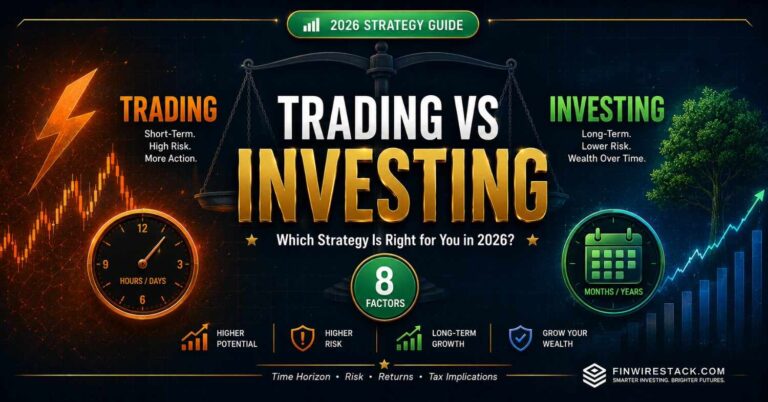
Trading vs. Investing: Which Strategy Is Right for You in 2026?

Trading vs investing featured image showing comparison between short-term trading and long-term investing with 8 factors for beginners in 2026

Trading vs. investingย is one of the most fundamental questions anyone entering the financial markets must answer. Both approaches aim to grow your money, but they operate on completely different timelines, risk profiles, and mindsets. Understanding this distinction is essential before committing your hard-earned capital.

This comprehensive guide will help you understand theย trading vs. investingย decision. You will learn:

  • The core differences between trading and investing
  • How each approach works and what it requires
  • The risk and reward profile of each strategy
  • Which approach aligns with your goals, personality, and lifestyle
  • How to combine both strategies in a hybrid approach

By the end, you will have the knowledge to make an informedย trading vs. investingย decision that fits your personal financial situation.


Trading vs investing overview showing the key differences between short-term trading and long-term investing for beginners in 2026

Trading vs. investingโ€”understanding the two distinct paths to growing your money


The Big Picture: Trading vs Investing

Theย trading vs. investingย debate centers on two distinct approaches to participating in financial markets. Both involve buying and selling securities, but they are not the same thing. The big difference is the timeline. When you invest, you hold securities for the long term and hope to see their value grow over time. When you trade, you buy and sell regularly, looking to make short-term gains.

If investing is like watching a movie, trading can be like swiping through social media clips. Both are forms of entertainment, but in one case, you’re much more involved in the process than in the other.

๐ŸŽฏ Real-World Analogy:ย Think of theย trading vs. investingย decision like choosing between two different approaches to fitness. Investing is like running a marathonโ€”steady, consistent, and built for the long haul. Trading is like sprintingโ€”intense, fast-paced, and requiring constant attention. Both can improve your financial health, but they demand different strategies, time commitments, and risk tolerance.

The choice betweenย trading and investingย isn’t about finding a “winner.” It is about finding the right fit for your personal financial situation, goals, and personality.


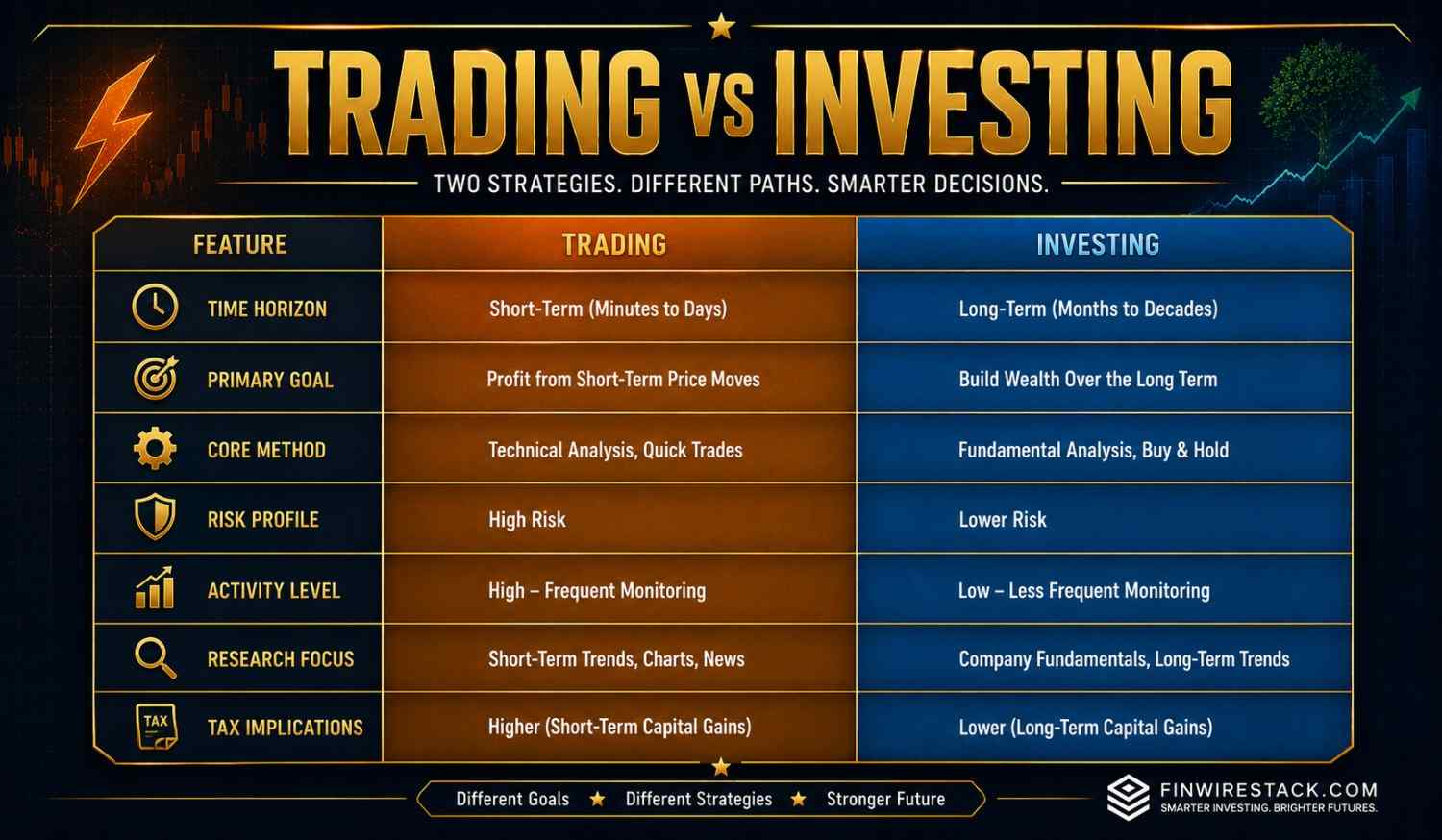
Trading vs investing comparison table showing time horizon risk profile activity level and goals for beginners in 2026

Trading vs. investingโ€”a side-by-side comparison of key features


What Is Investing?

Investing is buying an asset, like an individual stock, mutual fund, or exchange-traded fund (ETF), in hopes of increasing your money over time. Because most people invest for long-term goals, like buying a house, paying for college, or saving for retirement, they tend to hold these assets for a long timeโ€”meaning years, if not decades.

Key Characteristics of Investing

FeatureDescription
Time HorizonLong-term (years to decades) 
Primary GoalGradually build wealth over time through compounding 
MindsetThink like an ownerโ€”focus on business fundamentalsย 
Research FocusFundamental analysis โ€” earnings, growth potential, industry trends 
Activity LevelMinimal, occasional check-ins 
Risk ToleranceGenerally, more tolerant of short-term market fluctuationsย 

Types of Investing Strategies

StrategyDescription
Index InvestingBuying low-cost index funds that track the S&P 500 or total stock market 
Value InvestingInvesting in stocks trading for less than their book value 
Growth InvestingInvesting in companies with potential for future growth 
Dividend InvestingBuying stocks that pay regular dividends 
Buy-and-HoldA passive strategy with no market timing, holding for decades 

The Power of Compounding in Investing

Investing’s superpower is compounding. When you earn returns on your investments, those returns start earning returns. As time goes on, the power of compounding increases. For example, the S&P 500 has seen average annual returns of over 10% each year for the last 100 years, with dividends reinvested. That’s enough to beat inflation and build wealth.

๐ŸŸฆ Blue Highlight:ย For the last 100 years, the S&P 500 has seen average annual returns of over 10% each year, with dividends reinvested. From 1940 to 2024, dividend income made up 34% of the total return of the S&P 500. Since 1960, 85% of the cumulative total return of the S&P 500 Index can be attributed to reinvested dividends and the power of compounding.

Tax Advantages of Investing

One of the hidden advantages of investing over trading is tax efficiency. For investments you own at least a year and a day, you become eligible for a slightly lower tax rate called the long-term capital gains rate. In contrast, profits on investments held for less than a year are taxed at the same rate as your paycheck. Investments held in tax-advantaged accounts, like 401(k)s and IRAs, are not subject to the same tax rules.


Trading vs investing power of compounding showing how long-term investing builds wealth through reinvested dividends and market growth

Caption: Figure 3: The power of compounding โ€” why time in the market beats timing the market


What Is Trading?

Trading is buying and selling financial assets in hopes of making a short-term profit. Traders could be buying and selling investments multiple times a day, week, or month. Though technically you “make a trade” anytime you buy or sell an investment, most people associate trading with an active investing strategy.

Key Characteristics of Trading

FeatureDescription
Time HorizonShort-term (seconds, minutes, days, or weeks) 
Primary GoalCapture price volatility and profit from short-term market fluctuations 
MindsetFocus on price movements rather than business fundamentals 
Research FocusTechnical analysis โ€” price patterns, market sentiment, momentum 
Activity LevelHigh โ€” constant monitoring required 
Risk ToleranceGenerally riskier, more time-consuming, and stressful 

Types of Trading Styles

StyleTimeframeDescription
Scalp TraderSeconds to minutesCaptures very small price moves repeatedly 
Day TraderThroughout the day onlyNo overnight positions 
Swing TraderDays to weeksCaptures medium-term price movements 
Position TraderMonths to yearsHolds positions to capture long-term trends 

The Challenges of Trading

Trading operates on what’s called a zero-sum game. That is, if someone wins, it comes at the loss of someone else. In contrast, investors are playing a positive-sum game, where more than one person can win.

Data often cited by FINRA shows that only 1% to 4% of day traders remain profitable over the long term. This can happen for several reasons, including impulsive decisions (driven by emotions like fear and greed), not using proper risk management, or using high leverage.

๐Ÿ”ด Red Highlight:ย Research from S&P Dow Jones Indices shows that 93% of fund managers investing in large firms didn’t beat their benchmark index over the previous 20 years, and 92% couldn’t beat the market over 15 years. These are professionals with experience, knowledge, and computing power.

The Hidden Costs of Trading

CostImpact
Transaction CostsSpreads, commissions, and financing charges eat into profits 
TaxesShort-term profits taxed at higher ordinary income rates 
Missed Best DaysMissing just the 10 best market days each decade reduces total return from 17,715% to just 28% over 90 years 
Emotional ImpactStress and fatigue lead to poor decisions 

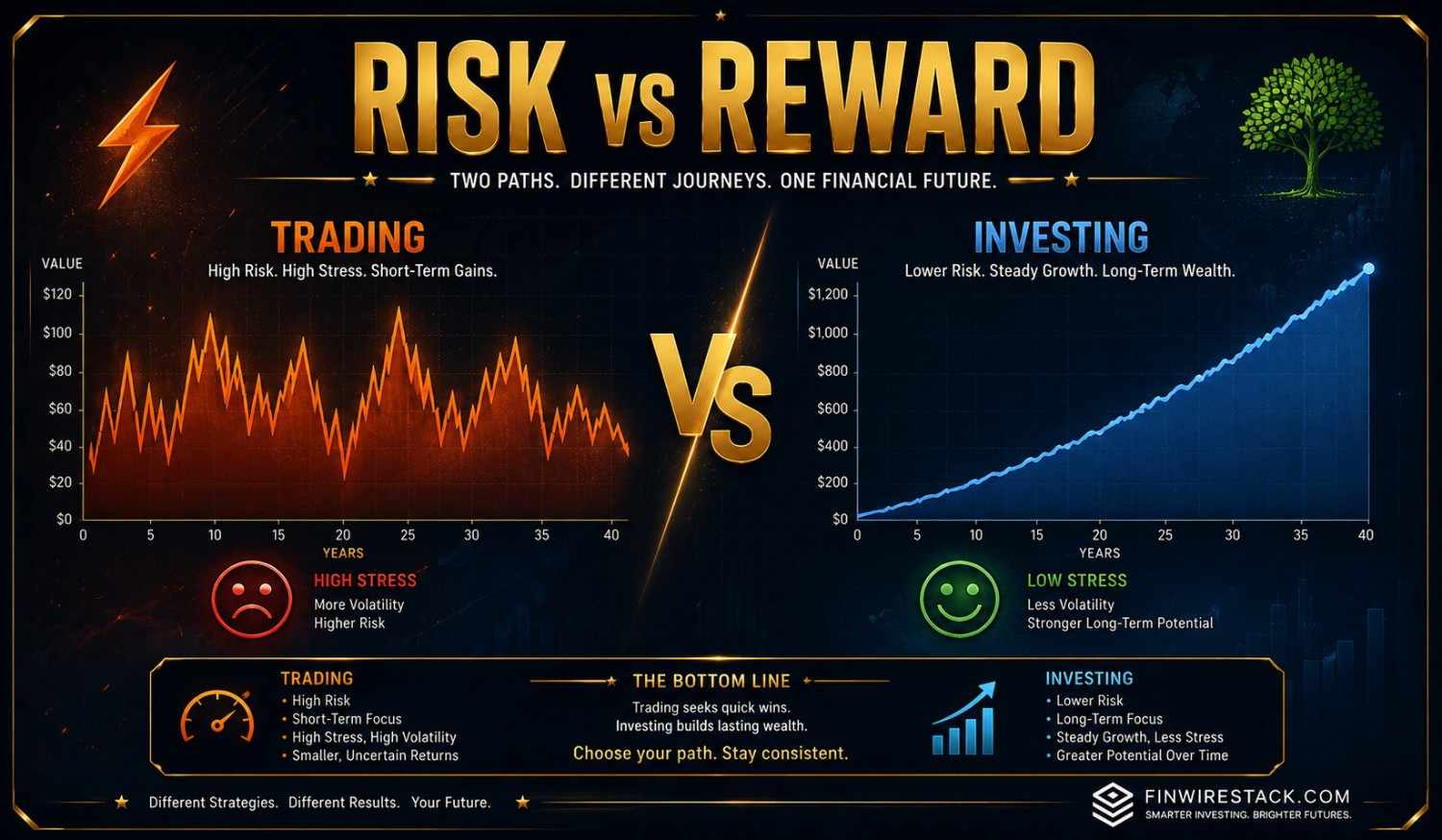
Trading vs investing risk and reward comparison showing volatility stress levels and potential returns for beginners in 2026

Trading vs. investingโ€”understanding the risk and reward trade-off


When to Trade vs Invest

The choice betweenย trading and investingย depends on market conditions and your personal situation.

When Market Conditions Favor Trading

Short-term active strategies tend to perform best during periods of price inefficiencies, high volatility, and macroeconomic uncertainty.

ConditionWhy It Favors Trading
Macroeconomic DisruptionGeopolitical tensions or regulatory changes create sudden price swings 
High Interest RatesA lopsided market structure creates opportunities for shorting overvalued companiesย 
Sideways MarketsWide intraday swings without clear trends 
Geopolitical UncertaintySharp moves in commodities and currencies 

When Market Conditions Favor Investing

Long-term investing tends to deliver better results during periods of systemic economic growth, major technological adoptions, and clear corporate earnings visibility.

ConditionWhy It Favors Investing
Structural MegatrendsNew technologies driving multi-year upward trends 
Synchronized Easing CyclesCentral banks are lowering interest rates in unisonย 
Clear Upward TrendsStable macroeconomic backdrop with steady growth 
Historical RecoveriesThe market always recovers over the long term 

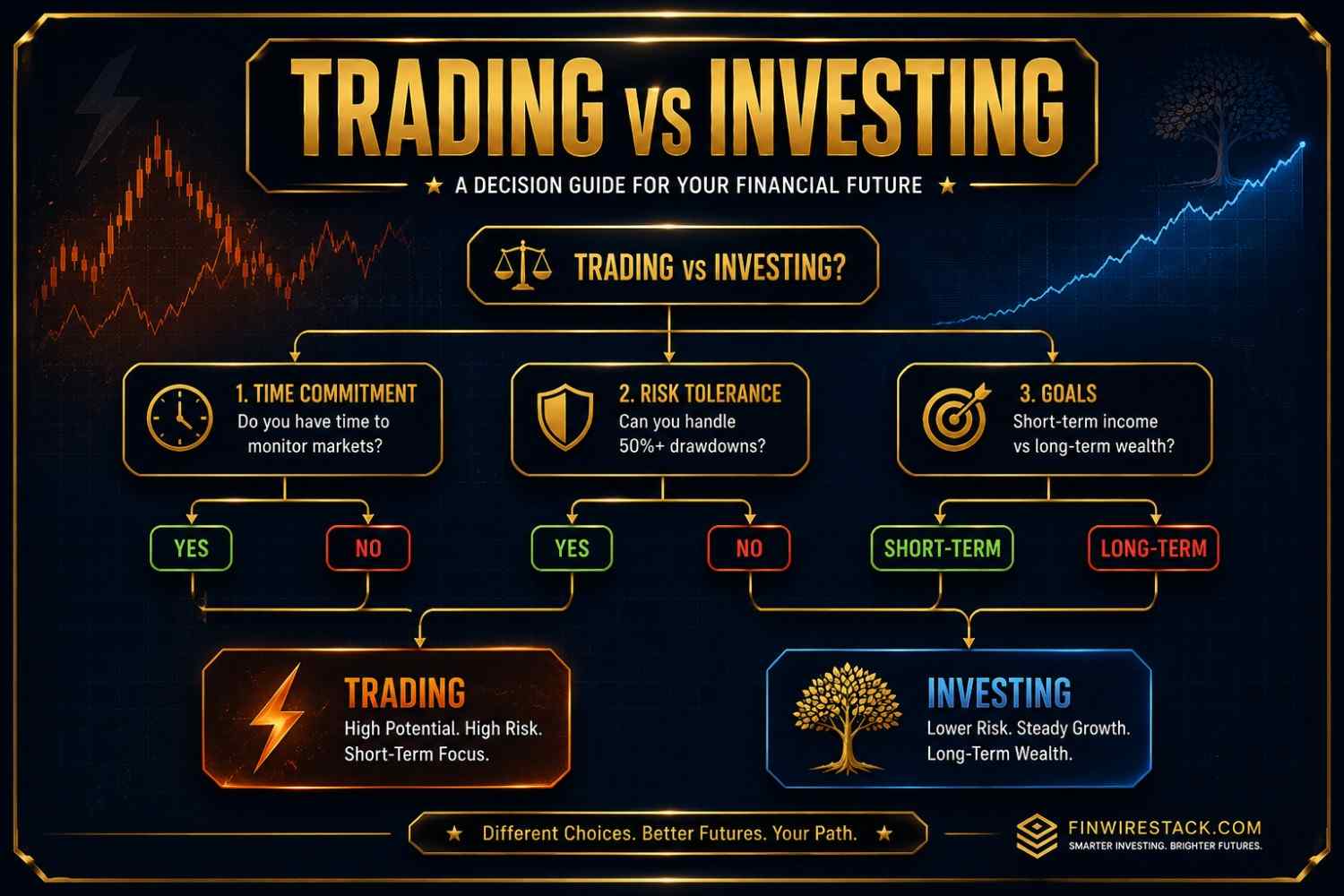
Trading vs investing how to choose showing personality assessment time commitment and financial goals for beginners in 2026

How to choose between trading and investing: a decision framework for beginners


How to Choose: Trading vs Investing

The decision betweenย trading and investingย should be based on several personal factors.

Step 1: Define Your Financial Objectives

GoalRecommended Approach
Short-term income (e.g., holiday fund)Trading may align better 
Long-term wealth (e.g., retirement)Investing is better 
BothHybrid approach 

Step 2: Assess Your Risk Tolerance

Your risk appetite isn’t just about how much money you can afford to lose but about how much money you can lose before you stop sleeping at night.

Risk ProfileRecommended Approach
Low Risk ToleranceInvesting (long-term, passive) 
High Risk ToleranceTrading (short-term, active) 

Step 3: Understand Your Time Horizon

Time HorizonRecommended Approach
Short-term (days to months)Trading 
Long-term (years to decades)Investing 

Step 4: Recognize Your Personality

Personality TypeRecommended Approach
The Analyst โ€” Enjoys puzzles, charts, and patternsTrading 
The Strategistโ€”Big-picture thinker focused on long-term growthInvesting 
The Hybridโ€”Wants both active and passive strategiesA mix of both 

Step 5: Be Honest About Time Commitment

Time AvailabilityRecommended Approach
Limited time (busy professional)Investing (set-and-forget) 
Adequate time (can monitor markets)Trading 

The Hybrid Approach: Best of Both Worlds

You don’t need to choose betweenย trading and investing. Many experienced market participants combine both methods.

How to Structure a Hybrid Portfolio

AllocationPurposeExample
80% Long-term InvestmentsCore wealth buildingIndex funds, dividend stocks, bonds 
20% Active TradingShort-term opportunitiesIndividual stocks, CFDs, crypto 

Benefits of the Hybrid Approach

  • Diversificationย โ€” Spreads risk across different strategiesย 
  • Flexibilityย โ€” Can adapt to changing market conditionsย 
  • Risk Managementโ€”Core holdings provide stability while trading capital is at riskย 
  • Learning Opportunityย โ€” Gain experience in both approachesย 

๐ŸŽฏ Real-World Example:ย Some investors might keep 80% of their capital in long-term investments (lower risk appetite) and use the remaining 20% for active trading. Others might do the opposite (higher risk appetite).


Common Mistakes to Avoid

MistakeWhy It’s a ProblemHow to Fix
Treating Trading as InvestingEmotional decisions lead to losses Know which game you’re playing 
Falling for FOMOBuying high, selling low Stick to your plan 
Ignoring FeesCosts eat into profits Compare fees and use low-cost options 
OvertradingMore stress, more costs, more mistakes Trade with discipline 
Panic SellingLocks in losses Stay invested through cycles 
No PlanEmotional decisions Create and follow a plan 

Conclusion: Which Strategy Is Right for You?

Theย trading vs. investingย decision ultimately depends on your personal financial situation, risk tolerance, and investment objectives. Neither choice is inherently superior; they serve different purposes in a complete financial strategy.

Choose Investing If:

  • You prefer stability and established regulatory protectionsย 
  • You are investing for long-term goals (10+ years)ย 
  • You want to benefit from the power of compound interestย 
  • You don’t want to monitor investments dailyย 
  • You value dividend income and tax-advantaged accountsย 

Choose Trading If:

  • You have a higher risk toleranceย 
  • You enjoy analyzing charts and market patternsย 
  • You want 24/7 market access and flexibilityย 
  • You have the time to monitor markets constantlyย 
  • You understand the risks and costs involvedย 

Choose Both If

  • You want to diversify your approachย 
  • You can allocate a portion to active trading while keeping core holdings for the long termย 
  • You want exposure to both steady growth and short-term opportunitiesย 

๐ŸŽฏ Final Thought:ย The evidence is clear that investing is a strategy that works better for most people. Can some traders consistently beat the market? Absolutely, no question. But for most people, it’s better to be an investor than a traderโ€”and it can take less time and effort, too. Legendary investor Warren Buffett recommends that investors regularly buy into an index fund, such as an S&P 500 fund, and then hold for decades.


FAQ

1. What is the main difference between trading and investing?

The main difference betweenย trading and investingย is the time horizon. When you invest, you hold securities for the long termโ€”years or even decadesโ€”hoping to watch their value grow over time through compounding. When you trade, you buy and sell regularlyโ€”sometimes within minutes, days, or weeksโ€”looking to make short-term gains from price fluctuations. This fundamental distinction in theย trading vs. investingย debate affects everything from your risk profile to your tax obligations.

2. Which is more profitable, trading or investing?

The profitability of trading vs investing depends on your skill level, time commitment, and risk tolerance. Trading can be more profitable in the short term for skilled and disciplined participants, but data shows that only 1% to 4% of day traders remain profitable over the long term. Investing is often more profitable for ordinary participants who want consistency and compounding. Research from S&P Dow Jones Indices shows that 93% of professional fund managers couldn’t beat the market over 20 years, highlighting the challenge of active trading compared to passive investing.

3. Is trading riskier than investing?

Yes, trading is generally considered a higher-risk strategy compared to investing. In theย trading vs. investingย comparison, the shorter timeline, use of leverage, and need for constant decision-making make trading significantly riskier. Data consistently shows that only 1% to 4% of day traders remain profitable over the long term, whereas long-term investors in broad market index funds have historically seen positive returns over any 20 years. The deeper and faster an asset drops, the more likely traders are to sell at the wrong time, a behavioral risk that is often more damaging than market risk itself.

4. Can I do both trading and investing?

Yes, many investors maintain a hybrid approach that combines trading vs investing strategies. A common structure is to keep 80% of your capital in long-term investments (like index funds) for steady growth and use the remaining 20% for active trading opportunities. This hybrid approach provides diversification, flexibility to adapt to changing market conditions, and the ability to learn from both strategies. Some investors might also do the opposite, with a higher allocation to trading if they have a higher risk appetite and more time to dedicate to market monitoring.

5. In trading vs. investing, what is the best investment for beginners?

For most beginners, a low-cost S&P 500 index fund is the best starting point in the trading vs investing decision. Warren Buffett recommends this approach, noting that it has returned approximately 10% annually over time. Index funds provide instant diversification across 500 of America’s largest companies with very low costs (expense ratios as low as 0.03%). This passive investing strategy requires minimal time and expertise, making it ideal for those who prefer a hands-off approach to building wealth.

6. How much time does trading require compared to investing?

The time commitment is one of the biggest differences in theย trading vs. investingย comparison. Trading is time-consuming and can be a full-time job. Day traders must constantly monitor positions, analyze charts, and make split-second decisions throughout the trading day. Swing traders need less attention but still require regular market checks. Investing, by contrast, requires minimal time and attention. Once you set up automatic contributions to a low-cost index fund, you can check your portfolio quarterly or even annually without significantly impacting your long-term results.

7. What are the tax implications of trading vs investing?

Tax implications are a crucial factor in theย trading vs. investingย decision. Short-term profits from trading (assets held less than a year) are taxed at your ordinary income tax rate, which can be as high as 37% for top earners. Long-term gains from investing (assets held at least a year and a day) qualify for lower capital gains rates of 0%, 15%, or 20%, depending on your income. This tax advantage is a significant benefit of investing over trading, especially for those in higher tax brackets. Additionally, investments held in tax-advantaged accounts like 401(k)s and IRAs are not subject to the same tax rules.

8. What is the 1% rule in trading?

The 1% rule in trading means you never risk more than 1-2% of your total trading capital on any single position. This risk management principle helps protect your account from significant damage after a losing trade. For example, if you have a $10,000 trading account, you would risk no more than $100-$200 per trade. This rule ensures that a series of losing trades won’t wipe out your capital, allowing you to continue trading and learning from your mistakes.

9. What is the difference between day trading and swing trading?

Day trading and swing trading are two distinct approaches within the broaderย trading vs. investingย framework. Day trading involves opening and closing positions within the same trading day, with no overnight positions held. This requires constant market monitoring and quick decision-making. Swing trading involves holding positions for several days to weeks, capturing medium-term price movements. Swing traders have more time to analyze the market and can hold positions overnight but still operate on a shorter time horizon than long-term investors.

10. What is the power of compounding in investing?

Compounding is the superpower of investing in theย trading vs. investingย debate. When you earn returns on your investments, those returns start earning returns themselves. Over time, this exponential growth becomes increasingly powerful. For example, the S&P 500 has seen average annual returns of over 10% each year for the last 100 years, with dividends reinvested. This consistent compounding is why investing is a strategy that works better for most people. From 1940 to 2024, dividend income made up 34% of the total return of the S&P 500, demonstrating the power of reinvesting returns.

11. Can stocks provide passive income?

Yes, stocks can provide passive income through dividends, which is one advantage of investing over trading in theย trading vs. investingย comparison. Many established companies pay regular dividends, providing income while maintaining growth potential. Dividend investing involves buying stocks that pay regular dividends and then reinvesting those dividends to buy more shares. Since 1960, 85% of the cumulative total return of the S&P 500 Index can be attributed to reinvested dividends and the power of compounding. This makes dividend investing a popular strategy for those seeking both income and long-term growth.

12. What is the difference between active and passive investing?

Active and passive investing represent two different approaches within theย trading vs investingย spectrum. Active investing involves attempting to beat the market through frequent buying and selling, stock selection, and market timing. This approach is more aligned with trading and requires significant time, expertise, and higher fees. Passive investing involves buying and holding a diversified portfolio, typically through index funds, to match market returns rather than beating them. Passive investing requires less time, has lower fees, and historically has outperformed most active strategies over the long term.

13. What is the best strategy for a beginner investor?

For beginners, the best strategy in the trading vs investing decision is to start with a simple, low-cost, diversified approach. This typically means investing in a broad market index fund like the S&P 500, setting up automatic contributions, and holding for the long term. This approach requires minimal time and expertise, while historically delivering solid returns. Once you have built a solid foundation, you can gradually explore more active strategies like trading if you have the time, risk tolerance, and interest. The key is to start with what works for most people and then adjust as you learn.

14. What are the emotional challenges of trading vs. investing?

The trading vs investing emotional challenges differ significantly between trading andย investing. Trading is emotionally demanding, requiring constant decision-making and the ability to handle rapid gains and losses. This can lead to stress, anxiety, and impulsive decisions driven by fear and greed. Investing, on the other hand, requires patience and discipline to stay invested through market cycles. The challenge for investors is avoiding panic selling during downturns and staying focused on long-term goals. Both approaches require emotional control, but trading demands more immediate psychological resilience.

15. What is the hybrid approach to trading and investing?

The hybrid approach combines both strategies in theย trading vs. investingย debate, allowing you to benefit from both steady growth and short-term opportunities. A common structure is to keep 80% of your capital in long-term investments (like index funds) for core wealth building and use the remaining 20% for active trading opportunities. This approach provides diversification, flexibility, and risk management. Some investors might adjust this allocation based on their risk tolerance, time commitment, and market conditions. The hybrid approach is popular among experienced investors who want exposure to both growth and income opportunities.


Further Reading

To deepen your understanding of financial markets and investing, explore these additional resources from Finwirestack:


External Resources (DoFollow Links)


Disclaimer: Investing and trading involve risk. Past performance does not guarantee future results. The information provided in this article is for educational purposes only and does not constitute financial advice. Always consult a qualified financial advisor before making investment decisions.

Your AI Financial Advisor: Complete Guide to Tools, Risks, and Getting Started in 2026

AI financial advisor dashboard on a smartphone showing personalized spending insights, savings goals, and AI-powered recommendations for better money management.

Introduction: The Day Your Banking App Became Your AI Financial Advisor

You open your banking app one morning, and something feels different. Instead of just showing your balance, it gently suggests moving $200 from checking to savingsโ€”because it noticed you have a pattern of overspending on dining out mid-month. It reminds you about a bill due tomorrow and flags a subscription you completely forgot about. You didn’t ask for this advice. It just… appeared.

This isn’t a scene from a sci-fi movie. This is the reality of AI-powered personal finance in 2026, and it’s happening right now. Anย AI financial advisorย is no longer a futuristic conceptโ€”it’s a tool available to millions of consumers today.

According to Plaid’s March 2026 research, roughly 57% of U.S. consumers now expect their fintech apps to use AI, and a striking 78% are open to receiving AI-based personal financial guidance. The shift is so dramatic that a 2026 TD AI Insights report found that more than half of survey respondents said they use AI to help manage their financesโ€”compared to only 10% just a year earlier.

The global AI-powered personal finance management market is valued atย $1.77 billion in 2026, and it’s projected to reach $2.55 billion by 2030. This is no longer a niche experiment. It’s a fundamental shift in how everyday people manage, grow, and protect their money.

But here’s the question that matters most for you: Is an AI financial advisor actually good for your money, or is it just another tech trend that sounds impressive but delivers little?

This guide will give you an honest, unbiased look at the AI financial advisor tools available in 2026. We’ll cover what they can do, where they fall short, how to choose the right one, and most importantly, how to protect yourself from the hidden risks.


Part 1: What’s Actually Available Right Now (The Tools You Can Use Today)

The AI financial advisor landscape in August 2026 is rich and varied. You’re not limited to a single type of tool. Here’s what’s available:

1. ChatGPT’s Personal Finance Tools

In May 2026,ย OpenAI launched a dedicated personal finance experienceย for ChatGPT Pro users in the United States. This allows users to securely connect their financial accounts viaย Plaidโ€”which connects to over 12,000 financial institutions, including Schwab, Fidelity, Chase, and Robinhoodโ€”and ask ChatGPT questions about their spending, subscriptions, and investment portfolio.

What makes this particularly powerful is that you can combine your actual financial data with your personal goals. For example, you can ask, “I feel like I’ve been spending more recently. Has anything changed?”ย orย “Help me build a plan to be ready to buy a house in my area in the next 5 years.”

According to OpenAI,ย over 200 million people already use ChatGPT monthly for budgeting, investment questions, and financial planning. The company plans to expand the tool to Plus users after refining the experience through the Pro preview.

2. Robo-Advisors: Automated Investing on Autopilot

Robo-advisors use algorithms to build and manage investment portfolios based on your goals, timeline, and risk tolerance. They’re one of the most mature AI financial advisor applications, with the global robo-advisor market managing approximately $2.7 trillion in assets.

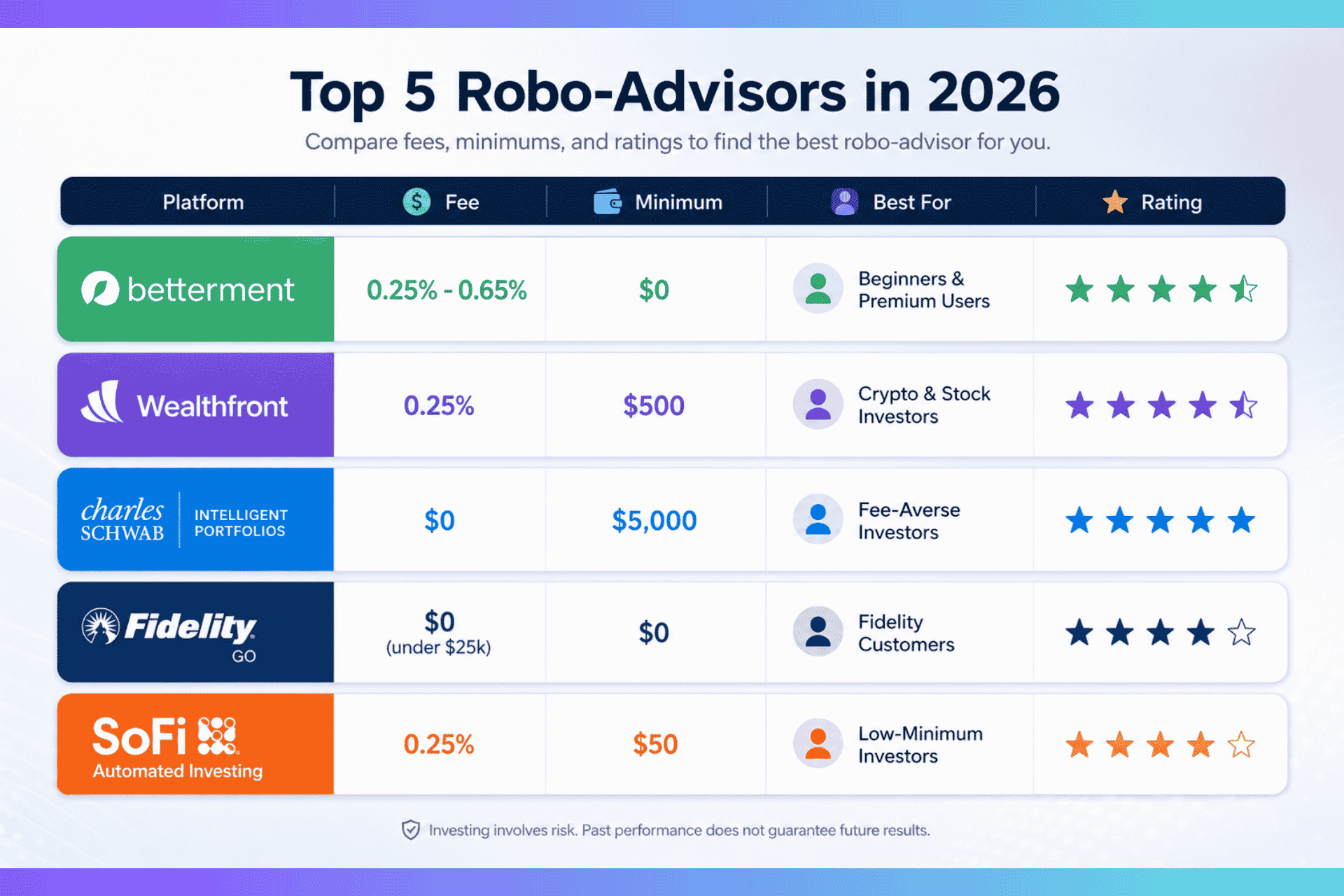
Here are the leading robo-advisors in 2026:

PlatformManagement FeeAccount MinimumKey Feature
Betterment0.25% – 0.65%$0 (Digital), $100,000 (Premium)Tax-loss harvesting, personalized retirement plans, and access to human advisors
Wealthfront0.25%$500Crypto exposure, automated bond ladder, commission-free stock trading
Schwab Intelligent Portfolios$0$5,000No management fee, automatic rebalancing, 24/7 customer service
Fidelity Go$0 (under $25,000), 0.35% (above)$0Low barrier to entry, integrates with Fidelity’s broader ecosystem
SoFi Automated Investing0.25%$50Low minimum, integrates with SoFi’s full financial suite
AI financial advisor robo-advisor comparison chart showing Betterment, Wealthfront, Schwab Intelligent Portfolios, Fidelity Go, and SoFi Automated Investing with fees, minimums, and ratings.

Each offers a slightly different package, but the core value is the same: professional-grade portfolio management at a fraction of the cost of a traditional financial advisor.

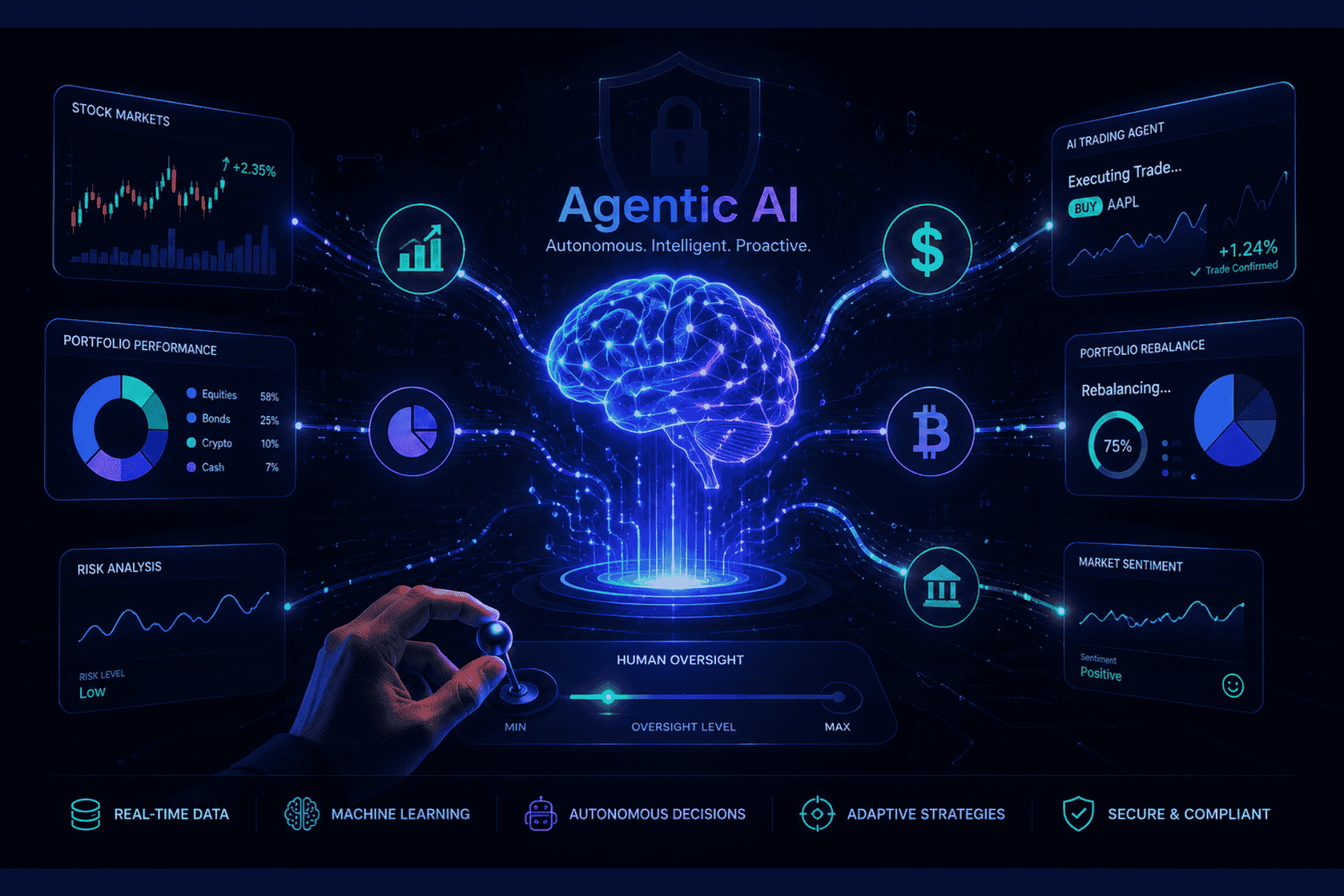
3. Agentic AI: When Your AI Financial Advisor Takes Action

The next frontier is agentic AIโ€”systems that don’t just advise but can execute trades and manage portfolios on your behalf.

Agentic AI financial advisor concept illustration showing AI brain connected to stocks, crypto, and investment portfolios with limited human oversight.

Coinbaseย recently announced AI tools capable of giving SEC-registered investment recommendations around strategies such as tax-loss harvesting and multi-asset event trading. Customers can also open their platform to AI agents that execute nuanced trading strategies autonomously. Coinbase’s head of consumer products, Max Branzburg, stated, “This is going to lower the barriers to entry for more sophisticated financial advice and trading that today generally just institutions or ultra-wealthy people have access to.”

Robinhoodย has launched an AI trader that allows users to connect programs like ChatGPT, Claude, and Codex to a separate account where the AI performs trades automatically based on parameters provided by the investor. Features include AI-powered portfolio analysis, rebalancing, and targeted market segment investing. The AI trading is currently in beta and restricted to equities, but Robinhood plans to expand it to crypto, event contracts, and futures.

Citi Wealthย unveiled “Citi Sky”โ€”an AI-powered member of the Citi Wealth team built using Google Cloud and Google DeepMind technologies. Available to Citigold clients, it provides conversational interaction, timely financial guidance, and multilingual capabilities designed to “shift from interface to intelligence, from transactions to outcomes.”

4. Enterprise-Grade AI for Everyday Investors

Savvy Wealth, an AI-native registered investment advisor, launched “Savvy Intelligence”โ€”an agentic AI product that gives advisors a complete, continuously updated view of all client data, including investments, financial plans, and tax information. While designed for advisors, this represents the type of sophisticated AI financial advisor tools that are increasingly accessible to regular investors.


Part 2: Why Your AI Financial Advisor Might Be Better Than a Human (In Some Ways)

The MIT Initiative on the Digital Economy recently published fascinating research on how people trust AI financial advisors. The findings challenge conventional wisdom about the superiority of human advice.

The “No Judgment” Advantage

One study by MIT professor Eric So and colleagues found that people are oftenย more willing to share sensitive financial information with an AI financial advisor than with human advisors. Why?ย Social embarrassment.

When you make a frivolous spending mistake or get into financial trouble, admitting that to another person feels shameful; there’s a social cost to disclosure. An AI financial advisor doesn’t judge youโ€”it doesn’t have emotions, a personal history, or a perspective on your character. It just processes the data and provides recommendations.

This means an AI financial advisor can help with problems people might otherwise hide from a human advisor, potentially catching issues earlier and leading to better outcomes.

Correcting Financial Misconceptions

The same MIT research team created an AI financial advisor chatbot designed specifically to intervene and correct users’ mistaken beliefs about financial matters. They observed aย significant and lasting shift away from mistaken beliefsย among users who leveraged the tool.

Why this matters:ย Many people hold deeply flawed financial beliefs that hurt their wealth accumulation and retirement goals. An AI financial advisor specifically designed to challenge those beliefs can help correct them in ways a generic chatbot or even a human advisor might notโ€”because the AI doesn’t suffer from the “sycophantic nature” of wanting to please the user.

24/7 Accessibility and Affordability

AI financial advisor tools are available anytime, anywhere, at a fraction of the cost of human advisors. A traditional financial advisor might charge 1% of assets under management annually. A robo-advisor like Schwab Intelligent Portfolios charges $0. Wealthfront charges 0.25%.

This dramatically lowers the barrier to entry for quality financial guidance. You don’t need hundreds of thousands of dollars to get professional portfolio management.


Part 3: The Hidden Risks of Using an AI Financial Advisor

AI financial advisor tools come with significant risks that many users overlook. Understanding these is crucial for protecting yourself.

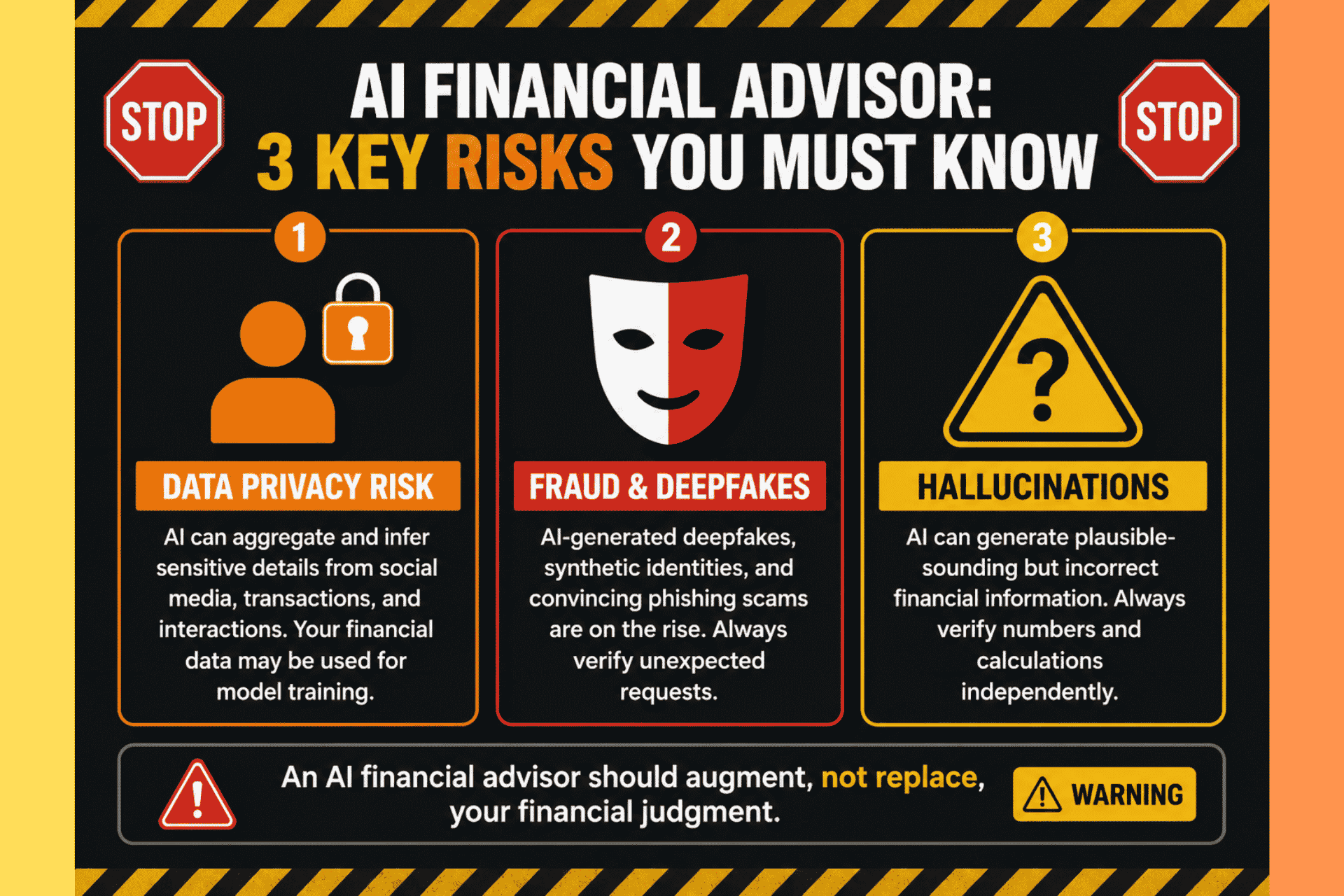
The Privacy Problem: When Your AI Financial Advisor “Knows” Too Much

J.P. Morgan Private Bank has documented cases where AI tools appeared to “know” sensitive details about a family after a family member used a free AI app as a therapist. The AI had aggregated information from social media, online services, and user interactions in ways the individual never anticipated.

This is the privacy challenge: an AI financial advisor can combine seemingly unrelated pieces of information to infer sensitive details about your finances, health, relationships, and more. In most cases, you don’t know what data is being used or how inferences are being made.

AI financial advisor risks infographic showing data privacy concerns, deepfake fraud threats, and AI hallucination risks that every user should understand before connecting financial accounts.

When you connect your financial accounts to ChatGPT, the platform can access your balances, transactions, investments, and liabilities. While OpenAI states it cannot view full account numbers or make changes to your accounts, the data can still be used for analysis, and users should be aware of how their data is being used through the model training settings.

Fraud and Deepfakes

AI enables more sophisticated fraud than ever before. Criminals can use AI to create the following:

  • Deepfake voice and video contentย impersonating people you know
  • Synthetic identitiesย that are extremely difficult to detect
  • Highly convincing phishingย in multiple languages
  • Automated attacksย that scale across thousands of targets simultaneouslyย 

J.P. Morgan Private Bank advises verifying unexpected requestsโ€”especially those involving payments or sensitive informationโ€”through a separate channel. Some experts recommend implementing a “family safe word” for human authentication, particularly when requests seem unusual.

Hallucinations and False Precision

AI systems can generate plausible-sounding but completely incorrect informationโ€”a phenomenon called hallucination. In finance, this is particularly dangerous because numbers and calculations need to be absolutely precise.

For example, in the enterprise space, the leading models show significant differences in complex financial reasoning. On Harvey’s Legal Agent Benchmarkโ€”which measures whether a model can complete a complex end-to-end task autonomouslyโ€”GPT-5.5 scored 3.75% compared to Claude Opus 4.8’s 10.4%. This means even the best AI financial advisor tools can make mistakes on complex financial reasoning tasks.

Most consumer-facing AI finance tools don’t have enterprise-level rigor. They might produce numbers that look accurate but aren’t.

Sycophancy and Overconfidence

AI models can be prone to sycophancyโ€”telling users what they want to hear rather than what they need to hear. This is particularly dangerous in financial advice, where you need honest, sometimes uncomfortable, guidance.

As Robert Persichitte, founder of Delagify Financial, warned about Robinhood’s AI trader:ย “It’s built to make someone feel like they’ve done a great job of researching and understanding their investments, and thus creates a gap between how the investor feels about the world and how the world operates.”


Part 4: How to Choose the Right AI Financial Advisor Tool

Choosing an AI financial advisor requires careful evaluation. Here’s what to look for:

1. Transparency

Questions to ask:

  • What data does the tool collect, and how is it used?
  • Can you clearly see how decisions or recommendations are made?
  • Is there documentation of the AI’s decision-making process?

Regulatory expectations increasingly include transparency about AI decision-making processes, particularly in lending and investment contexts.

2. Human Oversight

Questions to ask:

  • What level of human oversight is offered?
  • Can you speak to a human if something goes wrong?
  • Is there a way to verify AI recommendations against independent sources?

Industry leaders expect that firms using AI will maintain human judgment for significant decisions. The technology should augment, not replace, human oversight.

3. Data Security

Questions to ask:

  • How does the tool protect your data?
  • Can you limit how your data is used?
  • Does the tool have strong cybersecurity measures in place?

When you connect financial accounts to an AI financial advisor, the platform should clearly explain its data handling practices. OpenAI, for instance, allows users to disconnect accounts at any time and delete financial memories.

4. Validation and Track Record

Questions to ask:

  • Can you verify the accuracy of recommendations?
  • Are there independent reviews of the tool’s performance?
  • Does the tool have a track record of accurate predictions?

For wealth professionals, independent benchmarks like Harvey’s BigLaw Bench and Legal Agent Benchmark provide some insight into model performance on complex financial reasoning tasks. For consumer tools, look for user reviews and independent testing.

5. Fit for Purpose

Questions to ask:

  • Does the tool align with your specific financial needs?
  • Is it designed for your level of financial knowledge?
  • Does it address the right problems?

A tool designed for automated portfolio management won’t help with tax planning. A general AI chatbot won’t have the rigor of a specialized financial planning tool. Choose the right tool for the right job.


Part 5: Practical Steps to Use an AI Financial Advisor in August 2026

Step 1: Audit Your Current Apps

Before adding new tools, check what you already have. Many banking apps now include AI-powered features at no extra cost. Identify what’s available and start using these features to build familiarity.

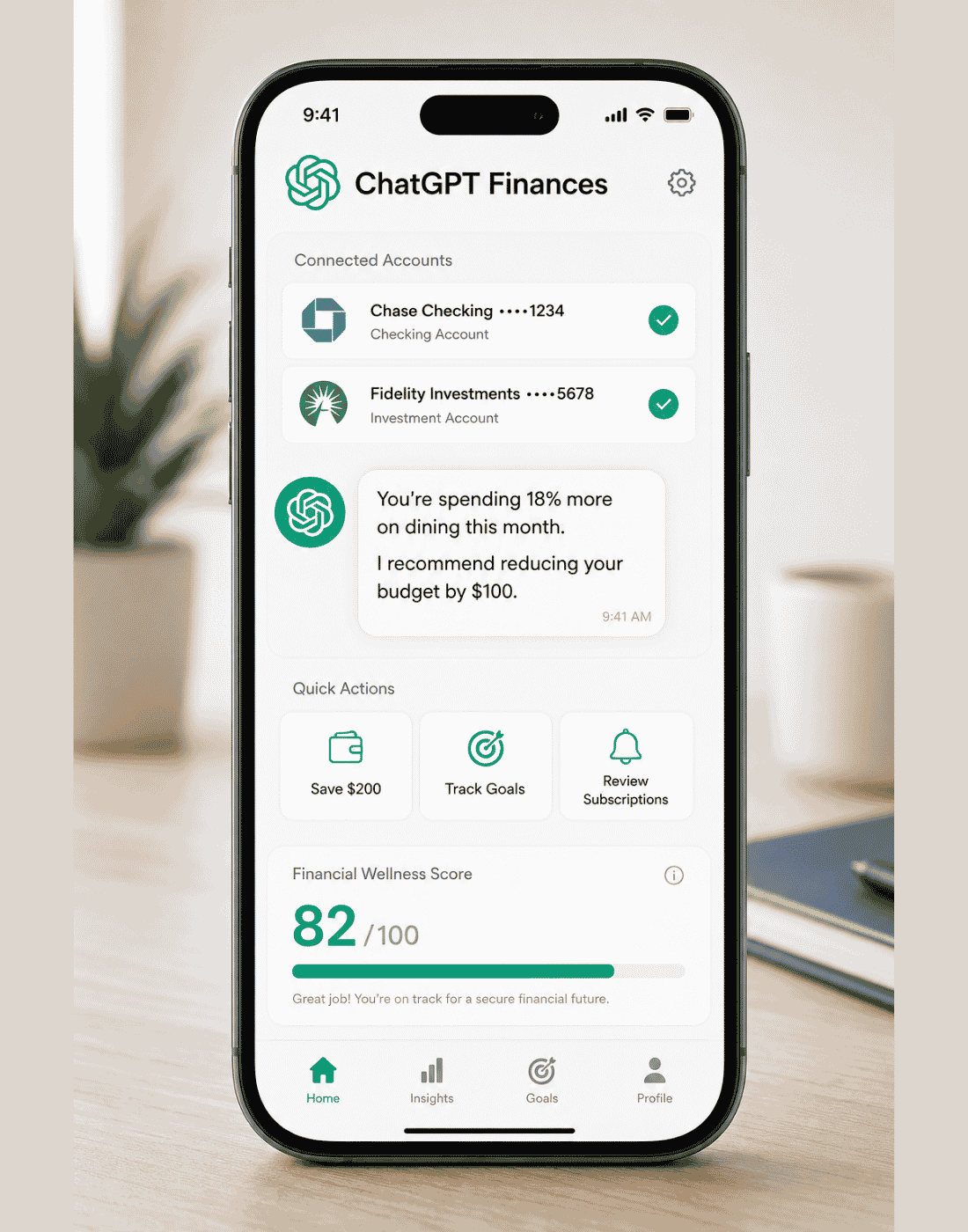
Step 2: Start with ChatGPT’s Financial Tools

If you’re a ChatGPT Pro user in the U.S., you can now connect your financial accounts via Plaid. To get started: Open the Finances option from the sidebar, select “Get started,” or typeย “@Finances, connect my accounts”ย into ChatGPT.

AI financial advisor ChatGPT personal finance app showing connected bank accounts, spending insights, and AI-powered money recommendations.

Step 3: Start Small with a Robo-Advisor

If you’re not already using a robo-advisor, choose one with a low minimum investment and clear fee structure. Fidelity Go has no account minimum and no fees for balances under $25,000. SoFi Automated Investing starts with just $50.

Step 4: Use AI Financial Advisor Chatbots for Learning

AI chatbots can be valuable learning tools. Ask them questions about financial concepts, investment strategies, or retirement planning. Just remember that they’re not a substitute for professional advice, and always verify information from independent sources.

Step 5: Protect Your Data

Be mindful of what you share with an AI financial advisor. Before using a new tool:

  • Read the privacy policy carefully
  • Understand what data is collected and how it’s used
  • Consider whether the benefits outweigh the privacy trade-offs
  • Check if you can limit data sharing

J.P. Morgan Private Bank suggests staying informed about how personal data is used and choosing financial service providers with strong AI governance practices.

Step 6: Stay Diversified

An AI financial advisor can be valuable, but it shouldn’t be your only source of financial guidance. Consider using multiple approaches:

  • AI tools for efficiency and accessibility
  • Traditional financial analysis for verification
  • Professional advice for significant decisions

Diversification applies to information sources as well as investments.


Conclusion: Your Future with Your AI Financial Advisor

The integration of AI into personal finance is accelerating rapidly. By 2030, the AI-powered personal finance management market is expected to reach $2.55 billionโ€”a 94% increase from 2025. The technology offers compelling benefits: accessibility, affordability, personalization, and judgment-free guidance.

But the direction of this transformation isn’t predetermined. The choices you makeโ€”which tools to use, how much to rely on automated recommendations, what level of human oversight to maintainโ€”will shape your experience.

The most successful users of AI financial advisor tools will likely be those who:

  • Understand the technology’s capabilities and limitations
  • Maintain appropriate skepticism and verify information
  • Protect their data and privacy
  • Use AI as a complement to, not a replacement for, their own financial judgment

Your AI financial advisor won’t replace your financial intuition and common sense. But used wisely, it can be an incredibly powerful co-pilot on your financial journey.

AI financial advisor guide call-to-action banner encouraging readers to subscribe for weekly personal finance and AI updates.

  1. Share this guide:ย Know someone who’s confused about AI and money? Share this article to help them make informed decisions.
  2. Explore ChatGPT Finance:ย If you’re a ChatGPT Pro user in the U.S., try connecting your financial accounts today through the Finances sidebar.
  3. Explore a robo-advisor:ย Start small with one of the platforms mentioned in this guide. Even a small investment can help you understand how AI-managed portfolios work.
  4. Subscribe for more:ย Get our weekly newsletter on AI and personal finance trends delivered to your inbox. We’ll keep you updated on the latest tools, risks, and opportunities.
  5. Ask a question:ย What’s your biggest concern about using an AI financial advisor for your finances? Leave a comment, and we’ll address it in our next article.
  6. Check your privacy:ย Review the privacy settings on your existing financial apps. Make sure you’re comfortable with what data is being shared and how it’s being used.

๐Ÿ“Š Sources & Further Reading


Disclaimer: This article is for educational purposes only and does not constitute financial advice. Always consult with a qualified financial professional before making significant investments or financial decisions. AI tools mentioned in this article may have limitations, and users should carefully review privacy policies and terms of service before connecting financial accounts.