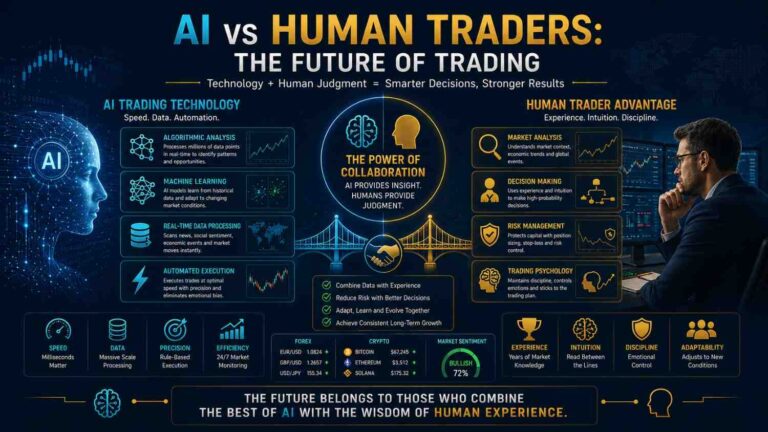

AI Investment Platforms in 2027 could fundamentally change how ordinary people research markets, build portfolios, and make long-term investment decisions.
For years, sophisticated artificial intelligence and quantitative systems were largely associated with institutional investors, hedge funds and large financial institutions.
That is changing rapidly.
Today, retail investors can access tools that can summarize financial information, analyze companies, compare investments, monitor portfolios, identify patterns, and provide personalized financial guidance.
At the same time, investors are showing increasing interest in artificial intelligence-related investments. Recent Charles Schwab data reported continued retail buying interest in AI stocks despite market volatility.
But there is another side to the story.
The U.S. SEC, FINRA and NASAA have warned that criminals are already using the popularity of AI to promote fake investment platforms, unrealistic returns and fraudulent trading systems. Investor.gov also warns investors not to rely solely on AI-generated information because AI can produce inaccurate, incomplete or misleading information.
So the real question isn’t:
“Will AI replace investing?”
The better question is:
“How should investors use AI without allowing AI to make dangerous financial decisions for them?”
That is what this guide explores.
What Are AI Investment Platforms?
AI investment platforms are financial technology services that use artificial intelligence, machine learning, large language models or related algorithms to assist with investment-related tasks.
Depending on the platform, AI may help investors with:
- Stock research
- Portfolio analysis
- Asset allocation
- Risk assessment
- Market research
- Financial planning
- Portfolio rebalancing
- Investment screening
- News analysis
- Tax-aware strategies
- Retirement planning
- Automated investing
However, not every platform using the word AI actually provides sophisticated artificial intelligence.
Some platforms use traditional algorithms and simply add AI-powered interfaces.
Others may combine:
Traditional financial models + machine learning + generative AI + human advisers.
Therefore, investors should examine what the technology actually does rather than assuming that every platform marketed as “AI-powered” has the same capabilities.
How AI Investment Platforms in 2027 Could Work
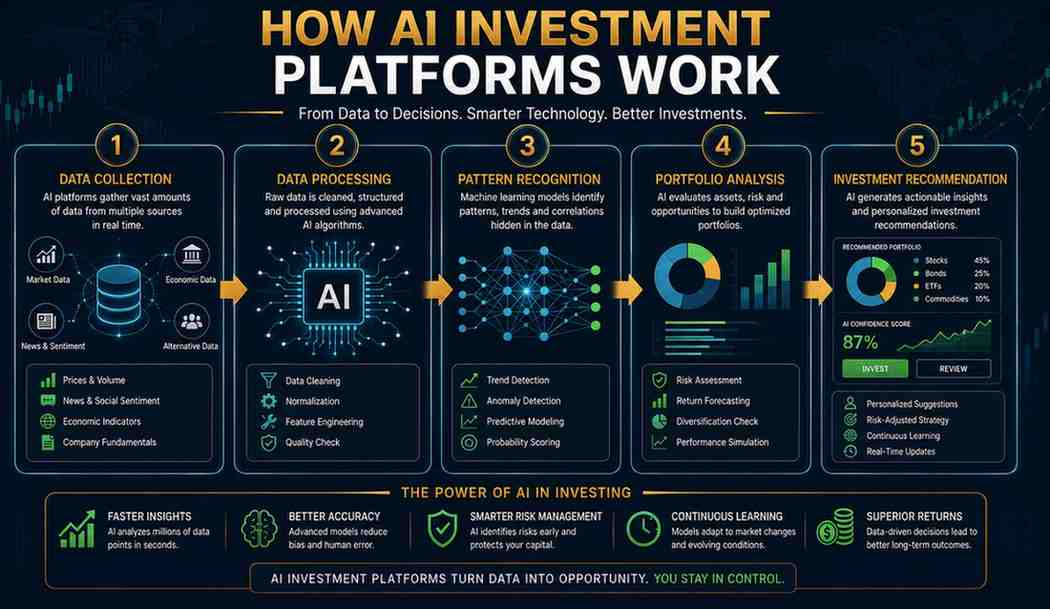
A modern AI investment platform may combine several layers of technology.
1. Data Collection
The system can collect large amounts of information, including
- Company financial statements
- Market prices
- Economic data
- Interest rates
- Earnings reports
- News
- Analyst information
- Portfolio data
- Investor objectives
2. Data Processing
AI systems can process and organize large datasets much faster than an individual investor could manually.
3. Pattern Recognition
Machine-learning systems can identify relationships and patterns within historical and current information.
4. Portfolio Analysis
The platform may examine:
- Asset allocation
- Concentration
- Risk exposure
- Correlation
- Diversification
- Volatility
5. Recommendations or Actions
Depending on the service, the platform may provide:
- Investment ideas
- Portfolio recommendations
- Risk alerts
- Rebalancing suggestions
- Automated transactions
The level of automation varies significantly.
Some systems simply provide information.
Others can recommend investments.
Some may eventually execute trades automatically after receiving authorization.
9 Powerful Ways AI Investment Platforms in 2027 Could Change Investing
1. AI Could Make Investment Research Faster
Traditional investment research can take hours.
An investor might need to examine:
- Annual reports
- Earnings releases
- Financial ratios
- Industry trends
- Competitor performance
- Economic conditions
- Analyst opinions
AI can potentially help organize this information much faster.
For example, an investor could ask:
“Summarize the most important financial developments affecting this company over the last year.”
The AI could organize information into categories such as:
This doesn’t mean the answer is automatically correct.
It means the investor has another research tool.
That distinction is crucial.
2. AI Could Personalize Investment Portfolios
Traditional investment advice often begins with broad categories:
Conservative
Moderate
Aggressive
AI could potentially make portfolio construction more personalized.
Instead of simply asking:
“What is my risk profile?”
an AI system could consider:
- Age
- Investment horizon
- Income
- Savings
- Financial goals
- Liquidity needs
- Existing investments
- Risk tolerance
- Spending patterns
Emerging research published in August 2026 is exploring AI systems capable of producing personalized, tax-aware portfolio recommendations based on natural-language financial goals.
That points toward an important shift:
Investors may increasingly describe their financial objectives in normal language rather than filling out complicated investment questionnaires.
3. AI Could Improve Portfolio Monitoring
Investors often make a portfolio and then forget to monitor whether it still matches their objectives.
AI systems could continuously examine:
- Portfolio concentration
- Sector exposure
- Geographic exposure
- Volatility
- Correlations
- Cash allocation
- Changes in risk
For example:
Technology exposure: 42%
An AI system could alert the investor:
“Your technology allocation has increased significantly relative to your original portfolio target.”
The investor can then decide whether rebalancing is appropriate.
The important word is decide.
AI should provide useful information rather than automatically becoming the final authority over your money.
4. AI Could Make Financial Education More Accessible
One of the most promising applications is education.
A beginner can ask:
“What is an ETF?”
Then:
“How does an ETF make money?”
Then:
“What is the difference between an ETF and an individual stock?”
Then:
“How would a diversified portfolio use ETFs?”
This creates an interactive learning environment.
For investors who are overwhelmed by financial terminology, AI could act as a personalized educational assistant.
This is especially valuable for new investors who may otherwise make decisions based on social media posts, influencers or incomplete information.
Our Trading vs Investing: Which Strategy Is Right for You? guide provides another useful foundation for understanding whether active trading or long-term investing better fits a particular objective.
5. AI Could Help Investors Identify Portfolio Risk
Risk management is one area where AI could become particularly useful.
Instead of simply asking:
“Will this stock go up?”
an investor could ask:
“What could cause my portfolio to lose 20%?”
The system could examine possible vulnerabilities such as:
- High concentration
- Interest-rate sensitivity
- Currency exposure
- Sector correlation
- High-growth valuation exposure
- Emerging-market exposure
- Commodity dependence
This is a much healthier way to use AI.
The objective isn’t to ask AI to predict the future.
It is to use AI to better understand possible scenarios.
Investors and traders can also strengthen their broader risk framework through Risk Management Mastery: 7 Proven Strategies.
6. AI Could Make Automated Investing More Intelligent
Traditional automated investing generally relies on predefined rules.
AI could make automation more adaptive.
For example:
Traditional system:
Maintain 60% stocks and 40% bonds.
AI-enhanced system:
Monitor the investor’s objectives, risk tolerance, portfolio exposure and market conditions, then identify whether the portfolio has materially deviated from its intended strategy.
The second approach has greater complexity.
But complexity isn’t automatically better.
Investors need to understand exactly what the system is permitted to do.
7. AI Could Transform Stock Screening
Stock screening is another area where AI could save time.
Instead of manually filtering thousands of companies, investors could search for combinations such as:
- Strong revenue growth
- Positive free cash flow
- Low debt
- Rising margins
- Sustainable competitive advantages
- Attractive valuation
AI could then help organize companies that match those criteria.
However, investors should distinguish between:
Screening
and
Prediction.
Finding companies that meet certain characteristics is not the same as knowing which stock will outperform.
8. AI Could Bring More Sophisticated Tools to Retail Investors
Institutional investors have historically had access to expensive:
- Research platforms
- Data terminals
- Quantitative models
- Portfolio analytics
- Risk-management systems
AI could reduce some of the technological barriers.
This is one reason the financial industry is paying increasing attention to AI-enabled retail advice.
Deloitte’s research suggests that generative AI could become a major source of retail investment advice as adoption increases.
The potential democratization of investment technology is therefore one of the most significant developments to watch between 2027 and 2030.
9. AI Could Create a New Hybrid Investor
The future may not be:
Human vs AI
It may be:
Human + AI
The investor provides:
- Goals
- Risk tolerance
- Time horizon
- Ethical preferences
- Financial constraints
- Final approval
AI provides:
- Research
- Organization
- Analysis
- Monitoring
- Scenario modelling
- Alerts
This hybrid model could become one of the dominant approaches to retail investing.
AI Financial Advisor vs Traditional Financial Advisor

The growth of AI does not necessarily mean traditional financial advisers will disappear.
Instead, the relationship may change.
| Feature | AI Financial Platform | Human Financial Adviser |
|---|---|---|
| Availability | Potentially 24/7 | Limited by schedule |
| Cost | Often lower | Usually higher |
| Data processing | Extremely fast | Human-dependent |
| Emotional understanding | Limited | Stronger |
| Complex life decisions | Limited | Stronger |
| Personal interaction | Digital | Human |
| Portfolio monitoring | Automated | Human/technology-assisted |
| Accountability | Depends on provider | Depends on adviser relationship |
| Best use | Analysis + automation | Judgment + complex planning |
Recent developments in the financial-advice industry are already pointing toward hybrid models in which AI increases adviser productivity rather than simply replacing advisers.
That distinction matters.
Can AI Actually Beat the Stock Market?
This is where investors need to be extremely careful.
AI can:
Process information.
Identify patterns.
Generate scenarios.
Analyze financial data.
But none of those capabilities guarantees superior investment returns.
Markets are influenced by:
- Unexpected economic events
- Political developments
- Central-bank decisions
- Investor psychology
- Liquidity
- Geopolitical events
- Corporate announcements
- Market structure
- New information
A model trained on historical relationships can also encounter conditions it has never seen before.
Therefore:
AI capability ≠ guaranteed investment performance.
Recent academic research is actively examining how well AI-generated financial advice performs under realistic conditions, including how recommendations can differ according to investor characteristics and the way questions are presented to the AI.
The Biggest Problem With AI Investing: False Confidence
AI can sound extremely convincing.
That is one of its greatest strengths—and one of its greatest dangers.
An AI system can provide:
- A detailed explanation
- Numbers
- Charts
- Investment terminology
- Confident conclusions
and still be wrong.
Investor.gov specifically warns that AI-generated information can be inaccurate, incomplete, misleading or even fabricated, and recommends confirming underlying information through multiple sources.
Therefore, investors should never confuse:
Confidence of presentation
with
Accuracy of information.
AI Hallucinations and Investment Decisions
An AI hallucination occurs when an AI system generates information that appears plausible but is inaccurate or fabricated.
In investing, this could be particularly dangerous.
Imagine asking:
“What were Company X’s earnings last quarter?”
The system could provide an incorrect number.
Or:
“What did the company’s CEO announce yesterday?”
The AI might provide outdated information.
Or:
“Which stock will rise tomorrow?”
The answer could create a false sense of certainty.
For financial decisions, this is unacceptable without verification.
AI Investment Platforms in 2027 and Investment Scams

This is perhaps the most important warning in the entire article.
The phrase:
“Powered by AI”
does not mean:
“Legitimate.”
Scammers know that AI is attractive.
Investor.gov warns that fraudulent investment platforms are already using AI-related claims to attract victims, including claims that proprietary AI systems cannot lose or can guarantee investment winners.
Watch for these warning signs:
- Guaranteed profits
- Guaranteed AI returns
- “Secret AI algorithm”
- No losing trades
- Risk-free investing
- Unrealistic monthly returns
- Anonymous operators
- Pressure to deposit
- Cryptocurrency-only deposits
- Fake testimonials
- Fake trading dashboards
- Withdrawal fees
- Unregistered platforms
Our AI Investment Scams 2027 article examines this threat in greater detail.
And for readers dealing with suspicious cryptocurrency platforms, Crypto Withdrawal Fees: 7 Ways to Spot & Stop Losing Money explains how fake withdrawal charges can be used to extract additional money from victims.
How to Verify an AI Investment Platform
Before depositing money, ask:
Is the company regulated?
Find out which regulator oversees the service, if any.
Who owns the company?
Look for a real legal entity.
Where is the company registered?
Check the jurisdiction.
Does it disclose its fees?
Avoid unclear pricing.
Can you withdraw your money?
Understand the withdrawal process before depositing.
Does it promise guaranteed returns?
If yes, stop and investigate.
Does it explain how its AI works?
You don’t need the source code, but the company should clearly explain what the AI does.
Does it provide risk disclosures?
Legitimate financial services should not hide risk.
Can you independently verify the claims?
Never rely solely on testimonials hosted by the platform itself.
Investor.gov recommends checking whether investment professionals and platforms are appropriately registered and investigating before committing funds.
AI Investment Platforms in 2027: What Investors Should Never Outsource to AI
AI can assist with many tasks.
But some decisions should remain firmly under human control.
Your Financial Goals
AI doesn’t automatically know what matters most to you.
Your Risk Tolerance
A questionnaire cannot completely capture how you will react when your portfolio falls sharply.
Your Emergency Fund
Investment AI cannot replace adequate cash reserves.
Your Debt Decisions
You should consider high-interest debt before chasing investment returns.
Your Final Investment Decision
AI should inform your decision—not remove your responsibility.
AI Investing vs Traditional Investing
| Feature | Traditional Investing | AI-Assisted Investing |
|---|---|---|
| Research | Manual | AI-assisted |
| Portfolio monitoring | Periodic | Potentially continuous |
| Data processing | Human | AI + human |
| Screening | Manual filters | Natural-language + automated |
| Risk analysis | Human/tools | AI-assisted |
| Rebalancing | Manual/automated rules | Potentially adaptive |
| Education | Books/courses/advisers | Interactive AI assistance |
| Decision-making | Human | Human + AI |
| Main risk | Human bias | Human + model error |
The key point is that AI does not eliminate investment risk.
It changes how investment decisions are made.
How Beginners Should Use AI for Investing
If you’re new to investing, don’t start by asking:
“What stock should I buy?”
Start with education.
Step 1: Learn the Basics
Ask AI to explain:
- Stocks
- Bonds
- ETFs
- Mutual funds
- Dividends
- Market capitalization
- Risk
- Volatility
- Diversification
Step 2: Define Your Goal
Examples:
Retirement
Education
Home purchase
Long-term wealth
Step 3: Understand Your Time Horizon
A 20-year objective is different from a two-year objective.
Step 4: Learn About Diversification
Don’t ask AI only:
“What is the best stock?”
Ask:
“How could concentration in one stock affect my portfolio?”
Step 5: Verify Information
Check AI-generated information against:
- Company filings
- Exchange information
- Regulator publications
- Official financial statements
- Reputable financial publications
Step 6: Start Small
AI doesn’t eliminate the need for disciplined investing.
The AI Investment Workflow Every Beginner Can Use
A useful workflow is
Goal
↓
Research
↓
AI Analysis
↓
Independent Verification
↓
Risk Assessment
↓
Human Decision
↓
Investment
↓
Portfolio Monitoring
↓
Periodic Review
The crucial step is:
Independent Verification.
Never remove it.
Five Ways AI Could Help Investors Avoid Mistakes
AI can also be used defensively.
1. Detect Concentration
Ask:
“What percentage of my portfolio is exposed to technology?”
2. Identify Hidden Correlations
Several investments may appear diversified but move together.
3. Summarize Financial Reports
AI can help identify important sections that deserve closer reading.
4. Create an Investment Checklist
Before buying, ask AI to generate questions about:
- Valuation
- Debt
- Revenue
- Competition
- Management
- Risks
5. Challenge Your Investment Thesis
Instead of asking:
“Why should I buy this stock?”
ask:
“Give me the strongest arguments against buying this stock.”
This can help reduce confirmation bias.
The Future of AI Investment Platforms Toward 2030
The next four years could produce major changes.
AI Personal Financial Assistants
Investors may have AI systems that continuously monitor:
- Investments
- Savings
- Spending
- Debt
- Retirement objectives
Natural-Language Portfolio Management
Instead of navigating complicated menus, investors may eventually say:
“Reduce my portfolio’s risk while maintaining long-term growth potential.”
The platform could translate that instruction into a proposed portfolio adjustment.
Tax-Aware AI
AI systems may increasingly consider:
- Capital gains
- Tax-loss harvesting
- Account location
- Retirement accounts
- Income levels
Real-Time Financial Education
Instead of reading a 30-page report, investors could ask questions about the report interactively.
Human-AI Hybrid Advice
Financial advisers could use AI to serve more clients while maintaining human oversight.
AI-Powered Fraud Detection
AI will also be used to identify suspicious activity.
But criminals will use AI too.
The result will be an ongoing technological arms race between:
AI-powered investing
and
AI-powered financial fraud.
Why 2027 Could Be a Turning Point for AI Investing
There are several reasons to watch the sector closely.
At the same time, current developments show financial institutions experimenting with AI-enhanced advice and automation. Recent reporting from Australia, for example, describes major financial institutions exploring AI to help address the shortage and cost of traditional financial advice.
This suggests the technology is moving beyond experimentation.
But adoption does not equal reliability.
The next stage of the industry will therefore likely involve a combination of:
AI capability + regulation + human oversight + investor education.
Should You Trust an AI Investment Platform?
Don’t ask:
“Does it use AI?”
Ask:
Who regulates it?
Who owns it?
What does it actually do?
How does it make money?
What fees does it charge?
What happens to my money?
What happens if the AI is wrong?
Can I override its decisions?
Can I withdraw my money?
What protections do I have?
Those questions are far more important than the marketing slogan.
AI Investment Platforms in 2027: The FinWireStack Safety Checklist

Before using an AI investment platform:
☐ Verify the company’s identity
☐ Check regulatory status where applicable.
☐ Understand the investment product
☐ Understand all fees
☐ Read the terms and conditions.
☐ Understand how your money is held
☐ Check withdrawal procedures
☐ Never trust guaranteed-return claims.
☐ Verify AI-generated information
☐ Compare multiple sources
☐ Understand portfolio risks
☐ Check whether a human adviser is available.
☐ Don’t give AI unrestricted authority over your finances.
☐ Start with education before automation.
☐ Keep emergency savings separate.
☐ Never invest money you cannot afford to lose.
AI Investment Platforms in 2027: What Investors Should Expect
The future of investing is unlikely to be completely human or completely artificial.
Instead, it will probably be a combination.
Humans provide the goals.
AI processes the information.
Algorithms identify opportunities and risks.
Humans provide judgment.
Technology executes approved decisions.
That model could make investing faster, cheaper, and more accessible.
But it could also make mistakes faster.
And that is the central lesson investors should remember.
AI is a tool.
It is not a crystal ball.
It does not eliminate market risk.
It does not guarantee returns.
And it should never become an excuse to stop thinking.
Final Verdict: Is AI Investing in the Future?
AI Investment Platforms in 2027 are likely to become increasingly important as financial technology becomes more personalized, automated, and accessible.
The biggest opportunity isn’t necessarily letting AI pick stocks for you.
The bigger opportunity may be using AI to become a better-informed investor.
Use AI to:
- Research faster
- Understand complex information
- Identify risks
- Compare alternatives
- Monitor portfolios
- Challenge your assumptions
- Learn financial concepts
- Build better investment habits
But verify important information independently.
Understand what you own.
Understand what you can lose.
And never hand complete financial control to a system simply because it sounds intelligent.
The investors who benefit most from AI toward 2030 may not be those who trust AI the most.
They may be those who know how to use AI while maintaining human judgment.
AI should make investors smarter—not make investors stop thinking.
Frequently Asked Questions
What are AI Investment Platforms in 2027?
AI investment platforms in 2027 are expected to use artificial intelligence, machine learning, and related technologies to help investors research investments, analyze portfolios, assess risk, receive financial guidance, and potentially automate certain investment decisions.
Can AI choose stocks?
AI can analyze information and generate investment ideas, but this does not guarantee that its selections will outperform the market.
Are AI investment platforms safe?
Safety depends on the provider, technology, regulatory status, security controls, and investment product. Investors should independently verify any platform before depositing money.
Can AI guarantee investment returns?
No legitimate AI system can guarantee future investment returns. Investor.gov specifically warns investors about AI-related schemes making unrealistic or guaranteed-return claims.
Is AI better than a financial adviser?
Not necessarily. AI can process information quickly, while human advisers can provide judgment, accountability, and context for complex personal financial situations. Hybrid human-AI advice may become increasingly common.
Can AI predict the stock market?
AI can analyze historical and current information, but predicting future market movements with certainty is not possible.
Should beginners use AI for investing?
Beginners can use AI as an educational and research tool but should verify important information and understand basic investment principles before making decisions.
Will AI replace financial advisers?
It is more likely that AI will change how financial advisers work than completely eliminate the profession. AI may automate research and administrative tasks while humans remain important for complex financial planning and judgment.
What is the biggest risk of AI investing?
One of the biggest risks is overconfidence—believing that a sophisticated-looking AI system is always accurate.
How will AI investing change by 2030?
AI investment technology could become more personalized, automated, tax-aware, and integrated with financial accounts. Regulatory oversight and fraud-prevention technology are also likely to become increasingly important.