

Essential forex trading terminology can feel like a foreign language when you first start looking at currency charts. Terms like “pips,” “margin calls,” and “cable” are thrown around by experienced traders as if they are common knowledge. If you do not understand this essential forex trading terminology, you are essentially trading blind.
But here’s the problem with most glossaries: they just give you definitions without showing you how these terms actually work in real trading scenarios. How do you calculate pip value? How does leverage actually affect your account? What does a margin call look like in numbers? This essential forex trading terminology guide changes that.
This comprehensive guide covers every key term with the following:
- 🎯 Real-world analogies you can relate to
- 🧮 Step-by-step calculations with clear math formulas
- 📊 Professional tables for quick reference
- 📈 Visual explanations that make complex concepts simple
- 🎨 Color-coded sections for easy navigation
Whether you’re a complete beginner or an intermediate trader, this guide will give you the essential forex trading terminology knowledge you need—plus the math skills to apply it.

Why Mastering Essential Forex Trading Terminology Matters
Before diving into the definitions, it is crucial to understand why learning this essential forex trading terminology is non-negotiable.
🔵 Reason 1: You’ll understand market commentary. When analysts say “EUR/USD broke resistance at 1.1200,” you’ll know exactly what that means.
🔵 Reason 2: You’ll avoid costly mistakes. If you don’t understand margin and leverage, you could blow up your account in a single trade. This essential forex trading terminology could save your account.
🔵 Reason 3: You’ll make better decisions. When you understand the math behind each trade, you trade with confidence, not emotion. Understanding essential forex trading terminology gives you that confidence.
According to Investopedia, the forex market is the largest financial market in the world, with over $7.5 trillion traded daily. Understanding the essential forex trading terminology is critical for anyone looking to participate.
BabyPips, one of the most respected forex education platforms, emphasizes that new traders often fail not because of bad strategies but because they don’t understand basic essential forex trading terminology like “margin” and “leverage.”
Part 1: Core Essential Forex Trading Terminology (The Basics)
These are the absolute foundational terms. If you only learn ten words from this entire guide, these should be them. This essential forex trading terminology forms the backbone of every trade you will ever place.
1. Forex (FX) — The Global Currency Marketplace
Definition: Forex, short for foreign exchange, is the global, decentralized marketplace where currencies are traded. It operates 24 hours a day, five days a week, and is the largest financial market in the world. This is arguably the most important piece of essential forex trading terminology to know.
🎯 Real-World Analogy: Think of forex like a giant, 24-hour airport currency exchange booth—but instead of one booth, there are thousands of banks, brokers, and traders all exchanging money with each other at the same time. Understanding this essential forex trading terminology helps you grasp the scale of the market.
Key Facts:
- Daily trading volume: $7.5+ trillion
- Trading hours: 24 hours, 5 days a week
- Market type: Decentralized (Over-the-Counter)
Why It Matters: Unlike the stock market, forex has no central exchange. This means you can trade at any time, but you also need to choose your broker carefully. This essential forex trading terminology affects your trading experience.
2. Currency Pair — The “Price Tag” of Money
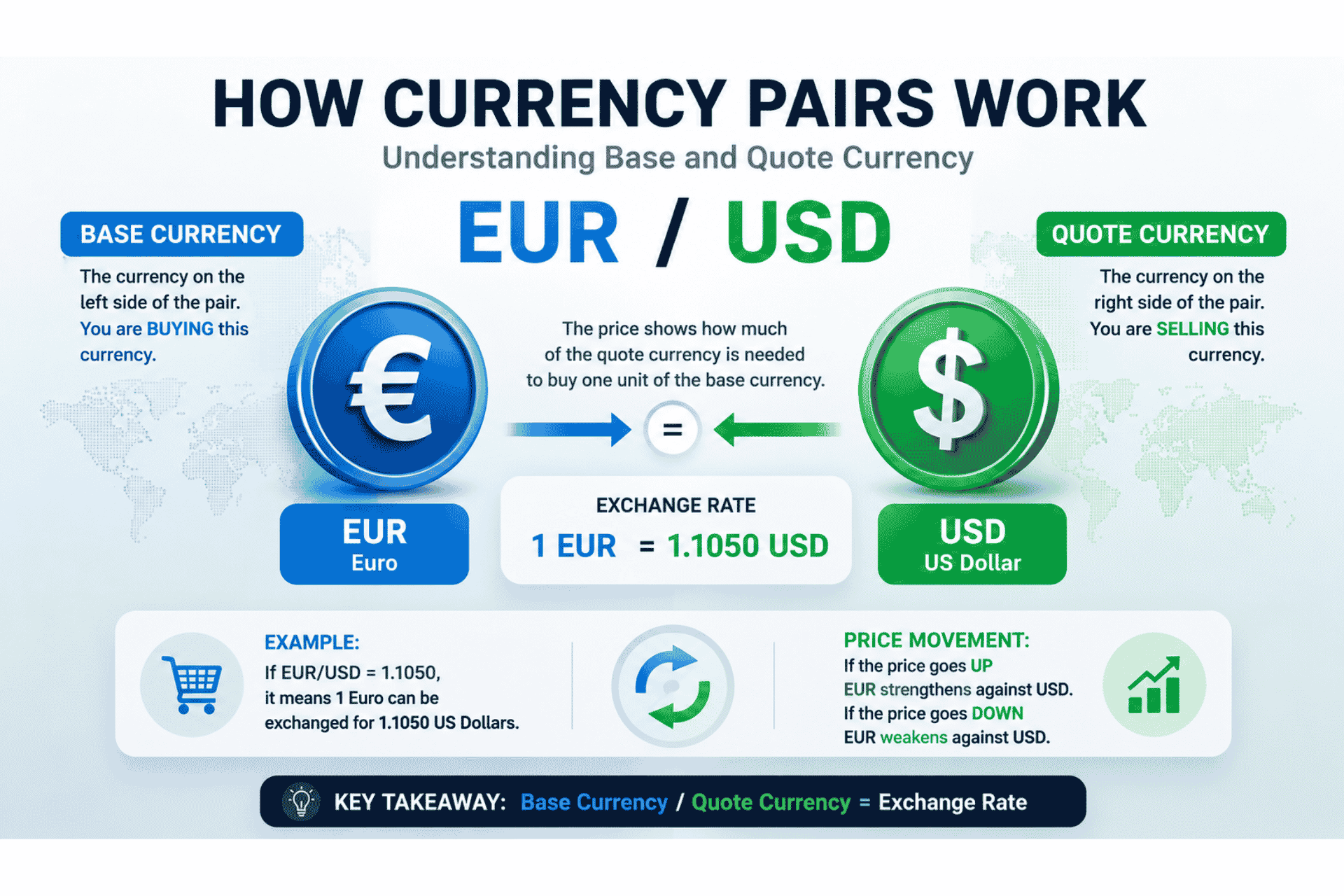
Definition: Forex trading always involves trading one currency against another. This is called a currency pair. Understanding currency pairs is a fundamental essential of forex trading terminology.
🎯 Real-World Analogy: Think of a currency pair like a price tag in a store. When you buy a banana, you pay with dollars. In forex, when you buy Euros, you pay with US Dollars. This analogy makes this essential forex trading terminology easy to remember.
Example: EUR/USD = 1.1050
- EUR (Euro) is the base currency (the product you’re buying)
- USD (US Dollar) is the quote currency (the money you’re paying)
- Meaning: 1 Euro costs $1.1050
3. Base Currency vs. Quote Currency
Definition:
- 🟦 Base Currency: The first currency in the pair. This is the “unit” you are buying or selling. This essential forex trading terminology is used in every trade.
- 🟩 Quote Currency: The second currency in the pair. This is the “price” of one unit of the base currency. Understanding this essential forex trading terminology helps you read prices.
Example: In GBP/USD = 1.3000:
- Base = GBP (British Pound)
- Quote = USD (US Dollar)
- Meaning: 1 British Pound costs $1.3000
🎯 Real-World Analogy: Imagine going to a store. The “base currency” is the item you want (like a pizza). The “quote currency” is the money you pay (like dollars). If a pizza costs $15, the “pizza/USD” price is 15. This makes essential forex trading terminology relatable.
📊 Table: Currency Pair Examples
| Currency Pair | Base Currency | Quote Currency | Price Meaning |
|---|---|---|---|
| EUR/USD = 1.1050 | 🟦 EUR (Euro) | 🟩 USD (US Dollar) | 1 Euro = $1.1050 |
| USD/JPY = 145.50 | 🟦 USD (US Dollar) | 🟩 JPY (Japanese Yen) | 1 Dollar = 145.50 Yen |
| GBP/USD = 1.3000 | 🟦 GBP (British Pound) | 🟩 USD (US Dollar) | 1 Pound = $1.3000 |
| AUD/USD = 0.6500 | 🟦 AUD (Australian Dollar) | 🟩 USD (US Dollar) | 1 Aussie = $0.6500 |
4. Major Pairs — The Most Liquid Currencies
Definition: The six most heavily traded currency pairs that all include the US Dollar. They offer the highest liquidity and tightest spreads. This essential forex trading terminology is used daily by institutional traders.
The Six Majors:
| Pair | Nickname | Liquidity | Typical Spread |
|---|---|---|---|
| EUR/USD | Fiber | Highest | 0.1 – 0.5 pips |
| USD/JPY | Ninja/Gopher | Very High | 0.2 – 0.7 pips |
| GBP/USD | Cable | Very High | 0.3 – 1.0 pips |
| USD/CHF | Swissy | High | 0.5 – 1.5 pips |
| AUD/USD | Aussie | High | 0.5 – 1.5 pips |
| USD/CAD | Loonie | High | 0.5 – 1.5 pips |
🟦 Blue Highlight: Tighter spreads mean lower costs. Higher liquidity means less slippage. This essential forex trading terminology is essential for choosing what to trade.
5-6. Cross Pairs & Exotic Pairs
| Pair Type | Definition | Examples | Characteristics |
|---|---|---|---|
| Cross Pairs | No USD involved | EUR/GBP, GBP/JPY, EUR/JPY | Wider spreads than majors |
| Exotic Pairs | Major + Emerging currency | USD/TRY, USD/ZAR, USD/SGD | Very wide spreads, high volatility |
⚠️ Orange Warning: Exotic pairs can have spreads of 10-50+ pips. This means you start your trade significantly in the red. This essential forex trading terminology helps you avoid costly mistakes.
7. Pip (Percentage in Point)—The “Inch” of Forex
Definition: The standard unit of measurement for price movement. This is the most important piece of essential forex trading terminology for calculating profit and loss.
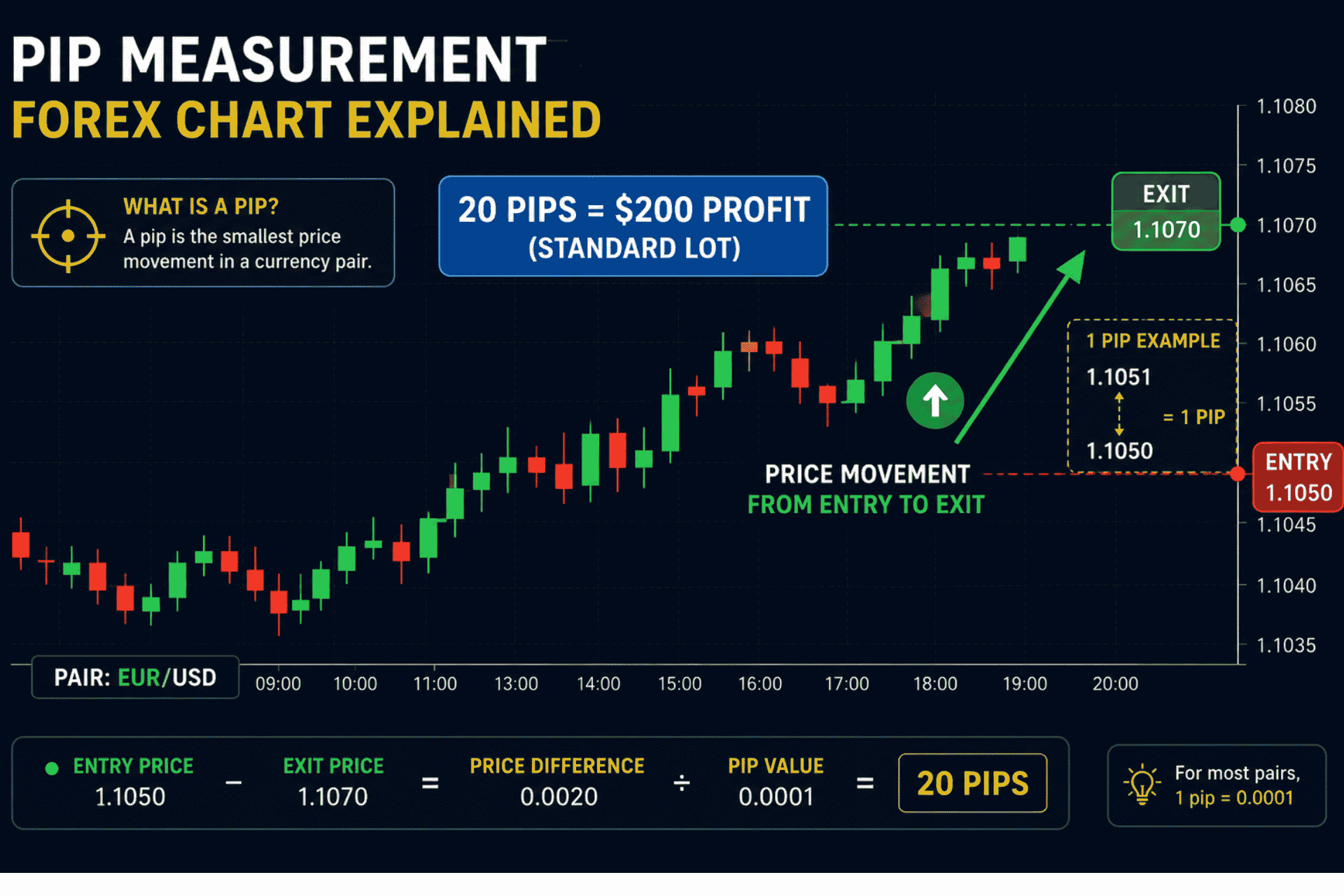
For most pairs (EUR/USD, GBP/USD, AUD/USD):
- 1 pip = 0.0001 (fourth decimal place)
- Example: EUR/USD moves from 1.1050 to 1.1051 = 1 pip
For JPY pairs (USD/JPY, EUR/JPY):
- 1 pip = 0.01 (second decimal place)
- Example: USD/JPY moves from 145.50 to 145.51 = 1 pip
🎯 Real-World Analogy: Think of a pip like an inch on a ruler. Just as an inch measures distance, a pip measures price movement. If a ruler moves from 10 inches to 11 inches, it has moved 1 inch. If EUR/USD moves from 1.1050 to 1.1051, it moved 1 pip. This analogy makes essential forex trading terminology easy to grasp.
📊 Table: Pip Values by Lot Size (EUR/USD)
| Lot Size | Units | Pip Value (USD) |
|---|---|---|
| 🟦 Standard Lot (1.0) | 100,000 | $10.00 |
| 🟩 Mini Lot (0.1) | 10,000 | $1.00 |
| 🟨 Micro Lot (0.01) | 1,000 | $0.10 |
| 🟧 Nano Lot (0.001) | 100 | $0.01 |
🧮 Pip Calculation Example (Step-by-Step)
Scenario: You buy 1 standard lot (100,000 units) of EUR/USD at 1.1050 and sell at 1.1070.
Step 1: Calculate the pip difference
- Entry: 1.1050
- Exit: 1.1070
- Difference: 1.1070 – 1.1050 = 0.0020 = 20 pips
Step 2: Calculate the profit
- Pip value for 1 standard lot: $10 per pip
- Profit = 20 pips × $10 = **🟩 $200 profit**
Step 3: Calculate profit percentage
- Account size: $5,000
- Profit percentage: $200 ÷ $5,000 × 100 = 4% return
✅ Result: You made a 4% return on your account in one trade. Understanding this essential forex trading terminology helps you calculate your returns.
🎯 Real-World Analogy: Imagine buying a product for $1.1050 and selling it for $1.1070. You made $0.0020 profit per unit. With 100,000 units, your profit is $200. This essential forex trading terminology calculation is used every day by traders.
8. Pipette — The “Fractional Inch”
Definition: A fractional pip, representing one-tenth of a pip. This essential forex trading terminology reflects modern trading precision.
Example: EUR/USD at 1.10501
- The 4th decimal (0) = pip
- The 5th decimal (1) = pipette
Why It Matters: Modern platforms display pipettes for greater precision. When you see 1.10501, the “1” is the pipette. This essential forex trading terminology helps you understand price quotes.
9-11. Bid, Ask, and Spread — The Cost of Trading
🎯 Real-World Analogy: Imagine a currency exchange booth at the airport. They have two prices:
- The price they will buy your currency at (lower)
- The price they will sell you currency at (higher)
The difference is how they make money. This essential forex trading terminology explains how brokers profit.
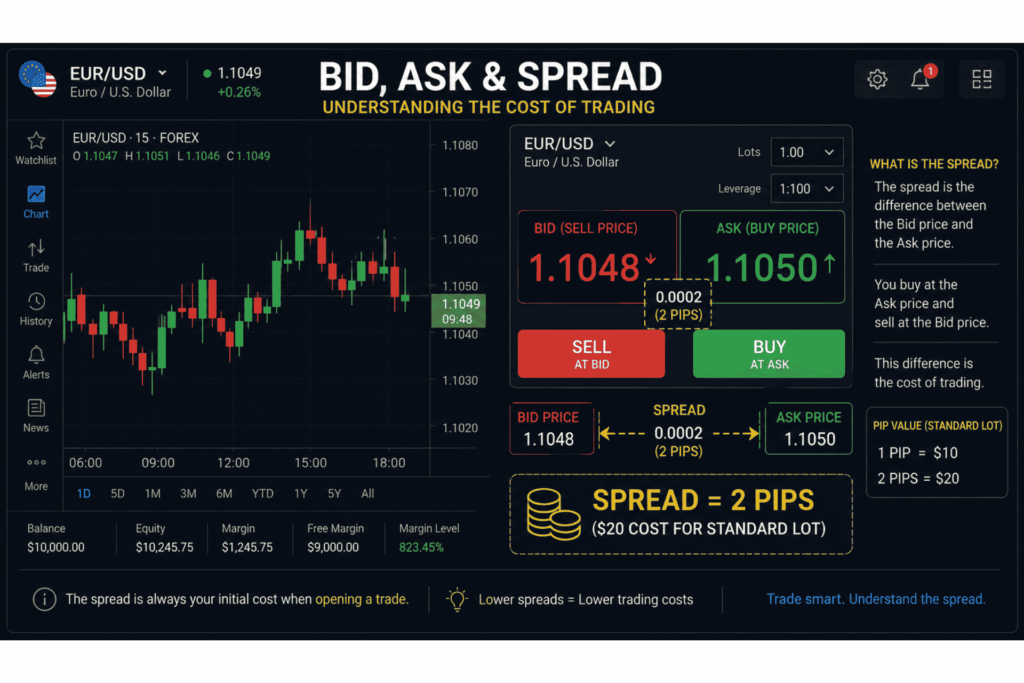
Bid Price: The price at which the broker will buy the base currency from you. This essential forex trading terminology is displayed on every trading platform.
Ask Price: The price at which the broker will sell the base currency to you. Together with the bid, this forms core essential forex trading terminology.
Spread: The difference between Ask and Bid (the broker’s fee). Understanding spreads is a vital essential forex trading term.
Example: EUR/USD
- Ask: 1.1050
- Bid: 1.1048
- Spread = 1.1050 – 1.1048 = 0.0002 = 2 pips
🟦 Blue Highlight: A tighter spread means lower trading costs. For beginners, trading majors with tight spreads is highly recommended. This essential forex trading terminology directly affects your profitability.
🧮 Spread Cost Calculation
Scenario: You buy 1 standard lot of EUR/USD with a 2-pip spread.
Step 1: Identify the spread
- Spread = 2 pips
Step 2: Calculate the cost
- Pip value for 1 standard lot = $10
- Cost = 2 pips × $10 = **$20**
✅ Result: You start your trade $20 in the red. The price must move 2 pips in your favor just to break even. This essential forex trading terminology calculation shows why spreads matter.
🔴 Red Highlight: This is why spreads matter. If you trade exotic pairs with 20-pip spreads, you need to make 20 pips just to break even. This essential forex trading terminology could save you money.
12-13. Liquidity & Volatility
| Term | Definition | Impact on Trading |
|---|---|---|
| 🟦 Liquidity | Ability to buy/sell without causing price changes | High liquidity = tight spreads, fast execution |
| 🟧 Volatility | Speed and magnitude of price changes | High volatility = big moves (risk and opportunity) |
📊 Table: Pair Types Comparison
| Pair Type | Liquidity | Spreads | Volatility | Slippage Risk |
|---|---|---|---|---|
| 🟦 Major Pairs | Highest | Tightest | Moderate | Lowest |
| 🟩 Minor Pairs | High | Moderate | Moderate | Moderate |
| 🟧 Exotic Pairs | Low | Wide | Very High | Highest |
14. Bullish vs. Bearish — Market Sentiment
- 🟦 Bullish: Expecting prices to rise (bulls thrust horns up)
- 🔴 Bearish: Expecting prices to fall (bears swipe claws down)
Example: If you are bullish on EUR/USD, you expect the Euro to strengthen against the Dollar. You would buy (go long). This essential forex trading terminology describes market sentiment.
If you are bearish on EUR/USD, you expect the Euro to weaken. You would sell (go short). Understanding this essential forex trading terminology helps you read the market.
🎯 Real-World Analogy: Imagine a sports game. “Bullish” traders are like fans cheering for their team to win. “Bearish” traders are like fans expecting their team to lose. This essential forex trading terminology is used daily by analysts.
Part 2: Order Types — How to Enter and Exit Trades
Understanding order types is a critical part of essential forex trading terminology. Using the wrong order at the wrong time can cost you a breakout opportunity or cause devastating slippage.
15. Market Order — Instant Execution
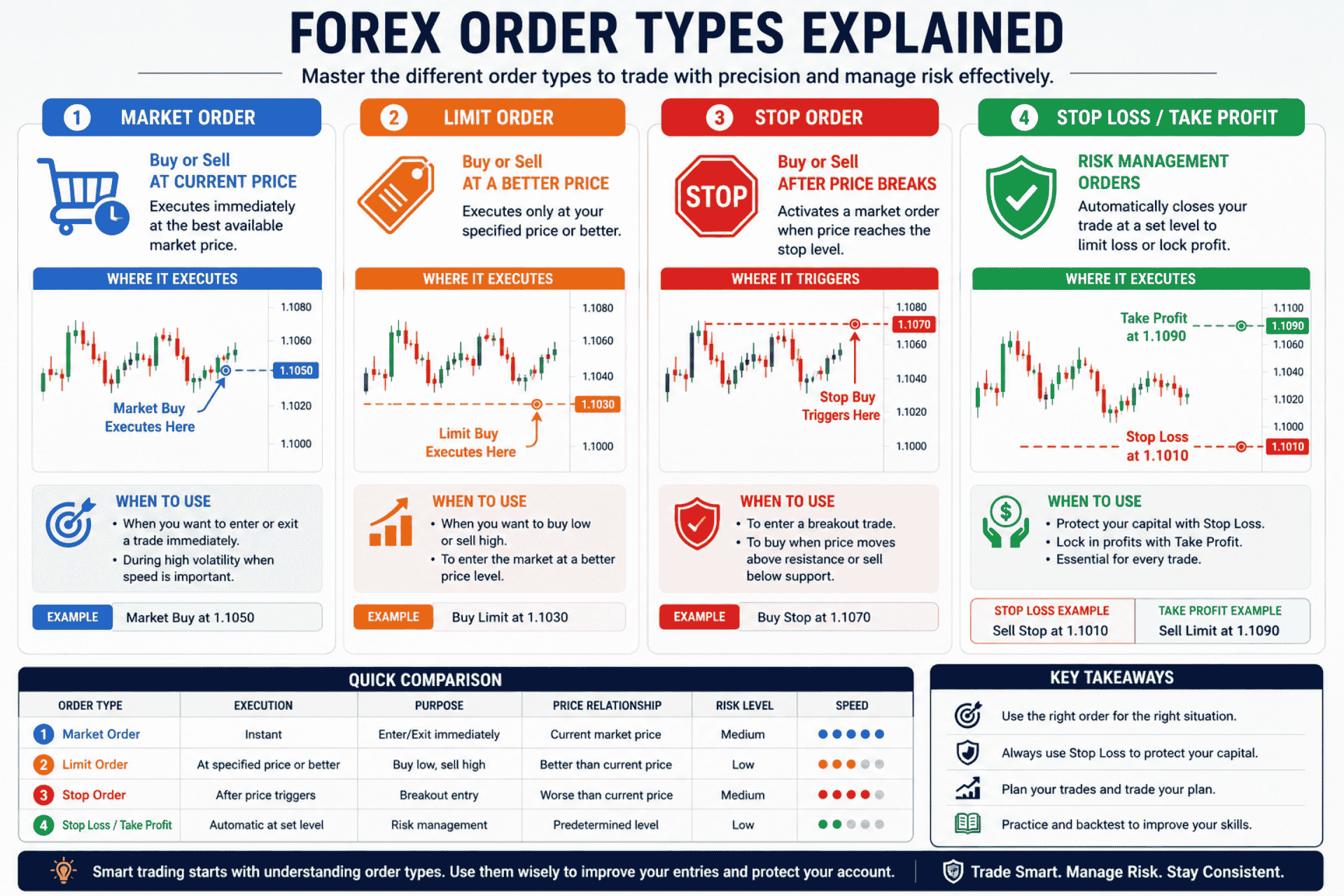
Definition: An order to buy or sell immediately at the current best available price. This is the most commonly used essential forex trading terminology.
🎯 Real-World Analogy: Walking into a store and buying a product at the displayed price. You don’t haggle—you pay and leave. This makes essential forex trading terminology easy to remember.
When to Use: When speed is more important than price precision.
Example: You see EUR/USD at 1.1050 and want to enter immediately. You place a Market Order to buy. The broker fills you at the current Ask price (1.1050).
⚠️ Orange Warning: In volatile markets, the price may move between clicking and execution (slippage). This essential forex trading terminology warns you of potential issues.
16. Limit Order — Price Precision
Definition: An order to buy or sell only at a specific price or better. This essential forex trading terminology helps you get better entries.
🎯 Real-World Analogy: You decide to buy a used car, but only if the price drops to $10,000. You tell the dealer: “Call me if the price hits $10,000.” That’s a limit order. This essential forex trading terminology analogy is easy to understand.
When to Use: When price precision is more important than speed.
Example: EUR/USD is at 1.1050. You want to buy, but only if the price drops to 1.1000.
You place a Buy Limit Order at 1.1000. The trade will only execute if the price drops to 1.1000.
🟦 Blue Highlight: Limit orders guarantee your price but not your execution. The market might never reach your limit price. This essential forex trading terminology helps you manage expectations.
17. Stop Order (Stop Entry) — Breakout Trading
Definition: An order that becomes a market order once a specific price is hit. Used to trade breakouts. This essential forex trading terminology is crucial for breakout traders.
🎯 Real-World Analogy: You’re waiting for a stock to break above $50. You tell your broker, “If the price hits $50.05, buy immediately.” That’s a stop order. This essential forex trading terminology is used by breakout traders.
When to Use: When you want to enter a trade only if the price breaks a key level.
Example: EUR/USD is at 1.1050. Resistance is at 1.1100. You believe a breakout above 1.1100 will lead to a rally.
You place a Buy Stop Order at 1.1105. If the price breaks above 1.1100 and hits 1.1105, your order triggers and you buy.
18. Stop Loss (SL) 🔴 — Your Safety Net
Definition: A pre-set order to close a trade at a specific price to cap your loss. This is the most important risk management tool. This is the most important essential forex trading terminology for survival.
🎯 Real-World Analogy: Like an airbag in a car. You hope you never need it, but you’re glad it’s there if things go wrong. This essential forex trading terminology analogy helps you remember its importance.
When to Use: Every single trade. Never enter without a stop loss. This essential forex trading terminology could save your account.
🟦 Blue Highlight: This is the most important piece of essential forex trading terminology for survival.
🧮 Stop Loss Calculation (Step-by-Step)
Scenario: You buy EUR/USD at 1.1050. You want to risk 1% of a $5,000 account. You are trading a Mini Lot (0.1).
Step 1: Calculate risk in dollars
- 1% of $5,000 = **$50 risk**
Step 2: Identify pip value
- Mini Lot (0.1) pip value = $1 per pip
Step 3: Calculate pip distance for stop loss
- Pip distance = $50 risk ÷ $1 per pip = 50 pips
Step 4: Set stop-loss level
- Entry: 1.1050
- Stop loss: 1.1050 – 0.0050 = 1.1000
✅ Result: Your stop loss is at 1.1000. If the price drops 50 pips, your loss is capped at $50. This essential forex trading terminology calculation is used by every professional trader.
📊 Table: Stop Loss Distance by Risk Amount
| Account Size | Risk % | Risk $ | Lot Size | Pip Value | Stop Loss (Pips) |
|---|---|---|---|---|---|
| $1,000 | 1% | $10 | 🟨 Micro (0.01) | $0.10 | 100 pips |
| $5,000 | 1% | $50 | 🟩 Mini (0.1) | $1.00 | 50 pips |
| $10,000 | 1% | $100 | 🟩 Mini (0.1) | $1.00 | 100 pips |
| $50,000 | 1% | $500 | 🟦 Standard (1.0) | $10.00 | 50 pips |
19. Take Profit (TP) 🟢 — Locking in Gains
Definition: A pre-set order to close a trade at a specific price to lock in your gains. This essential forex trading terminology helps you secure profits.
🎯 Real-World Analogy: Like setting an alarm clock. When the price reaches your target, the “alarm” goes off and you automatically take your profit. This essential forex trading terminology analogy is easy to remember.
When to Use: Every single trade. Don’t get greedy—take profits when your target is hit. This essential forex trading terminology helps you stay disciplined.
Example: You buy EUR/USD at 1.1050. Your target is 1.1150.
You set a Take Profit at 1.1150. When the price reaches 1.1150, your trade automatically closes, locking in a 100-pip profit.
🧮 Risk/Reward Ratio Calculation
Scenario: Your stop loss is at 1.1000 (50 pips risk). Your take profit is at 1.1150 (100 pips reward).
Step 1: Calculate risk in pips
- Risk = 50 pips
Step 2: Calculate reward in pips
- Reward = 100 pips
Step 3: Calculate risk/reward ratio
- R:R = Risk ÷ Reward = 50 ÷ 100 = 1:2
✅ Result: Your risk/reward ratio is 1:2. You risk $50 to make $100. This essential forex trading terminology calculation determines your profitability.
📊 Table: Break-Even Win Rates by R:R
| R:R Ratio | Risk $ | Reward $ | Win Rate Needed | Break-Even Win Rate |
|---|---|---|---|---|
| 1:1 | $100 | $100 | 50% | 50% |
| 🟦 1:2 | $100 | $200 | 33% | ✅ 33% |
| 1:3 | $100 | $300 | 25% | 25% |
| 1:4 | $100 | $400 | 20% | 20% |
🟦 Blue Highlight: With a 1:2 risk/reward ratio, you only need to win 33% of your trades to break even. This is why professional traders prioritize risk/reward over win rate. This essential forex trading terminology concept is crucial for profitability.
20. Trailing Stop — Letting Winners Run
Definition: A dynamic stop loss that moves in your favor as the price moves in your favor. This advanced essential forex trading terminology is used by professional traders.
🎯 Real-World Analogy: Imagine following a moving target. As the target moves forward, you move your aim forward too. If the target stops, you stop. This essential forex trading terminology analogy helps you understand the concept.
Example: You buy EUR/USD at 1.1050 with a 50-pip trailing stop.
- Price moves to 1.1100 (+50 pips) → Stop loss moves from 1.1000 to 1.1050
- Price moves to 1.1150 (+100 pips) → Stop loss moves to 1.1100
- Price reverses to 1.1100 → Stop loss triggers, locking in 50 pips profit
🟦 Blue Highlight: Trailing stops lock in profits while letting winning trades run. This essential forex trading terminology helps you maximize winning trades.
21-25: Additional Order Types
| Term | Definition | When to Use |
|---|---|---|
| GTC (Good-Til-Canceled) | The order stays active until filled or canceled | Swing trading, limit orders |
| FOK (Fill or Kill) | Must be filled entirely or canceled immediately | Large institutional orders |
| IOC (Immediate-or-Cancel) | Fill what you can; cancel the rest | Partial fills accepted |
| 🟧 Slippage | Trade fills at a different price than requested | High volatility, low liquidity |
| 🟧 Requote | The broker offers a new (worse) price | Fast-moving markets |
Part 3: Money Management and Account Terminology
This is the most crucial part of essential forex trading terminology for survival. If you ignore these terms, you will blow up your account.
26-27. Long vs. Short Position
- 🟦 Long: Buying the base currency (betting it will rise). This is basic essential forex trading terminology.
- 🔴 Short: Selling the base currency (betting it will fall). This essential forex trading terminology is essential for trading both directions.
Example:
- Long EUR/USD: You buy Euros, sell Dollars. Profit if EUR/USD rises.
- Short EUR/USD: You sell Euros, buy Dollars. Profit if EUR/USD falls.
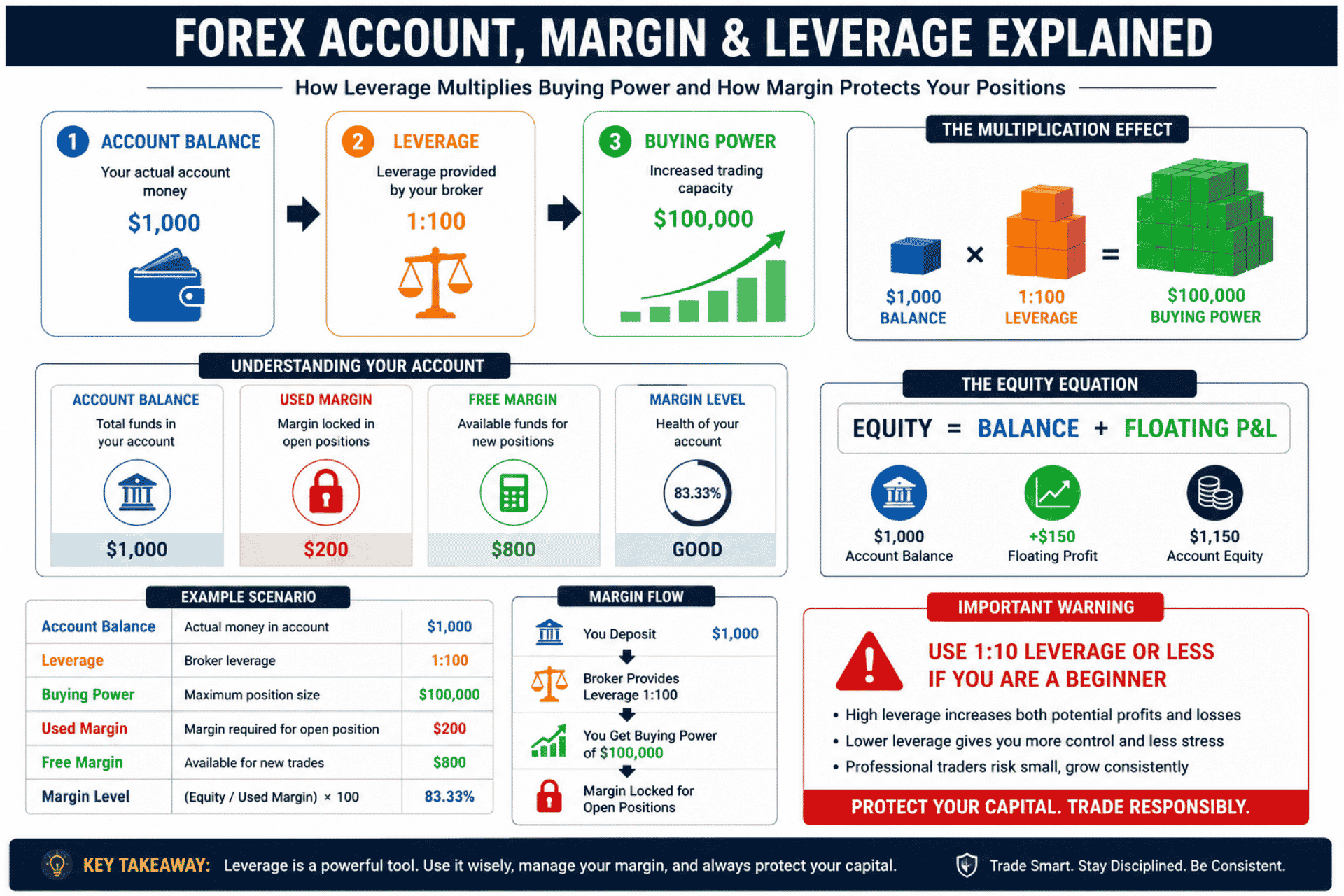
28. Leverage ⚠️ — The Double-Edged Sword
Definition: Borrowed capital provided by the broker to increase your position size. This is dangerous essential forex trading terminology that must be respected.
🎯 Real-World Analogy: Leverage is like a magnifying glass. It makes everything bigger—both the good and the bad. A tiny flame becomes a roaring fire. A small loss becomes a disaster. This essential forex trading terminology analogy helps you understand the risk.
Formula:
Position Size = Account Balance × Leverage
Example:
- Account: $1,000
- Leverage: 100:1
- Buying power: $1,000 × 100 = $100,000
📊 Table: Leverage Effects
| Account Size | Leverage | Buying Power | 1% Move Profit/Loss |
|---|---|---|---|
| $1,000 | 1:1 | $1,000 | $10 |
| $1,000 | 10:1 | $10,000 | $100 |
| $1,000 | 50:1 | $50,000 | $500 |
| $1,000 | 100:1 | $100,000 | $1,000 |
🔴 Red Highlight: High leverage amplifies both profits and losses. A 1% move with 100:1 leverage means the following:
- Profit: +100% of your account
- Loss: -100% of your account (you lose everything)
🟦 Blue Highlight: Beginners should use 1:5 to 1:10 leverage maximum. Never use maximum leverage. This essential forex trading terminology could save your account.
🧮 Leverage Calculation (Real Example)
Scenario: You have a $5,000 account. You use 50:1 leverage.
Step 1: Calculate buying power
- Buying power = $5,000 × 50 = **$250,000**
Step 2: Calculate position size in lots
- 1 standard lot = 100,000 units
- $250,000 ÷ $100,000 = 2.5 standard lots
Step 3: Calculate profit/loss on a 100-pip move
- 1 standard lot pip value = $10
- 2.5 lots pip value = $25 per pip
- 100 pips × $25 = **$2,500**
✅ Result: A 100-pip move makes or loses $2,500—which is 50% of your account. This essential forex trading terminology calculation shows why leverage is dangerous.
🔴 Red Highlight: This is why proper position sizing is essential. A 100-pip move can wipe out half your account. This essential forex trading terminology concept is crucial for survival.
29. Margin — The “Good Faith Deposit”
Definition: The collateral required to open a leveraged position. It’s a “good faith deposit.” This essential forex trading terminology is often misunderstood by beginners.
🎯 Real-World Analogy: Margin is like a security deposit on an apartment. You don’t own the apartment, but you pay a deposit to show you’re serious. This essential forex trading terminology analogy helps you understand the concept.
Formula:
Margin Required = Position Size ÷ Leverage
Example:
- Position size: $100,000
- Leverage: 100:1
- Margin required: $100,000 ÷ 100 = $1,000
🧮 Margin Calculation (Real Example)
Scenario: You want to trade 2 standard lots (200,000 units) of EUR/USD. Your broker offers 50:1 leverage.
Step 1: Calculate total position size
- 2 lots × 100,000 = $200,000
Step 2: Calculate margin required
- Margin = $200,000 ÷ 50 = **$4,000**
✅ Result: You need $4,000 in your account to open this trade. This essential forex trading terminology calculation helps you plan your trades.
📊 Table: Margin Requirements by Leverage
| Leverage | Margin Required for 1 Standard Lot | Margin Required for 1 Mini Lot |
|---|---|---|
| 1:1 | $100,000 | $10,000 |
| 10:1 | $10,000 | $1,000 |
| 30:1 | $3,333 | $333 |
| 50:1 | $2,000 | $200 |
| 100:1 | $1,000 | $100 |
| 500:1 | $200 | $20 |
30-35. Margin and Equity Terms
📊 Table: Account Terminology
| Term | Definition | Formula |
|---|---|---|
| Balance | Cash after all trades closed | N/A |
| Equity | Real-time account value | Balance + Floating P&L |
| Used Margin | Collateral locked up | Position Size ÷ Leverage |
| Free Margin | Available to open new trades | Equity – Used Margin |
| Floating P&L | Unrealized profit/loss | (Current Price – Entry Price) × Position Size |
| Realized P&L | Locked in profit/loss | Closing Price – Opening Price |
🧮 Equity Calculation (Real Example)
Scenario: Your account has:
- Balance: $10,000
- Open trade: 1 standard lot EUR/USD
- Entry: 1.1050
- Current price: 1.1080 (+30 pips)
- Pip value: $10 per pip
Step 1: Calculate the floating P&L
- Profit = 30 pips × $10 = **+$300** 🟩
Step 2: Calculate equity
- Equity = Balance + Floating P&L
- Equity = $10,000 + $300 = $10,300 🟦
Step 3: Calculate free margin
- Used Margin = $1,000 (for 1 standard lot at 100:1)
- Free Margin = Equity – Used Margin
- Free Margin = $10,300 – $1,000 = $9,300 🟩
✅ Result: You have $9,300 available to open new trades. This essential forex trading terminology calculation helps you manage your account.
36. Margin Call 🔴 — The Warning Signal
Definition: A warning from the broker that your Equity has dropped too low relative to your Used Margin. These are critical essential forex trading terms to avoid.
🎯 Real-World Analogy: Like a low fuel warning in your car. You haven’t run out of fuel yet, but you will soon if you don’t act. This essential forex trading terminology analogy helps you remember to act.
When It Happens:
- Your losing trades are eating into your equity
- Your equity approaches your used margin level
Real Example:
- Used Margin: $1,000
- Equity: $1,100 (falling)
- Margin Call Level: 100% (equity = used margin)
If equity falls below $1,000 → 🔴 MARGIN CALL
What to Do:
- Close losing trades immediately
- Add more funds to your account
- Reduce position sizes for future trades
37. Stop Out ⚠️ — Forced Liquidation
Definition: Forced liquidation of your open positions by the broker. This essential forex trading terminology is your final warning.
🎯 Real-World Analogy: Like the tow truck that takes your car when you run out of fuel on the highway. You don’t want it to happen, but it will if you ignore the warnings. This essential forex trading terminology analogy helps you understand the consequences.
When It Happens: When you ignore the margin call and equity continues to fall.
Real Example:
- Used Margin: $1,000
- Equity: $800 (below 100%)
- Stop Out Level: 50% (equity = 50% of margin)
If equity falls below $500 → 🔴 STOP OUT
What Happens: The broker automatically closes your positions, starting with the most losing trade.
🟦 Blue Highlight: This is why you always use stop losses. Stop-outs happen at the worst possible price. This essential forex trading terminology could save your account.
🧮 Margin Call & Stop Out Calculation
Scenario: You have a $2,000 account. You open 1 standard lot of EUR/USD at 100:1 leverage.
Step 1: Calculate the used margin
- 1 lot = $100,000
- $100,000 ÷ 100 = **$1,000 used margin**
Step 2: Calculate pip value
- 1 standard lot = $10 per pip
Step 3: Find the margin call level
- Margin Call Level: 100% (equity = used margin)
- Equity must stay above $1,000
Step 4: Calculate the losing move
- Current equity: $2,000
- Margin call at: $1,000
- Loss needed: $2,000 – $1,000 = $1,000
- Pips to margin call: $1,000 ÷ $10 = 100 pips
✅ Result: If EUR/USD moves 100 pips against you, you get a margin call. This essential forex trading terminology calculation helps you plan your risk.
📊 Table: Margin Call Levels
| Account Size | Used Margin | Pip Value | Pips Until Margin Call |
|---|---|---|---|
| $2,000 | $1,000 | $10 | 100 pips |
| $5,000 | $1,000 | $10 | 400 pips |
| $10,000 | $1,000 | $10 | 900 pips |
38. Drawdown — The Cost of Losing
Definition: The peak-to-trough decline in your account balance during a specific period. Understanding drawdown is essential for forex trading terminology.
🎯 Real-World Analogy: Like falling into a hole. The deeper the hole, the harder it is to climb out. This essential forex trading terminology analogy helps you understand the risk.
Formula:
Drawdown % = (Peak Balance – Trough Balance) ÷ Peak Balance × 100
Example:
- Peak: $10,000
- Trough: $8,000
- Drawdown = ($10,000 – $8,000) ÷ $10,000 × 100 = 20%
📊 Table: Recovery Required After Drawdown
| Drawdown % | Recovery % Needed |
|---|---|
| 10% | 11% |
| 20% | 25% |
| 30% | 43% |
| 40% | 67% |
| 50% | 100% |
| 60% | 150% |
🔴 Red Highlight: A 50% drawdown requires a 100% gain to recover. This is why risk management is essential. This essential forex trading terminology concept is crucial for long-term survival.
39-40. Lot Size & Pip Value
Definition:
- Lot Size: The standardized volume of a trade. This essential forex trading terminology determines your position size.
- Pip Value: The actual monetary value of one pip movement. This essential forex trading terminology helps you calculate risk.
📊 Table: Lot Sizes and Pip Values
| Lot Type | Units | Abbreviation | Pip Value (USD) |
|---|---|---|---|
| 🟦 Standard Lot | 100,000 | 1.0 | $10 |
| 🟩 Mini Lot | 10,000 | 0.1 | $1 |
| 🟨 Micro Lot | 1,000 | 0.01 | $0.10 |
| 🟧 Nano Lot | 100 | 0.001 | $0.01 |
💡 Pro Tip: Start with micro lots (0.01) to minimize risk while learning. This essential forex trading terminology advice could save your account.
41. Position Sizing — The Golden Rule
Definition: The process of calculating how much of a currency to buy or sell based on your account size and risk tolerance. This is the most important essential forex trading terminology for long-term survival.
🎯 Real-World Analogy: Like measuring ingredients for a recipe. Too much salt ruins the dish. Too much risk ruins your account. This essential forex trading terminology analogy helps you remember its importance.
🟦 Blue Highlight: This is the most important piece of essential forex trading terminology for long-term survival.
The 1% Rule: Never risk more than 1% of your account on a single trade.
Why: If you risk 1% per trade, you can lose 20 trades in a row and still have 80% of your account. If you risk 10% per trade, 10 losing trades wipe you out. This essential forex trading terminology rule is used by professional traders.
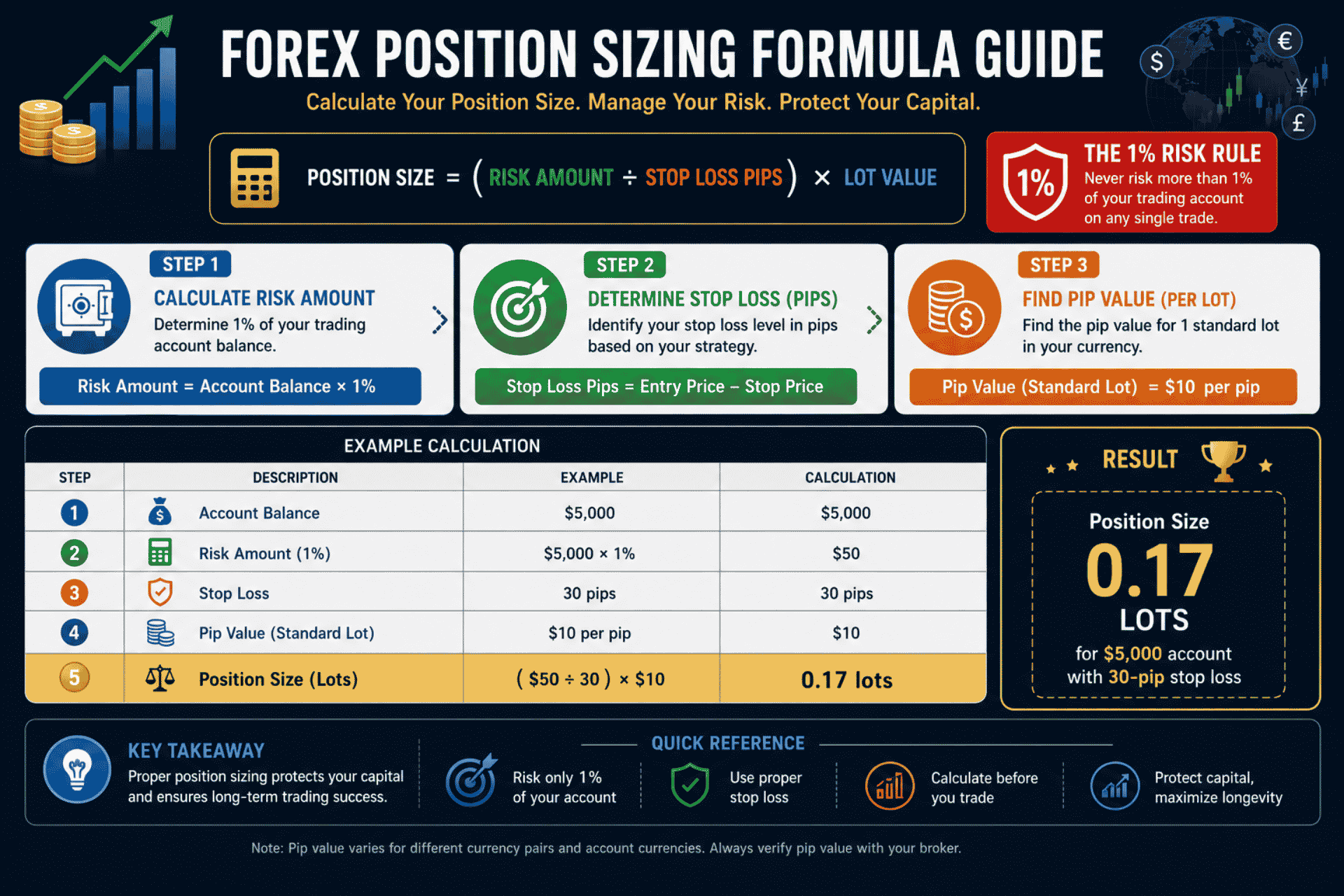
🧮 Position Sizing Calculation (The Golden Formula)
Scenario: You have a $5,000 account. You risk 1% per trade. You want to trade EUR/USD. Your stop loss is 30 pips.
Step 1: Calculate risk in dollars
- 1% of $5,000 = **$50** 🔴
Step 2: Calculate pip value needed
- Stop loss = 30 pips
- Risk per pip = $50 ÷ 30 pips = **$1.67 per pip** 🟦
Step 3: Calculate lot size
- 1 standard lot = $10 per pip
- 1 mini lot = $1 per pip
- $1.67 per pip = 0.167 mini lots (or 1.67 micro lots)
✅ Result: Your position size should be 0.167 lots (approx. 0.17 mini lots). This essential forex trading terminology calculation is used by every professional trader.
📊 Table: Position Sizing Examples
| Account Size | Risk % | Risk $ | Stop Loss (Pips) | Position Size |
|---|---|---|---|---|
| $1,000 | 1% | $10 | 50 pips | 0.02 lots (2 micro) |
| $5,000 | 1% | $50 | 30 pips | 0.17 lots (1.7 mini) |
| $10,000 | 1% | $100 | 40 pips | 0.25 lots (2.5 mini) |
| $50,000 | 1% | $500 | 50 pips | 1.00 lots (1 standard) |
42. Risk/Reward Ratio (R: R)
Definition: The ratio of potential loss to potential gain. This essential forex trading terminology determines your profitability.
🎯 Real-World Analogy: Like betting on a horse. If you risk $10 to win $30, your risk/reward ratio is 1:3. This essential forex trading terminology analogy helps you understand the concept.
Formula:
R:R = Potential Loss ÷ Potential Gain
Example:
- Stop Loss: 20 pips below entry
- Take Profit: 60 pips above entry
- R:R = 20 ÷ 60 = 1:3
📊 Table: Profitability Matrix (Win Rate vs. R:R)
| Win Rate | 1:1 R:R | 1:2 R:R | 1:3 R:R |
|---|---|---|---|
| 30% | 🔴 -40% | 🔴 -10% | 🟩 20% |
| 40% | 🔴 -20% | 🟩 20% | 🟩 60% |
| 50% | 🟦 0% | 🟩 50% | 🟩 100% |
| 60% | 🟩 20% | 🟩 80% | 🟩 140% |
🟦 Blue Highlight: Even with a 40% win rate, a 1:3 R:R ratio is profitable. This is why professionals focus on R: R, not win rate. This essential forex trading terminology concept is crucial for profitability.
43. Win Rate
Definition: The percentage of trades that result in a profit. This essential forex trading terminology must be balanced with risk/reward.
Formula:
Win Rate = Winning Trades ÷ Total Trades × 100
Example: 50 winning trades out of 100 total = 50% win rate
🔴 Red Highlight: A 70% win rate is useless if your average loss is larger than your average win. Always balance win rate with risk/reward. This essential forex trading terminology concept is often misunderstood by beginners.
Part 4: Forex Slang (Trader Nicknames)
This part of essential forex trading terminology is what separates the novices from the insiders. If you hear someone say “Cable is looking weak,” you need to know they are talking about GBP/USD.
| Slang Term | Meaning | Why It’s Called That |
|---|---|---|
| Cable | GBP/USD | Transatlantic telegraph cable |
| Loonie | USD/CAD | Loon bird on Canadian coin |
| Aussie | AUD/USD | Australian Dollar |
| Kiwi | NZD/USD | New Zealand’s national bird |
| Swissy | USD/CHF | Swiss Franc |
| Dragon | GBP/JPY | Extreme volatility (“fire-breathing”) |
| Fiber | EUR/USD | Fiber optic cables |
| Greenback | USD | Color of US currency |
| Old Lady | Bank of England | Historic nickname |
| Hawkish | Pro-higher rates | Hawk = aggressive |
| Dovish | Pro-lower rates | Dove = peaceful |
Part 5: Technical Analysis Terminology
If you plan to trade using charts, these essential forex trading terminology entries are essential for reading price action.
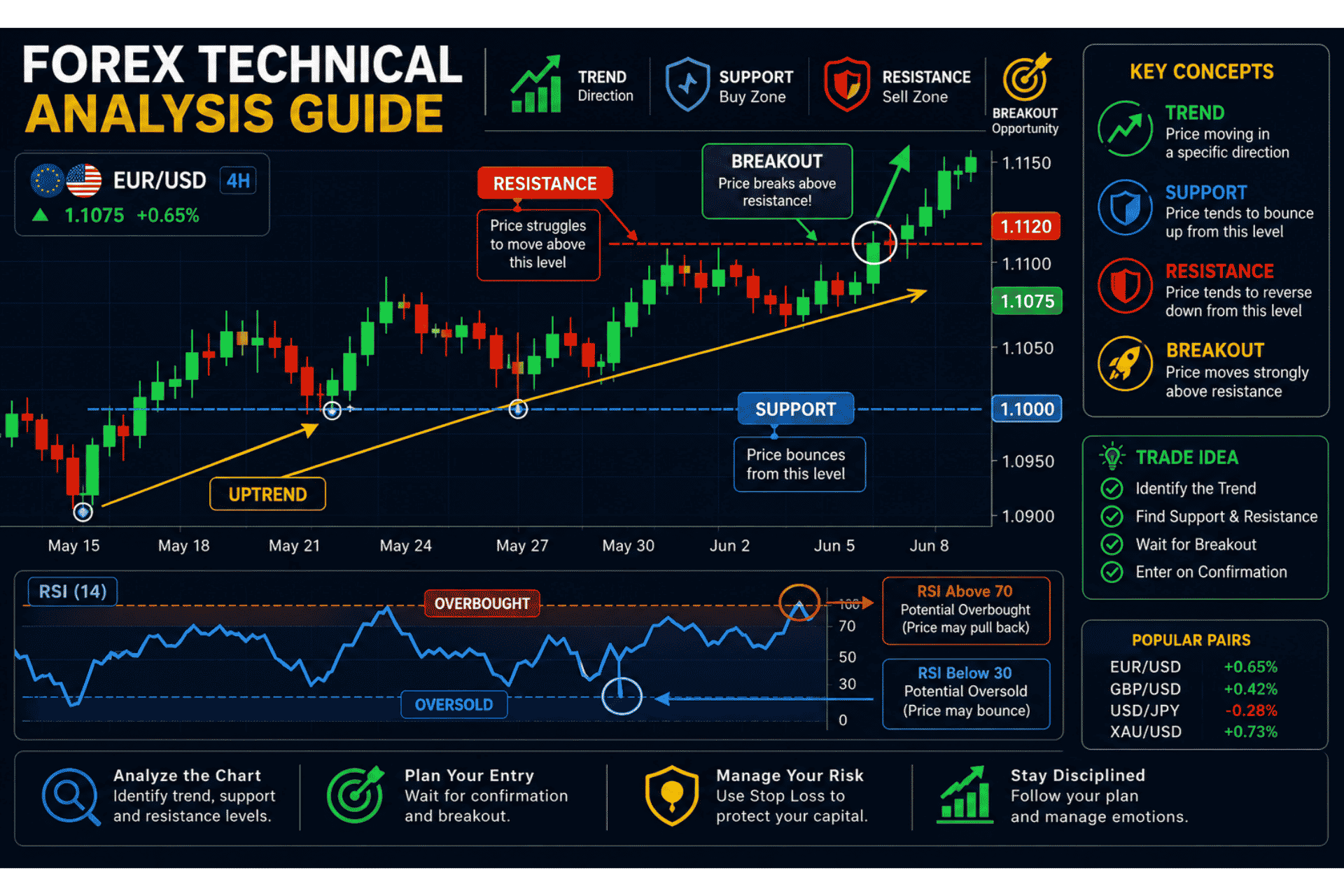
📊 Key Technical Terms with Examples
| Term | Definition | Example |
|---|---|---|
| Support | Price “floor” where buying is strong | EUR/USD bounces at 1.1000 three times |
| Resistance | Price “ceiling” where selling is strong | The EUR/USD was rejected at 1.1200 twice |
| Breakout | The price explodes through support/resistance | EUR/USD closes above 1.1200 = BUY signal |
| Pullback | Temporary reversal against the trend | EUR/USD dips to 1.1150 before continuing up |
| Moving Average | Smoothed price line | 50-day MA shows trend direction |
| RSI | Momentum oscillator | RSI > 70 = overbought, RSI < 30 = oversold |
| Divergence | Price and indicator move opposite | Price makes a higher high, RSI makes a lower high = BEARISH |
Part 6: Fundamental Analysis Terminology
These terms relate to the economic factors that drive long-term currency values. Understanding this essential forex trading terminology helps you trade the news.
📰 Key Fundamental Terms with Examples
| Term | Definition | Market Impact |
|---|---|---|
| Interest Rate | Central bank policy rate | A higher rate = stronger currency |
| CPI | Inflation measure | Rising CPI = higher rates expected |
| NFP | US employment report | The biggest USD volatility event |
| GDP | Economic growth measure | Strong GDP = strong currency |
| QE | Central bank buying bonds | QE = currency weakens |
| Forward Guidance | Central bank signals | “We may hike in 6 months” = currency strengthens |
| Safe Haven | Risk-off currency | USD, JPY, CHF strengthen in crises |
Conclusion: Why Mastering This Essential Forex Trading Terminology Changes Everything
Learning essential forex trading terminology is the first and most critical step toward becoming a confident trader. This glossary is not a one-time read; it is a living document you should bookmark and revisit.
When you understand this essential forex trading terminology:
- You gain confidence: You stop second-guessing every button you click on your trading platform. This essential forex trading terminology gives you the knowledge you need.
- You identify scams: If an “expert” promises guaranteed returns but doesn’t know what a “margin call” is, you’ll know to run the other way. This essential forex trading terminology protects you from fraud.
- You interpret the news: You can finally understand what analysts mean when they say “The Fed is turning hawkish” or “We are seeing a liquidity sweep.” This essential forex trading terminology helps you understand market commentary.
- You survive: Proper risk management, essential forex trading terminology, is the difference between a long trading career and blowing up your account in a week.
- You trade like a pro: Professionals speak this language fluently. When you understand essential forex trading terminology, you can participate in conversations, analyze markets, and make decisions with clarity.
Keep this guide open as you learn, reference it when you are confused, and soon these words will become second nature. This essential forex trading terminology will serve you throughout your trading career.
Frequently Asked Questions (FAQ)
1. How do I calculate the pip value for any currency pair?
For USD quote pairs: Pip Value = (0.0001 ÷ Exchange Rate) × Lot Size. For simplicity, remember: a standard lot = $10/pip, Mini lot = $1/pip, Micro lot = $0.10/pip. This essential forex trading terminology calculation is used every day by traders.
2. What leverage should a beginner use?
Beginners should use 1:5 to 1:10 maximum. Never use 100:1 or higher until you have months of experience and a proven strategy. This essential forex trading terminology advice could save your account.
3. What is the 1% rule in forex?
Never risk more than 1% of your account on any single trade. With a $10,000 account, your maximum loss per trade is $100. This essential forex trading terminology rule is followed by professional traders.
4. What’s the difference between a Stop Loss and a Take Profit?
- Stop Loss: Caps your loss (safety net) 🔴
- Take Profit: Locks in your gain (target) 🟢
Both are essential for every trade. This essential forex trading terminology helps you manage every trade.
5. Do I need to know all the slang to trade profitably?
No. Slang helps you understand market conversations, but it’s not necessary. The technical terms—Pip, Spread, Leverage, Margin, Stop Loss, and Position Sizing—are what you absolutely must know. This essential forex trading terminology is non-negotiable.
6. What is the most important forex trading terminology for beginners?
The most important essential forex trading terminology for beginners includes: Pip, Spread, Leverage, Margin, Stop Loss, Take Profit, and Position Sizing. Mastering these seven terms will protect your capital and give you a solid foundation.
7. How can I remember all this terminology?
We recommend keeping this glossary open while you practice on a demo account. Every time you encounter a term you don’t understand, refer back to this guide. Over time, this essential forex trading terminology will become second nature.
Further Reading
To deepen your understanding of the forex market, we recommend exploring these additional resources from Finwirestack:
- How to Start Trading Forex: A Step-by-Step Guide for Beginners — Learn how to choose a broker, open an account, and place your first trade with confidence.
- Technical vs Fundamental Analysis: Which Strategy is Right for You? — Discover which trading approach suits your personality and goals.
- The Role of Central Banks in the Forex Market — Understand how the Fed, ECB, and BoJ move the markets and influence currency values.
- Risk Management for Forex Traders: Protect Your Capital — Master position sizing, stop-loss strategies, and trading psychology to protect your account.
External Resources (DoFollow Links)
For additional learning, we recommend these trusted external resources:
- Investopedia Forex Section — Comprehensive forex education and trading terminology explanations.
- BabyPips Forex School — The most popular free forex education platform for beginners.
- FXStreet Education — Daily market analysis and educational articles for forex traders.
- DailyFX Education — Trading education and market insights from a leading forex news source.
Disclaimer: Trading forex and CFDs involves significant risk of loss. It is not suitable for all investors. You should carefully consider your investment objectives, level of experience, and risk appetite before trading. Never trade with money you cannot afford to lose. The information provided in this article is for educational purposes only and does not constitute financial advice.






[…] Learn the basics — Understand currency pairs, pips, leverage, and margin before you start trading forex. […]
[…] Essential Forex Trading Terminology: Ultimate Guide — Master the language of forex with 100+ terms explained with real examples. […]
[…] Essential Forex Trading Terminology: Ultimate Guide — Master the language of forex with 100+ terms explained with real examples. […]
[…] Essential Forex Trading Terminology: Ultimate Guide — Master the language of forex with 100+ terms explained with real examples on how to read forex charts. […]
[…] Essential Forex Trading Terminology: Ultimate Guide — Master the language of forex with 100+ terms explained with real examples. […]
[…] Essential Forex Trading Terminology: Ultimate Guide — Master the language of forex with 100+ terms explained with real examples. […]
[…] Article Link: Essential Forex Trading Terminology: Ultimate Guide […]
[…] Before placing your first trade, you must understand the language of Forex and various Forex trading terminologies. […]