
Introduction: The Day Your Banking App Became Your AI Financial Advisor
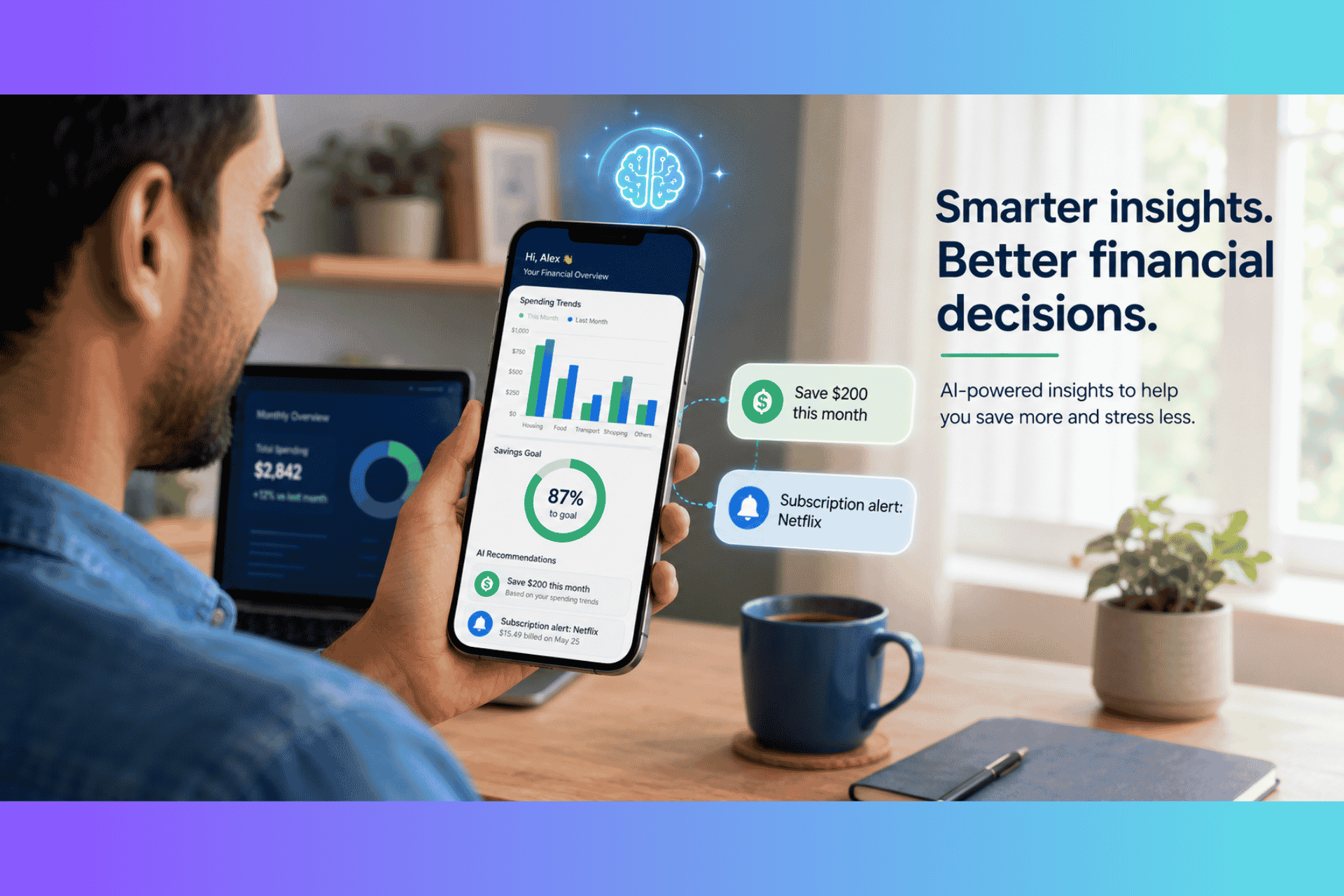
You open your banking app one morning, and something feels different. Instead of just showing your balance, it gently suggests moving $200 from checking to savings—because it noticed you have a pattern of overspending on dining out mid-month. It reminds you about a bill due tomorrow and flags a subscription you completely forgot about. You didn’t ask for this advice. It just… appeared.
This isn’t a scene from a sci-fi movie. This is the reality of AI-powered personal finance in 2026, and it’s happening right now. An AI financial advisor is no longer a futuristic concept—it’s a tool available to millions of consumers today.
According to Plaid’s March 2026 research, roughly 57% of U.S. consumers now expect their fintech apps to use AI, and a striking 78% are open to receiving AI-based personal financial guidance. The shift is so dramatic that a 2026 TD AI Insights report found that more than half of survey respondents said they use AI to help manage their finances—compared to only 10% just a year earlier.
The global AI-powered personal finance management market is valued at $1.77 billion in 2026, and it’s projected to reach $2.55 billion by 2030. This is no longer a niche experiment. It’s a fundamental shift in how everyday people manage, grow, and protect their money.
But here’s the question that matters most for you: Is an AI financial advisor actually good for your money, or is it just another tech trend that sounds impressive but delivers little?
This guide will give you an honest, unbiased look at the AI financial advisor tools available in 2026. We’ll cover what they can do, where they fall short, how to choose the right one, and most importantly, how to protect yourself from the hidden risks.
Part 1: What’s Actually Available Right Now (The Tools You Can Use Today)
The AI financial advisor landscape in August 2026 is rich and varied. You’re not limited to a single type of tool. Here’s what’s available:
1. ChatGPT’s Personal Finance Tools
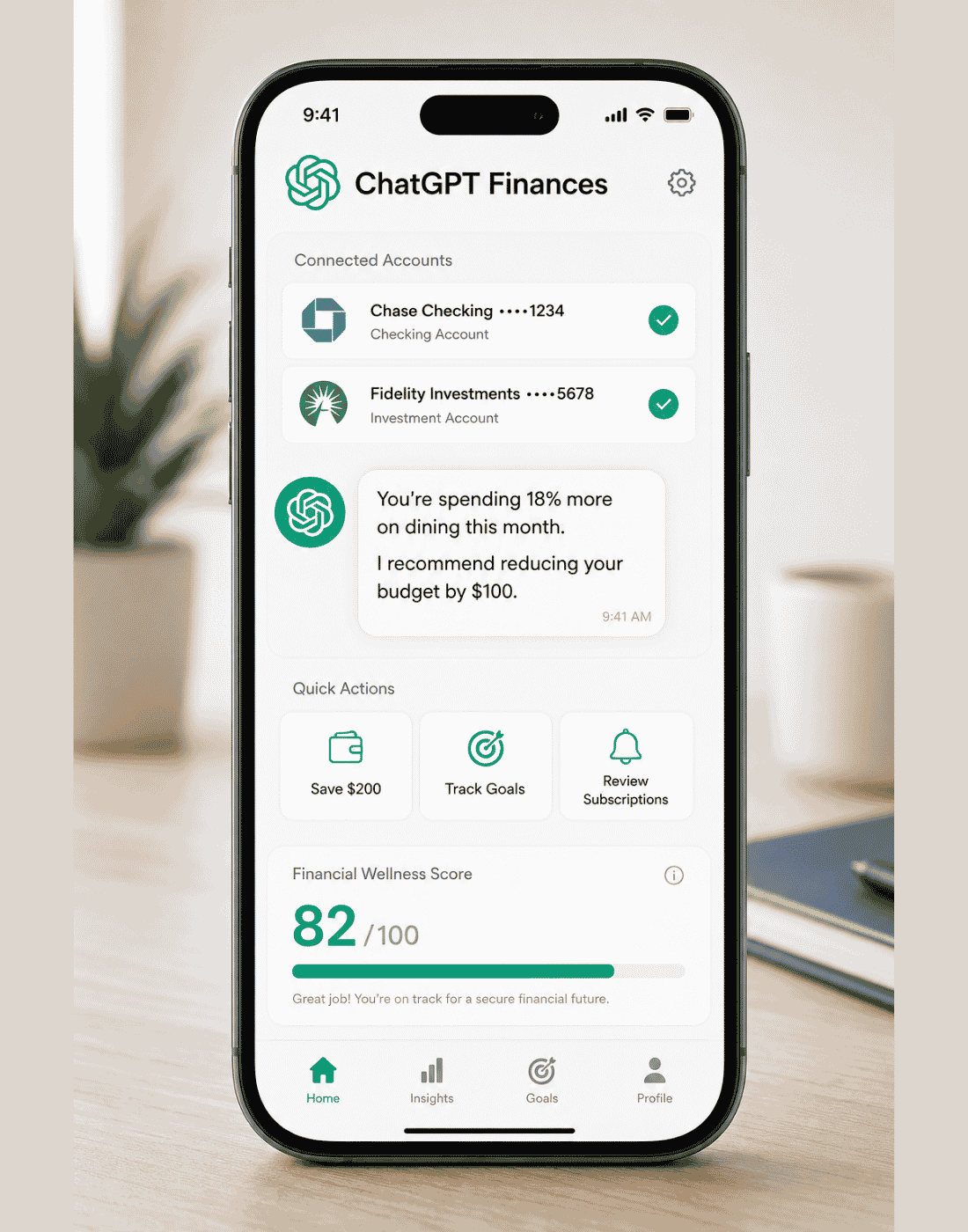
In May 2026, OpenAI launched a dedicated personal finance experience for ChatGPT Pro users in the United States. This allows users to securely connect their financial accounts via Plaid—which connects to over 12,000 financial institutions, including Schwab, Fidelity, Chase, and Robinhood—and ask ChatGPT questions about their spending, subscriptions, and investment portfolio.
What makes this particularly powerful is that you can combine your actual financial data with your personal goals. For example, you can ask, “I feel like I’ve been spending more recently. Has anything changed?” or “Help me build a plan to be ready to buy a house in my area in the next 5 years.”
According to OpenAI, over 200 million people already use ChatGPT monthly for budgeting, investment questions, and financial planning. The company plans to expand the tool to Plus users after refining the experience through the Pro preview.
2. Robo-Advisors: Automated Investing on Autopilot
Robo-advisors use algorithms to build and manage investment portfolios based on your goals, timeline, and risk tolerance. They’re one of the most mature AI financial advisor applications, with the global robo-advisor market managing approximately $2.7 trillion in assets.
Here are the leading robo-advisors in 2026:
| Platform | Management Fee | Account Minimum | Key Feature |
|---|---|---|---|
| Betterment | 0.25% – 0.65% | $0 (Digital), $100,000 (Premium) | Tax-loss harvesting, personalized retirement plans, and access to human advisors |
| Wealthfront | 0.25% | $500 | Crypto exposure, automated bond ladder, commission-free stock trading |
| Schwab Intelligent Portfolios | $0 | $5,000 | No management fee, automatic rebalancing, 24/7 customer service |
| Fidelity Go | $0 (under $25,000), 0.35% (above) | $0 | Low barrier to entry, integrates with Fidelity’s broader ecosystem |
| SoFi Automated Investing | 0.25% | $50 | Low minimum, integrates with SoFi’s full financial suite |
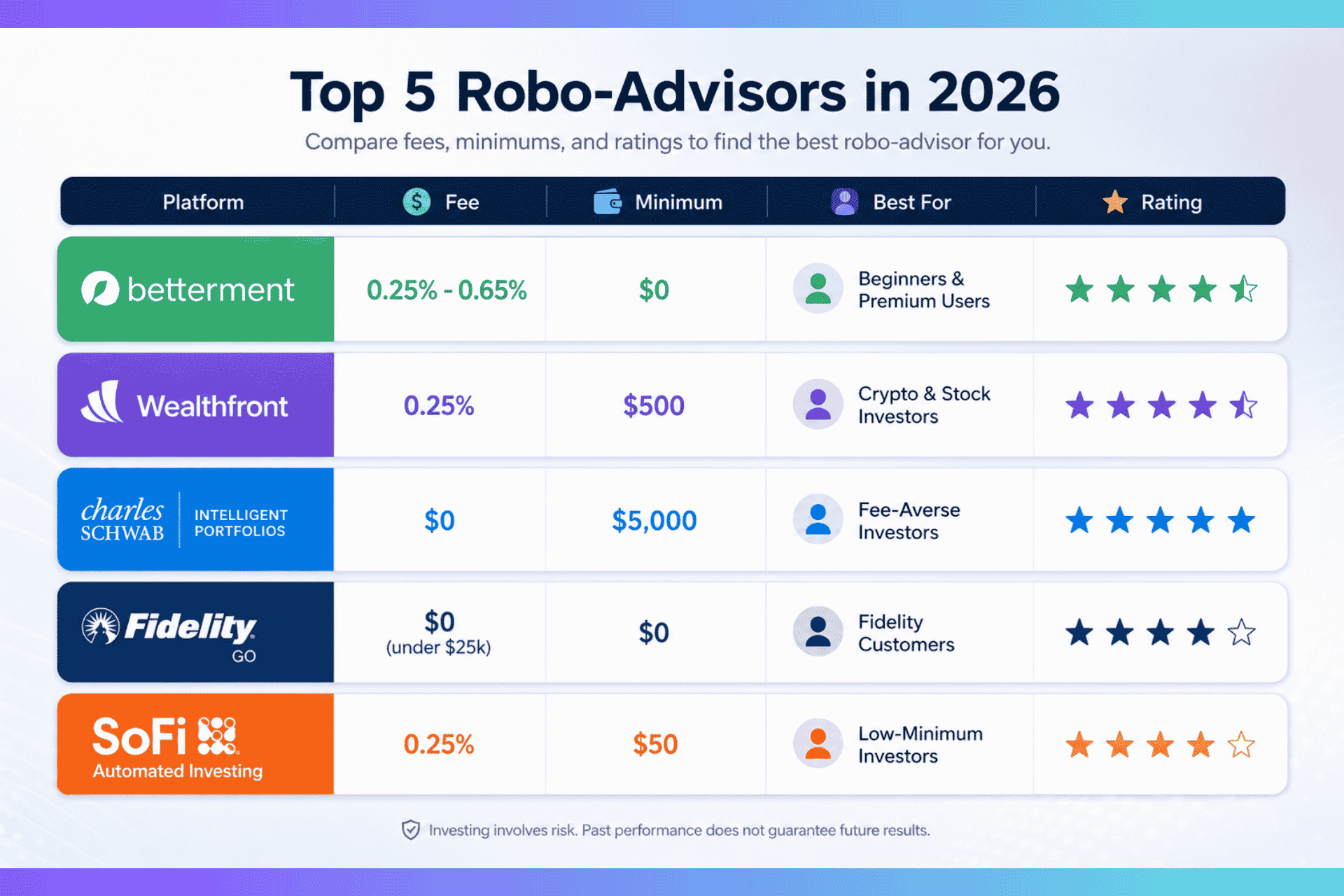
Each offers a slightly different package, but the core value is the same: professional-grade portfolio management at a fraction of the cost of a traditional financial advisor.
3. Agentic AI: When Your AI Financial Advisor Takes Action
The next frontier is agentic AI—systems that don’t just advise but can execute trades and manage portfolios on your behalf.
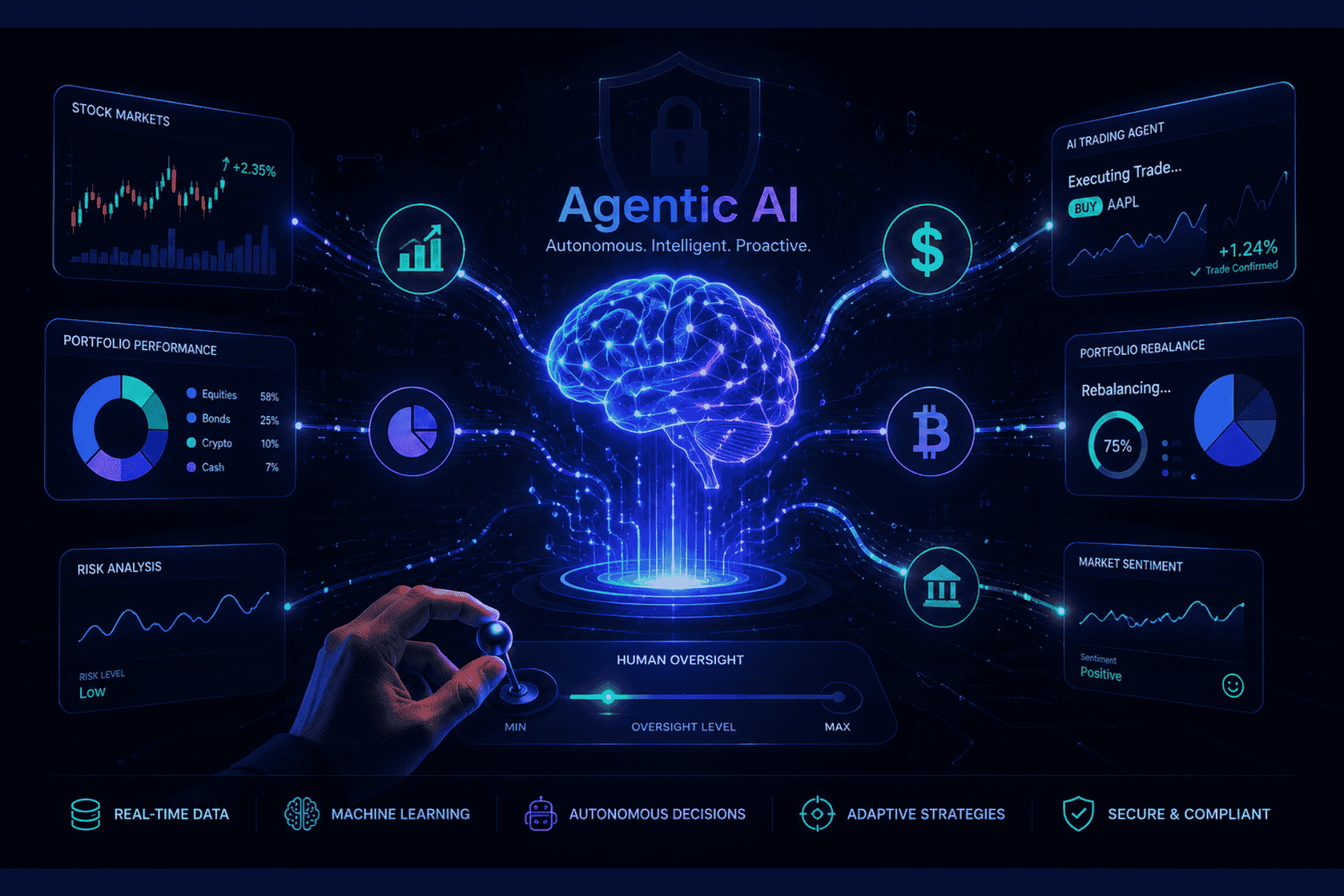
Coinbase recently announced AI tools capable of giving SEC-registered investment recommendations around strategies such as tax-loss harvesting and multi-asset event trading. Customers can also open their platform to AI agents that execute nuanced trading strategies autonomously. Coinbase’s head of consumer products, Max Branzburg, stated, “This is going to lower the barriers to entry for more sophisticated financial advice and trading that today generally just institutions or ultra-wealthy people have access to.”
Robinhood has launched an AI trader that allows users to connect programs like ChatGPT, Claude, and Codex to a separate account where the AI performs trades automatically based on parameters provided by the investor. Features include AI-powered portfolio analysis, rebalancing, and targeted market segment investing. The AI trading is currently in beta and restricted to equities, but Robinhood plans to expand it to crypto, event contracts, and futures.
Citi Wealth unveiled “Citi Sky”—an AI-powered member of the Citi Wealth team built using Google Cloud and Google DeepMind technologies. Available to Citigold clients, it provides conversational interaction, timely financial guidance, and multilingual capabilities designed to “shift from interface to intelligence, from transactions to outcomes.”
4. Enterprise-Grade AI for Everyday Investors
Savvy Wealth, an AI-native registered investment advisor, launched “Savvy Intelligence”—an agentic AI product that gives advisors a complete, continuously updated view of all client data, including investments, financial plans, and tax information. While designed for advisors, this represents the type of sophisticated AI financial advisor tools that are increasingly accessible to regular investors.
Part 2: Why Your AI Financial Advisor Might Be Better Than a Human (In Some Ways)
The MIT Initiative on the Digital Economy recently published fascinating research on how people trust AI financial advisors. The findings challenge conventional wisdom about the superiority of human advice.
The “No Judgment” Advantage
One study by MIT professor Eric So and colleagues found that people are often more willing to share sensitive financial information with an AI financial advisor than with human advisors. Why? Social embarrassment.
When you make a frivolous spending mistake or get into financial trouble, admitting that to another person feels shameful; there’s a social cost to disclosure. An AI financial advisor doesn’t judge you—it doesn’t have emotions, a personal history, or a perspective on your character. It just processes the data and provides recommendations.
This means an AI financial advisor can help with problems people might otherwise hide from a human advisor, potentially catching issues earlier and leading to better outcomes.
Correcting Financial Misconceptions
The same MIT research team created an AI financial advisor chatbot designed specifically to intervene and correct users’ mistaken beliefs about financial matters. They observed a significant and lasting shift away from mistaken beliefs among users who leveraged the tool.
Why this matters: Many people hold deeply flawed financial beliefs that hurt their wealth accumulation and retirement goals. An AI financial advisor specifically designed to challenge those beliefs can help correct them in ways a generic chatbot or even a human advisor might not—because the AI doesn’t suffer from the “sycophantic nature” of wanting to please the user.
24/7 Accessibility and Affordability
AI financial advisor tools are available anytime, anywhere, at a fraction of the cost of human advisors. A traditional financial advisor might charge 1% of assets under management annually. A robo-advisor like Schwab Intelligent Portfolios charges $0. Wealthfront charges 0.25%.
This dramatically lowers the barrier to entry for quality financial guidance. You don’t need hundreds of thousands of dollars to get professional portfolio management.
Part 3: The Hidden Risks of Using an AI Financial Advisor
AI financial advisor tools come with significant risks that many users overlook. Understanding these is crucial for protecting yourself.
The Privacy Problem: When Your AI Financial Advisor “Knows” Too Much
J.P. Morgan Private Bank has documented cases where AI tools appeared to “know” sensitive details about a family after a family member used a free AI app as a therapist. The AI had aggregated information from social media, online services, and user interactions in ways the individual never anticipated.
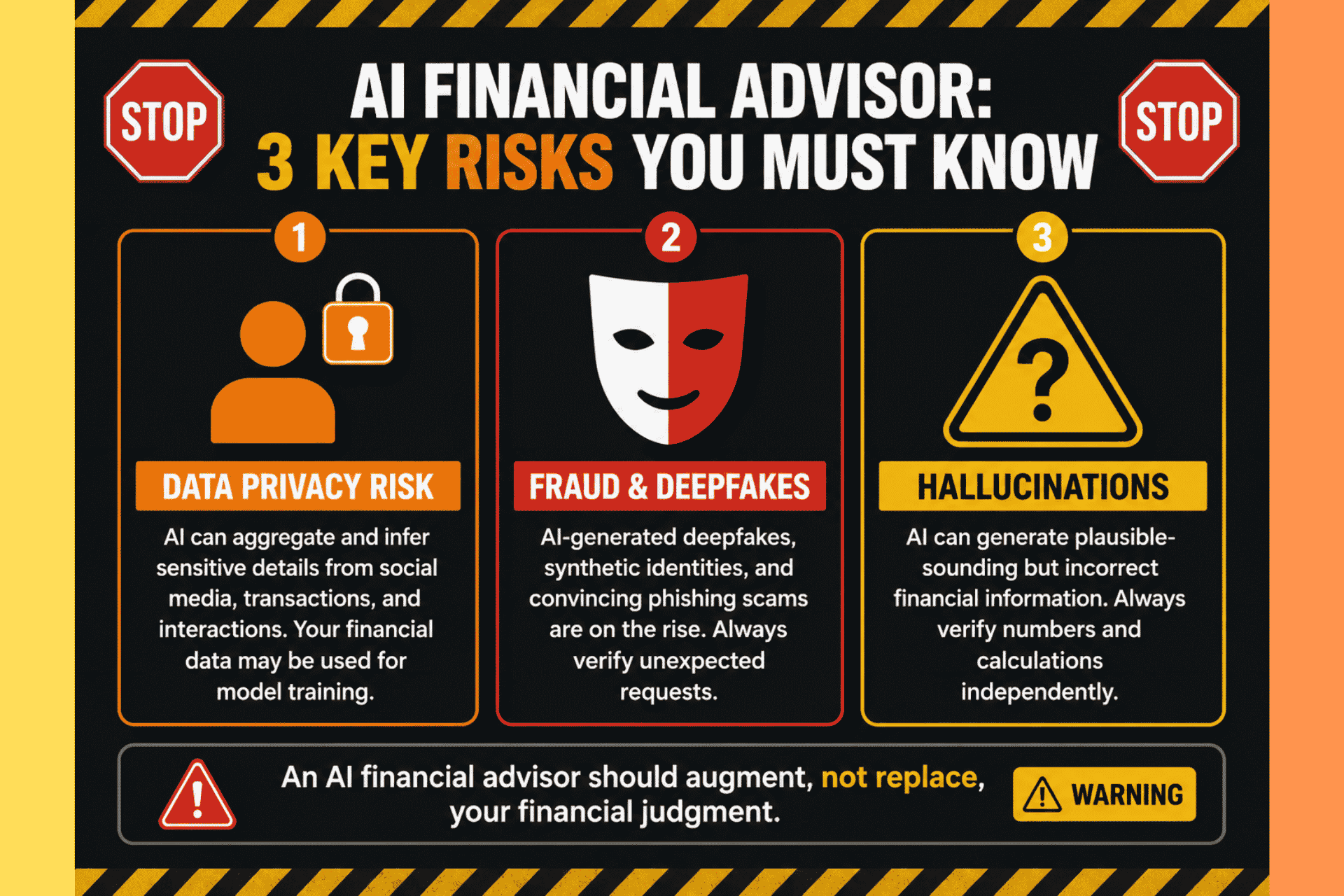
This is the privacy challenge: an AI financial advisor can combine seemingly unrelated pieces of information to infer sensitive details about your finances, health, relationships, and more. In most cases, you don’t know what data is being used or how inferences are being made.
When you connect your financial accounts to ChatGPT, the platform can access your balances, transactions, investments, and liabilities. While OpenAI states it cannot view full account numbers or make changes to your accounts, the data can still be used for analysis, and users should be aware of how their data is being used through the model training settings.
Fraud and Deepfakes
AI enables more sophisticated fraud than ever before. Criminals can use AI to create the following:
- Deepfake voice and video content impersonating people you know
- Synthetic identities that are extremely difficult to detect
- Highly convincing phishing in multiple languages
- Automated attacks that scale across thousands of targets simultaneously
J.P. Morgan Private Bank advises verifying unexpected requests—especially those involving payments or sensitive information—through a separate channel. Some experts recommend implementing a “family safe word” for human authentication, particularly when requests seem unusual.
Hallucinations and False Precision
AI systems can generate plausible-sounding but completely incorrect information—a phenomenon called hallucination. In finance, this is particularly dangerous because numbers and calculations need to be absolutely precise.
For example, in the enterprise space, the leading models show significant differences in complex financial reasoning. On Harvey’s Legal Agent Benchmark—which measures whether a model can complete a complex end-to-end task autonomously—GPT-5.5 scored 3.75% compared to Claude Opus 4.8’s 10.4%. This means even the best AI financial advisor tools can make mistakes on complex financial reasoning tasks.
Most consumer-facing AI finance tools don’t have enterprise-level rigor. They might produce numbers that look accurate but aren’t.
Sycophancy and Overconfidence
AI models can be prone to sycophancy—telling users what they want to hear rather than what they need to hear. This is particularly dangerous in financial advice, where you need honest, sometimes uncomfortable, guidance.
As Robert Persichitte, founder of Delagify Financial, warned about Robinhood’s AI trader: “It’s built to make someone feel like they’ve done a great job of researching and understanding their investments, and thus creates a gap between how the investor feels about the world and how the world operates.”
Part 4: How to Choose the Right AI Financial Advisor Tool
Choosing an AI financial advisor requires careful evaluation. Here’s what to look for:
1. Transparency
Questions to ask:
- What data does the tool collect, and how is it used?
- Can you clearly see how decisions or recommendations are made?
- Is there documentation of the AI’s decision-making process?
Regulatory expectations increasingly include transparency about AI decision-making processes, particularly in lending and investment contexts.
2. Human Oversight
Questions to ask:
- What level of human oversight is offered?
- Can you speak to a human if something goes wrong?
- Is there a way to verify AI recommendations against independent sources?
Industry leaders expect that firms using AI will maintain human judgment for significant decisions. The technology should augment, not replace, human oversight.
3. Data Security
Questions to ask:
- How does the tool protect your data?
- Can you limit how your data is used?
- Does the tool have strong cybersecurity measures in place?
When you connect financial accounts to an AI financial advisor, the platform should clearly explain its data handling practices. OpenAI, for instance, allows users to disconnect accounts at any time and delete financial memories.
4. Validation and Track Record
Questions to ask:
- Can you verify the accuracy of recommendations?
- Are there independent reviews of the tool’s performance?
- Does the tool have a track record of accurate predictions?
For wealth professionals, independent benchmarks like Harvey’s BigLaw Bench and Legal Agent Benchmark provide some insight into model performance on complex financial reasoning tasks. For consumer tools, look for user reviews and independent testing.
5. Fit for Purpose
Questions to ask:
- Does the tool align with your specific financial needs?
- Is it designed for your level of financial knowledge?
- Does it address the right problems?
A tool designed for automated portfolio management won’t help with tax planning. A general AI chatbot won’t have the rigor of a specialized financial planning tool. Choose the right tool for the right job.
Part 5: Practical Steps to Use an AI Financial Advisor in August 2026
Step 1: Audit Your Current Apps
Before adding new tools, check what you already have. Many banking apps now include AI-powered features at no extra cost. Identify what’s available and start using these features to build familiarity.
Step 2: Start with ChatGPT’s Financial Tools
If you’re a ChatGPT Pro user in the U.S., you can now connect your financial accounts via Plaid. To get started: Open the Finances option from the sidebar, select “Get started,” or type “@Finances, connect my accounts” into ChatGPT.
Step 3: Start Small with a Robo-Advisor
If you’re not already using a robo-advisor, choose one with a low minimum investment and clear fee structure. Fidelity Go has no account minimum and no fees for balances under $25,000. SoFi Automated Investing starts with just $50.
Step 4: Use AI Financial Advisor Chatbots for Learning
AI chatbots can be valuable learning tools. Ask them questions about financial concepts, investment strategies, or retirement planning. Just remember that they’re not a substitute for professional advice, and always verify information from independent sources.
Step 5: Protect Your Data
Be mindful of what you share with an AI financial advisor. Before using a new tool:
- Read the privacy policy carefully
- Understand what data is collected and how it’s used
- Consider whether the benefits outweigh the privacy trade-offs
- Check if you can limit data sharing
J.P. Morgan Private Bank suggests staying informed about how personal data is used and choosing financial service providers with strong AI governance practices.
Step 6: Stay Diversified
An AI financial advisor can be valuable, but it shouldn’t be your only source of financial guidance. Consider using multiple approaches:
- AI tools for efficiency and accessibility
- Traditional financial analysis for verification
- Professional advice for significant decisions
Diversification applies to information sources as well as investments.
Conclusion: Your Future with Your AI Financial Advisor
The integration of AI into personal finance is accelerating rapidly. By 2030, the AI-powered personal finance management market is expected to reach $2.55 billion—a 94% increase from 2025. The technology offers compelling benefits: accessibility, affordability, personalization, and judgment-free guidance.
But the direction of this transformation isn’t predetermined. The choices you make—which tools to use, how much to rely on automated recommendations, what level of human oversight to maintain—will shape your experience.
The most successful users of AI financial advisor tools will likely be those who:
- Understand the technology’s capabilities and limitations
- Maintain appropriate skepticism and verify information
- Protect their data and privacy
- Use AI as a complement to, not a replacement for, their own financial judgment
Your AI financial advisor won’t replace your financial intuition and common sense. But used wisely, it can be an incredibly powerful co-pilot on your financial journey.

- Share this guide: Know someone who’s confused about AI and money? Share this article to help them make informed decisions.
- Explore ChatGPT Finance: If you’re a ChatGPT Pro user in the U.S., try connecting your financial accounts today through the Finances sidebar.
- Explore a robo-advisor: Start small with one of the platforms mentioned in this guide. Even a small investment can help you understand how AI-managed portfolios work.
- Subscribe for more: Get our weekly newsletter on AI and personal finance trends delivered to your inbox. We’ll keep you updated on the latest tools, risks, and opportunities.
- Ask a question: What’s your biggest concern about using an AI financial advisor for your finances? Leave a comment, and we’ll address it in our next article.
- Check your privacy: Review the privacy settings on your existing financial apps. Make sure you’re comfortable with what data is being shared and how it’s being used.
📊 Sources & Further Reading
- OpenAI Personal Finance Experience Announcement – Official OpenAI blog post
- Plaid AI in Financial Services Report (2026) – Consumer AI adoption data
- TechCrunch: OpenAI Launches ChatGPT Personal Finance Tools—Detailed product coverage
- Mashable: ChatGPT Personal Finance Tools – User guide and how-to
- Citi Wealth Citi Sky Announcement – Enterprise AI financial advisor
- Coinbase AI Tools Announcement – Agentic AI for investing
- Robinhood AI Trader Coverage – Risks and Advisor Concerns
- MIT Initiative on the Digital Economy – Research on AI financial advisors and trust
- InvestmentNews AI Platform Guide (2026) – Enterprise AI comparison
- Wealth Professional AI Models Guide (2026) – AI model comparison for financial professionals
- Savvy Wealth Savvy Intelligence Launch – AI-native RIA platform
Disclaimer: This article is for educational purposes only and does not constitute financial advice. Always consult with a qualified financial professional before making significant investments or financial decisions. AI tools mentioned in this article may have limitations, and users should carefully review privacy policies and terms of service before connecting financial accounts.