
Important: Forex, cryptocurrency, and leveraged trading involve substantial risk. No indicator, algorithm, AI system, or trading strategy can guarantee profits or eliminate losses. This article is educational and is not personalized financial, investment, tax, or legal advice.
Forex and Crypto Trading Are Entering a New Era
Forex and crypto trading are entering a new era in 2026.
The technology available to ordinary traders today would have seemed extraordinary only a few years ago.
A beginner can open a TradingView chart, monitor currencies and cryptocurrencies, receive automated alerts, study technical patterns, and use sophisticated charting indicators from a smartphone or laptop.
Artificial intelligence is also changing the way market information is processed.
Algorithms can scan charts.
Trading indicators can identify potential setups.
Automated alerts can notify traders when specific conditions appear.
AI-assisted systems can attempt to interpret patterns that would be difficult for a human to monitor continuously.
But there is an important problem.
Better technology does not mean guaranteed profits.
In fact, the easier trading becomes technologically, the more important education, risk management, and discipline become.
The U.S. Commodity Futures Trading Commission currently warns that approximately two out of three retail customers at registered OTC forex dealers lose money after costs. It also warns that traders should be cautious about automated programs and systems promoted as ways to generate exceptional returns.
That is the central message of this guide.
The opportunity is real.
The technology is real.
The risks are real too.
As we move through August–December 2026 and look toward the broader 2027–2030 period, successful participation in financial markets will require something more valuable than another flashy trading signal.
It will require the ability to distinguish between:
technology and hype,
analysis and prediction,
risk management and gambling,
and
a useful trading tool and a promise that sounds too good to be true.
The 7 Smart Ways to Trade Better From 2026 to 2030
If you are interested in forex and crypto trading, these seven principles should form the foundation of your approach:
- Understand the market before using the tool.
- Use AI and algorithms as analytical assistance—not crystal balls.
- Make risk management more important than profit targets.
- Learn to recognize AI-powered trading scams.
- Combine indicators with market structure and context.
- Adapt as regulation, technology, and market conditions change.
- Build a repeatable trading process instead of chasing individual signals.
These principles are more important than finding a “perfect” indicator.
Let’s examine why.
1. Understand the Market Before Using the Tool
One of the biggest mistakes beginners make is starting with a trading indicator before understanding the market.
A new trader might install an indicator, see a green BUY signal, and immediately think:
“The software says buy, so I should buy.”
That is not a trading strategy.
It is dependence on a signal.
A useful indicator should ideally help you interpret information—not eliminate the need for interpretation.
Before acting on a forex trading signal or crypto trading signal, ask:
- What market am I trading?
- What timeframe am I using?
- Is the market trending or ranging?
- Where are the major support and resistance levels?
- Is volatility unusually high?
- Is major economic news approaching?
- Where would my trade idea be invalidated?
- How much capital am I risking?
- What happens if the signal fails?
These questions transform the trading process.
Instead of:
Signal → Trade
you have:
Market context → Setup → Confirmation → Risk assessment → Trade decision
That is a much healthier framework.
Trading Is Not the Same as Investing
Before going further, it is worth understanding the distinction between active trading and long-term investing.
Trading generally focuses on shorter-term price movements and attempts to benefit from market fluctuations.
Investing generally has a longer time horizon and often focuses on ownership, business fundamentals, portfolio construction, and long-term wealth creation.
They are not interchangeable.
If you are still deciding which approach fits your goals, read our guide on Trading vs Investing: 2026 Ultimate Smart Guide:
Understanding this distinction matters because many beginners enter forex and crypto markets expecting trading to behave like long-term investing.
It does not.
2. AI and Algorithms Are Tools—Not Crystal Balls
The phrase AI trading has become one of the most powerful marketing terms in financial technology.
It is also one of the most misunderstood.
Artificial intelligence can be used to process information, identify patterns, classify data, generate alerts, and support analytical workflows.
Algorithmic trading can use predefined rules to process market conditions.
For example:
IF price crosses a particular level
AND momentum meets a predefined condition,
THEN generate an alert.
That is rule-based logic.
More advanced systems may incorporate machine-learning or AI techniques.
But regardless of the technology used, there is one thing that remains unchanged:
The market can surprise you.
The SEC’s Investor.gov has warned investors about fraudulent AI trading systems that make unrealistic claims such as guaranteed returns or systems that supposedly cannot lose.
That warning should not lead us to reject AI.
It should lead us to use AI more intelligently.
There is a major difference between:
“AI can help me analyze the market.”
and:
“AI knows what the market will do next.”
The first can be a reasonable technology proposition.
The second should immediately trigger skepticism.

What Makes an AI Trading Indicator Useful?
A useful AI-assisted or algorithmic trading indicator should ideally help simplify a trader’s decision process.
It might help with:
- identifying potential trend direction;
- highlighting possible entry areas;
- identifying support and resistance;
- generating alerts;
- displaying potential target zones;
- organizing chart information;
- reducing the need to monitor multiple charts continuously.
But the trader still has to decide:
Should I take the trade?
That decision matters.
Technology can make information easier to see.
It cannot make risk disappear.
3. Risk Management Should Come Before Profit
This may be the most important lesson in forex and crypto trading.
New traders tend to ask:
“How much can I make?”
Experienced risk managers ask:
“How much can I lose if I am wrong?”
That difference is enormous.
Suppose a trader identifies what looks like an excellent Bitcoin setup.
The trader is convinced.
The chart looks strong.
An indicator confirms the direction.
But the trader risks 30% of the account.
The analysis could be correct.
The position could still be financially destructive.
Why?
Because the trade size is too large.
This is why position sizing matters.
Leverage Can Magnify Mistakes
Leverage can make a relatively small amount of capital control a larger position.
That can increase potential gains.
It can also increase losses.
This is particularly dangerous when traders confuse a high percentage return with a good trading strategy.
A trader who makes 20% on one trade may feel brilliant.
But if the strategy routinely exposes the account to catastrophic losses, that one successful trade means very little.
A more sustainable mindset is:
Protect capital first.
Seek opportunities second.
A Simple Risk Framework
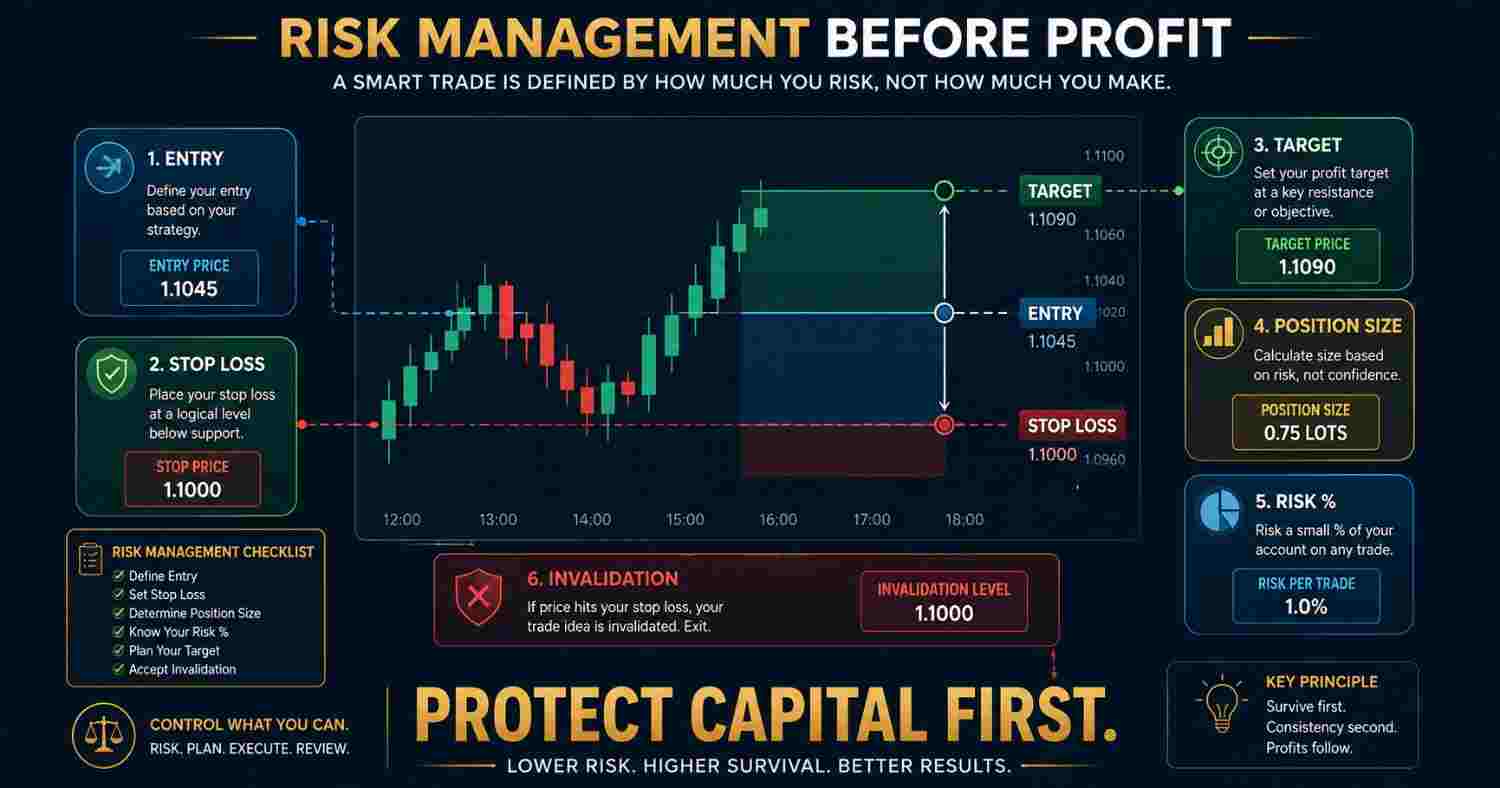
Before entering a trade, establish:
Entry
Where do you plan to enter?
Invalidation
At what price would your trade idea be considered wrong?
Stop-Loss
Where will you exit if the market moves against you?
Target
Where might you take profit?
Position Size
How much capital are you exposing?
Maximum Daily/Weekly Loss
At what point will you stop trading and reassess?
These questions should be answered before the position is opened.
Not after.
4. The AI Trading Scam Problem Is Getting More Serious

This is one of the most important emerging issues for 2026–2030.
The financial industry is not the only sector benefiting from artificial intelligence.
Unfortunately, criminals are benefiting too.
Scammers can use AI to create:
- realistic videos;
- fake experts;
- convincing voices;
- fake testimonials;
- synthetic screenshots;
- fraudulent trading platforms;
- fake social-media profiles;
- fabricated account balances;
- realistic investment presentations.
The SEC has specifically warned that fraudsters use investment group chats, social media and AI-generated impersonations to make fraudulent trading opportunities appear legitimate. In some schemes, victims are shown supposed profits but later asked to pay fees or taxes before they can withdraw their money.
This is not a theoretical problem.
It is a real investor-protection issue.
The “AI + Guaranteed Profit” Red Flag
Be extremely cautious if you encounter marketing that says:
- “Guaranteed AI profits.”
- “Our algorithm never loses.”
- “Guaranteed monthly income.”
- “AI predicts Bitcoin with 99% accuracy.”
- “No experience required.”
- “Zero-risk crypto investment.”
- “Deposit now before access closes.”
- “Our secret algorithm is used by banks.”
- “Pay a small fee to unlock your profits.”
These are not proof of a scam by themselves, but they are major warning signs.
Investor.gov specifically advises investors to be wary of AI investment promotions promising extraordinary returns or claiming that AI systems cannot lose.
And if someone shows you an account displaying enormous profits, remember:
A screenshot is not evidence of withdrawable money.
Never Trust a Trading Group Simply Because Everyone Is Winning
Another major issue heading into the late 2020s is the rise of investment communities on social platforms and messaging applications.
A group may contain hundreds of people.
Everyone may post winning trades.
An “expert” may provide daily commentary.
Members may share screenshots of profits.
Someone may even appear to be a famous investor.
That does not prove legitimacy.
Investor.gov warns that group chats can be used as gateways to investment scams and that fraudsters may impersonate financial professionals or use AI-generated videos and other synthetic media.
The lesson:
Popularity is not verification.
5. Combine Trading Indicators With Market Context
This is where trading tools can become genuinely useful.
A good indicator should not encourage you to stop thinking.
It should help you think more clearly.
Imagine that an indicator produces a BUY signal.
Instead of immediately entering, ask:
Trend
Is the higher timeframe also bullish?
Structure
Is price making higher highs and higher lows?
Support
Is the signal occurring near a meaningful support zone?
Resistance
Is there major resistance directly overhead?
Momentum
Is momentum supporting the setup?
Volatility
Is the market unusually volatile?
News
Is a major economic event approaching?
Risk
Can you define a sensible stop-loss?
If several factors align, the setup may deserve further consideration.
If they conflict, the trader may decide to wait.
That is the difference between using an indicator and obeying an indicator.
Why TradingView Indicators Are Becoming More Popular
TradingView has become a central charting environment for traders who want to analyze different markets from one interface.
This makes TradingView indicators particularly interesting for people who want additional visual tools without constantly changing platforms.
VIP Algos currently markets its indicators for TradingView and says its tools can be used across forex, crypto, gold, stocks, indices, futures, and other markets.
Its current product lineup includes tools for:
- Buy/Sell alerts;
- trend direction;
- support and resistance;
- market scanning;
- chart patterns;
- target zones;
- stop-loss planning;
- technical analysis.
That does not mean the tools predict the market with certainty.
It means they can potentially help organize the information a trader is already trying to interpret.
Where VIP Algos Fits Into the Picture
If you are looking for a commercial trading tool to complement your technical analysis, VIP Algos is one option worth examining.
The current VIP Algos platform describes itself as a collection of premium TradingView indicators and chart-analysis tools. Its directory currently lists 25+ tools, including indicators, scanners, alerts, zone tools, pattern tools and educational resources.
Its main platform currently highlights:
- Buy/Sell chart alerts;
- trend direction;
- chart-pattern recognition;
- possible entry areas;
- Take Profit zones;
- Stop Loss zones;
- support and resistance;
- market scanners;
- TradingView integration;
- trading education;
- setup guidance.
The important word is possible.
The tools are designed to identify potential market conditions.
They are not a guarantee that those conditions will produce a profitable trade.
What Does VIP Algos Actually Offer?

For example, the Trading Signal Suite currently presents Buy/Sell alerts, trend direction, signal strength, setup-quality information, and potential Entry/Take Profit/Stop Loss zones on one dashboard.
The VIP Market Scanner is designed to help traders identify market direction, Buy/Sell alerts, and potential Take Profit/Stop Loss zones.
The Market Prediction Indicator presents a forecast-style line, possible market direction, Buy/Sell areas, and potential target zones.
VIP Algos also offers a Trade Predictor AI product that the vendor describes as an AI-powered TradingView indicator intended to show potential next moves, Buy/Sell signals, expected move size, target levels and alerts.
The company itself emphasizes that its tools are charting-analysis products rather than financial, trading, or investment advice. Its historical examples are also presented as demonstrations rather than guarantees of future performance.
That distinction is exactly what a responsible buyer should want to see.
What VIP Algos Does Not Do
A trading indicator should never be treated as a personal financial adviser.
VIP Algos states that it provides charting analysis tools and does not provide financial, trading or investment advice.
That means the trader remains responsible for decisions such as:
- whether to enter;
- how much to risk;
- where to place a stop;
- whether leverage is appropriate;
- which broker or exchange to use;
- whether the market is suitable;
- whether a particular signal fits the trading plan.
This is important.
The purpose of technology should be to support informed decision-making, not to encourage blind obedience.
What About VIP Algos’ Historical Testing?
VIP Algos currently displays historical chart-testing information, including thousands of chart events and alert examples. Its pages explicitly describe these as historical examples and state that they are not forecasts or guarantees of future performance.
This distinction matters.
A historical chart can show what happened under particular conditions.
It cannot tell you with certainty what will happen tomorrow.
Market conditions change.
Volatility changes.
Liquidity changes.
Trading behaviour changes.
Regulation changes.
The same strategy can behave differently under different market regimes.
Therefore, the correct question is not:
“Did this indicator work in the past?”
The better question is:
“Under what conditions did it work, and how does it fit into my own risk-managed strategy?”
6. Forex and Crypto Regulation Will Matter More Through 2026–2030
Regulation is another major theme investors should follow.
Crypto regulation in particular continues to evolve.
In Europe, the Markets in Crypto-Assets framework—MiCA—has introduced requirements concerning crypto-asset issuers and service providers, including investor-protection, disclosure, and safeguarding provisions.
ESMA’s current MiCA materials include rules requiring crypto-asset service providers to act honestly, fairly, and professionally, provide information that is fair, clear and not misleading, and warn clients about crypto-asset risks.
MiCA also provides supervisory authorities with powers to restrict or prohibit certain crypto-asset activities where investor-protection or market-integrity concerns arise.
These developments matter because crypto markets are gradually becoming more integrated into formal financial regulation.
But traders should not make a dangerous assumption:
Regulation does not mean risk-free.
Regulation Cannot Protect You From Every Bad Trade
Even in a regulated environment, you can lose money because:
- Your market analysis is wrong;
- Your position is too large;
- volatility increases;
- Your stop is triggered;
- a market gap
- liquidity changes;
- you misunderstand a product;
- you use excessive leverage;
- you fall victim to an unrelated scam;
- Your trading strategy stops working.
Regulation can improve market standards.
It cannot guarantee your trading results.
Crypto Trading and the 24/7 Problem
Crypto markets introduce another psychological challenge.
They do not follow the same traditional schedule as many conventional financial markets.
Prices can move while you sleep.
They can move during holidays.
They can move while you are at work.
They can move when you are supposed to be relaxing.
That creates a dangerous temptation:
Always be watching.
But constant monitoring can produce overtrading.
A trader sees a move.
They enter.
The market reverses.
They exit.
Another signal appears.
They enter again.
Soon the trader is no longer following a strategy.
They are reacting emotionally to every candle.
Alerts and scanners can potentially help reduce the need to stare at charts continuously, but they should not become an excuse to trade every alert.
7. Build a Repeatable Trading Process
The final major principle is simple:
Do not build your financial future around individual signals. Build it around a process.
A process can look like this:
Step 1— Choose Your Market
Decide whether you are focusing on forex, crypto, stocks, gold, or another market.
Step 2— Choose Your Timeframe
Decide whether you are studying scalping, intraday, swing, or longer-term setups.
Step 3 — Define Your Setup
Write down exactly what conditions must exist before you consider entering.
Step 4—Add Confirmation
Use price structure, trend, support/resistance, and indicators as appropriate.
Step 5—Define Risk
Know the maximum amount you are willing to lose.
Step 6 — Set Your Exit
Know where the setup becomes invalid.
Step 7—Record the Trade
Document what happened.
Step 8 — Review Your Results
Look for patterns across many trades rather than judging yourself on one result.
This process can help turn trading from emotional guesswork into structured decision-making.
Forex Trading in the 2026-2027 Environment
For the remainder of 2026, traders should keep an eye on the forces that can rapidly change currency markets.
These include:
- interest-rate expectations;
- inflation;
- employment data;
- central-bank decisions;
- geopolitical developments;
- economic growth;
- government debt;
- risk sentiment;
- commodity prices.
A forex pair can move sharply when market expectations change.
This means a technically attractive setup can sometimes fail because a major macroeconomic event changes the market environment.
That is why technical analysis should be used with awareness of the broader environment.
Crypto Trading in the 2026-2030 Environment
Crypto traders face a different collection of risks.
These include:
- extreme volatility;
- regulatory announcements;
- exchange risk;
- cybersecurity incidents;
- liquidity changes;
- token-specific events;
- market sentiment;
- leverage;
- social-media-driven speculation.
Crypto markets can move rapidly in both directions.
This makes position sizing particularly important.
A trader who is comfortable risking a small amount may be able to survive volatility that would destroy an oversized position.
What Could Change Between 2027 and 2030?
Nobody knows exactly what financial markets will look like in 2030.
Anyone claiming to know the exact price of Bitcoin, EUR/USD, or another asset on a particular future date is making a prediction—not reporting a fact.
However, we can identify several areas worth watching.
2027: AI-Assisted Analysis Becomes More Common
Trading platforms will likely continue adding AI-assisted features.
The result may be faster:
- market scanning;
- pattern identification;
- chart summaries;
- alert generation;
- data analysis;
- portfolio monitoring.
But there is a paradox.
Faster information can create faster mistakes.
If a trader receives 100 alerts, that does not mean there are 100 trades worth taking.
2028: Human Psychology May Become an Even Bigger Advantage
As analytical tools become more accessible, technology itself may become less of a differentiator.
Discipline could become more important.
Consider two traders.
Trader A has 30 indicators and no trading plan.
Trader B has three well-understood tools, strict risk management, and a detailed journal.
More technology does not automatically make Trader A better.
The trader who understands their process may have the stronger foundation.
2029: Data Quality Will Matter More
Modern traders already have more data than they can realistically process.
The challenge is filtering it.
Price.
Volume.
Momentum.
News.
Social sentiment.
Economic data.
Blockchain activity.
Technical indicators.
AI-generated summaries.
The future trader may need to become increasingly skilled at distinguishing:
signal from noise.
2030: Technology May Handle More Analysis, But Traders Still Own the Risk
AI may become significantly more capable by 2030.
But someone will still need to decide:
- how much money to risk;
- whether a strategy is appropriate;
- which markets to trade;
- when to stop;
- whether the technology is trustworthy;
- whether the risk/reward makes sense.
The trader may increasingly become a risk manager using intelligent technology.
That is a much healthier vision of the future than the fantasy of a machine that prints money.
How to Use AI Trading Indicators Responsibly
If you decide to use an AI-powered or algorithmic indicator, consider this five-part framework.
1. Understand What the Indicator Shows
Do not use a tool you cannot explain.
Learn what the labels, signals, zones, and alerts actually mean.
2. Test Before Committing Meaningful Capital
Use historical analysis and, where appropriate, paper trading or other controlled testing.
Do not assume a historical chart automatically predicts future results.
3. Use Multiple Forms of Confirmation
Consider:
- market structure;
- trend;
- support/resistance;
- volatility;
- news;
- risk/reward;
- indicator signals.
4. Keep Position Sizes Controlled
A brilliant analysis with excessive risk is still a dangerous trade.
5. Keep Your Own Trading Journal
Record the reason for every trade.
Over time, this can reveal whether your strategy is actually helping you.
Seven Questions to Ask Before Buying Any Trading Indicator
Before purchasing any forex indicator, crypto indicator, or AI trading system, ask these seven questions.
1. Does the product guarantee profits?
If yes, be extremely skeptical.
2. Does it explain the risks?
A legitimate educational product should not hide the possibility of losses.
3. What exactly does the software do?
Does it scan?
Does it alert?
Does it execute?
Does it forecast?
Does it merely display technical information?
Understand the mechanism.
4. Can the claims be independently evaluated?
Historical screenshots are not enough.
5. Is education included?
A tool becomes more useful when the user understands what they are seeing.
6. Does the system encourage risk management?
A good tool should fit into a sensible trading plan.
7. Do you remain in control?
You should know exactly what the product can and cannot do.
Why We Think VIP Algos Is Worth a Look
We are not recommending VIP Algos because we believe it can guarantee profits.
It cannot.
We are recommending that interested readers investigate it as a trading-analysis toolkit because its current offering is aligned with several needs modern traders have.
The platform currently provides multiple TradingView indicators covering areas such as:
- Buy/Sell alerts;
- market direction;
- support and resistance;
- chart patterns;
- market scanning;
- potential target zones;
- Stop-Loss planning;
- technical analysis.
It also provides beginner-oriented educational resources and setup guidance.
That combination is potentially more useful than purchasing a standalone signal and blindly following it.
The product should be viewed as:
Tool + education + personal judgment + risk management.
Not:
Tool = guaranteed income.
The VIP Algos Advantage for a Beginner
One of the biggest challenges facing new traders is information overload.
A new trader can open a chart and immediately see:
- candles;
- moving averages;
- RSI;
- MACD;
- Bollinger Bands;
- trendlines;
- support;
- resistance;
- volume;
- Fibonacci levels;
- economic news;
- dozens of community indicators.
The result?
Confusion.
VIP Algos attempts to simplify parts of this process through visual alerts, trend information, zones, and charting tools. Its current product pages emphasize beginner-friendly setup and TradingView integration.
That does not make the trading decision automatic.
But it can potentially make the chart easier to interpret.
A Smarter Way to Approach the Purchase
If you are considering VIP Algos, do not ask:
“Will this make me rich?”
Ask:
“Will this help me analyze charts more efficiently and follow a disciplined trading process?”
That is the better question.
If you are completely new to trading, spend time learning the basics before risking substantial money.
If you already trade, consider whether the tools add something useful to your current workflow.
If you are already overwhelmed by indicators, adding more software may not be the solution.
The right product is the one that improves your process.
Explore VIP Algos.

If you want to see the current VIP Algos offering for yourself, review the product information, features, terms, and current price directly from the vendor before making a decision.
The current VIP Algos pages describe TradingView-based indicators, Buy/Sell alerts, trend signals, potential target and stop-loss zones, scanners, pattern tools, and educational resources.
The current Trading Signal Suite page, for example, advertises a one-time price of $47 at the time of writing, but pricing and offers can change, so verify the current offer on the vendor page before purchasing.
The Bigger Picture: Trading Technology Is Not the Strategy
This point deserves repeating.
A trading indicator is not a complete financial plan.
A chart scanner is not a risk-management system.
An AI model is not a guarantee.
An alert is not an instruction.
A historical backtest is not your future account balance.
And a profitable trade does not necessarily mean you made a good decision.
Sometimes a bad decision makes money.
Sometimes a good decision loses money.
The purpose of a robust process is to judge decisions over a large sample—not one trade.
The Difference Between Trading and Gambling
There is a simple distinction.
A gambler asks:
“What happens if I bet this money?”
A disciplined trader asks:
“What is my thesis, what invalidates it, how much can I lose, and how will I evaluate the decision afterward?”
The second approach does not guarantee success.
But it creates structure.
That structure is essential.
Your 2026 Trading Checklist
Before opening a trade, ask:
- Is this a market I understand?
- Is the market trending or ranging?
- What timeframe am I using?
- What is the broader market structure?
- Where are support and resistance?
- What does my indicator show?
- What does price action show?
- Is major news approaching?
- Where is my stop?
- Where is my target?
- How much am I risking?
- Does the trade fit my plan?
- Am I entering because of analysis or FOMO?
If you cannot answer these questions, consider waiting.
There will always be another setup.
The Long-Term 2026–2030 Opportunity
The biggest opportunity may not be a particular currency pair or cryptocurrency.
It may be the ability to become a better financial decision-maker.
Technology is democratizing access to information.
AI is making analysis faster.
Trading platforms are becoming more accessible.
Regulation is evolving.
Financial education is becoming easier to access.
But these developments create both opportunity and responsibility.
The person who learns how to use these tools intelligently may be better positioned than someone who simply follows whatever appears on a screen.
That is the difference between technology-assisted trading and technology-dependent trading.
Frequently Asked Questions About Forex and Crypto Trading
Is forex and crypto trading safe for beginners?
Neither forex nor crypto trading is risk-free.
Forex can involve leverage, rapid price movements, spreads, financing costs, and counterparty considerations. The CFTC currently states that about two-thirds of customers at registered OTC forex dealers lose money after costs.
Crypto trading can involve substantial volatility, platform risk, cybersecurity risk, and regulatory uncertainty.
Beginners should therefore focus on education and risk management before committing meaningful capital.
Can AI predict forex prices?
No AI system can guarantee the future direction of a forex pair.
AI can process information and identify patterns, but financial markets remain uncertain.
Claims that an AI system cannot lose or guarantees extraordinary returns should be treated as major warning signs. Investor.gov specifically warns investors about such claims.
Can AI predict cryptocurrency prices?
AI can be used to analyze historical and current information, but it cannot guarantee the future price of Bitcoin or another cryptocurrency.
Crypto markets can be particularly volatile, and unexpected news or market events can invalidate a prediction quickly.
What are AI trading indicators?
AI trading indicators are charting tools that use AI-related or algorithmic methods to help interpret market information.
Depending on the product, they may generate:
- Buy/Sell alerts;
- trend information;
- possible entry areas;
- target zones;
- Stop Loss zones;
- market forecasts;
- pattern recognition;
- alerts.
The exact functionality depends on the product.
What is VIP Algos?
VIP Algos is a TradingView-focused trading-indicator platform. Its current lineup includes multiple charting tools, scanners, alerts, pattern tools, support/resistance tools, and educational resources.
Does VIP Algos automatically trade my account?
The current VIP Algos information describes its products as charting-analysis tools rather than a service that provides financial advice or guarantees results. The Trading Signal Suite, for example, is presented as an indicator that displays alerts, trend information, and potential TP/SL zones on TradingView.
Always check the current product documentation before purchase and before connecting any software to a trading account.
Does VIP Algos guarantee profits?
No.
The vendor’s current pages explicitly state that historical examples are not forecasts and do not guarantee profit, accuracy, income or future performance.
Can beginners use VIP Algos?
VIP Algos currently markets its products to beginners as well as more experienced traders and provides beginner-oriented educational material, setup guidance, and chart-reading resources.
However, beginners should still learn basic trading and risk-management principles before risking significant capital.
Does VIP Algos work with TradingView?
Yes. VIP Algos states that its indicators are designed for TradingView and can be used with a free TradingView account.
Can VIP Algos be used for crypto trading?
The vendor currently says its indicators are designed for markets including crypto, forex, gold, stocks, indices, futures, and other markets.
What is the biggest mistake a beginner can make?
One of the biggest mistakes is treating a trading signal as a guaranteed instruction.
A signal is one piece of information.
A complete trading decision should consider market context, risk, position size, invalidation, timeframe and the trader’s overall strategy.

Final Thoughts: Trade Smarter, Not Louder
The financial markets are changing.
Forex is changing.
Crypto is changing.
Artificial intelligence is changing.
Regulation is changing.
And the way ordinary people access financial information is changing faster than ever.
But one principle remains constant:
Technology cannot eliminate risk.
The best trading indicator in the world cannot guarantee that the next trade will win.
The most sophisticated AI cannot know every future event.
The most beautiful trading dashboard cannot replace discipline.
And no screenshot of someone else’s profits can tell you what will happen to your money.
That is why the smartest approach to forex and crypto trading in 2026–2030 is not to chase certainty.
It is to build capability.
Learn the market.
Understand technical analysis.
Use technology intelligently.
Question extraordinary claims.
Verify platforms.
Understand regulation.
Control leverage.
Protect your capital.
Keep a trading journal.
Test your ideas.
And always know what happens if you are wrong.
Ready to Explore a Smarter Trading Toolkit?
If you are looking for TradingView-based tools that can help organize chart analysis, display potential Buy/Sell alerts, and highlight trend conditions. and map potential target and Stop-Loss areas, VIP Algos is worth investigating.
The current platform offers a broad collection of indicators and charting tools, along with educational resources and setup guidance.
But go into it with the right expectation:
You are buying a tool—not certainty.
Use the technology.
Learn what it does.
Test it.
Combine it with your own analysis.
Manage your risk.
And remain responsible for every trading decision.
Create a Difference for a Better Tomorrow
At Finwirestack, we believe financial technology should empower people—not confuse them.
The future trader should not be the person who blindly follows every signal.
The future trader should be the person who understands the technology, understands the risks and makes decisions with discipline.
AI can help.
Algorithms can help.
Indicators can help.
Education can help.
But you remain the decision-maker.
As we move from August 2026 toward 2027, 2028, 2029, and 2030, that may be the most valuable advantage of all.
Trade with knowledge.
Invest with discipline.
Use technology intelligently.
Protect what you have while building what comes next.
Create a difference for a better tomorrow.
Risk Disclosure
Forex, cryptocurrency, CFDs, leveraged products, and other forms of active trading carry substantial risk and may not be suitable for every person. You can lose some or all of the capital you trade. Never trade money you cannot afford to lose.
Historical performance, backtests, demonstrations, screenshots, testimonials, and hypothetical examples do not guarantee future results.
No AI system, trading algorithm, indicator, signal or software can guarantee profits or eliminate market risk.
Before using a broker, exchange, trading platform, or financial service, independently verify its regulatory status, terms, fees, security, and suitability for your circumstances.
For additional investor-protection information, consult official resources such as the CFTC and Investor.gov.
Sources & Further Reading
Affiliate Disclosure
This article contains affiliate links. If you purchase a product through one of our links, Finwirestack.com may receive a commission at no additional cost to you. We only recommend that you consider products after reviewing their features, limitations, pricing, and risk disclosures for yourself.