Category Artificial Intelligence & Finance

AI vs Human Traders: 11 Powerful Reasons the Future of Trading May Surprise You
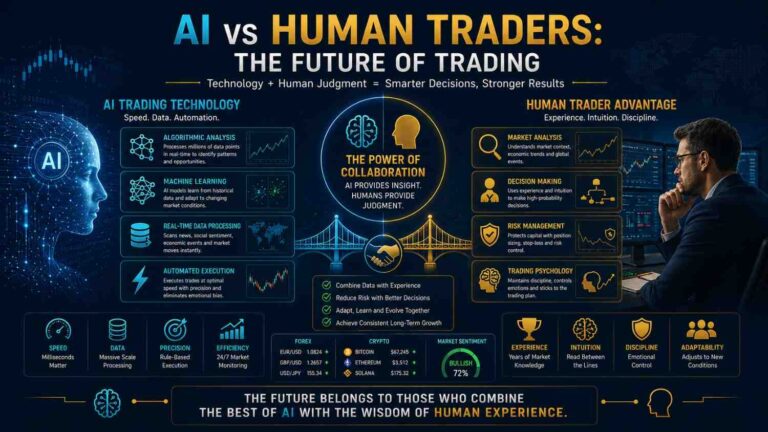
AI vs human traders in the future of trading

For decades, successful trading depended heavily on human skills: experience, discipline, market knowledge, patience, and the ability to interpret changing conditions.

Today, technology is challenging that model.

Artificial intelligence can process enormous amounts of information, recognize patterns, monitor markets continuously, and execute instructions within fractions of a second.

That naturally raises a difficult question:

Will AI replace human traders?

The answer is more complicated than simply choosing between AI vs. human traders.

The financial industry is already moving toward greater use of artificial intelligence. The Bank of England reported in July 2026 that financial firms are increasingly using more autonomous AI systems, although fully autonomous trading remains less established than applications such as research, coding, surveillance, and operational support.

The Bank of International Settlements is also studying how large language model agents could behave as portfolio managers in simulated financial markets through Project Logos.

This suggests that the future is unlikely to be as simple as-

Human traders disappear.

Instead, the more important question may be:

How will human traders use AI to become better traders?


What Does AI vs. Human Traders Actually Mean?

The AI vs. human traders debate compares two fundamentally different approaches to market decision-making.

A human trader relies primarily on:

  • Experience
  • Market interpretation
  • Psychology
  • Judgment
  • Risk tolerance
  • Strategy
  • Context

An AI trading system relies primarily on:

  • Data
  • Algorithms
  • Statistical patterns
  • Computational processing
  • Automated rules
  • Machine learning
  • Execution technology

However, the comparison between AI vs. Human Traders, becomes more interesting when AI and humans work together.

Instead of asking:

AI or human?

we should increasingly ask:

What should AI do, and what should the human trader continue doing?

That distinction could determine who succeeds in the markets between 2027 and 2030.


AI vs Human Traders: 11 Major Differences

AI vs. human traders comparison

1. Speed Favors AI Trading

One of the clearest advantages in the AI vs. human traders debate is speed.

A human trader must:

See โ†’ interpret โ†’ decide โ†’ execute.

An automated system can potentially:

Detect โ†’ calculate โ†’ decide โ†’ execute.

This can happen extremely quickly.

Why Speed Matters

Markets can react rapidly to:

  • Economic announcements
  • Interest-rate decisions
  • Inflation data
  • Employment reports
  • Corporate earnings
  • Geopolitical developments
  • Unexpected news

A human trader may need several seconds or minutes to process information.

An AI trading system can process structured information much faster.

But Speed Does Not Equal Profit

This is an important distinction.

Being faster does not automatically mean being more profitable.

A fast system can execute a bad decision faster.

That means speed is an advantage only when the underlying strategy, risk controls, and data are reliable.


2. Humans Have Better Contextual Judgment

The strongest argument for human traders is not speed.

It is the context of AI vs. Human Traders.

A human trader can sometimes understand that a market event does not fit a historical pattern.

For example, a trader may recognize that:

โ€œThis central-bank announcement is different from previous announcements because the language has changed significantly.โ€

AI can also analyze language and context, but models can misinterpret information or rely on incomplete data.

FINRA warns investors not to rely solely on AI-generated information because AI output can be inaccurate, incomplete, outdated, or misleading.

This remains an important limitation in the AI vs. Human Traders debate.


3. AI Trading Systems Do Not Get Tired

Human traders have physical and psychological limitations.

A trader cannot monitor markets continuously without eventually becoming:

  • Tired
  • Distracted
  • Emotional
  • Impatient
  • Overconfident

AI systems do not need sleep.

They can monitor predefined markets continuously.

The 24/7 Advantage

This is particularly relevant to cryptocurrency markets, which operate around the clock.

An automated system can monitor:

London โ†’ New York โ†’ Asia โ†’ Weekend crypto markets

without requiring a human to remain in front of a screen.

That doesn’t mean every trader needs automation.

It means automation can solve one important human limitation:

attention.


4. Human Traders Understand Psychology Better

Human psychology is one of the greatest sources of trading mistakes.

Common problems include:

  • Fear
  • Greed
  • Revenge trading
  • FOMO
  • Overconfidence
  • Confirmation bias
  • Loss aversion
  • Impulsive entries

A properly designed AI trading system does not experience these emotions.

That gives AI a significant advantage.

However, the human trader has an important advantage in understanding human behavior.

Markets are ultimately influenced by people, institutions, and automated systems.

A skilled trader may recognize:

โ€œTraders are becoming excessively bullish.โ€

That psychological interpretation can sometimes be difficult to capture through purely quantitative signals.


5. AI Can Analyze More Information

Humans have limited cognitive capacity.

An experienced trader might monitor:

  • Several currency pairs
  • Economic calendars
  • Charts
  • News
  • Market sentiment
  • Correlations

But the amount of information quickly becomes overwhelming.

in AI vs. Human Traders, AI can potentially process many more data points simultaneously.

BIS research has demonstrated how AI can be used to monitor financial markets by combining large numbers of market indicators with news analysis.

This is one of the strongest advantages in the AI vs. Human traders comparison.

More Information Can Also Create More Noise

However, more information isn’t necessarily better.

If an AI system processes poor-quality data, it may produce poor decisions.

The principle remains:

Garbage in, garbage out.


6. Human Traders Can Adapt to Unexpected Situations

Markets occasionally produce events that historical data cannot adequately describe.

Examples include:

  • Unexpected political events
  • Sudden financial crises
  • Exchange failures
  • Major cyberattacks
  • Natural disasters
  • Surprise central-bank decisions
  • Unprecedented market shocks

A human trader can stop trading.

That sounds simple, but it is extremely important.

The Human โ€œDo Nothingโ€ Decision

Sometimes the best trading decision is.

Don’t trade.

An automated system may continue executing according to its programming unless appropriate safeguards exist.

The Bank of England has specifically highlighted challenges around validating and bounding autonomous AI systems in financial markets where economic relationships can change quickly.

This is a major reason the AI vs. human traders debate cannot be reduced to technology versus intelligence.


7. AI Is More Consistent

One of the most powerful benefits of AI trading is consistency.

Suppose a trader has a strategy:

Risk 1% per trade.

After three consecutive losses, the human trader may become frustrated.

The next position might suddenly become:

Risk 5%.

That is emotional decision-making.

A properly programmed AI trading system can continue following its risk rules.

Consistency Is Not the Same as Correctness

With AI vs. human traders, AI can consistently execute a bad strategy.

Therefore:

Consistency + bad strategy = consistent losses.

The goal isn’t simply automation.

The goal is disciplined automation built around a tested strategy.


8. AI Can Reduce Emotional Trading

This is perhaps the most practical benefit for struggling traders trying to understand AI vs. human traders.

Many retail traders know exactly what they should do.

Their problem is actually doing it.

For example:

Trading plan: Stop after losing 3 trades.

Reality: โ€œOne more trade will recover everything.โ€

That single decision can destroy an otherwise reasonable trading system.

AI can help enforce predetermined rules.

Where AI Can Help

AI-assisted trading can help with:

  • Entry alerts
  • Position sizing
  • Stop-loss placement
  • Trading limits
  • Exposure monitoring
  • Trade journaling
  • Performance analysis

The human trader can therefore spend more time on strategy and less time fighting emotions.


9. Human Traders Have an Important Advantage: Accountability

An AI system does not take responsibility for a trading loss.

The human trader does.

This creates an important principle:

Technology should support responsibility, not eliminate it.

If an AI trading system loses 20% of an account, the trader cannot simply say:

โ€œThe AI made the decision.โ€

The capital still belongs to the trader.

That means traders using AI must understand the technology they deploy.


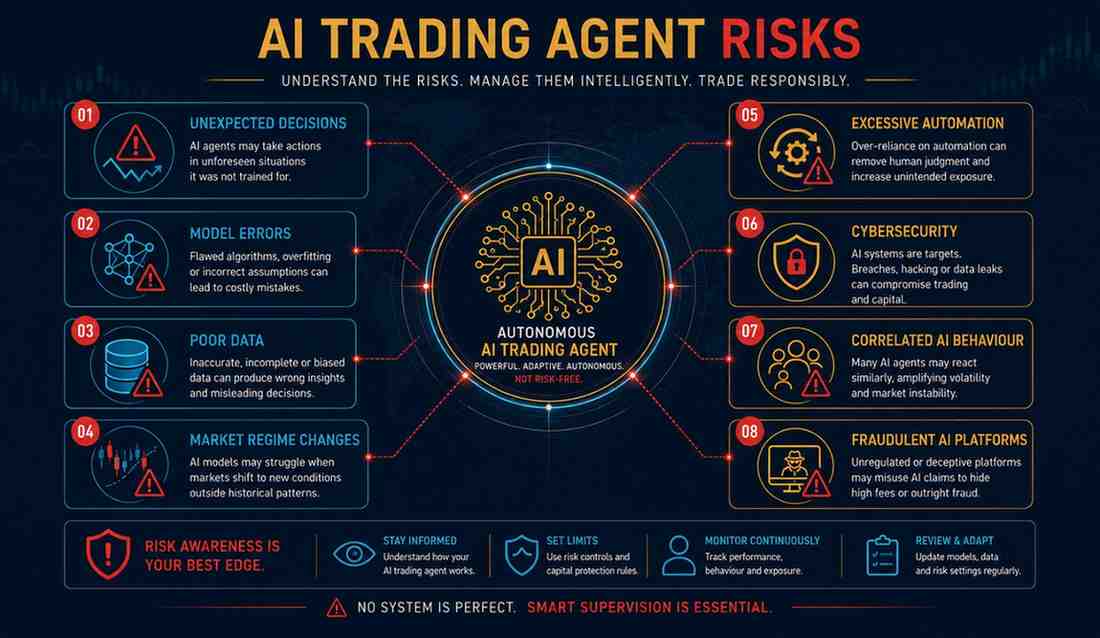
10. AI Creates New Risks
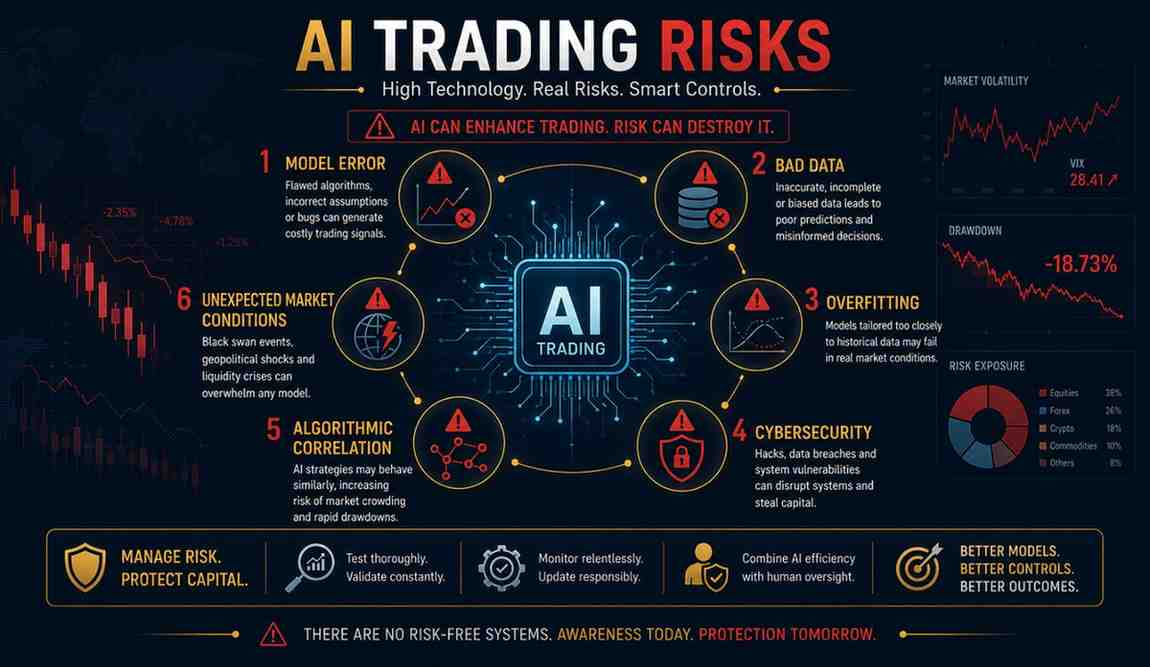
AI trading risks and limitations

The AI vs. human traders discussion often focuses heavily on advantages.

That is dangerous.

AI introduces its own risks.

These include:

  • Model errors
  • Data errors
  • Overfitting
  • Cybersecurity threats
  • Algorithmic feedback loops
  • Correlated trading
  • Technical failures
  • Unexpected model behavior

The Bank of England has highlighted operational and cyber risks associated with greater AI adoption in financial markets.

BIS Project Logos is specifically examining whether LLM-based portfolio agents could produce greater homogeneity in financial decision-making and potentially amplify correlated behavior.

This could become increasingly important as more institutions use similar AI models.


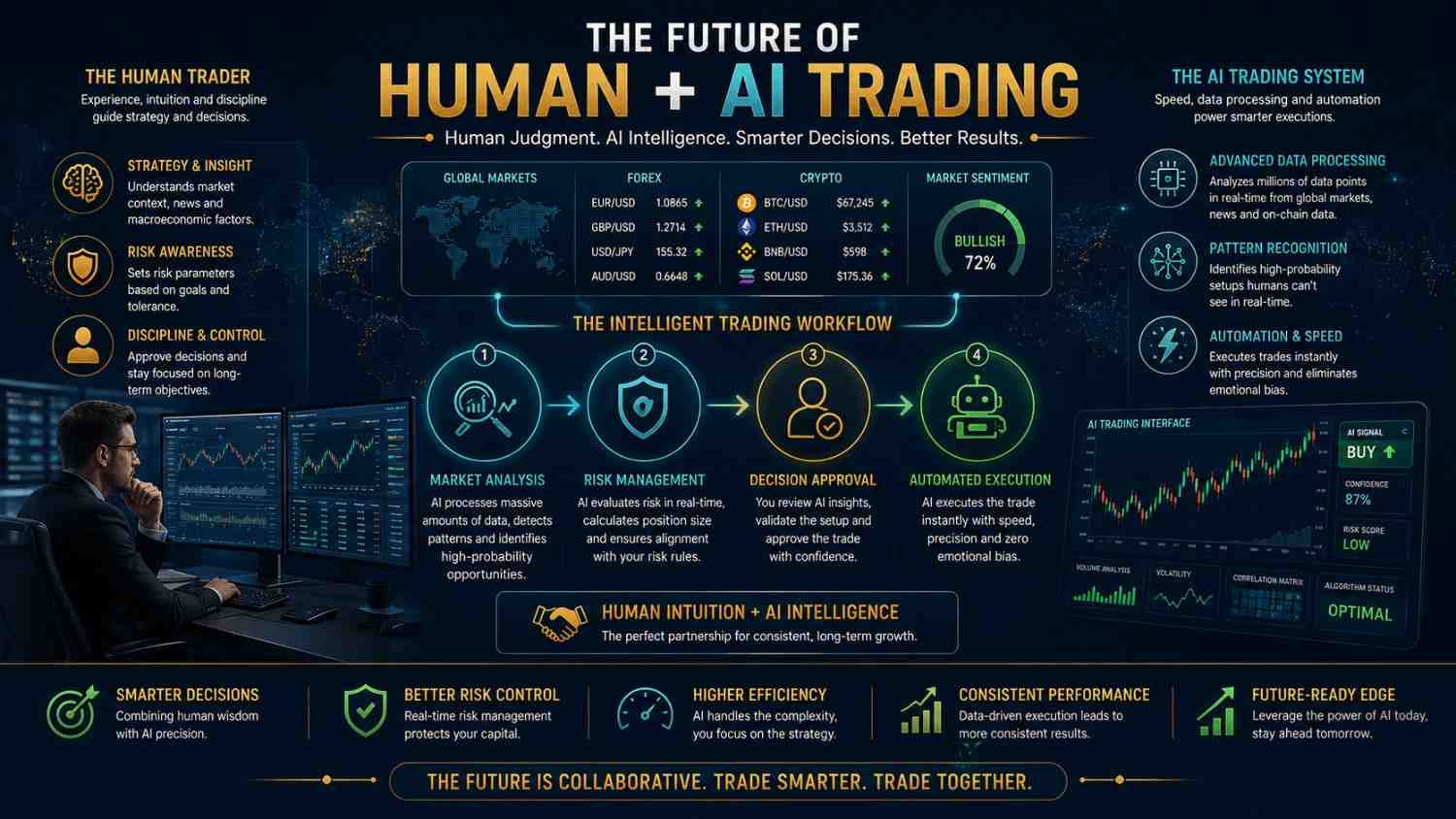
11. The Winner May Be the Human-AI Trader

This may be the most important conclusion of the entire AI vs. human traders debate.

The future may not belong exclusively to AI.

It may belong to traders who know how to combine:

Human judgment + AI analysis + strict risk management.

Consider the following division.

Trading FunctionHumanAI
Market monitoringLimitedExcellent
Data processingLimitedExcellent
Emotional controlVariableStrong
Contextual judgmentStrongImproving
Pattern recognitionStrongExcellent
Continuous monitoringLimitedExcellent
Strategy designStrongHelpful
Risk enforcementVariableExcellent
Unexpected eventsStrongLimited
AccountabilityEssentialNone

This makes the answer to AI vs. human traders much clearer.

The strongest model may be.

Human decides โ†’ AI assists โ†’ Human supervises.


AI Trading vs Human Trading: What Should Beginners Do?

Beginners should not immediately assume that AI will solve their trading problems.

If a trader cannot explain:

  • Risk per trade
  • Stop-loss
  • Drawdown
  • Position sizing
  • Leverage
  • Spread
  • Slippage

Then an AI trading system will not magically make the trader profitable.

In fact, it could make losses happen faster.

Traders interested in automated systems should also read AI Trading Bots: How to Spot the Real Ones From the Scams before connecting software to a live trading account.


AI vs. Human Traders for Forex

Forex provides an interesting environment for comparing humans and AI.

The market operates across major global sessions and produces enormous amounts of price data.

AI systems can analyze:

  • Currency correlations
  • Volatility
  • Technical patterns
  • Economic calendars
  • Interest-rate expectations
  • News sentiment

Human traders can contribute:

  • Macro interpretation
  • Central-bank context
  • Market psychology
  • Strategic judgment

The Best Forex Approach

A practical approach may be;

AI: monitor markets.

AI: Identify potential setups.

Human: evaluate context.

Human: approve high-risk decisions.

AI: execute predefined risk rules.

Human: review performance.

This hybrid model could become increasingly common through 2030.


AI vs. Human Traders in Cryptocurrency

Cryptocurrency creates an even stronger case for automation.

Crypto markets operate continuously.

That makes constant monitoring difficult for humans.

AI can monitor:

  • Bitcoin
  • Ethereum
  • Altcoins
  • Exchange activity
  • Volatility
  • Market sentiment
  • News
  • On-chain information

But cryptocurrency also introduces substantial risks.

Extreme volatility can cause automated strategies to behave unexpectedly.

A bot that performed well during a calm market may struggle during a sudden crash.

This reinforces an important principle:

Never confuse automation with safety.


AI Trading and the Future of Retail Investors

The rise of AI is not limited to professional institutions.

Retail investors are increasingly gaining access to AI-powered tools.

That changes the competitive landscape.

A trader who previously had access to:

Price + indicators + economic calendar

may now have access to:

Price + indicators + news analysis + sentiment + automated monitoring + AI assistants.

This can reduce some technological disadvantages faced by retail traders.

But it creates another danger:

Everyone may start using similar tools.


What Happens If Everyone Uses AI?

This is one of the most fascinating questions surrounding AI vs. human traders.

Imagine thousands of AI systems receiving similar:

  • Price data
  • News
  • Economic information
  • Sentiment
  • Technical signals

If those systems make similar decisions at approximately the same time, the market could experience stronger correlations.

BIS Project Logos is exploring precisely this concern, including whether common AI infrastructure could produce more homogeneous decision-making in financial markets.

The Paradox

AI could make individual traders smarter while making the market more synchronized.

That could potentially increase certain forms of volatility.


Will AI Replace Human Traders by 2030?

Probably not completely.

Instead, we are likely to see several categories of traders.

The Traditional Trader

Uses:

  • Charts
  • Indicators
  • Economic news
  • Manual execution
The AI-Assisted Trader

Uses AI for:

  • Research
  • Analysis
  • Screening
  • Risk monitoring
  • Decision support
The Automated Trader

Uses algorithms for:

  • Signals
  • Entries
  • Exits
  • Risk management
  • Execution
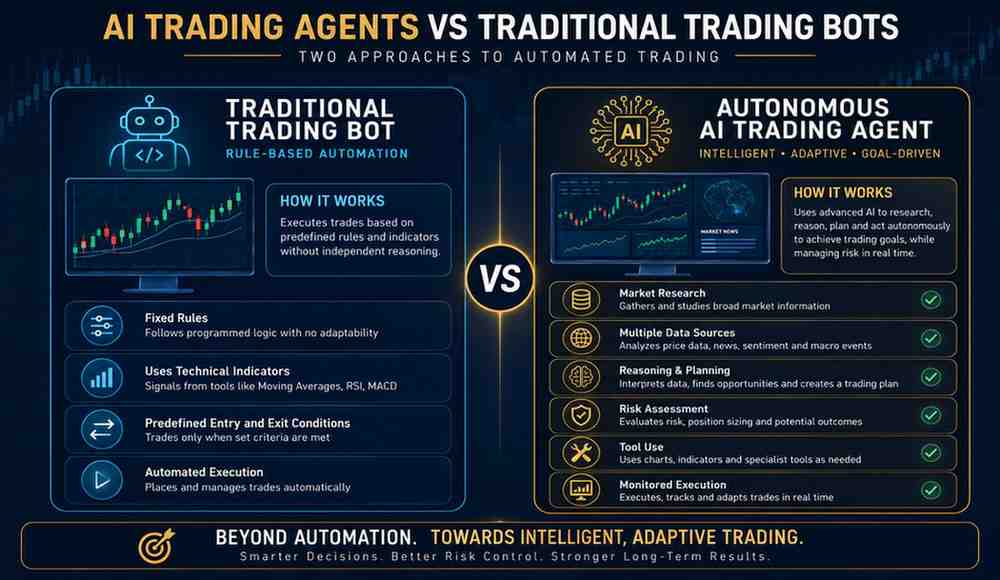
The AI Agent Trader

The emerging category.

AI agents could potentially:

Monitor โ†’ research โ†’ analyze โ†’ decide โ†’ execute โ†’ review

with increasingly limited human intervention.

However, the technology is still developing, and the risks associated with autonomous decision-making remain significant. The Bank of England notes that fully autonomous trading is not yet the dominant use of AI in financial markets.


The Skills Human Traders Will Need by 2030

If AI becomes increasingly powerful, traders should not compete with AI at everything.

Instead, develop skills AI cannot easily replace.

Critical Thinking

Don’t accept every AI-generated conclusion.

Ask:

Why?

Based on what data?

What could make this analysis wrong?

Risk Management

Understand:

  • Position sizing
  • Maximum drawdown
  • Leverage
  • Correlation
  • Stop-losses
  • Capital preservation
AI Literacy

Learn how AI systems work.

You don’t necessarily need to become a machine-learning engineer.

But you should understand:

What data does the model use?

What are its limitations?

Can its output be independently verified?

Market Understanding

AI literacy without financial literacy is dangerous.

The best future trader may therefore be:

Financially educated + technologically capable + psychologically disciplined.


A Practical Human-AI Trading Framework

human AI trading workflow

Instead of asking whether AI vs. human traders will win, the following framework may be more useful.

Stage 1โ€”Human Defines the Strategy

Determine:

  • Market
  • Timeframe
  • Entry criteria
  • Exit criteria
  • Risk
  • Maximum drawdown
Stage 2 โ€” AI Performs Research

Use AI to:

  • Analyze historical information
  • Identify patterns
  • Summarize news
  • Compare scenarios
Stage 3โ€”Human Validates

Ask:

Does this make sense?

Does the evidence support the conclusion?

What could invalidate the setup?

Stage 4 โ€” AI Monitors

AI can monitor the market continuously.

Stage 5โ€”Human Controls Risk

Set maximum acceptable losses.

Stage 6 โ€” AI Executes Where Appropriate

Automation can handle predefined decisions.

Stage 7 โ€” Human Reviews

Analyze:

  • Wins
  • Losses
  • Drawdown
  • Execution
  • Strategy performance

This creates a feedback loop:

Human โ†’ AI โ†’ Human โ†’ AI โ†’ Human

rather than:

Human โ†’ Black Box โ†’ Money


The Dangerous Side of AI Trading

There is another issue traders cannot ignore while understanding AI vs. human traders.

AI can make scams more convincing.

FINRA warns that generative AI is being used by fraudsters to create realistic websites, documents, audio, video, and other deceptive material.

That means the future trader must learn to distinguish:

AI-powered legitimate technology

from

AI-powered marketing fraud.

This is why our AI Investment Scams in 2027 guide remains an important companion to this article.


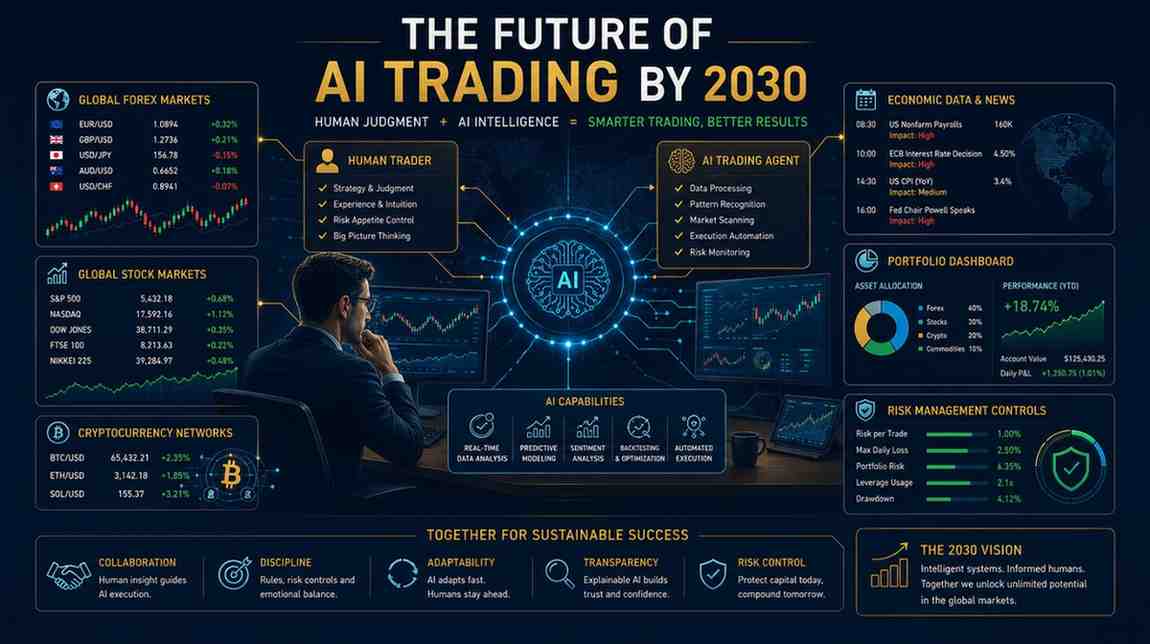
The Future of AI vs. Human Traders From 2027 to 2030

future of trading in 2030 with AI and human traders

The next several years could produce a major transformation in AI vs. human traders.

2027

AI-assisted research and automated trading tools become increasingly accessible to retail traders.

2028

More traders combine AI research, algorithmic execution, and traditional technical analysis.

2029

AI agents become more capable of managing multi-step financial tasks.

2030

The distinction between

Human traders and AI trader may become less important.

Instead, we may see:

human-directed intelligent trading systems.

The Bank of England already identifies AI as a technology capable of transforming financial services while warning that its adoption brings new operational, cyber and financial-stability risks.


7 Mistakes to Avoid When Using AI for Trading

1. Assuming AI Is Always Correct

AI can be wrong.

2. Giving AI Complete Control

Keep appropriate human oversight.

3. Ignoring Risk Management

Automation cannot eliminate financial risk.

4. Believing Guaranteed Returns

No legitimate AI system can guarantee future profits.

5. Copying AI Signals Blindly

Understand why the signal exists.

6. Using Poor Data

Bad data produces bad decisions.

7. Increasing Position Size Because AI โ€œLooks Smartโ€

Technology should never be an excuse to take excessive risk.


AI vs Human Traders: The Final Verdict

So, who wins the AI vs. human traders competition?

Neither side wins completely.

AI is better at:

  • Speed
  • Scale
  • Data processing
  • Consistency
  • Monitoring
  • Automation

Humans remain stronger at:

  • Judgment
  • Context
  • Responsibility
  • Creativity
  • Adaptation
  • Understanding unusual situations

The most powerful combination of AI vs. human traders, may therefore be,

Human judgment + AI intelligence + disciplined risk management.

The trader of 2030 does not necessarily need to defeat AI.

The trader needs to know how to use AI without becoming dependent on it.

That distinction could separate successful traders from those who simply follow technology blindly.

The future isn’t necessarily,

AI replaces humans.

It may instead become:

Humans who use AI replace humans who refuse to adapt.


Frequently Asked Questions

Will AI replace human traders?

AI is likely to automate more trading tasks, but current evidence does not suggest that human traders will simply disappear. Human judgment, context, and oversight remain important.

Is AI better than human traders?

AI is better at certain tasks, such as processing large amounts of data and monitoring markets continuously. Humans remain important for judgment, context, risk decisions, and accountability.

Can AI trading systems make guaranteed profits?

No. AI cannot guarantee future trading profits. Investors should be particularly suspicious of systems promising guaranteed or unusually high returns.

Should beginners use AI trading?

Beginners should first understand trading fundamentals and risk management before relying heavily on AI. AI should be treated as a tool rather than a replacement for financial knowledge.

What is AI-assisted trading?

AI-assisted trading means using artificial intelligence to support activities such as market research, screening, analysis, signal generation, or risk monitoring while keeping a human involved in decision-making.

Will AI trading become more common by 2030?

AI adoption in finance is already increasing. The Bank of England reports growing use of more autonomous AI systems in financial firms, although fully autonomous trading remains less established than other applications.

What is the biggest advantage of human traders?

Human traders can provide judgment, context, and adaptability when market conditions do not resemble historical patterns.

What is the biggest advantage of AI trading?

AI can process large amounts of information quickly and consistently while continuously monitoring markets.

Can AI trading systems lose money?

Yes. AI systems can lose money because models can be wrong, market conditions can change, execution can fail, and historical relationships may not continue.

What is the future of AI vs human traders?

The strongest possibility is increased collaboration. Human traders may increasingly use AI for research, analysis, monitoring, and execution while retaining responsibility for strategy and risk.


AI vs. human traders: information sources.

Bank of Englandโ€”Financial Stability Report, July 2026: AI and financial stability. The report discusses growing AI adoption in financial markets, autonomous systems, operational risks, and the challenges of controlling AI behavior while mastering AI vs. human traders.

BIS โ€” Project Logos: Observing the behavior of LLM-based agents in a simulated financial market environment. This provides important context on AI agents acting as portfolio managers and the potential for correlated decision-making AI vs. human traders.

BISโ€”Harnessing AI for monitoring financial markets: Harnessing artificial intelligence for monitoring financial markets. The research examines how AI can process financial indicators and news to monitor market conditions to help understand AI vs. human traders.

FINRA: Artificial Intelligence (AI) and Investment Fraud. Provides investor guidance on AI-generated misinformation, AI-related investment scams, and the importance of verifying information in AI vs. human traders.

FINRA: Protecting Your Investment Accounts From GenAI Fraud. Explains how generative AI is increasingly being used in investment-account fraud and account takeovers, and how to understand AI vs. human traders.


Financial Disclaimer

FinWireStack provides educational and informational content and does not provide personalized investment, financial, legal, or tax advice. Trading Forex, cryptocurrencies, CFDs, stocks, and other financial instruments involves substantial risk and may result in the loss of some or all of your invested capital. AI trading systems, automated trading strategies, and human trading strategies do not guarantee profits. Past performance does not guarantee future results. Always conduct your own research, understand the risks, and consider consulting an appropriately qualified financial professional before making investment decisions.

AI Trading Bots: How to Spot the Real Ones From the Scams

AI trading bots real vs scams

Are AI Trading Bots Really the Future of Trading?

AI trading bots are becoming increasingly visible across Forex, stocks, cryptocurrencies and other financial markets.

A search for automated trading can produce everything from sophisticated algorithmic systems to inexpensive Expert Advisors, signal services, and websites promising that artificial intelligence can generate consistent profits with almost no effort.

That creates a serious problem for traders.

Which AI trading bots are legitimate?

Which AI trading bots are simply conventional algorithms with an AI label?

And perhaps the most important question:

How can a beginner distinguish genuine AI trading technology from an AI trading bot scam?

The concern is not theoretical.

The U.S. Commodity Futures Trading Commission warns that scammers have promoted AI trading bots with claims of enormous or guaranteed returns, including supposed 100% win rates.

FINRA has also warned about the growth of unregistered automated trading services that claim to be beginner-friendly, risk-free or capable of producing consistently high monthly returns. It specifically identifies โ€œAI washingโ€โ€”exaggerating or falsely claiming AI capabilitiesโ€”as a risk.

That means the growth of AI trading creates two very different opportunities:

Better technology for traders.

and

Better technology for scammers.

This FinWireStack guide explains how AI trading bots actually work, what legitimate systems should look like, the biggest warning signs, how to test an AI trading bot, and what traders should consider before giving any automated system access to their money.


What Are AI Trading Bots?

An AI trading bot is software designed to analyze market information and automatically or semi-automatically assist with trading decisions.

Depending on its design, an AI trading bot may:

  • Analyze price data
  • Identify technical patterns
  • Process market news
  • Generate buy or sell signals
  • Calculate risk
  • Determine position size
  • Execute trades
  • Adjust trading parameters
  • Monitor open positions
  • Close trades automatically

However, the term AI trading bot is used very loosely.

Not every automated trading program is genuinely artificial intelligence.

Traditional Trading Bots

A traditional automated trading system may follow predetermined rules.

For example:

If the 9 EMA crosses above the 20 EMA, open a BUY position.

That is automation.

It does not necessarily involve machine learning.

AI-Powered Trading Bots

A more sophisticated system may use:

  • Machine learning
  • Natural-language processing
  • Neural networks
  • Pattern recognition
  • Sentiment analysis
  • Adaptive algorithms
  • Large language models
  • Multiple data sources

The distinction matters because marketing a simple rule-based Expert Advisor as an advanced AI trading bot can mislead traders.

AI-Assisted Trading

There is also a middle category.

An AI system may provide:

Market analysis โ†’ Signal โ†’ Human approval โ†’ Trade execution

rather than executing every decision independently.

For many traders, this hybrid approach may be more appropriate than completely automated trading.


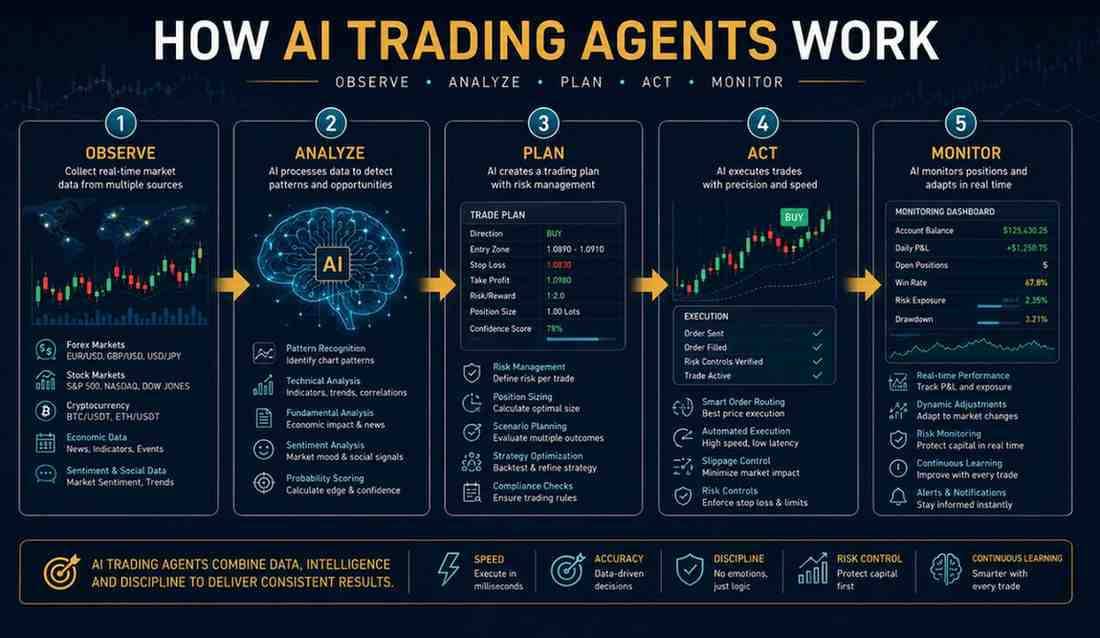
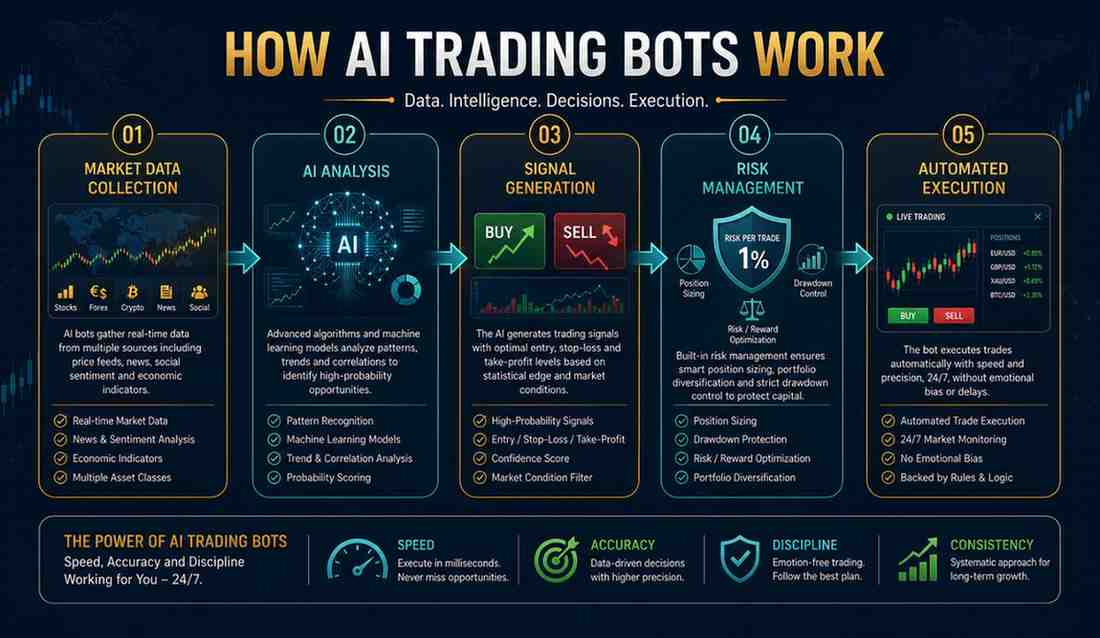
How AI Trading Bots Work

How AI Trading Bots Wor

Understanding the technology is one of the best ways to avoid misleading marketing.

Market Data Collection

A trading bot can collect information such as:

  • Price
  • Volume
  • Candlestick data
  • Technical indicators
  • Economic data
  • News
  • Market sentiment
  • Order-book information
  • Historical market behavior

Historical Data

Historical data allows a system to examine how a strategy would have behaved under previous market conditions.

But historical performance is not proof of future performance.

The CFTC specifically warns that automated programs can be adjusted to historical market activity without providing certainty that similar conditions will continue.

Real-Time Data

Real-time information is required if the system is expected to respond to current market conditions.

Latency, spreads, liquidity, and execution quality can therefore affect actual performance.


Signal Generation

Once data has been collected, the AI trading bot attempts to identify a trading opportunity.

For example, it may detect:

  • A trend
  • A momentum shift
  • A volatility breakout
  • A price anomaly
  • A sentiment change
  • A technical pattern

The system may then generate:

BUY

SELL

or

NO TRADE

A good system should also be capable of determining that doing nothing is sometimes the correct decision.


Risk Management

This is one of the most important components of legitimate automated trading.

A sophisticated system should consider:

  • Stop-loss distance
  • Position size
  • Account equity
  • Maximum drawdown
  • Risk per trade
  • Correlated positions
  • Daily loss limits
  • Exposure by asset

A bot that focuses entirely on entries while ignoring risk management is dangerous.


Trade Execution

The final stage is execution.

Depending on the system, the AI trading bot may send instructions to a broker or trading platform.

This is where another important distinction appears.

A profitable strategy on paper can still perform poorly in live trading.

Reasons include:

  • Spread
  • Slippage
  • Execution delays
  • Liquidity
  • Commissions
  • Market gaps
  • Server interruptions
  • Broker restrictions

Can AI Trading Bots Actually Make Money?

Yes, an automated system can potentially make money.

But that statement is very different from:

โ€œThis AI trading bot will make you money.โ€

No legitimate technology can guarantee future trading profits.

The CFTC explicitly warns that AI cannot predict the future and cautions investors against automated trading schemes promising unreasonable or guaranteed returns.

Recent academic work also illustrates why caution is necessary. A July 2026 study examining AI-assisted cryptocurrency timing models found that several tested policies produced negative results after considering assumed trading costs, reinforcing the importance of realistic testing rather than relying on predictive accuracy alone.

Prediction Is Not the Same as Profit

A model may correctly identify market direction frequently and still lose money.

Why?

Because profitability depends on:

Entry + exit + position size + costs + risk + market conditions

A system with a high prediction accuracy can therefore still produce poor returns.


The Biggest AI Trading Bot Red Flags

AI trading bot scams and red flags

This is the section every trader should save.

1. Guaranteed Profits

If an AI trading bot claims:

โ€œGuaranteed 20% every month.โ€

Stop.

If it says:

โ€œZero losing trades.โ€

Stop.

If it says:

โ€œOur AI never loses.โ€

Stop.

Investments involve risk, and regulators repeatedly warn that guaranteed high returns are a major fraud warning sign.


2. Unrealistic Win Rates

A website advertising:

99% win rate

should immediately raise questions.

Ask:

  • Over what period?
  • Which market?
  • Which broker?
  • What timeframe?
  • What account size?
  • Was the result live?
  • Was it independently audited?
  • Are losing trades included?
  • What was the maximum drawdown?

A win rate without context tells you very little.


3. โ€œAIโ€ With No Explanation

A legitimate provider doesn’t necessarily need to reveal its proprietary source code.

But it should explain its technology at a reasonable level.

Warning Signs

Be cautious when a provider repeatedly uses terms such as:

Deep Learning

Quantum AI

Neural Engine

Institutional Algorithm

Predictive AI

without explaining what these technologies actually do.

FINRA specifically warns investors to be skeptical of vague or overstated AI claims and recommends asking providers to explain their technology with specificity.


4. AI Washing

AI washing occurs when a company exaggerates or falsely claims its use of artificial intelligence.

For example:

A conventional moving-average strategy could be marketed as:

โ€œProprietary institutional AI technology.โ€

That doesn’t automatically make the product fraudulent, but it makes verification essential.

FINRA specifically identifies AI washing as a growing concern in automated trading services.


5. Fake Trading Results

Be suspicious of screenshots showing:

$500 โ†’ $50,000

in a few weeks.

A screenshot is not audited evidence.

Better Evidence

Look for:

  • Verified live accounts
  • Long-term track records
  • Maximum drawdown
  • Complete trade history
  • Independent verification
  • Broker statements
  • Clear methodology
  • Realistic assumptions

6. Pressure to Deposit

A legitimate provider should not need to pressure you.

Warning phrases include:

โ€œDeposit today.โ€

โ€œOnly 10 accounts remaining.โ€

โ€œAI opportunity expires tonight.โ€

โ€œVIP investors only.โ€

Investor.gov identifies pressure to act immediately as a classic investment-fraud warning sign.


7. Unregistered or Anonymous Operators

If you cannot determine:

  • Who owns the company
  • Where it is registered
  • Who operates the service
  • Where client funds are held
  • Which regulator oversees it

do not send money simply because the website looks professional.

FINRA recommends researching automated trading providers and verifying claims about relationships with registered firms.


AI Trading Bot Scams: How the Fraud Usually Works

An AI trading bot scam may follow a predictable pattern.

Step 1 โ€” The Advertisement

You see an advertisement claiming:

โ€œOur AI predicts the market.โ€

Step 2 โ€” The Social Proof

The website displays:

  • Luxury cars
  • Expensive homes
  • Trading screenshots
  • Testimonials
  • Celebrity endorsements
Step 3 โ€” The Small Deposit

You are encouraged to start with a relatively small amount.

Step 4 โ€” Fake Profits

The dashboard begins displaying profits.

Your account appears to grow.

Step 5 โ€” Larger Deposits

You are encouraged to deposit more.

Step 6 โ€” Withdrawal Problems

When you request your money, the platform may demand:

  • Tax
  • Verification fee
  • Withdrawal fee
  • Security deposit
  • Account upgrade
  • Blockchain fee
Step 7 โ€” More Pressure

The scammer may tell you:

โ€œPay the fee or your account will be frozen.โ€

This is a major warning sign.

Investor.gov warns that scammers can use fake websites, fake trading information and manipulated account displays to make victims believe their investments are profitable.


How to Test an AI Trading Bot Before Using Real Money

Never start with a large deposit.

Step 1โ€”Understand the Strategy

Ask:

What exactly causes the bot to enter a trade?

What causes it to exit?

How does it determine position size?

What happens during extreme volatility?

If the provider cannot explain the system adequately, be cautious.


Step 2 โ€” Request a Demo

Use a demo environment before committing real capital.

Test:

  • Execution
  • Frequency
  • Drawdown
  • Trade duration
  • Spread sensitivity
  • Behavior during volatile markets

Step 3โ€”Backtest Properly

Backtesting can be useful, but poor backtesting can produce misleading results.

Avoid Overfitting

A strategy can be optimized so aggressively for historical data that it performs poorly in live markets.

H4: Include Trading Costs

Testing should account for:

  • Spread
  • Commission
  • Slippage
  • Swap
  • Platform costs

Test Different Market Conditions

A bot should ideally be examined during:

Trending markets

Range-bound markets

High-volatility markets

Low-volatility markets

Major news events


Forward Testing Is More Important Than a Beautiful Backtest

After backtesting, run the AI trading bot in a live market environment without risking substantial capital.

This is called forward testing.

It can reveal differences between:

Backtest performance

and

real-world execution.

That difference can be substantial.


What a Legitimate AI Trading Bot Should Disclose

A credible provider should make it possible for traders to understand the product.

Strategy Information

The provider should explain the general strategy.

Risk Information

It should disclose that losses are possible.

Performance Information

Performance claims should have context.

Fees

You should know about:

  • Subscription fees
  • Performance fees
  • Broker fees
  • Spreads
  • Commissions

Data Requirements

If the bot requires access to your trading account, understand exactly what information it receives.

Account Permissions

Be extremely careful about providing account credentials.

FINRA specifically warns that giving unregistered auto-trading services brokerage credentials can create serious privacy and financial-security risks.


Should an AI Trading Bot Have Full Access to Your Account?

Prefer systems that use secure authorization mechanisms rather than asking for your main brokerage password.

If a provider says:

โ€œSend us your broker username and password.โ€

stop and investigate.

You should understand:

  • What permissions are granted
  • Whether withdrawals can be initiated
  • Whether trades can be placed
  • Whether credentials are stored
  • Who can access them
  • How access can be revoked

Never assume that a sophisticated-looking interface automatically means sophisticated cybersecurity.


AI Forex Trading Bots vs AI Crypto Trading Bots

AI trading bots can operate across different markets, but each market has different characteristics.

AI Forex Trading Bots

Forex bots may operate around:

  • Currency pairs
  • Economic releases
  • Interest-rate decisions
  • Central-bank announcements
  • Trading sessions
  • Volatility changes

Forex also involves significant leverage risk.

The CFTC notes that most retail forex traders lose money and warns that automated programs cannot guarantee that historical market relationships will continue.

AI Crypto Trading Bots

Crypto bots may face:

  • 24/7 markets
  • Extreme volatility
  • Liquidity differences
  • Exchange outages
  • Token-specific risks
  • Rapid market sentiment changes

The always-open nature of cryptocurrency markets can make automated monitoring particularly attractiveโ€”but it can also expose poorly designed systems to continuous market risk.


AI Trading Bots for Beginners: Are They a Good Idea?

Beginners should be particularly careful.

An AI trading bot can make trading appear easy.

That creates a dangerous psychological effect:

If the computer does everything, I don’t need to learn anything.

That is wrong.

In AI Trading Bots, a beginner should understand at least:

  • Risk management
  • Leverage
  • Drawdown
  • Position sizing
  • Stop losses
  • Spread
  • Slippage
  • Market volatility
  • Trading psychology

Our Risk Management Mastery: 7 Proven Strategies guide is particularly useful before experimenting with automated systems.

And traders who don’t yet understand chart structure can start with How to Read Forex Charts: A Beginner’s Guide.


AI Trading Bots and the Human Trader

The strongest approach may not be:

100% manual

or

100% automated.

A hybrid approach can combine both.

Human Responsibilities

The trader determines:

  • Risk tolerance
  • Trading objectives
  • Maximum acceptable drawdown
  • Capital allocation
  • Markets to trade

AI Responsibilities

The system can assist with:

  • Data analysis
  • Signal generation
  • Monitoring
  • Execution
  • Risk alerts
  • Trade journaling

This creates a useful division:

Human chooses the rules.

AI helps enforce the rules.


AI Trading Bots in 2027: What Will Change?

human and AI trading bots working together in 2027

Icon Label

The technology is likely to become increasingly sophisticated.

More Multimodal Analysis

Future systems may combine:

  • Price charts
  • News
  • Earnings reports
  • Economic calendars
  • Social sentiment
  • Alternative data

More Agentic Trading

AI trading agents may increasingly be capable of:

Observe โ†’ Analyze โ†’ Decide โ†’ Execute โ†’ Monitor โ†’ Adjust

This is a natural progression from today’s simpler automated trading systems.

More Regulation

As AI becomes more involved in financial services, regulators are likely to pay greater attention to:

  • AI claims
  • Automated advice
  • Consumer protection
  • Data security
  • Algorithmic accountability
Better Fraud Detection

AI will also be used to identify suspicious investment activity.

Unfortunately, scammers will use AI too.

That means traders will need to become increasingly sophisticated at verifying financial products.


The Future Problem: AI Trading Bot vs AI Trading Bot

By 2030, the challenge may not simply be:

Human trader vs market.

It may increasingly become:

AI system vs. AI system.

If thousands of automated systems analyze similar information and respond to similar signals, market behavior could change.

This creates questions about:

  • Crowded trades
  • Algorithmic feedback loops
  • Volatility spikes
  • Liquidity
  • Correlated strategies

AI may therefore improve trading technology while simultaneously introducing new forms of market complexity.


10 Questions to Ask Before Buying an AI Trading Bot

Before paying for any AI trading bot, ask:

1. What exactly makes this system โ€œAIโ€?
2. Who owns the company?
3. Is the company regulated where required?
4. Can I verify the performance independently?
5. What is the maximum historical drawdown?
6. Does the performance include spreads and commissions?
7. What happens when the market changes?
8. What permissions does the software require?
9. Can I withdraw my money without additional payments?
10. Does the company guarantee profits?

If the answer to the final question is yes, walk away.


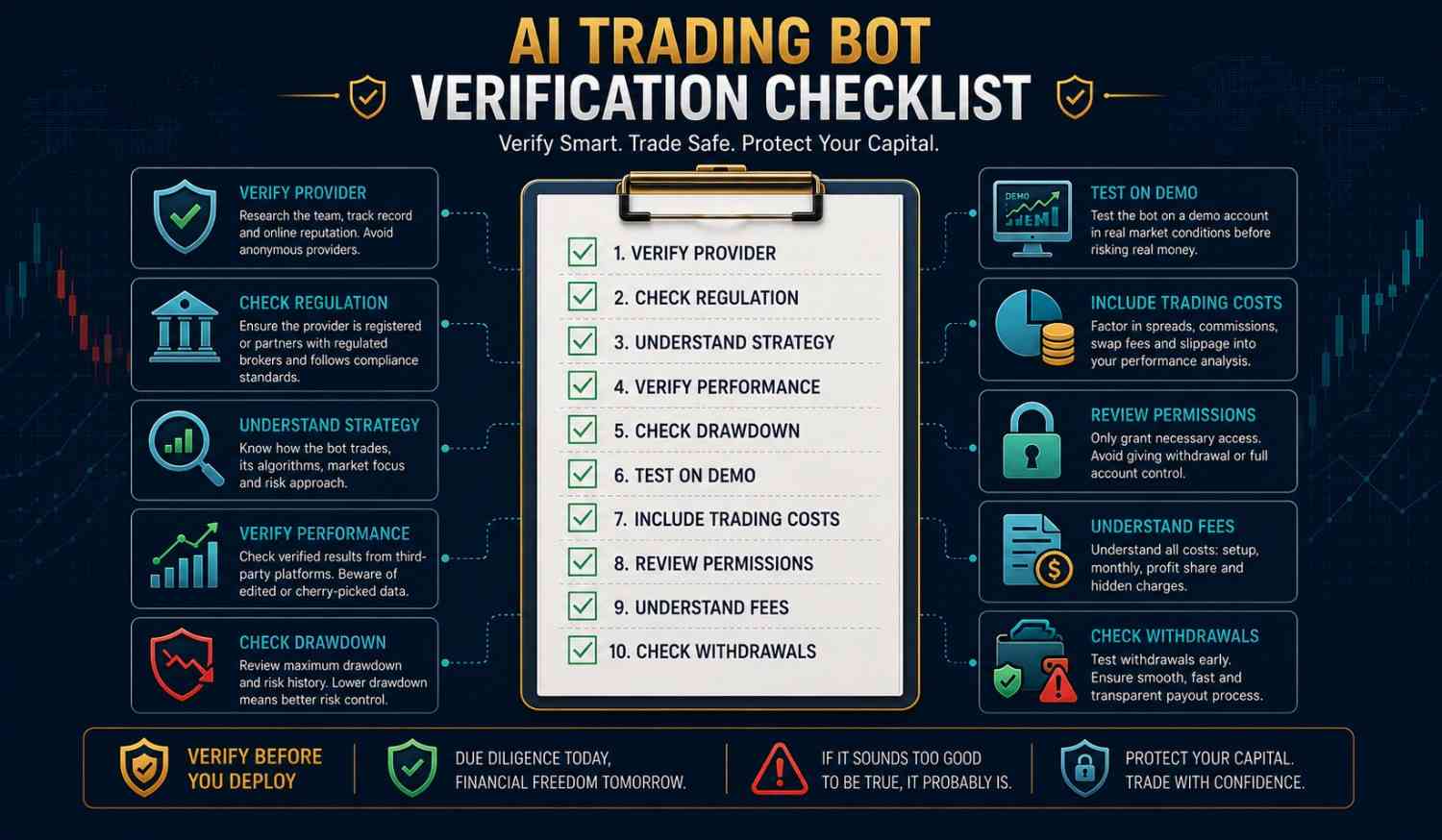
AI Trading Bot Selection Checklist

Before connecting an AI trading bot to a live account:

โ˜ Understand the trading strategy

โ˜ Verify the company

โ˜ Check regulatory status where applicable.

โ˜ Verify performance independently

โ˜ Examine maximum drawdown

โ˜ Test on a demo account

โ˜ Conduct realistic backtests

โ˜ Include spreads and commissions

โ˜ Forward-test the system

โ˜ Understand account permissions

โ˜ Protect broker credentials

โ˜ Check withdrawal procedures

โ˜ Understand subscription fees

โ˜ Avoid guaranteed-return claims.

โ˜ Avoid pressure to deposit

โ˜ Never invest money you cannot afford to lose.


What Makes an AI Trading Bots Legitimate?

legitimate AI trading bot verification checklist

There is no single feature that proves a bot is legitimate.

Instead, look for a combination of:

Transparency

Verifiable ownership

Appropriate registration

Realistic performance claims

Clear risk disclosures

Understandable technology

Secure account permissions

Transparent fees

Independent verification

No guaranteed profits

The more a provider refuses to explain, the more cautious you should become.


AI Trading Bots vs. Manual Trading

FeatureManual TradingAI Trading Bots
ExecutionHumanAutomated
SpeedHuman-dependentPotentially very fast
EmotionsMajor factorReduced during execution
MonitoringRequires traderCan be continuous
StrategyHuman rulesProgrammed/AI-assisted
Risk of technical failureLowerHigher
AdaptabilityHuman judgmentDepends on model
OverconfidenceHuman-drivenCan come from model marketing
Learning requirementHighStill essential
Guaranteed profitsNoNo

Automation doesn’t eliminate risk.

It changes the source of the risk.


The Biggest Mistake Traders Make With AI Trading Bots

The biggest mistake isn’t necessarily choosing the wrong indicator.

It is believing:

โ€œBecause AI is involved, the system must be smarter than me.โ€

AI can process enormous quantities of information.

It can analyze patterns.

It can automate execution.

But markets remain uncertain.

A model can be wrong.

A strategy can stop working.

A broker can experience execution problems.

A market regime can change.

And an apparently legitimate platform can still expose users to operational or cybersecurity risks.

FINRA advises investors to continue monitoring their accounts even when using automated services provided by regulated entities, ensuring activity remains consistent with their goals and risk tolerance.


Final Verdict: Should You Use AI Trading Bots?

AI trading bots can be useful tools.

They can automate repetitive tasks, analyze large datasets, enforce trading rules, and potentially reduce emotional interference.

But they are not money-printing machines.

A legitimate AI trading bot should never need to promise:

Guaranteed profits.

No losing trades.

100% accuracy.

Risk-free returns.

Those claims should immediately make you investigate further.

The safest approach is to treat AI trading bots as technology requiring verification, not as financial shortcuts.

Learn the market.

Understand the strategy.

Test the technology.

Measure drawdown.

Verify the provider.

Protect your account.

And most importantly:

Never allow the word โ€œAIโ€ to replace due diligence.

The traders who benefit most from AI between 2027 and 2030 may not be those who blindly automate everything.

They may be the traders who understand where AI helps, where AI fails, and when a human should remain in control.


Frequently Asked Questions

What are AI trading bots?

AI trading bots are software systems that use automated rules, machine learning, artificial intelligence or related technologies to analyze financial markets and generate or execute trading decisions.

Are AI trading bots profitable?

Some of AI trading Bots’ automated trading strategies can be profitable under particular conditions, but profitability is never guaranteed. Performance can change when market conditions, costs, or liquidity change.

Are AI trading bots scams?

Not necessarily. Legitimate automated trading technology exists, but scammers also use AI marketing to promote fraudulent investment schemes. Regulators, including the CFTC and FINRA, have warned about these practices.

Can AI trading bots guarantee profits?

No. Guaranteed trading profits are a major warning sign. The CFTC specifically warns against AI trading schemes making unreasonable or guaranteed-return claims.

Can AI trading bots trade Forex?

Yes. Automated systems can trade Forex when connected to a compatible trading platform and broker, but the risks of leverage, spread, slippage, and changing market conditions remain.

Can AI trading bots trade cryptocurrency?

Yes. Crypto trading bots can operate on supported exchanges, although cryptocurrency markets can experience significant volatility and liquidity differences.

Are AI trading bots good for beginners?

Beginners should be cautious. Automated trading does not remove the need to understand risk management, leverage, drawdown, execution, and the underlying strategy.

How can I identify a legitimate AI trading bots?

Investigate the company, regulatory status, ownership, technology, performance evidence, fees, security permissions, and withdrawal procedures. Be particularly skeptical of guaranteed-return claims.

What is AI washing?

AI washing is the practice of exaggerating or falsely claiming the use or capabilities of artificial intelligence. FINRA specifically identifies AI washing as a risk in automated trading services.

Can AI predict the stock or Forex market?

With AI trading bots, AI can analyze information and generate forecasts or signals, but it cannot reliably predict the future with certainty. Market conditions can change unexpectedly.


Sources

CFTC: Customer Advisory: AI Wonโ€™t Turn Trading Bots into Money Machinesโ€”primary source for warnings about AI trading bots, guaranteed returns, and automated trading scams.

FINRA: Know the Risks of Auto-Trading Services Offered by unregistered entitiesโ€”particularly useful for AI washing, unregistered auto-trading services, credentials, and performance claims.

FINRA: Artificial Intelligence (AI) and Investment Fraudโ€”guidance on AI-related investment fraud and unreliable AI-generated information.

Investor.gov: Artificial Intelligence (AI) and Investment Fraud: Investor Alert โ€” SEC/NASAA/FINRA investor guidance on AI investment fraud.

CFTC: Forex Fraudsโ€”useful for Forex-specific fraud and automated trading risks.

Investor.gov: Protect Your Money: How to Avoid Investment Scamsโ€”In AI Trading Bots, general investment-scam prevention guidance.


Financial Disclaimer

FinWireStack provides educational and informational content and does not provide personalized investment, financial, legal, or tax advice. Trading Forex, cryptocurrencies, CFDs, stocks, and other financial instruments involves substantial risk and may result in the loss of some or all of your invested capital. AI trading bots and automated trading systems do not guarantee profits, and past performance does not guarantee future results. Always conduct your own research, verify the regulatory status of financial service providers where applicable, understand the risks, and consider consulting a qualified financial professional before making investment decisions.

AI Is Moving From the Trading Desk to the Everyday Investor

Investment Platforms in 2027 transforming modern investing

AI Investment Platforms in 2027 could fundamentally change how ordinary people research markets, build portfolios, and make long-term investment decisions.

For years, sophisticated artificial intelligence and quantitative systems were largely associated with institutional investors, hedge funds and large financial institutions.

That is changing rapidly.

Today, retail investors can access tools that can summarize financial information, analyze companies, compare investments, monitor portfolios, identify patterns, and provide personalized financial guidance.

At the same time, investors are showing increasing interest in artificial intelligence-related investments. Recent Charles Schwab data reported continued retail buying interest in AI stocks despite market volatility.

But there is another side to the story.

The U.S. SEC, FINRA and NASAA have warned that criminals are already using the popularity of AI to promote fake investment platforms, unrealistic returns and fraudulent trading systems. Investor.gov also warns investors not to rely solely on AI-generated information because AI can produce inaccurate, incomplete or misleading information.

So the real question isn’t:

โ€œWill AI replace investing?โ€

The better question is:

โ€œHow should investors use AI without allowing AI to make dangerous financial decisions for them?โ€

That is what this guide explores.


What Are AI Investment Platforms?

AI investment platforms are financial technology services that use artificial intelligence, machine learning, large language models or related algorithms to assist with investment-related tasks.

Depending on the platform, AI may help investors with:

  • Stock research
  • Portfolio analysis
  • Asset allocation
  • Risk assessment
  • Market research
  • Financial planning
  • Portfolio rebalancing
  • Investment screening
  • News analysis
  • Tax-aware strategies
  • Retirement planning
  • Automated investing

However, not every platform using the word AI actually provides sophisticated artificial intelligence.

Some platforms use traditional algorithms and simply add AI-powered interfaces.

Others may combine:

Traditional financial models + machine learning + generative AI + human advisers.

Therefore, investors should examine what the technology actually does rather than assuming that every platform marketed as โ€œAI-poweredโ€ has the same capabilities.


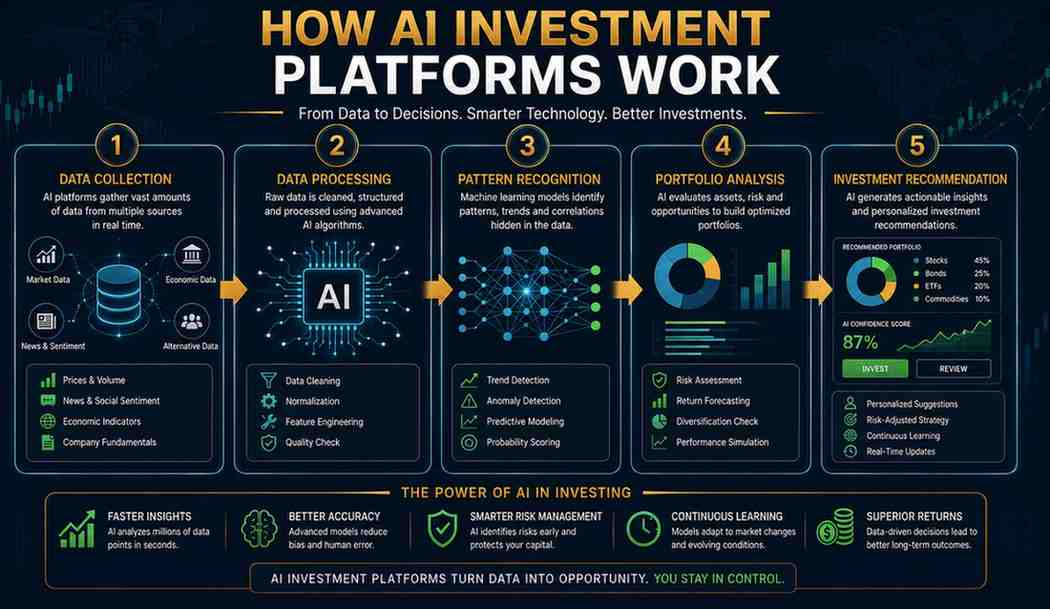
How AI Investment Platforms in 2027 Could Work

how AI investment platforms in 2027 work

A modern AI investment platform may combine several layers of technology.

1. Data Collection

The system can collect large amounts of information, including

  • Company financial statements
  • Market prices
  • Economic data
  • Interest rates
  • Earnings reports
  • News
  • Analyst information
  • Portfolio data
  • Investor objectives

2. Data Processing

AI systems can process and organize large datasets much faster than an individual investor could manually.

3. Pattern Recognition

Machine-learning systems can identify relationships and patterns within historical and current information.

4. Portfolio Analysis

The platform may examine:

  • Asset allocation
  • Concentration
  • Risk exposure
  • Correlation
  • Diversification
  • Volatility

5. Recommendations or Actions

Depending on the service, the platform may provide:

  • Investment ideas
  • Portfolio recommendations
  • Risk alerts
  • Rebalancing suggestions
  • Automated transactions

The level of automation varies significantly.

Some systems simply provide information.

Others can recommend investments.

Some may eventually execute trades automatically after receiving authorization.


9 Powerful Ways AI Investment Platforms in 2027 Could Change Investing

1. AI Could Make Investment Research Faster

Traditional investment research can take hours.

An investor might need to examine:

  • Annual reports
  • Earnings releases
  • Financial ratios
  • Industry trends
  • Competitor performance
  • Economic conditions
  • Analyst opinions

AI can potentially help organize this information much faster.

For example, an investor could ask:

โ€œSummarize the most important financial developments affecting this company over the last year.โ€

The AI could organize information into categories such as:

  • Revenue
  • Profitability
  • Debt
  • Growth
  • Competition
  • Risks
  • Management

This doesn’t mean the answer is automatically correct.

It means the investor has another research tool.

That distinction is crucial.


2. AI Could Personalize Investment Portfolios

Traditional investment advice often begins with broad categories:

Conservative

Moderate

Aggressive

AI could potentially make portfolio construction more personalized.

Instead of simply asking:

โ€œWhat is my risk profile?โ€

an AI system could consider:

  • Age
  • Investment horizon
  • Income
  • Savings
  • Financial goals
  • Liquidity needs
  • Existing investments
  • Risk tolerance
  • Spending patterns

Emerging research published in August 2026 is exploring AI systems capable of producing personalized, tax-aware portfolio recommendations based on natural-language financial goals.

That points toward an important shift:

Investors may increasingly describe their financial objectives in normal language rather than filling out complicated investment questionnaires.


3. AI Could Improve Portfolio Monitoring

Investors often make a portfolio and then forget to monitor whether it still matches their objectives.

AI systems could continuously examine:

  • Portfolio concentration
  • Sector exposure
  • Geographic exposure
  • Volatility
  • Correlations
  • Cash allocation
  • Changes in risk

For example:

Technology exposure: 42%

An AI system could alert the investor:

โ€œYour technology allocation has increased significantly relative to your original portfolio target.โ€

The investor can then decide whether rebalancing is appropriate.

The important word is decide.

AI should provide useful information rather than automatically becoming the final authority over your money.


4. AI Could Make Financial Education More Accessible

One of the most promising applications is education.

A beginner can ask:

โ€œWhat is an ETF?โ€

Then:

โ€œHow does an ETF make money?โ€

Then:

โ€œWhat is the difference between an ETF and an individual stock?โ€

Then:

โ€œHow would a diversified portfolio use ETFs?โ€

This creates an interactive learning environment.

For investors who are overwhelmed by financial terminology, AI could act as a personalized educational assistant.

This is especially valuable for new investors who may otherwise make decisions based on social media posts, influencers or incomplete information.

Our Trading vs Investing: Which Strategy Is Right for You? guide provides another useful foundation for understanding whether active trading or long-term investing better fits a particular objective.


5. AI Could Help Investors Identify Portfolio Risk

Risk management is one area where AI could become particularly useful.

Instead of simply asking:

โ€œWill this stock go up?โ€

an investor could ask:

โ€œWhat could cause my portfolio to lose 20%?โ€

The system could examine possible vulnerabilities such as:

  • High concentration
  • Interest-rate sensitivity
  • Currency exposure
  • Sector correlation
  • High-growth valuation exposure
  • Emerging-market exposure
  • Commodity dependence

This is a much healthier way to use AI.

The objective isn’t to ask AI to predict the future.

It is to use AI to better understand possible scenarios.

Investors and traders can also strengthen their broader risk framework through Risk Management Mastery: 7 Proven Strategies.


6. AI Could Make Automated Investing More Intelligent

Traditional automated investing generally relies on predefined rules.

AI could make automation more adaptive.

For example:

Traditional system:

Maintain 60% stocks and 40% bonds.

AI-enhanced system:

Monitor the investor’s objectives, risk tolerance, portfolio exposure and market conditions, then identify whether the portfolio has materially deviated from its intended strategy.

The second approach has greater complexity.

But complexity isn’t automatically better.

Investors need to understand exactly what the system is permitted to do.


7. AI Could Transform Stock Screening

Stock screening is another area where AI could save time.

Instead of manually filtering thousands of companies, investors could search for combinations such as:

  • Strong revenue growth
  • Positive free cash flow
  • Low debt
  • Rising margins
  • Sustainable competitive advantages
  • Attractive valuation

AI could then help organize companies that match those criteria.

However, investors should distinguish between:

Screening

and

Prediction.

Finding companies that meet certain characteristics is not the same as knowing which stock will outperform.


8. AI Could Bring More Sophisticated Tools to Retail Investors

Institutional investors have historically had access to expensive:

  • Research platforms
  • Data terminals
  • Quantitative models
  • Portfolio analytics
  • Risk-management systems

AI could reduce some of the technological barriers.

This is one reason the financial industry is paying increasing attention to AI-enabled retail advice.

Deloitte’s research suggests that generative AI could become a major source of retail investment advice as adoption increases.

The potential democratization of investment technology is therefore one of the most significant developments to watch between 2027 and 2030.


9. AI Could Create a New Hybrid Investor

The future may not be:

Human vs AI

It may be:

Human + AI

The investor provides:

  • Goals
  • Risk tolerance
  • Time horizon
  • Ethical preferences
  • Financial constraints
  • Final approval

AI provides:

  • Research
  • Organization
  • Analysis
  • Monitoring
  • Scenario modelling
  • Alerts

This hybrid model could become one of the dominant approaches to retail investing.


AI Financial Advisor vs Traditional Financial Advisor

AI financial advisor vs human financial advisor

The growth of AI does not necessarily mean traditional financial advisers will disappear.

Instead, the relationship may change.

FeatureAI Financial PlatformHuman Financial Adviser
AvailabilityPotentially 24/7Limited by schedule
CostOften lowerUsually higher
Data processingExtremely fastHuman-dependent
Emotional understandingLimitedStronger
Complex life decisionsLimitedStronger
Personal interactionDigitalHuman
Portfolio monitoringAutomatedHuman/technology-assisted
AccountabilityDepends on providerDepends on adviser relationship
Best useAnalysis + automationJudgment + complex planning

Recent developments in the financial-advice industry are already pointing toward hybrid models in which AI increases adviser productivity rather than simply replacing advisers.

That distinction matters.


Can AI Actually Beat the Stock Market?

This is where investors need to be extremely careful.

AI can:

Process information.

Identify patterns.

Generate scenarios.

Analyze financial data.

But none of those capabilities guarantees superior investment returns.

Markets are influenced by:

  • Unexpected economic events
  • Political developments
  • Central-bank decisions
  • Investor psychology
  • Liquidity
  • Geopolitical events
  • Corporate announcements
  • Market structure
  • New information

A model trained on historical relationships can also encounter conditions it has never seen before.

Therefore:

AI capability โ‰  guaranteed investment performance.

Recent academic research is actively examining how well AI-generated financial advice performs under realistic conditions, including how recommendations can differ according to investor characteristics and the way questions are presented to the AI.


The Biggest Problem With AI Investing: False Confidence

AI can sound extremely convincing.

That is one of its greatest strengthsโ€”and one of its greatest dangers.

An AI system can provide:

  • A detailed explanation
  • Numbers
  • Charts
  • Investment terminology
  • Confident conclusions

and still be wrong.

Investor.gov specifically warns that AI-generated information can be inaccurate, incomplete, misleading or even fabricated, and recommends confirming underlying information through multiple sources.

Therefore, investors should never confuse:

Confidence of presentation

with

Accuracy of information.


AI Hallucinations and Investment Decisions

An AI hallucination occurs when an AI system generates information that appears plausible but is inaccurate or fabricated.

In investing, this could be particularly dangerous.

Imagine asking:

โ€œWhat were Company X’s earnings last quarter?โ€

The system could provide an incorrect number.

Or:

โ€œWhat did the company’s CEO announce yesterday?โ€

The AI might provide outdated information.

Or:

โ€œWhich stock will rise tomorrow?โ€

The answer could create a false sense of certainty.

For financial decisions, this is unacceptable without verification.


AI Investment Platforms in 2027 and Investment Scams

AI Investment Platforms in 2027 risks and warning signs

This is perhaps the most important warning in the entire article.

The phrase:

โ€œPowered by AIโ€

does not mean:

โ€œLegitimate.โ€

Scammers know that AI is attractive.

Investor.gov warns that fraudulent investment platforms are already using AI-related claims to attract victims, including claims that proprietary AI systems cannot lose or can guarantee investment winners.

Watch for these warning signs:

  • Guaranteed profits
  • Guaranteed AI returns
  • โ€œSecret AI algorithmโ€
  • No losing trades
  • Risk-free investing
  • Unrealistic monthly returns
  • Anonymous operators
  • Pressure to deposit
  • Cryptocurrency-only deposits
  • Fake testimonials
  • Fake trading dashboards
  • Withdrawal fees
  • Unregistered platforms

Our AI Investment Scams 2027 article examines this threat in greater detail.

And for readers dealing with suspicious cryptocurrency platforms, Crypto Withdrawal Fees: 7 Ways to Spot & Stop Losing Money explains how fake withdrawal charges can be used to extract additional money from victims.


How to Verify an AI Investment Platform

Before depositing money, ask:

Is the company regulated?

Find out which regulator oversees the service, if any.

Who owns the company?

Look for a real legal entity.

Where is the company registered?

Check the jurisdiction.

Does it disclose its fees?

Avoid unclear pricing.

Can you withdraw your money?

Understand the withdrawal process before depositing.

Does it promise guaranteed returns?

If yes, stop and investigate.

Does it explain how its AI works?

You don’t need the source code, but the company should clearly explain what the AI does.

Does it provide risk disclosures?

Legitimate financial services should not hide risk.

Can you independently verify the claims?

Never rely solely on testimonials hosted by the platform itself.

Investor.gov recommends checking whether investment professionals and platforms are appropriately registered and investigating before committing funds.


AI Investment Platforms in 2027: What Investors Should Never Outsource to AI

AI can assist with many tasks.

But some decisions should remain firmly under human control.

Your Financial Goals

AI doesn’t automatically know what matters most to you.

Your Risk Tolerance

A questionnaire cannot completely capture how you will react when your portfolio falls sharply.

Your Emergency Fund

Investment AI cannot replace adequate cash reserves.

Your Debt Decisions

You should consider high-interest debt before chasing investment returns.

Your Final Investment Decision

AI should inform your decisionโ€”not remove your responsibility.


AI Investing vs Traditional Investing

FeatureTraditional InvestingAI-Assisted Investing
ResearchManualAI-assisted
Portfolio monitoringPeriodicPotentially continuous
Data processingHumanAI + human
ScreeningManual filtersNatural-language + automated
Risk analysisHuman/toolsAI-assisted
RebalancingManual/automated rulesPotentially adaptive
EducationBooks/courses/advisersInteractive AI assistance
Decision-makingHumanHuman + AI
Main riskHuman biasHuman + model error

The key point is that AI does not eliminate investment risk.

It changes how investment decisions are made.


How Beginners Should Use AI for Investing

If you’re new to investing, don’t start by asking:

โ€œWhat stock should I buy?โ€

Start with education.

Step 1: Learn the Basics

Ask AI to explain:

  • Stocks
  • Bonds
  • ETFs
  • Mutual funds
  • Dividends
  • Market capitalization
  • Risk
  • Volatility
  • Diversification
Step 2: Define Your Goal

Examples:

Retirement

Education

Home purchase

Long-term wealth

Step 3: Understand Your Time Horizon

A 20-year objective is different from a two-year objective.

Step 4: Learn About Diversification

Don’t ask AI only:

โ€œWhat is the best stock?โ€

Ask:

โ€œHow could concentration in one stock affect my portfolio?โ€

Step 5: Verify Information

Check AI-generated information against:

  • Company filings
  • Exchange information
  • Regulator publications
  • Official financial statements
  • Reputable financial publications
Step 6: Start Small

AI doesn’t eliminate the need for disciplined investing.


The AI Investment Workflow Every Beginner Can Use

A useful workflow is

Goal

โ†“

Research

โ†“

AI Analysis

โ†“

Independent Verification

โ†“

Risk Assessment

โ†“

Human Decision

โ†“

Investment

โ†“

Portfolio Monitoring

โ†“

Periodic Review

The crucial step is:

Independent Verification.

Never remove it.


Five Ways AI Could Help Investors Avoid Mistakes

AI can also be used defensively.

1. Detect Concentration

Ask:

โ€œWhat percentage of my portfolio is exposed to technology?โ€

2. Identify Hidden Correlations

Several investments may appear diversified but move together.

3. Summarize Financial Reports

AI can help identify important sections that deserve closer reading.

4. Create an Investment Checklist

Before buying, ask AI to generate questions about:

  • Valuation
  • Debt
  • Revenue
  • Competition
  • Management
  • Risks

5. Challenge Your Investment Thesis

Instead of asking:

โ€œWhy should I buy this stock?โ€

ask:

โ€œGive me the strongest arguments against buying this stock.โ€

This can help reduce confirmation bias.


The Future of AI Investment Platforms Toward 2030

The next four years could produce major changes.

AI Personal Financial Assistants

Investors may have AI systems that continuously monitor:

  • Investments
  • Savings
  • Spending
  • Debt
  • Retirement objectives

Natural-Language Portfolio Management

Instead of navigating complicated menus, investors may eventually say:

โ€œReduce my portfolio’s risk while maintaining long-term growth potential.โ€

The platform could translate that instruction into a proposed portfolio adjustment.

Tax-Aware AI

AI systems may increasingly consider:

  • Capital gains
  • Tax-loss harvesting
  • Account location
  • Retirement accounts
  • Income levels

Real-Time Financial Education

Instead of reading a 30-page report, investors could ask questions about the report interactively.

Human-AI Hybrid Advice

Financial advisers could use AI to serve more clients while maintaining human oversight.

AI-Powered Fraud Detection

AI will also be used to identify suspicious activity.

But criminals will use AI too.

The result will be an ongoing technological arms race between:

AI-powered investing

and

AI-powered financial fraud.


Why 2027 Could Be a Turning Point for AI Investing

There are several reasons to watch the sector closely.

At the same time, current developments show financial institutions experimenting with AI-enhanced advice and automation. Recent reporting from Australia, for example, describes major financial institutions exploring AI to help address the shortage and cost of traditional financial advice.

This suggests the technology is moving beyond experimentation.

But adoption does not equal reliability.

The next stage of the industry will therefore likely involve a combination of:

AI capability + regulation + human oversight + investor education.


Should You Trust an AI Investment Platform?

Don’t ask:

โ€œDoes it use AI?โ€

Ask:

Who regulates it?
Who owns it?
What does it actually do?
How does it make money?
What fees does it charge?
What happens to my money?
What happens if the AI is wrong?
Can I override its decisions?
Can I withdraw my money?
What protections do I have?

Those questions are far more important than the marketing slogan.


AI Investment Platforms in 2027: The FinWireStack Safety Checklist

AI Investment Platforms in 2027 investor safety checklist

Before using an AI investment platform:

โ˜ Verify the company’s identity

โ˜ Check regulatory status where applicable.

โ˜ Understand the investment product

โ˜ Understand all fees

โ˜ Read the terms and conditions.

โ˜ Understand how your money is held

โ˜ Check withdrawal procedures

โ˜ Never trust guaranteed-return claims.

โ˜ Verify AI-generated information

โ˜ Compare multiple sources

โ˜ Understand portfolio risks

โ˜ Check whether a human adviser is available.

โ˜ Don’t give AI unrestricted authority over your finances.

โ˜ Start with education before automation.

โ˜ Keep emergency savings separate.

โ˜ Never invest money you cannot afford to lose.


AI Investment Platforms in 2027: What Investors Should Expect

The future of investing is unlikely to be completely human or completely artificial.

Instead, it will probably be a combination.

Humans provide the goals.

AI processes the information.

Algorithms identify opportunities and risks.

Humans provide judgment.

Technology executes approved decisions.

That model could make investing faster, cheaper, and more accessible.

But it could also make mistakes faster.

And that is the central lesson investors should remember.

AI is a tool.

It is not a crystal ball.

It does not eliminate market risk.

It does not guarantee returns.

And it should never become an excuse to stop thinking.


Final Verdict: Is AI Investing in the Future?

AI Investment Platforms in 2027 are likely to become increasingly important as financial technology becomes more personalized, automated, and accessible.

The biggest opportunity isn’t necessarily letting AI pick stocks for you.

The bigger opportunity may be using AI to become a better-informed investor.

Use AI to:

  • Research faster
  • Understand complex information
  • Identify risks
  • Compare alternatives
  • Monitor portfolios
  • Challenge your assumptions
  • Learn financial concepts
  • Build better investment habits

But verify important information independently.

Understand what you own.

Understand what you can lose.

And never hand complete financial control to a system simply because it sounds intelligent.

The investors who benefit most from AI toward 2030 may not be those who trust AI the most.

They may be those who know how to use AI while maintaining human judgment.

AI should make investors smarterโ€”not make investors stop thinking.


Frequently Asked Questions

What are AI Investment Platforms in 2027?

AI investment platforms in 2027 are expected to use artificial intelligence, machine learning, and related technologies to help investors research investments, analyze portfolios, assess risk, receive financial guidance, and potentially automate certain investment decisions.

Can AI choose stocks?

AI can analyze information and generate investment ideas, but this does not guarantee that its selections will outperform the market.

Are AI investment platforms safe?

Safety depends on the provider, technology, regulatory status, security controls, and investment product. Investors should independently verify any platform before depositing money.

Can AI guarantee investment returns?

No legitimate AI system can guarantee future investment returns. Investor.gov specifically warns investors about AI-related schemes making unrealistic or guaranteed-return claims.

Is AI better than a financial adviser?

Not necessarily. AI can process information quickly, while human advisers can provide judgment, accountability, and context for complex personal financial situations. Hybrid human-AI advice may become increasingly common.

Can AI predict the stock market?

AI can analyze historical and current information, but predicting future market movements with certainty is not possible.

Should beginners use AI for investing?

Beginners can use AI as an educational and research tool but should verify important information and understand basic investment principles before making decisions.

Will AI replace financial advisers?

It is more likely that AI will change how financial advisers work than completely eliminate the profession. AI may automate research and administrative tasks while humans remain important for complex financial planning and judgment.

What is the biggest risk of AI investing?

One of the biggest risks is overconfidenceโ€”believing that a sophisticated-looking AI system is always accurate.

How will AI investing change by 2030?

AI investment technology could become more personalized, automated, tax-aware, and integrated with financial accounts. Regulatory oversight and fraud-prevention technology are also likely to become increasingly important.

AI Trading Agents 2027: How Autonomous AI Could Change Forex, Stocks, and Crypto

AI trading agents 2027

The Next Evolution of Automated Trading

AI trading agents 2027 could represent one of the biggest changes in retail and professional trading since algorithmic trading became widely accessible. Traditional trading software follows instructions. Traditional trading bots execute predefined rules. AI trading agents could go further.

Instead of simply following a fixed instruction such as “buy when the 9 EMA crosses above the 20 EMA,” an autonomous AI agent can potentially interpret information, reason through a task, use external tools, evaluate changing conditions, and take multiple actions toward a defined objective. That distinction is important. The next generation of AI trading agents is not simply about generating another BUY or SELL signal. It is about creating systems capable of completing parts of the trading workflow with increasingly limited human intervention.

The trend is already attracting serious attention from regulators and central banks. In July 2026, the UK’s Financial Conduct Authority published a major review examining how AI could reshape retail financial services through 2030 and beyond. The review specifically highlighted the growing consumer interest in agentic AI. The Bank of England has also reported that trading firms are increasingly using autonomous AI for research, coding support, surveillance, and other lower-risk activities, while warning that greater autonomy could eventually affect trading and portfolio decisions.

Meanwhile, the Bank for International Settlements launched Project Logos to study how large language model-based agents could behave as portfolio managers in simulated financial markets. So what does this mean for ordinary traders? It means that AI trading agents in 2027 deserve serious attentionโ€”not because they guarantee better returns, but because they could change how financial decisions are researched, executed, and monitored.

What Are AI Trading Agents?

An AI trading agent is an artificial intelligence system designed to perform multiple steps toward a financial objective rather than simply responding to a single instruction. A traditional trading bot might operate like this: IF condition A happens, โ†’ execute trade B.

An AI trading agent could potentially operate more like this: Monitor the market โ†’ collect relevant information โ†’ analyze conditions โ†’ evaluate risk โ†’ compare possible actions โ†’ execute an approved strategy โ†’ monitor the position โ†’ report the result.

That is the fundamental difference between rule-based automation and agentic AI. An AI trading agent can be designed to interact with other software tools, databases, market feeds, analytical systems, and trading platforms. The system may therefore become an entire workflow rather than a single indicator or trading signal. However, autonomy does not automatically mean intelligence. And intelligence does not automatically mean profitability.

AI Trading Agents vs Traditional Trading Bots

The distinction between an AI trading agent and a traditional trading bot is important for anyone considering automated trading.

AI trading agents vs traditional trading bots
FeatureTraditional Trading BotAI Trading Agent
Decision processPredefined rulesAI-assisted reasoning and planning
Market analysisFixed indicators/rulesPotentially multiple information sources
AdaptabilityUsually limitedPotentially more adaptive
External toolsLimitedCan potentially interact with multiple tools
ExecutionAutomatedPotentially automated
Human oversightUsually predefinedCan range from high to low
ComplexityLowerHigher
Risk of unexpected behaviorLower but still presentPotentially higher
A traditional bot is often easier to understand.
An AI agent can be more flexible, but that flexibility introduces additional uncertainty.
For traders, this means the question should not simply be:
“Is this an AI trading agent?”
A better question is:
“What exactly is this system allowed to do?”

How Do AI Trading Agents Work?

A sophisticated AI trading agent may combine several technologies.

AI trading agent workflow

1. Market Data

The agent can receive information from price feeds, economic calendars, financial news, market data providers, and other sources.

2. Artificial Intelligence

A large language model, machine-learning model or specialized financial model can process information and generate an interpretation.

3. Tools

The agent may have access to charting systems, calculators, databases, economic calendars, risk-management software or other applications.

4. Planning

Instead of immediately producing a trade, the agent can break the objective into several steps. For example: Identify market โ†’ analyze trend โ†’ check volatility โ†’ review news โ†’ evaluate risk โ†’ determine whether setup meets rules.

5. Execution

If authorized, the agent may send instructions to another system that executes the trade.

6. Monitoring

After execution, the agent can potentially continue monitoring the position and report changes. This creates a continuous loop: Observe โ†’ Analyze โ†’ Plan โ†’ Act โ†’ Monitor โ†’ Reassess. That loop is what makes agentic AI different from a simple trading indicator.

Why AI Trading Agents 2027 Matter

The growth of AI trading agents 2027 is not happening in isolation. Financial institutions are already experimenting with AI across research, operations, customer service, fraud detection, compliance, and decision support. The FCA’s 2026 review identifies AI as a technology capable of changing how financial firms operate, how consumers interact with financial services, and how competition develops.

It also highlights the possibility of increased fraud and cyber risks. The Bank of England has similarly highlighted the possibility that increasingly autonomous AI systems could affect financial market behavior and create new challenges for monitoring and financial stability. This suggests that AI trading agents are not merely another retail trading trend. They are part of a much larger transformation in financial technology.

11 Ways AI Trading Agents Could Change Markets

1. AI Trading Agents Could Monitor Multiple Markets

A human trader may monitor a handful of instruments. An AI trading agent could potentially monitor hundreds or thousands of instruments continuously. For example, an agent could monitor:

  • EUR/USD
  • GBP/USD
  • USD/JPY
  • XAU/USD
  • Major stock indices
  • Individual stocks
  • ETFs
  • Cryptocurrency markets
    The objective would not necessarily be to trade everything.
    Instead, the agent could identify markets that meet predefined conditions and bring only the most relevant opportunities to the trader.
    This could reduce the time spent manually scanning charts.

2. AI Trading Agents Could Combine Multiple Data Sources

A major limitation of manual trading is information overload. A trader may have to check charts, economic calendars, news reports, company announcements, and market sentiment separately. An AI trading agent could potentially combine these information sources into a single analysis. For example: EUR/USD setup detected โ†’ inflation data reviewed โ†’ central-bank commentary checked โ†’ volatility measured โ†’ technical structure analyzed โ†’ risk conditions assessed. This does not make the final prediction certain. It simply makes information processing more systematic.

3. AI Trading Agents Could Analyze Economic News Faster

Economic announcements can move financial markets rapidly. Central-bank decisions, inflation reports, employment data, and GDP releases can change expectations about interest rates and currencies.AI agents could potentially process these releases almost immediately and summarize the information for traders. They could compare new information with previous announcements and identify significant changes. However, traders should still verify critical information against the source. AI can misunderstand context.

4. AI Trading Agents Could Improve Trading Journals

One of the most underrated applications of AI may be analyzing a trader’s own historical performance. Instead of asking, “What trade should I take?” A trader could ask, Why am I losing money?” An AI trading agent could analyze hundreds of historical trades and identify patterns such as,

  • Overtrading
  • Excessive risk after losses
  • Poor performance during specific sessions
  • Weakness in particular currency pairs
  • Frequent early exits
  • Moving stop-losses
  • Revenge trading
  • Poor risk-reward ratios
    This could transform the trading journal from a simple record into an analytical tool.

5. AI Trading Agents Could Monitor Risk Continuously

Risk management may ultimately become more important than trade prediction. An AI trading agent could monitor:

  • Account exposure
  • Position size
  • Maximum drawdown
  • Correlated positions
  • Volatility
  • Leverage
  • Stop-loss levels
  • Portfolio concentration
    For example, a trader might have separate EUR/USD, GBP/USD, and GBP/JPY positions.
    Although they appear to be different trades, they may create substantial exposure to similar currency movements.
    An AI system could identify this concentration and alert the trader.
    For traders who want to strengthen their foundation first, FinWireStack’s Forex risk management guide explains position sizing, stop-loss placement, risk-reward ratios, and trading psychology.

6. AI Trading Agents Could Execute Multi-Step Strategies

A traditional bot might execute a single strategy. An AI trading agent could potentially coordinate several processes. For example: Step 1: Identify trend. Step 2: Check higher-timeframe structure. Step 3: Analyze volatility. Step 4: Check economic events. Step 5: Calculate position size. Step 6: Verify risk limits. Step 7: Execute the order if all conditions are satisfied. Step 8: Monitor the trade. This is much closer to a digital trading assistant than a traditional Expert Advisor.

7. AI Trading Agents Could Personalize Trading

Imagine two traders using the same market. One wants conservative swing trades. The other wants short-term intraday setups. An AI agent could potentially operate according to each trader’s specific rules. It could remember:

  • Preferred instruments
  • Maximum risk
  • Trading sessions
  • Preferred strategies
  • Maximum number of daily trades
  • Trading psychology weaknesses
  • Performance history
    This could make AI trading technology much more personalized.

8. AI Trading Agents Could Connect Research With Execution

Today, many traders use separate tools for research, charting, economic news, trade journaling, and execution. The next generation of AI trading agents could potentially connect these processes. The agent becomes the bridge between: Research โ†’ Analysis โ†’ Decision โ†’ Execution โ†’ Monitoring โ†’ Review. This is one of the most important reasons the technology deserves attention.

9. AI Trading Agents Could Help Beginners Learn Faster

Agentic AI could become a personalized trading tutor. A beginner could upload a trading plan and ask the AI to identify weaknesses. The system could explain:

  • Leverage
  • Margin
  • Stop-losses
  • Risk-reward ratios
  • Position sizing
  • Technical indicators
  • Candlestick patterns
  • Trading psychology
    FinWireStack’s Forex chart-reading guide can also help beginners build the technical foundation needed before relying heavily on automation.
    The important rule is:
    Use AI to improve your understanding, not to replace it.

10. AI Trading Agents Could Change Portfolio Management

Agentic AI is not limited to Forex. It could also influence stock investing, ETFs, and cryptocurrency portfolios. A portfolio agent could potentially monitor asset allocation, identify concentration risks, summarize company developments, and alert investors when their portfolio moves outside predefined limits. The BIS Project Logos initiative is particularly relevant because it is examining how LLM-based agents could behave as portfolio managers in simulated financial markets.

11. AI Trading Agents Could Become Personal Financial Assistants

The most significant development may eventually be the combination of trading, investing, and personal finance. Instead of having separate applications for:

  • Budgeting
  • Investing
  • Trading
  • Portfolio monitoring
  • Financial research
  • Risk management
    A consumer could potentially have one AI financial agent coordinating these activities.
    That possibility is one reason regulators are already examining how agentic AI could affect consumers through 2030.

AI Forex Trading: What Could Change by 2027?

Forex traders are likely to be among the users experimenting with AI trading agents. The foreign-exchange market produces enormous amounts of price and economic information. An AI Forex trading agent could potentially:

  • Monitor currency pairs
  • Analyze economic releases
  • Track central-bank statements
  • Identify technical setups
  • Calculate position size
  • Monitor open trades
  • Maintain a trading journal
  • Alert traders to unusual volatility
    However, automated Forex trading remains risky.
    A system can execute a bad decision faster than a human.
    This is why risk controls must be designed before automation.
    For beginners, FinWireStack’s complete beginner’s guide to Forex trading provides the foundational concepts that should come before sophisticated automation.

AI Trading Agents and Cryptocurrency Markets

Cryptocurrency markets create an interesting environment for autonomous AI because they operate continuously. Unlike traditional Forex markets, which generally operate around the clock during the business week, many crypto markets operate 24/7. An AI crypto trading agent could therefore monitor markets continuously. Potential applications include:

  • Arbitrage monitoring
  • Volatility detection
  • Sentiment analysis
  • Portfolio rebalancing
  • Liquidity monitoring
  • Risk alerts
    But 24/7 markets also create additional risks.
    A system could potentially continue trading during periods of extreme volatility while the human owner is asleep.
    That makes automated risk limits essential.
    FinWireStack’s Forex vs. Crypto Trading guide can help readers understand the broader differences between the two markets.

The Biggest Problem With AI Trading Agents: Autonomy

The more authority an AI system receives, the more important governance becomes. Consider the difference between these two systems: System A: AI analyzes the market and sends an alert. System B: AI analyzes the market, decides what to trade, places the trade, and manages the position. System B has far more authority.

If the AI makes a mistake, the consequences can be financial. The Bank of England has highlighted the difficulty of reliably anticipating AI outputs and validating more autonomous systems in financial markets where conditions can change quickly. This creates a fundamental principle: The greater the autonomy, the stronger the controls need to be.

Can AI Trading Agents Be Trusted With Real Money?

Not automatically. Before allowing an AI trading agent to access a live account, traders should ask: What can the agent see? Does it have access to market data only, or can it access account information? What can the agent do? Can it generate recommendations, or can it place trades? What limits exist? Is there a maximum position size? Can the agent override the trader? This should generally be prevented unless the system is specifically designed for controlled autonomy. Can the system be stopped immediately? There should always be a reliable emergency shutdown mechanism.

The 8 Biggest Risks of AI Trading Agents

AI trading agent risks

1. Unexpected Decisions

AI systems may produce outputs that are difficult to anticipate.

2. Model Errors

A model can misunderstand data or interpret information incorrectly.

3. Poor Data

Bad data can lead to bad decisions regardless of how advanced the AI model is.

4. Market Regime Changes

A strategy trained under one market environment may behave poorly under another.

5. Excessive Automation

The trader may become dependent on the system and stop understanding what is happening.

6. Cybersecurity

An AI trading system connected to financial accounts creates another potential attack surface.

7. Correlated AI Behavior

If many systems use similar models, they may respond to the same information in similar ways. The BIS specifically identifies the possibility that common AI infrastructure could create greater homogeneity in financial-market decision-making.

8. Fraudulent AI Platforms

Perhaps the biggest risk for ordinary retail traders is not sophisticated AI. It is fake AI. Regulators have repeatedly warned investors about fraudulent investment schemes that use AI terminology to appear sophisticated.

The SEC, NASAA, and FINRA warn investors to be skeptical of platforms claiming AI systems cannot lose or can guarantee extraordinary returns. The CFTC similarly warns that AI cannot turn trading bots into “money machines” and advises investors to research companies, understand fees and spreads, and be skeptical of unusually high or guaranteed returns.

How to Identify a Fake AI Trading Agent

Be especially careful when a platform promises:

  • Guaranteed profits
  • Guaranteed monthly returns
  • No losing trades
  • 90%+ win rates without credible evidence
  • Risk-free trading
  • Secret institutional AI
  • Guaranteed passive income
  • Huge returns from a tiny deposit
  • Immediate wealth
  • No trading experience required
    These are not proof of a sophisticated AI system.
    They are warning signs.
    The SEC’s Investor.gov guidance on AI investment fraud specifically warns about unregistered platforms claiming to use AI and unrealistic investment promises.
    The CFTC’s AI trading bot advisory provides additional guidance for investors evaluating automated trading schemes.

AI Trading Agents and the Human Trader

The future does not necessarily have to be humans versus machines. A more realistic model is Human + AI + Automation + Risk Controls. The human defines the objectives. The AI processes information. The trading system executes approved instructions. Risk controls limit what the system is allowed to do. The human reviews performance. This is known as a human-in-the-loop approach. It may be one of the safest ways for retail traders to experiment with agentic AI.

Should Beginners Use AI Trading Agents?

Beginners should be cautious. The biggest mistake is using AI to skip the learning process. A beginner who does not understand leverage may not recognize why an automated strategy is dangerous. A trader who does not understand stop-loss placement may not know whether an AI-generated trade has excessive risk.

A person who cannot read a chart may struggle to identify when an AI system is behaving abnormally. The better approach is: Learn โ†’ Practice โ†’ Test โ†’ Automate gradually. Before experimenting with autonomous trading, beginners should understand the basics covered in FinWireStack’s beginner Forex trading guide.

A Safer AI Trading Agent Framework

If you eventually use an AI trading agent, consider implementing five levels of authority.

Level 1 โ€” Research Only

The AI can analyze information but cannot place trades.

Level 2 โ€” Signal Generation

The AI can identify potential setups but requires human approval.

Level 3 โ€” Trade Preparation

The AI can calculate position size, stop-loss, and take-profit levels but still requires approval.

Level 4 โ€” Limited Automation

The AI can execute trades within strict predefined limits.

Level 5 โ€” High Autonomy

The AI can independently make and execute decisions. For most retail traders, Level 1โ€“3 provides a much more controlled starting point. High autonomy should not be treated as an automatic upgrade. It represents a significant increase in risk.

AI Trading Agents 2027: What Traders Should Prepare For

Traders should prepare for an environment where AI becomes part of almost every stage of the trading process. That does not mean every trader needs an autonomous trading agent. It means understanding the technology will become increasingly valuable.

By 2027, traders may increasingly use AI to:

  • Analyze charts
  • Summarize financial news
  • Monitor markets
  • Analyze trading journals
  • Calculate risk
  • Test strategies
  • Automate repetitive tasks
  • Monitor portfolios
  • Detect unusual market conditions
    By 2030, more sophisticated AI financial agents could potentially coordinate several of these activities simultaneously.
    The FCA’s 2026 review explicitly considers how AI could reshape retail financial services through 2030 and beyond.

What Could AI Trading Look Like by 2030?

AI trading future 2030 human and AI

Imagine starting your trading day in 2030. Instead of opening ten applications, your AI financial agent provides a personalized briefing: “EUR/USD is approaching a key technical level. U.S. inflation data is due in three hours. Your exposure to USD is already above your preferred limit.

No trade is recommended until the economic release passes. “The agent could then monitor the market. If your conditions are met, it could ask for approval. If you authorize the trade, it could calculate the position size and execute it. Afterward, it could monitor the trade and update your journal.

This is not necessarily science fiction. The technology needed to create parts of this workflow already exists. The challenge is making the system reliable, secure, transparent, and properly controlled.

The Bigger Financial-Market Risk: Everyone Using the Same AI

There is another issue that retail traders should understand. Imagine millions of investors using similar AI systems. A major economic announcement occurs. Thousands of AI agents interpret the event in similar ways. They all begin selling. That selling creates a price decline. Other AI systems observe the decline and begin selling too. The process could reinforce itself. This is one reason central banks are studying autonomous AI behavior.

The BIS Project Logos initiative is specifically examining whether LLM-based agents could create greater homogeneity in financial-market decisions and how that could affect portfolio allocation. The Bank of England has also warned that similar AI responses could amplify volatility during periods of market stress. This means the AI revolution could potentially create not only individual trading risks but also broader market-structure questions.

AI Trading Agents and Regulation

Regulation will probably become increasingly important as autonomous financial systems become more capable. The challenge for regulators is difficult. Technology evolves rapidly. Financial regulation generally moves more slowly. The FCA has said it intends to rely on existing regulatory frameworks while supporting responsible AI innovation, including governance and consumer-protection requirements.

The FCA has also been testing advanced AI through its Supercharged Sandbox, including applications involving agent-led payments, fraud detection, governance, and financial-service automation. This shows that regulators are not simply trying to stop AI. They are trying to understand how it can be deployed safely.

AI Trading Agents vs Human Traders: Who Wins?

The wrong question is “Will AI replace traders?” The better question is, Which trading tasks will AI perform better than humans?” AI is likely to be better at:

  • Processing huge datasets
  • Monitoring multiple markets
  • Performing repetitive calculations
  • Detecting certain patterns
  • Executing predefined instructions
  • Maintaining continuous monitoring
    Humans remain important for:
  • Setting objectives
  • Understanding personal risk tolerance
  • Challenging assumptions
  • Interpreting unusual events
  • Making ethical decisions
  • Deciding how much capital to expose
  • Knowing when not to trade
    The strongest traders of the future may therefore be those who understand both sides.

AI Trading Agent Checklist

Before connecting any autonomous AI system to a real trading account, ask:

โ˜ Is the provider identifiable?

โ˜ Is the provider properly regulated where regulation applies?

โ˜ Can its performance claims be independently verified?

โ˜ Can I see the maximum historical drawdown?

โ˜ Does the system use realistic trading costs?

โ˜ Are spreads and commissions included?

โ˜ Is slippage considered?

โ˜ Can I limit the maximum position size?

โ˜ Can I limit daily losses?

โ˜ Can I stop the agent immediately?

โ˜ Does the system require approval before high-risk actions?

โ˜ Can I test it in a demo environment?

โ˜ Does it clearly disclose its limitations?

โ˜ Does the company promise guaranteed profits?

If the answer to the final question is yes, investigate before depositing any money. Investor.gov’s guide to avoiding investment scams also recommends being highly skeptical of promises of high returns with little or no risk and pressure to act immediately.

The Most Important Rule for AI Trading Agents

Do not give an AI system more authority than you can safely control. If you would not allow a new employee to move $10,000 without supervision, you should think carefully before allowing an AI system to do the same. Start small. Test extensively. Set hard limits. Monitor performance. Keep emergency controls. And never confuse technological sophistication with financial reliability.

Final Verdict: AI Trading Agents 2027 Could Change the Game

AI trading agents 2027 could represent a major step beyond traditional algorithmic trading. The technology could combine market research, data analysis, risk management, strategy testing, execution, and monitoring into increasingly autonomous systems.

For Forex traders, AI agents could scan currency markets and analyze economic events. For stock investors, they could monitor companies, portfolios, and market developments. For cryptocurrency traders, they could operate continuously across 24/7 markets. For beginners, they could become personalized financial tutors. For experienced traders, they could become powerful research and automation assistants. But there is another side.

The more autonomous AI becomes, the greater the need for transparency, cybersecurity, risk controls, and human oversight. Regulators and central banks are already examining these questions because the impact could extend beyond individual traders to the stability and behavior of financial markets themselves.

The future should therefore not be about blindly handing your trading account to an AI agent. It should be about learning how to use increasingly powerful technology responsibly. The smartest trader of 2027 may not be the person with the most advanced AI. It may be the person who knows exactly when to trust itโ€”and when not to.

Frequently Asked Questions About AI Trading Agents 2027

What are AI trading agents?

AI trading agents are artificial intelligence systems designed to perform multiple steps in a financial workflow, such as collecting information, analyzing markets, evaluating risk, generating decisions, and potentially executing trades.

Are AI trading agents the same as trading bots?

No. Traditional trading bots generally follow predefined rules, while AI trading agents can potentially interpret information, plan actions, interact with tools, and perform multi-step tasks.

Are AI trading agents profitable?

There is no guarantee. An AI system can make mistakes, perform poorly when market conditions change, and incur trading costs. Claims of guaranteed profits should be treated as a major warning sign.

Can AI trading agents trade Forex?

Technically, AI systems can be integrated with trading platforms and Forex infrastructure, depending on the available technology and permissions. However, automation does not eliminate Forex trading risk.

Can AI trading agents trade cryptocurrency?

AI systems can potentially monitor and trade cryptocurrency markets, which operate continuously. However, crypto markets can experience extreme volatility and liquidity changes.

Are AI trading agents safe for beginners?

Beginners should start with education, research, and simulation rather than immediately granting an AI system access to a live account.

Will AI replace human traders?

AI is likely to automate many trading tasks, but human judgment, risk assessment, and oversight will remain important, particularly when markets behave unexpectedly.

What is agentic AI in finance?

Agentic AI refers to AI systems capable of pursuing goals through multiple steps, using tools, and making decisions with varying degrees of autonomy. In finance, this can include research, portfolio management, trading support, and potentially autonomous execution.

Conclusion

AI trading agents 2027 are moving the conversation beyond simple trading bots and automated indicators. The next stage of financial automation could involve systems capable of researching markets, interpreting information, planning actions, managing risk, and coordinating multiple trading tasks. That opportunity is enormous.

So are the risks. AI can process information faster than humans. It can monitor more markets. It can automate repetitive work. It can identify patterns. But it can also make mistakes at machine speed. For traders, the goal should not be to surrender control. The goal should be to build a better relationship between human judgment and artificial intelligence.

Learn the market. Test the technology. Control the risk. Automate gradually. That is the approach most likely to help traders benefit from AI as we move from 2027 toward 2030.

Disclaimer: This article is provided for educational and informational purposes only and does not constitute financial, investment, trading, tax, or legal advice. AI systems and automated trading technologies can produce errors and financial losses. Always conduct independent research, verify important information, and consider consulting an appropriately qualified financial professional before making investment decisions.
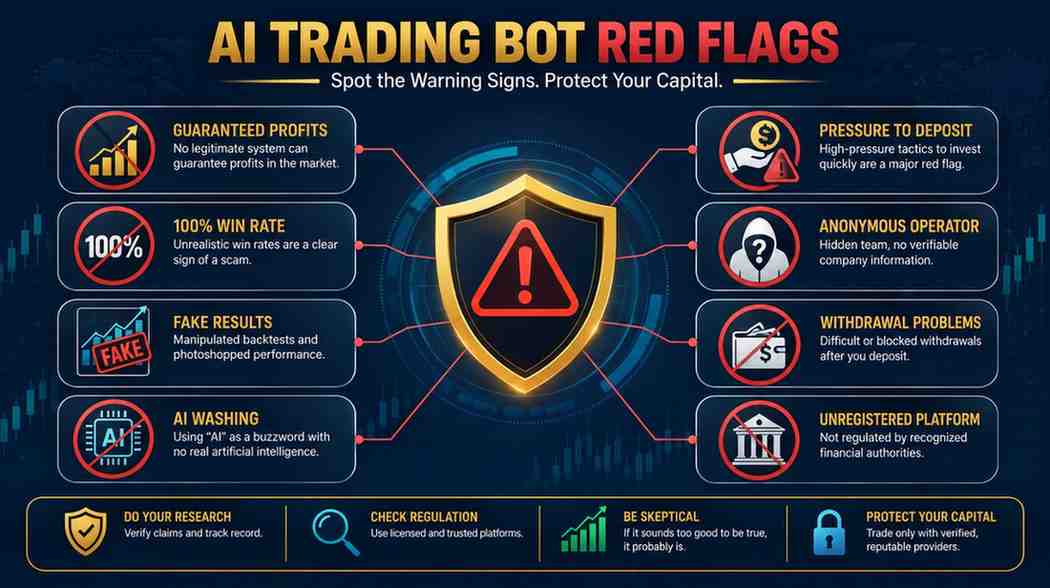
Sources

Your AI Financial Advisor: Complete Guide to Tools, Risks, and Getting Started in 2026

AI financial advisor dashboard on a smartphone showing personalized spending insights, savings goals, and AI-powered recommendations for better money management.

Introduction: The Day Your Banking App Became Your AI Financial Advisor

You open your banking app one morning, and something feels different. Instead of just showing your balance, it gently suggests moving $200 from checking to savingsโ€”because it noticed you have a pattern of overspending on dining out mid-month. It reminds you about a bill due tomorrow and flags a subscription you completely forgot about. You didn’t ask for this advice. It just… appeared.

This isn’t a scene from a sci-fi movie. This is the reality of AI-powered personal finance in 2026, and it’s happening right now. Anย AI financial advisorย is no longer a futuristic conceptโ€”it’s a tool available to millions of consumers today.

According to Plaid’s March 2026 research, roughly 57% of U.S. consumers now expect their fintech apps to use AI, and a striking 78% are open to receiving AI-based personal financial guidance. The shift is so dramatic that a 2026 TD AI Insights report found that more than half of survey respondents said they use AI to help manage their financesโ€”compared to only 10% just a year earlier.

The global AI-powered personal finance management market is valued atย $1.77 billion in 2026, and it’s projected to reach $2.55 billion by 2030. This is no longer a niche experiment. It’s a fundamental shift in how everyday people manage, grow, and protect their money.

But here’s the question that matters most for you: Is an AI financial advisor actually good for your money, or is it just another tech trend that sounds impressive but delivers little?

This guide will give you an honest, unbiased look at the AI financial advisor tools available in 2026. We’ll cover what they can do, where they fall short, how to choose the right one, and most importantly, how to protect yourself from the hidden risks.


Part 1: What’s Actually Available Right Now (The Tools You Can Use Today)

The AI financial advisor landscape in August 2026 is rich and varied. You’re not limited to a single type of tool. Here’s what’s available:

1. ChatGPT’s Personal Finance Tools

In May 2026,ย OpenAI launched a dedicated personal finance experienceย for ChatGPT Pro users in the United States. This allows users to securely connect their financial accounts viaย Plaidโ€”which connects to over 12,000 financial institutions, including Schwab, Fidelity, Chase, and Robinhoodโ€”and ask ChatGPT questions about their spending, subscriptions, and investment portfolio.

What makes this particularly powerful is that you can combine your actual financial data with your personal goals. For example, you can ask, “I feel like I’ve been spending more recently. Has anything changed?”ย orย “Help me build a plan to be ready to buy a house in my area in the next 5 years.”

According to OpenAI,ย over 200 million people already use ChatGPT monthly for budgeting, investment questions, and financial planning. The company plans to expand the tool to Plus users after refining the experience through the Pro preview.

2. Robo-Advisors: Automated Investing on Autopilot

Robo-advisors use algorithms to build and manage investment portfolios based on your goals, timeline, and risk tolerance. They’re one of the most mature AI financial advisor applications, with the global robo-advisor market managing approximately $2.7 trillion in assets.

Here are the leading robo-advisors in 2026:

PlatformManagement FeeAccount MinimumKey Feature
Betterment0.25% – 0.65%$0 (Digital), $100,000 (Premium)Tax-loss harvesting, personalized retirement plans, and access to human advisors
Wealthfront0.25%$500Crypto exposure, automated bond ladder, commission-free stock trading
Schwab Intelligent Portfolios$0$5,000No management fee, automatic rebalancing, 24/7 customer service
Fidelity Go$0 (under $25,000), 0.35% (above)$0Low barrier to entry, integrates with Fidelity’s broader ecosystem
SoFi Automated Investing0.25%$50Low minimum, integrates with SoFi’s full financial suite
AI financial advisor robo-advisor comparison chart showing Betterment, Wealthfront, Schwab Intelligent Portfolios, Fidelity Go, and SoFi Automated Investing with fees, minimums, and ratings.

Each offers a slightly different package, but the core value is the same: professional-grade portfolio management at a fraction of the cost of a traditional financial advisor.

3. Agentic AI: When Your AI Financial Advisor Takes Action

The next frontier is agentic AIโ€”systems that don’t just advise but can execute trades and manage portfolios on your behalf.

Agentic AI financial advisor concept illustration showing AI brain connected to stocks, crypto, and investment portfolios with limited human oversight.

Coinbaseย recently announced AI tools capable of giving SEC-registered investment recommendations around strategies such as tax-loss harvesting and multi-asset event trading. Customers can also open their platform to AI agents that execute nuanced trading strategies autonomously. Coinbase’s head of consumer products, Max Branzburg, stated, “This is going to lower the barriers to entry for more sophisticated financial advice and trading that today generally just institutions or ultra-wealthy people have access to.”

Robinhoodย has launched an AI trader that allows users to connect programs like ChatGPT, Claude, and Codex to a separate account where the AI performs trades automatically based on parameters provided by the investor. Features include AI-powered portfolio analysis, rebalancing, and targeted market segment investing. The AI trading is currently in beta and restricted to equities, but Robinhood plans to expand it to crypto, event contracts, and futures.

Citi Wealthย unveiled “Citi Sky”โ€”an AI-powered member of the Citi Wealth team built using Google Cloud and Google DeepMind technologies. Available to Citigold clients, it provides conversational interaction, timely financial guidance, and multilingual capabilities designed to “shift from interface to intelligence, from transactions to outcomes.”

4. Enterprise-Grade AI for Everyday Investors

Savvy Wealth, an AI-native registered investment advisor, launched “Savvy Intelligence”โ€”an agentic AI product that gives advisors a complete, continuously updated view of all client data, including investments, financial plans, and tax information. While designed for advisors, this represents the type of sophisticated AI financial advisor tools that are increasingly accessible to regular investors.


Part 2: Why Your AI Financial Advisor Might Be Better Than a Human (In Some Ways)

The MIT Initiative on the Digital Economy recently published fascinating research on how people trust AI financial advisors. The findings challenge conventional wisdom about the superiority of human advice.

The “No Judgment” Advantage

One study by MIT professor Eric So and colleagues found that people are oftenย more willing to share sensitive financial information with an AI financial advisor than with human advisors. Why?ย Social embarrassment.

When you make a frivolous spending mistake or get into financial trouble, admitting that to another person feels shameful; there’s a social cost to disclosure. An AI financial advisor doesn’t judge youโ€”it doesn’t have emotions, a personal history, or a perspective on your character. It just processes the data and provides recommendations.

This means an AI financial advisor can help with problems people might otherwise hide from a human advisor, potentially catching issues earlier and leading to better outcomes.

Correcting Financial Misconceptions

The same MIT research team created an AI financial advisor chatbot designed specifically to intervene and correct users’ mistaken beliefs about financial matters. They observed aย significant and lasting shift away from mistaken beliefsย among users who leveraged the tool.

Why this matters:ย Many people hold deeply flawed financial beliefs that hurt their wealth accumulation and retirement goals. An AI financial advisor specifically designed to challenge those beliefs can help correct them in ways a generic chatbot or even a human advisor might notโ€”because the AI doesn’t suffer from the “sycophantic nature” of wanting to please the user.

24/7 Accessibility and Affordability

AI financial advisor tools are available anytime, anywhere, at a fraction of the cost of human advisors. A traditional financial advisor might charge 1% of assets under management annually. A robo-advisor like Schwab Intelligent Portfolios charges $0. Wealthfront charges 0.25%.

This dramatically lowers the barrier to entry for quality financial guidance. You don’t need hundreds of thousands of dollars to get professional portfolio management.


Part 3: The Hidden Risks of Using an AI Financial Advisor

AI financial advisor tools come with significant risks that many users overlook. Understanding these is crucial for protecting yourself.

The Privacy Problem: When Your AI Financial Advisor “Knows” Too Much

J.P. Morgan Private Bank has documented cases where AI tools appeared to “know” sensitive details about a family after a family member used a free AI app as a therapist. The AI had aggregated information from social media, online services, and user interactions in ways the individual never anticipated.

This is the privacy challenge: an AI financial advisor can combine seemingly unrelated pieces of information to infer sensitive details about your finances, health, relationships, and more. In most cases, you don’t know what data is being used or how inferences are being made.

AI financial advisor risks infographic showing data privacy concerns, deepfake fraud threats, and AI hallucination risks that every user should understand before connecting financial accounts.

When you connect your financial accounts to ChatGPT, the platform can access your balances, transactions, investments, and liabilities. While OpenAI states it cannot view full account numbers or make changes to your accounts, the data can still be used for analysis, and users should be aware of how their data is being used through the model training settings.

Fraud and Deepfakes

AI enables more sophisticated fraud than ever before. Criminals can use AI to create the following:

  • Deepfake voice and video contentย impersonating people you know
  • Synthetic identitiesย that are extremely difficult to detect
  • Highly convincing phishingย in multiple languages
  • Automated attacksย that scale across thousands of targets simultaneouslyย 

J.P. Morgan Private Bank advises verifying unexpected requestsโ€”especially those involving payments or sensitive informationโ€”through a separate channel. Some experts recommend implementing a “family safe word” for human authentication, particularly when requests seem unusual.

Hallucinations and False Precision

AI systems can generate plausible-sounding but completely incorrect informationโ€”a phenomenon called hallucination. In finance, this is particularly dangerous because numbers and calculations need to be absolutely precise.

For example, in the enterprise space, the leading models show significant differences in complex financial reasoning. On Harvey’s Legal Agent Benchmarkโ€”which measures whether a model can complete a complex end-to-end task autonomouslyโ€”GPT-5.5 scored 3.75% compared to Claude Opus 4.8’s 10.4%. This means even the best AI financial advisor tools can make mistakes on complex financial reasoning tasks.

Most consumer-facing AI finance tools don’t have enterprise-level rigor. They might produce numbers that look accurate but aren’t.

Sycophancy and Overconfidence

AI models can be prone to sycophancyโ€”telling users what they want to hear rather than what they need to hear. This is particularly dangerous in financial advice, where you need honest, sometimes uncomfortable, guidance.

As Robert Persichitte, founder of Delagify Financial, warned about Robinhood’s AI trader:ย “It’s built to make someone feel like they’ve done a great job of researching and understanding their investments, and thus creates a gap between how the investor feels about the world and how the world operates.”


Part 4: How to Choose the Right AI Financial Advisor Tool

Choosing an AI financial advisor requires careful evaluation. Here’s what to look for:

1. Transparency

Questions to ask:

  • What data does the tool collect, and how is it used?
  • Can you clearly see how decisions or recommendations are made?
  • Is there documentation of the AI’s decision-making process?

Regulatory expectations increasingly include transparency about AI decision-making processes, particularly in lending and investment contexts.

2. Human Oversight

Questions to ask:

  • What level of human oversight is offered?
  • Can you speak to a human if something goes wrong?
  • Is there a way to verify AI recommendations against independent sources?

Industry leaders expect that firms using AI will maintain human judgment for significant decisions. The technology should augment, not replace, human oversight.

3. Data Security

Questions to ask:

  • How does the tool protect your data?
  • Can you limit how your data is used?
  • Does the tool have strong cybersecurity measures in place?

When you connect financial accounts to an AI financial advisor, the platform should clearly explain its data handling practices. OpenAI, for instance, allows users to disconnect accounts at any time and delete financial memories.

4. Validation and Track Record

Questions to ask:

  • Can you verify the accuracy of recommendations?
  • Are there independent reviews of the tool’s performance?
  • Does the tool have a track record of accurate predictions?

For wealth professionals, independent benchmarks like Harvey’s BigLaw Bench and Legal Agent Benchmark provide some insight into model performance on complex financial reasoning tasks. For consumer tools, look for user reviews and independent testing.

5. Fit for Purpose

Questions to ask:

  • Does the tool align with your specific financial needs?
  • Is it designed for your level of financial knowledge?
  • Does it address the right problems?

A tool designed for automated portfolio management won’t help with tax planning. A general AI chatbot won’t have the rigor of a specialized financial planning tool. Choose the right tool for the right job.


Part 5: Practical Steps to Use an AI Financial Advisor in August 2026

Step 1: Audit Your Current Apps

Before adding new tools, check what you already have. Many banking apps now include AI-powered features at no extra cost. Identify what’s available and start using these features to build familiarity.

Step 2: Start with ChatGPT’s Financial Tools

If you’re a ChatGPT Pro user in the U.S., you can now connect your financial accounts via Plaid. To get started: Open the Finances option from the sidebar, select “Get started,” or typeย “@Finances, connect my accounts”ย into ChatGPT.

AI financial advisor ChatGPT personal finance app showing connected bank accounts, spending insights, and AI-powered money recommendations.

Step 3: Start Small with a Robo-Advisor

If you’re not already using a robo-advisor, choose one with a low minimum investment and clear fee structure. Fidelity Go has no account minimum and no fees for balances under $25,000. SoFi Automated Investing starts with just $50.

Step 4: Use AI Financial Advisor Chatbots for Learning

AI chatbots can be valuable learning tools. Ask them questions about financial concepts, investment strategies, or retirement planning. Just remember that they’re not a substitute for professional advice, and always verify information from independent sources.

Step 5: Protect Your Data

Be mindful of what you share with an AI financial advisor. Before using a new tool:

  • Read the privacy policy carefully
  • Understand what data is collected and how it’s used
  • Consider whether the benefits outweigh the privacy trade-offs
  • Check if you can limit data sharing

J.P. Morgan Private Bank suggests staying informed about how personal data is used and choosing financial service providers with strong AI governance practices.

Step 6: Stay Diversified

An AI financial advisor can be valuable, but it shouldn’t be your only source of financial guidance. Consider using multiple approaches:

  • AI tools for efficiency and accessibility
  • Traditional financial analysis for verification
  • Professional advice for significant decisions

Diversification applies to information sources as well as investments.


Conclusion: Your Future with Your AI Financial Advisor

The integration of AI into personal finance is accelerating rapidly. By 2030, the AI-powered personal finance management market is expected to reach $2.55 billionโ€”a 94% increase from 2025. The technology offers compelling benefits: accessibility, affordability, personalization, and judgment-free guidance.

But the direction of this transformation isn’t predetermined. The choices you makeโ€”which tools to use, how much to rely on automated recommendations, what level of human oversight to maintainโ€”will shape your experience.

The most successful users of AI financial advisor tools will likely be those who:

  • Understand the technology’s capabilities and limitations
  • Maintain appropriate skepticism and verify information
  • Protect their data and privacy
  • Use AI as a complement to, not a replacement for, their own financial judgment

Your AI financial advisor won’t replace your financial intuition and common sense. But used wisely, it can be an incredibly powerful co-pilot on your financial journey.

AI financial advisor guide call-to-action banner encouraging readers to subscribe for weekly personal finance and AI updates.

  1. Share this guide:ย Know someone who’s confused about AI and money? Share this article to help them make informed decisions.
  2. Explore ChatGPT Finance:ย If you’re a ChatGPT Pro user in the U.S., try connecting your financial accounts today through the Finances sidebar.
  3. Explore a robo-advisor:ย Start small with one of the platforms mentioned in this guide. Even a small investment can help you understand how AI-managed portfolios work.
  4. Subscribe for more:ย Get our weekly newsletter on AI and personal finance trends delivered to your inbox. We’ll keep you updated on the latest tools, risks, and opportunities.
  5. Ask a question:ย What’s your biggest concern about using an AI financial advisor for your finances? Leave a comment, and we’ll address it in our next article.
  6. Check your privacy:ย Review the privacy settings on your existing financial apps. Make sure you’re comfortable with what data is being shared and how it’s being used.

๐Ÿ“Š Sources & Further Reading


Disclaimer: This article is for educational purposes only and does not constitute financial advice. Always consult with a qualified financial professional before making significant investments or financial decisions. AI tools mentioned in this article may have limitations, and users should carefully review privacy policies and terms of service before connecting financial accounts.