The Next Evolution of Automated Trading
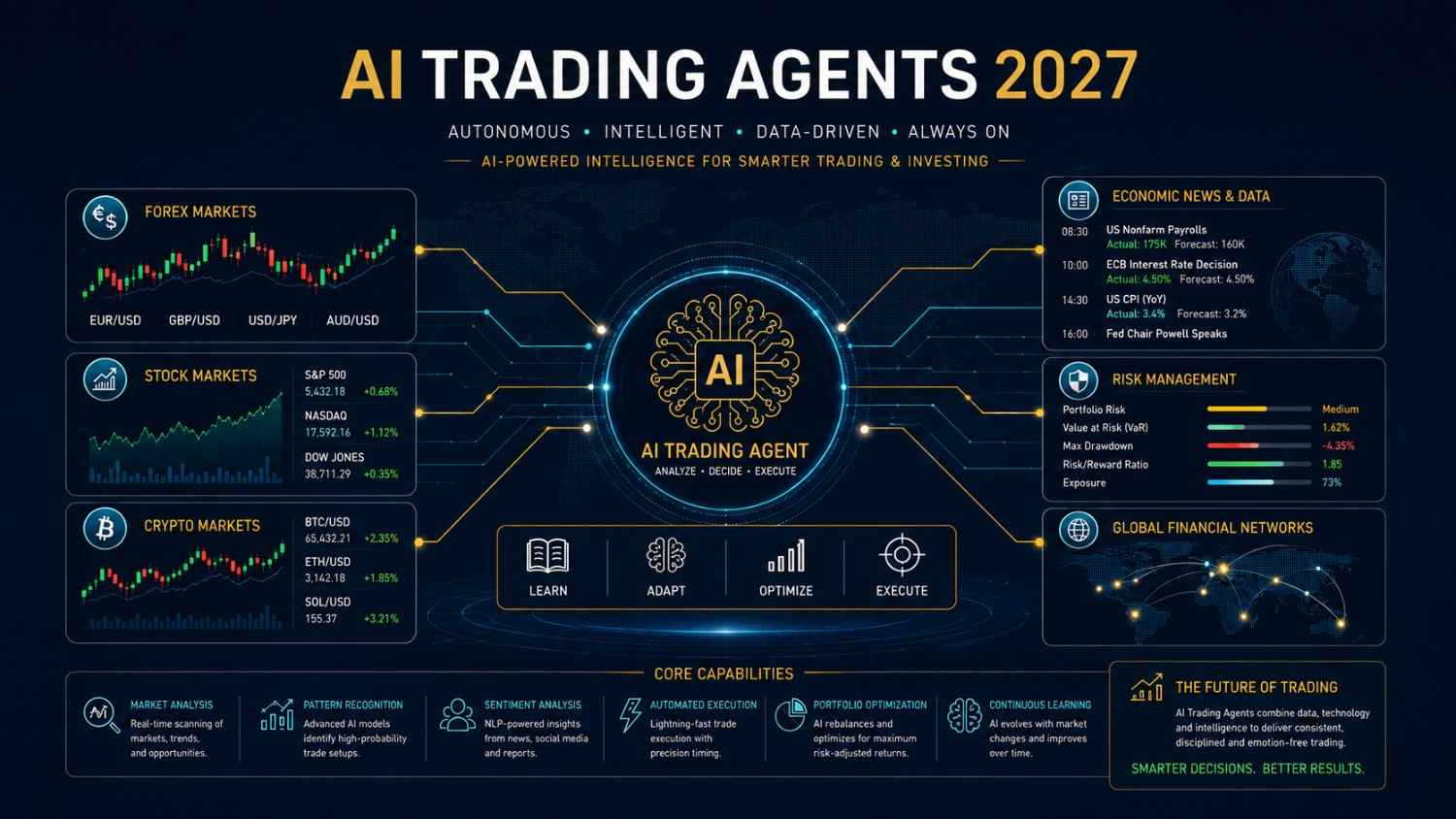
AI trading agents 2027 could represent one of the biggest changes in retail and professional trading since algorithmic trading became widely accessible. Traditional trading software follows instructions. Traditional trading bots execute predefined rules. AI trading agents could go further.
Instead of simply following a fixed instruction such as “buy when the 9 EMA crosses above the 20 EMA,” an autonomous AI agent can potentially interpret information, reason through a task, use external tools, evaluate changing conditions, and take multiple actions toward a defined objective. That distinction is important. The next generation of AI trading agents is not simply about generating another BUY or SELL signal. It is about creating systems capable of completing parts of the trading workflow with increasingly limited human intervention.
The trend is already attracting serious attention from regulators and central banks. In July 2026, the UK’s Financial Conduct Authority published a major review examining how AI could reshape retail financial services through 2030 and beyond. The review specifically highlighted the growing consumer interest in agentic AI. The Bank of England has also reported that trading firms are increasingly using autonomous AI for research, coding support, surveillance, and other lower-risk activities, while warning that greater autonomy could eventually affect trading and portfolio decisions.
Meanwhile, the Bank for International Settlements launched Project Logos to study how large language model-based agents could behave as portfolio managers in simulated financial markets. So what does this mean for ordinary traders? It means that AI trading agents in 2027 deserve serious attention—not because they guarantee better returns, but because they could change how financial decisions are researched, executed, and monitored.
What Are AI Trading Agents?
An AI trading agent is an artificial intelligence system designed to perform multiple steps toward a financial objective rather than simply responding to a single instruction. A traditional trading bot might operate like this: IF condition A happens, → execute trade B.
An AI trading agent could potentially operate more like this: Monitor the market → collect relevant information → analyze conditions → evaluate risk → compare possible actions → execute an approved strategy → monitor the position → report the result.
That is the fundamental difference between rule-based automation and agentic AI. An AI trading agent can be designed to interact with other software tools, databases, market feeds, analytical systems, and trading platforms. The system may therefore become an entire workflow rather than a single indicator or trading signal. However, autonomy does not automatically mean intelligence. And intelligence does not automatically mean profitability.
AI Trading Agents vs Traditional Trading Bots
The distinction between an AI trading agent and a traditional trading bot is important for anyone considering automated trading.
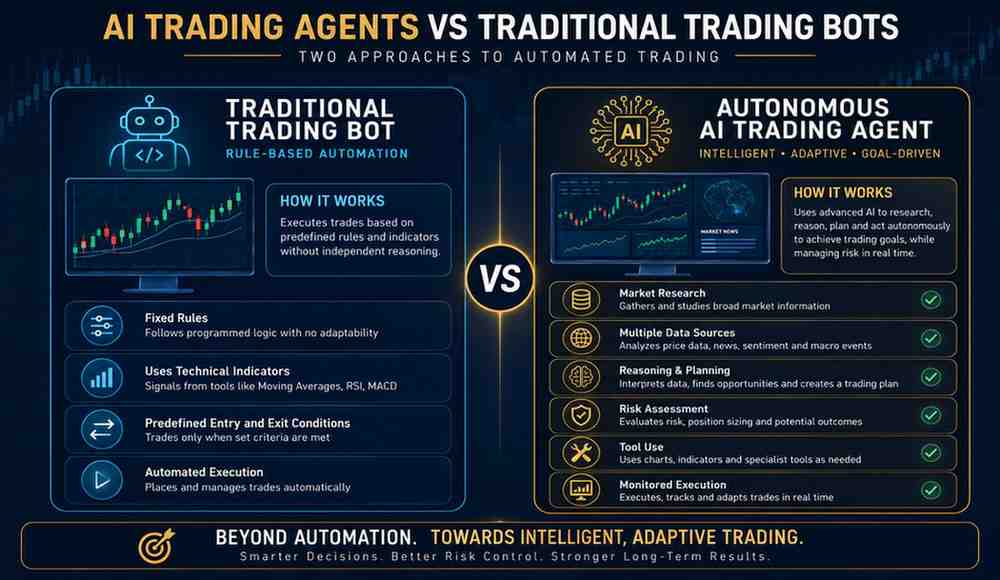
| Feature | Traditional Trading Bot | AI Trading Agent |
|---|---|---|
| Decision process | Predefined rules | AI-assisted reasoning and planning |
| Market analysis | Fixed indicators/rules | Potentially multiple information sources |
| Adaptability | Usually limited | Potentially more adaptive |
| External tools | Limited | Can potentially interact with multiple tools |
| Execution | Automated | Potentially automated |
| Human oversight | Usually predefined | Can range from high to low |
| Complexity | Lower | Higher |
| Risk of unexpected behavior | Lower but still present | Potentially higher |
| A traditional bot is often easier to understand. | ||
| An AI agent can be more flexible, but that flexibility introduces additional uncertainty. | ||
| For traders, this means the question should not simply be: | ||
| “Is this an AI trading agent?” | ||
| A better question is: | ||
| “What exactly is this system allowed to do?” |
How Do AI Trading Agents Work?
A sophisticated AI trading agent may combine several technologies.
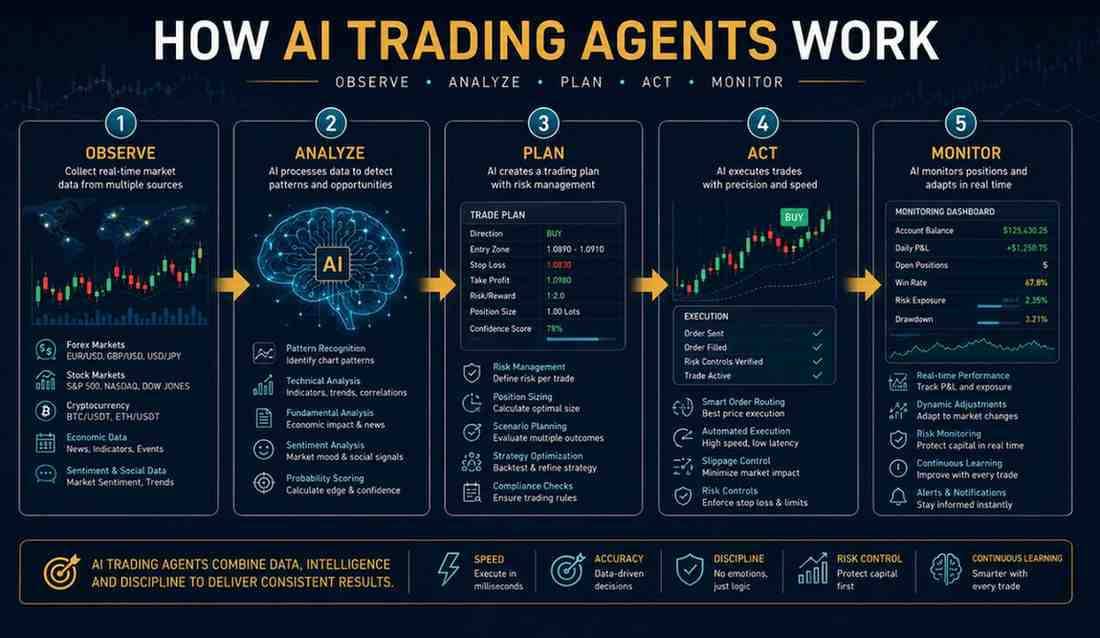
1. Market Data
The agent can receive information from price feeds, economic calendars, financial news, market data providers, and other sources.
2. Artificial Intelligence
A large language model, machine-learning model or specialized financial model can process information and generate an interpretation.
3. Tools
The agent may have access to charting systems, calculators, databases, economic calendars, risk-management software or other applications.
4. Planning
Instead of immediately producing a trade, the agent can break the objective into several steps. For example: Identify market → analyze trend → check volatility → review news → evaluate risk → determine whether setup meets rules.
5. Execution
If authorized, the agent may send instructions to another system that executes the trade.
6. Monitoring
After execution, the agent can potentially continue monitoring the position and report changes. This creates a continuous loop: Observe → Analyze → Plan → Act → Monitor → Reassess. That loop is what makes agentic AI different from a simple trading indicator.
Why AI Trading Agents 2027 Matter
The growth of AI trading agents 2027 is not happening in isolation. Financial institutions are already experimenting with AI across research, operations, customer service, fraud detection, compliance, and decision support. The FCA’s 2026 review identifies AI as a technology capable of changing how financial firms operate, how consumers interact with financial services, and how competition develops.
It also highlights the possibility of increased fraud and cyber risks. The Bank of England has similarly highlighted the possibility that increasingly autonomous AI systems could affect financial market behavior and create new challenges for monitoring and financial stability. This suggests that AI trading agents are not merely another retail trading trend. They are part of a much larger transformation in financial technology.
11 Ways AI Trading Agents Could Change Markets
1. AI Trading Agents Could Monitor Multiple Markets
A human trader may monitor a handful of instruments. An AI trading agent could potentially monitor hundreds or thousands of instruments continuously. For example, an agent could monitor:
- EUR/USD
- GBP/USD
- USD/JPY
- XAU/USD
- Major stock indices
- Individual stocks
- ETFs
- Cryptocurrency markets
The objective would not necessarily be to trade everything.
Instead, the agent could identify markets that meet predefined conditions and bring only the most relevant opportunities to the trader.
This could reduce the time spent manually scanning charts.
2. AI Trading Agents Could Combine Multiple Data Sources
A major limitation of manual trading is information overload. A trader may have to check charts, economic calendars, news reports, company announcements, and market sentiment separately. An AI trading agent could potentially combine these information sources into a single analysis. For example: EUR/USD setup detected → inflation data reviewed → central-bank commentary checked → volatility measured → technical structure analyzed → risk conditions assessed. This does not make the final prediction certain. It simply makes information processing more systematic.
3. AI Trading Agents Could Analyze Economic News Faster
Economic announcements can move financial markets rapidly. Central-bank decisions, inflation reports, employment data, and GDP releases can change expectations about interest rates and currencies.AI agents could potentially process these releases almost immediately and summarize the information for traders. They could compare new information with previous announcements and identify significant changes. However, traders should still verify critical information against the source. AI can misunderstand context.
4. AI Trading Agents Could Improve Trading Journals
One of the most underrated applications of AI may be analyzing a trader’s own historical performance. Instead of asking, “What trade should I take?” A trader could ask, Why am I losing money?” An AI trading agent could analyze hundreds of historical trades and identify patterns such as,
- Overtrading
- Excessive risk after losses
- Poor performance during specific sessions
- Weakness in particular currency pairs
- Frequent early exits
- Moving stop-losses
- Revenge trading
- Poor risk-reward ratios
This could transform the trading journal from a simple record into an analytical tool.
5. AI Trading Agents Could Monitor Risk Continuously
Risk management may ultimately become more important than trade prediction. An AI trading agent could monitor:
- Account exposure
- Position size
- Maximum drawdown
- Correlated positions
- Volatility
- Leverage
- Stop-loss levels
- Portfolio concentration
For example, a trader might have separate EUR/USD, GBP/USD, and GBP/JPY positions.
Although they appear to be different trades, they may create substantial exposure to similar currency movements.
An AI system could identify this concentration and alert the trader.
For traders who want to strengthen their foundation first, FinWireStack’s Forex risk management guide explains position sizing, stop-loss placement, risk-reward ratios, and trading psychology.
6. AI Trading Agents Could Execute Multi-Step Strategies
A traditional bot might execute a single strategy. An AI trading agent could potentially coordinate several processes. For example: Step 1: Identify trend. Step 2: Check higher-timeframe structure. Step 3: Analyze volatility. Step 4: Check economic events. Step 5: Calculate position size. Step 6: Verify risk limits. Step 7: Execute the order if all conditions are satisfied. Step 8: Monitor the trade. This is much closer to a digital trading assistant than a traditional Expert Advisor.
7. AI Trading Agents Could Personalize Trading
Imagine two traders using the same market. One wants conservative swing trades. The other wants short-term intraday setups. An AI agent could potentially operate according to each trader’s specific rules. It could remember:
- Preferred instruments
- Maximum risk
- Trading sessions
- Preferred strategies
- Maximum number of daily trades
- Trading psychology weaknesses
- Performance history
This could make AI trading technology much more personalized.
8. AI Trading Agents Could Connect Research With Execution
Today, many traders use separate tools for research, charting, economic news, trade journaling, and execution. The next generation of AI trading agents could potentially connect these processes. The agent becomes the bridge between: Research → Analysis → Decision → Execution → Monitoring → Review. This is one of the most important reasons the technology deserves attention.
9. AI Trading Agents Could Help Beginners Learn Faster
Agentic AI could become a personalized trading tutor. A beginner could upload a trading plan and ask the AI to identify weaknesses. The system could explain:
- Leverage
- Margin
- Stop-losses
- Risk-reward ratios
- Position sizing
- Technical indicators
- Candlestick patterns
- Trading psychology
FinWireStack’s Forex chart-reading guide can also help beginners build the technical foundation needed before relying heavily on automation.
The important rule is:
Use AI to improve your understanding, not to replace it.
10. AI Trading Agents Could Change Portfolio Management
Agentic AI is not limited to Forex. It could also influence stock investing, ETFs, and cryptocurrency portfolios. A portfolio agent could potentially monitor asset allocation, identify concentration risks, summarize company developments, and alert investors when their portfolio moves outside predefined limits. The BIS Project Logos initiative is particularly relevant because it is examining how LLM-based agents could behave as portfolio managers in simulated financial markets.
11. AI Trading Agents Could Become Personal Financial Assistants
The most significant development may eventually be the combination of trading, investing, and personal finance. Instead of having separate applications for:
- Budgeting
- Investing
- Trading
- Portfolio monitoring
- Financial research
- Risk management
A consumer could potentially have one AI financial agent coordinating these activities.
That possibility is one reason regulators are already examining how agentic AI could affect consumers through 2030.
AI Forex Trading: What Could Change by 2027?
Forex traders are likely to be among the users experimenting with AI trading agents. The foreign-exchange market produces enormous amounts of price and economic information. An AI Forex trading agent could potentially:
- Monitor currency pairs
- Analyze economic releases
- Track central-bank statements
- Identify technical setups
- Calculate position size
- Monitor open trades
- Maintain a trading journal
- Alert traders to unusual volatility
However, automated Forex trading remains risky.
A system can execute a bad decision faster than a human.
This is why risk controls must be designed before automation.
For beginners, FinWireStack’s complete beginner’s guide to Forex trading provides the foundational concepts that should come before sophisticated automation.
AI Trading Agents and Cryptocurrency Markets
Cryptocurrency markets create an interesting environment for autonomous AI because they operate continuously. Unlike traditional Forex markets, which generally operate around the clock during the business week, many crypto markets operate 24/7. An AI crypto trading agent could therefore monitor markets continuously. Potential applications include:
- Arbitrage monitoring
- Volatility detection
- Sentiment analysis
- Portfolio rebalancing
- Liquidity monitoring
- Risk alerts
But 24/7 markets also create additional risks.
A system could potentially continue trading during periods of extreme volatility while the human owner is asleep.
That makes automated risk limits essential.
FinWireStack’s Forex vs. Crypto Trading guide can help readers understand the broader differences between the two markets.
The Biggest Problem With AI Trading Agents: Autonomy
The more authority an AI system receives, the more important governance becomes. Consider the difference between these two systems: System A: AI analyzes the market and sends an alert. System B: AI analyzes the market, decides what to trade, places the trade, and manages the position. System B has far more authority.
If the AI makes a mistake, the consequences can be financial. The Bank of England has highlighted the difficulty of reliably anticipating AI outputs and validating more autonomous systems in financial markets where conditions can change quickly. This creates a fundamental principle: The greater the autonomy, the stronger the controls need to be.
Can AI Trading Agents Be Trusted With Real Money?
Not automatically. Before allowing an AI trading agent to access a live account, traders should ask: What can the agent see? Does it have access to market data only, or can it access account information? What can the agent do? Can it generate recommendations, or can it place trades? What limits exist? Is there a maximum position size? Can the agent override the trader? This should generally be prevented unless the system is specifically designed for controlled autonomy. Can the system be stopped immediately? There should always be a reliable emergency shutdown mechanism.
The 8 Biggest Risks of AI Trading Agents
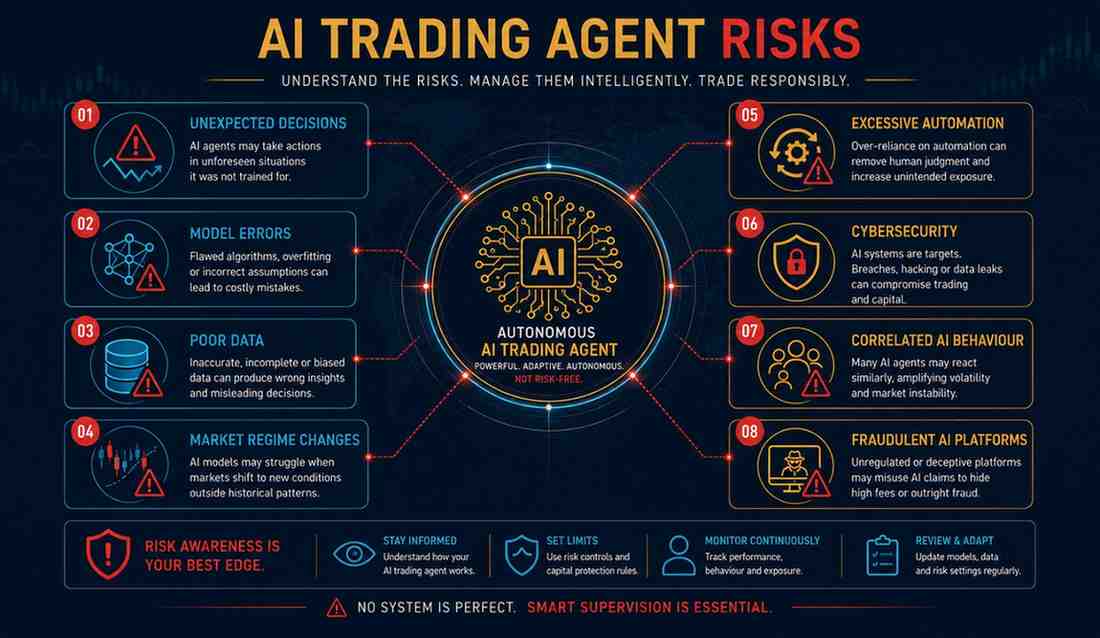
1. Unexpected Decisions
AI systems may produce outputs that are difficult to anticipate.
2. Model Errors
A model can misunderstand data or interpret information incorrectly.
3. Poor Data
Bad data can lead to bad decisions regardless of how advanced the AI model is.
4. Market Regime Changes
A strategy trained under one market environment may behave poorly under another.
5. Excessive Automation
The trader may become dependent on the system and stop understanding what is happening.
6. Cybersecurity
An AI trading system connected to financial accounts creates another potential attack surface.
7. Correlated AI Behavior
If many systems use similar models, they may respond to the same information in similar ways. The BIS specifically identifies the possibility that common AI infrastructure could create greater homogeneity in financial-market decision-making.
8. Fraudulent AI Platforms
Perhaps the biggest risk for ordinary retail traders is not sophisticated AI. It is fake AI. Regulators have repeatedly warned investors about fraudulent investment schemes that use AI terminology to appear sophisticated.
The SEC, NASAA, and FINRA warn investors to be skeptical of platforms claiming AI systems cannot lose or can guarantee extraordinary returns. The CFTC similarly warns that AI cannot turn trading bots into “money machines” and advises investors to research companies, understand fees and spreads, and be skeptical of unusually high or guaranteed returns.
How to Identify a Fake AI Trading Agent
Be especially careful when a platform promises:
- Guaranteed profits
- Guaranteed monthly returns
- No losing trades
- 90%+ win rates without credible evidence
- Risk-free trading
- Secret institutional AI
- Guaranteed passive income
- Huge returns from a tiny deposit
- Immediate wealth
- No trading experience required
These are not proof of a sophisticated AI system.
They are warning signs.
The SEC’s Investor.gov guidance on AI investment fraud specifically warns about unregistered platforms claiming to use AI and unrealistic investment promises.
The CFTC’s AI trading bot advisory provides additional guidance for investors evaluating automated trading schemes.
AI Trading Agents and the Human Trader
The future does not necessarily have to be humans versus machines. A more realistic model is Human + AI + Automation + Risk Controls. The human defines the objectives. The AI processes information. The trading system executes approved instructions. Risk controls limit what the system is allowed to do. The human reviews performance. This is known as a human-in-the-loop approach. It may be one of the safest ways for retail traders to experiment with agentic AI.
Should Beginners Use AI Trading Agents?
Beginners should be cautious. The biggest mistake is using AI to skip the learning process. A beginner who does not understand leverage may not recognize why an automated strategy is dangerous. A trader who does not understand stop-loss placement may not know whether an AI-generated trade has excessive risk.
A person who cannot read a chart may struggle to identify when an AI system is behaving abnormally. The better approach is: Learn → Practice → Test → Automate gradually. Before experimenting with autonomous trading, beginners should understand the basics covered in FinWireStack’s beginner Forex trading guide.
A Safer AI Trading Agent Framework
If you eventually use an AI trading agent, consider implementing five levels of authority.
Level 1 — Research Only
The AI can analyze information but cannot place trades.
Level 2 — Signal Generation
The AI can identify potential setups but requires human approval.
Level 3 — Trade Preparation
The AI can calculate position size, stop-loss, and take-profit levels but still requires approval.
Level 4 — Limited Automation
The AI can execute trades within strict predefined limits.
Level 5 — High Autonomy
The AI can independently make and execute decisions. For most retail traders, Level 1–3 provides a much more controlled starting point. High autonomy should not be treated as an automatic upgrade. It represents a significant increase in risk.
AI Trading Agents 2027: What Traders Should Prepare For
Traders should prepare for an environment where AI becomes part of almost every stage of the trading process. That does not mean every trader needs an autonomous trading agent. It means understanding the technology will become increasingly valuable.
By 2027, traders may increasingly use AI to:
- Analyze charts
- Summarize financial news
- Monitor markets
- Analyze trading journals
- Calculate risk
- Test strategies
- Automate repetitive tasks
- Monitor portfolios
- Detect unusual market conditions
By 2030, more sophisticated AI financial agents could potentially coordinate several of these activities simultaneously.
The FCA’s 2026 review explicitly considers how AI could reshape retail financial services through 2030 and beyond.
What Could AI Trading Look Like by 2030?
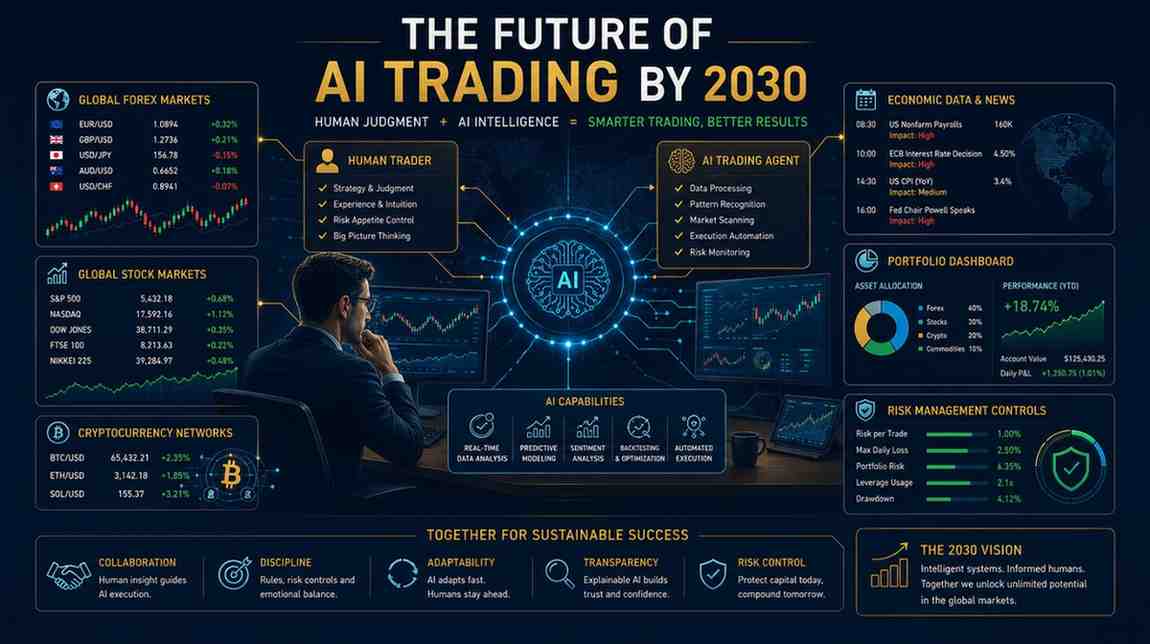
Imagine starting your trading day in 2030. Instead of opening ten applications, your AI financial agent provides a personalized briefing: “EUR/USD is approaching a key technical level. U.S. inflation data is due in three hours. Your exposure to USD is already above your preferred limit.
No trade is recommended until the economic release passes. “The agent could then monitor the market. If your conditions are met, it could ask for approval. If you authorize the trade, it could calculate the position size and execute it. Afterward, it could monitor the trade and update your journal.
This is not necessarily science fiction. The technology needed to create parts of this workflow already exists. The challenge is making the system reliable, secure, transparent, and properly controlled.
The Bigger Financial-Market Risk: Everyone Using the Same AI
There is another issue that retail traders should understand. Imagine millions of investors using similar AI systems. A major economic announcement occurs. Thousands of AI agents interpret the event in similar ways. They all begin selling. That selling creates a price decline. Other AI systems observe the decline and begin selling too. The process could reinforce itself. This is one reason central banks are studying autonomous AI behavior.
The BIS Project Logos initiative is specifically examining whether LLM-based agents could create greater homogeneity in financial-market decisions and how that could affect portfolio allocation. The Bank of England has also warned that similar AI responses could amplify volatility during periods of market stress. This means the AI revolution could potentially create not only individual trading risks but also broader market-structure questions.
AI Trading Agents and Regulation
Regulation will probably become increasingly important as autonomous financial systems become more capable. The challenge for regulators is difficult. Technology evolves rapidly. Financial regulation generally moves more slowly. The FCA has said it intends to rely on existing regulatory frameworks while supporting responsible AI innovation, including governance and consumer-protection requirements.
The FCA has also been testing advanced AI through its Supercharged Sandbox, including applications involving agent-led payments, fraud detection, governance, and financial-service automation. This shows that regulators are not simply trying to stop AI. They are trying to understand how it can be deployed safely.
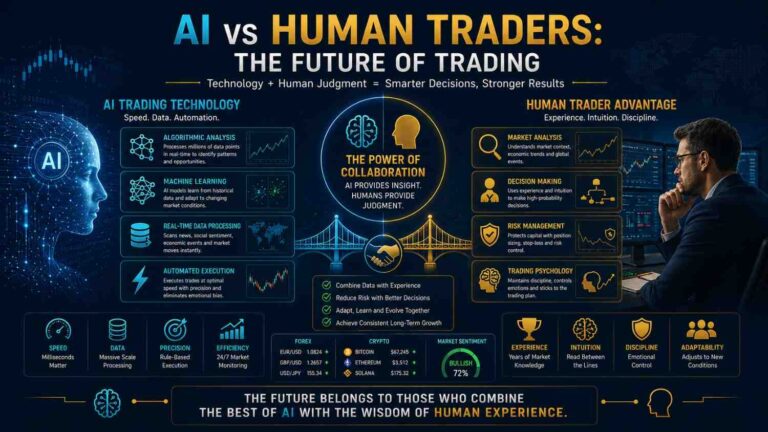
AI Trading Agents vs Human Traders: Who Wins?
The wrong question is “Will AI replace traders?” The better question is, Which trading tasks will AI perform better than humans?” AI is likely to be better at:
- Processing huge datasets
- Monitoring multiple markets
- Performing repetitive calculations
- Detecting certain patterns
- Executing predefined instructions
- Maintaining continuous monitoring
Humans remain important for: - Setting objectives
- Understanding personal risk tolerance
- Challenging assumptions
- Interpreting unusual events
- Making ethical decisions
- Deciding how much capital to expose
- Knowing when not to trade
The strongest traders of the future may therefore be those who understand both sides.
AI Trading Agent Checklist
Before connecting any autonomous AI system to a real trading account, ask:
☐ Is the provider identifiable?
☐ Is the provider properly regulated where regulation applies?
☐ Can its performance claims be independently verified?
☐ Can I see the maximum historical drawdown?
☐ Does the system use realistic trading costs?
☐ Are spreads and commissions included?
☐ Is slippage considered?
☐ Can I limit the maximum position size?
☐ Can I limit daily losses?
☐ Can I stop the agent immediately?
☐ Does the system require approval before high-risk actions?
☐ Can I test it in a demo environment?
☐ Does it clearly disclose its limitations?
☐ Does the company promise guaranteed profits?
If the answer to the final question is yes, investigate before depositing any money. Investor.gov’s guide to avoiding investment scams also recommends being highly skeptical of promises of high returns with little or no risk and pressure to act immediately.
The Most Important Rule for AI Trading Agents
Do not give an AI system more authority than you can safely control. If you would not allow a new employee to move $10,000 without supervision, you should think carefully before allowing an AI system to do the same. Start small. Test extensively. Set hard limits. Monitor performance. Keep emergency controls. And never confuse technological sophistication with financial reliability.
Final Verdict: AI Trading Agents 2027 Could Change the Game
AI trading agents 2027 could represent a major step beyond traditional algorithmic trading. The technology could combine market research, data analysis, risk management, strategy testing, execution, and monitoring into increasingly autonomous systems.
For Forex traders, AI agents could scan currency markets and analyze economic events. For stock investors, they could monitor companies, portfolios, and market developments. For cryptocurrency traders, they could operate continuously across 24/7 markets. For beginners, they could become personalized financial tutors. For experienced traders, they could become powerful research and automation assistants. But there is another side.
The more autonomous AI becomes, the greater the need for transparency, cybersecurity, risk controls, and human oversight. Regulators and central banks are already examining these questions because the impact could extend beyond individual traders to the stability and behavior of financial markets themselves.
The future should therefore not be about blindly handing your trading account to an AI agent. It should be about learning how to use increasingly powerful technology responsibly. The smartest trader of 2027 may not be the person with the most advanced AI. It may be the person who knows exactly when to trust it—and when not to.
Frequently Asked Questions About AI Trading Agents 2027
What are AI trading agents?
AI trading agents are artificial intelligence systems designed to perform multiple steps in a financial workflow, such as collecting information, analyzing markets, evaluating risk, generating decisions, and potentially executing trades.
Are AI trading agents the same as trading bots?
No. Traditional trading bots generally follow predefined rules, while AI trading agents can potentially interpret information, plan actions, interact with tools, and perform multi-step tasks.
Are AI trading agents profitable?
There is no guarantee. An AI system can make mistakes, perform poorly when market conditions change, and incur trading costs. Claims of guaranteed profits should be treated as a major warning sign.
Can AI trading agents trade Forex?
Technically, AI systems can be integrated with trading platforms and Forex infrastructure, depending on the available technology and permissions. However, automation does not eliminate Forex trading risk.
Can AI trading agents trade cryptocurrency?
AI systems can potentially monitor and trade cryptocurrency markets, which operate continuously. However, crypto markets can experience extreme volatility and liquidity changes.
Are AI trading agents safe for beginners?
Beginners should start with education, research, and simulation rather than immediately granting an AI system access to a live account.
Will AI replace human traders?
AI is likely to automate many trading tasks, but human judgment, risk assessment, and oversight will remain important, particularly when markets behave unexpectedly.
What is agentic AI in finance?
Agentic AI refers to AI systems capable of pursuing goals through multiple steps, using tools, and making decisions with varying degrees of autonomy. In finance, this can include research, portfolio management, trading support, and potentially autonomous execution.
Conclusion
AI trading agents 2027 are moving the conversation beyond simple trading bots and automated indicators. The next stage of financial automation could involve systems capable of researching markets, interpreting information, planning actions, managing risk, and coordinating multiple trading tasks. That opportunity is enormous.
So are the risks. AI can process information faster than humans. It can monitor more markets. It can automate repetitive work. It can identify patterns. But it can also make mistakes at machine speed. For traders, the goal should not be to surrender control. The goal should be to build a better relationship between human judgment and artificial intelligence.
Learn the market. Test the technology. Control the risk. Automate gradually. That is the approach most likely to help traders benefit from AI as we move from 2027 toward 2030.
Disclaimer: This article is provided for educational and informational purposes only and does not constitute financial, investment, trading, tax, or legal advice. AI systems and automated trading technologies can produce errors and financial losses. Always conduct independent research, verify important information, and consider consulting an appropriately qualified financial professional before making investment decisions.
Sources
- FCA — The Mills Review: https://www.fca.org.uk/publications/calls-input/review-long-term-impact-ai-retail-financial-services-mills-review
- Bank of England — Financial Stability Report July 2026: https://www.bankofengland.co.uk/financial-stability-report/2026/july-2026
- BIS — Project Logos: https://www.bis.org/about/bisih/topics/suptech_regtech/logos.htm
- CFTC — AI Trading Bots: https://www.cftc.gov/LearnAndProtect/AdvisoriesAndArticles/AITradingBots.html
- Investor.gov — AI Investment Fraud: https://www.investor.gov/introduction-investing/general-resources/news-alerts/alerts-bulletins/investor-alerts/artificial-intelligence-fraud
- Investor.gov — Protect Your Money: https://www.investor.gov/protect-your-investments/fraud/protect-your-money
- FCA — AI in Financial Services: https://www.fca.org.uk/news/blogs/ai-financial-services-approach





[…] AI systems could increasingly participate in market research, decision-making, and execution. AI Trading Agents 2027However, AI does not eliminate the fundamental risk of following another person’s strategy.It […]