AI Trading Bots: How to Spot the Real Ones From the Scams

Are AI Trading Bots Really the Future of Trading?
AI trading bots are becoming increasingly visible across Forex, stocks, cryptocurrencies and other financial markets.
A search for automated trading can produce everything from sophisticated algorithmic systems to inexpensive Expert Advisors, signal services, and websites promising that artificial intelligence can generate consistent profits with almost no effort.
That creates a serious problem for traders.
Which AI trading bots are legitimate?
Which AI trading bots are simply conventional algorithms with an AI label?
And perhaps the most important question:
How can a beginner distinguish genuine AI trading technology from an AI trading bot scam?
The concern is not theoretical.
The U.S. Commodity Futures Trading Commission warns that scammers have promoted AI trading bots with claims of enormous or guaranteed returns, including supposed 100% win rates.
FINRA has also warned about the growth of unregistered automated trading services that claim to be beginner-friendly, risk-free or capable of producing consistently high monthly returns. It specifically identifies “AI washing”—exaggerating or falsely claiming AI capabilities—as a risk.
That means the growth of AI trading creates two very different opportunities:
Better technology for traders.
and
Better technology for scammers.
This FinWireStack guide explains how AI trading bots actually work, what legitimate systems should look like, the biggest warning signs, how to test an AI trading bot, and what traders should consider before giving any automated system access to their money.
What Are AI Trading Bots?
An AI trading bot is software designed to analyze market information and automatically or semi-automatically assist with trading decisions.
Depending on its design, an AI trading bot may:
- Analyze price data
- Identify technical patterns
- Process market news
- Generate buy or sell signals
- Calculate risk
- Determine position size
- Execute trades
- Adjust trading parameters
- Monitor open positions
- Close trades automatically
However, the term AI trading bot is used very loosely.
Not every automated trading program is genuinely artificial intelligence.
Traditional Trading Bots
A traditional automated trading system may follow predetermined rules.
For example:
If the 9 EMA crosses above the 20 EMA, open a BUY position.
That is automation.
It does not necessarily involve machine learning.
AI-Powered Trading Bots
A more sophisticated system may use:
- Machine learning
- Natural-language processing
- Neural networks
- Pattern recognition
- Sentiment analysis
- Adaptive algorithms
- Large language models
- Multiple data sources
The distinction matters because marketing a simple rule-based Expert Advisor as an advanced AI trading bot can mislead traders.
AI-Assisted Trading
There is also a middle category.
An AI system may provide:
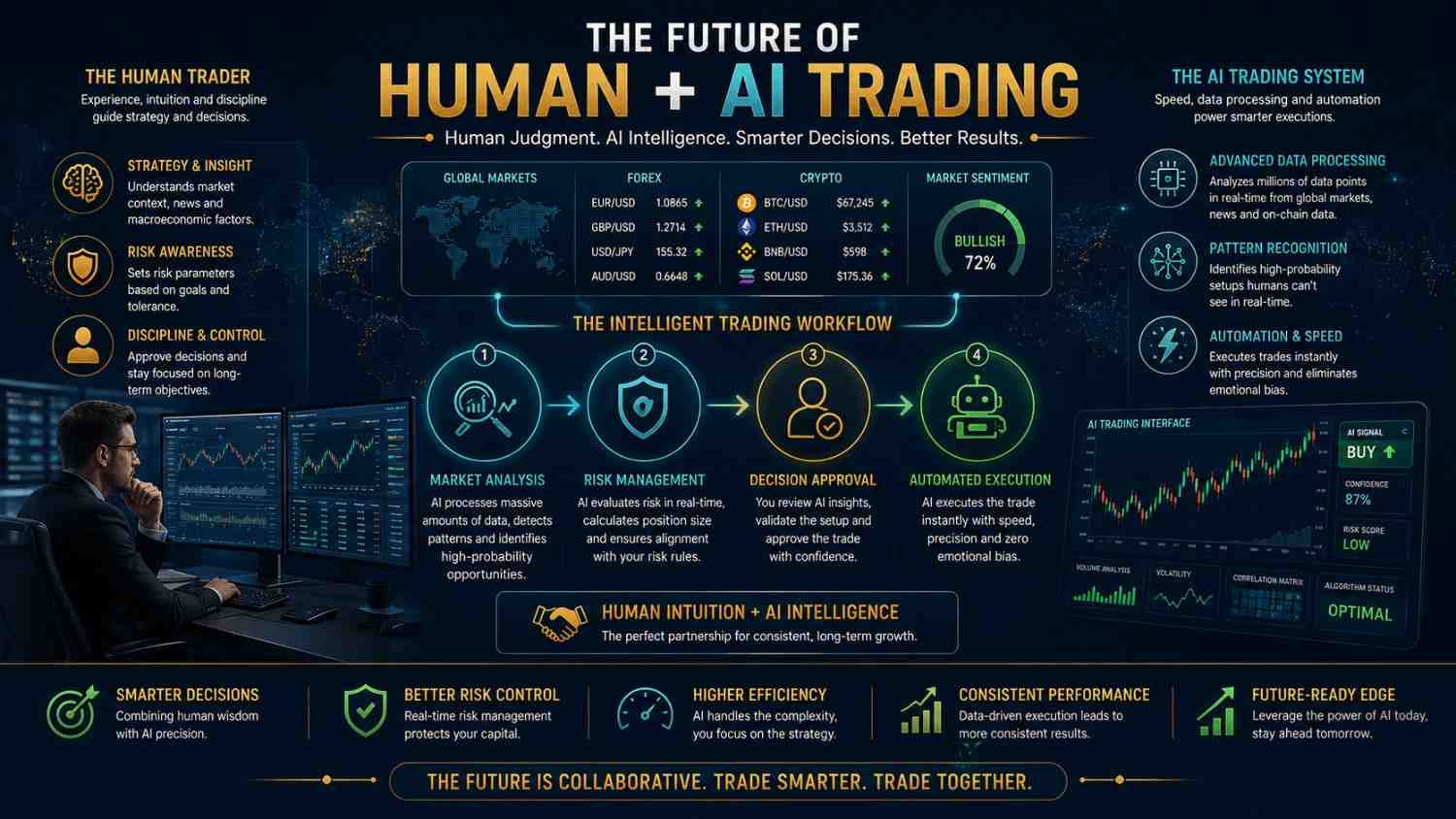
Market analysis → Signal → Human approval → Trade execution
rather than executing every decision independently.
For many traders, this hybrid approach may be more appropriate than completely automated trading.
How AI Trading Bots Work
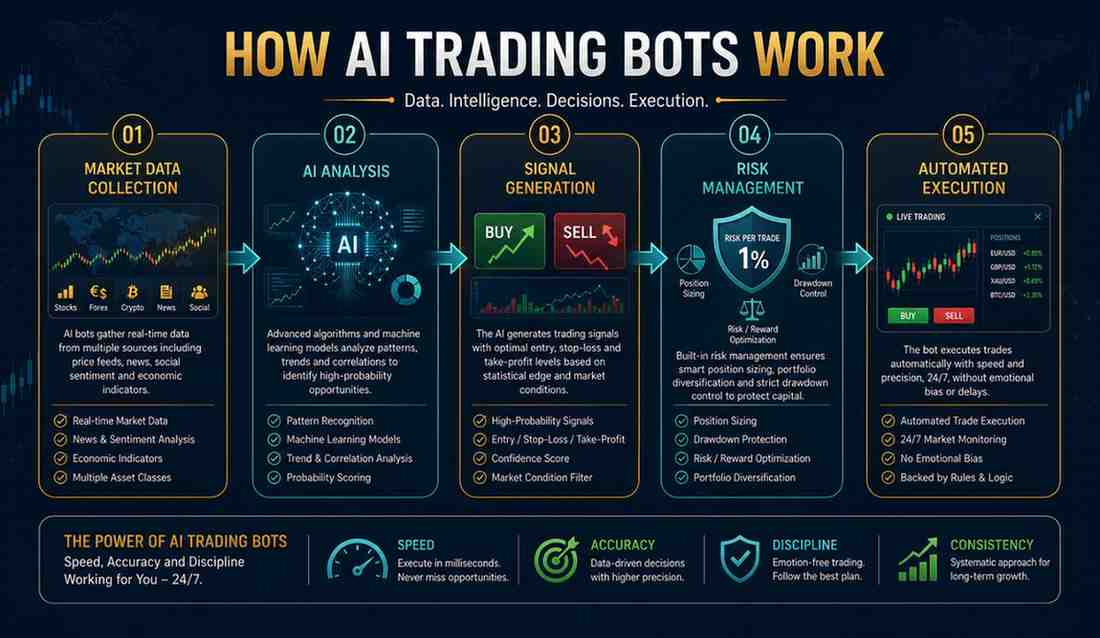
Understanding the technology is one of the best ways to avoid misleading marketing.
Market Data Collection
A trading bot can collect information such as:
- Price
- Volume
- Candlestick data
- Technical indicators
- Economic data
- News
- Market sentiment
- Order-book information
- Historical market behavior
Historical Data
Historical data allows a system to examine how a strategy would have behaved under previous market conditions.
But historical performance is not proof of future performance.
The CFTC specifically warns that automated programs can be adjusted to historical market activity without providing certainty that similar conditions will continue.
Real-Time Data
Real-time information is required if the system is expected to respond to current market conditions.
Latency, spreads, liquidity, and execution quality can therefore affect actual performance.
Signal Generation
Once data has been collected, the AI trading bot attempts to identify a trading opportunity.
For example, it may detect:
- A trend
- A momentum shift
- A volatility breakout
- A price anomaly
- A sentiment change
- A technical pattern
The system may then generate:
BUY
SELL
or
NO TRADE
A good system should also be capable of determining that doing nothing is sometimes the correct decision.
Risk Management
This is one of the most important components of legitimate automated trading.
A sophisticated system should consider:
- Stop-loss distance
- Position size
- Account equity
- Maximum drawdown
- Risk per trade
- Correlated positions
- Daily loss limits
- Exposure by asset
A bot that focuses entirely on entries while ignoring risk management is dangerous.
Trade Execution
The final stage is execution.
Depending on the system, the AI trading bot may send instructions to a broker or trading platform.
This is where another important distinction appears.
A profitable strategy on paper can still perform poorly in live trading.
Reasons include:
- Spread
- Slippage
- Execution delays
- Liquidity
- Commissions
- Market gaps
- Server interruptions
- Broker restrictions
Can AI Trading Bots Actually Make Money?
Yes, an automated system can potentially make money.
But that statement is very different from:
“This AI trading bot will make you money.”
No legitimate technology can guarantee future trading profits.
The CFTC explicitly warns that AI cannot predict the future and cautions investors against automated trading schemes promising unreasonable or guaranteed returns.
Recent academic work also illustrates why caution is necessary. A July 2026 study examining AI-assisted cryptocurrency timing models found that several tested policies produced negative results after considering assumed trading costs, reinforcing the importance of realistic testing rather than relying on predictive accuracy alone.
Prediction Is Not the Same as Profit
A model may correctly identify market direction frequently and still lose money.
Why?
Because profitability depends on:
Entry + exit + position size + costs + risk + market conditions
A system with a high prediction accuracy can therefore still produce poor returns.
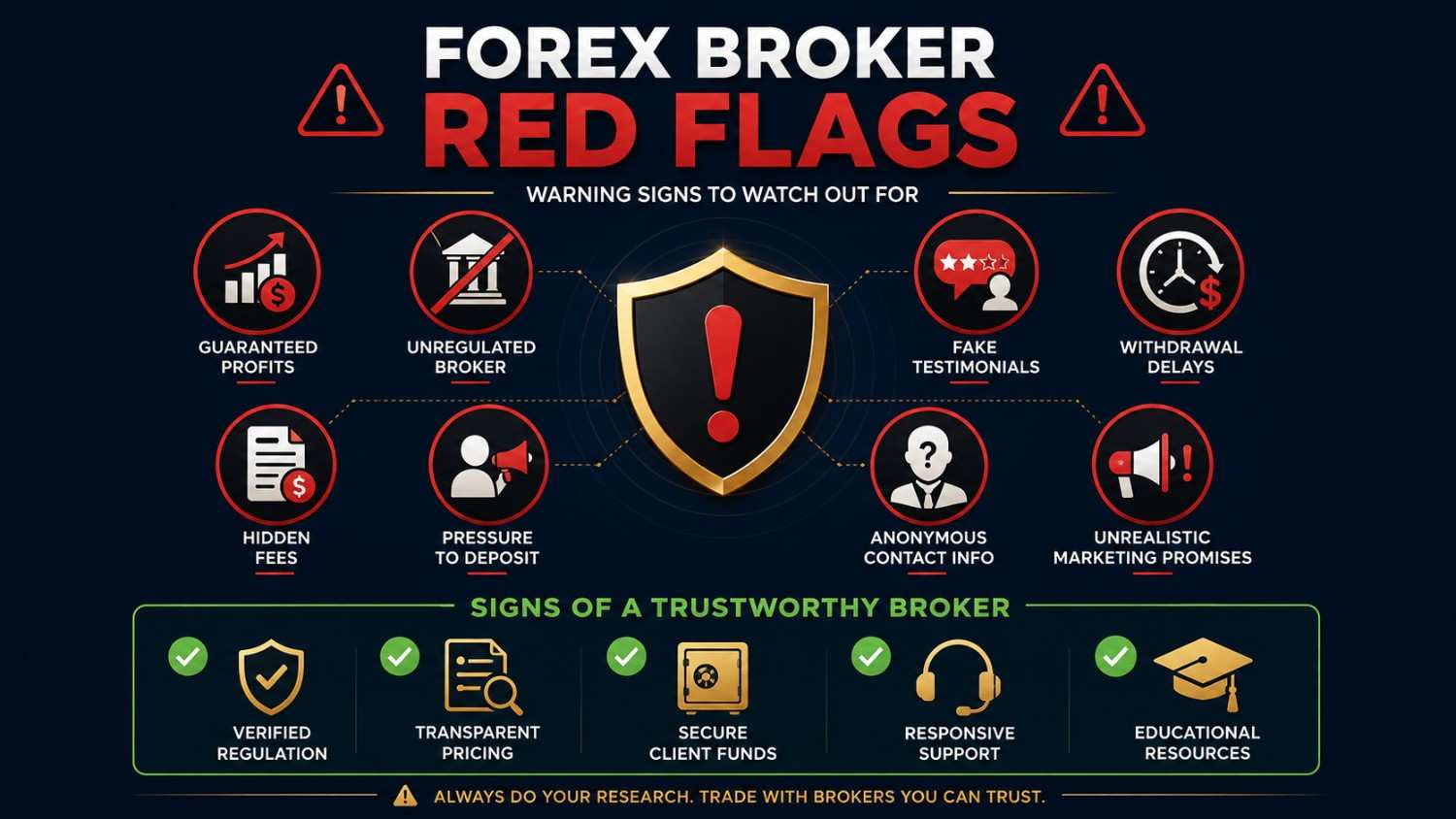
The Biggest AI Trading Bot Red Flags
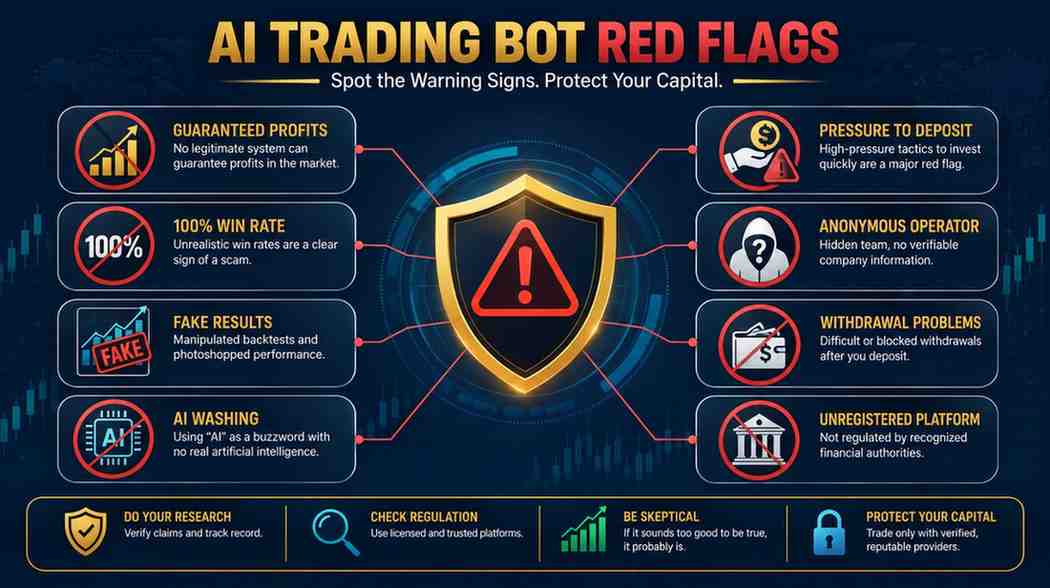
This is the section every trader should save.
1. Guaranteed Profits
If an AI trading bot claims:
“Guaranteed 20% every month.”
Stop.
If it says:
“Zero losing trades.”
Stop.
If it says:
“Our AI never loses.”
Stop.
Investments involve risk, and regulators repeatedly warn that guaranteed high returns are a major fraud warning sign.
2. Unrealistic Win Rates
A website advertising:
99% win rate
should immediately raise questions.
Ask:
- Over what period?
- Which market?
- Which broker?
- What timeframe?
- What account size?
- Was the result live?
- Was it independently audited?
- Are losing trades included?
- What was the maximum drawdown?
A win rate without context tells you very little.
3. “AI” With No Explanation
A legitimate provider doesn’t necessarily need to reveal its proprietary source code.
But it should explain its technology at a reasonable level.
Warning Signs
Be cautious when a provider repeatedly uses terms such as:
Deep Learning
Quantum AI
Neural Engine
Institutional Algorithm
Predictive AI
without explaining what these technologies actually do.
FINRA specifically warns investors to be skeptical of vague or overstated AI claims and recommends asking providers to explain their technology with specificity.
4. AI Washing
AI washing occurs when a company exaggerates or falsely claims its use of artificial intelligence.
For example:
A conventional moving-average strategy could be marketed as:
“Proprietary institutional AI technology.”
That doesn’t automatically make the product fraudulent, but it makes verification essential.
FINRA specifically identifies AI washing as a growing concern in automated trading services.
5. Fake Trading Results
Be suspicious of screenshots showing:
$500 → $50,000
in a few weeks.
A screenshot is not audited evidence.
Better Evidence
Look for:
- Verified live accounts
- Long-term track records
- Maximum drawdown
- Complete trade history
- Independent verification
- Broker statements
- Clear methodology
- Realistic assumptions
6. Pressure to Deposit
A legitimate provider should not need to pressure you.
Warning phrases include:
“Deposit today.”
“Only 10 accounts remaining.”
“AI opportunity expires tonight.”
“VIP investors only.”
Investor.gov identifies pressure to act immediately as a classic investment-fraud warning sign.
7. Unregistered or Anonymous Operators
If you cannot determine:
- Who owns the company
- Where it is registered
- Who operates the service
- Where client funds are held
- Which regulator oversees it
do not send money simply because the website looks professional.
FINRA recommends researching automated trading providers and verifying claims about relationships with registered firms.
AI Trading Bot Scams: How the Fraud Usually Works
An AI trading bot scam may follow a predictable pattern.
Step 1 — The Advertisement
You see an advertisement claiming:
“Our AI predicts the market.”
Step 2 — The Social Proof
The website displays:
- Luxury cars
- Expensive homes
- Trading screenshots
- Testimonials
- Celebrity endorsements
Step 3 — The Small Deposit
You are encouraged to start with a relatively small amount.
Step 4 — Fake Profits
The dashboard begins displaying profits.
Your account appears to grow.
Step 5 — Larger Deposits
You are encouraged to deposit more.
Step 6 — Withdrawal Problems
When you request your money, the platform may demand:
- Tax
- Verification fee
- Withdrawal fee
- Security deposit
- Account upgrade
- Blockchain fee
Step 7 — More Pressure
The scammer may tell you:
“Pay the fee or your account will be frozen.”
This is a major warning sign.
Investor.gov warns that scammers can use fake websites, fake trading information and manipulated account displays to make victims believe their investments are profitable.
How to Test an AI Trading Bot Before Using Real Money
Never start with a large deposit.
Step 1—Understand the Strategy
Ask:
What exactly causes the bot to enter a trade?
What causes it to exit?
How does it determine position size?
What happens during extreme volatility?
If the provider cannot explain the system adequately, be cautious.
Step 2 — Request a Demo
Use a demo environment before committing real capital.
Test:
- Execution
- Frequency
- Drawdown
- Trade duration
- Spread sensitivity
- Behavior during volatile markets
Step 3—Backtest Properly
Backtesting can be useful, but poor backtesting can produce misleading results.
Avoid Overfitting
A strategy can be optimized so aggressively for historical data that it performs poorly in live markets.
H4: Include Trading Costs
Testing should account for:
- Spread
- Commission
- Slippage
- Swap
- Platform costs
Test Different Market Conditions
A bot should ideally be examined during:
Trending markets
Range-bound markets
High-volatility markets
Low-volatility markets
Major news events
Forward Testing Is More Important Than a Beautiful Backtest
After backtesting, run the AI trading bot in a live market environment without risking substantial capital.
This is called forward testing.
It can reveal differences between:
Backtest performance
and
real-world execution.
That difference can be substantial.
What a Legitimate AI Trading Bot Should Disclose
A credible provider should make it possible for traders to understand the product.
Strategy Information
The provider should explain the general strategy.
Risk Information
It should disclose that losses are possible.
Performance Information
Performance claims should have context.
Fees
You should know about:
- Subscription fees
- Performance fees
- Broker fees
- Spreads
- Commissions
Data Requirements
If the bot requires access to your trading account, understand exactly what information it receives.
Account Permissions
Be extremely careful about providing account credentials.
FINRA specifically warns that giving unregistered auto-trading services brokerage credentials can create serious privacy and financial-security risks.
Should an AI Trading Bot Have Full Access to Your Account?
Prefer systems that use secure authorization mechanisms rather than asking for your main brokerage password.
If a provider says:
“Send us your broker username and password.”
stop and investigate.
You should understand:
- What permissions are granted
- Whether withdrawals can be initiated
- Whether trades can be placed
- Whether credentials are stored
- Who can access them
- How access can be revoked
Never assume that a sophisticated-looking interface automatically means sophisticated cybersecurity.
AI Forex Trading Bots vs AI Crypto Trading Bots
AI trading bots can operate across different markets, but each market has different characteristics.
AI Forex Trading Bots
Forex bots may operate around:
- Currency pairs
- Economic releases
- Interest-rate decisions
- Central-bank announcements
- Trading sessions
- Volatility changes
Forex also involves significant leverage risk.
The CFTC notes that most retail forex traders lose money and warns that automated programs cannot guarantee that historical market relationships will continue.
AI Crypto Trading Bots
Crypto bots may face:
- 24/7 markets
- Extreme volatility
- Liquidity differences
- Exchange outages
- Token-specific risks
- Rapid market sentiment changes
The always-open nature of cryptocurrency markets can make automated monitoring particularly attractive—but it can also expose poorly designed systems to continuous market risk.
AI Trading Bots for Beginners: Are They a Good Idea?
Beginners should be particularly careful.
An AI trading bot can make trading appear easy.
That creates a dangerous psychological effect:
If the computer does everything, I don’t need to learn anything.
That is wrong.
In AI Trading Bots, a beginner should understand at least:
- Risk management
- Leverage
- Drawdown
- Position sizing
- Stop losses
- Spread
- Slippage
- Market volatility
- Trading psychology
Our Risk Management Mastery: 7 Proven Strategies guide is particularly useful before experimenting with automated systems.
And traders who don’t yet understand chart structure can start with How to Read Forex Charts: A Beginner’s Guide.
AI Trading Bots and the Human Trader
The strongest approach may not be:
100% manual
or
100% automated.
A hybrid approach can combine both.
Human Responsibilities
The trader determines:
- Risk tolerance
- Trading objectives
- Maximum acceptable drawdown
- Capital allocation
- Markets to trade
AI Responsibilities
The system can assist with:
- Data analysis
- Signal generation
- Monitoring
- Execution
- Risk alerts
- Trade journaling
This creates a useful division:
Human chooses the rules.
AI helps enforce the rules.
AI Trading Bots in 2027: What Will Change?
The technology is likely to become increasingly sophisticated.
More Multimodal Analysis
Future systems may combine:
- Price charts
- News
- Earnings reports
- Economic calendars
- Social sentiment
- Alternative data
More Agentic Trading
AI trading agents may increasingly be capable of:
Observe → Analyze → Decide → Execute → Monitor → Adjust
This is a natural progression from today’s simpler automated trading systems.
More Regulation
As AI becomes more involved in financial services, regulators are likely to pay greater attention to:
- AI claims
- Automated advice
- Consumer protection
- Data security
- Algorithmic accountability
Better Fraud Detection
AI will also be used to identify suspicious investment activity.
Unfortunately, scammers will use AI too.
That means traders will need to become increasingly sophisticated at verifying financial products.
The Future Problem: AI Trading Bot vs AI Trading Bot
By 2030, the challenge may not simply be:
Human trader vs market.
It may increasingly become:
AI system vs. AI system.
If thousands of automated systems analyze similar information and respond to similar signals, market behavior could change.
This creates questions about:
- Crowded trades
- Algorithmic feedback loops
- Volatility spikes
- Liquidity
- Correlated strategies
AI may therefore improve trading technology while simultaneously introducing new forms of market complexity.
10 Questions to Ask Before Buying an AI Trading Bot
Before paying for any AI trading bot, ask:
1. What exactly makes this system “AI”?
2. Who owns the company?
3. Is the company regulated where required?
4. Can I verify the performance independently?
5. What is the maximum historical drawdown?
6. Does the performance include spreads and commissions?
7. What happens when the market changes?
8. What permissions does the software require?
9. Can I withdraw my money without additional payments?
10. Does the company guarantee profits?
If the answer to the final question is yes, walk away.
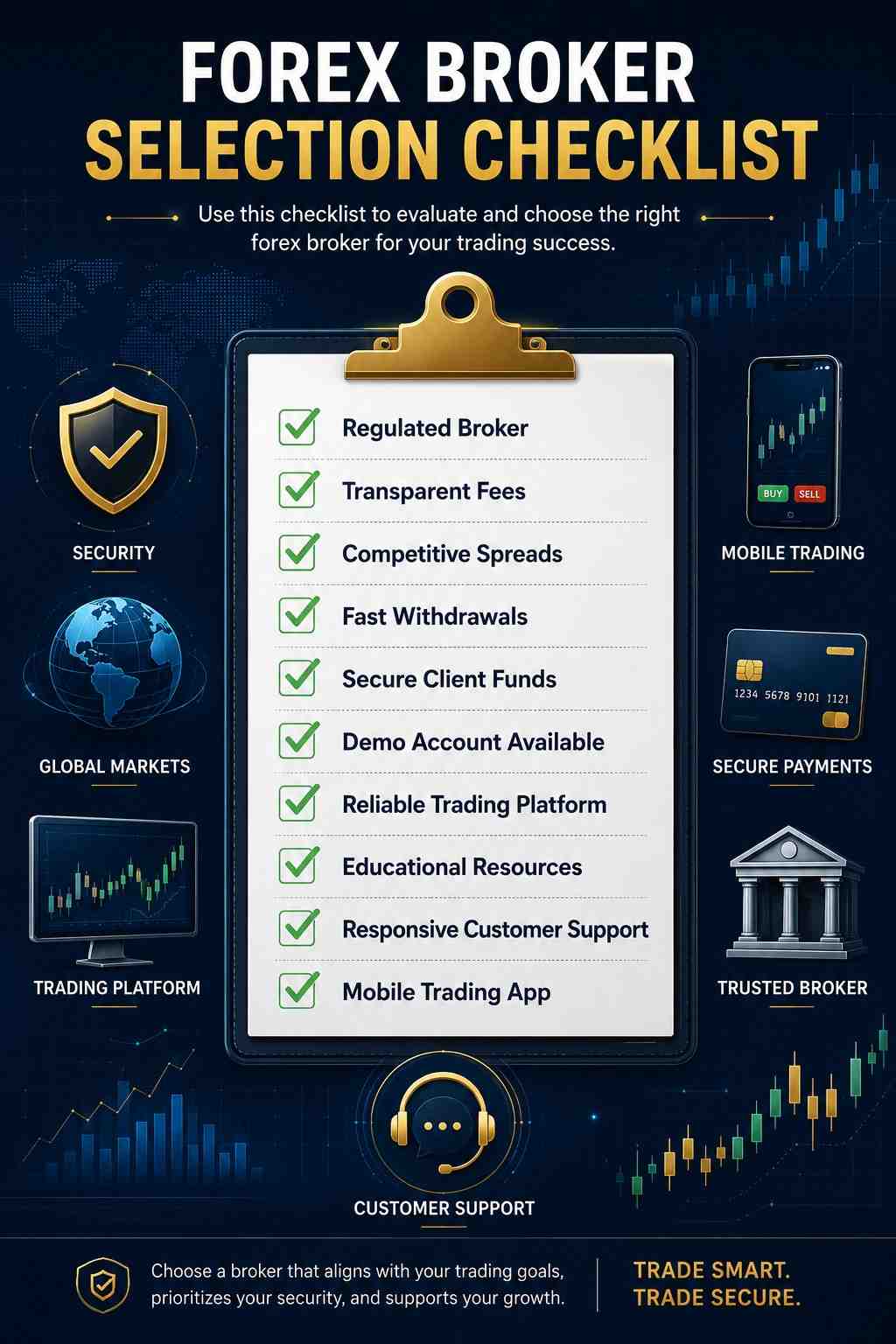
AI Trading Bot Selection Checklist
Before connecting an AI trading bot to a live account:
☐ Understand the trading strategy
☐ Verify the company
☐ Check regulatory status where applicable.
☐ Verify performance independently
☐ Examine maximum drawdown
☐ Test on a demo account
☐ Conduct realistic backtests
☐ Include spreads and commissions
☐ Forward-test the system
☐ Understand account permissions
☐ Protect broker credentials
☐ Check withdrawal procedures
☐ Understand subscription fees
☐ Avoid guaranteed-return claims.
☐ Avoid pressure to deposit
☐ Never invest money you cannot afford to lose.
What Makes an AI Trading Bots Legitimate?
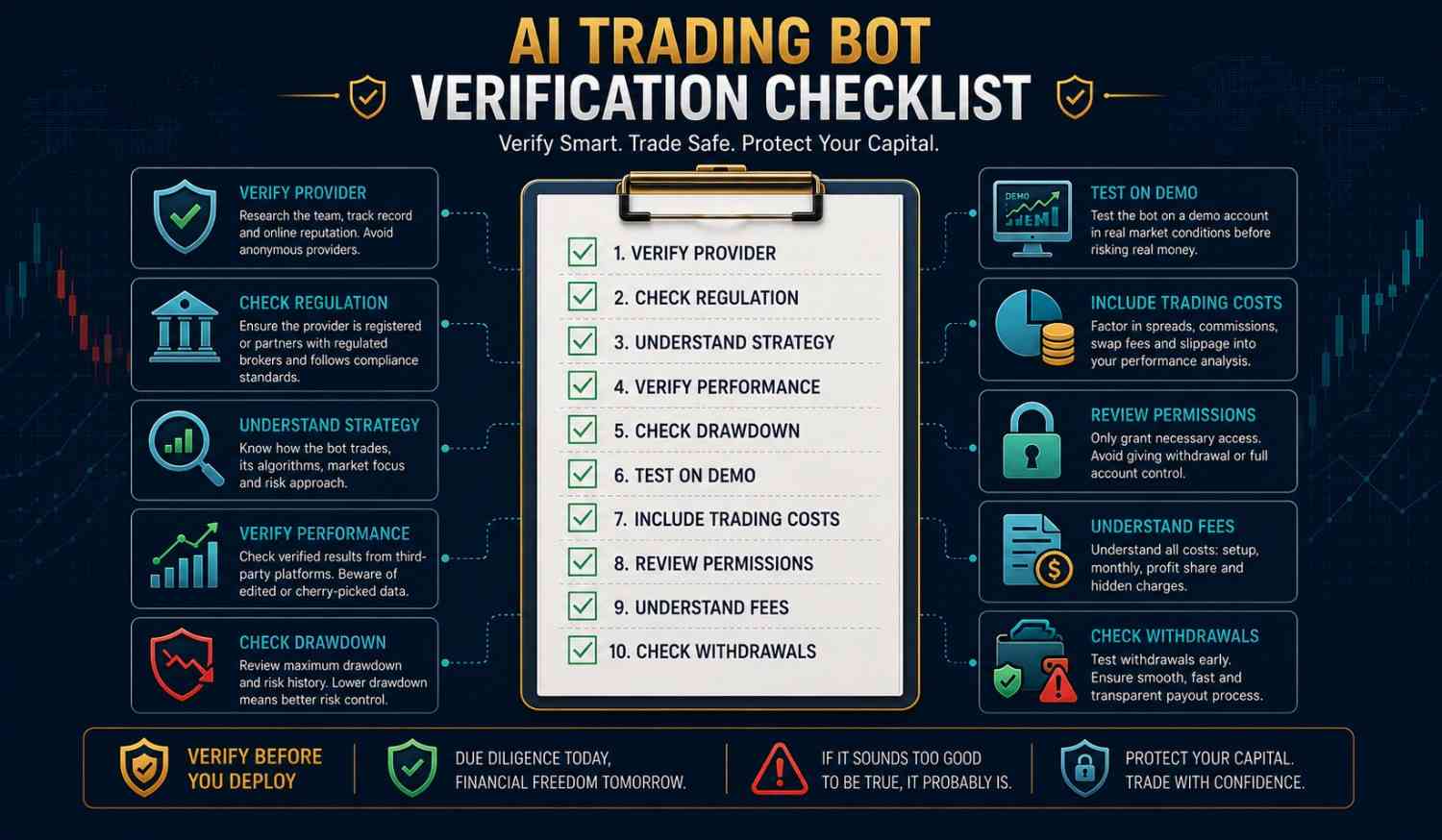
There is no single feature that proves a bot is legitimate.
Instead, look for a combination of:
Transparency
Verifiable ownership
Appropriate registration
Realistic performance claims
Clear risk disclosures
Understandable technology
Secure account permissions
Transparent fees
Independent verification
No guaranteed profits
The more a provider refuses to explain, the more cautious you should become.
AI Trading Bots vs. Manual Trading
| Feature | Manual Trading | AI Trading Bots |
|---|---|---|
| Execution | Human | Automated |
| Speed | Human-dependent | Potentially very fast |
| Emotions | Major factor | Reduced during execution |
| Monitoring | Requires trader | Can be continuous |
| Strategy | Human rules | Programmed/AI-assisted |
| Risk of technical failure | Lower | Higher |
| Adaptability | Human judgment | Depends on model |
| Overconfidence | Human-driven | Can come from model marketing |
| Learning requirement | High | Still essential |
| Guaranteed profits | No | No |
Automation doesn’t eliminate risk.
It changes the source of the risk.
The Biggest Mistake Traders Make With AI Trading Bots
The biggest mistake isn’t necessarily choosing the wrong indicator.
It is believing:
“Because AI is involved, the system must be smarter than me.”
AI can process enormous quantities of information.
It can analyze patterns.
It can automate execution.
But markets remain uncertain.
A model can be wrong.
A strategy can stop working.
A broker can experience execution problems.
A market regime can change.
And an apparently legitimate platform can still expose users to operational or cybersecurity risks.
FINRA advises investors to continue monitoring their accounts even when using automated services provided by regulated entities, ensuring activity remains consistent with their goals and risk tolerance.
Final Verdict: Should You Use AI Trading Bots?
AI trading bots can be useful tools.
They can automate repetitive tasks, analyze large datasets, enforce trading rules, and potentially reduce emotional interference.
But they are not money-printing machines.
A legitimate AI trading bot should never need to promise:
Guaranteed profits.
No losing trades.
100% accuracy.
Risk-free returns.
Those claims should immediately make you investigate further.
The safest approach is to treat AI trading bots as technology requiring verification, not as financial shortcuts.
Learn the market.
Understand the strategy.
Test the technology.
Measure drawdown.
Verify the provider.
Protect your account.
And most importantly:
Never allow the word “AI” to replace due diligence.
The traders who benefit most from AI between 2027 and 2030 may not be those who blindly automate everything.
They may be the traders who understand where AI helps, where AI fails, and when a human should remain in control.
Frequently Asked Questions
What are AI trading bots?
AI trading bots are software systems that use automated rules, machine learning, artificial intelligence or related technologies to analyze financial markets and generate or execute trading decisions.
Are AI trading bots profitable?
Some of AI trading Bots’ automated trading strategies can be profitable under particular conditions, but profitability is never guaranteed. Performance can change when market conditions, costs, or liquidity change.
Are AI trading bots scams?
Not necessarily. Legitimate automated trading technology exists, but scammers also use AI marketing to promote fraudulent investment schemes. Regulators, including the CFTC and FINRA, have warned about these practices.
Can AI trading bots guarantee profits?
No. Guaranteed trading profits are a major warning sign. The CFTC specifically warns against AI trading schemes making unreasonable or guaranteed-return claims.
Can AI trading bots trade Forex?
Yes. Automated systems can trade Forex when connected to a compatible trading platform and broker, but the risks of leverage, spread, slippage, and changing market conditions remain.
Can AI trading bots trade cryptocurrency?
Yes. Crypto trading bots can operate on supported exchanges, although cryptocurrency markets can experience significant volatility and liquidity differences.
Are AI trading bots good for beginners?
Beginners should be cautious. Automated trading does not remove the need to understand risk management, leverage, drawdown, execution, and the underlying strategy.
How can I identify a legitimate AI trading bots?
Investigate the company, regulatory status, ownership, technology, performance evidence, fees, security permissions, and withdrawal procedures. Be particularly skeptical of guaranteed-return claims.
What is AI washing?
AI washing is the practice of exaggerating or falsely claiming the use or capabilities of artificial intelligence. FINRA specifically identifies AI washing as a risk in automated trading services.
Can AI predict the stock or Forex market?
With AI trading bots, AI can analyze information and generate forecasts or signals, but it cannot reliably predict the future with certainty. Market conditions can change unexpectedly.
Sources
CFTC: Customer Advisory: AI Won’t Turn Trading Bots into Money Machines—primary source for warnings about AI trading bots, guaranteed returns, and automated trading scams.
FINRA: Know the Risks of Auto-Trading Services Offered by unregistered entities—particularly useful for AI washing, unregistered auto-trading services, credentials, and performance claims.
FINRA: Artificial Intelligence (AI) and Investment Fraud—guidance on AI-related investment fraud and unreliable AI-generated information.
Investor.gov: Artificial Intelligence (AI) and Investment Fraud: Investor Alert — SEC/NASAA/FINRA investor guidance on AI investment fraud.
CFTC: Forex Frauds—useful for Forex-specific fraud and automated trading risks.
Investor.gov: Protect Your Money: How to Avoid Investment Scams—In AI Trading Bots, general investment-scam prevention guidance.
Financial Disclaimer
FinWireStack provides educational and informational content and does not provide personalized investment, financial, legal, or tax advice. Trading Forex, cryptocurrencies, CFDs, stocks, and other financial instruments involves substantial risk and may result in the loss of some or all of your invested capital. AI trading bots and automated trading systems do not guarantee profits, and past performance does not guarantee future results. Always conduct your own research, verify the regulatory status of financial service providers where applicable, understand the risks, and consider consulting a qualified financial professional before making investment decisions.