
Forex trading psychology is the single most important factor separating successful traders from those who consistently lose money. According to recent research published in the Review of Behavioral Finance, traders’ responses to prior trading shocks exhibit a clear asymmetry—after small shocks, whether gains or losses, traders become more risk-averse, but after large shocks, especially gains, they become increasingly risk-seeking. Understanding this psychological pattern is essential for long-term survival in the forex market.
This comprehensive guide will teach you forex trading psychology fundamentals, helping you identify and overcome emotional biases that destroy trading accounts. You will learn:
- The 7 most dangerous emotions in trading and how to control them
- How recent research reveals the nonlinear nature of risk preferences
- Practical strategies to build emotional discipline
- How to create a trading plan that protects you from yourself
- Real-world examples of psychological traps and how to avoid them
By the end, you will understand forex trading psychology well enough to trade with confidence, discipline, and emotional control—even during market volatility.
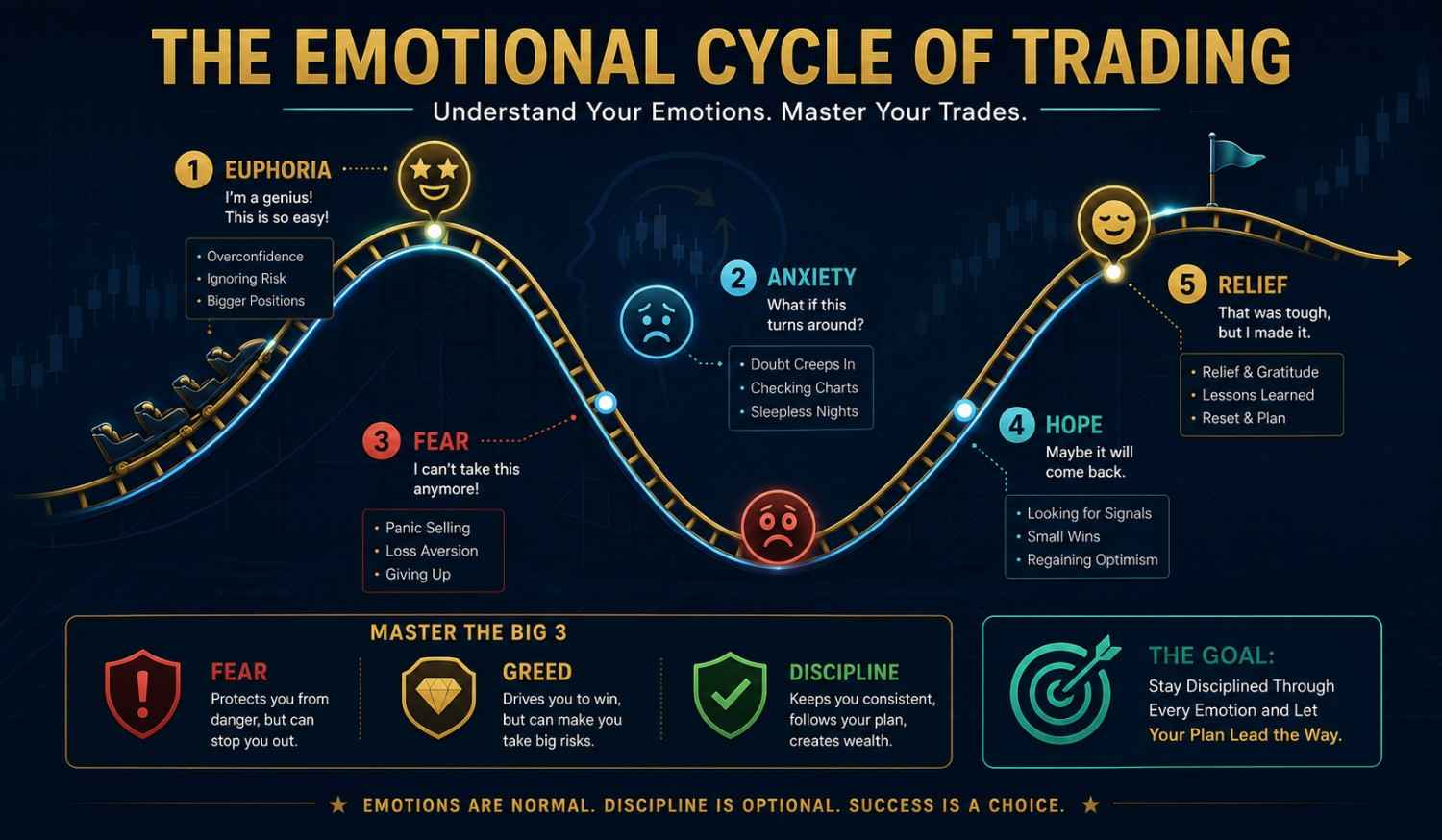
Forex trading psychology—mastering your emotions is the key to consistent profits
What Is Forex Trading Psychology?
Forex trading psychology refers to the mental and emotional state of a trader when making decisions. It is as important—if not more—than fundamental and technical analysis because emotions usually override logic. When traders act based on emotions rather than logic, they tend to close trades too early, take on unnecessary risks, and refuse to accept that losses are part of the game.
According to industry experts, the trader’s mindset is equally important to the trading strategy. Various industry reports suggest that many retail traders fail to earn consistent profits due to emotional decision-making, lack of strategy, and poor risk management. This often happens when beginners spend most of their time learning how to read charts and use technical indicators without spending time learning about their own forex trading psychology or how market movements affect their emotions.
🎯 Real-World Analogy: Trading psychology is like a pilot’s ability to stay calm during turbulence. The instruments (your trading strategy) tell you what’s happening, but if you panic, you’ll make wrong decisions. A calm pilot follows the instruments and lands safely, even in a storm.
The 7 Most Dangerous Emotions in Trading
Research and expert analysis consistently identify seven emotions that derail traders. Understanding how forex trading psychology works means recognizing these emotions before they take control.
1. Greed
Greed is the temptation to behave irrationally in search of excessive profit. When a trader wants to buy more of a position that has performed well but doesn’t have the capital, leverage may provide the fuel to add to positions. Borrowing money to take excessively large positions could be a sign of greed.
🎯 Real-World Example: A trader wins three trades in a row. Overconfidence takes over, and they increase their position size to 10% of their account—well above the recommended 1-2%. The next trade goes against them, wiping out all three previous profits and more.
How It Appears: Greed often tells you to ignore your profit target because the price might slightly rise. But by holding on to a position for too long, a winning trade could turn into a losing one after unexpected news.
The Fix: Set profit targets and stick to them. Lock in profits early—you’re less likely to see a winning trade turn against you.
2. Fear
“Trading fear” refers to the anxiety caused by the possibility of loss, real or imagined. Traders might experience four types of fear: fear of missing out (FOMO), fear of loss, fear of being wrong, and fear of letting a win turn into a loss.
🎯 Real-World Example: A trader has experienced three consecutive losses. Fear paralyzes them, and they hesitate to enter a new trade even when their setup appears. They watch the price move in their predicted direction without profiting.
How It Appears: Fear can push traders to exit trades too early, causing them to miss out on potential profits or even prevent them from entering trades altogether.
The Fix: Use a well-defined trading plan. When fear arises, refer back to your plan—it was created when you were calm and objective. Use stop-loss orders to limit potential losses.
3. Hope
Hope is a double-edged sword that can both help and harm your trading strategy. While it’s nice to be positive, hope can easily make you deny that trades start going bad.
🎯 Real-World Example: You buy EUR/USD at 1.1050, and it drops to 1.1000. Instead of cutting your losses, you hold on, hoping the price will recover. It drops further to 1.0950. Your small loss has become a large loss.
How It Appears: If you hold onto a losing position for too long, waiting for the market to turn around, the losses usually get bigger instead of reducing.
The Fix: Accept that losses are part of trading. Replace hope with objectivity. If your stop-loss is hit, accept the loss and move on. Professional traders don’t hope—they act.
4. Anger and Revenge Trading
Anger is an intense emotional state felt when a trade has gone wrong. It might drive you to make a rash decision to exit a position early if you’re mad about its short-term performance.
🎯 Real-World Example: You lose $200 on a bad trade. Instead of stopping to analyze the mistake, you immediately place another trade with double the position size, hoping to win back losses. Often, this leads to an even bigger loss.
How It Appears: Revenge trading is an impulsive, emotion-driven behavior where a trader immediately enters new, often larger, trades to recover recent financial losses. Driven by anger, frustration, or a bruised ego, the trader abandons risk management in an attempt to “get back” at the market. This can be a fast track to an empty account.
The Fix: Take a break after losses. Step away from the screen and reflect. Losses are part of the business. Review what went wrong before returning to the market.
5. Pride and Overconfidence
You can experience pride from repeated trading success. But this success could make you feel like you’re guaranteed to make money, blinding you to taking on extra risk that could lead to losses.
🎯 Real-World Example: A trader experiences a winning streak and becomes convinced they’ve “figured out” the market. They start ignoring their risk management rules and take oversized positions. The market shifts, and they lose everything.
How It Appears: After major wins, traders often increase position size and relax discipline. This pattern repeats throughout trading careers. Overconfidence, or an inflated ego, often stems from a streak of successful trades, leading traders to undertake bigger-than-normal risks.
The Fix: Balance your confidence with realism. Despite winning big, remind yourself of your trading strategy and don’t trade with money you can’t afford to lose. Confidence must be grounded in process, not outcomes.
6. Impatience
Impatience is the inability to wait, which usually appears as intolerance, irritability, or restlessness. Impatient traders can feel frustrated and abandon carefully crafted plans.
🎯 Real-World Example: You see the market moving fast and feel the urge to “get in on the action” without waiting for confirmation. You enter impulsively, and the price immediately reverses.
How It Appears: The trader enters too early, exits too early, fails to wait for confirmation, and wants every trade to be profitable instantly.
The Fix: Patience is a superpower in trading. Wait for the proper setup before opening a position and enable winning trades to develop over time. If you make impulsive decisions, you turn potential profits into losses.
7. FOMO (Fear of Missing Out)
FOMO is a common phenomenon in trading. Driven by envy that others are making profitable trades while you are not, traders often make impulsive, ill-timed decisions, such as entering trades without proper analysis or overtrading.
🎯 Real-World Example: You see a currency pair rallying sharply and hear others talking about their profits. You rush in without analysis, buying at the top. The price reverses, and you’re stuck with a losing position.
How It Appears: FOMO has become a part of the markets with the rise of social media and online trading communities. Chatter on these channels can lead to some traders believing that if they don’t act now, they could miss out on a potentially lucrative opportunity to get rich.
The Fix: The key to overcoming FOMO is to develop a well-researched trading strategy and stick to it, regardless of market hype or the actions of others. Markets will always offer opportunities—don’t chase them.
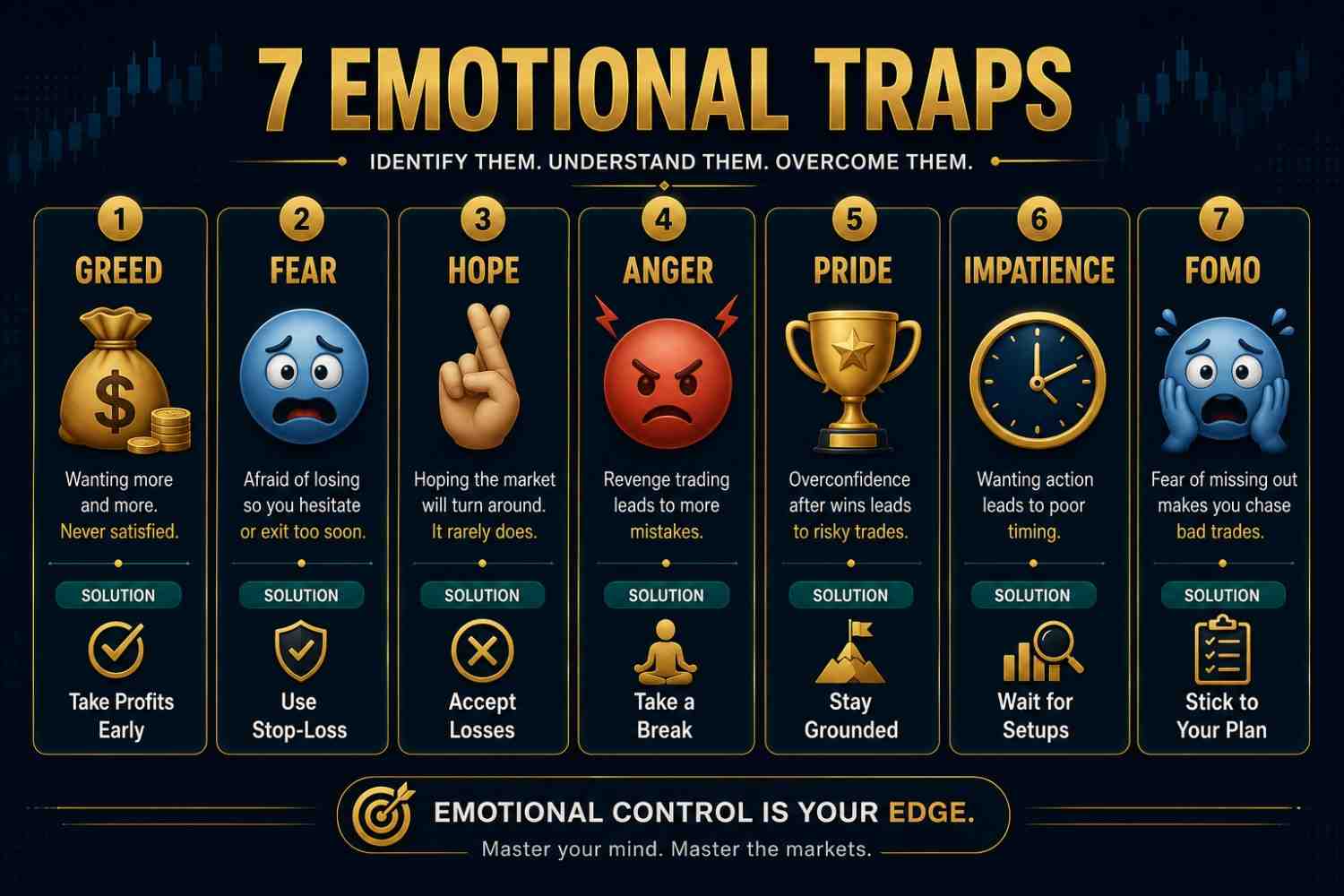
The 7 most dangerous emotions in forex trading and how to control them
The Science of Risk Preferences: What Research Reveals
Recent academic research has uncovered critical insights about forex trading psychology that every trader should understand. A comprehensive study published in the Review of Behavioral Finance analyzed over 349,000 daily retail trading records to understand how traders respond to gains and losses.
Key Research Findings
Finding 1: Nonlinear Risk Preferences
Traders’ responses to prior shocks exhibit clear asymmetry. After small shocks, whether gains or losses, traders become more risk-averse. In contrast, after large shocks, especially gains, they become increasingly risk-seeking.
What This Means: After a small loss, a trader might become cautious. But after a big win, they become overconfident and take excessive risks—often leading to disaster.
Finding 2: The Switching Point
The switching point between risk aversion and risk seeking lies deeper in the loss domain. This means traders tolerate more losses before becoming risk-seeking compared to gains.
Finding 3: Effects Scale and Fade
These effects scale with shock levels and fade over time. The bigger the win, the more overconfident the trader becomes. But over time, emotions normalize—unless the trader experiences another shock.
Practical Implications
These findings have profound implications for forex trading psychology:
- After big wins: Recognize that you are statistically more likely to take excessive risks. Reduce position size intentionally to counter this bias.
- After small losses: This is actually a good time to trade—you’re more cautious and risk-aware.
- After big losses, you may become overly risk-averse, missing opportunities. But this is also when you’re most vulnerable to revenge trading.
- The cycle continues: High returns create overconfidence, which increases risk-taking, which eventually leads to large losses—restarting the cycle.
🎯 Real-World Application: If you just had a big winning streak, immediately reduce your position size by 50%. You might feel confident, but research shows that’s exactly when you’re most likely to make mistakes.
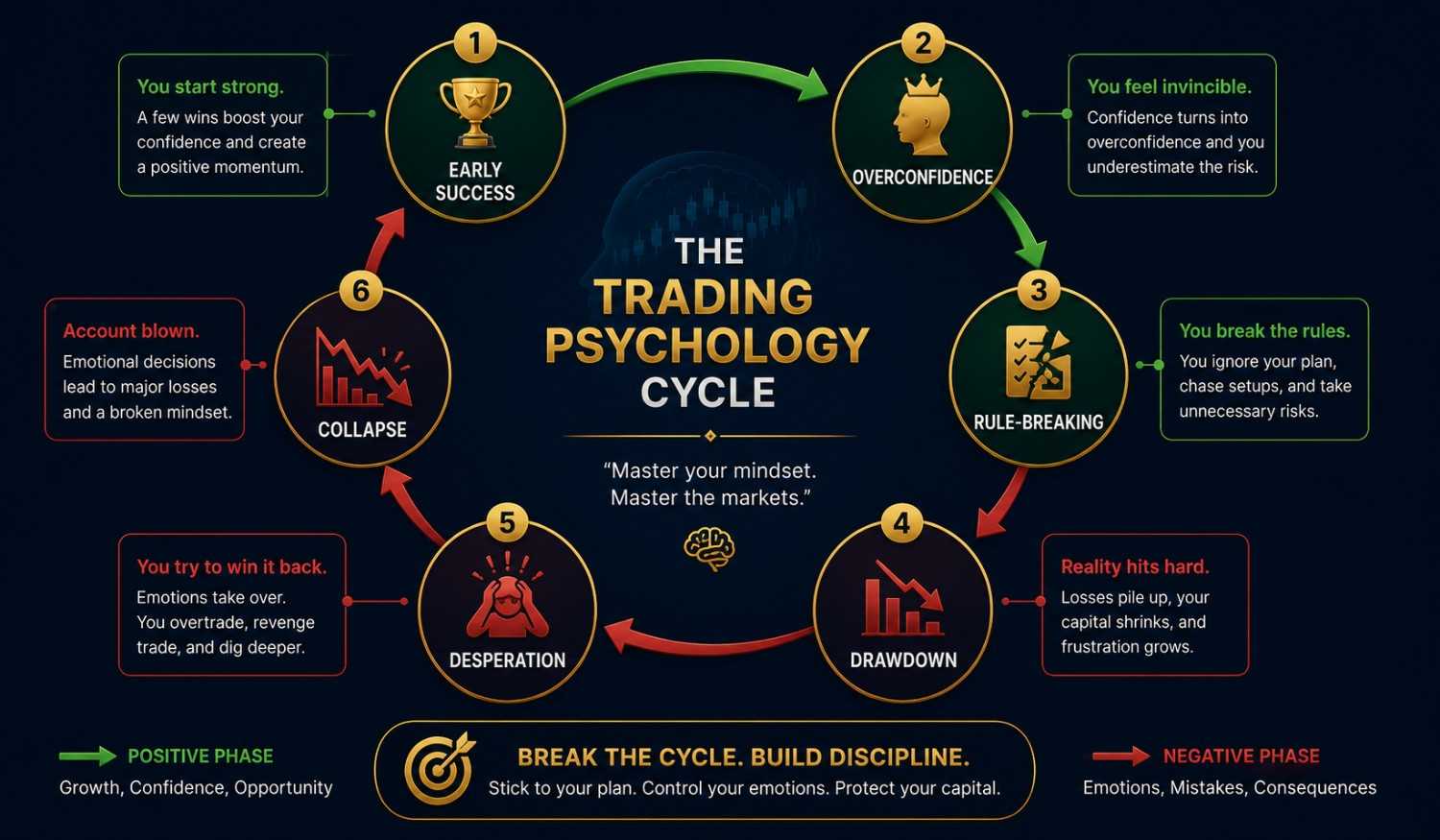
The trader’s psychological cycle—recognize it before it destroys your account
How to Build Your Trading Plan for Psychological Success
A trading plan is a road map that outlines the objectives you hope to accomplish, your risk/reward profile, and the trading approach you feel most comfortable with. It acts as a powerful tool to prevent emotional decision-making. If your screen is filled with multiple indicators and flashing news feeds, your brain could experience ‘analysis paralysis’—a state where a decision or action is never taken.
The 3 Core Questions
Your plan should answer three questions :
- What is my specific trigger to enter a trade?
- Where will I exit if the market moves unfavorably?
- Where will I set my take-profit if the trade moves in my favor?
Trading Plan Checklist
| Element | What to Include | Why It Matters |
|---|---|---|
| Market Selection | Which pairs do you trade | Avoids random decisions |
| Timeframe | H1, H4, Daily, etc. | Prevents timeframe confusion |
| Entry Rules | Specific conditions for entry | Removes impulse entries |
| Exit Rules | Stop-loss and take-profit levels | Protects capital |
| Risk Per Trade | 1-2% maximum | Ensures survival |
| Daily/Weekly Loss Limit | Stop trading after X losses | Prevents revenge trading |
| Review Schedule | Weekly journal review | Enables continuous improvement |
The Power of Journaling
Keeping a trading journal is a good way to keep your emotions in check while trading. A journal reminds you of why you entered a trade.
What to Record:
- Date and time of entry and exit
- Chart screenshot
- Entry/exit price and position size
- Stop-loss and target
- Result of the trade
- Emotions and reasoning behind the trade
- Whether the trade followed your plan
Why It Works: When you look back through your notes, patterns start to emerge . Perhaps you’ll see that you frequently exit the market too soon when it’s still moving in your favour, indicating that you lack patience. Or you may observe that you sometimes dive in without a clear plan, which usually backfires. Over time, the journal becomes more than a record but a tool that shows you what’s working, what isn’t, and how to adjust.
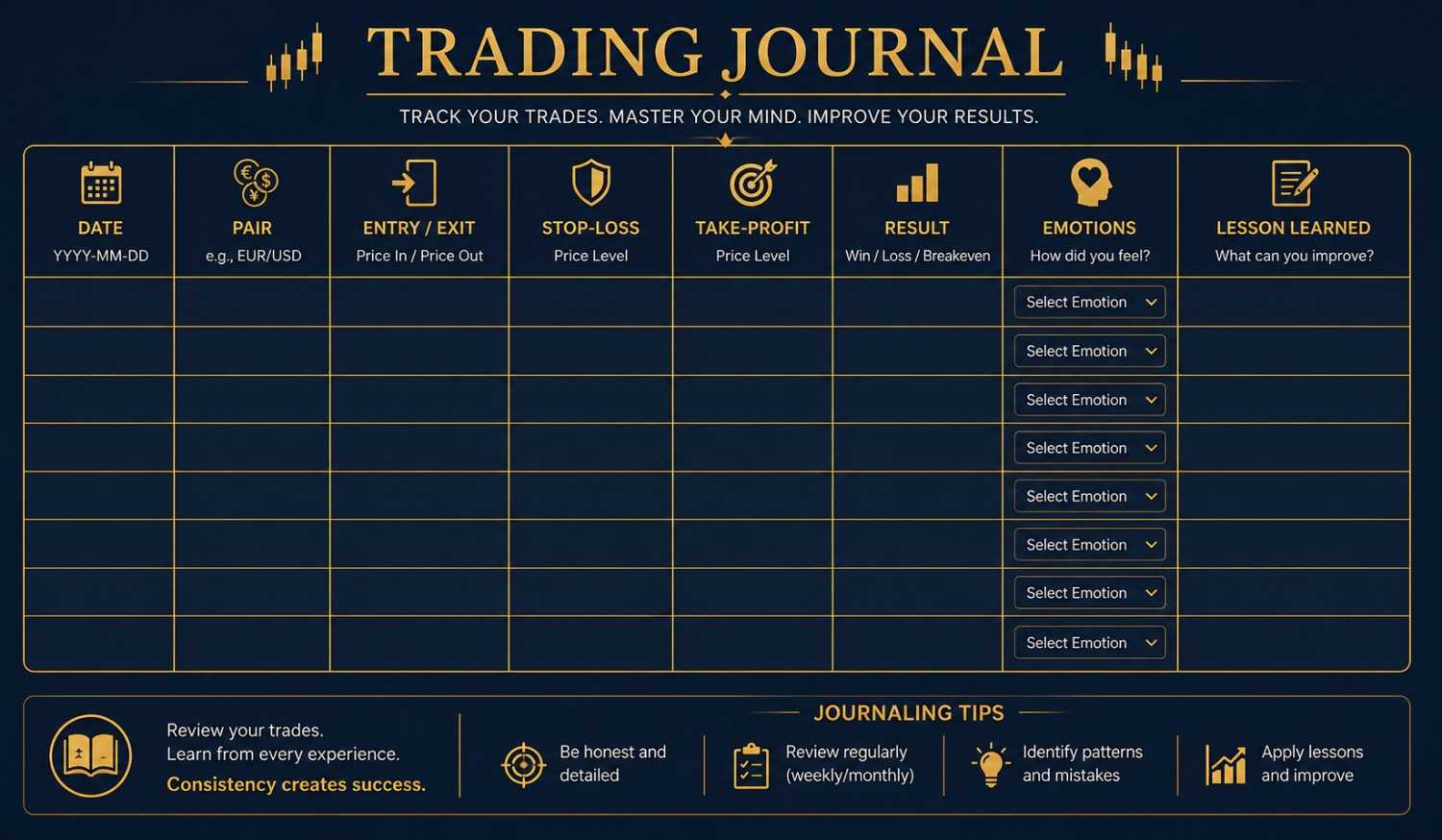
The trading journal—your most powerful tool for mastering trading psychology
Risk Management and Trading Psychology
Good trading psychology requires smart risk management. When managing their emotions, traders are also capable of managing risks better. If traders are calm, they set the right stop-loss orders and do not move them because they feel bad after a losing trade.
The 1% Rule
The most important rule in forex trading psychology is the 1% rule: never risk more than 1-2% of your trading capital per trade. Ignoring this rule can wipe out months of profits in a single mistake.
Example: A trader with $10,000 capital risks $5,000 on one trade because they feel “confident.” If the trade goes wrong, half the account is gone. Recovering from such a loss requires a 100% gain, which is extremely difficult.
Why Risk Management Prevents Emotional Trading
| Risk Management Practice | Psychological Benefit |
|---|---|
| Small position sizes | Reduces stress and fear |
| Stop-loss orders | Removes fear of “what if” |
| Profit targets | Prevents greed from taking over |
| Daily loss limits | Prevents revenge trading |
| Correlation awareness | Prevents overexposure |
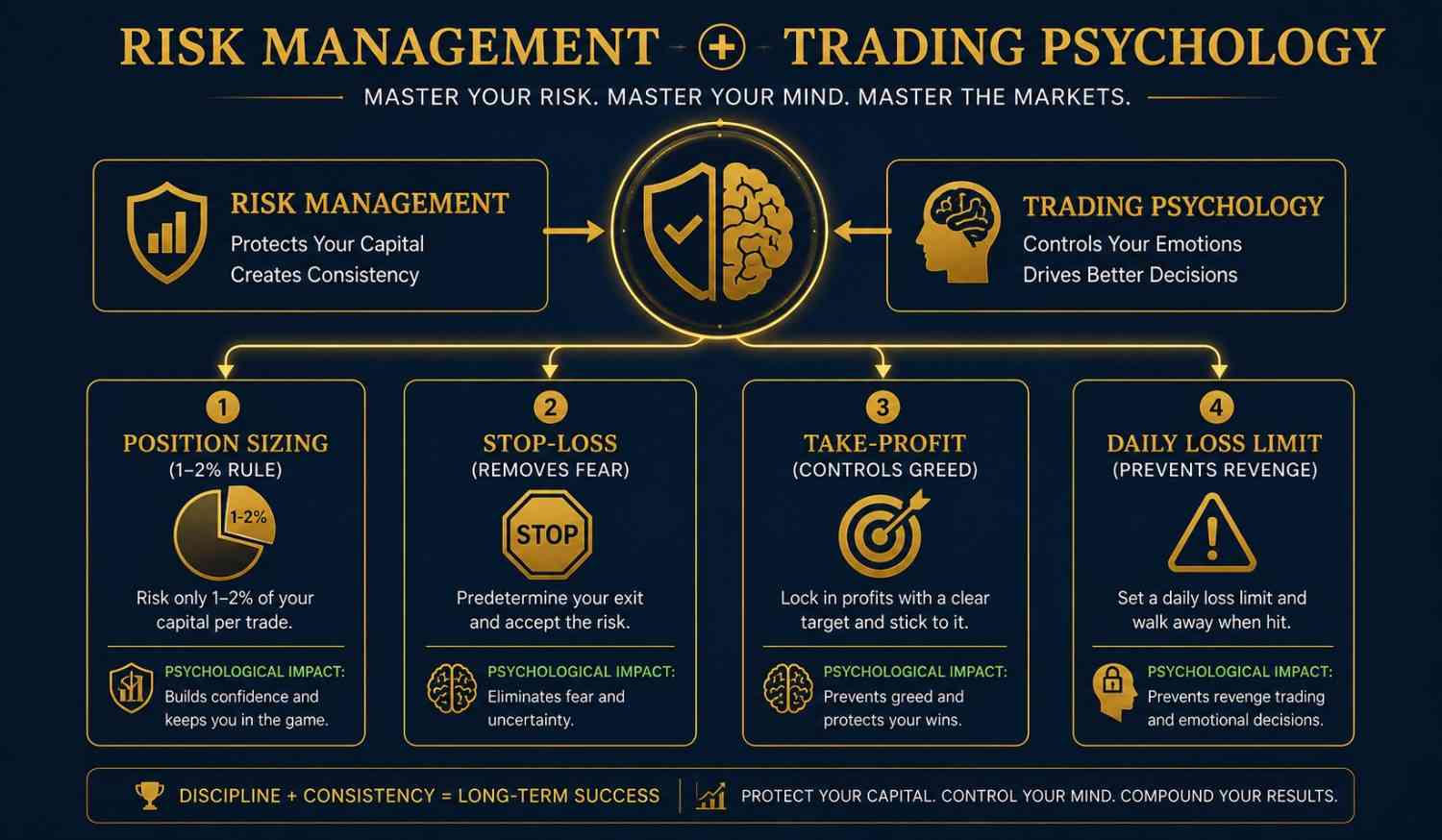
Caption: Figure 5: Risk management is the foundation of trading psychology
Common Psychological Mistakes and How to Avoid Them
Trading psychology mistakes are often the difference between success and failure. Here are the most common, based on expert analysis:
1. Revenge Trading
The Mistake: After a loss, traders immediately jump into another trade, desperate to recover.
The Cost: Poor entries, disregard for setups, and compounding losses.
The Fix: Accept losses as part of the business. Take a break after significant drawdowns. Review what went wrong before returning to the market.
2. Overtrading
The Mistake: Taking too many trades in a day or week, often without solid setups.
The Cost: High transaction costs, emotional fatigue, and poor decision-making.
The Fix: Focus on quality, not quantity. A single high-probability setup can be more profitable than 10 random ones. Define your trading plan and stick to it.
3. Ignoring Market Conditions
The Mistake: Applying the same approach regardless of volatility, liquidity, or trend conditions.
The Cost: Misaligned trades—trend-following in sideways markets or scalping in low-volume environments.
The Fix: Always assess market structure before trading. Identify whether the market is trending, consolidating, or reversing.
4. Forgetting Risk Management
The Mistake: Ignoring position sizing and failing to use stop-loss orders.
The Cost: One bad trade wipes out weeks of profits.
The Fix: Never risk more than 1-2% of your account per trade. Always define exit points before entering.
5. Trading Without Education
The Mistake: Jumping into trading with little knowledge, believing you can “figure it out as you go.”
The Cost: Losses due to a lack of understanding of market fundamentals, technical analysis, and risk-reward.
The Fix: Treat trading as a lifelong learning process. Read, backtest, follow credible analysts, and review your trades weekly.
Lessons from History: Jesse Livermore’s Trading Psychology
Jesse Livermore, one of the most successful speculators in history, understood forex trading psychology before the term even existed. His life offers profound lessons for modern traders.
1. Price Over Opinion
“The market is never wrong. Opinions often are.”
Livermore’s core belief was that price action represents the final verdict of the market. He learned that no matter how compelling a story or narrative might appear, price behavior always takes precedence.
Application: Never allow news to override price structure. Let price action confirm whether the market agrees with the narrative.
2. Patience as a Competitive Advantage
“There is a time to go long, a time to go short, and a time to go fishing.”
Livermore’s greatest strength was not constant activity but selective engagement. Forex markets trade 24 hours a day, creating the illusion of endless opportunity.
Application: Define when not to trade. Avoiding low-quality market conditions is a professional decision, not a missed opportunity.
3. Letting Winners Run
“It was never my thinking that made the big money for me. It was my sitting.”
Livermore’s biggest profits came from holding winning positions, not frequent trading. Modern forex traders often do the opposite: taking profits too early while holding losing trades due to hope .
Application: Define trade invalidation, not prediction. Trail winners using structure or volatility. Add to positions only when price confirms strength.
4. The Psychological Cycle
Many traders unknowingly repeat Livermore’s psychological cycle: early success, overconfidence, rule-breaking, drawdown, desperation, and collapse. Recognizing this cycle early allows traders to intervene before damage becomes irreversible.
Application: Fixed rules that do not change with emotion, regular trading reviews, and scheduled breaks from markets.
Practical Strategies to Improve Your Trading Psychology
Based on expert analysis and research, here are proven strategies to strengthen your forex trading psychology:
1. Practice Through Paper Trading
Paper trading gives you a chance to assess how you would react in certain situations and also refine your reactions and emotional responses.
2. Keep a Trading Journal
A trading journal forces you to write down every decision, which makes it easier to see what’s actually working and what’s costing you money.
3. Take Breaks After Losses
When you take a series of losses, it is always advisable to take a break. Taking a break not only pauses the cycle of losses but also allows you to reflect on things you may have done wrong and how to approach your trades better.
4. Develop a Disciplined Trading Routine
Establish a disciplined trading routine. This includes consistent analysis, following your trading plan, and staying up to date with the latest financial news. Discipline helps you avoid impulsive decisions.
5. Set Realistic Goals
Consider your experience, available capital, risk tolerance, and the overall movements of the market. Make sure that you set goals that are clear and achievable.
6. Identify Your Personality Traits
When actively trading, maintain awareness of individual personality traits that could impact decision-making.
7. Research and Learn Continuously
Spend adequate time researching and learning about a security before investing. The market is always changing, and so are the reactions of market participants.
Conclusion: Master Your Mindset, Master the Market
The human side of forex trading is just as important as technical skills or having knowledge about the markets. Fear, hope, and patience can either guide your journey or lead to multiple mistakes based on how you manage them.
An effective trader is not someone who does not feel these emotions. It is someone who understands them and remains disciplined, irrespective of what is going on in the market. If you combine self-control with smart strategies, you can make more confident trading decisions, avoid emotional trading, and build a more strategic trading journey that lasts longer.
Key Takeaways:
- Understand your emotions — Greed, fear, hope, anger, and FOMO are your biggest enemies
- Recognize the psychological cycle—Early success → Overconfidence → Rule-breaking → Collapse
- Follow the 1% rule—Never risk more than 1-2% of your account per trade to master your Forex trading psychology
- Keep a trading journal—Record every trade, including your emotional state
- Take breaks after losses—Prevent revenge trading psychology
- Stick to your trading plan—it was created when you were calm
- Accept losses as part of trading—They are tuition fees paid to the market
🎯 Final Thought: The markets will always be uncertain. A trader’s job is not to predict perfectly but to manage risk, follow discipline, and protect capital. In trading, survival is success, and wisdom is the ultimate edge. Trade wisely and master your Forex trading psychology.
FAQ
1. What is trading psychology?
Trading psychology is the mental and emotional state you experience when trading. It refers to aspects of a trader’s behavior that influence the decision-making process when trading securities.
2. Why is trading psychology important?
It is as important—if not more—than fundamental and technical analysis because emotions usually override logic. Understanding your trading psychology can be key to your performance as a trader.
3. What are the most common emotional biases in trading?
The most common emotional biases are greed, fear, hope, anger, pride, impatience, FOMO, confirmation bias, anchoring bias, and the gambler’s fallacy.
4. How can I control my emotions while trading?
Create a solid trading plan, manage risk with the 1% rule, use stop-loss orders, keep a trading journal, and take breaks after losses to master your Forex trading psychology.
5. What is revenge trading, and why is it dangerous?
Revenge trading is an impulsive, emotion-driven behavior where a trader immediately enters new, often larger, trades to recover recent financial losses. Driven by anger or frustration, the trader abandons risk management, leading to even bigger losses.
6. What is the 1% rule in trading?
The 1% rule means you never risk more than 1-2% of your trading account on any single trade. This ensures that a few losing trades don’t destroy your entire account.
7. How does a trading journal help with psychology?
A trading journal forces you to write down every decision, making it easier to see what’s actually working and what’s costing you money. Patterns emerge that help you identify emotional triggers.
8. What should I do after a big loss?
Take a break from trading. Review what went wrong. Accept the loss as part of the business. Return when you are calm and can think clearly.
9. What is FOMO in trading?
FOMO (Fear of Missing Out) is the feeling of pressure to rush into trades without proper analysis because others are profiting. It often leads to poor timing and regretful choices.
10. How can I overcome overconfidence?
Balance your confidence in Forex trading psychology with a dose of realism and skepticism. Despite winning big, remind yourself of your trading strategy and don’t trade with money you can’t afford to lose.
Further Reading
To deepen your understanding of forex trading and psychology, explore these additional resources from Finwirestack:
- AI in Forex Trading: 2026 Ultimate Smart Guide — Discover how artificial intelligence is transforming currency markets.
- Risk Management Mastery: 7 Proven Strategies — Master position sizing, stop-loss strategies, and trading psychology.
- How to Trade Forex News: 2026 Smart Guide to Profiting — Learn to profit from economic events without emotional mistakes.
- How to Read Forex Charts: 5 Powerful Patterns for Beginners — Learn to spot key patterns and understand price action.
External Resources (DoFollow Links)
- Benzinga: Trading Psychology Guide—Comprehensive guide to trading psychology and emotional control, all in Forex trading psychology.
- FP Markets: Trading Psychology for Beginners — Beginner-friendly guide to mastering your mindset in Forex trading psychology.
- ThinkMarkets: Trading Psychology Guide — Professional insights on improving trading psychology.
- IronFX: The Human Side of Forex Trading — Deep dive into fear, hope, and patience in Forex trading psychology.
Disclaimer: Trading forex and CFDs involves significant risk of loss. It is not suitable for all investors. You should carefully consider your investment objectives, level of experience, and risk appetite before trading. Never trade with money you cannot afford to lose. The information provided in this article is for educational purposes only and does not constitute financial advice.





[…] Forex Trading Psychology: 7 Secrets to Master Your Mindset — Master your emotions for consistent trading success. […]
[…] Trading Psychology: Why Emotions Matter in Forex vs. Crypto Trading […]