
Advanced Forex strategies are the bridge between retail gambling and professional trading. While basic strategies focus on simple indicators and hope, advanced approaches use institutional-grade techniques that professional traders and hedge funds deploy to achieve consistent profitability.
This comprehensive guide will teach you advanced Forex strategies that go beyond the basics. You will learn:
- 15 institutional-grade trading strategies used by professionals
- How Smart Money Concepts (SMC) reveals institutional footprints
- Advanced risk management techniques for capital preservation
- Algorithmic trading approaches for automated execution
- How to combine strategies for a complete trading system
By the end, you will understand advanced Forex strategies well enough to elevate your trading from gambling to professional execution.
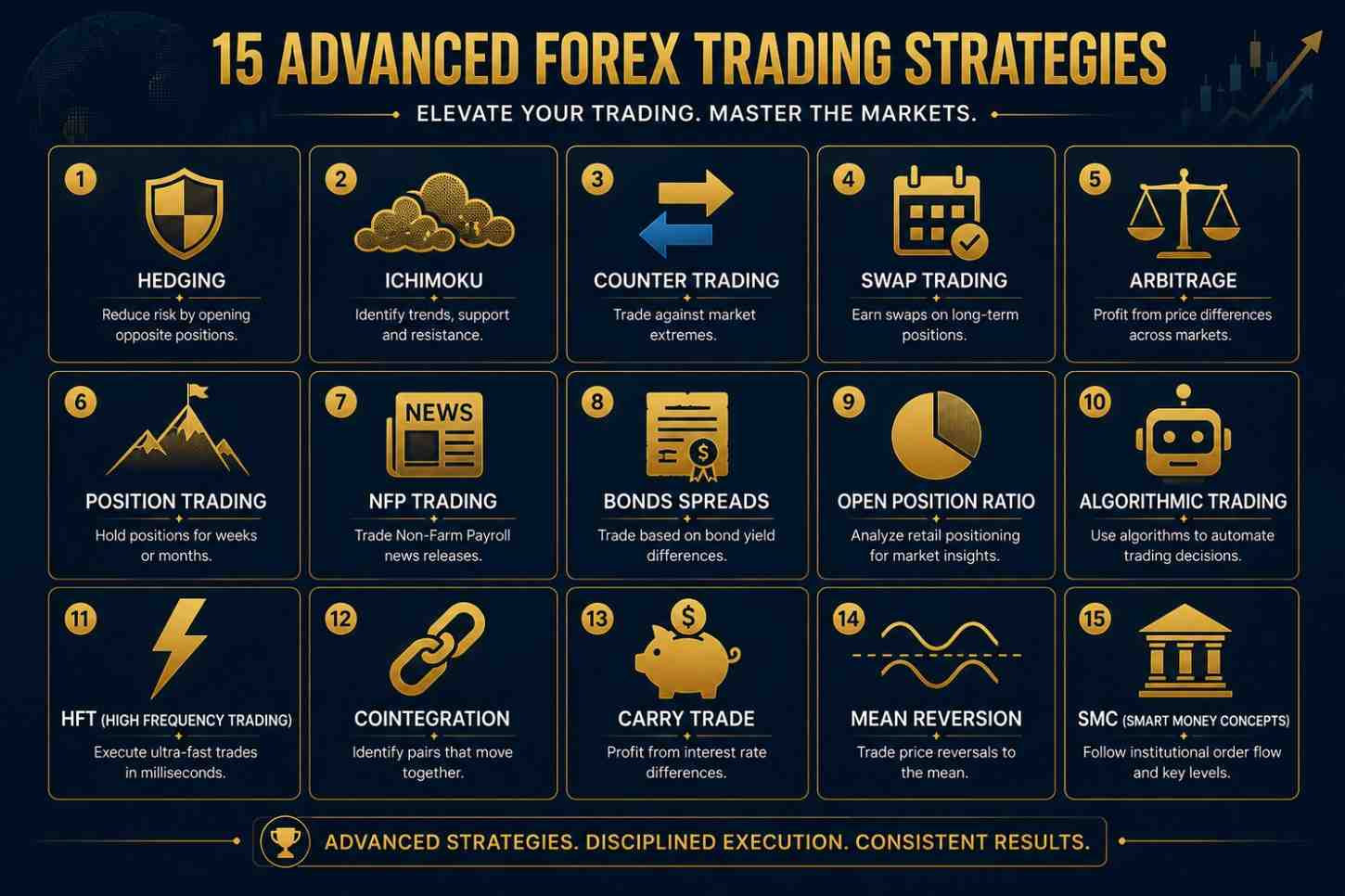
Advanced Forex strategies—15 institutional-grade techniques for consistent profits
What Are Advanced Forex Strategies?
Advanced Forex strategies are crafted approaches that leverage detailed market analysis to identify optimal entry and exit points for trades. Unlike basic techniques, these strategies combine multiple technical tools and require a keen understanding of market behavior and trends.
Institutional Forex trading operates at a completely different level from retail trading. While retail activity continues to grow, most price discovery still comes from banks, hedge funds, and Forex trading institutions that operate through deep institutional FX liquidity networks and advanced execution systems. These large players shape spreads, volatility, and order flow by using models built on Forex institutional data, interbank pricing, and multi-venue routing.
🎯 Real-World Analogy: Think of retail trading like fishing with a rod from the shore. Advanced institutional trading is like operating a commercial fishing fleet with sonar and nets. Both catch fish, but the scale, efficiency, and consistency are entirely different. Advanced Forex strategies give you access to the sonar.
The Smart Money Concept (SMC): The Foundation of Advanced Trading
The Smart Money Concept (SMC) offers a radical shift in perspective from traditional retail trading. Instead of relying on lagging indicators like RSI and MACD, SMC focuses on the footprints left by the world’s largest financial institutions.
Why Retail Traders Struggle
Traditional retail trading is built on “lagging” information. Indicators like the Stochastic or RSI take past price data, smooth it out, and tell you what has already happened. By the time an indicator gives a “buy” signal, the big move is often already over.
The result: a staggering 90% of retail traders consistently lose money. This happens because retail indicators are designed to follow price action that has already occurred; they do not account for the massive capital injections required to move a currency pair.
Core Pillars of SMC
1. Market Structure: The Foundation
Market structure is the roadmap of the market. Price moves in a series of highs and lows.
- Break of Structure (BOS): Occurs when the price continues in its current trend. In a bullish trend, when the price breaks above the previous “Higher High,” it creates a BOS, confirming the trend’s strength.
- Change of Character (CHoCH): The first signal of a potential trend reversal. It happens when the price breaks the specific structural low or high responsible for the last “push” in the trend.
2. Liquidity: The Fuel
Liquidity is essentially “money sitting on the charts.” In SMC, we look for equal highs (EQH) or equal lows (EQL). Retail traders see these as “Strong Resistance” or “Strong Support” and place their stop losses just above or below them. Smart Money sees these as targets. They will “sweep” these levels to grab those stops before reversing the price.
3. Order Blocks (OB): Institutional Footprints
An Order Block (OB) is a specific candle or price zone where institutions previously placed massive orders that caused a significant move. These are effectively “supply and demand” zones on steroids. When the price returns to these zones, we often see a sharp reaction because institutions are “mitigating” (closing out or adding to) their remaining positions.
4. Fair Value Gaps (FVG)
An FVG occurs when there is an imbalance in the market—usually a massive, impulsive candle that leaves “holes” in the price action. Because the market seeks efficiency, it has a natural tendency to return to these gaps to “rebalance” the price before continuing its move.
5. Premium & Discount Zones
Smart money logic dictates that you should always “buy low and sell high”.
- Discount Zone: Using a Fibonacci tool from the start to the end of a price move, anything below the 50% equilibrium is the “Discount” area (ideal for buying).
- Premium Zone: Anything above the 50% equilibrium is the “Premium” area (ideal for selling).

Caption: Figure 2: Smart Money Concept — understanding institutional footprints in the market
15 Advanced Forex Strategies You Should Know
1. Hedging Forex
Hedging reduces exposure by taking offsetting positions, so gains on one trade cushion a loss on another. Traders pair correlated currencies and open opposite trades or use options and futures to lock in rates, controlling tail risk from volatility, leverage, and sudden news.
How It Works: If you’re long EUR/USD, you might short GBP/USD (which is correlated) or use options to protect your position.
Best For: Protecting existing positions, managing risk during uncertainty, and reducing drawdown.
2. Ichimoku Clouds
Ichimoku shows trend, momentum, and support and resistance through five plotted lines and the cloud area, letting you read market structure at a glance. Use the cloud position relative to price, crossovers between the Tenkan and Kijun lines, and the Chikou span to confirm entries, exits, and the strength of trends across time frames.
Key Components:
- Tenkan-sen: Fast-moving average
- Kijun-sen: Slow-moving average
- Senkou Span A & B: The “cloud” defining support/resistance
- Chikou Span: Lagging line confirming strength
Best For: Identifying trend direction, support/resistance, and momentum.
3. Counter Trading
Counter trading seeks short-term gains by entering against the prevailing move once momentum weakens, often using candlestick signals and rejection patterns. This requires precise entry at swing highs or lows, strict stop loss discipline above recent extremes, and small position sizing to survive false reversals in volatile markets.
Best For: Range-bound markets and catching reversals.
4. Swap Trading
Swap trading uses overnight interest differentials to earn or pay swaps when positions remain open until the next settlement time. In advanced Forex strategies, traders plan long or short positions based on expected rate differentials, central bank trajectories, and rollover fees, adding a carry component to price returns.
Best For: Long-term positions where interest rate differentials favor the trade.
5. Cross-Currency Triangulation
Triangulation exploits pricing relations among three currency pairs to improve execution and find small arbitrage or conversion gains without costly conversions to the US dollar. You calculate implied rates from two pairs to compare with the quoted third pair and then place trades where the math shows a temporary mismatch.
Best For: Detecting pricing inefficiencies across pairs.
6. Arbitrage Trading
In advanced Forex strategies, arbitrage involves buying a currency when it is cheap and selling it when it is rich, locking in a near risk-free profit while prices converge. Opportunities surface across platforms, time zones, or related pairs but vanish quickly as liquidity providers and algorithms correct the gap.
Best For: Fast, low-risk profits when price discrepancies exist.
7. Position Trading Strategy
Position traders hold trades through significant moves, ignoring short-term noise and relying on macro trends, economic fundamentals, and weekly or monthly charts to set entries. Position trading asks for disciplined risk controls, occasional rebalancing, and awareness of macro drivers like interest rate cycles and bond yields that influence currency direction.
Best For: Long-term investors who can weather volatility.
8. Non-Farm Payroll Trading
For advanced Forex strategies, NFP releases create sharp spikes in dollar pairs because they quickly update expectations for US growth and policy. Traders prepare by marking key technical levels, using straddle orders or scaled entries, and limiting exposure because spreads and slippage expand at release.
Best For: Traders comfortable with high volatility.
9. Bonds Spreads Trading
Bond spread trading links currency strength to relative yields and yield curve shifts between countries, turning fixed income signals into forex entries. When one country offers higher yields, capital may flow there, strengthening its currency.
Best For: Understanding the link between fixed income and currency markets.
10. Open Position Ratio
The open position ratio shows where retail and institutional money is concentrated and exposes crowded trades that may reverse during volatility. Compare the ratio with volume and price action to spot potential squeezes or contrarian opportunities.
Best For: Identifying extreme retail positioning.
11. Algorithmic Trading
Algorithmic systems execute predefined trading rules across markets, using indicators, statistical models, or machine learning to scan for setups and manage risk automatically. Good algo trading depends on robust backtesting, walk-forward analysis, and careful control of overfitting, slippage, and execution costs.
Best For: Systematic traders who want to remove emotions.
🎯 Real-World Example: Algorithmic trading uses precise risk-reward ratios and fixed position sizing rules. Targeting 1:2 risk-reward ratios means one winner pays for two losers. Programs execute the next instruction according to probability models, nothing more.
12. High-Frequency Trading
High-frequency trading uses ultra-low latency systems and colocated servers to exploit tiny price inefficiencies at scale, placing massive order flow with razor-thin margins. Success rests on execution speed, market microstructure expertise, and continuous risk controls.
Best For: Institutional traders with the necessary infrastructure.
13. Cointegration Trading
Cointegration identifies pairs whose price series share a long-term equilibrium, allowing temporary deviations to offer mean reversion trades with a statistical edge. Use tests like Engle Granger to validate relationships, set entry thresholds based on z scores, and manage risk with time-based exits or stop losses if the relationship breaks.
Best For: advanced Forex strategies, statistical arbitrage, and mean reversion.
14. Carry Trade
Carry trade borrows in a low-rate currency and funds a high-yielding currency to earn the interest differential, creating a passive income stream while exposed to spot moves. This strategy benefits from stable rate differentials and low volatility, but it suffers when risk appetite shifts and funding currencies strengthen.
Best For: Stable market conditions with clear rate differentials.
15. Mean Reversion
Mean reversion strategies enter after substantial deviations from moving averages or bands, expecting prices to drift back toward the mean, often using indicators like Bollinger Bands and moving average envelopes. You must calibrate entry thresholds, exit rules, and stop loss levels because trends can persist and cause significant losses if the market does not revert quickly.
Best For: Range-bound markets with clear mean levels.
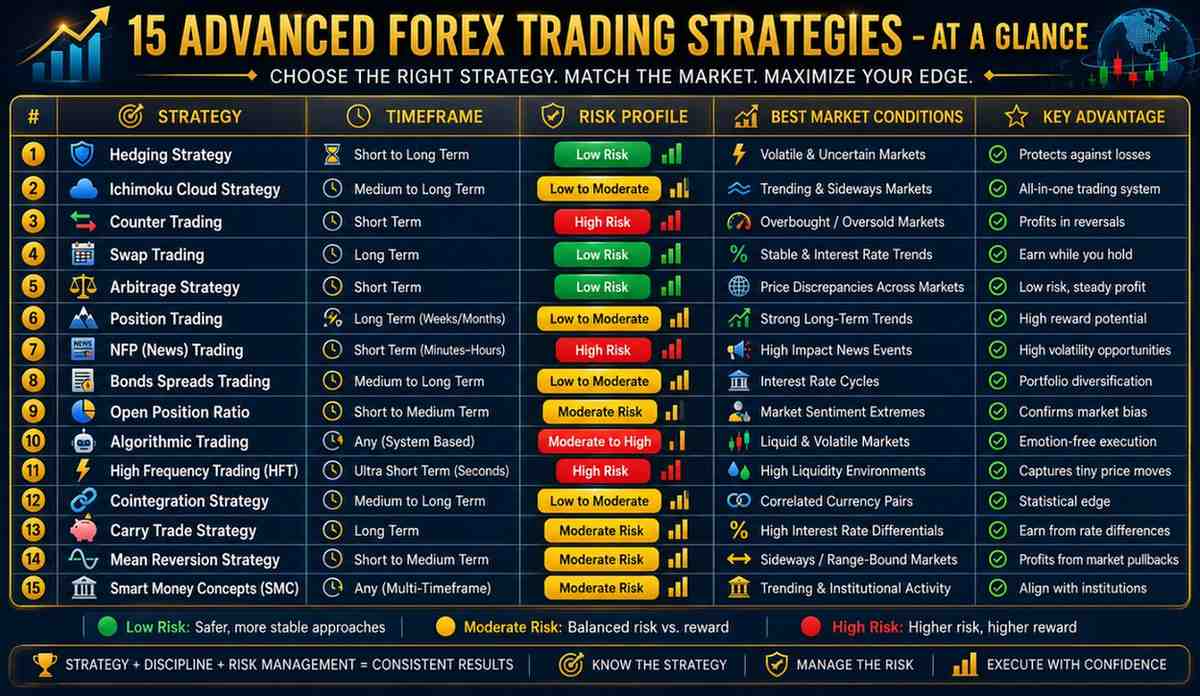
Advanced Forex strategies — comparison of 15 institutional-grade techniques
Algorithmic Trading: The Institutional Edge
Advanced automated systems are increasingly vital in modern forex trading. Institutional algorithms now generate more than 70% of daily FX volume, according to industry estimates. Manual retail traders face a latency disadvantage measured not in seconds but in hundreds of milliseconds.
The Execution Gap
How Retail Traders Can Compete
Retail algorithmic trading closes the competitive gap through discipline, not raw speed. A retail expert advisor running on a dedicated VPS eliminates human hesitation, fatigue, and emotional override—three failure modes that no institutional algo faces. Furthermore, retail algos operate smaller position sizes that slip through liquidity gaps institutions cannot access. Machine learning and advanced Forex strategies now allow retail systems to detect session-specific patterns that manual analysis misses at scale.
💡 Pro Tip: The retail edge lies not in execution speed but in consistent rule-based decision-making across all market sessions. AI won’t replace retail traders, but traders using AI will replace those who don’t.
Algorithmic Trading Software Options
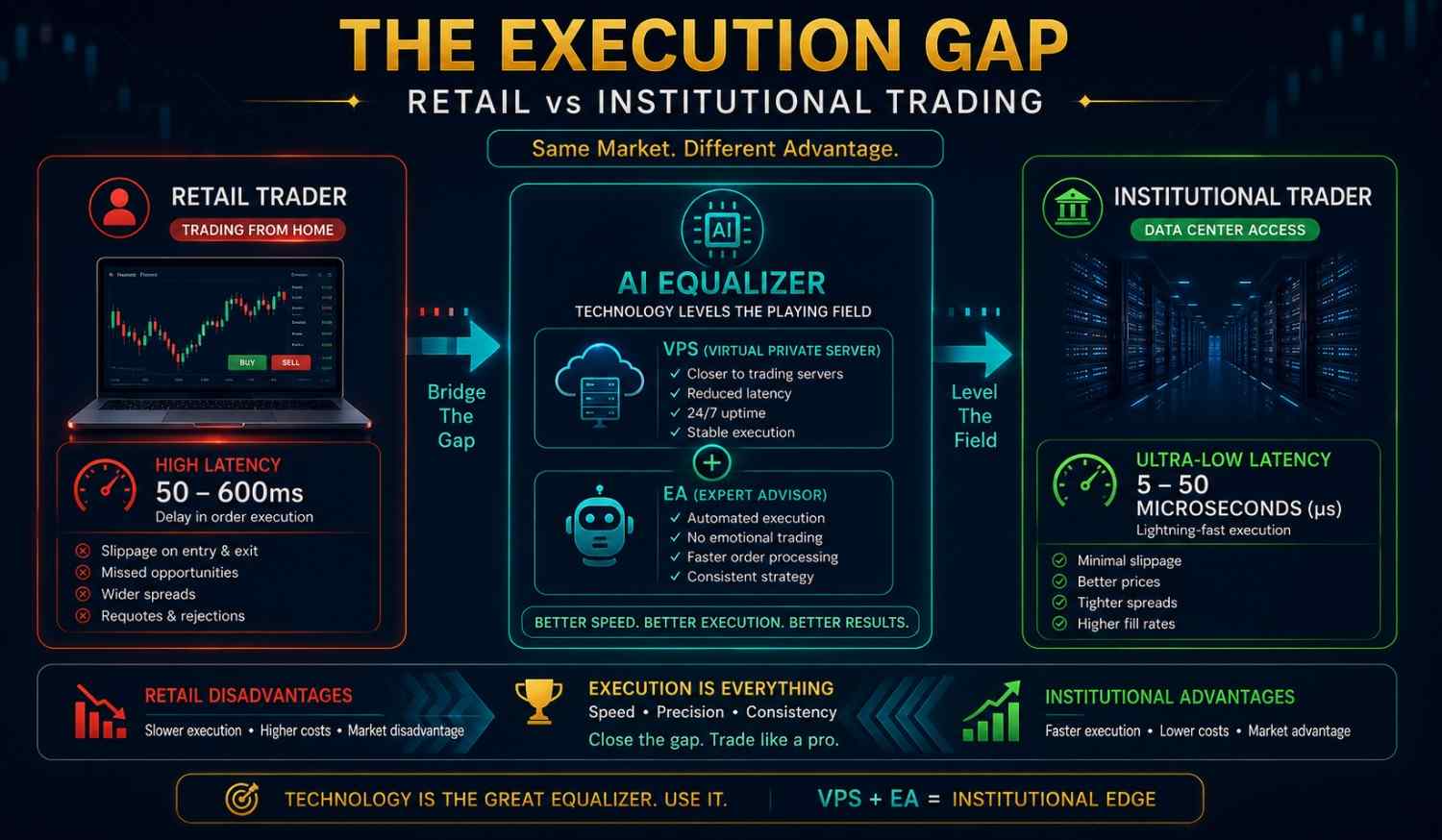
Algorithmic trading — bridging the gap between retail and institutional execution
Advanced Risk Management Techniques
Advanced risk management separates consistent traders from those who blow up accounts.
The 3 Pillars of Algorithmic Profitability
- Validated Edge: The strategy must produce statistically significant positive expectancy across 500 or more backtested trades with out-of-sample confirmation.
- Dynamic Optimization: Prop traders run monthly or quarterly parameter reviews to prevent strategy decay as market regime shifts occur.
- Capital Efficiency: Algorithmic execution on a funded account amplifies a proven edge across institutional-scale capital without requiring personal risk capital.
Quantitative Risk Assessment Methods
Position sizing algorithms form the backbone of disciplined trading systems. Rather than risking fixed dollar amounts, successful traders calculate position sizes based on account percentages and volatility measurements. This approach adapts automatically to changing market conditions.
Correlation analysis prevents over-exposure to similar currency pairs, protecting your portfolio from concentrated risks. Understanding how EUR/USD correlates with GBP/USD helps diversify your positions effectively.

Advanced risk management techniques for consistent trading success
Common Mistakes with Advanced Strategies
Conclusion: Elevate Your Trading
Advanced Forex strategies represent a significant step up from retail trading approaches. By understanding institutional logic, market structure, and algorithmic execution, you can bridge the gap between amateur and professional trading.
Key Takeaways:
- The Smart Money Concept reveals institutional footprints—order blocks, fair value gaps, and liquidity sweeps show where big players operate
- Choose strategies that match your personality—not every advanced strategy suits every trader
- Algorithmic trading provides a competitive edge—remove emotions and execute with precision
- Risk management is more important than strategy—protect capital at all costs
- Validate everything—backtest, forward test, and optimize continuously
🎯 Final Thought: The competitive advantage shifts to traders who understand how to deploy advanced Forex strategies within a structured, rule-based framework. Mastering advanced Forex strategies requires time, discipline, and continuous learning—but the rewards are worth the effort.
FAQ
1. What is the Smart Money Concept (SMC)?
SMC is a trading framework that focuses on the footprints left by institutional traders. It uses market structure, order blocks, fair value gaps, and liquidity sweeps to identify where big players are placing orders.
2. What is an order block in forex?
In advanced Forex strategies, an order block is a specific candle or price zone where institutions previously placed massive orders that caused a significant move. These act as supply/demand zones where the price often reacts strongly.
3. What is the difference between SMC and traditional technical analysis?
Traditional analysis uses lagging indicators like RSI and MACD. SMC focuses on price action, market structure, and institutional footprints. SMC traders look for where big players are active rather than waiting for indicator signals.
4. Can retail traders use algorithmic trading?
Yes, retail traders can use algorithmic trading through Expert Advisors (EAs) on MetaTrader platforms or no-code algorithmic trading software. The retail edge lies in consistent rule-based decision-making, not raw speed.
5. What is the best algorithmic trading software for beginners?
In advanced Forex strategies, no-code platforms with visual drag-and-drop interfaces are best for beginners. They require no coding knowledge and typically cost $30-50/month.
6. What are the most profitable advanced forex strategies?
Profitability in advanced Forex strategies depends on market conditions and execution. High-performing strategies include algorithmic trading, SMC-based order block trading, cointegration trading, and careful position trading. Success requires validation and risk management.
7. How do I validate an advanced trading strategy?
Use out-of-sample testing on at least 500 backtested trades, walk-forward analysis, and forward testing on a demo account before risking real capital.
8. What is the 1% rule in advanced trading?
Never risk more than 1-2% of your account on any single trade. This ensures you survive losing streaks and protect your capital.
Further Reading
To deepen your understanding of forex trading, explore these additional resources from Finwirestack:
- AI in Forex Trading: 2026 Ultimate Smart Guide — Discover how artificial intelligence is transforming currency markets and its application to advanced Forex strategies.
- Forex Trading Psychology: 7 Secrets to Master Your Mindset — Master your emotions for consistent trading success.
- How to Trade Forex News: 2026 Smart Guide to Profiting — Learn to profit from economic events without emotional mistakes with advanced Forex strategies.
- How to Read Forex Charts: 5 Powerful Patterns for Beginners — Learn to spot key patterns and understand price action, focusing on advanced Forex strategies.
External Resources (DoFollow Links)
- Hantec Markets: Smart Money Concept Guide — Comprehensive SMC education on advanced Forex strategies.
- The5ers: AI Trading Bots & Algos in 2026 — How smart retail traders compete with institutions working on advanced forex strategies.
- Traders Union: Institutional Forex Trading Guide — Understanding how institutions trade with advanced Forex strategies.
- Goat-Funded Trader: Advanced Forex Trading Strategies — 15 top advanced Forex strategies.
Disclaimer: Trading forex and CFDs involves significant risk of loss. It is not suitable for all investors. You should carefully consider your investment objectives, level of experience, and risk appetite before trading. Never trade with money you cannot afford to lose. The information provided in this article is for educational purposes only and does not constitute financial advice.