How to trade forex news is one of the most powerful skills a trader can develop. Every month, a single number—Non-Farm Payrolls, CPI, or an interest rate decision—moves billions of dollars through the currency markets in minutes. EUR/USD can swing 100 pips before most traders finish their coffee.
But here is the truth that most beginners discover the hard way: learning how to trade forex news isn’t about predicting the number. It’s about understanding market expectations and trading the surprise. As one experienced trader put it, markets don’t move on the news itself—they move on the deviation between what was expected and what actually happened.
This comprehensive guide will teach you how to trade forex news with confidence. You will learn:
- Which economic events actually move the market
- The three proven news trading strategies
- How to manage risk during volatile releases
- Real-world examples and practical setups
- Common mistakes to avoid
How to trade forex news — mastering economic events in 2026
What is Forex News Trading?
How to trade forex news starts with understanding what it actually means. News trading is a strategy where traders take positions based on scheduled economic releases and events that impact currency values. Instead of relying purely on technical analysis, you are trading the market’s reaction to new information.
The core idea is simple: economic data affects a country’s currency. Strong employment numbers typically strengthen a currency. Unexpected inflation might trigger rate hike expectations. Central bank statements can shift sentiment in seconds.
But here is the key insight most beginners miss: how to trade forex news effectively means understanding that markets don’t move on the news itself—they move on the surprise.
How News Actually Moves the Forex Market
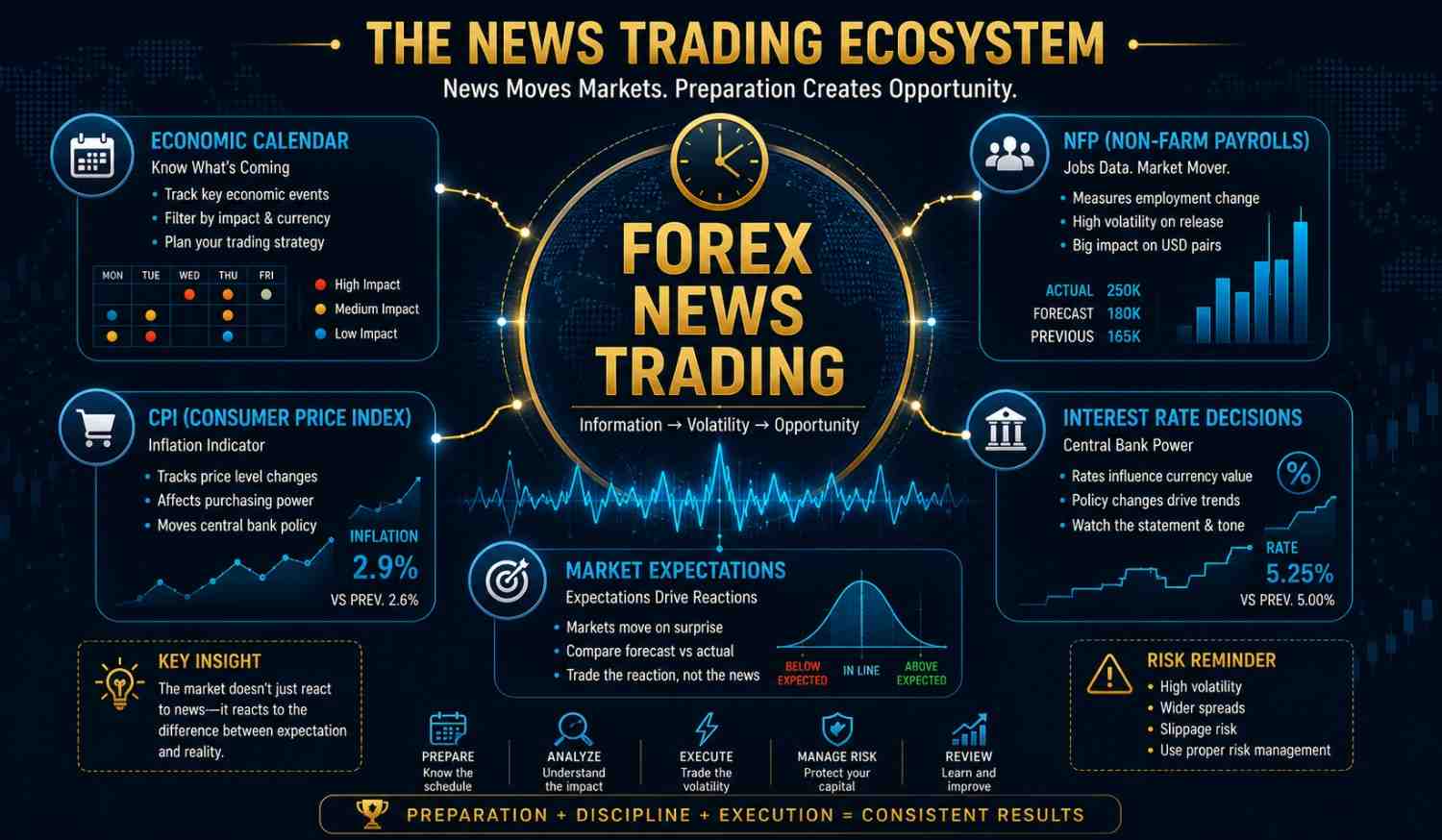
Before any major release, analysts publish forecasts. Traders and institutions position themselves based on these expectations. By the time the news hits, much of the “expected” outcome is already priced in.
What moves markets is the deviation—the difference between what was expected and what actually happened.
Real-World Example:
- NFP Forecast: +180,000 jobs
- Actual Result: +250,000 jobs
- Market Reaction: USD strengthens (better than expected)
Now imagine the same +250,000 result, but the forecast was +300,000. Same number, opposite reaction—because the market expected more. This is why successful news traders don’t just know what the data is. They know what the market expected, and they trade the gap.
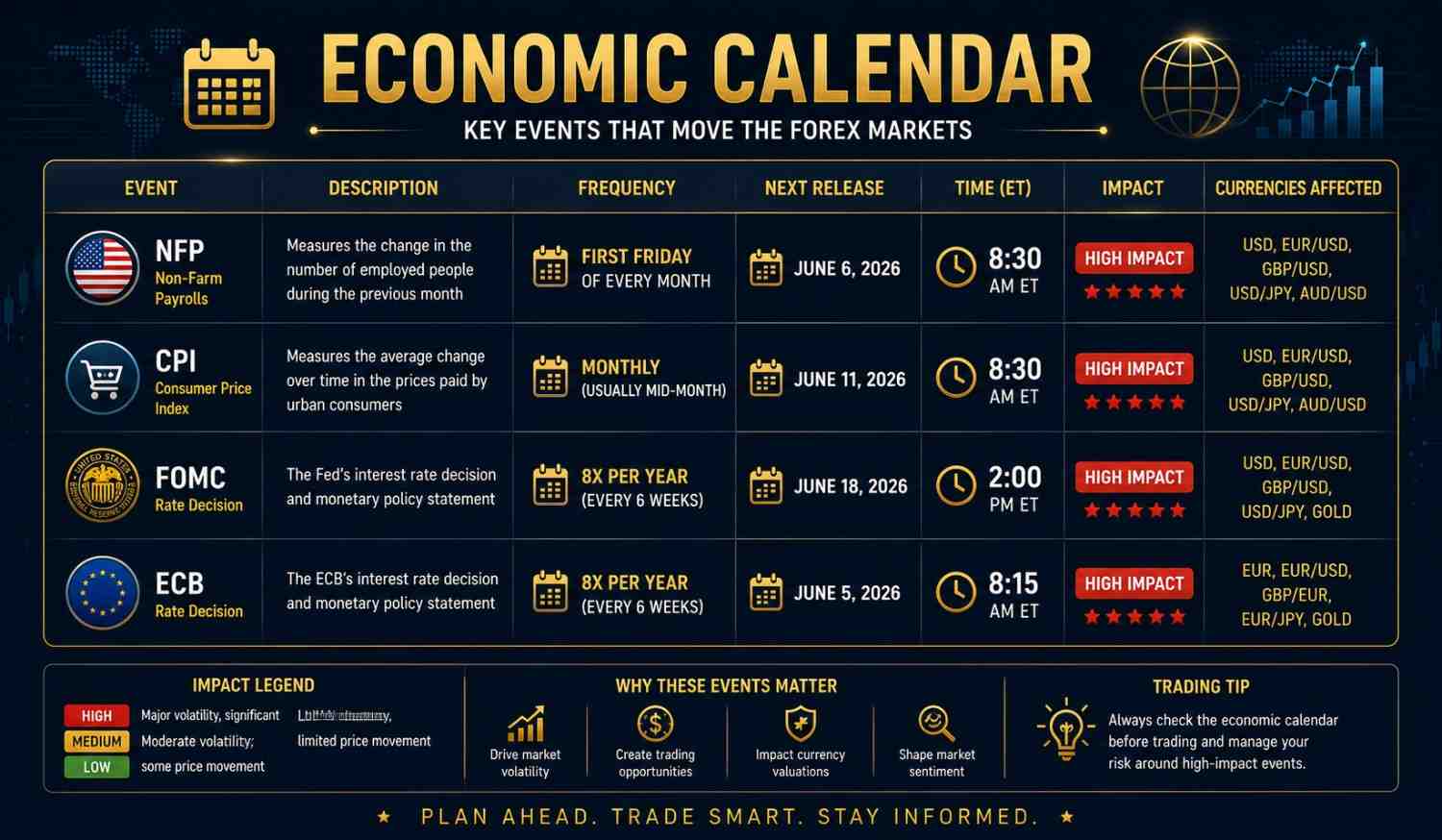
The economic calendar—your essential tool for how to trade forex news
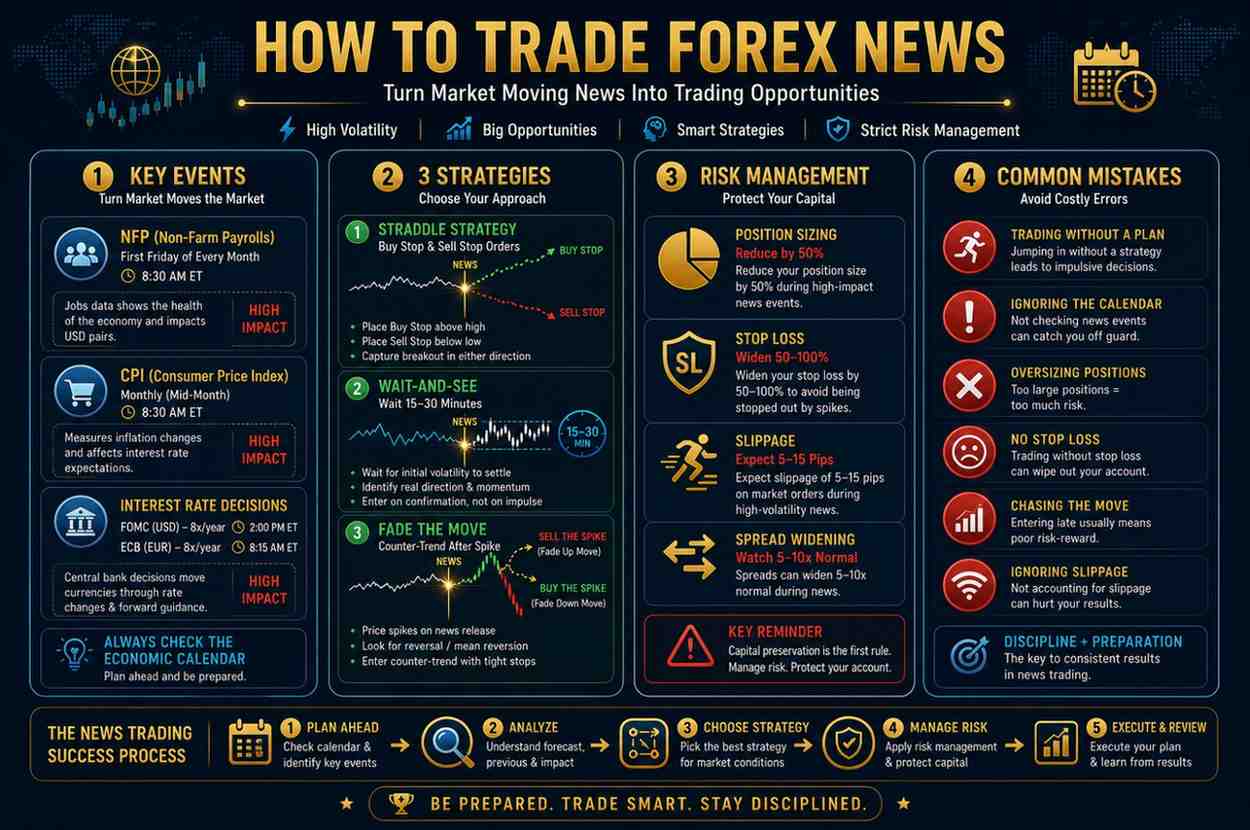
Key Economic Events Every Trader Should Know
Not all news is created equal. Some releases consistently move markets. Others barely register. Understanding which events matter is the first step in how to trade forex news effectively.
High-Impact Events (Major Market Movers)
Medium-Impact Events
- PMI (Purchasing Managers Index) — Manufacturing and services health
- Retail Sales — Consumer spending trends
- Employment Data — Unemployment rate, jobless claims
- Trade Balance — Import/export dynamics
Central Banks to Watch
Tools You Need to Trade Forex News
Before trading any news event, you need to know when it’s happening and what the market expects. Here are the essential tools for how to trade forex news.
Economic Calendars
An economic calendar shows upcoming releases with their scheduled times, previous values, and analyst forecasts. The essential ones:
- Forex Factory Calendar — Industry standard, clean interface
- Investing.com Calendar — Comprehensive with impact ratings
- Your broker’s calendar — Often integrated into the trading platform
Reading the Calendar
Every economic calendar shows three numbers when studying how to trade forex news:
- Previous: Last month’s or quarter’s result
- Forecast: Analyst consensus expectation
- Actual: The real number (released at the scheduled time)
The trading opportunity lies in the gap between the forecast and the actual. Bigger surprise = bigger potential move.
Setting Up Alerts
Most calendars let you set alerts for upcoming events. Set reminders 15-30 minutes before high-impact releases, so you’re prepared—whether that means entering a position or staying flat.
Three proven strategies for how to trade forex news events
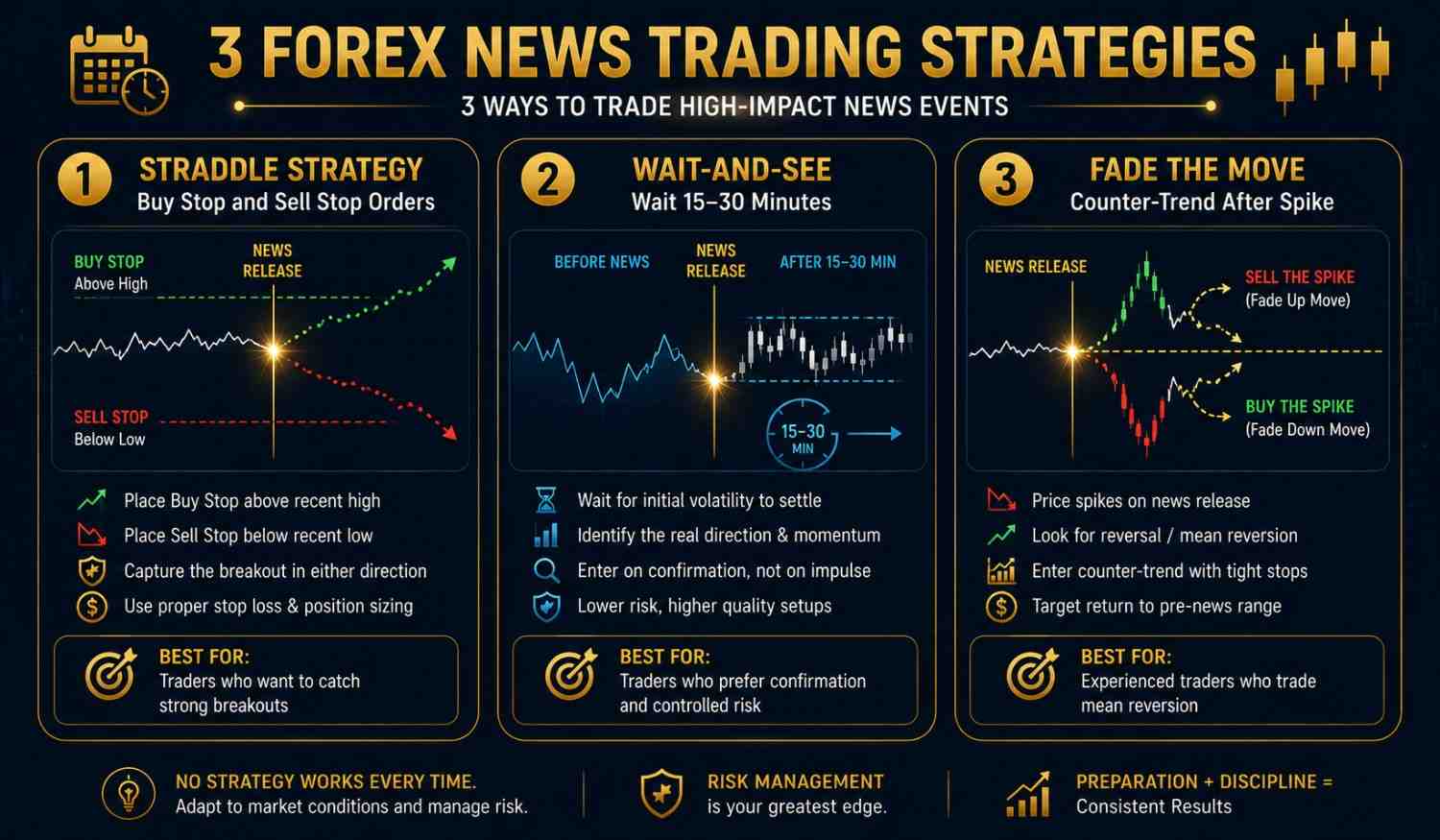
Three Proven News Trading Strategies
There are three distinct windows around any scheduled release, and each one calls for a different approach. The timing window you choose should match your risk tolerance and experience level.
Strategy 1: The Straddle Strategy (Trading During the News)
Best for: Traders comfortable with high volatility and fast execution
This is the classic how to trade forex news approach. About two minutes before the release, place buy and sell stop orders roughly 20 to 30 pips above and below the current price. When the data prints, one order triggers. Cancel the unfilled order immediately.
How it works in practice:
- Identify the news event (e.g., NFP at 8:30 AM ET)
- Two minutes before, place Buy Stop at current price + 3 pips and Sell Stop at current price – 3 pips
- Set Take Profit at 45 pips and a trailing stop-loss
- When one order triggers, cancel the other immediately
- The trailing stop-loss automatically manages the trade as the price moves
A Word of Caution: Spreads on EUR/USD can widen from a normal 1 pip to 10 pips or more during NFP. Some brokers also requote or delay execution. Factor this into your position sizing, so your worst-case fill stays within your predefined risk limits.
An Automated Approach: Some traders use bots to execute this strategy automatically. A popular open-source Forex NewsTrading Bot connects to MetaTrader 5, places buy stop and Sell Stop orders before the news, and manages trades with a trailing stop-loss once one order is triggered.
Strategy 2: The Wait-and-See Approach (Trading After the News)
Best for: Cautious beginners who want to reduce risk
This is the safest way to trade news. Instead of trying to catch the initial spike, you wait for the dust to settle and trade the established direction.
How it works:
- Identify a high-impact news event on your calendar
- Stay flat (no position) when the news releases
- Wait 15-30 minutes for the initial volatility to calm
- Identify the direction the market has chosen
- Enter in that direction with a clear stop-loss
Why it works: You avoid the chaos of the initial release—the widened spreads, the slippage, the fake-outs. By waiting, you get a clearer picture of where the market actually wants to go.
Trade-off: You’ll miss the biggest part of the move. But you’ll also avoid getting caught in whipsaws.
Real-World Example: After NFP, currency pairs can spike 80 pips in one direction, only to completely reverse within 15 minutes. By waiting, you can avoid the fake-out and trade the real trend.
Strategy 3: Fade the Overreaction (Counter-Trend Strategy)
Best for: More experienced traders with solid chart-reading skills, not when learning how to trade forex news
Markets often overreact to news in the first few minutes. This strategy involves waiting for an exaggerated move, then trading the reversal back toward pre-news levels.
How it works:
- Watch the initial reaction to the news
- Look for signs of exhaustion (long wicks, stalling momentum)
- If the move looks overdone, enter against it
- Target a partial retracement (50-61.8% of the move)
- Use a tight stop beyond the extreme
Warning: This is riskier than the other strategies. Sometimes the “overreaction” is actually the beginning of a larger trend. Only use this if you’re confident reading price action with good knowledge of how to trade forex news.
Example: The BoE’s December 2025 meeting delivered a rate cut that was almost certain (priced above 90%). The cut came, but the pound went up because the vote was a razor-thin 5 to 4 split, and Governor Bailey’s tone was cautious: “With every cut we make, how much further we go becomes a closer call.” Traders who simply shorted the pound expecting the cut to weaken it got it wrong. Those who waited for the press conference and read the tone correctly caught the real move.
Risk management is essential when learning how to trade forex news
Risk Management for News Trading
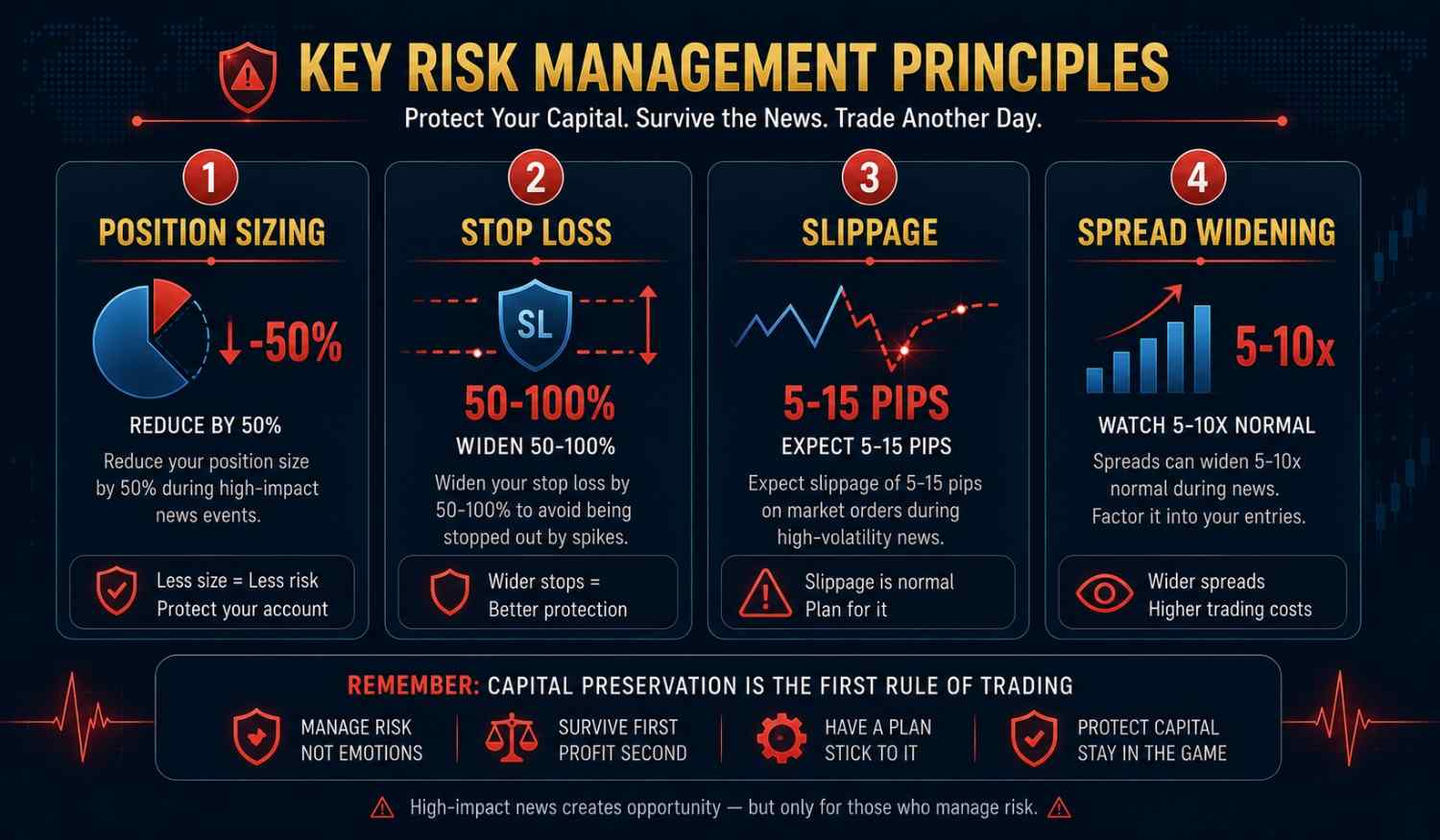
News trading amplifies both opportunities and risks. Standard risk management isn’t enough—you need to account for the unique challenges of volatile markets when studying how to trade forex news.
Reduce Position Size
If your normal risk is 1-2% per trade, consider cutting that in half during news events. The increased volatility means larger moves—and larger potential losses.
How to Apply when Learning how to Trade Forex News:
- Normal position: 0.10 lots (1% risk)
- News trade position: 0.05 lots (0.5% risk)
- This protects you from unexpected whipsaws
Widen Your Stops (Or Don’t Trade)
Tight stop-losses don’t work during news. A 20-pip stop can get hit in seconds by normal volatility, even if your direction is ultimately correct. Either widen your stop to account for the noise, or wait until the market settles.
Tip: You will note that some traders place stops at least 50-100% wider than normal technical analysis would suggest. You can achieve this when learning how to trade forex news
Expect slippage.
Your order might not fill at your intended price. During fast markets, slippage of 5-15 pips is common. In extreme cases, it can be much worse. Factor this into your risk calculations.
What is Slippage? When your trade executes at a different price than requested. Usually occurs during high volatility (news events) or low liquidity.
Watch the Spread
Spreads can widen dramatically during news, sometimes 5-10x their normal levels. A pair that normally has a 1-pip spread might jump to 8-10 pips during NFP.
Result: This widens your effective entry cost and can turn winning trades into losers.
Consider Your Execution Setup
When markets move fast, latency matters. A trading VPS positioned close to your broker’s servers can help ensure your orders execute quickly—especially important if you’re running automated strategies during news events.
Common Mistakes When Learning How to Trade Forex News
Most beginners make the same errors when starting with news trading.
Trading Every Release
Not every news event is worth trading. Low and medium-impact releases rarely produce tradeable moves. Focus on the high-impact events that consistently move markets.
Overleveraging
The volatility of news trading is exciting—and dangerous. Using excessive leverage during news events is one of the fastest ways to blow an account. Reduce your position size, not increase it.
Ignoring the Spread when studying how to trade forex news
Many beginners focus only on the price move, forgetting that widened spreads eat into profits. A 30-pip move with a 10-pip spread is really only a 20-pip opportunity.
Chasing the Move
If you missed the initial reaction, don’t panic—enter late. The best part of the move is already gone, and you’re more likely to catch the reversal than the continuation.
No Plan Before the News
Decide before the release: What level will you enter? Where’s your stop? What’s your target? Making these decisions in the heat of the moment leads to emotional, inconsistent trading.
How to trade forex news — complete summary guide
Getting Started: Your Action Plan
Ready to try news trading? Here’s a practical path forward:
- Open a demo account—Practice without risking real money while studying how to trade forex news
- Bookmark an economic calendar—Forex Factory is the standard, especially when mastering how to trade forex news
- Focus on one event — Start with NFP. Learn how it moves, what typical reactions look like
- Use the wait-and-see approach—don’t try to catch the initial spike until you’re experienced, especially in how to trade forex news.
- Track your results—Journal every news trade. What worked? What didn’t? How was the spread?
- Graduate to live trading slowly—When you’re consistently profitable on demo, start with minimal real position sizes. This is after you’ve polished on how to trade forex news.
FAQ
1. What is the best news event to trade in forex?
Non-Farm Payrolls (NFP) and interest rate decisions are the most popular and consistently produce significant market moves. NFP releases on the first Friday of each month at 8:30 AM ET and typically moves USD pairs 50-150+ pips. Interest rate decisions from central banks like the Federal Reserve, ECB, and Bank of England also create major volatility, especially when accompanied by press conferences and forward guidance.
2. How much can forex move on news?
Major news events can move currency pairs 50-150 pips or more within minutes. During extreme surprises, moves of 200+ pips are possible. For example, EUR/USD might move 80-100 pips on an unexpected NFP result or Fed rate decision. The most extreme moves often occur when the actual number deviates significantly from the consensus forecast.
3. Should beginners trade forex news?
Beginners learning how to trade forex can trade news, but should start cautiously. Practice on a demo account first, use smaller position sizes, and consider the wait-and-see approach rather than trading the initial spike. News trading carries a higher risk due to volatility, slippage, and spread widening. Focus on understanding the market’s reaction pattern before risking real capital.
4. What time does NFP come out?
Non-Farm Payrolls is released at 8:30 AM Eastern Time (ET) on the first Friday of each month by the U.S. Bureau of Labor Statistics. It is one of the most anticipated economic releases globally and typically causes the highest volatility in USD pairs. Mark your calendar and prepare your trading plan in advance, .
5. What is the straddle strategy in news trading?
The straddle strategy places buy stop and sell stop orders above and below the current price before a news release. When the news hits, one order triggers as the price moves. The opposite order is cancelled immediately. This captures the breakout direction without predicting the outcome. For example, place a Buy Stop 3 pips above and a Sell Stop 3 pips below the current price. When one triggers, cancel the other immediately.
6. What is slippage in news trading?
Slippage occurs when your trade executes at a different price than requested. During fast-moving news events, slippage of 5-15 pips is common. In extreme cases, it can be much worse. It happens due to high volatility and low liquidity as the market processes the new information. Factor slippage into your risk calculations and use wider stop-losses to accommodate it.
7. How can I avoid getting stopped out during news events, especially when learning how to trade forex news?
Widen your stop-losses to account for increased volatility. Tight stops that work in normal conditions will almost certainly get hit during news releases. Consider using stops that are 50-100% wider than normal, or trade with smaller position sizes to accommodate wider stops without exceeding your risk limits. Alternatively, wait for the initial volatility spike to settle before entering.
8. What is the best timeframe for news trading?
For the straddle strategy, use 1-minute or 5-minute charts to capture the initial spike. For the wait-and-see approach, use 15-minute or 1-hour charts to identify the established direction after the dust settles. For the fade the move strategy, use 5-minute charts to spot exhaustion signals. Always check the higher timeframe (H1, H4) to understand the broader trend context.
9. How do I read the economic calendar?
Every economic calendar shows three key numbers: Previous (last month/quarter’s result), Forecast (analyst consensus expectation), and Actual (the real number released at the scheduled time). The trading opportunity lies in the gap between the forecast and actual. A bigger surprise (deviation) typically produces a larger market move. Focus on high-impact events marked in red.
10. What is the difference between high-impact and low-impact news?
When High-impact news events (NFP, interest rate decisions, CPI, GDP) consistently move markets and produce significant volatility. Low-impact events (building permits, wholesale inventories) rarely produce tradeable moves and often generate minimal market reaction. Focus your news trading efforts on high-impact events to maximize your chances of capturing meaningful moves.
11. How do central bank speeches affect forex?
Central bank speeches provide forward guidance and can shift market expectations. A hawkish comment (suggesting higher rates) can strengthen a currency, while a dovish comment (suggesting lower rates) can weaken it. The most impactful speeches come from central bank governors (Powell, Lagarde, and Bailey) and can move markets even without a scheduled policy announcement.
12. Can I trade news events automatically?
Yes, many traders use Expert Advisors (EAs) or trading bots to automate news trading. Popular open-source solutions connect to MetaTrader 5 and place Buy Stop and Sell Stop orders before the news, then manage trades with trailing stop losses once one order triggers. However, always backtest thoroughly and monitor performance, as market conditions can change.
13. How do I manage risk during news trading?
Reduce position size (consider 50% of normal), widen stop-losses (50-100% wider), expect slippage (5-15 pips), and be aware of spread widening (can increase 5-10x normal levels). Never risk more than 1-2% of your account on any single news trade. Consider using a VPS for faster execution if trading automatically.
14. What is the wait-and-see strategy?
The wait-and-see strategy involves staying flat (no position) when the news releases, waiting 15-30 minutes for the initial volatility to calm, then entering in the direction the market has chosen. This approach avoids the chaos of the initial release—widened spreads, slippage, and fake-outs. While you miss the biggest part of the move, you also avoid getting caught in whipsaws.
15. What is the fade move strategy?
The fade the move strategy involves waiting for an exaggerated initial reaction, then trading the reversal back toward pre-news levels. Look for signs of exhaustion (long wicks, stalling momentum). If the move looks overdone, enter against it, targeting a 50-61.8% retracement. This is riskier than other strategies and should only be used by experienced traders confident in reading price action.
16. What is the best time to enter a news trade when learning how to trade forex news?
For the straddle strategy, enter 1-2 minutes before the release. For the wait-and-see approach, enter 15-30 minutes after the release once the market has settled. For the fade the move strategy, enter when you see signs of exhaustion (long wicks, stalling momentum), typically 5-10 minutes after the release. Always have your entry, stop-loss, and take-profit levels pre-defined.
17. How do I set take-profit levels in news trading?
For the straddle strategy, a common approach is to set a take-profit at 45 pips with a trailing stop-loss. For the wait-and-see approach, use technical levels (support/resistance, Fibonacci retracements) to set targets. For the fade-the-move strategy, target a 50-61.8% retracement of the initial move. Always use a risk-reward ratio of at least 1:2 for your trades. which can be very practical when learning how to trade forex news.
18. What is the most common mistake in news trading?
When learning how to trade forex news, trading every news event (not all are worth trading), overleveraging (using excessive leverage during volatile releases), ignoring the spread (widened spreads eat into profits), chasing the move (entering late after the best part of the move is gone), and having no plan before the news (making decisions in the heat of the moment leads to emotional trading).
Further Reading
To deepen your understanding of forex trading, explore these additional resources from Finwirestack:
- AI in Forex Trading: 2026 Ultimate Smart Guide — Discover how artificial intelligence is transforming currency markets.
- Risk Management Mastery: 7 Proven Strategies — Master position sizing, stop-loss strategies, and trading psychology in relation to how to trade forex news.
- Central Banks & Forex: 5 Powerful Ways They Move Markets — Understand how the Fed, ECB, and BoJ move the markets.
- How to Read Forex Charts: 5 Powerful Patterns for Beginners — Learn to spot key patterns and understand price action in relation to how to trade forex news.
External Resources (DoFollow Links)
- Forex Factory Economic Calendar—The industry standard economic calendar on how to trade forex news.
- Investing.com Economic Calendar — Comprehensive calendar with impact ratings on how to trade forex news.
- BabyPips: News Trading — Beginner-friendly education on how to trade forex news.
- OANDA: News Trading Guide — Professional insights on news trading risks and strategies on how to trade forex news.
Disclaimer: Trading forex and CFDs involves significant risk of loss. It is not suitable for all investors. You should carefully consider your investment objectives, level of experience, and risk appetite before trading. Never trade with money you cannot afford to lose. The information provided in this article is for educational purposes only and does not constitute financial advice.





[…] How to Trade Forex News: 2026 Smart Guide to Profiting — Learn to profit from economic events without emotional mistakes with advanced Forex strategies. […]
[…] How to Trade Forex News: 2026 Smart Guide to Profiting — Learn to profit from economic events without emotional mistakes. […]