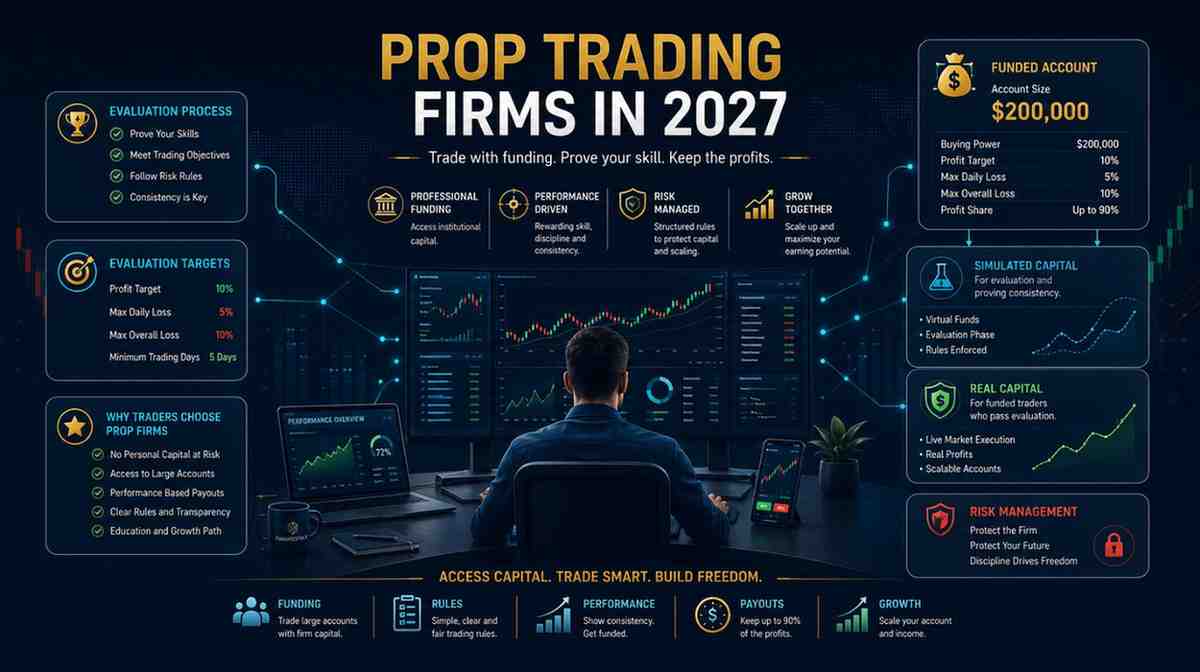
Prop trading firms in 2027 are attracting a new generation of retail traders with a powerful proposition:
Trade a large account without putting the full account value into the market yourself.
For someone with a $500, $1,000, or $2,000 personal trading account, the idea of controlling a $50,000, $100,000, or even larger account can sound revolutionary.
But there is an important question that every trader should ask before paying for a challenge:
What exactly does “funded” mean?
That question matters because modern retail prop firms are not necessarily structured like traditional proprietary trading desks.
Some online firms provide simulated trading environments and pay traders rewards based on their performance. FTMO, for example, describes its modern funded-account model as simulated trading capital rather than a conventional live brokerage account.
Meanwhile, traditional proprietary trading firms can operate very differently, using their own capital and professional trading infrastructure.
Therefore, prop trading firms in 2027 should not be evaluated simply by looking at the advertised account size.
The real questions are:
- What does the trader actually receive?
- Is the account simulated or live?
- What does the evaluation cost?
- What are the drawdown rules?
- What happens when the trader breaches a rule?
- How are payouts calculated?
- What restrictions apply?
- Who operates the company?
- What legal protections apply?
- And most importantly, does the business model make sense for the trader?
What Are Prop Trading Firms?
A proprietary trading firm, commonly called a prop firm, traditionally uses its own capital to trade financial markets.
Instead of managing money for outside investors, the firm trades for its own account.
Traditional proprietary trading can involve:
- Professional traders
- Quantitative analysts
- Algorithmic trading
- Market making
- Arbitrage
- Institutional technology
- Risk-management systems
- Large trading books
However, the term prop firm is now widely used online for retail-funded trader programs.
These businesses typically allow traders to purchase an evaluation or challenge.
The trader then has to satisfy specific trading conditions.
These may include:
- Profit targets
- Maximum daily loss
- Maximum overall drawdown
- Minimum trading days
- Maximum position size
- Consistency requirements
- News-trading restrictions
- Overnight restrictions
- Weekend restrictions
- Prohibited strategies
If the trader successfully completes the evaluation, they may receive access to a larger trading account or a simulated funded environment.
That distinction is critical when researching Prop Trading Firms in 2027.
How Do Funded Trading Accounts Work?
A typical funded trading account follows several stages.
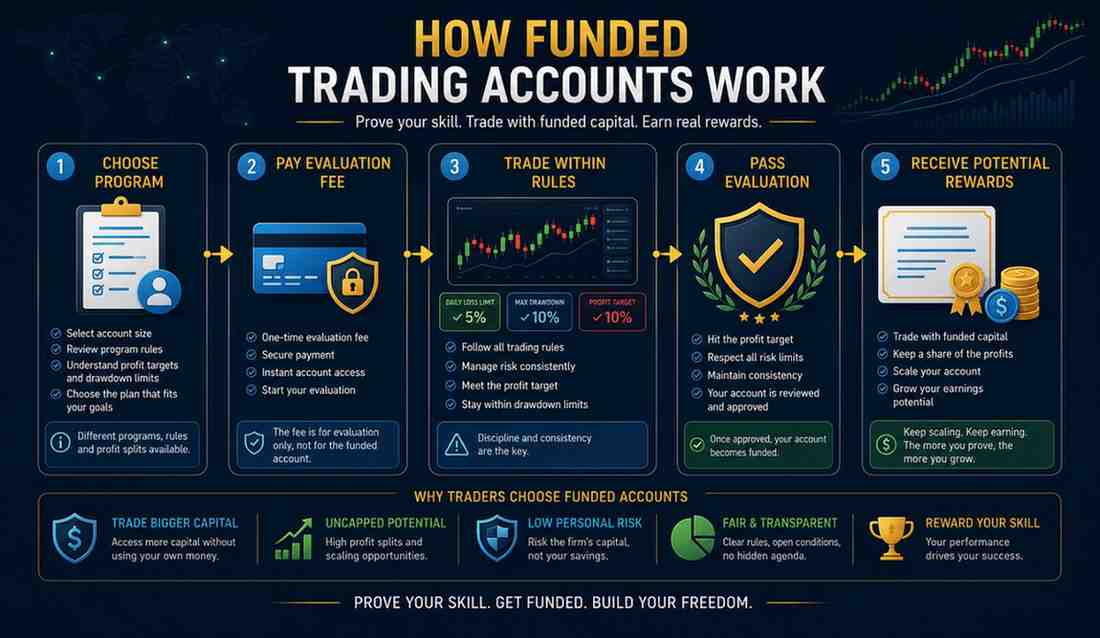
Stage 1: Choose a Program
The trader selects a challenge based on account size and rules.
For example:
| Program Feature | Example |
|---|---|
| Advertised account size | $100,000 |
| Challenge fee | Varies |
| Profit target | Varies |
| Maximum daily loss | Varies |
| Maximum total loss | Varies |
| Profit split | Varies |
| Minimum trading days | Varies |
These figures are examples only. Every firm has different rules.
Stage 2: Pay the Evaluation Fee
Many online funded trading programs charge an evaluation or challenge fee.
The fee may provide access to a simulated trading environment and the opportunity to demonstrate performance.
This means traders should not automatically interpret the advertised account size as money deposited into their personal brokerage account.
Stage 3: Trade Within the Rules
The trader attempts to reach the required performance target without violating the risk rules.
This is where many traders struggle.
A strategy that works perfectly on a normal personal account may fail under strict prop-firm restrictions.
Stage 4: Pass the Evaluation
If the trader satisfies the firm’s conditions, they may advance to another stage or receive a funded-account status.
The exact structure varies substantially between companies.
Stage 5: Trade and Request Rewards
Depending on the program, the trader may receive a percentage of eligible profits.
For example, a firm may advertise an 80% or 90% trader share.
But the percentage alone doesn’t tell you whether the program is attractive.
You must examine the entire rulebook.
The $100,000 Account Illusion

One of the biggest misunderstandings surrounding prop Trading Firms in 2027 is the meaning of a “$100,000 funded account.”
A trader may see:
$100,000 ACCOUNT
and assume:
“The firm has deposited $100,000 into an account that I can freely lose or withdraw.”
That may not be the case.
Some modern prop programs explicitly state that the trading environment is simulated.
This doesn’t automatically make such a program fraudulent.
It simply means the trader needs to understand the business model.
The important question is not
“Is the account real?”
The better question is,
“What contractual relationship am I entering into, what am I paying for, what can I earn, and what risks do I assume?”
Traditional Prop Trading vs Modern Funded Trader Programs
| Feature | Traditional Proprietary Firm | Modern Retail Funded Program |
|---|---|---|
| Capital | Usually firm’s capital | Often simulated |
| Trader | Employee/contractor | Independent participant |
| Entry | Recruitment/application | Challenge/evaluation |
| Fee | Usually no retail challenge fee | Often evaluation fee |
| Trading environment | Live/institutional | Often simulated |
| Revenue model | Trading profits | Varies by firm |
| Profit sharing | Employment/contract arrangement | Reward/profit split |
| Rules | Internal risk framework | Published challenge rules |
| Technology | Institutional | Retail platforms |
| Regulation | Depends on activity/jurisdiction | Varies significantly |
This distinction should become one of the most important concepts in Prop Trading Firms in 2027.
Why Are Prop Trading Firms So Popular?
The appeal is easy to understand.
1. Lower Personal Capital Requirement
A trader may not have enough personal capital to trade a large account responsibly.
A funded program can potentially provide access to a larger notional trading environment without requiring the trader to deposit the entire advertised account size.
2. Defined Loss Limits
A personal trading account can be destroyed if the trader repeatedly deposits more money.
A funded challenge typically has predefined loss limits.
Once those limits are breached, the account may be terminated.
3. Performance-Based Opportunity
Successful traders may receive rewards based on their performance.
4. Psychological Separation From Personal Savings
Some traders prefer risking a defined evaluation fee rather than placing a large portion of personal savings into a trading account.
However, that does not mean the evaluation fee is low-risk.
Repeated failed challenges can become expensive.
5. Trading Technology
Modern prop programs can offer access to platforms and tools that resemble professional trading environments.
The Biggest Problem With Prop Trading Firms in 2027
The biggest danger isn’t necessarily the concept.
It is misunderstanding the rules.
A trader might have a profitable strategy but still fail because of:
- Daily drawdown
- Trailing drawdown
- News restrictions
- Maximum lot size
- Overnight rules
- Weekend restrictions
- Consistency rules
- Copy-trading restrictions
- Expert Advisor restrictions
- Arbitrage restrictions
- Minimum trading days
A trader can therefore be profitable and still fail the challenge.
That is why understanding risk management remains essential. Risk Management Mastery: 7 Proven Strategies provides a useful foundation for understanding position sizing, drawdowns, and disciplined trading.
11 Powerful Rules for Choosing Prop Trading Firms in 2027
Rule 1: Understand What “Funded” Actually Means
Before paying anything, find out whether the account is:
- Live
- Simulated
- Demo
- Hybrid
- Performance-based
- Connected to actual market execution
Do not rely on the word funded.
Read the firm’s legal terms.
Rule 2: Read the Maximum Drawdown Rule
This may be more important than the advertised profit split.
Suppose:
Account size = $100,000
Maximum drawdown = 10%
The practical loss threshold is approximately
$10,000
If the account reaches the firm’s loss threshold, the program may terminate the account.
But drawdown can be calculated differently.
It could be:
- Static
- Trailing
- Equity-based
- Balance-based
- Intraday
- End-of-day
Never assume two firms with a “10% drawdown” have identical rules.
Rule 3: Understand Daily Loss Limits
A firm might have:
Maximum daily loss = 5%
But how is the day calculated?
Does it use:
- Balance?
- Equity?
- Floating losses?
- Closed trades?
- Swap?
- Commission?
These details matter.
A trader can breach a rule without realizing how the firm calculates it.
Rule 4: Examine the Profit Target
A 10% profit target may sound achievable.
But consider the risk required to reach it.
If you risk 2% per trade and need 10%, five consecutive winning trades might seem attractive.
But losses can quickly compound in the opposite direction.
The objective should not be:
Pass as quickly as possible.
It should be:
Trade in a way that can survive long enough to demonstrate genuine consistency.
Rule 5: Examine the Profit Split
A 90/10 split sounds better than an 80/20 split.
But profit split alone should never determine your choice.
Consider:
- Payout frequency
- Minimum payout
- Eligibility conditions
- Consistency rules
- Scaling requirements
- Withdrawal methods
- Account reset conditions
- Processing time
A smaller percentage from a transparent program can potentially be preferable to a larger percentage surrounded by restrictive conditions.
Rule 6: Read the Prohibited Strategy List
This is especially important for algorithmic traders.
Some firms restrict:
- Expert Advisors
- Trade copiers
- Arbitrage
- Latency trading
- High-frequency strategies
- Grid systems
- Martingale
- Hedging
- Account sharing
- Copying another trader
Rules differ substantially.
For example, one current funded program explicitly prohibits copying trades from other traders and restricts certain bots and strategies.
Therefore, never assume that an EA or strategy that works with one firm will be allowed at another.
Rule 7: Investigate the Company Behind the Brand
Don’t stop at the website.
Find:
- Legal entity
- Registered address
- Terms and conditions
- Privacy policy
- Company registration
- Regulatory status where applicable
- Ownership information
- Contact information
- Complaint procedures
A professional website is not proof of legitimacy.
Rule 8: Understand the Payout Process
Before purchasing a challenge, ask:
What conditions must be satisfied before I can receive money?
Check:
- Minimum payout
- Payout schedule
- Identity verification
- Profit requirements
- Consistency requirements
- Maximum payout
- Payment methods
- Processing times
- Reasons for payout denial
Don’t build your trading plan around an advertised payout percentage without reading the conditions.
Rule 9: Check the Jurisdiction
Where is the company legally based?
Where is your contract with?
Which laws govern the agreement?
Where would you make a complaint?
These questions matter because protections can vary significantly between jurisdictions.
The FCA has repeatedly warned consumers about firms operating without appropriate UK authorization and about losing regulatory protections when dealing with unauthorized or offshore entities.
Rule 10: Never Believe Guaranteed Profit Claims
This should be a universal rule.
Avoid statements such as:
“Guaranteed income.”
“Risk-free funded account.”
“Guaranteed $10,000 monthly.”
“Pass with our secret strategy.”
“Never lose your own money.”
Trading involves uncertainty.
The FCA has warned about unrealistic return promises and high-pressure financial promotions in the broader CFD and trading ecosystem.
Rule 11: Calculate Your True Cost
Your cost isn’t necessarily the challenge fee.
Consider:
- Challenge fee.
- Reset fees.
- Second attempt
- Platform costs
- Data costs
- Trading costs
- Potential payout limitations
- Time spent.
- Psychological cost
This gives you a much more realistic picture of Prop Trading Firms in 2027.
Prop Firm Challenge Fees: The Cost Most Traders Underestimate
Suppose a trader pays:
$100
for a challenge.
They fail.
They pay another:
$100
They fail again.
Another:
$100
After ten attempts:
$1,000
The trader may eventually pass.
But the question becomes:
How much did it cost to reach the payout stage?
This is why traders should calculate their total challenge expenditure, not simply the price of one evaluation.
Why Good Traders Can Still Fail Prop Challenges
This is one of the most important lessons for beginners.
A trader can have a profitable strategy and still fail a prop challenge because of the mismatch between:
Strategy risk
and
Prop-firm rules.
Consider a swing trader.
Their normal strategy might tolerate:
8% drawdown
before recovering.
But the prop firm allows only,
6% maximum drawdown.
The strategy could be profitable over twelve months but still fail the evaluation.
This doesn’t necessarily mean the trader is bad.
It means the strategy and account structure are incompatible.
Prop Trading Firms in 2027 and Algorithmic Trading
Automation will become increasingly important.
Traders are already using:
- Expert Advisors
- Python systems
- Trading bots
- AI-assisted strategies
- Trade copiers
- Automated risk managers
- Algorithmic execution
But Prop Trading Firms in 2027 will not necessarily allow every form of automation.
Before using an EA, check:
Is automated trading permitted?
Then check:
Are third-party EAs permitted?
Then:
Are trade copiers permitted?
Then:
Are latency-arbitrage strategies prohibited?
Never assume.
A trader who has spent months developing an automated system could lose an account by violating a rule they never read.
AI and Prop Trading Firms in 2027
AI could significantly change the funded-trader industry.
A trader might use AI for:
- Market research
- Economic-news analysis
- Strategy development
- Coding
- Backtesting
- Risk management
- Trade journaling
- Performance analysis
- Psychological tracking
Prop firms themselves could also use AI to analyze:
- Trading behavior
- Risk exposure
- Rule violations
- Account correlations
- Suspicious activity
- Strategy duplication
This creates an interesting future.
The trader will increasingly compete not only against the market but also against sophisticated risk-monitoring systems.
Our earlier article, AI Trading Agents 2027, examines how autonomous AI systems could influence the future of market research, decision-making, and execution.
Prop Trading Firms in 2027 vs. Personal Trading Account
| Feature | Prop Trading | Personal Account |
|---|---|---|
| Initial capital | Usually lower personal outlay | Your own capital |
| Maximum loss | Program-defined | Potentially your entire account |
| Control | Limited by firm rules | Full |
| Strategy freedom | Often restricted | Greater |
| Leverage | Firm-defined | Broker-defined |
| Profit sharing | Usually required | You keep your trading profit |
| Evaluation | Usually required | Usually not |
| Psychological pressure | Challenge rules | Personal capital |
| Payout | Subject to rules | Withdraw according to broker terms |
| Long-term ownership | Usually no | Yes |
Neither model is automatically better.
The correct choice depends on the trader’s capital, skill, discipline, strategy, and objectives.
Prop Trading vs Copy Trading
These two models are often confused.
Copy trading means following another trader’s positions.
Prop trading means attempting to trade under a firm’s capital or simulated-capital program in exchange for potential rewards.
| Feature | Prop Trading | Copy Trading |
|---|---|---|
| Trader makes decisions | Yes | Usually another trader |
| Evaluation | Often | Usually no |
| Capital model | Firm/simulated | Investor’s account |
| Skill requirement | High | Lower initially |
| Control | High within rules | Lower |
| Main risk | Rule + market risk | Trader + market risk |
| Profit split | Common | Usually not |
| Monitoring | Essential | Essential |
Is Prop Trading Safer Than Trading Your Own Money?
This question needs a nuanced answer.
A trader may potentially limit their direct financial exposure to the evaluation fee.
But that does not mean prop trading is automatically safer.
You can lose:
- Challenge fees
- Reset fees
- Trading time
- Emotional capital
- Potential profits
And if you repeatedly purchase challenges because you are failing, your losses can accumulate.
The better question is:
Does the prop model help you control your risk, or does it encourage you to take more risk because the account looks large?
That distinction matters.
The Psychology of Funded Trading
The number displayed on a trading platform can influence behavior.
Imagine seeing:
$100,000
on your dashboard.
You may psychologically treat it differently from:
$1,000 of your own money.
That can lead to:
- Oversizing
- Revenge trading
- Overtrading
- Moving stop losses
- Chasing the profit target
- Trading during unsuitable market conditions
A professional trader should think in terms of risk percentage, not account size.
If your maximum acceptable risk is 0.5% per trade, that principle should remain consistent regardless of whether the nominal account is $10,000 or $100,000.
Red Flags When Evaluating Prop Trading Firms in 2027

Be cautious when you encounter:
Guaranteed Returns
No legitimate trading model can guarantee future market profits.
Unrealistic Profit Claims
Claims that ordinary traders can consistently generate enormous monthly returns deserve scrutiny.
Hidden Rules
The challenge should have clearly accessible terms.
Constant Rule Changes
Frequent changes can make historical comparisons difficult.
Aggressive Upselling
Be cautious if you’re repeatedly pressured to purchase larger accounts or additional challenges.
Unclear Legal Entity
You should know who you’re contracting with.
Unclear Payout Conditions
If you cannot understand when and why you can receive a payout, stop and investigate.
Anonymous Ownership
A professional financial business should provide meaningful information about its corporate identity.
Pressure to Deposit More
This is a major warning sign in any financial service.
How to Research a Prop Trading Firm
Before paying a challenge fee, create a simple research sheet.
| Question | Your Answer |
|---|---|
| Legal company name | |
| Country of registration | |
| Regulatory status | |
| Challenge fee | |
| Profit target | |
| Daily loss limit | |
| Maximum drawdown | |
| Trailing drawdown | |
| Minimum trading days | |
| News restrictions | |
| Weekend restrictions | |
| EA allowed? | |
| Copy trading allowed? | |
| Profit split | |
| Payout conditions | |
| Refund policy | |
| Customer support | |
| Terms and conditions |
If you cannot fill this table confidently, you probably haven’t researched the firm enough.
A Better Way to Compare Prop Trading Firms in 2027
Instead of asking:
“Which prop firm is the best?”
ask:
“Which prop firm best matches my trading strategy?”
A scalper may need:
- Tight spreads
- Fast execution
- Flexible news rules
- Low trading costs
A swing trader may prioritize:
- Overnight holding
- Weekend holding
- No restrictive time limits
An algorithmic trader may need:
- EA compatibility
- VPS access
- API support
- Stable execution
A news trader may need completely different conditions.
Therefore, there is no universal best prop trading firm.
There is only a potentially better or worse fit for a particular trader.
Prop Trading Firms in 2027: A Practical Scoring System
Use a 100-point framework:
| Category | Weight |
|---|---|
| Rule transparency | 20 |
| Drawdown structure | 20 |
| Payout terms | 15 |
| Company transparency | 15 |
| Strategy compatibility | 10 |
| Trading costs | 10 |
| Platform/technology | 5 |
| Customer support | 5 |
| Total | 100 |
This isn’t an official industry scoring system.
It is a FinWireStack educational framework for comparing programs more systematically.
Should Beginners Use Prop Trading Firms?
Prop Trading Firms in 2027 may look attractive to beginners, but a challenge should not be treated as a shortcut to becoming a profitable trader.
If you are consistently losing on a $500 personal account, obtaining a $100,000 nominal funded account will not automatically fix the problem.
In fact, the additional rules may make the situation harder.
Before attempting a challenge, beginners should understand:
- Risk management
- Position sizing
- Stop-loss placement
- Leverage
- Drawdown
- Trading psychology
- Market structure
- Trading costs
- Their own strategy
If you are still learning technical analysis, our How to Read Forex Charts: Beginner’s Guide can serve as a useful starting point.
When a Prop Firm May Make Sense
A funded trading program may potentially make sense for a trader who:
- Already has a tested strategy
- Understands risk management
- Can follow rules consistently
- Has realistic return expectations
- Understands the firm’s business model
- Can afford the evaluation fee
- Has studied the payout conditions
- Does not depend on challenge profits for essential expenses
When a Prop Firm May NOT Make Sense
Avoid rushing into a challenge if:
- You have no tested strategy
- You revenge trade
- You regularly over-leverage
- You cannot follow stop losses
- You need immediate income
- You are borrowing the challenge fee
- You believe a funded account guarantees income
- You are choosing firms solely because of social media influencers
- You haven’t read the rules
- You are repeatedly failing challenges
The Future of Prop Trading Firms Toward 2030
The industry could evolve significantly between 2027 and 2030.
Potential developments include:
AI-Based Trader Evaluation
Firms could assess traders using behavioral and statistical models rather than simple profit targets.
Dynamic Risk Limits
Instead of fixed rules, limits could adapt according to volatility and trader behavior.
More Automated Monitoring
AI could detect:
- Rule violations
- Account sharing
- Strategy copying
- Suspicious trading patterns
- Correlated accounts
- Abnormal execution
Greater Regulatory Attention
As retail-funded programs grow, regulators may increasingly examine how companies market these products and describe simulated trading, payouts, and financial risks.
Greater Transparency for Prop Trading Firms in 2027
Competition could encourage firms to publish:
- Pass rates
- Payout statistics
- Rule changes
- Legal entities
- Trading environments
- Historical performance
Integration With AI Trading
By 2030, traders may increasingly combine:
Human judgment + AI research + automated execution + funded capital.
That could make the prop-trading ecosystem very different from today’s model.
The Future May Not Be About Bigger Accounts
This is perhaps the most important point for Prop Trading Firms in 2027.
The industry has spent years marketing:
$10K
$50K
$100K
$200K
$500K
But the account size is not necessarily the most important number.
The more meaningful numbers are,
Maximum drawdown
Daily loss limit
Trading costs
Payout conditions
Risk per trade
Strategy expectancy
A $50,000 account with a sensible structure may be more useful than a $200,000 account with restrictive rules.
10 Questions to Ask Before Buying a Funded Account
Before paying for Prop Trading Firms in 2027, ask:
1. Is the trading account live or simulated?
2. What exactly happens to my challenge fee?
3. What is the maximum daily loss?
4. What is the maximum overall drawdown?
5. Is the drawdown static or trailing?
6. What strategies are prohibited?
7. How are payouts calculated?
8. What conditions can cause a payout to be denied?
9. Who legally operates the company?
10. What happens if the company shuts down?
If you cannot get clear answers, don’t rush.
Prop Trading Firms in 2027 Checklist

Before purchasing any funded trading challenge:
☐ Verify the legal company.
☐ Read the complete terms.
☐ Confirm whether the account is live or simulated.
☐ Understand the evaluation fee.
☐ Understand the profit target.
☐ Calculate the maximum daily loss.
☐ Calculate maximum drawdown.
☐ Understand trailing drawdown.
☐ Check payout conditions.
☐ Check profit split.
☐ Check minimum trading days.
☐ Check news restrictions.
☐ Check weekend restrictions.
☐ Check EA restrictions.
☐ Check copy-trading restrictions.
☐ Check prohibited strategies.
☐ Verify customer support.
☐ Research independent reviews carefully.
☐ Never believe guaranteed-profit claims.
☐ Never borrow money to purchase repeated challenges.
Frequently Asked Questions
Are prop trading firms in 2027 worth it?
Prop trading firms in 2027 may be worthwhile for experienced traders who understand the rules, risk, and business model. They are not automatically worthwhile for beginners or consistently unprofitable traders.
Is a funded trading account real money?
It depends on the provider. Some modern funded programs explicitly operate simulated accounts. FTMO, for example, describes its funded account as a simulated trading environment.
Can you really make money with prop firms?
Some traders receive rewards or payouts, but profitability is not guaranteed. A trader must satisfy the firm’s rules and remain within its risk limits.
What is the biggest risk of prop trading?
In Prop Trading Firms in 2027, the biggest risks include losing evaluation fees, repeatedly purchasing challenges, violating restrictive rules, misunderstanding drawdown calculations, and assuming that advertised account size represents accessible cash capital.
Are prop firms regulated?
There is no single regulatory status shared by every online prop firm. The legal structure, jurisdiction, products, and services differ. Traders should independently verify the specific company’s legal and regulatory position.
What is a prop firm challenge?
A prop firm challenge is an evaluation process in which a trader attempts to meet predefined performance and risk requirements.
What is maximum drawdown?
Maximum drawdown is the largest permitted decline from a specified account level or equity/balance reference point. The calculation method varies between firms.
What is a profit split?
A profit split determines how eligible trading profits or rewards are divided between the trader and the firm.
Can beginners use prop firms?
They can, but Prop Trading Firms in 2027 should not be treated as a substitute for learning how to trade. Beginners should first develop risk management and trading skills.
Are bigger funded accounts better?
Not necessarily. The advertised account size should be evaluated alongside drawdown, leverage, trading restrictions, fees, and payout conditions.
Final Verdict: Are Prop Trading Firms in 2027 Worth It?
Prop Trading Firms in 2027 could provide opportunities for disciplined traders who lack sufficient personal capital and want to operate within predefined risk parameters.
But the industry needs to be understood correctly.
A “$100,000 funded account” does not necessarily mean that a firm has placed $100,000 of withdrawable cash into your personal brokerage account.
A 90% profit split does not automatically mean a better deal.
A cheap challenge does not necessarily mean lower risk.
A large social media following does not prove that a company is trustworthy.
And passing an evaluation does not guarantee long-term profitability.
In Prop Trading Firms in 2027, the smartest trader is therefore not the person who chooses the biggest account.
It is the person who understands the business model, rules, risk, costs, and payout structure before paying a cent.
As the industry moves toward 2030, AI, automation, and sophisticated risk monitoring are likely to make funded trading more technologically advanced.
That could create genuine opportunities.
It could also create increasingly sophisticated marketing.
The trader’s best protection will remain the same:
Read the rules. Understand the risk. Verify the company. Control your expectations.
And never confuse access to a large trading account with having a large amount of risk-free money.
Disclaimer: This article, Prop Trading Firms in 2027, is for educational and informational purposes only and does not constitute financial, investment, tax, or legal advice. Prop trading and financial-market trading involve substantial risk. Funded-account structures, rules, fees, payouts, and regulatory treatment vary by provider and jurisdiction. Always read the provider’s current legal documents and do your own research before paying for a trading program.