

Choosing the right broker is one of the most important decisions you will make as a trader. How to Choose a Forex Broker is not simply about finding the platform with the lowest spreads or the highest leverage. It is about protecting your money, accessing reliable trading tools, and building your trading journey on a trustworthy foundation.
Every year, thousands of beginners lose money—not because their trading strategy is poor—but because they deposit funds with unreliable brokers, fall victim to scams, or overlook important details such as regulation, withdrawal policies, and execution quality.
As the Forex industry continues to evolve in 2027, traders have access to more brokers than ever before. While increased competition has improved trading technology and reduced costs, it has also made it harder to distinguish reputable firms from those that should be avoided.
This comprehensive guide explains how to choose a Forex broker using 17 practical evaluation criteria. Whether you are opening your first trading account or considering switching providers, these tips will help you make an informed decision and reduce unnecessary risks.
- Why broker selection matters.
- How financial regulation protects traders.
- The differences between broker types.
- How to compare spreads, commissions, and fees.
- Which trading platforms are best for beginners.
- Common Forex broker scams and warning signs.
- A step-by-step checklist before funding your account.
Making the right choice today can save you money, reduce stress, and support your long-term success in the Forex market.
Why Choosing the Right Forex Broker Matters
Before learning how to choose a Forex broker, it is important to understand the role brokers play in every trade.
A Forex broker acts as the intermediary between you and the foreign exchange market. Through the broker’s trading platform, you can buy and sell currency pairs, analyze charts, manage your account, and execute trades.
Your broker influences almost every aspect of your trading experience, including:
- Trade execution speed.
- Available currency pairs.
- Transaction costs.
- Charting tools.
- Customer support.
- Deposit and withdrawal options.
- Account security.
- Educational resources.
Even the best trading strategy can produce disappointing results if you use a broker with poor execution, hidden fees, or unreliable systems.
A trustworthy broker provides a stable environment where you can focus on learning and improving your trading skills rather than worrying about operational issues.
What Does a Forex Broker Do?
A Forex broker provides the technology and infrastructure that allows retail traders to participate in the global foreign exchange market.
Without a broker, individuals generally cannot access interbank currency markets directly.
Most brokers offer:
- Trading platforms.
- Live price quotes.
- Technical analysis tools.
- Economic calendars.
- Market news.
- Risk management features.
- Mobile trading applications.
- Educational materials.
Some brokers also provide additional services such as copy trading, algorithmic trading support, webinars, and AI-assisted market analysis.
Understanding these services helps you evaluate which broker best matches your trading style and goals.
Understanding Forex Broker Regulation
If there is one factor that deserves your immediate attention when learning how to choose a Forex broker, it is regulation.
Financial regulators establish rules designed to protect investors, promote market integrity, and improve transparency within financial markets.
Although regulations differ by country, reputable regulators generally require licensed brokers to:
- Maintain sufficient operating capital.
- Keep client funds separate from company funds.
- Submit to regular audits.
- Follow strict reporting requirements.
- Provide transparent pricing and disclosures.
These requirements help reduce the risk of fraud and improve accountability.
Regulation does not eliminate investment risk, but it can provide important protections that unregulated firms may not offer.
Major Financial Regulators
Several regulators are widely recognized for overseeing financial markets.
Examples include:
Financial Conduct Authority (FCA)
The UK’s Financial Conduct Authority regulates financial firms operating within its jurisdiction and establishes standards for consumer protection.
Commodity Futures Trading Commission (CFTC)
The CFTC oversees U.S. derivatives markets and works to promote market integrity and protect market participants.
National Futures Association (NFA)
The NFA is a self-regulatory organization in the United States that provides educational resources and allows investors to verify member firms.
Australian Securities and Investments Commission (ASIC)
ASIC regulates financial services in Australia and is recognized internationally for its supervisory role.
Cyprus Securities and Exchange Commission (CySEC)
CySEC supervises investment firms operating within its regulatory framework and plays an important role in European financial markets.
Why Regulation Matters
Choosing a regulated broker can provide greater confidence that the company operates within an established legal framework.
Potential benefits include:
- Greater transparency.
- Clear dispute resolution processes.
- Client fund segregation requirements.
- Ongoing regulatory oversight.
- Compliance with financial reporting standards.
Before opening an account, verify a broker’s regulatory status directly through the regulator’s official register rather than relying solely on marketing materials.
You are also advised to read the following:
- The Complete Beginner’s Guide to Forex Trading in 2027
- Forex vs Crypto Trading: 15 Essential Differences Every Beginner Must Know
- The Complete Guide to Forex Risk Management
- Trading Psychology: Why Emotions Matter
- AI in Forex Trading
- How to Avoid Forex & Crypto Scams
Other materials worth reading include:
- Bank for International Settlements (BIS) – Global Forex market research.
- Commodity Futures Trading Commission (CFTC) – Investor education.
- National Futures Association (NFA) – Broker verification.
- Financial Conduct Authority (FCA) – Consumer guidance.
- Australian Securities and Investments Commission (ASIC) – Financial services information.
Understanding the Different Types of Forex Brokers
Before learning how to choose a Forex broker, it’s important to understand that not all brokers operate the same way. The way a broker executes your trades can influence spreads, pricing, execution speed, and your overall trading experience.
Although brokers use different business models, beginners should focus on transparency, regulation, and reliability rather than marketing claims.
The three common execution models are:
- Market Maker
- STP (Straight Through Processing)
- ECN (Electronic Communication Network)
Market Maker Brokers
Market makers create a market for their clients by quoting bid and ask prices. They may execute trades internally rather than routing every order directly to external liquidity providers.
Advantages
- Often lower minimum deposits.
- Beginner-friendly platforms.
- Stable pricing during normal market conditions.
- Educational resources are commonly available.
Considerations
Execution methods vary between brokers, so it’s important to understand how orders are handled and review the broker’s disclosures.
STP (Straight Through Processing)
STP brokers route client orders to one or more liquidity providers.
Advantages
- Competitive pricing.
- Fast execution.
- Generally fewer dealing desk interventions.
Best For
Intermediate traders seeking efficient order execution with relatively simple pricing structures.
ECN (Electronic Communication Network)
ECN brokers connect traders to a network of market participants, allowing access to competitive bid and ask prices.
Advantages
- Highly competitive spreads.
- Fast execution.
- Transparent pricing.
- Popular among experienced traders.
Considerations
ECN accounts often charge a commission in addition to spreads.
Broker Model Comparison
| Feature | Market Maker | STP | ECN |
|---|---|---|---|
| Beginner Friendly | ⭐⭐⭐⭐⭐ | ⭐⭐⭐⭐ | ⭐⭐⭐ |
| Spread Type | Usually Fixed or Variable | Variable | Usually Very Low + Commission |
| Execution Speed | Fast | Very Fast | Very Fast |
| Commission | Often Included in Spread | Usually Low | Separate Commission |
| Suitable For | Beginners | Intermediate | Advanced |
Essential Tip #1 — Verify Regulation First
If you remember only one lesson from this article on how to choose a Forex broker, let it be this:
Always verify regulations before depositing money.
Never rely solely on a broker’s homepage or advertising.
Visit the official website of the stated regulator and confirm that the broker’s license is active and matches the company details.
Reliable regulators often maintain searchable online registers where investors can verify authorization.
Taking a few minutes to verify a broker can help you avoid unnecessary risks.
Essential Tip #2 — Research the Broker’s Reputation
A broker’s reputation develops over years of serving clients.
Before opening an account, research:
- Years in operation.
- Public company information (if applicable).
- Educational offerings.
- Customer support responsiveness.
- Transparency of fees.
- Complaint handling procedures.
Read multiple independent reviews rather than relying on a single source.
Look for consistent patterns rather than isolated positive or negative comments.
Essential Tip #3 — Compare Trading Costs
Trading costs directly affect profitability.
These costs may include:
- Spreads.
- Commissions.
- Overnight financing charges (swap fees).
- Currency conversion fees.
- Inactivity fees.
- Withdrawal charges.
The lowest advertised spread does not always mean the lowest total trading cost.
Evaluate the complete pricing structure.
Essential Tip #4 — Understand Spreads
The spread is the difference between the buying price (Ask) and selling price (Bid).
Example:
EUR/USD
Bid
1.1050
Ask
1.1052
Spread
2 pips
Smaller spreads generally reduce trading costs, particularly for active traders.
However, spreads can widen during periods of low liquidity or significant market news.
Essential Tip #5 — Understand Commissions
Some brokers include their fees within the spread.
Others charge:
- Raw spreads
- Plus a fixed commission per trade
Neither pricing model is inherently better.
Choose the structure that best aligns with your trading frequency and preferred strategy.

Essential Tip #6 — Evaluate Trading Platforms
Your trading platform is where you will spend most of your time.
A quality platform should provide:
- Reliable charting.
- Fast execution.
- Technical indicators.
- Risk management tools.
- Mobile compatibility.
- Stable performance.
Choose a platform that is intuitive and supports your trading style.
Essential Tip #7 — Execution Speed
Execution quality can influence trade outcomes, especially during periods of increased market activity.
Look for brokers that emphasize:
- Reliable infrastructure.
- Low latency.
- Transparent execution policies.
Fast execution helps reduce the likelihood of unexpected price differences between placing and executing an order.
Essential Tip #8 — Available Currency Pairs
Not every broker offers the same markets.
Most beginners focus on major currency pairs such as:
- EUR/USD
- GBP/USD
- USD/JPY
- AUD/USD
- USD/CAD
As your knowledge grows, you may also explore minor and exotic currency pairs, provided you understand their characteristics and risks.
Essential Tip #9 — Account Types
Many brokers offer different account options.
Examples include:
- Standard Accounts
- Micro Accounts
- Cent Accounts
- Demo Accounts
- Islamic (Swap-Free) Accounts
- Professional Accounts (where available)
Choose an account type that aligns with your experience level and trading objectives.
Essential Tip #10 — Demo Accounts
Before funding a live account, practice using a demo account whenever possible.
Demo trading allows you to:
- Learn the platform.
- Test trading strategies.
- Practice order placement.
- Build confidence.
- Develop discipline without risking real money.
While demo trading cannot fully replicate live-market emotions, it remains an excellent learning tool for beginners.
Essential Tip #11 – Evaluate Deposit and Withdrawal Methods
One of the most overlooked aspects of how to choose a Forex broker is understanding how you can deposit and withdraw your funds.
A reputable broker should clearly explain:
- Accepted payment methods.
- Minimum deposit requirements.
- Processing times.
- Currency conversion fees (if applicable).
- Withdrawal procedures.
Questions to Ask
- How long do withdrawals usually take?
- Are there withdrawal fees?
- Is identity verification required before withdrawing?
- Are there daily or monthly withdrawal limits?
Transparent policies help build trust and reduce surprises later.
Essential Tip #12 – Test Customer Support
Reliable customer support becomes especially important when you encounter technical issues or account questions.
Before opening an account, consider testing the broker’s support team by asking a few questions.
Evaluate:
- Response time.
- Professionalism.
- Accuracy of information.
- Availability during trading hours.
- Communication channels (email, live chat, phone).
Good support reflects a broker’s commitment to its clients.
Essential Tip #13 – Educational Resources
The best brokers invest in educating their clients.
Look for resources such as:
- Beginner guides.
- Video tutorials.
- Webinars.
- Economic calendars.
- Trading glossaries.
- Market analysis.
- Demo accounts.
- Risk management articles.
Educational content can help shorten your learning curve and encourage responsible trading.
Essential Tip #14 – Security of Client Funds
Protecting client funds is a key consideration when deciding how to choose a Forex broker.
Features to look for include:
- Segregated client accounts.
- Secure login procedures.
- Two-factor authentication (2FA), if available.
- Strong encryption for data transmission.
- Transparent privacy policies.
Although no system is immune to risk, these measures demonstrate a broker’s commitment to account security.
Essential Tip #15 – Mobile Trading Experience
Many traders monitor markets using smartphones or tablets.
A quality mobile app should allow you to:
- View charts.
- Place and modify trades.
- Monitor open positions.
- Receive notifications.
- Access account information securely.
Before relying on mobile trading, test the app’s usability through a demo account if available.
Essential Tip #16 – AI Tools and Trading Technology
Artificial Intelligence is becoming increasingly integrated into trading platforms.
Some brokers now provide:
- AI-assisted market analysis.
- Pattern recognition tools.
- Economic news summaries.
- Risk monitoring dashboards.
- Trading performance analytics.
These features can improve efficiency, but they should never replace your own education and decision-making.
Remember:
AI is a tool—not a guarantee of profits.
Essential Tip #17 – Watch for Warning Signs
One of the most important lessons in how to choose a Forex broker is recognizing red flags.
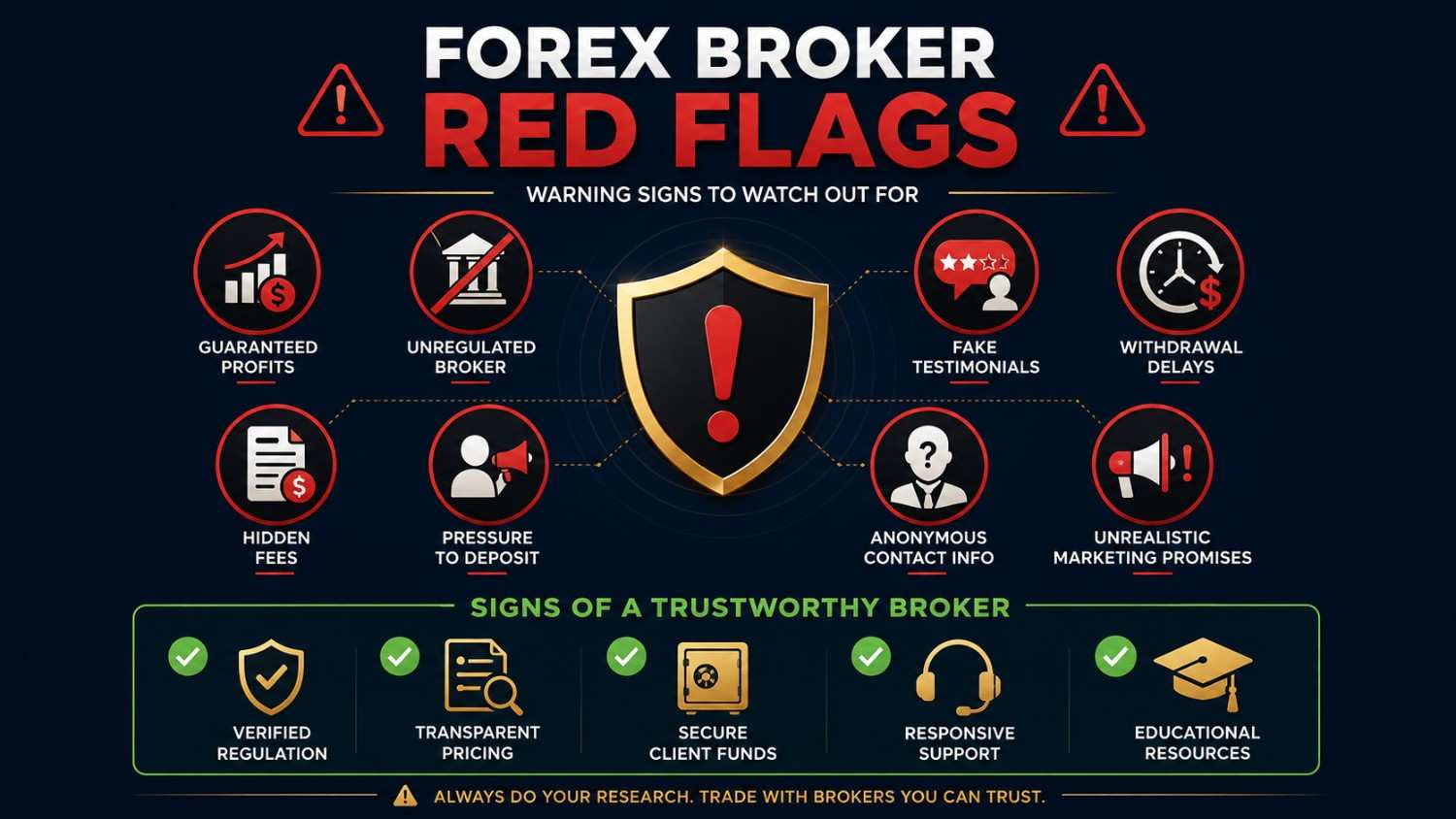
Be cautious if a broker:
🚩 Guarantees profits.
🚩 Promises “risk-free trading.”
🚩 Pressures you to deposit immediately.
🚩 Refuses to explain fees.
🚩 Makes withdrawals unnecessarily difficult.
🚩 Uses aggressive sales tactics.
🚩 Provides little information about regulation.
🚩 Has inconsistent contact information.
🚩 Relies heavily on luxury lifestyle marketing instead of education.
Professional brokers focus on transparency rather than unrealistic promises.
Common Forex Broker Scams
Unfortunately, scams continue to target new traders.
Understanding these schemes helps protect both your capital and your confidence.
Clone Websites
Fraudsters copy the branding of legitimate brokers and create nearly identical websites.
Always verify the website address carefully before registering or logging in.
Fake Investment Managers
Scammers offer to trade on your behalf while promising guaranteed monthly returns.
Legitimate investments always involve risk.
No professional can guarantee profits.
Bonus Scams
Some promotions may include conditions that make withdrawals difficult.
Always read the terms and conditions before accepting bonuses or promotional offers.
Withdrawal Delays
If a broker repeatedly delays legitimate withdrawal requests without explanation, investigate carefully and contact the appropriate regulator if necessary.
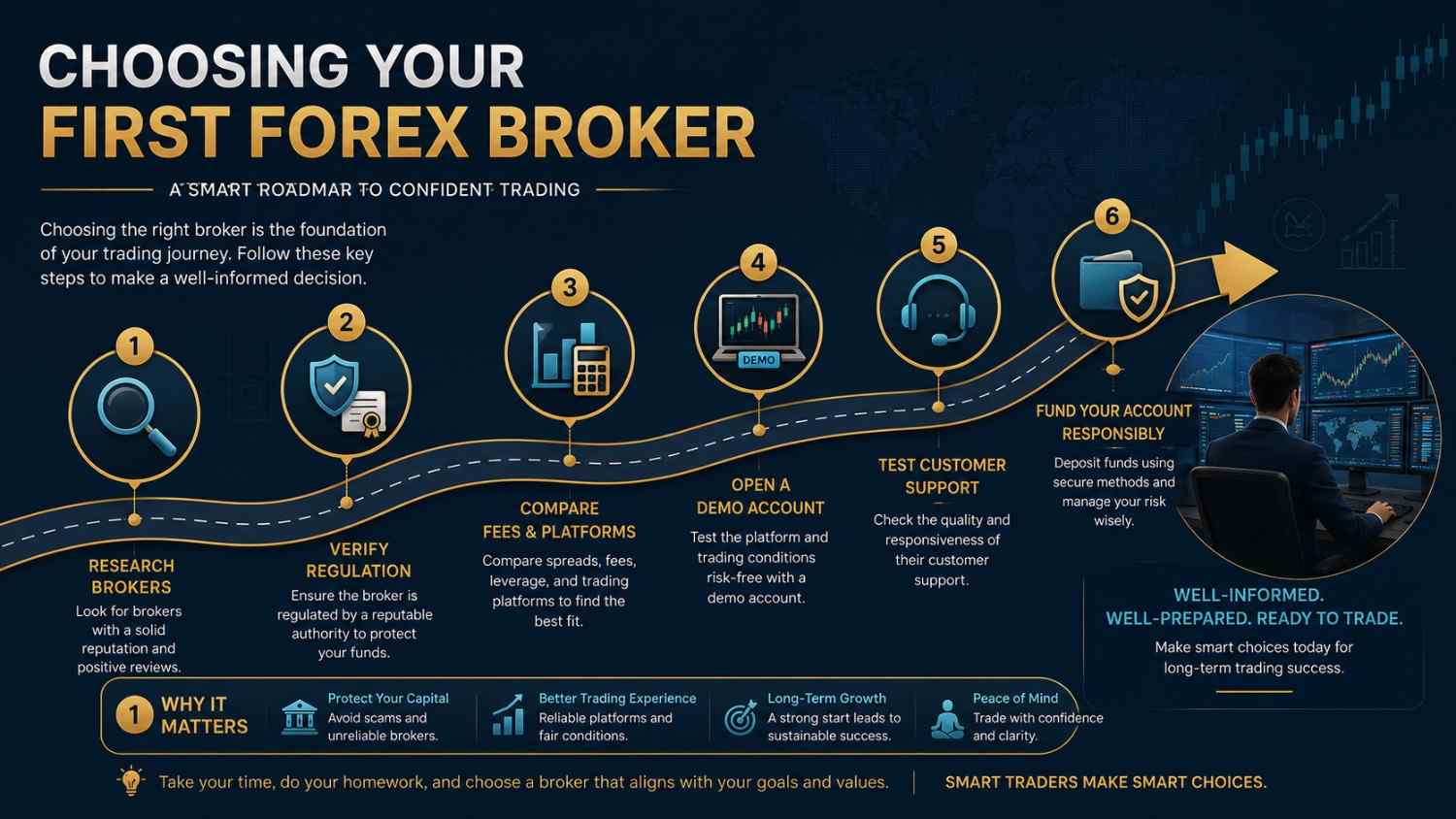
Questions to Ask Before Opening an Account
Before funding your account, ask yourself:
- Is the broker regulated?
- Have I verified the license independently?
- Do I fully understand the fee structure?
- Have I tested the demo platform?
- Have I read the withdrawal policy?
- Does customer support respond professionally?
- Does the broker provide educational materials?
- Am I comfortable with the trading platform?
- Does the broker match my trading goals?
If you cannot confidently answer these questions, continue researching before making a decision.
Practical Broker Comparison Worksheet
| Feature | Broker A | Broker B | Broker C |
|---|---|---|---|
| Regulation Verified | ☐ | ☐ | ☐ |
| Transparent Fees | ☐ | ☐ | ☐ |
| Competitive Spreads | ☐ | ☐ | ☐ |
| Demo Account | ☐ | ☐ | ☐ |
| Educational Resources | ☐ | ☐ | ☐ |
| Fast Withdrawals | ☐ | ☐ | ☐ |
| Responsive Support | ☐ | ☐ | ☐ |
| Mobile App | ☐ | ☐ | ☐ |
| Overall Confidence | ⭐ | ⭐ | ⭐ |
Encourage readers to print or save this checklist and use it when comparing brokers.
Frequently Asked Questions About How to Choose a Forex Broker
How do I know if a Forex broker is legitimate?
The first step in how to choose a Forex broker is verifying that the broker is authorized by a recognized financial regulator. Visit the regulator’s official website and search for the broker’s license rather than relying only on information displayed on the broker’s website.
Also consider the broker’s operating history, transparency, customer support, and educational resources before opening an account.
What is the safest type of Forex broker?
There is no single “safest” broker model. Market Maker, STP, and ECN brokers can all provide excellent services when they are properly regulated and transparent.
Instead of focusing solely on the execution model, evaluate:
- Regulation
- Client fund protection
- Trading costs
- Platform reliability
- Customer support
- Withdrawal policies
Should beginners choose ECN or Market Maker brokers?
Many beginners start with brokers that offer user-friendly platforms, educational resources, and demo accounts.
As trading experience grows, some traders may decide to explore ECN-style accounts because of their pricing structure and execution model.
The best choice depends on your experience, trading style, and learning objectives.
How much money should I deposit?
Avoid depositing more money than you can comfortably afford to lose.
Many beginners start with a modest amount while they continue learning, practicing risk management, and refining their trading plans.
Growing gradually is generally more sustainable than making a large initial deposit.
Are low spreads always better?
Not necessarily.
Some brokers advertise extremely low spreads but charge higher commissions or other fees.
Always compare the total trading cost rather than focusing on one figure.
Can I trust online broker reviews?
Online reviews can be useful, but they should not be your only source of information.
Read reviews from multiple independent sources and compare them with information published by financial regulators and the broker itself.
Look for consistent patterns rather than isolated comments.
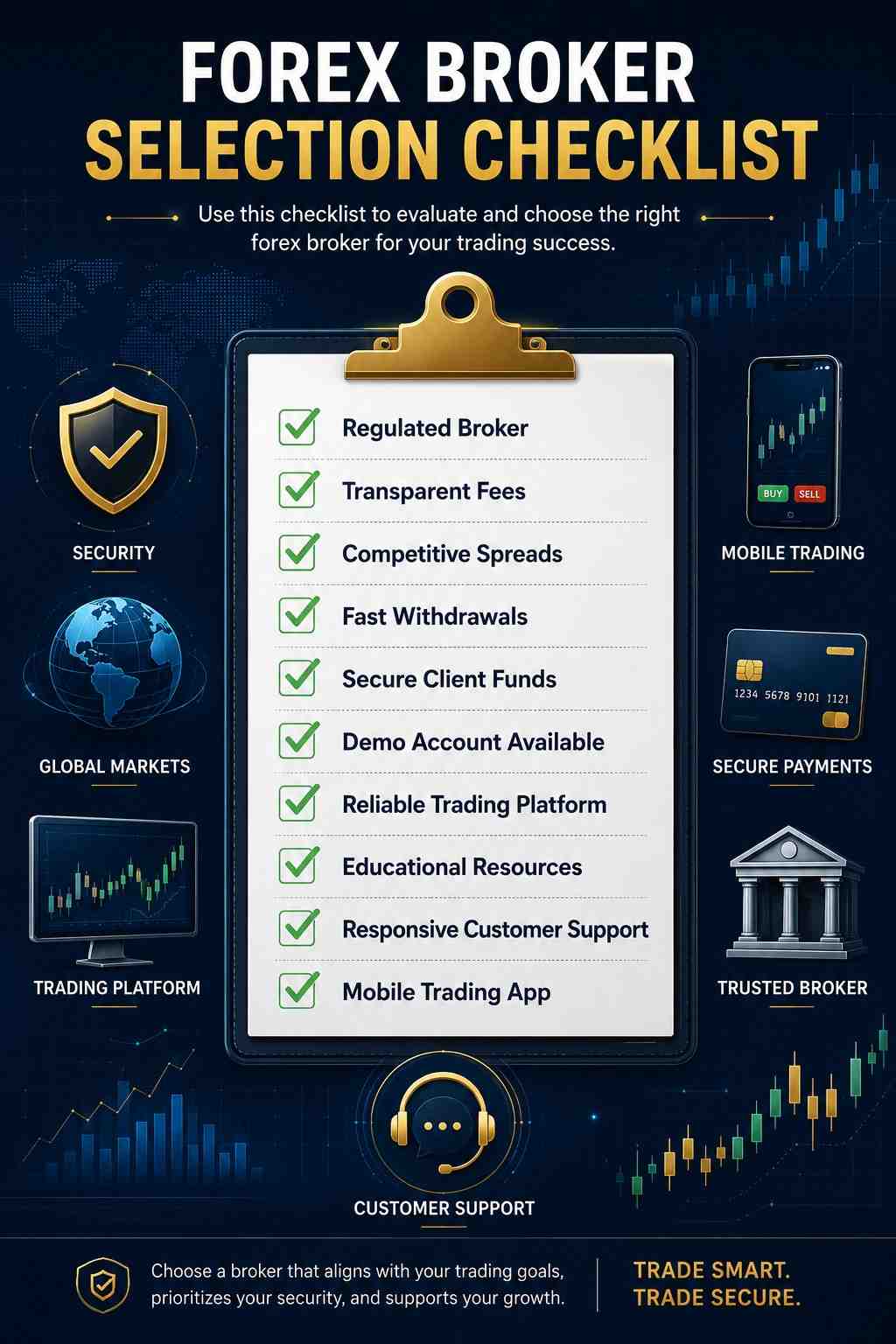
Broker Comparison Checklist
Before opening your account, make sure you can answer YES to most of the following questions:
| Question | Yes. |
|---|---|
| Is the broker regulated? | ☐ |
| Did I verify the license independently? | ☐ |
| Are fees transparent? | ☐ |
| Does the broker offer a demo account? | ☐ |
| Is customer support responsive? | ☐ |
| Are withdrawals clearly explained? | ☐ |
| Are client funds protected? | ☐ |
| Is the trading platform reliable? | ☐ |
| Does the broker provide educational resources? | ☐ |
| Do I fully understand the risks? | ☐ |
If several boxes remain unchecked, continue researching before committing your funds.
Common Mistakes Beginners Make
Many new traders lose money before placing a single trade—not because of market conditions, but because they choose the wrong broker.
Avoid these common mistakes:
- Selecting a broker based only on bonuses or promotions.
- Ignoring regulation.
- Not reading the fee schedule.
- Failing to test a demo account.
- Depositing large amounts immediately.
- Trusting guaranteed-profit claims.
- Ignoring withdrawal policies.
- Choosing a broker solely because of social media advertising.
Taking time to compare brokers carefully can help you avoid costly mistakes.
Final Thoughts
Learning how to choose a Forex broker is one of the most valuable investments you can make before entering the financial markets.
A trustworthy broker provides more than a trading platform—it provides the infrastructure, security, transparency, and support that allow you to focus on developing your skills.
Remember these key principles:
- Regulation comes first.
- Verify everything independently.
- Compare total trading costs, not just spreads.
- Use demo accounts before risking real money.
- Read withdrawal policies carefully.
- Prioritize education over marketing.
- Never rush into opening an account because of promotional pressure.
The best broker is not necessarily the one with the biggest advertisement or the highest leverage. It is the one that aligns with your goals, offers transparent services, and helps you trade responsibly.
At FinWireStack, our mission is to equip you with practical, unbiased financial education so you can make informed decisions with confidence.






[…] How to Choose a Forex Broker […]
[…] how-to-choose-a-forex-broker […]