Category Investment Education

Fidelity Investments Explained: A Complete Beginner’s Guide to Investing in the U.S. in 2026

Fidelity Investments beginner guide to investing in the United States

If you have never invested before, the financial world can feel intimidating.

You hear people talking about stocks, ETFs, index funds, 401(k)s, Roth IRAs, mutual funds, dividends, capital gains, and compound interest.

Then you hear another name repeatedly:

Fidelity Investments.

But what exactly is Fidelity?

Is Fidelity a bank?

Is Fidelity a stock?

Is Fidelity an investment fund?

Can you buy stocks through Fidelity?

How much money do you need?

And, most importantly, how does a complete beginner actually use Fidelity Investments to start building wealth?

This guide answers those questions from the ground up.

By the end, you should understand what Fidelity is, what it offers, how the different accounts work, what you can invest in, what the major risks are, and what a sensible beginner investing journey could look like.

Important: Fidelity is not an investment itself. Fidelity is a financial-services company and investment platform through which eligible customers can access different financial products.


What Is Fidelity Investments?

Fidelity Investments is one of the major financial services companies serving U.S. investors.

Through its platforms, Fidelity provides access to investment accounts, stocks, ETFs, mutual funds, bonds, retirement accounts, managed investing, and other financial services. Fidelity’s current account lineup includes brokerage accounts, retirement accounts, managed solutions, cash-management products, crypto offerings, and accounts for children and education.

Think of Fidelity as a financial supermarket.

You do not go to Fidelity simply to “buy Fidelity.”

Instead, you open an appropriate account and then decide which investments belong inside that account.

For example:

Fidelity account โ†’ ETF โ†’ stocks inside the ETF

or

Fidelity IRA โ†’ mutual fund โ†’ diversified portfolio

or

Fidelity brokerage account โ†’ individual stocks

This distinction is fundamental for beginners.


Fidelity Investments in Simple Terms

Imagine you want to build a house.

You need:

  • A place to build
  • Building materials
  • Tools
  • A construction plan

Your Fidelity account is similar to the place where your investments are held.

Your stocks, ETFs, bonds and mutual funds are the building materials.

Your investment strategy is the construction plan.

Fidelity provides the platform and tools.

You still need to decide what you are building.


Why Is Fidelity Investments Getting So Much Attention?

The interest surrounding Fidelity fits into several major changes happening in U.S. investing.

AI and Technology

Artificial intelligence has become a major investment theme.

Fidelity’s own 2026 research identifies AI infrastructure as a major economic force and points to potential opportunities across semiconductor companies, utilities, energy, and other businesses supporting AI infrastructure.

Low-Cost Investing

Investors increasingly focus on fees because even small recurring costs can significantly affect long-term returns.

Fidelity currently advertises $0 online commissions for U.S. stocks and ETFs and offers zero-expense-ratio index mutual funds.

Fractional Investing

Fidelity allows eligible investors to purchase fractional shares, with its brokerage materials stating that investors can start with as little as $1.

Retirement Investing

Americans continue to use retirement accounts such as 401(k)s and IRAs to build long-term wealth.

For 2026, the IRS says the annual IRA contribution limit is $7,500, with an additional $1,100 catch-up contribution for eligible investors aged 50 and above.

Crypto

Fidelity has also expanded into digital assets.

Its current crypto offerings includes Bitcoin, Ethereum, Fidelity Digital Dollar, Litecoin, and Solana, and Fidelity also offers crypto-related exchange-traded products.

These trends help explain why understanding Fidelity Investments is increasingly relevant to people learning about modern U.S. investing.


How Does Fidelity Investments Actually Work?

The process is surprisingly simple.

Step 1: Choose an Account

You first decide what type of account you need.

Step 2: Deposit Money

You transfer money into the account.

Step 3: Select Investments

You choose stocks, ETFs, mutual funds, bonds or another eligible investment.

Step 4: Place the Investment

You purchase the investment.

Step 5: Monitor and Rebalance

You review your portfolio periodically and make adjustments when appropriate.

The biggest beginner mistake is believing that depositing money into Fidelity automatically means you are invested.

It does not.

Cash sitting inside an account is different from money invested in a security.


The Most Important Fidelity Accounts Beginners Should Understand

Fidelity Investments account types including brokerage, IRA, and Fidelity Go
1. Fidelity Brokerage Account

The standard brokerage account is one of the easiest places to start learning.

Fidelity describes its brokerage account as a multi-feature account that can provide access to stocks, ETFs, options, bonds, mutual funds, and other investments. It currently has no account minimum and allows investing from $1 through fractional shares.

Best For

A brokerage account can make sense for someone who wants:

  • Flexible investing
  • No retirement-account restrictions
  • Stock investing
  • ETF investing
  • Long-term wealth building
  • Access to taxable investments

The major disadvantage is taxation.

Investment income and realized capital gains can create tax obligations.


2. Traditional IRA

A Traditional IRA is designed primarily for retirement investing.

Depending on your circumstances, contributions may qualify for tax deductions, and investments generally grow tax-deferred.

However, withdrawal rules and tax consequences apply.

2026 IRA Contribution Limit

For 2026, the combined IRA contribution limit is:

$7,500 if under age 50

$8,600 if age 50 or older

The additional amount represents the catch-up contribution.

Always check the current IRS rules before making retirement contributions.


3. Roth IRA

A Roth IRA is another important retirement account.

The major attraction is the potential for tax-free qualified withdrawals.

However, eligibility and contribution rules apply.

For 2026, the IRS rules allow eligible individuals to contribute up to the applicable IRA limit, but higher-income taxpayers may face reduced or eliminated direct Roth IRA contribution eligibility. Fidelity’s current 2026 guidance lists income thresholds for Roth IRA eligibility.

Why Beginners Should Understand Roth IRAs

Suppose a young investor contributes consistently for decades.

The combination of:

contributions + investment growth + compounding + tax advantages

can become extremely powerful.

The right choice depends on your income, tax situation, retirement expectations, and eligibility.

But a Roth IRA is not automatically “better” than a Traditional IRA.


4. 401(k)

A 401(k) is generally an employer-sponsored retirement plan.

If your employer offers a 401(k), this deserves attention before opening additional investment accounts.

Why?

Because some employers provide a matching contribution.

For example, if an employer matches part of your contribution, not taking advantage of the available match can mean leaving part of your compensation unused.

Fidelity provides retirement-plan services to employers and employees, although the exact investments and rules available depend on the particular employer plan.


5. Fidelity Go

Not everyone wants to choose investments manually.

That is where a robo-advisor can become useful.

Fidelity Go is Fidelity’s automated investing service.

Fidelity states that Fidelity Go is available to U.S. residents aged 18 and above, and there is no minimum initial investment; once the account reaches $10, Fidelity begins investing according to the selected strategy.

This can be attractive to someone who says:

“I want to invest, but I don’t know which investments to select.”

Instead of manually selecting every security, the investor provides information about their goals and risk preferences, and the automated service manages the portfolio within its framework.


What Can You Buy Through Fidelity?

Fidelity Investments stocks ETFs index funds mutual funds bonds and crypt

This is where things become interesting.

Stocks

You can purchase shares of individual publicly traded companies.

For example, you might buy shares of companies operating in:

  • Technology
  • Healthcare
  • Financial services
  • Energy
  • Consumer products
  • Industrials

But individual stocks carry company-specific risk.

If the company performs poorly, the stock can fall significantly.


ETFs

An ETF is a basket of investments traded on an exchange.

Instead of purchasing 500 individual companies, you can buy an ETF designed to track a broad market index.

This can provide diversification with a single transaction.

Fidelity offers a broad range of ETFs and provides research tools for evaluating them.

Why Beginners Often Prefer ETFs

ETFs can provide:

Diversification

Convenience

Transparency

Low costs

Simple portfolio construction

But not every ETF is diversified.

Some ETFs concentrate heavily on one industry, theme, or asset.

Always investigate what is actually inside an ETF.


Fidelity Index Funds

Index funds attempt to track a particular market index.

One of Fidelity’s most well-known index funds is the Fidelity 500 Index Fund (FXAIX), which seeks to track the S&P 500.

The fund currently has an extremely low expense ratio, and current market reporting places its expense ratio at 0.015%.

This illustrates one reason index investing has become so popular.

Instead of trying to identify the next winning company, the investor obtains exposure to a broad group of companies.

Important

Low fees do not eliminate market risk.

An S&P 500 index fund can still decline substantially during a market downturn.


Fidelity Mutual Funds

Mutual funds pool money from multiple investors and invest according to a defined strategy.

Fidelity has a large mutual-fund lineup covering different objectives.

These can include:

  • U.S. equities
  • International equities
  • Bonds
  • Target-date funds
  • Sector funds
  • Growth funds
  • Income funds
  • Index funds

The important question is not

“Is this a Fidelity fund?”

The important questions are:

“What does this fund own?”

“What does it charge?”

“What is its objective?”

“What risks does it take?”


Fidelity Bonds and CDs

Investing does not have to mean buying stocks.

Fidelity also provides access to fixed-income investments such as bonds and CDs.

These can play a role in portfolios designed around:

  • Income
  • Capital preservation
  • Diversification
  • Retirement planning
  • Lower equity exposure

Fidelity currently lists $1 per bond or CD for secondary-market trading and free online trading for U.S. Treasuries, subject to applicable conditions and rules.


Fidelity Crypto

This is one of the most important modern developments to understand.

Fidelity now offers cryptocurrency exposure through multiple structures.

These include:

Fidelity Crypto

Crypto ETPs

Crypto IRA options

Its current direct crypto offering includes Bitcoin, Ethereum, Fidelity Digital Dollar, Litecoin, and Solana.

Fidelity also offers crypto funds such as FBTC, FETH and FSOL, which provide exposure to Bitcoin, Ether, and Solana through exchange-traded products.

But Crypto Is Different

Fidelity itself warns that cryptocurrency is highly volatile and may become illiquid.

Investors can lose their entire investment.

Crypto should therefore not automatically become the foundation of a beginner’s portfolio.


Fidelity Fractional Shares Explained

Suppose a stock costs $500 per share.

You only have $50.

With fractional investing, you may be able to purchase a portion of that share rather than waiting until you have $500.

Fidelity states that its brokerage account supports fractional shares and allows investors to get started with as little as $1.

This is particularly important for younger investors.

You no longer necessarily need thousands of dollars to begin building a diversified investment habit.


How Much Money Do You Need to Start With Fidelity?
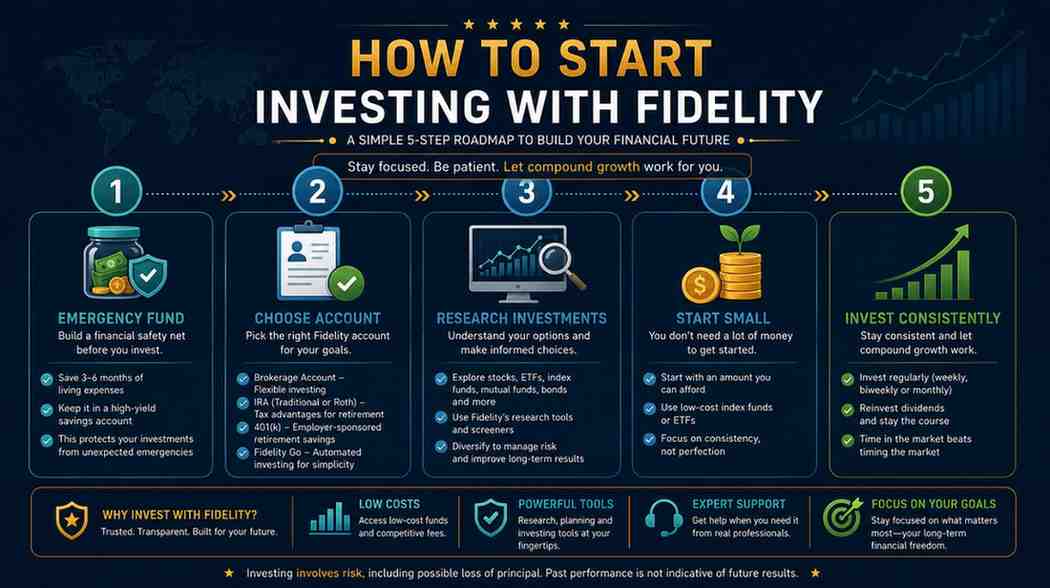
how to start investing with Fidelity Investments step by step

This is one of the most common questions for beginners.

The answer is

You do not necessarily need a large amount.

Fidelity’s standard brokerage account currently has no account minimum, and its fractional-share system allows eligible investors to start investing with $1.

But there is a difference between:

minimum required to start

and

amount needed to achieve a meaningful financial goal.

Starting with $1 teaches you how the platform works.

Building meaningful wealth requires consistent contributions over time.


Fidelity Fees: What Beginners Should Watch

One reason Fidelity attracts investors is its low-cost structure.

Fidelity currently advertises:

  • $0 online commissions for U.S. stocks
  • $0 online commissions for ETFs
  • $0 account fees for its standard brokerage account
  • Zero-expense-ratio index mutual funds

However, “$0 commission” does not mean every possible transaction is free.

Other costs can include:

  • Options contract fees
  • Certain mutual-fund transaction fees
  • Bond/CD charges
  • Advisory fees
  • Fund expense ratios
  • Margin interest
  • Other specialized service fees

Always examine the current fee schedule before investing.


The Difference Between Commission and Expense Ratio

Beginners often confuse these.

Commission

A commission is a charge associated with executing a transaction.

Expense Ratio

An expense ratio represents the annual operating expenses of a fund as a percentage of assets.

Imagine you invest $10,000 in a fund with a 0.10% expense ratio.

That is approximately

$10 per year

before considering changes in the investment value.

The lower the expense ratio, the less of the investment return is consumed by fund expenses, all else equal.

This is one reason low-cost index investing is such a major theme among long-term investors.


What Is the Best Fidelity Investment for a Beginner?

There is no universal “best Fidelity Investments.”

The right investment depends on:

  • Age
  • Income
  • Financial goals
  • Time horizon
  • Risk tolerance
  • Tax situation
  • Existing investments
  • Emergency savings
  • Debt

However, a beginner interested in long-term investing might investigate broad-market index funds or diversified ETFs before jumping into speculative individual stocks.

A Simple Beginner Framework

A hypothetical long-term investor might think in terms of:

Core portfolio

Broad-market diversified investments.

Growth allocation

Potentially higher-growth assets.

Defensive allocation

Bonds or cash-like investments depending on objectives.

Speculative allocation

Only money the investor can genuinely afford to lose.

The exact percentages should not be copied blindly from another investor.


Fidelity Investments and the AI Boom

AI is one of the biggest investment themes influencing U.S. markets in 2026.

Fidelity’s own research describes AI infrastructure spending as a major driver of U.S. economic activity and highlights potential opportunities in semiconductor companies, utilities, energy, and other infrastructure providers.

But there is an important lesson here.

Do Not Confuse a Trend With a Strategy

AI may be a powerful long-term technological transformation.

That does not mean every AI-related stock will rise.

Some companies may:

  • Become market leaders
  • Lose market share
  • Fail to monetize AI
  • Become overvalued
  • Face intense competition

A beginner should therefore investigate the business and valuation, not simply buy something because it contains the word “AI.”


Fidelity Investments and the U.S. Stock Market in 2026

Fidelity’s recent market analysis says U.S. information technology and growth stocks rebounded strongly during the second quarter of 2026, while international equities also showed broad strength.

That creates an important diversification lesson.

You do not necessarily need to put everything into U.S. technology stocks simply because they are performing strongly.

Markets rotate.

Leadership changes.

Economic conditions change.

Interest rates change.

Investor expectations change.

A diversified portfolio is designed around the possibility that you will be wrong about which asset class performs best next.


How a Beginner Could Start Investing With Fidelity

Let’s make this practical.

Step 1: Build an Emergency Fund

Before investing aggressively, consider whether you have sufficient emergency savings.

Do not invest money that you may need next month for rent, food, or an emergency.


Step 2: Eliminate Dangerous High-Interest Debt

Credit card debt with extremely high interest can work against your investment strategy.

Suppose your investment earns 8% over a particular period while your credit card balance costs you 25%.

The mathematics may not favor investing before dealing with the expensive debt.


Step 3: Define Your Goal

Ask:

Why am I investing?

Maybe your goal is:

  • Retirement
  • Buying a home
  • Children’s education
  • Financial independence
  • Long-term wealth
  • Building an investment portfolio

Your goal determines your time horizon.


Step 4: Choose the Correct Account

Consider whether you need:

Brokerage account

Traditional IRA

Roth IRA

401(k)

Fidelity Go

or another specialized account.


Step 5: Choose Your Investment

Do not buy anything until you understand:

  • What it owns
  • How it makes money
  • What it costs
  • How risky it is
  • How diversified it is
  • What your expected holding period is

Step 6: Start Small

You do not need to begin with $10,000.

The objective at the beginning is to build:

knowledge + discipline + consistency.


Step 7: Automate Contributions

Suppose someone invests $100 every month.

They are not attempting to predict every market movement.

They are building a habit.

Over years, the combination of regular contributions and compounding can become meaningful.


What Is Compound Growth?

Suppose you invest money and earn returns.

Those returns remain invested.

Then future returns can potentially be earned on:

your original money + previous investment gains.

That is compounding.

For illustration, if an investor contributed $200 per month and achieved a hypothetical 8% annual return compounded monthly, the account could grow to roughly $117,800 after 20 years.

The investor would have contributed:

$48,000

The remainder would represent investment growth.

But remember:

8% is a hypothetical assumption, not a guaranteed Fidelity return.

Real investment returns vary.


Fidelity Investments vs. Buying Stocks Directly

This is another misconception about Fidelity Investments.

When you use Fidelity, you are not necessarily buying “Fidelity stock.”

You are using Fidelity as the platform through which you can purchase investments.

For example:

Fidelity account

โ†“

Fidelity 500 Index Fund

โ†“

Portfolio of large U.S. companies

Or:

Fidelity account

โ†“

Individual company stock

โ†“

One company

The risk profile is very different.


Fidelity vs. a Bank Account

A bank account and investment account serve different purposes.

Bank/Savings Account

Usually designed for:

  • Cash storage
  • Spending
  • Emergency funds
  • Short-term goals

Investment Account

Designed for:

  • Long-term growth
  • Stocks
  • ETFs
  • Bonds
  • Mutual funds
  • Other investments

Investment values can rise and fall.

Cash accounts are generally much more stable.

Therefore, you should not treat an investment account as though it were a guaranteed savings account.


Can Someone in Africa Open a Fidelity Investments Account?

This is extremely important for FinWireStack’s international readership.

If you currently reside in Africa and do not already have a Fidelity relationship, you generally cannot open a new Fidelity account as an African resident.

Fidelity’s own international-customer guidance states that it does not open accounts for new customers residing outside the United States.

This means an African reader should not attempt to bypass Fidelity’s residency requirements using false information or another person’s U.S. address.

Instead, international investors should investigate brokers and investment platforms that legally accept residents of their country.

This distinction is critical because availability of U.S. investments and availability of a particular U.S. broker are two different things.


Who Is Fidelity Investments Best Suited For?

Fidelity can be particularly attractive for eligible U.S. investors who want:

  • Long-term investing
  • Retirement planning
  • Stocks
  • ETFs
  • Index funds
  • Mutual funds
  • Fractional shares
  • Automated investing
  • Research tools
  • Low-cost investing
  • One financial platform

It can serve both beginners and experienced investors.


Who Should Be Careful?

Fidelity may not be appropriate for someone who:

  • Wants guaranteed returns
  • Does not understand investment risk
  • Wants to day-trade without a strategy
  • Uses excessive margin
  • Buys stocks based entirely on social media hype
  • Does not understand taxes
  • Invests emergency savings
  • Cannot tolerate temporary losses

A reputable platform cannot protect you from a poor investment decision.


Common Fidelity Investing Mistakes Beginners Make

Mistake 1: Buying Whatever Is Trending

A stock appearing repeatedly on TikTok, YouTube, or Google Trends is not automatically a good investment.

Mistake 2: Confusing Fidelity With an Investment

Fidelity is the platform.

The investment is what you purchase through it.

Mistake 3: Investing Without an Emergency Fund

A market downturn can become devastating if you are forced to sell investments to pay an unexpected bill.

Mistake 4: Chasing AI Stocks

AI is a powerful trend, but not every AI company will succeed.

Mistake 5: Ignoring Fees

Small costs can compound over decades.

Mistake 6: Using Margin Too Early

Borrowing money to invest can magnify losses.

Mistake 7: Checking Your Portfolio Every Five Minutes

Long-term investing is generally different from short-term trading.


Fidelity Investments vs. Trading

This distinction deserves special attention for FinWireStack readers.

Investing generally focuses on building wealth over years or decades.

Trading focuses more heavily on shorter-term price movements.

Someone can use Fidelity for both investing and trading, but the mindset is different.

Investing

Goal: Long-term wealth

Typical holding period: Years/decades

Focus: Fundamentals, diversification, asset allocation

Trading

Goal: Profit from price movements

Typical holding period: Minutes to months

Focus: Market behavior, execution, risk management

If you are interested in trading automation, see Algorithmic Trading in 2027.


What About Fidelity Investments Crypto?

Crypto is becoming increasingly integrated into mainstream investment platforms.

Fidelity now allows eligible U.S. customers to access direct cryptocurrency through Fidelity Crypto and crypto exposure through exchange-traded products.

However, crypto should not be confused with traditional diversified investing.

Fidelity explicitly warns that crypto is highly volatile and investors can lose their entire investment.

A beginner should therefore understand the difference between:

Diversified index exposure

and

single-asset cryptocurrency exposure.


A Beginner’s Fidelity Investments Checklist

Before making your first investment, ask yourself:

Financial Preparation

โ˜ Do I have emergency savings?

โ˜ Have I addressed high-interest debt?

โ˜ Do I know my investment objective?

Account Selection

โ˜ Do I need a brokerage account?

โ˜ Should I investigate an IRA?

โ˜ Do I have access to an employer 401(k)?

Investment Selection

โ˜ Do I understand what I am buying?

โ˜ Is it diversified?

โ˜ What does it cost?

โ˜ What are the risks?

Long-Term Plan

โ˜ How much can I invest monthly?

โ˜ How long will I invest?

โ˜ What will I do during a market crash?

โ˜ Will I continue investing consistently?


The 2026 Fidelity Investments Trends Beginners Should Watch

Fidelity Investments trends in 2026: AI ETFs retirement crypto and fractional investing

Based on Fidelity’s current research and product direction, several themes deserve attention.

AI Infrastructure

AI is expanding demand for computing power, data centers, semiconductors, and electricity infrastructure. Fidelity identifies these areas as potential investment opportunities while also emphasizing the importance of valuation and risk.

Low-Cost Index Investing

Index funds and ETFs remain central to many long-term portfolios.

Fractional Investing

The ability to invest with smaller amounts makes market access easier for beginners.

Automated Investing

Robo-advisors such as Fidelity Go can help investors who prefer an automated approach.

Crypto Integration

Fidelity’s expansion into direct crypto and crypto ETPs shows how digital assets are increasingly being integrated into mainstream investment platforms.

Retirement Tax Planning

IRA contribution limits and tax rules remain important considerations for American investors.


Is Fidelity Investments Safe?

Fidelity is an established U.S. financial-services company, but “safe platform” does not mean “your investments cannot lose money.”

Your investment can decline.

A stock can go to zero.

An ETF can fall.

A cryptocurrency can experience extreme losses.

Safety therefore has two dimensions:

Platform and custody protections

versus

Investment risk.

Never confuse the two.

Fidelity Investments’ brokerage entities identify their applicable regulatory and SIPC membership information, but investors should understand exactly which product they own and what protections apply to it.

This becomes particularly important with cryptocurrency because Fidelity states that crypto investments do not receive the same regulatory protections applicable to registered securities.


The Beginner’s Best Way to Think About Fidelity Investments

Don’t ask:

“Which Fidelity Investments will make me rich?”

Ask:

“Which Fidelity Investments account and investment structure best fit my financial goal, risk tolerance, and time horizon?”

That single change in mindset can dramatically improve the quality of your investment decisions.


Final Takeaway

Fidelity Investments is not a single investment.

It is a large financial-services platform that gives eligible investors access to a wide range of accounts and investments.

A beginner can use Fidelity Investments to access:

  • Stocks
  • ETFs
  • Index funds
  • Mutual funds
  • Bonds
  • CDs
  • Retirement accounts
  • Fractional shares
  • Automated investing
  • Cryptocurrency

Its current direction also reflects some of the biggest themes shaping U.S. investing in 2026: AI, technology, low-cost investing, automation, retirement planning, and digital assets.

But the platform does not determine whether you make money.

Your financial plan, strategy, risk management, time horizon, and behavior matter far more.

For a beginner, the most sensible progression in Fidelity Investments is:

Learn โ†’ Build an emergency fund โ†’ Understand accounts โ†’ Choose diversified investments โ†’ Invest consistently โ†’ Control costs โ†’ Avoid unnecessary speculation โ†’ Review periodically.

And if you are outside the United States, remember the crucial eligibility issue: Fidelity currently says it does not open accounts for new customers who reside outside the U.S.

So for a Kenyan investor, the educational lesson is still highly valuableโ€”but the practical next step is to identify a regulated investment platform that legally accepts Kenyan residents rather than attempting to circumvent Fidelity’s eligibility requirements.


Frequently Asked Questions on Fidelity Investments.

Is Fidelity Investments a bank?

Fidelity Investments is primarily a financial services and investment company. It provides brokerage, retirement, investment-management, cash-management, and other financial products.

Is Fidelity good for beginners?

It can be. Fidelity provides educational resources, fractional shares, low-cost investment options, and both self-directed and automated investing services.

How much money do I need to start investing with Fidelity Investments?

Fidelity’s standard brokerage account currently has no account minimum, and eligible investors can use fractional shares to invest with as little as $1.

Can I buy ETFs through Fidelity?

Yes. Fidelity provides access to ETFs and offers its own ETF lineup as well as other investment choices.

Can I buy Bitcoin through Fidelity?

Eligible U.S. customers can access Bitcoin and other cryptocurrencies through Fidelity Crypto. Fidelity also offers crypto ETPs through brokerage accounts.

Can Africans open an account in Fidelity Investments?

Fidelity states that it does not open accounts for new customers residing outside the United States.

What is the difference between Fidelity and an ETF?

Fidelity is a financial-services platform. An ETF is an investment product that you can potentially purchase through Fidelity.

What is FXAIX?

FXAIX is the Fidelity 500 Index Fund, which seeks to track the S&P 500. It is one of Fidelity’s best-known index funds.

Does Fidelity guarantee investment returns?

No. Investments can lose value, and past performance does not guarantee future results.


Recommended Official Resources on Fidelity Investments

Fidelity Investments: Fidelity Investments official website

Fidelity Brokerage Account: The Fidelity Account

Fidelity Investment Accounts: Fidelity account and product directory

Fidelity Fees: Fidelity pricing and fees

Fidelity ETFs: Investing in ETFs at Fidelity

IRS: 2026 IRA and retirement contribution information


Learn more about investments here:

Algorithmic Trading in 2027 in Relation to Fidelity Investments.

AI Trading Bots: Real vs Scams in Relation to Fidelity Investments.

AI vs Human Traders 2030 in Relation to Fidelity Investments.

Copy Trading in 2027 in Relation to Fidelity Investments.

AI Investment Platforms in 2027 in Relation to Fidelity Investments.

Copy Trading in 2027: Is Following Another Trader Really a Shortcut to Profit?

Copy Trading in 2027

Copy trading in 2027 is becoming an increasingly important topic for retail traders who want market exposure without making every trading decision themselves. The idea sounds simple. Find a successful trader. Connect your account. Copy their trades automatically.

When they buy, your account buys. When they sell, your account sells. For a beginner struggling to understand charts, indicators, economic news, and risk management, copy trading in 2027 can look like an attractive shortcut. But there is a problem. Following a trader does not automatically mean following their success. You are also copying their losses, leverage, drawdowns, timing, strategy limitations, and potentially their mistakes.

The growth of social and mobile trading is making this distinction more important. Regulators have been paying attention to copy trading because automated copying can cross into investment or portfolio management depending on how the service is structured. The UK’s Financial Conduct Authority states that copy trading can be treated as portfolio or investment management where there is no clear manual intervention from the account holder.

That makes Copy trading in 2027 much more than a question of finding the trader with the highest return. The real question is, can you identify a trader whose strategy, risk level, transparency, and performance are compatible with your own financial goals?

What Is Copy Trading?

Copy trading in 2027 refers to using a platform or service that allows one trader’s transactions to be automatically replicated in another investor’s account. The person being followed is commonly called a:

  • Signal provider
  • Strategy provider
  • Lead trader
  • Master trader
  • Trader to copy
    The person following them may be called:
  • Copier
  • Follower
  • Investor
  • Copy trader
    The copied trade may be replicated proportionally according to the amount allocated to the strategy.
    For example, suppose a trader opens a EUR/USD position using 5% of their account.
    Your copy-trading platform may allocate a corresponding proportion of your designated copy-trading capital.
    The exact mechanism depends on the platform.
    This is important because copy trading in 2027 does not necessarily mean that you own the same portfolio or experience the same percentage return.
    Execution prices, spreads, commissions, leverage, account size, and platform rules can all affect your results.

Why Copy Trading in 2027 Is Becoming More Attractive

Several trends are making Copy trading in 2027 particularly relevant.

1. Trading Is Becoming More Social

Modern trading platforms increasingly combine:

  • Market data
  • Social feeds
  • Trader rankings
  • Performance dashboards
  • Community discussions
  • Automated execution
    This creates an environment where trading ideas can spread rapidly.
2. Mobile Trading Is Normal

A trader no longer needs a traditional desktop workstation to monitor an account. Mobile platforms allow users to:

  • Follow traders
  • Review performance
  • Adjust allocations
  • Monitor positions
  • Receive notifications
  • Stop copying strategies
    That accessibility is one reason copy trading in 2027 could attract more inexperienced market participants.
3. AI Is Changing Trader Discovery

AI can potentially help investors analyze:

  • Historical returns
  • Drawdowns
  • Trading frequency
  • Asset exposure
  • Volatility
  • Risk-adjusted performance
  • Correlations
    This could make Copy trading in 2027 more analytical than the old approach of simply choosing the trader with the biggest percentage gain.
4. Finfluencer Culture Is Growing

How Copy Trading Will Actually Work in 2027

Social media has created a new class of financial personalities. Some provide useful educational content. Others may promote trading services, signals, or managed accounts without giving investors enough information about the risks. The FCA has specifically warned that some finfluencers promote unrealistic returns and encourage consumers to copy trades, invest in managed accounts, or purchase trading tips. Therefore, copy trading in 2027 should never be based solely on the personality of the trader.

how Copy Trading in 2027 works

A typical copy trading process in 2027 looks like this:

Step 1: Open an Account

You register with a platform that offers social or copy trading.

Step 2: Select a Trader

The platform normally displays information such as:

  • Return
  • Drawdown
  • Number of followers
  • Trading history
  • Risk score
  • Assets traded
  • Trading frequency

Step 3: Allocate Capital

You decide how much money to dedicate to copying. This is critical. Your entire investment portfolio does not have to be allocated to one trader.

Step 4: Activate Copying

Once activated, new trades from the selected trader may be replicated automatically.

Step 5: Monitor Performance

You should continue monitoring the strategy. Copy trading in 2027 is not “set it and forget it.”

Step 6: Stop or Adjust

If the trader’s strategy changes or risk becomes unacceptable, you should be able to reduce allocation or stop copying, depending on the platform.

The Biggest Mistake: Choosing the Highest Return

Copy Trading in 2027 trader selection

One of the biggest mistakes in Copy trading in 2027 will be chasing the trader at the top of the leaderboard. Imagine three traders:

TraderReturnMaximum DrawdownTrading Style
Trader A+180%-65%Aggressive
Trader B+65%-18%Moderate
Trader C+28%-9%Conservative
Trader A looks impressive.
But a 65% drawdown can be devastating.
If your $5,000 allocation falls 65%, you are left with approximately $1,750.
Recovering from a 65% loss requires a gain of approximately 186%.
That is why Copy Trading in 2027 should focus on risk-adjusted performance rather than headline returns.

11 Rules for Safer Copy Trading in 2027

Rule 1: Examine Maximum Drawdown

Maximum drawdown tells you how far an account or strategy has fallen from a previous peak. It is one of the most important measurements in copy trading in 2027. A trader who produces excellent returns but regularly suffers enormous drawdowns may be unsuitable for a conservative investor. Ask: How much of my capital can I tolerate losing before I stop copying?

Rule 2: Look at the Full Trading History

Do not judge Copy Trading in 2027 performance from the last 30 days. A trader can have an exceptional month because of:

  • Market conditions
  • One large position
  • High leverage
  • Concentration
  • Luck
    Look for a longer history where available.
    Ideally, examine multiple market conditions.

Rule 3: Understand the Trader’s Strategy

Before using Copy trading in 2027, understand what the trader actually does. Ask:

  • Are they scalping?
  • Day trading?
  • Swing trading?
  • Position trading?
  • Using leverage?
  • Trading CFDs?
  • Trading crypto?
  • Holding positions overnight?
  • Using automated systems?
    A trader whose strategy you cannot explain is difficult to monitor responsibly.

Rule 4: Check Leverage

Leverage can dramatically change Copy trading risk in 2027. A trader may produce impressive returns because they are taking enormous positions. If the market reverses, the same leverage can produce severe losses. Never assume that a high return means a low-risk strategy.

Rule 5: Check Risk Per Trade

A trader who repeatedly risks a large percentage of capital on individual trades may eventually experience a major drawdown. This is where FinWireStack’s Risk Management Mastery: 7 Proven Strategies can complement your copy-trading research. Risk Management Mastery: 7 Proven Strategies. The same principles of position sizing, stop-loss management, and drawdown control apply when evaluating copy Trading in 2027.

Rule 6: Do Not Put Everything Into One Trader

Diversification matters. Suppose you have $10,000 available for copy trading. Putting all $10,000 behind one highly aggressive trader creates concentration risk. A more diversified structure might involve different strategies or keeping some capital outside the copy-trading system. The correct allocation depends on your circumstances and risk tolerance.

Rule 7: Investigate the Platform

Copy Trading in 2027 is only as safe as the platform holding and executing your money.

Check:

  • Regulation
  • Legal company name
  • Client-fund arrangements
  • Fees
  • Withdrawal rules
  • Execution model
  • Complaint procedures
  • Account protection
    Do not assume a platform is legitimate simply because it has thousands of users.

Rule 8: Investigate the Trader

Follower count is not enough. A trader may have:

  • 50,000 followers
  • Attractive lifestyle content
  • Expensive cars
  • Luxury holidays
  • Screenshots of profits
    None of these prove that the strategy is sustainable.
    Copy Trading in 2027 should be based on evidence, not lifestyle marketing.

Rule 9: Understand All Fees

Your actual Copy trading in 2027 return can be affected by:

  • Spreads
  • Commissions
  • Performance fees
  • Management fees
  • Withdrawal fees
  • Currency conversion
  • Overnight financing
  • Platform charges
    A trader can show a strong gross return while your net return is considerably lower.

Rule 10: Set a Maximum Loss

Before activating Copy Trading in 2027, establish a personal risk limit. For example: “If this strategy reaches a 15% drawdown, I will review or stop copying.” The exact number should reflect your own risk tolerance and the strategy involved. The important principle is having a predefined rule.

Rule 11: Be Prepared to Stop

Stopping a losing strategy is not failure. Continuing to copy because you hope the trader will recover can turn a manageable loss into a much larger one. Copy Trading in 2027 requires the same discipline as direct trading.

Can Copy Trading in 2027 Actually Make Money?

Yes, it can produce profits. But that does not mean it is easy. The outcome depends on:

  • Trader selection
  • Market conditions
  • Risk management
  • Costs
  • Execution
  • Capital allocation
  • Strategy consistency
  • Your decision to stop or continue
    The key question is not:
    “Can copy trading in 2027 make money?”
    It is:
    “Can I identify and manage a strategy whose risk is acceptable to me?”
    A profitable trader can experience a losing period.
    A trader with an excellent historical record can change strategy.
    A strategy that worked in one market environment may fail in another.
    Therefore, Copy Trading in 2027 should be treated as an investment process rather than a guaranteed-income system.

Copy Trading in 2027 and Forex

Forex is one of the markets where copy trading has become particularly popular. A Forex copy trader may follow trading strategies:

  • EUR/USD
  • GBP/USD
  • USD/JPY
  • USD/CHF
  • AUD/USD
  • Gold
  • Major indices
    The advantage is convenience.
    The danger is leverage.
    A Forex strategy can appear highly profitable during a strong trend and then experience a rapid drawdown when market conditions change.
    If you are considering Forex copy trading, understanding how to read Forex charts can still be valuable even when someone else makes the trading decisions. How to Read Forex Charts: Beginner’s Guide
    You do not need to become a professional analyst.
    But you should understand enough to know what the trader is doing with your money.

Copy Trading in 2027 and Cryptocurrency

Crypto copy trading presents a different risk profile. Cryptocurrency markets can operate around the clock and may experience sharp price movements. A trader who performs well during a strong crypto bull market may have a very different result during a prolonged decline. Crypto copy trading also introduces platform, custody, and regulatory considerations. That means copy trading in 2027 should not be evaluated solely by the trader’s percentage return. You should also understand:

  • Which assets are being traded
  • Whether leverage is used
  • Where assets are held
  • What happens during extreme volatility
  • What fees apply
  • What happens if the platform becomes unavailable

Copy Trading in 2027 vs. Trading Yourself

FactorCopy Trading in 2027Trading Yourself
Decision-makingShared/delegatedYou decide.
Time requirementLowerHigher
Learning opportunityModerateHigh
ControlPartialFull
RiskDepends on providerDepends on you
Emotional pressurePotentially lowerPotentially higher
Skill requirementTrader selectionMarket analysis + execution
MonitoringStill requiredRequired
FeesPlatform + trading costsTrading costs
Neither approach is automatically superior.
Copy Trading in 2027 may suit someone who does not have the time or expertise to execute every trade.
Direct trading may suit someone who wants complete control and is willing to develop the required skills.

Copy Trading in 2027 Is Not Passive Investing

This distinction matters. Passive investing generally involves buying diversified assets and holding them for a long period. Copy trading in 2027 is usually much more active. The trader may:

  • Open positions frequently
  • Change exposure
  • Increase leverage
  • Close trades quickly
  • Change strategy
    Therefore, copying someone does not transform an active trading strategy into passive investing.

The Finfluencer Problem

Social media is likely to remain a major driver of Copy Trading in 2027. A trader can build a large audience by displaying:

  • Luxury cars
  • Profitable trades
  • Trading screens
  • Expensive watches
  • Travel
  • High account balances
    The problem is that social media usually shows the highlights.
    You rarely see:
  • Losing months
  • Margin calls
  • Failed strategies
  • Drawdowns
  • Hidden costs
  • Withdrawals
  • Personal financial losses
    The FCA has already raised concerns about finfluencers and unrealistic return claims connected with copy trading and managed accounts.
    Copy Trading in 2027 should therefore separate the trader’s marketing identity from their verified trading record.

How AI Could Change Copy Trading in 2027

AI could make copy trading in 2027 significantly more sophisticated. Instead of simply ranking traders by return, AI systems could potentially compare:

  • Risk-adjusted returns
  • Drawdown patterns
  • Correlations
  • Position concentration
  • Trading frequency
  • Volatility exposure
  • Market regime performance
  • Strategy changes
  • Behavioral patterns
    This could help investors identify whether two traders are actually diversified or simply making similar bets.
    AI may also help detect sudden changes in a trader’s behavior.
    For example:
    A trader historically risks 1% per position.
    Suddenly, they begin risking 8%.
    An intelligent monitoring system could flag the change.
    This direction fits into the broader evolution toward AI-assisted investing and autonomous financial tools.
    FinWireStack’s AI Trading Agents 2027 article explores how autonomous AI systems could increasingly participate in market research, decision-making, and execution. AI Trading Agents 2027
    However, AI does not eliminate the fundamental risk of following another person’s strategy.
    It simply gives investors more tools for evaluating that strategy.

A Copy Trading in 2027 Scoring System

Before choosing a trader, consider scoring them across several categories.

CategoryWeight
Long-term track record20%
Maximum drawdown20%
Risk management15%
Strategy transparency15%
Consistency10%
Leverage10%
Fees5%
Platform/regulatory quality5%
Do not interpret the percentages as a universal formula.
They are simply a framework for thinking beyond headline returns.
The goal of Copy Trading in 2027 is not to identify the trader who made the most money last month.
It is to identify the strategy that offers a reasonable combination of potential return, risk and transparency.

7 Questions to Ask Before Copying a Trader

Before starting Copy Trading in 2027, ask:

1. How long has the trader been active?

A few profitable weeks are not enough evidence.

2. What is the maximum historical drawdown?

This helps you understand potential downside.

3. How much leverage does the trader use?

High leverage can transform normal volatility into severe losses.

4. What assets does the trader trade?

Know what you are actually exposed to.

5. How much do fees reduce my return?

Focus on net results rather than advertised returns.

6. What happens if I stop copying?

Understand how open positions are handled.

7. Is the platform properly regulated?

Verify this independently. These questions can dramatically improve the quality of your Copy Trading in 2027 decision.

Common Copy Trading Mistakes

Chasing Last Year’s Winner

A trader who performed exceptionally well in the past may not repeat that performance.

Ignoring Drawdown

Return without drawdown analysis is incomplete.

Copying Too Many Traders

Owning ten strategies does not necessarily create diversification. They may all trade the same assets.

Using Money You Cannot Afford to Lose

Copy trading remains exposed to market risk.

Trusting Social Media

Popularity is not proof.

Ignoring Fees

Costs compound over time.

Never Checking the Account

Automatic execution does not mean automatic supervision.

Increasing Allocation After a Winning Streak

A winning streak can create false confidence.

Copying High-Leverage Strategies

Large returns may simply reflect large risk.

Expecting Monthly Income

Trading performance is not a salary.

Is Copy Trading in 2027 Good for Beginners?

Copy trading in 2027 can be useful for beginners as an educational tool, but beginners should not confuse convenience with safety. A new trader can observe:

  • How professionals enter trades
  • How they manage positions
  • How they react to market changes
  • How frequently they trade
  • How drawdowns develop
    But the beginner should also study the underlying principles.
    A person who blindly copies another trader may never learn how markets work.
    A person who combines copy trading with education can use the experience as a learning laboratory.

A Safer Beginner Framework for Copy Trading in 2027

A beginner could approach copy trading in 2027 using five stages:

Stage 1 โ€” Learn:

Understand basic market terminology, leverage, spreads, and risk.

Stage 2 โ€” Observe:

Track several traders without committing capital.

Stage 3โ€”Compare:

Analyze returns, drawdown, leverage, and strategy.

Stage 4 โ€” Start Small:

If you decide to proceed, use an amount appropriate to your risk tolerance.

Stage 5 โ€” Review:

Monitor performance and determine whether the strategy still fits your objectives.

This is much more disciplined than choosing a trader because their profile displays the highest return.

What Regulators Are Telling Investors

Regulatory attention to copy trading is increasing. The FCA explains that copy trading may fall within portfolio or investment management requirements when investors automatically follow another person’s trades without meaningful manual intervention.

ESMA has also issued supervisory guidance covering copy-trading services, including requirements and expectations around marketing communications, costs, suitability, appropriateness, remuneration and the qualifications of traders whose trades are copied. This matters because Copy Trading in 2027 is not simply a social-media trend.

It intersects with investor protection, financial promotion, suitability, and regulation. The FCA has separately warned that consumers are sometimes encouraged by finfluencers to copy trades or invest in managed accounts based on unrealistic return claims.

What Could Go Wrong With Copy Trading in 2027?

Consider this scenario. You allocate $2,000 to a trader. The trader has generated a 90% return over the previous year. You assume the strategy is reliable. Three months later, the trader experiences a 30% drawdown. You panic and stop copying. Two weeks later, the strategy recovers. The trader finishes the year profitably. You still lose money because your timing was different. This is an important lesson.

Copy Trading in 2027 Risks

Copy Trading in 2027 does not guarantee that your result will match the trader’s displayed result. Differences can arise from:

  • Entry price
  • Execution
  • Slippage
  • Fees
  • Allocation
  • Timing
  • Account size
  • When you start copying
  • When you stop copying

The Biggest Psychological Trap

The biggest psychological danger in copy trading in 2027 may be giving up responsibility. When you make your own trade, you know the decision belongs to you. When another trader makes it, you may blame them. That can create a dangerous cycle: Profit โ†’ Increase allocation โ†’ Loss โ†’ Blame trader โ†’ Switch trader โ†’ Repeat. The solution is to treat every copied position as your own financial exposure. You are still responsible for deciding how much capital to allocate.

Final Verdict: Can You Make Money With Copy Trading in 2027?

Yes, copy trading in 2027 can potentially make money. But it is not a guaranteed income strategy. It is not a shortcut around risk. It is not a substitute for financial education. And it should never be treated as a magic button that turns another person’s trading history into your future profits. The strongest approach to copy trading in 2027 is selective, analytical, and risk-controlled. Look beyond returns. Study drawdown. Understand leverage. Check fees. Investigate the platform.

Verify the trader. Watch for strategy changes. Set your own risk limits. And never allow a social media personality to make your financial decisions for you. The future of copy trading in 2027 will likely be more automated, more personalized, and increasingly AI-supported.

That could make it easier to identify good traders. It could also make bad traders better at marketing themselves. The investor’s advantage will therefore come from one skill above all: knowing how to separate evidence from hype.

Copy Trading in 2027 Checklist

Copy Trading in 2027 Checklist

Before activating a strategy, ask yourself:

โ˜ I understand how the strategy works.

โ˜ I have reviewed the trader’s history.

โ˜ I have checked the maximum drawdown.

โ˜ I understand the leverage used.

โ˜ I know what assets are traded.

โ˜ I understand every major fee.

โ˜ I have verified the platform.

โ˜ I have checked the regulatory position.

โ˜ I have set my maximum acceptable loss.

โ˜ I am not relying on social media popularity.

โ˜ I am not chasing the highest recent return.

โ˜ I understand that past performance does not guarantee future results.

โ˜ I can afford to lose the capital allocated.

โ˜ I will continue monitoring the strategy.

If several answers are “no,” you are not ready to start copy trading in 2027.

Frequently Asked Questions

Is copy trading in 2027 profitable?

Copy trading in 2027 can be profitable, but profitability is not guaranteed. Results depend on trader selection, strategy, risk management, market conditions, costs, and execution.

Is copy trading in 2027 safe for beginners?

Copy trading in 2027 can reduce the amount of direct trade execution a beginner needs to perform, but it does not remove market risk. Beginners should understand leverage, drawdown, and fees before allocating money.

What is the biggest risk of copy trading in 2027?

The biggest risk is assuming that a trader’s historical performance will automatically become your future performance. Drawdowns, leverage, fees, execution, and timing can create very different results.

Can AI improve copy trading in 2027?

AI may improve trader discovery, risk analysis, portfolio monitoring, and strategy comparison. However, AI cannot guarantee future returns or eliminate market risk.

Should I copy the trader with the highest return?

No. A high return can come with extremely high risk. Examine maximum drawdown, leverage, consistency, and risk-adjusted performance before choosing a trader.

Can I lose all my money through copy trading?

Depending on the product, leverage, platform, and strategy, substantial or even total losses may be possible. Always understand the specific risks before investing.

Is copy trading the same as investing?

No. Many copy-trading strategies are active trading strategies rather than long-term passive investments.

How much money should I use for copy trading?

There is no universal amount that is appropriate for everyone. The amount should reflect your financial circumstances, risk tolerance, and ability to withstand losses.

Conclusion

Copy trading in 2027 could become one of the most accessible ways for retail investors to participate in active trading. But accessibility is not the same as safety. The platforms may become smarter. AI may make trader analysis faster. Mobile apps may make execution easier. Social networks may make successful traders more visible.

None of these developments changes the fundamental rule: You are still responsible for the risk attached to the money you allocate.

If you approach copy trading in 2027 by chasing profits, you may end up copying risk you do not understand. If you approach copy trading in 2027 by studying performance, drawdown, leverage, fees, regulation, and strategy consistency, you have a much stronger foundation for making an informed decision.

The goal is not to find someone who never loses. That person does not exist. The goal is to find a strategy whose risks you understand, whose performance you can evaluate, and whose potential losses you can genuinely afford.

Copy trading can copy a strategy. It cannot copy certainty.

Disclaimer: This article is for educational and informational purposes only and does not constitute financial, investment, tax, or legal advice. Trading and investing involve substantial risk, and past performance does not guarantee future results. Always conduct independent research and consider your financial circumstances and risk tolerance before allocating capital.

Sources

Financial Conduct Authority (FCA): Copy Tradingโ€”regulatory treatment and investor information. FCA Copy Trading Guidance.

Financial Conduct Authority (FCA): FCA warns investors in CFDs risk losing out on protections.

FCA Investor Protection Warning.

European Securities and Markets Authority (ESMA): Supervisory guidance for copy trading services. ESMA Copy Trading Guidance.

European Securities and Markets Authority (ESMA): Risks from social-media-driven trading. ESMA Social Trading Risk Warning.

U.S. Securities and Exchange Commission / Investor.gov: Social Sentiment Investing Tools. Investor.gov Social Sentiment Investing Tools.

Trading vs. Investing: Which Strategy Is Right for You in 2026?

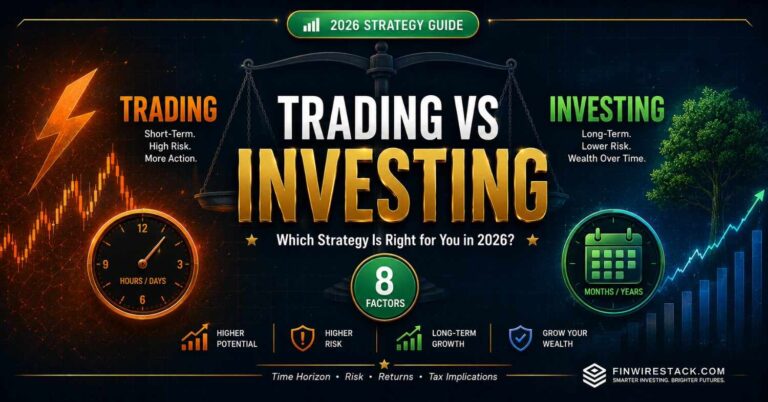
Trading vs investing featured image showing comparison between short-term trading and long-term investing with 8 factors for beginners in 2026

Trading vs. investingย is one of the most fundamental questions anyone entering the financial markets must answer. Both approaches aim to grow your money, but they operate on completely different timelines, risk profiles, and mindsets. Understanding this distinction is essential before committing your hard-earned capital.

This comprehensive guide will help you understand theย trading vs. investingย decision. You will learn:

  • The core differences between trading and investing
  • How each approach works and what it requires
  • The risk and reward profile of each strategy
  • Which approach aligns with your goals, personality, and lifestyle
  • How to combine both strategies in a hybrid approach

By the end, you will have the knowledge to make an informedย trading vs. investingย decision that fits your personal financial situation.


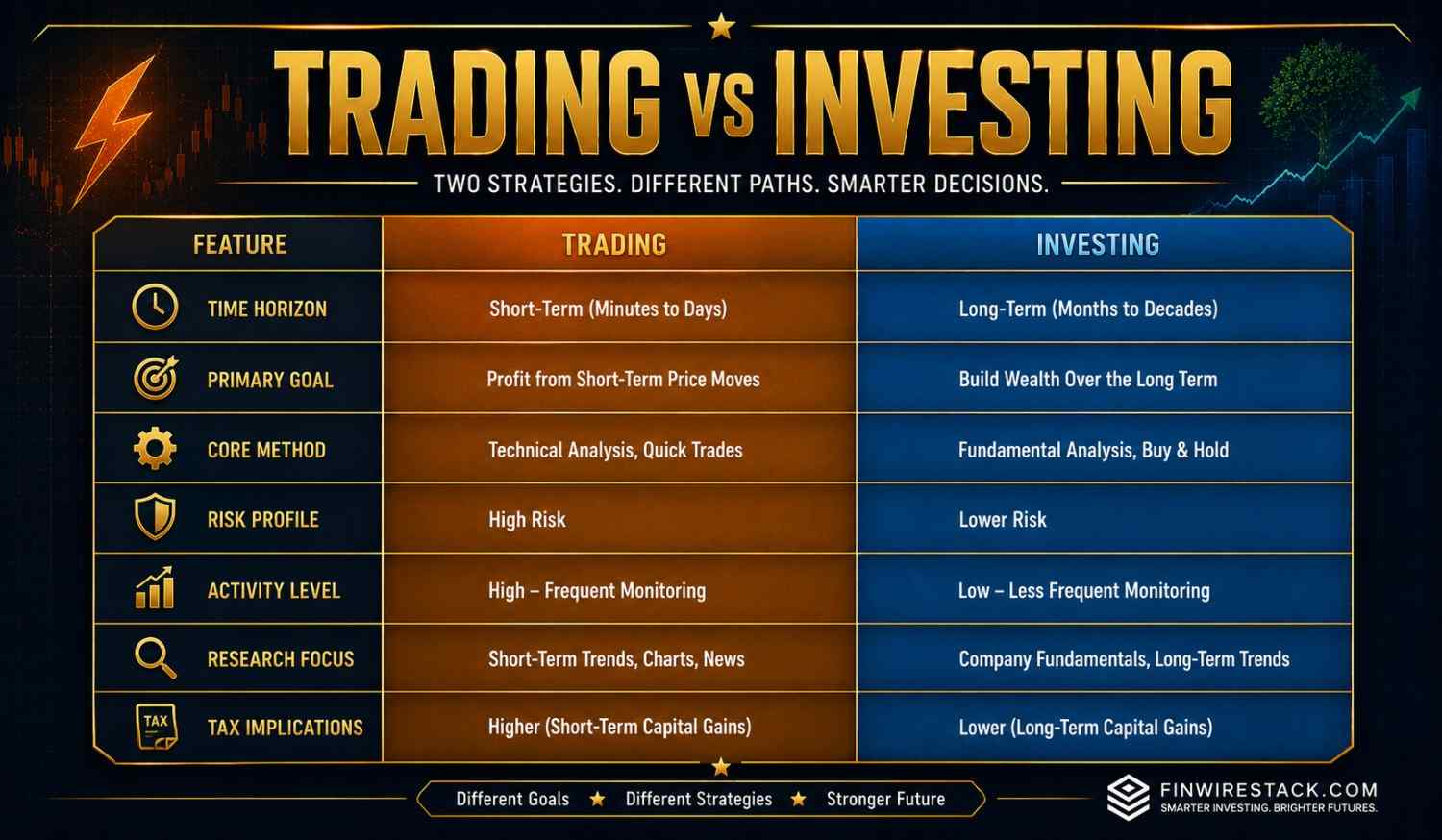
Trading vs investing overview showing the key differences between short-term trading and long-term investing for beginners in 2026

Trading vs. investingโ€”understanding the two distinct paths to growing your money


The Big Picture: Trading vs Investing

Theย trading vs. investingย debate centers on two distinct approaches to participating in financial markets. Both involve buying and selling securities, but they are not the same thing. The big difference is the timeline. When you invest, you hold securities for the long term and hope to see their value grow over time. When you trade, you buy and sell regularly, looking to make short-term gains.

If investing is like watching a movie, trading can be like swiping through social media clips. Both are forms of entertainment, but in one case, you’re much more involved in the process than in the other.

๐ŸŽฏ Real-World Analogy:ย Think of theย trading vs. investingย decision like choosing between two different approaches to fitness. Investing is like running a marathonโ€”steady, consistent, and built for the long haul. Trading is like sprintingโ€”intense, fast-paced, and requiring constant attention. Both can improve your financial health, but they demand different strategies, time commitments, and risk tolerance.

The choice betweenย trading and investingย isn’t about finding a “winner.” It is about finding the right fit for your personal financial situation, goals, and personality.


Trading vs investing comparison table showing time horizon risk profile activity level and goals for beginners in 2026

Trading vs. investingโ€”a side-by-side comparison of key features


What Is Investing?

Investing is buying an asset, like an individual stock, mutual fund, or exchange-traded fund (ETF), in hopes of increasing your money over time. Because most people invest for long-term goals, like buying a house, paying for college, or saving for retirement, they tend to hold these assets for a long timeโ€”meaning years, if not decades.

Key Characteristics of Investing

FeatureDescription
Time HorizonLong-term (years to decades) 
Primary GoalGradually build wealth over time through compounding 
MindsetThink like an ownerโ€”focus on business fundamentalsย 
Research FocusFundamental analysis โ€” earnings, growth potential, industry trends 
Activity LevelMinimal, occasional check-ins 
Risk ToleranceGenerally, more tolerant of short-term market fluctuationsย 

Types of Investing Strategies

StrategyDescription
Index InvestingBuying low-cost index funds that track the S&P 500 or total stock market 
Value InvestingInvesting in stocks trading for less than their book value 
Growth InvestingInvesting in companies with potential for future growth 
Dividend InvestingBuying stocks that pay regular dividends 
Buy-and-HoldA passive strategy with no market timing, holding for decades 

The Power of Compounding in Investing

Investing’s superpower is compounding. When you earn returns on your investments, those returns start earning returns. As time goes on, the power of compounding increases. For example, the S&P 500 has seen average annual returns of over 10% each year for the last 100 years, with dividends reinvested. That’s enough to beat inflation and build wealth.

๐ŸŸฆ Blue Highlight:ย For the last 100 years, the S&P 500 has seen average annual returns of over 10% each year, with dividends reinvested. From 1940 to 2024, dividend income made up 34% of the total return of the S&P 500. Since 1960, 85% of the cumulative total return of the S&P 500 Index can be attributed to reinvested dividends and the power of compounding.

Tax Advantages of Investing

One of the hidden advantages of investing over trading is tax efficiency. For investments you own at least a year and a day, you become eligible for a slightly lower tax rate called the long-term capital gains rate. In contrast, profits on investments held for less than a year are taxed at the same rate as your paycheck. Investments held in tax-advantaged accounts, like 401(k)s and IRAs, are not subject to the same tax rules.


Trading vs investing power of compounding showing how long-term investing builds wealth through reinvested dividends and market growth

Caption: Figure 3: The power of compounding โ€” why time in the market beats timing the market


What Is Trading?

Trading is buying and selling financial assets in hopes of making a short-term profit. Traders could be buying and selling investments multiple times a day, week, or month. Though technically you “make a trade” anytime you buy or sell an investment, most people associate trading with an active investing strategy.

Key Characteristics of Trading

FeatureDescription
Time HorizonShort-term (seconds, minutes, days, or weeks) 
Primary GoalCapture price volatility and profit from short-term market fluctuations 
MindsetFocus on price movements rather than business fundamentals 
Research FocusTechnical analysis โ€” price patterns, market sentiment, momentum 
Activity LevelHigh โ€” constant monitoring required 
Risk ToleranceGenerally riskier, more time-consuming, and stressful 

Types of Trading Styles

StyleTimeframeDescription
Scalp TraderSeconds to minutesCaptures very small price moves repeatedly 
Day TraderThroughout the day onlyNo overnight positions 
Swing TraderDays to weeksCaptures medium-term price movements 
Position TraderMonths to yearsHolds positions to capture long-term trends 

The Challenges of Trading

Trading operates on what’s called a zero-sum game. That is, if someone wins, it comes at the loss of someone else. In contrast, investors are playing a positive-sum game, where more than one person can win.

Data often cited by FINRA shows that only 1% to 4% of day traders remain profitable over the long term. This can happen for several reasons, including impulsive decisions (driven by emotions like fear and greed), not using proper risk management, or using high leverage.

๐Ÿ”ด Red Highlight:ย Research from S&P Dow Jones Indices shows that 93% of fund managers investing in large firms didn’t beat their benchmark index over the previous 20 years, and 92% couldn’t beat the market over 15 years. These are professionals with experience, knowledge, and computing power.

The Hidden Costs of Trading

CostImpact
Transaction CostsSpreads, commissions, and financing charges eat into profits 
TaxesShort-term profits taxed at higher ordinary income rates 
Missed Best DaysMissing just the 10 best market days each decade reduces total return from 17,715% to just 28% over 90 years 
Emotional ImpactStress and fatigue lead to poor decisions 

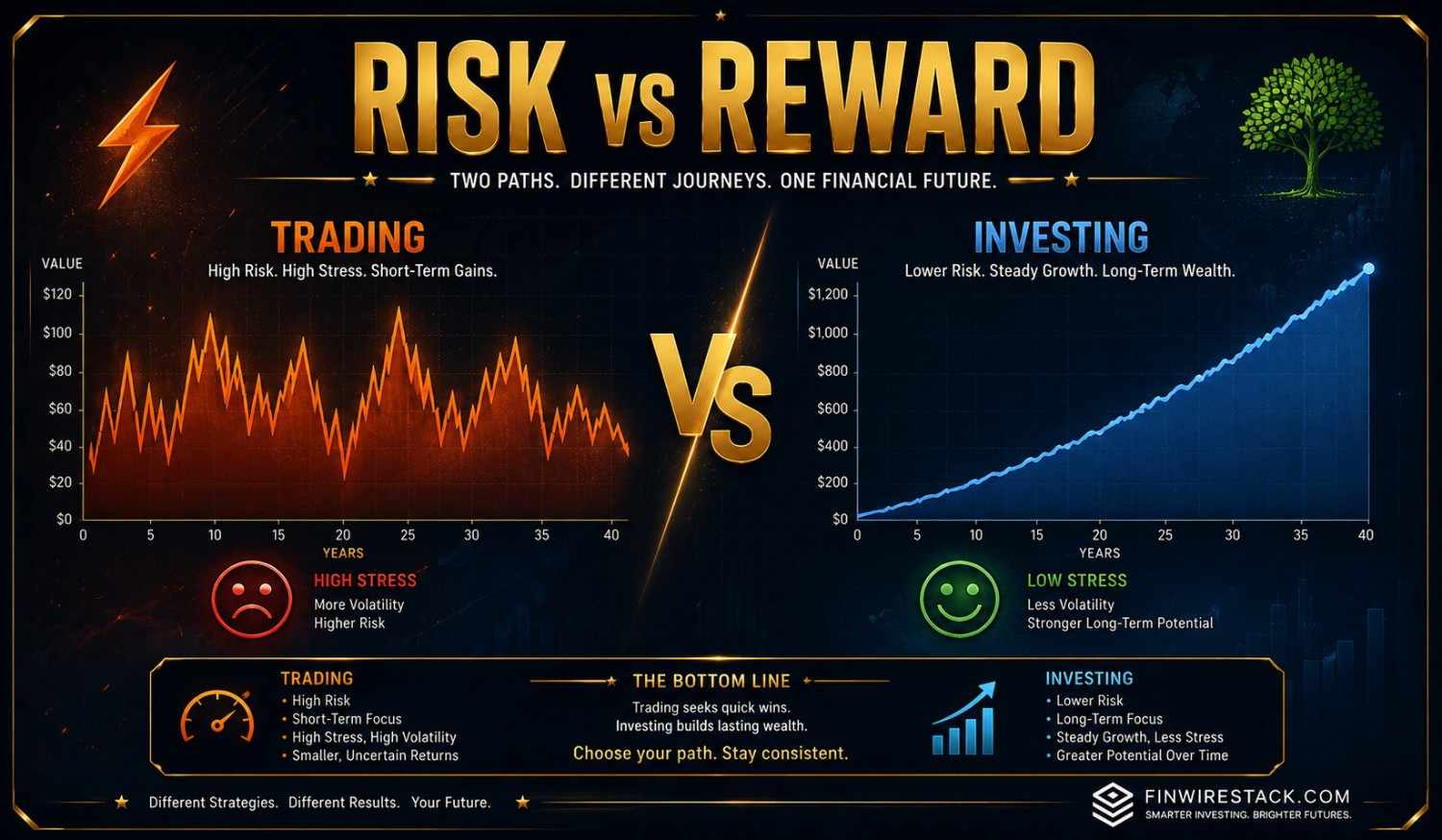
Trading vs investing risk and reward comparison showing volatility stress levels and potential returns for beginners in 2026

Trading vs. investingโ€”understanding the risk and reward trade-off


When to Trade vs Invest

The choice betweenย trading and investingย depends on market conditions and your personal situation.

When Market Conditions Favor Trading

Short-term active strategies tend to perform best during periods of price inefficiencies, high volatility, and macroeconomic uncertainty.

ConditionWhy It Favors Trading
Macroeconomic DisruptionGeopolitical tensions or regulatory changes create sudden price swings 
High Interest RatesA lopsided market structure creates opportunities for shorting overvalued companiesย 
Sideways MarketsWide intraday swings without clear trends 
Geopolitical UncertaintySharp moves in commodities and currencies 

When Market Conditions Favor Investing

Long-term investing tends to deliver better results during periods of systemic economic growth, major technological adoptions, and clear corporate earnings visibility.

ConditionWhy It Favors Investing
Structural MegatrendsNew technologies driving multi-year upward trends 
Synchronized Easing CyclesCentral banks are lowering interest rates in unisonย 
Clear Upward TrendsStable macroeconomic backdrop with steady growth 
Historical RecoveriesThe market always recovers over the long term 

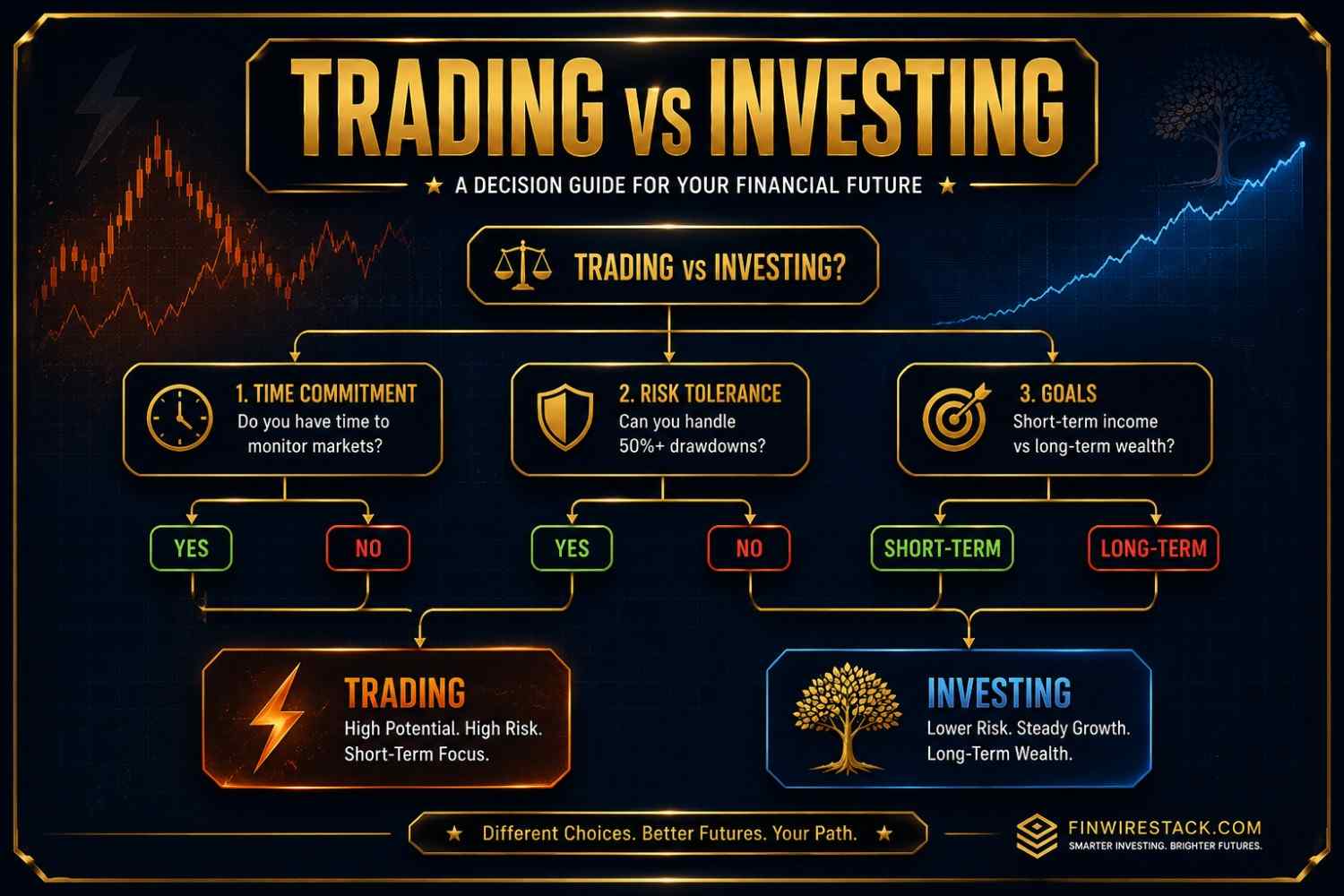
Trading vs investing how to choose showing personality assessment time commitment and financial goals for beginners in 2026

How to choose between trading and investing: a decision framework for beginners


How to Choose: Trading vs Investing

The decision betweenย trading and investingย should be based on several personal factors.

Step 1: Define Your Financial Objectives

GoalRecommended Approach
Short-term income (e.g., holiday fund)Trading may align better 
Long-term wealth (e.g., retirement)Investing is better 
BothHybrid approach 

Step 2: Assess Your Risk Tolerance

Your risk appetite isn’t just about how much money you can afford to lose but about how much money you can lose before you stop sleeping at night.

Risk ProfileRecommended Approach
Low Risk ToleranceInvesting (long-term, passive) 
High Risk ToleranceTrading (short-term, active) 

Step 3: Understand Your Time Horizon

Time HorizonRecommended Approach
Short-term (days to months)Trading 
Long-term (years to decades)Investing 

Step 4: Recognize Your Personality

Personality TypeRecommended Approach
The Analyst โ€” Enjoys puzzles, charts, and patternsTrading 
The Strategistโ€”Big-picture thinker focused on long-term growthInvesting 
The Hybridโ€”Wants both active and passive strategiesA mix of both 

Step 5: Be Honest About Time Commitment

Time AvailabilityRecommended Approach
Limited time (busy professional)Investing (set-and-forget) 
Adequate time (can monitor markets)Trading 

The Hybrid Approach: Best of Both Worlds

You don’t need to choose betweenย trading and investing. Many experienced market participants combine both methods.

How to Structure a Hybrid Portfolio

AllocationPurposeExample
80% Long-term InvestmentsCore wealth buildingIndex funds, dividend stocks, bonds 
20% Active TradingShort-term opportunitiesIndividual stocks, CFDs, crypto 

Benefits of the Hybrid Approach

  • Diversificationย โ€” Spreads risk across different strategiesย 
  • Flexibilityย โ€” Can adapt to changing market conditionsย 
  • Risk Managementโ€”Core holdings provide stability while trading capital is at riskย 
  • Learning Opportunityย โ€” Gain experience in both approachesย 

๐ŸŽฏ Real-World Example:ย Some investors might keep 80% of their capital in long-term investments (lower risk appetite) and use the remaining 20% for active trading. Others might do the opposite (higher risk appetite).


Common Mistakes to Avoid

MistakeWhy It’s a ProblemHow to Fix
Treating Trading as InvestingEmotional decisions lead to losses Know which game you’re playing 
Falling for FOMOBuying high, selling low Stick to your plan 
Ignoring FeesCosts eat into profits Compare fees and use low-cost options 
OvertradingMore stress, more costs, more mistakes Trade with discipline 
Panic SellingLocks in losses Stay invested through cycles 
No PlanEmotional decisions Create and follow a plan 

Conclusion: Which Strategy Is Right for You?

Theย trading vs. investingย decision ultimately depends on your personal financial situation, risk tolerance, and investment objectives. Neither choice is inherently superior; they serve different purposes in a complete financial strategy.

Choose Investing If:

  • You prefer stability and established regulatory protectionsย 
  • You are investing for long-term goals (10+ years)ย 
  • You want to benefit from the power of compound interestย 
  • You don’t want to monitor investments dailyย 
  • You value dividend income and tax-advantaged accountsย 

Choose Trading If:

  • You have a higher risk toleranceย 
  • You enjoy analyzing charts and market patternsย 
  • You want 24/7 market access and flexibilityย 
  • You have the time to monitor markets constantlyย 
  • You understand the risks and costs involvedย 

Choose Both If

  • You want to diversify your approachย 
  • You can allocate a portion to active trading while keeping core holdings for the long termย 
  • You want exposure to both steady growth and short-term opportunitiesย 

๐ŸŽฏ Final Thought:ย The evidence is clear that investing is a strategy that works better for most people. Can some traders consistently beat the market? Absolutely, no question. But for most people, it’s better to be an investor than a traderโ€”and it can take less time and effort, too. Legendary investor Warren Buffett recommends that investors regularly buy into an index fund, such as an S&P 500 fund, and then hold for decades.


FAQ

1. What is the main difference between trading and investing?

The main difference betweenย trading and investingย is the time horizon. When you invest, you hold securities for the long termโ€”years or even decadesโ€”hoping to watch their value grow over time through compounding. When you trade, you buy and sell regularlyโ€”sometimes within minutes, days, or weeksโ€”looking to make short-term gains from price fluctuations. This fundamental distinction in theย trading vs. investingย debate affects everything from your risk profile to your tax obligations.

2. Which is more profitable, trading or investing?

The profitability of trading vs investing depends on your skill level, time commitment, and risk tolerance. Trading can be more profitable in the short term for skilled and disciplined participants, but data shows that only 1% to 4% of day traders remain profitable over the long term. Investing is often more profitable for ordinary participants who want consistency and compounding. Research from S&P Dow Jones Indices shows that 93% of professional fund managers couldn’t beat the market over 20 years, highlighting the challenge of active trading compared to passive investing.

3. Is trading riskier than investing?

Yes, trading is generally considered a higher-risk strategy compared to investing. In theย trading vs. investingย comparison, the shorter timeline, use of leverage, and need for constant decision-making make trading significantly riskier. Data consistently shows that only 1% to 4% of day traders remain profitable over the long term, whereas long-term investors in broad market index funds have historically seen positive returns over any 20 years. The deeper and faster an asset drops, the more likely traders are to sell at the wrong time, a behavioral risk that is often more damaging than market risk itself.

4. Can I do both trading and investing?

Yes, many investors maintain a hybrid approach that combines trading vs investing strategies. A common structure is to keep 80% of your capital in long-term investments (like index funds) for steady growth and use the remaining 20% for active trading opportunities. This hybrid approach provides diversification, flexibility to adapt to changing market conditions, and the ability to learn from both strategies. Some investors might also do the opposite, with a higher allocation to trading if they have a higher risk appetite and more time to dedicate to market monitoring.

5. In trading vs. investing, what is the best investment for beginners?

For most beginners, a low-cost S&P 500 index fund is the best starting point in the trading vs investing decision. Warren Buffett recommends this approach, noting that it has returned approximately 10% annually over time. Index funds provide instant diversification across 500 of America’s largest companies with very low costs (expense ratios as low as 0.03%). This passive investing strategy requires minimal time and expertise, making it ideal for those who prefer a hands-off approach to building wealth.

6. How much time does trading require compared to investing?

The time commitment is one of the biggest differences in theย trading vs. investingย comparison. Trading is time-consuming and can be a full-time job. Day traders must constantly monitor positions, analyze charts, and make split-second decisions throughout the trading day. Swing traders need less attention but still require regular market checks. Investing, by contrast, requires minimal time and attention. Once you set up automatic contributions to a low-cost index fund, you can check your portfolio quarterly or even annually without significantly impacting your long-term results.

7. What are the tax implications of trading vs investing?

Tax implications are a crucial factor in theย trading vs. investingย decision. Short-term profits from trading (assets held less than a year) are taxed at your ordinary income tax rate, which can be as high as 37% for top earners. Long-term gains from investing (assets held at least a year and a day) qualify for lower capital gains rates of 0%, 15%, or 20%, depending on your income. This tax advantage is a significant benefit of investing over trading, especially for those in higher tax brackets. Additionally, investments held in tax-advantaged accounts like 401(k)s and IRAs are not subject to the same tax rules.

8. What is the 1% rule in trading?

The 1% rule in trading means you never risk more than 1-2% of your total trading capital on any single position. This risk management principle helps protect your account from significant damage after a losing trade. For example, if you have a $10,000 trading account, you would risk no more than $100-$200 per trade. This rule ensures that a series of losing trades won’t wipe out your capital, allowing you to continue trading and learning from your mistakes.

9. What is the difference between day trading and swing trading?

Day trading and swing trading are two distinct approaches within the broaderย trading vs. investingย framework. Day trading involves opening and closing positions within the same trading day, with no overnight positions held. This requires constant market monitoring and quick decision-making. Swing trading involves holding positions for several days to weeks, capturing medium-term price movements. Swing traders have more time to analyze the market and can hold positions overnight but still operate on a shorter time horizon than long-term investors.

10. What is the power of compounding in investing?

Compounding is the superpower of investing in theย trading vs. investingย debate. When you earn returns on your investments, those returns start earning returns themselves. Over time, this exponential growth becomes increasingly powerful. For example, the S&P 500 has seen average annual returns of over 10% each year for the last 100 years, with dividends reinvested. This consistent compounding is why investing is a strategy that works better for most people. From 1940 to 2024, dividend income made up 34% of the total return of the S&P 500, demonstrating the power of reinvesting returns.

11. Can stocks provide passive income?

Yes, stocks can provide passive income through dividends, which is one advantage of investing over trading in theย trading vs. investingย comparison. Many established companies pay regular dividends, providing income while maintaining growth potential. Dividend investing involves buying stocks that pay regular dividends and then reinvesting those dividends to buy more shares. Since 1960, 85% of the cumulative total return of the S&P 500 Index can be attributed to reinvested dividends and the power of compounding. This makes dividend investing a popular strategy for those seeking both income and long-term growth.

12. What is the difference between active and passive investing?

Active and passive investing represent two different approaches within theย trading vs investingย spectrum. Active investing involves attempting to beat the market through frequent buying and selling, stock selection, and market timing. This approach is more aligned with trading and requires significant time, expertise, and higher fees. Passive investing involves buying and holding a diversified portfolio, typically through index funds, to match market returns rather than beating them. Passive investing requires less time, has lower fees, and historically has outperformed most active strategies over the long term.

13. What is the best strategy for a beginner investor?

For beginners, the best strategy in the trading vs investing decision is to start with a simple, low-cost, diversified approach. This typically means investing in a broad market index fund like the S&P 500, setting up automatic contributions, and holding for the long term. This approach requires minimal time and expertise, while historically delivering solid returns. Once you have built a solid foundation, you can gradually explore more active strategies like trading if you have the time, risk tolerance, and interest. The key is to start with what works for most people and then adjust as you learn.

14. What are the emotional challenges of trading vs. investing?

The trading vs investing emotional challenges differ significantly between trading andย investing. Trading is emotionally demanding, requiring constant decision-making and the ability to handle rapid gains and losses. This can lead to stress, anxiety, and impulsive decisions driven by fear and greed. Investing, on the other hand, requires patience and discipline to stay invested through market cycles. The challenge for investors is avoiding panic selling during downturns and staying focused on long-term goals. Both approaches require emotional control, but trading demands more immediate psychological resilience.

15. What is the hybrid approach to trading and investing?

The hybrid approach combines both strategies in theย trading vs. investingย debate, allowing you to benefit from both steady growth and short-term opportunities. A common structure is to keep 80% of your capital in long-term investments (like index funds) for core wealth building and use the remaining 20% for active trading opportunities. This approach provides diversification, flexibility, and risk management. Some investors might adjust this allocation based on their risk tolerance, time commitment, and market conditions. The hybrid approach is popular among experienced investors who want exposure to both growth and income opportunities.


Further Reading

To deepen your understanding of financial markets and investing, explore these additional resources from Finwirestack:


External Resources (DoFollow Links)


Disclaimer: Investing and trading involve risk. Past performance does not guarantee future results. The information provided in this article is for educational purposes only and does not constitute financial advice. Always consult a qualified financial advisor before making investment decisions.

Crypto vs Stocks: Which Market Is Right for You in 2026?

Crypto vs stocks featured image showing comparison between Bitcoin and stock market investing with 10 factors for beginners in 2026

Crypto vs. stocksย is one of the most debated questions in personal finance today. Both offer pathways to build wealth, but they operate under completely different rules. Stocks provide ownership in established companies with centuries of regulatory framework. Cryptocurrency offers exposure to blockchain technology and decentralized finance, but with extreme price swings and limited investor protection.

This comprehensive guide will help you understand theย crypto vs. stocksย decision. You will learn:

  • How each market works and what drives its returns
  • The risk and reward profile of each asset class
  • Which market aligns with your financial goals and risk tolerance
  • Practical steps to get started in either market
  • How to build a diversified portfolio that includes both

By the end, you will have the knowledge to make an informed crypto vs stocks decision that fits your personal financial situation.


Crypto vs stocks comparison overview showing Bitcoin trading and stock market investing with risk reward analysis for beginners in 2026

Crypto vs stocks: understanding the key differences between two distinct investment approaches


Crypto vs Stocks: The Big Picture

Theย crypto vs stocksย debate centers on two distinct investment approaches. Cryptocurrency markets now process over $50 billion in daily trading volume, while global stock markets handle approximately $200 billion daily. This massive liquidity difference highlights just one of many factors new investors must consider.

Understanding these markets isn’t just about potential returns. It is about matching your risk tolerance, time commitment, and financial goals with the right investment vehicle. The choice betweenย crypto vs. stocksย isn’t about finding a “winner.” It is about finding the right fit for you.

๐ŸŽฏ Real-World Analogy: Think of the crypto vs stocks decision like choosing between two different vehicles. Stocks are like a reliable sedanโ€”steady, predictable, and built for the long haul. Crypto is like a sports carโ€”exciting, fast, but with a higher chance of spinning out. Both can get you where you want to go, but they require different skills and risk tolerance.


Crypto vs stocks comparison table showing trading hours volatility regulation and accessibility differences for beginners in 2026

Crypto vs stocksโ€”a side-by-side comparison of key features


Market Structure and Accessibility

Understanding how each market operates helps you choose the environment that suits your preferences and schedule.

FeatureCryptocurrencyStock Market
Trading Hours24/7, including weekends9:30 AM โ€“ 4:00 PM ET, weekdays only
Minimum InvestmentNo minimum; can buy fractional coinsOften $500-1000 broker minimums
Regulatory OversightLimited regulation, buyer beware SEC-regulated investor protections
Settlement TimeMinutes to hoursT+2 (two business days)
Market Maturity15 years old, still developingOver 100 years of established trading
Available Assets10,000+ cryptocurrencies4,000+ individual stocks, thousands of funds
Research ToolsLimited fundamental analysisExtensive fundamental analysis available
Insurance ProtectionNo government insuranceFDIC on cash, SIPC on securities
Transaction CostsNetwork fees + exchange feesOften commission-free for stocks
Tax ReportingManual tracking is often requiredStandardized 1099 forms provided

๐ŸŸฆ Blue Highlight:ย The stock market offers more stability and regulatory protection, while cryptocurrency provides 24/7 access and lower entry barriers. This is the fundamentalย crypto vs. stocksย trade-off.


Historical Performance and Returns

Theย crypto vs stocksย performance comparison reveals very different patterns.

Stock Market Performance

While understanding crypto vs stocks, stock markets have delivered consistent long-term returns over decades. The S&P 500 has averaged approximately 10% annual returns since 1957, despite periodic bear markets and recessions. For most investors, broad stock ETFs linked to indices like the S&P 500 remain the simplest starting point.

The Power of Compounding:ย A $10,000 investment in the S&P 500 30 years ago would be worth approximately $187,000 today. This consistent compounding is why stocks remain the default core for most long-term portfolios.

Cryptocurrency Performance

Cryptocurrency performance shows explosive growth periods followed by severe corrections. Bitcoin has achieved over 100% annual returns in some years but also declined by 80% or more during bear cycles.

The approval of spot Bitcoin ETFs in January 2024 and spot Ethereum ETFs later in 2024 changed the landscape significantly. These approvals gave investors a regulated wrapper through traditional brokerages, making crypto easier to access and easier to place next to stocks in the same portfolio. The Bitcoin halving in April 2024 cut the block reward from 6.25 BTC to 3.125 BTC, reinforcing Bitcoin’s supply narrative.

๐ŸŽฏ Real-World Example: If you had invested $1,000 in Bitcoin in 2015, it would be worth over $100,000 today. But you would have endured several 50-80% drawdowns along the way. The same $1,000 in the S&P 500 would be worth approximately $3,000โ€”less exciting, but far less stressful.


Crypto vs stocks risk and reward analysis showing volatility comparison and historical performance for beginners in 2026

Crypto vs stocksโ€”understanding the risk and reward trade-off


Risk Profiles and Return Expectations

Risk tolerance forms the foundation of anyย crypto vs. stocksย decision. Both markets carry risks, but the nature and magnitude differ dramatically.

Volatility Comparison

Stock market volatility typically ranges from 15-25% annually for broad market indices. During market corrections, stocks might decline 20-30% before recovering. Even the S&P 500 can go through ugly stretches, but broad stock funds are usually less volatile than crypto.

In crypto vs. stocks, cryptocurrency volatility often exceeds 80% annually for major coins like Bitcoin and Ethereum. Smaller altcoins can experience 200-500% price swings within months. However, Wells Fargo’s research shows digital asset volatility has moderated significantly over the past 15 years, declining from 182% annualized standard deviation to 70% in the latest period. This suggests that greater accessibility and institutional adoption should support continued price stability over time.

๐Ÿ”ด Red Highlight:ย The deeper and faster an asset drops, the more likely investors are to sell at the wrong time. This behavior risk is often more damaging than the market risk itself.

Risk Management Tools Available

Stock markets offer mature risk management through diversified index funds, dividend-paying stocks, and established options markets. Investors can hedge positions and generate income through covered calls or protective puts.

Crypto markets provide fewer sophisticated risk management options. While futures and options exist for major cryptocurrencies, the tools remain less developed than traditional finance offerings. Hardware wallets such as Ledger and Trezor can reduce exchange risk, but they do not remove user responsibility.


Getting Started: Practical Steps for Each Market

Your first steps in theย crypto vs. stocksย decision depend on which market aligns with your goals and risk tolerance.

Step 1: Assess Your Financial Situation

Determine how much you can afford to invest without affecting essential expenses. Financial advisors typically recommend investing only money you won’t need for at least five years. For crypto, many experts suggest limiting exposure to 5-10% of your total investment portfolio.

Step 2: Choose Your Platform

For stocks:ย Consider established brokerages like Fidelity, Schwab, or Vanguard that offer commission-free trading and extensive research tools. Fidelity offers zero commissions on stocks and ETFs, with 3,500+ no-transaction-fee mutual funds. Charles Schwab provides excellent customer service and educational resources.

For crypto:ย Platforms like Coinbase, Kraken, or Gemini provide user-friendly interfaces with educational resources. Bitget offers access to 1,300+ cryptocurrencies with spot trading fees as low as 0.01% maker/taker. Robinhood has evolved from a commission-free trading app into a broader consumer financial platform offering brokerage, cryptocurrency, retirement, banking, and advisory products.

Step 3: Start with Broad Exposure

Stock beginners should consider low-cost index funds that track the S&P 500 or the total stock market. These provide instant diversification across hundreds of companies. The Vanguard S&P 500 ETF (VOO) charges just 0.03% annually.

Crypto beginners might start with Bitcoin and Ethereum before exploring smaller altcoins. As Wells Fargo notes, digital asset investment may offer exposure to blockchain technology, a foundational innovation that enables secure, decentralized transactions.

Step 4: Develop a Learning Plan

Stock investing requires understanding financial statements, price-to-earnings ratios, and market cycles. Crypto investing demands knowledge of blockchain technology, tokenomics, and decentralized finance concepts. Allocate time weekly to expand your knowledge in your chosen area.

Step 5: Implement Dollar-Cost Averaging

Invest fixed amounts regularly regardless of market prices. This strategy reduces the impact of volatility and removes emotion from investment timing decisions. Automated DCA features, available on most modern platforms, execute purchases without manual intervention.


Investment Vehicles and Account Types

Traditional Securities and Tax-Advantaged Accounts

Equities remain the cornerstone of long-term wealth building, with historical annual returns averaging 10% before inflation. Index funds and exchange-traded funds (ETFs) offer diversified equity exposure at minimal costโ€”broad market ETFs typically charge expense ratios below 0.1% annually.

Fixed-income investments serve multiple portfolio functions: capital preservation, income generation, and volatility dampening. Government bonds offer safety with modest returns; corporate bonds provide higher yields with credit risk.

Digital Assets

Digital assets have matured into a recognized alternative asset class, with institutional adoption accelerating through 2026. The Wells Fargo 2026 Outlook report highlights that digital assets and blockchain represent a transformative technology that aligns with broader trends such as artificial intelligence, automation, and next-generation payment systems.

Bitcoinย functions as “digital gold” with a fixed supply cap of 21 million coins, appealing to investors seeking inflation protection and portfolio diversification. The Wells Fargo analysis shows Bitcoin’s price has drawn closer to that of gold, reinforcing its safe-haven appeal.

Ethereumย supports decentralized applications and smart contracts, creating utility beyond store-of-value functions. Ethereum’s network utility and staking capabilities make it a different kind of digital asset compared to Bitcoin.

Stablecoinsย are cryptocurrencies linked to stable assets, such as the U.S. dollar, to minimize price volatility. They are often used as trading pairs and for quickly moving funds between exchanges.

Automated Investment Tools

Robo-advisors democratize professional portfolio management through algorithm-driven asset allocation and automatic rebalancing. These platforms typically charge 0.25-0.50% annually, significantly less than traditional financial advisors’ 1-2% fees.

Dollar-cost averaging (DCA) automates investment timing by purchasing fixed dollar amounts at regular intervals regardless of price. This approach eliminates emotional decision-making and reduces timing risk.


Crypto vs stocks getting started guide showing platform selection dollar cost averaging and portfolio diversification for beginners in 2026

How to get started with crypto and stocks โ€” a practical guide for beginners

Building a Diversified Portfolio

Theย crypto vs. stocksย decision isn’t necessarily an either/or choice. Many investors find that a diversified portfolio including both asset classes offers the best balance of growth and stability.

Asset Allocation Framework

Effective personal finance begins with strategic asset allocation. Research consistently shows that asset allocation accounts for approximately 90% of portfolio performance variance over time.

A well-structured portfolio typically includes a mix of equities for growth, fixed-income securities for stability, alternative assets for diversification, and liquid reserves for emergencies.

Modern Portfolio Example:

  • 50% Global equities
  • 25% Fixed income
  • 15% Alternative investments (including digital assets)
  • 10% High-liquidity assets

Crypto Allocation Guidelines:

  • Conservative investor: 1-5% of portfolio
  • Moderate investor: 5-10% of portfolio
  • Aggressive investor: 10-15% of portfolio

๐ŸŸฆ Blue Highlight:ย Financial advisors often recommend limiting crypto exposure to 5-15% of total portfolio value, given volatility characteristicsโ€”annual price swings of 50% or more remain common.


Crypto vs stocks portfolio diversification showing asset allocation models for conservative, moderate, and aggressive investors in 2026

Building a diversified portfolio โ€” how to allocate between crypto and stocks


Future Trends Shaping the Investment Landscape

Understanding where finance is headed helps inform theย crypto vs. stocksย decision.

AI and Digital Assets Converge

Digital assets and blockchain represent a transformative technology that aligns with broader trends such as artificial intelligence, automation, and next-generation payment systems. Generative AI spending is expected to surge over the next decade, supporting growth across technology and infrastructure sectors.

Tokenization of Real-World Assets

Tokenization is converting physical and financial assets into digital tokens on a blockchain. This can include real estate, stocks, bonds, and more. Tokenization can increase liquidity, allow fractional ownership, and make it easier to buy and sell assets. Bitget’s TradFi 101 educational initiative is preparing users for this era of universal exchange and multi-asset investing.

ESG Investing

ESG stands for Environmental, Social, and Governance. There has been a growing interest in ESG investments, with sustainability becoming an important part of many investment portfolios. Many investors today want to earn returns while also supporting companies that follow sustainable business models.

Geopolitics and Markets

Geopolitical events are becoming constant market drivers. Wars in key regions, energy-price swings, and shifting interest-rate expectations are influencing markets and can affect investment portfolios. This reinforces the need for diversified, resilient portfolios.


Common Mistakes When Choosing Between Crypto vs Stocks

MistakeWhy It’s a ProblemHow to Fix
Treating Them as InterchangeableThey serve different portfolio rolesUnderstand each asset’s purpose
Over-Investing in CryptoExtreme volatility can wipe out savingsLimit to 5-15% of portfolio
Panic SellingLocks in losses and misses recoveriesStay invested through cycles
Ignoring RegulationLimited protection in cryptoChoose regulated platforms
Not DiversifyingConcentrated risk in one assetUse index funds for stocks and major coins for crypto
Chasing “Hot” InvestmentsBuying high and selling lowStick to a long-term strategy

Conclusion: Which Market Is Right for You: Crypto vs. Stocks?

Theย crypto vs. stocksย decision ultimately depends on your personal financial situation, risk tolerance, and investment objectives. Neither choice is inherently superior; they serve different purposes in a complete financial strategy.

Choose Stocks If:

  • You prefer stability and established regulatory protections
  • You are investing for long-term goals (10+ years)
  • You want to benefit from the power of compound interest
  • You don’t want to monitor investments daily
  • You value dividend income and tax-advantaged accounts

Choose Crypto If:

  • You have a higher risk tolerance and can handle 50%+ drawdowns
  • You believe in the long-term potential of blockchain technology
  • You want 24/7 market access and flexibility
  • You are comfortable with self-custody and security responsibilities
  • You understand the unique risks and lack of regulatory protection

Choose Both If

  • You want to diversify your portfolio across asset classes
  • You can allocate 5-15% of your portfolio to crypto while keeping the core in stocks
  • You have a long-term time horizon and can weather volatility
  • You want exposure to both traditional business growth and blockchain innovation

๐ŸŽฏ Final Thought:ย Stock markets provide the foundation for most successful long-term investment plans. The stability, regulatory protection, and historical performance make stocks essential for retirement planning and steady wealth building. Cryptocurrency offers a different kind of upside, with Bitcoin and Ethereum giving investors exposure to scarce and programmable digital assets. The right mix depends on your risk tolerance, time horizon, and whether the goal is growth, stability, or better diversification.


FAQ

1. What is the main difference between crypto and stocks?

Stocks represent ownership in companies with earnings, cash flow, and regulatory oversight. Crypto represents ownership of digital assets driven by adoption, utility, network effects, and sentiment.

2. Which is more volatile, crypto or stocks?

Cryptocurrency is significantly more volatile, with annual price swings often exceeding 80%, compared to 15-25% for broad stock indices.

3. Is crypto a good investment for beginners?

Crypto can be suitable for beginners who are willing to learn the technology, accept extreme volatility, and limit exposure to 5-10% of their portfolio. Stocks are generally considered a better starting point for most beginners.

4. Can I invest in both crypto and stocks?

Yes, many investors maintain diversified portfolios with both asset classes. This can provide exposure to both traditional business growth and blockchain innovation.

5. What is the best crypto for beginners?

Bitcoin and Ethereum are the best choices for beginners. They have the largest market capitalizations, strongest networks, and highest liquidity.

6. What is the best stock for beginners?

S&P 500 index funds like VOO are the best choice. They provide instant diversification across 500 companies with very low costs (0.03% expense ratio).

7. How much of my portfolio should be in crypto?

Financial advisors typically recommend 5-15% of total portfolio value, depending on risk tolerance. Conservative investors might limit it to 5%, while aggressive investors might allocate up to 15%.

8. What are the risks of investing in crypto?

Key risks include extreme volatility, limited regulatory protection, security risks (hacks, lost private keys), and complex tax reporting requirements.

9. How do I choose between crypto and stocks?

Consider your risk tolerance, time horizon, financial goals, and interest in the underlying technology. If you prefer stability and long-term compounding, lean toward stocks. If you have a higher risk tolerance and believe in blockchain technology, consider a crypto allocation.

10. What are spot crypto ETFs?

Spot crypto ETFs are investment products that hold actual Bitcoin or Ethereum, allowing investors to gain exposure through traditional brokerage accounts. They were approved in 2024, making crypto more accessible to mainstream investors.

11. How do I start investing in stocks?

Open a brokerage account with a platform like Vanguard, Fidelity, or Schwab. Choose a low-cost S&P 500 index fund (like VOO). Set up automatic contributions and invest consistently.

12. How do I start investing in crypto?

Choose a regulated exchange like Coinbase, Kraken, or Bitget. Complete KYC verification. Start with a small amount and stick to major coins like Bitcoin and Ethereum.

13. What is dollar-cost averaging?

Dollar-cost averaging means investing a fixed amount regularly, regardless of price. This strategy reduces the impact of volatility and removes emotion from investment timing.

14. Are crypto profits taxable?

Yes, in most countries, crypto is treated as property for tax purposes. Selling crypto, trading one coin for another, or using crypto to buy something can all create taxable events.

15. Can stocks provide passive income?

Yes, through dividends and dividend reinvestment. Many established companies pay regular dividends, providing income while maintaining growth potential.


Further Reading

To deepen your understanding of financial markets and trading, explore these additional resources from Finwirestack:


External Resources (DoFollow Links)


Disclaimer: Investing in stocks and cryptocurrencies involves risk. Past performance does not guarantee future results. The information provided in this article is for educational purposes only and does not constitute financial advice. Always consult a qualified financial advisor before making investment decisions.