
Expert Analysis | July 22, 2026 | Reading Time: 18 min
Executive Summary
The Trump financial records lawsuit explained in this comprehensive guide begins with a landmark ruling: a federal judge has ordered President Trump to hand over detailed financial records from his business empire. This decision is part of a $10 billion defamation lawsuit against the BBC that opens an unprecedented window into the financial affairs of a sitting U.S. president.
But why should you care? Because this case illuminates critical questions about financial privacy that affect every American. In this Trump financial records lawsuit explained guide, we break down what the lawsuit means, why financial privacy matters, and how you can protect your own financial information in an increasingly transparent digital age.
What Is the Trump-BBC Lawsuit About?
The legal battle began in December 2025 when President Trump filed a $10 billion defamation lawsuit against the British Broadcasting Corporation (BBC). The dispute centers on a 2024 Panorama documentary titled “Trump, A Second Chance,” which featured an edited version of Trump’s January 6, 2021, speech.
The Core Allegations
Trump’s lawsuit claims the BBC
- Intentionally and deceptively doctored his speech from January 6, 2021
- Created a “mistaken impression that President Trump made a direct call for violent action”
- Damaged his business interests and reputation
The BBC’s Response
The BBC has already apologized for the editing error, acknowledging it gave a misleading impression. However, the broadcaster continues to defend itself, arguing:
- The documentary was not broadcast in the United States
- The defamation claims lack legal merit
The Court Ruling: Trump Financial Records Lawsuit Explained in Detail.
On July 21, 2026, U.S. Magistrate Judge Enjoliqué Lett issued a ruling with far-reaching implications. To fully understand this case, the Trump financial records lawsuit explanation must include what the judge ordered and why it matters.
What the Judge Ordered

The ruling compels Trump to produce detailed financial records from the following:
| Entity | Significance |
|---|---|
| The Donald J. Trump Revocable Trust | Manages his businesses while he is president |
| Hundreds of Trump family businesses | Provides a full picture of his financial empire |
Why the BBC Wants These Records
The BBC’s legal team argues the following:
- Financial Loss Claim: Trump claims the documentary damaged his businesses—the BBC wants to test this claim
- Evidence of Harm: If his wealth increased after the documentary aired, it contradicts his claim of financial damage
- Discovery Imbalance: The BBC has produced 87,000 pages of documents, while Trump’s team produced only 735 pages, which the BBC called a “sham production.”
The “One-Sided” Discovery Problem
Charles Tobin, counsel for the BBC, told the court that the discovery process had been “entirely one-sided.” Trump’s legal team has accused the BBC of a “fishing expedition” and described their requests as “oppressive” and “sweeping.” This is a key aspect of the Trump financial records lawsuit explained narrative, as it highlights the tension between legal discovery and privacy rights.
Trump’s Defense Strategy
Trump’s lawyers, led by Alejandro Brito, are attempting to limit the scope of the lawsuit. They have indicated they will amend the complaint to argue the following:
- The documentary only caused reputational damage, not financial harm
- Therefore, financial records are irrelevant
However, Judge Lett’s ruling currently allows the BBC to proceed with its financial records requests.
Why Financial Privacy Matters to You.

You might be thinking, “I’m not a president. Why should I care about this?”
The answer lies in the universal principles of financial privacy that this case illuminates. The Trump financial records lawsuit explained here shows that even the most powerful individuals are subject to financial scrutiny.
The Value of Financial Privacy
Financial privacy is not just for celebrities and politicians. It protects you from:
| Risk | Impact |
|---|---|
| Identity Theft | Criminals can use your financial information to open credit accounts, take loans, or drain your savings |
| Financial Fraud | Access to bank account details, Social Security numbers, and credit history can enable sophisticated fraud schemes |
| Discrimination | Landlords, employers, and insurers can use financial information to discriminate against you |
| Personal Safety | Publicly visible assets can make you a target for theft or extortion |
| Stalking and Harassment | Financial records reveal where you live, work, and spend your time |
The Trump Case in Perspective
This lawsuit demonstrates that even sitting presidents can be compelled to reveal financial information when it’s relevant to legal proceedings. If the most powerful person in the world cannot shield their finances from court scrutiny, it’s a powerful reminder that your financial records are also discoverable in certain circumstances.
The Growing Trend of Financial Transparency
We are living in an era of unprecedented financial transparency:
- Tax records are increasingly scrutinized (recall the controversy over Trump’s tax returns before his presidency)
- Bank accounts are subject to automated reporting under the Foreign Account Tax Compliance Act (FATCA)
- Cryptocurrency transactions are traceable on public blockchains
- Real estate ownership is tracked in public property records
How to Protect Your Financial Privacy (5 Actionable Steps).
While you cannot make your finances completely invisible, you can take smart steps to protect your financial privacy. Here are five actionable strategies:

Step 1: Secure Your Credit
| Action | Why It Matters |
|---|---|
| Freeze your credit | Prevents criminals from opening new accounts in your name |
| Monitor your credit reports | Check Equifax, Experian, and TransUnion annually |
| Place a fraud alert | Makes it harder for identity thieves to open accounts |
Step 2: Protect Your Personal Information
- Secure your Social Security Number: Only share when necessary
- Use strong, unique passwords: For banking and financial accounts
- Enable two-factor authentication: Adds an extra layer of security
- Shred financial documents: Before discarding bank statements, tax returns, and credit offers
Step 3: Understand Your Legal Rights
| Right | Explanation |
|---|---|
| Right to privacy | Recognized in various state and federal laws |
| Right to access credit reports | Free annual reports from each credit bureau |
| Right to dispute errors | Under the Fair Credit Reporting Act |
| Right to limit sharing | Opt-out options under the Gramm-Leach-Bliley Act |
Step 4: Be Strategic with Sharing
- Social media: Avoid posting about large purchases, vacations, or personal assets
- Public records: Understand what’s publicly available (property ownership, business registrations)
- Trusted contacts: Only share financial details with trusted family members and professionals
Step 5: Consult Professionals
- Work with a financial advisor who understands privacy concerns
- Engage an estate planning attorney to structure assets with privacy in mind
- Consider trusts and LLCs for holding assets to maintain privacy
The Broader Implications for Financial Transparency.
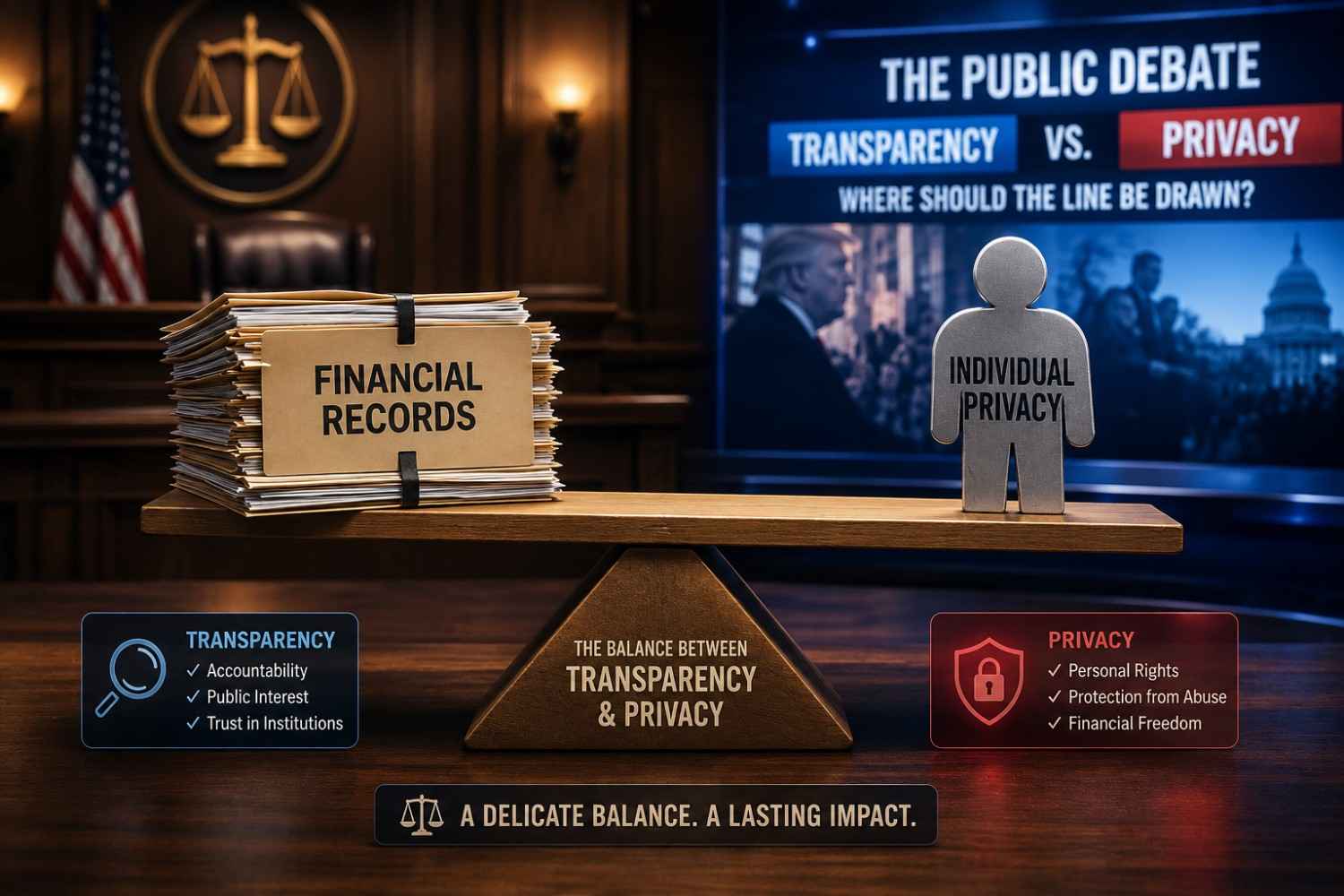
Financial Privacy vs. Accountability
The Trump-BBC case highlights an ongoing tension between the following:
- The public’s right to know about leaders’ financial interests
- The individual’s right to financial privacy
This balance is being tested in courtrooms, legislatures, and public opinion.
The Future of Financial Privacy
What can we expect in the coming years?
| Trend | Potential Impact |
|---|---|
| Automated reporting | More financial data automatically shared with governments |
| Blockchain transparency | Greater visibility into transactions |
| Data breaches | Increased risk of private information being exposed |
| Privacy legislation | Potential new laws to protect consumer financial data |
A Word of Caution
While transparency can expose wrongdoing, unfettered access to financial records can also be weaponized against individuals—as the Trump case shows, with his legal team arguing the BBC’s requests are “oppressive.”
Frequently Asked Questions
1. Why is the BBC seeking President Trump’s financial records?
The BBC wants to test Trump’s claim that the documentary damaged his businesses. If his wealth increased after the documentary aired, it contradicts his financial loss claim.
2. Can the court compel a president to release financial records?
Yes, as seen in this case. Judge Lett ruled that Trump must hand over records held by his revocable trust. The ruling can still be appealed.
3. Could this happen to an ordinary citizen?
In civil lawsuits, parties can request relevant financial records from each other. Courts balance the need for information against privacy interests.
4. What is a revocable trust?
A revocable trust (or “living trust”) is a legal entity that holds assets during your lifetime. You can change it at any time. It’s commonly used for estate planning and privacy purposes.
5. How is this case different from Trump’s IRS lawsuit?
The IRS case involved Trump suing his own government over the leak of his tax records. Judge Kathleen Williams ruled the IRS lawsuit was filed for an “improper purpose” and “to manipulate the judicial process.”
Key Takeaways
- The Trump-BBC case is setting a precedent for financial disclosure in high-profile lawsuits
- Financial privacy is a universal concern, not just for the wealthy and powerful
- You can take practical steps to protect your financial information (freeze your credit, monitor accounts, secure personal data)
- The balance between privacy and accountability continues to evolve in courts and public policy
- Estate planning (trusts, prenuptial agreements, up-to-date wills) is essential to protect your family from financial disputes—as demonstrated by the Malcolm-Jamal Warner case highlighted in our coverage
What to Read Next
- Malcolm-Jamal Warner Family Trust Dispute: 5 Lessons to Protect Your Estate—Learn how an outdated trust created chaos for a celebrity family
- [Your Money & Your Mental Health: How to Reduce Financial Stress] — Practical strategies for financial wellness
- [How to Choose a Financial Power of Attorney (And Avoid a Legal Mess)] — A step-by-step guide
Sources
- [^1] Donald Trump Drops BBC Studios From $10bn Trump BBC Financial Records Lawsuit. El-Balad.com, July 20, 2026.
- [^6] Judge Rules Trump Must Hand Over Financial Records Sought by BBC in Defamation Case. BBC News, July 20, 2026.
- [^15] Trump Must Divulge Financial Details About Businesses in a $10 bn BBC Lawsuit: The Guardian, July 21, 2026.
- [^11] Judge Rules Donald Trump’s Settlement with IRS Tried to ‘Manipulate the Judicial Process.’ ABC News (Australia), July 14, 2026.
FinWireStack is committed to providing transparent, unbiased financial education. We do not accept payment for positive reviews. Every recommendation is based on real testing and research.





[…] Trump Financial Records Lawsuit Explained: 5 Privacy Lessons for You — Understanding financial privacy in legal disputes […]
[…] Trump Financial Records Lawsuit Explained: 5 Privacy Lessons for You — Understanding financial privacy in legal disputes […]
[…] Trump Financial Records Lawsuit Explained: 5 Privacy Lessons for You — Financial privacy in legal disputes […]