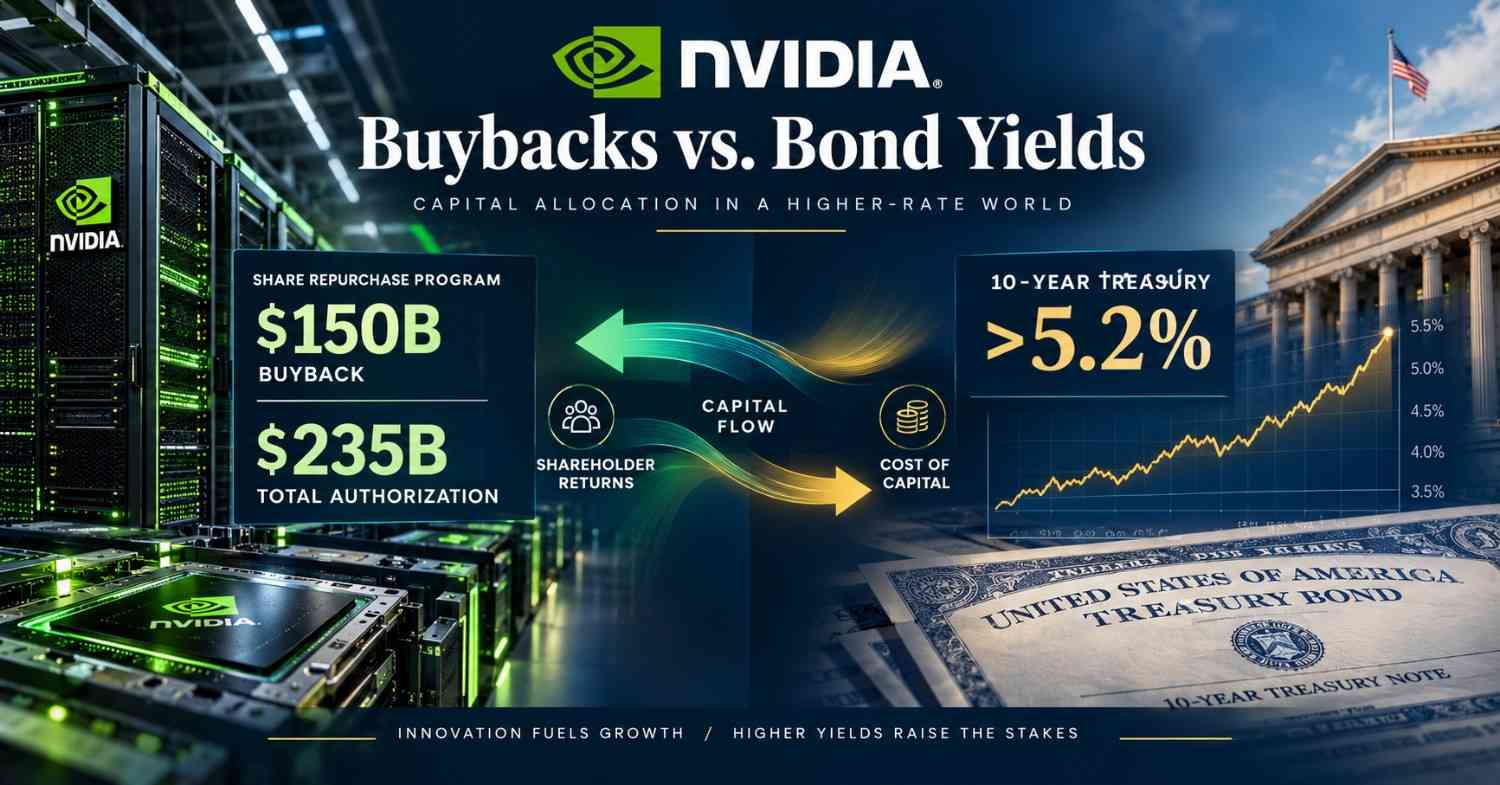
Nvidia has just sent one of the strongest signals yet that it believes the artificial-intelligence boom still has a long runway. On September 28, 2026, the chipmaker announced a $150 billion increase to its share repurchase authorization, taking its total available authorization to $235 billion.
The announcement arrived at an uncomfortable moment for the broader AI investment story.
U.S. Treasury yields have been climbing sharply, with the 10-year yield moving above 5.2% and later reaching approximately 5.27%, while oil prices have added to inflation concerns. At the same time, major technology companies are borrowing heavily to finance data centers, computing infrastructure and other AI-related capital expenditures.
That creates an important distinction for investors.
Nvidia is not borrowing $150 billion to fund its stock buyback. Instead, the company’s enormous cash-generation capacity allows it to return capital to shareholders while continuing to invest in its business. The bigger question is whether the companies building the infrastructure required to support the AI boom can continue financing that expansion at increasingly higher interest rates.
This is the emerging AI debt dilemma: can the revenue and productivity created by artificial intelligence grow quickly enough to justify a dramatically higher cost of capital?
The answer matters not only for Nvidia but also for semiconductor stocks, cloud companies, corporate bonds and portfolios exposed to the broader AI trade.
Key Takeaways
- Nvidia increased its share repurchase authorization by $150 billion, taking total authorization to $235 billion.
- The move signals management’s confidence, but a buyback does not eliminate valuation, competitive, or industry risks.
- The U.S. 10-year Treasury yield has moved above 5.2%, increasing the opportunity cost of owning riskier assets and raising corporate financing costs.
- AI-related companies are increasingly relying on debt to finance data-center expansion, making interest rates and credit spreads increasingly important.
- The critical investment question is shifting from simply “How fast is AI growing?” to “What return will companies generate on the enormous capital being deployed?”
Nvidia’s $150 Billion Buyback Is a Major Signal
What Nvidia’s Buyback Really Signals to Wall Street
Nvidia’s latest capital-return decision is extraordinary by historical standards.
The company announced an additional $150 billion share repurchase authorization, lifting its total authorization to $235 billion. Reuters reported that the new authorization exceeds Apple’s previous $110 billion record announced in 2024. Nvidia intends to use the expanded authorization through fiscal 2028, subject to market conditions and other considerations.
The significance goes beyond the headline number.
A stock buyback allows a company to use cash to purchase its own shares. When shares are retired, the number of shares outstanding falls. If earnings remain constant, earnings per share can increase because those earnings are distributed across fewer shares.
But investors should avoid treating buybacks as automatic evidence that a stock is undervalued.
The more meaningful signal from Nvidia is its confidence in its cash-generation capacity.
Nvidia’s fiscal 2026 results already showed substantial shareholder returns. The company repurchased approximately $40.4 billion of stock during that fiscal year. Its subsequent quarterly filing showed another $39.8 billion of repurchases during the first half of fiscal 2027.
The September authorization therefore represents a substantial escalation in the amount of capital potentially available for future repurchases.
Management has also continued to emphasize that AI and accelerated computing represent a major long-term platform shift.
That creates two possible interpretations for investors.
The bullish interpretation is straightforward: Nvidia believes demand for AI computing will remain strong enough to generate substantial free cash flow, even while the company continues investing heavily in future technologies.
The more cautious interpretation is that the market should focus on cash flow per share, earnings growth, and valuation, rather than the headline size of the authorization.
A company can repurchase billions of dollars of stock and still deliver disappointing shareholder returns if its future earnings growth slows dramatically or the shares are purchased at an excessive valuation.
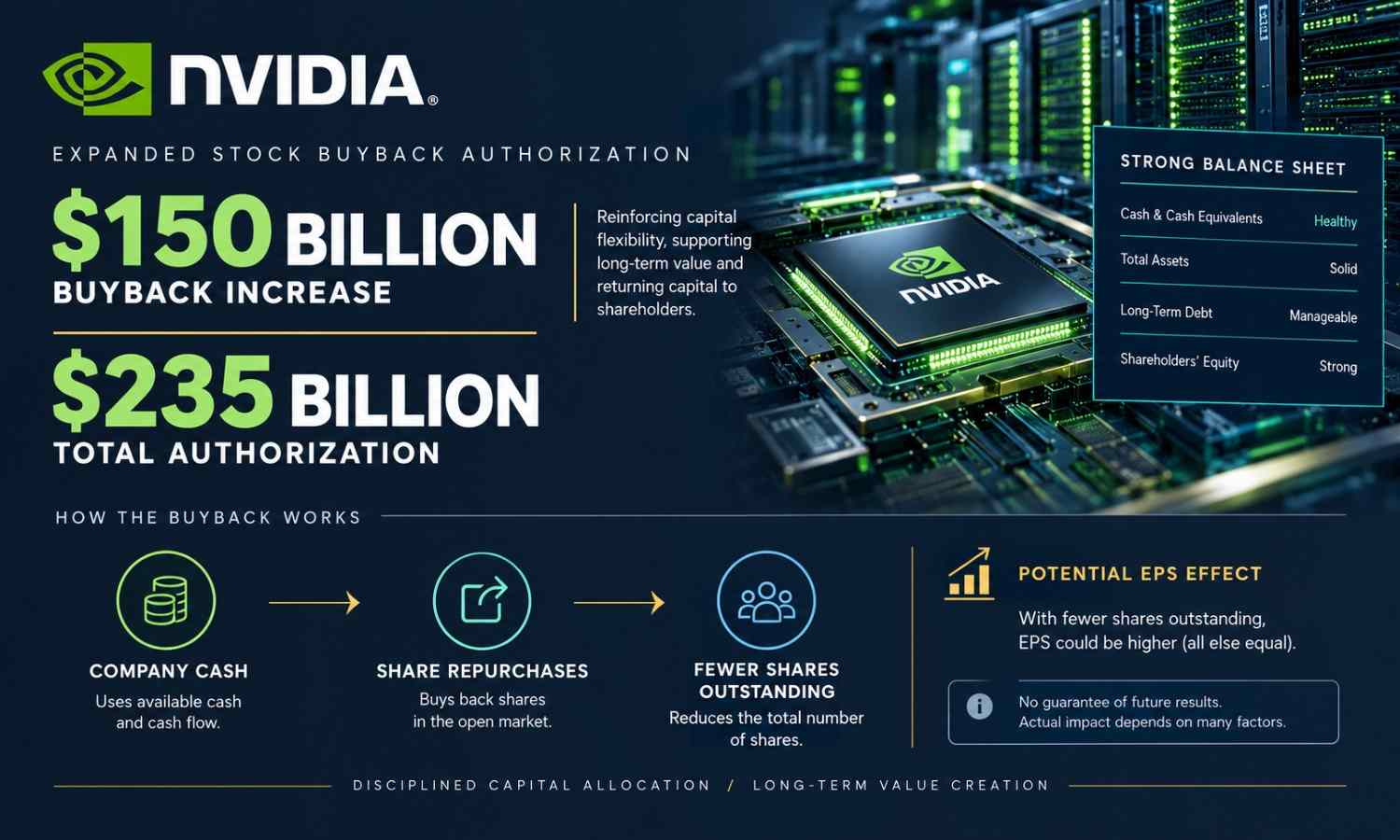
In other words, a stock buyback can amplify shareholder value when the underlying business is performing well, but it cannot replace fundamental business growth.
Why 5.2% Treasury Yields Change the AI Investment Equation
The other side of this story is the bond market.
The U.S. 10-year Treasury yield has moved above 5.2%, reaching roughly 5.27% in the latest market reporting. Reuters described the move as part of a broader bond-market selloff, with long-term yields reaching multi-year highs.
The combination matters because Treasury yields influence the cost of money throughout the financial system.
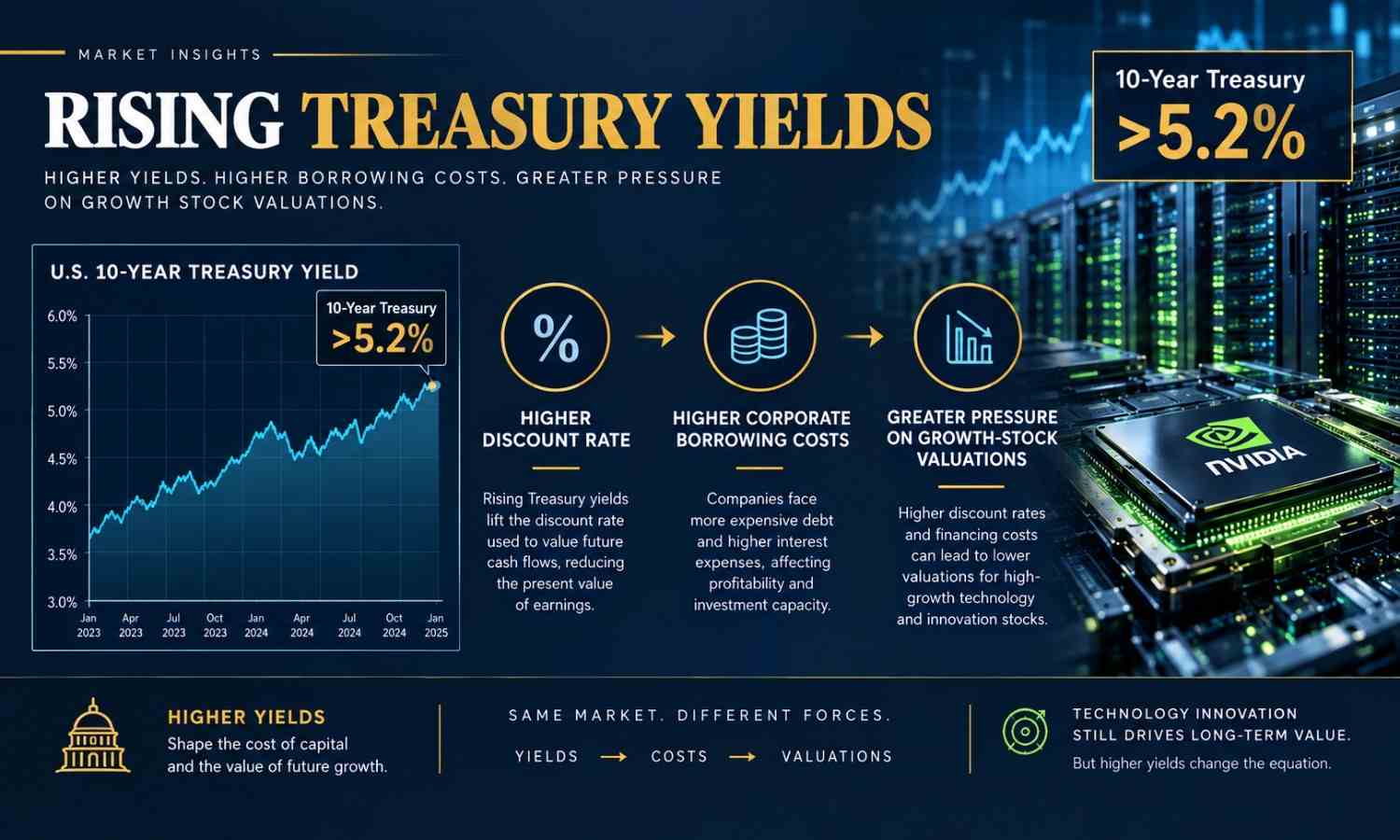
When government bond yields rise, investors can demand higher returns from corporate bonds and other risk assets. Companies issuing new debt may therefore need to pay higher coupons or offer investors greater compensation for taking credit risk.
That is particularly important for businesses undertaking enormous capital projects.
AI data centers require land, electricity, cooling systems, networking equipment, GPUs, CPUs, memory and other infrastructure. The spending can be enormous, and companies do not necessarily fund all of it from current operating cash flow.
Some of the financing therefore comes from debt.
And this is where the AI debt dilemma becomes more important.
The Feedback Loop: How AI Debt Can Pressure the Market
Consider a simplified chain:
More AI investment → more corporate borrowing → greater bond supply → higher required financing costs → higher capital expenditure → greater pressure to generate returns.
This does not mean every new AI bond is dangerous.
Large technology companies can have significant cash flows, valuable intellectual property and strong balance sheets. Reuters reported, for example, that AI-related corporate bond issuance has become large enough for investors to become more selective, with major issuers including Alphabet and Meta facing greater scrutiny over the scale and predictability of their borrowing needs.
Reuters has estimated that AI-related bond issuance could reach approximately $420 billion in 2027.
That is a critical development for investors.
The AI investment story is increasingly becoming a capital-allocation story.
The question is no longer only whether companies can sell more AI services. Investors must also ask how much capital those companies must deploy to produce each additional dollar of revenue and how much that capital costs.
Rising oil prices complicate the equation further because higher energy costs can reinforce inflation pressures and make it harder for central banks to reduce interest rates quickly.
For technology stocks whose valuations depend heavily on future earnings, that combination can matter enormously.
The AI Debt Dilemma: Can Growth Outrun the Cost of Capital?
This is where the Nvidia story becomes more interesting than a simple buyback headline.
Nvidia itself is not the obvious example of an AI company being squeezed by debt financing.
The bigger concern is the ecosystem around Nvidia.
Hyperscalers and other infrastructure providers are spending enormous amounts to construct the computing capacity needed for AI. Reuters reported that hyperscalers had issued approximately $220 billion of bonds during the year, while concerns over financing costs and credit spreads were beginning to appear in the corporate debt market.
Oracle and Meta are among the companies attracting attention because of their capital requirements and financing activity.
The fundamental issue is return on invested capital.
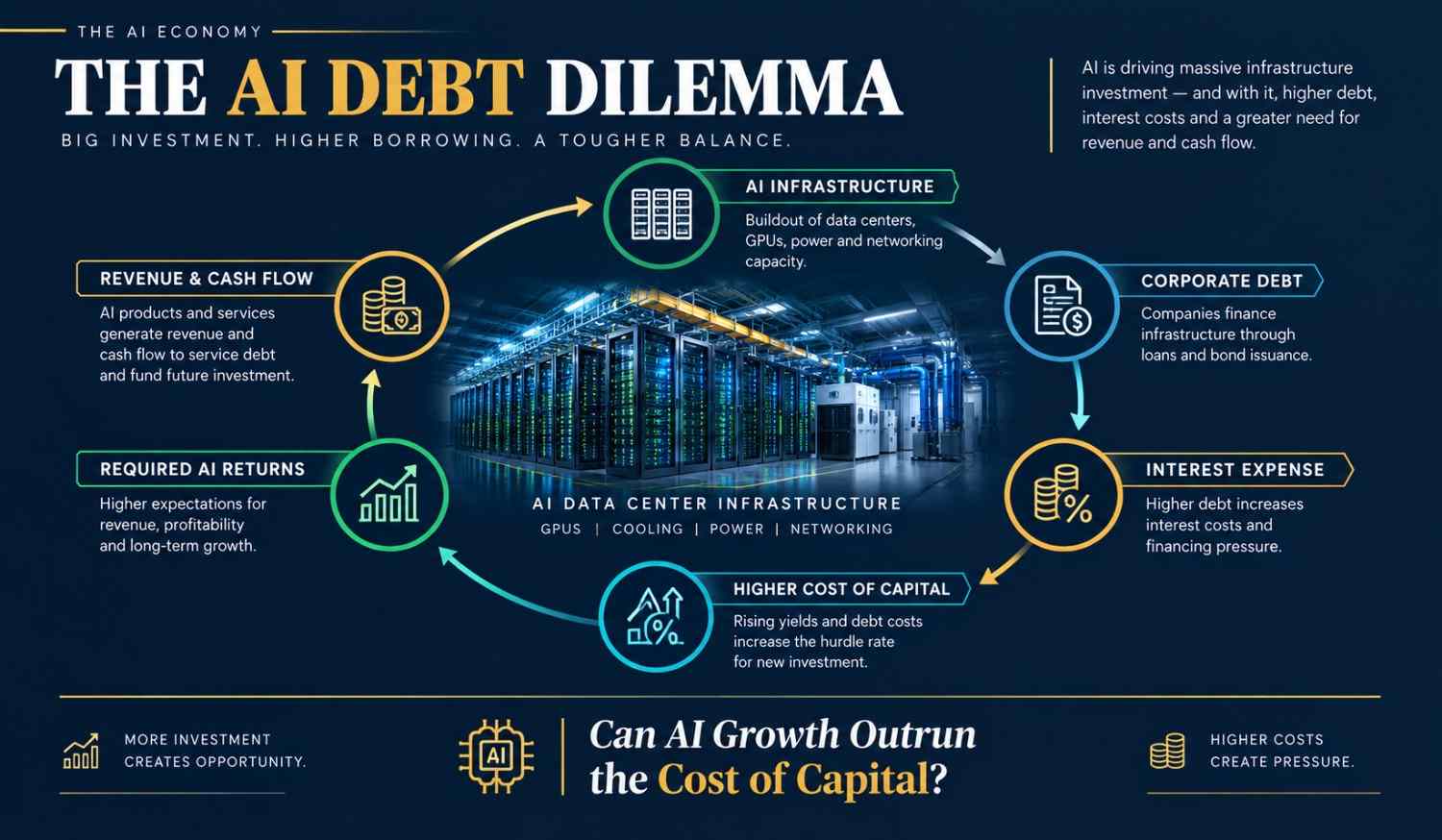
Suppose a company spends $100 billion building AI infrastructure. Investors ultimately need to know whether that infrastructure can produce returns sufficiently above the company’s cost of capital.
If interest rates rise, the hurdle becomes higher.
If revenue grows rapidly enough, the investment can still work.
However, if revenue growth disappoints while borrowing costs rise, the economics become less attractive.
This is why investors should distinguish between AI demand and AI investment returns.
The first can be extremely strong while the second remains uncertain.
Intel and AMD Show That AI Demand Is Still Real
The semiconductor market provides another important piece of the puzzle.
Intel CEO Lip-Bu Tan recently said the company could supply only about half of what customers were requesting, highlighting how strong processor demand has become.
That shortage is particularly interesting because AI infrastructure requires more than GPUs.
Modern AI systems also depend on CPUs, memory, networking, and other components. The expansion of agentic AI and inference workloads is increasing the importance of general-purpose computing.
AMD is benefiting from this broader demand.
Mercury Research data cited in recent reporting showed AMD’s server CPU unit share reaching 34.5% in the second quarter of 2026, compared with 27.3% a year earlier.
AMD has also projected that its server CPU total addressable market could grow at more than 50% annually through 2030 and reach approximately $220 billion.
Its data center revenue increased 107% year over year in the second quarter, according to reporting surrounding the Intel development.
These numbers illustrate an important point:
The AI infrastructure boom is not imaginary.
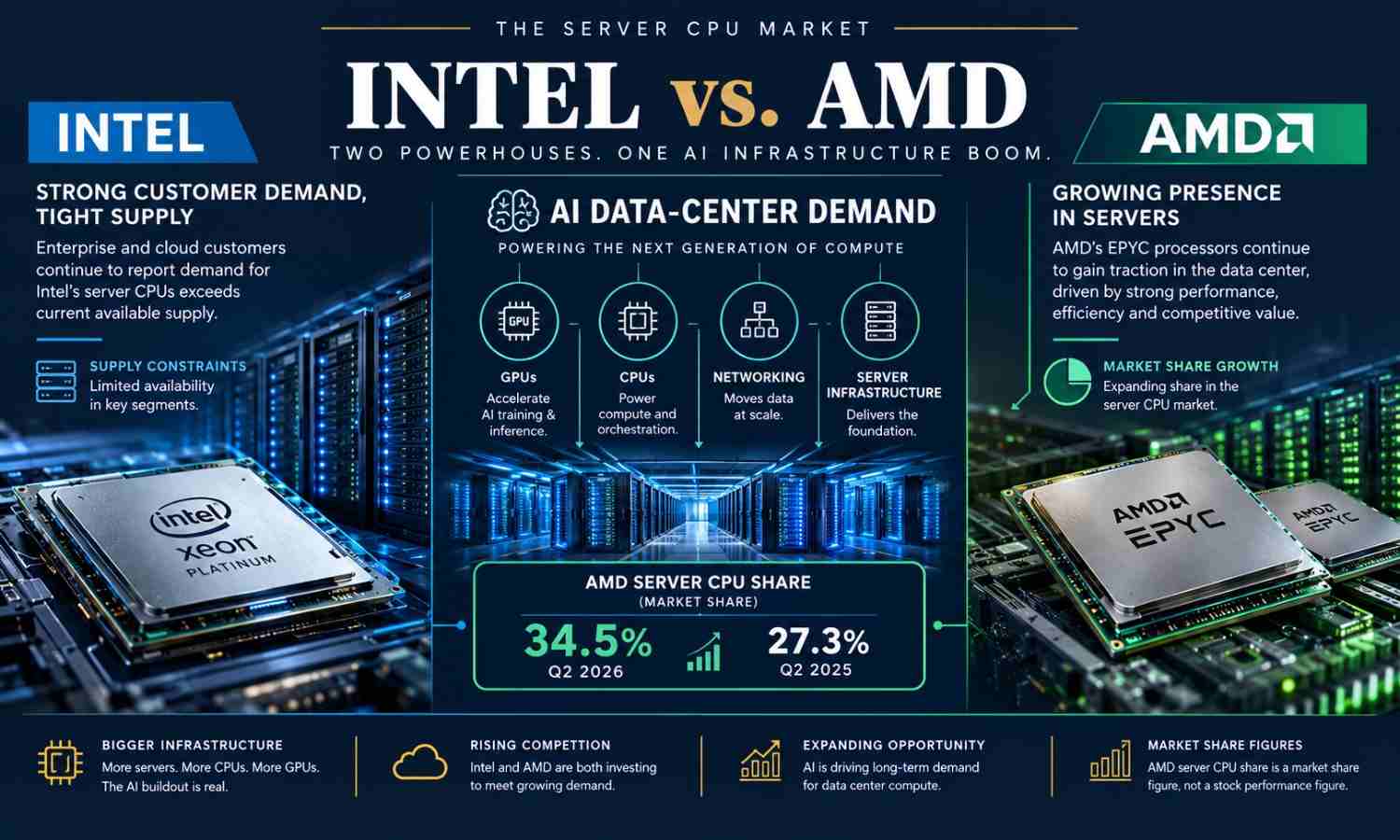
There is real demand for processors and data-center capacity.
But genuine demand does not automatically mean every infrastructure investment will generate attractive returns.
That distinction could become one of the defining investment themes of the next phase of the AI cycle.
What Nvidia’s Buyback Means for Different Investors
Growth Investors: Watch Earnings, Not Just Buybacks
For growth investors, Nvidia’s buyback may reinforce confidence in management’s long-term expectations.
However, the most important metrics remain:
- Data-center revenue growth
- Gross and operating margins
- Free cash flow
- AI accelerator demand
- Customer concentration
- Competitive developments
- Capital expenditure across major AI customers
- Forward earnings expectations
A large buyback should be treated as additional information, not as a substitute for fundamental analysis.
Investors following AI stocks should also monitor whether hyperscalers continue increasing capital expenditure and whether that spending translates into profitable AI services.
Income Investors: Rising Yields Change the Competition
For income-oriented investors, higher Treasury yields create a different opportunity set.
When government bonds offer materially higher yields, investors have an alternative to dividend-paying equities and lower-rated corporate debt.
That can influence valuations.
A technology company with a relatively low dividend yield may need stronger earnings growth to justify its valuation when investors can earn substantially more from high-quality government bonds.
This is one reason bond yields matter to stock-market valuation even when the company itself has little debt.
Conservative Investors: Diversification Matters More
For conservative portfolios, the current environment highlights the importance of diversification.
A portfolio concentrated entirely in high-growth technology stocks can become particularly sensitive to changes in interest rates and valuation multiples.
Investors may therefore consider how stocks, Treasury securities, corporate bonds, cash equivalents, and other assets interact within their broader portfolio management strategy.
The objective is not necessarily to abandon AI.
It is to understand the different risks attached to each part of the market.
How to Position a Portfolio in a High-Rate, AI-Driven Market
Rather than asking whether Nvidia is automatically a buy or sell because of the announcement, investors can monitor several measurable signals.
1. Follow the 10-Year Treasury Yield
A sustained move higher would generally increase the discount rate applied to future corporate earnings.
A meaningful decline could have the opposite effect.
2. Track Corporate Bond Spreads
Treasury yields show the risk-free benchmark.
Credit spreads show how much additional compensation investors demand for lending to corporations.
If AI-related spreads continue widening, that could indicate growing concern about the amount of capital being deployed.
3. Watch AI Capital Expenditure
The next question is not simply whether companies are spending more.
Investors should examine whether companies are generating enough revenue and operating cash flow to justify that spending.
4. Monitor Nvidia’s Free Cash Flow
The buyback is supported by Nvidia’s ability to generate cash.
That makes free cash flow particularly important.
If cash generation continues to grow alongside AI demand, the capital-return argument becomes stronger. If cash flow growth slows sharply, investors may reassess the pace and sustainability of repurchases.
5. Watch Semiconductor Competition
Nvidia is not operating in isolation.
AMD, Intel, and other semiconductor companies are competing for different portions of the AI computing market.
The server CPU shortage reported by Intel is evidence of strong underlying infrastructure demand, while AMD’s market-share gains demonstrate that the competitive landscape continues to evolve.
What Investors Should Watch Next
The AI investment narrative could change quickly as new economic and corporate data arrive.
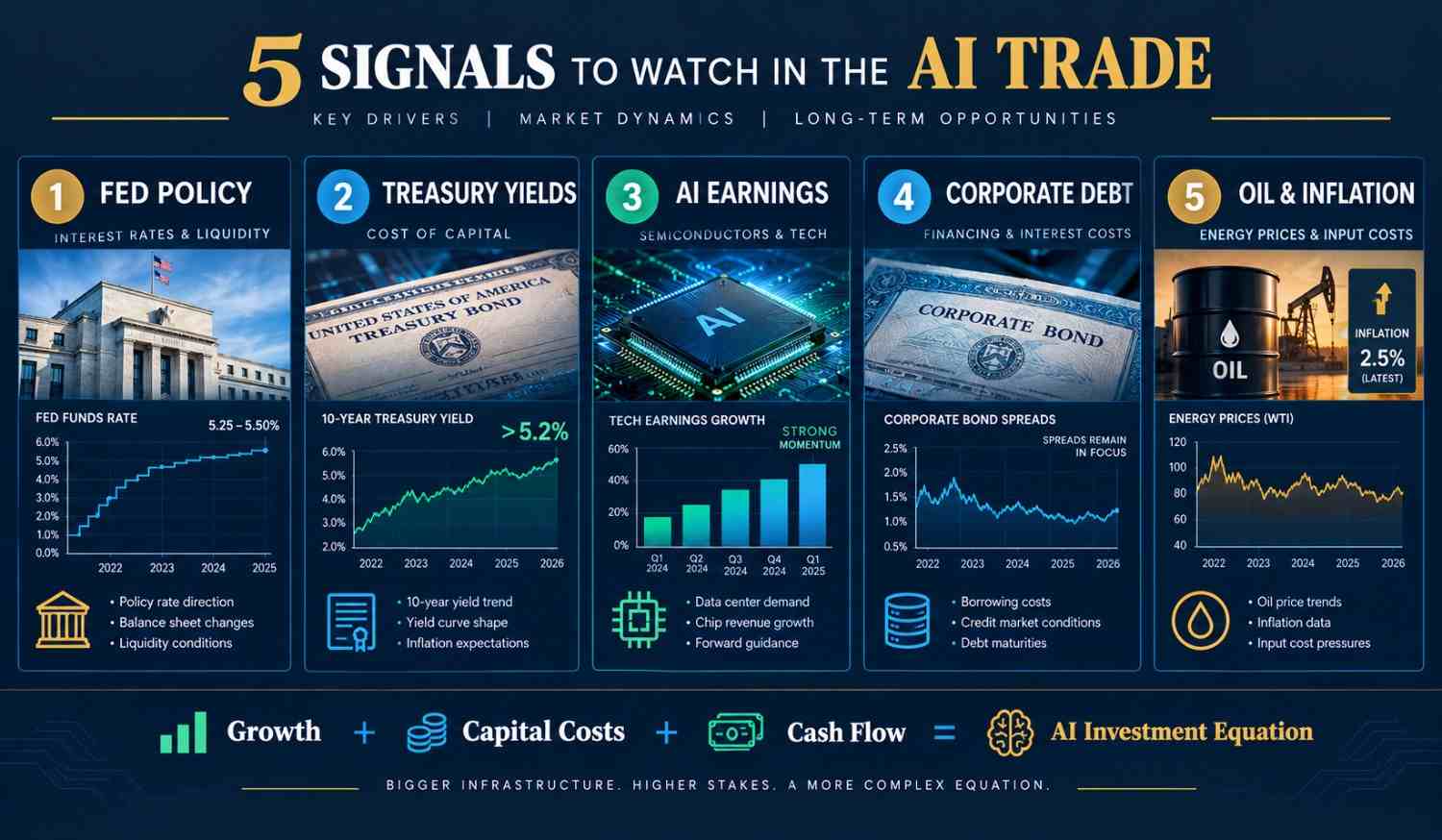
Federal Reserve policy
The September rate increase puts additional focus on future inflation and employment data.
If inflation remains elevated, investors may need to price in higher rates for longer.
If inflation falls substantially, pressure on long-term yields could ease.
Treasury yields
The 10-year Treasury is now one of the most important variables for technology-stock valuations.
Investors should watch whether yields stabilize, continue rising, or reverse lower.
Nvidia, AMD and Intel earnings
Quarterly results will provide direct evidence about whether AI demand is translating into revenue and profit.
For Nvidia, investors should pay particular attention to data-center growth, margins and free cash flow.
For AMD and Intel, server CPU demand and supply constraints will remain important.
Corporate debt issuance
Investors should monitor how much additional debt major technology companies issue and at what cost.
A rising volume of issuance is not automatically negative. The key question is whether the returns generated by the underlying AI infrastructure justify the financing cost.
Oil and inflation
Higher energy prices can complicate the Federal Reserve’s inflation fight.
That makes oil another variable investors should monitor alongside Treasury yields and corporate credit spreads.
The Bottom Line: Nvidia’s Buyback Is a Confidence Signal, Not a Shield
Nvidia’s $150 billion buyback expansion is one of the most significant corporate capital-return announcements of 2026. It demonstrates that management believes the company can continue generating enough cash to invest in AI while returning substantial capital to shareholders.
But investors should not confuse that confidence with immunity from macroeconomic risk.
The more important story is happening across the broader AI financing ecosystem.
Nvidia can have exceptional cash generation while other companies building AI infrastructure face increasingly expensive financing.
That is the heart of the AI debt dilemma.
The AI boom may continue to produce enormous demand for GPUs, CPUs, networking equipment, and data centers. Intel’s supply constraints and AMD’s rising server CPU share provide evidence that the infrastructure cycle remains powerful.
At the same time, a 5%+ Treasury environment changes the mathematics of investment.
The hurdle for capital-intensive projects becomes higher. Corporate borrowers may have to pay more to finance expansion. Investors have more attractive alternatives in fixed income. And technology valuations become more sensitive to the discount rate applied to future earnings.
For investors, the most useful question is therefore not simply “Is AI still growing?”
It is:
“Are AI companies generating returns that justify the capital being committed to the AI buildout?”
That question will increasingly connect Nvidia’s buyback, Treasury yields, corporate debt, semiconductor competition, and the future direction of the stock market.
For more evidence-based analysis of investing, technology, and financial markets, subscribe to FinWireStack and follow the next developments in the AI investment cycle.
Key Takeaways
- Nvidia’s $150 billion buyback expansion takes its total authorization to $235 billion and represents a major capital-return commitment.
- Nvidia is not borrowing $150 billion to fund the buyback. The debt concern is primarily about the wider AI infrastructure financing cycle.
- Treasury yields above 5.2% raise the opportunity cost of equities and increase financing costs across the corporate market.
- AI demand remains strong, with Intel reporting severe server CPU supply constraints and AMD continuing to gain server CPU market share.
- The next phase of the AI investment story will increasingly depend on return on invested capital, free cash flow, debt costs, and sustainable revenue growth rather than AI spending alone.
FinWireStack provides educational and informational market commentary and does not provide individualized investment advice. Market conditions can change rapidly. Investors should consider their objectives, time horizon, and risk tolerance and conduct independent research before making investment decisions.