Physical Address
Remote team based in Bozeman, Montana.
Physical Address
Remote team based in Bozeman, Montana.
Banking, credit cards, budgeting, saving money, paying off debt.
Here is a question that keeps 64% of Americans awake at night: Where did all my money go?
You get paid. You pay bills. Two weeks later, your account is empty. You cannot point to any big purchase. No vacation. No new TV. Just… nothing.
The silent budget killer is not a single expense. It is dozens of small leaks that drain your bank account without you noticing.
The silent budget killer is invisible by design. Subscription services auto-renew. Convenience fees hide at checkout. Energy vampires suck power while you sleep. None of these expenses triggers alarm bells. But together, they can cost you $4,000 to $15,000 per year.
The average American loses $238 per month** to hidden expenses they never see. That is **$2,856 per year. For a family of four, the number doubles to nearly $6,000.
The silent budget killer is the reason you feel broke even when your income is okay. It is the gap between what you earn and what you keep.
The good news is that once you see these leaks, you can stop them. This article reveals the 7 most common silent budget killers and exactly how to plug each one.
For understanding your full financial picture, see How to Build an Emergency Fund from Scratch.
For tracking your spending, see Best Budgeting Apps for Couples.
For the emotional side of money leaks, see How to Stop Worrying About Money.
The silent budget killer starts with subscriptions. You signed up for a free trial. You forgot to cancel. Months later, you are still paying.
| Statistic | Value |
|---|---|
| Average number of subscriptions per person | 4-6 |
| Average monthly subscription spend | $80-150 |
| Subscriptions people forget they have | 2-3 |
| Money wasted on unused subscriptions annually | $300-600 per person |
| Subscription Type | Typical Monthly Cost | Annual Cost |
|---|---|---|
| Streaming services (Netflix, Hulu, Disney+) | $15-50 | $180-600 |
| Gym membership | $30-60 | $360-720 |
| Meal kits | $50-100 | $600-1,200 |
| Cloud storage | $5-15 | $60-180 |
| App subscriptions | $5-20 | $60-240 |
| Magazine or news | $10-20 | $120-240 |
| Box subscriptions | $20-40 | $240-480 |
| Reason | Explanation |
|---|---|
| Free trials | You intend to cancel but forget |
| Annual billing | You forget when the renewal date arrives |
| Small charges | $9.99 does not feel like real money |
| No visibility | You do not check your statements |
| Auto-renewal | Companies make cancellation difficult |
| Step | Action | Time |
|---|---|---|
| 1 | Check your last 3 months of bank statements | 20 minutes |
| 2 | Highlight every recurring charge | 10 minutes |
| 3 | Ask: “Have I used this in the last 30 days?” | 5 minutes |
| 4 | Cancel everything you have not used | 15 minutes |
| Tool | Price | What It Does |
|---|---|---|
| Rocket Money | Free / $4-12/month | Finds and cancels subscriptions |
| Truebill (now Rocket Money) | Free | Tracks recurring charges |
| Your bank app | Free | Often has subscription tracking |
| Manual spreadsheet | Free | Lists all subscriptions with renewal dates |
The silent budget killer of subscription creep can be eliminated in one hour. The average person finds $50-100 in monthly savings.
For saving the money you find, see Automated Savings Apps That Actually Work.
For digital banking tools, see Digital Banking vs Traditional Banking.
The silent budget killer number two is the price you pay for convenience. Delivery fees. Service fees. Processing fees. Convenience fees. They seem small. They add up fast.
| Convenience | Fee | Annual Cost (if used weekly) |
|---|---|---|
| Food delivery (DoorDash, UberEats) | $5-10 delivery + fees + tip | $500-1,500 |
| ATM fees (out-of-network) | $3-5 per transaction | $150-250 |
| Late payment fees | $25-40 per occurrence | $300-500 |
| Ticket processing fees | $5-15 per ticket | $100-300 |
| Hotel resort fees | $20-50 per night | $500-1,500 (vacation) |
| Credit card convenience fees | 2-4% of transaction | Varies |
| In-app purchase markup | 10-30% markup | Varies |
| Method | Meal Cost for 2 | Monthly (4x) | Annual |
|---|---|---|---|
| Pick up yourself | $25 | $100 | $1,200 |
| Delivery (+ fees + tip) | $40 | $160 | $1,920 |
| Savings from picking up | $15 | $60 | $720 |
| Behavior | Monthly ATM Fees | Annual Cost |
|---|---|---|
| Use out-of-network ATM 2x/week ($4 fee) | $32 | $384 |
| Use your bank’s ATM | $0 | $0 |
| Savings | $32 | $384 |
| Convenience | Alternative | Savings |
|---|---|---|
| Food delivery | Pick up your own food | $10-15 per order |
| Out-of-network ATM | Plan ahead, get cash back at stores | $3-5 per transaction |
| Late fees | Set up automatic bill pay | $25-40 per occurrence |
| Ticket fees | Buy at box office | $5-15 per ticket |
| Resort fees | Choose hotels without them | $20-50 per night |
| Credit card fees | Use debit or cash | 2-4% per transaction |
The silent budget killer of convenience fees is the easiest to fix. Every time you choose the free option, you pay yourself.
For avoiding late fees, see How to Get Out of Credit Card Debt Fast When You Have No Money.
For banking without fees, see Digital Banking vs Traditional Banking.
The silent budget killer number three lives inside your own bank account. Millions of Americans pay hundreds of dollars each year in fees they could easily avoid.
| Fee Type | Typical Cost | Annual Cost (if incurred monthly) |
|---|---|---|
| Monthly maintenance fee | $5-25 | $60-300 |
| Overdraft fee | $35 per occurrence | $420 (one per month) |
| Returned deposit fee | $15-25 | $180-300 |
| Wire transfer fee (domestic) | $15-30 | $180-360 |
| Wire transfer fee (international) | $35-50 | $420-600 |
| Paper statement fee | $1-5 | $12-60 |
| Account closure fee | $0-25 | One-time |
| Scenario | Cost |
|---|---|
| You buy coffee for $4.50 | |
| Your balance is $4.25 | |
| Coffee purchase goes through | $35 overdraft fee |
| Cost of that coffee | $39.50 |
| Month | Overdrafts | Fees Paid |
|---|---|---|
| January | 1 | $35 |
| February | 1 | $70 |
| March | 1 | $105 |
| April | 1 | $140 |
| May | 1 | $175 |
| June | 1 | $210 |
| Total after 6 months | $210 |
| Fee | Solution |
|---|---|
| Monthly maintenance | Switch to a no-fee bank or credit union |
| Overdraft | Opt out of overdraft protection (transaction will simply be declined) |
| Paper statements | Switch to electronic statements |
| Wire transfer fees | Use free services like Zelle, Venmo, or PayPal |
| Minimum balance fees | Choose a bank with no minimum requirement |
| Bank | Monthly Fee | Overdraft Fee | Minimum Balance |
|---|---|---|---|
| SoFi | $0 | $0 | $0 |
| Ally Bank | $0 | $0 | $0 |
| Chime | $0 | $0 | $0 |
| Capital One 360 | $0 | $0 | $0 |
| Discover Bank | $0 | $0 | $0 |
The silent budget killer of bank fees is completely avoidable. If your bank charges fees, switch today.
For comparing banks, see Digital Banking vs Traditional Banking.
For free checking accounts, see How to Build an Emergency Fund from Scratch.
The silent budget killer number four is hiding in your walls. Electronic devices continue drawing power even when they are turned off.
Energy vampires are devices that consume electricity when they are not in active use. They sit in “standby” mode, waiting for a signal to wake up.
| Device | Standby Power Draw | Annual Cost |
|---|---|---|
| Gaming consoles (PS5, Xbox) | 10-15 watts | $15-25 |
| Computers (desktop) | 5-10 watts | $8-15 |
| Cable box | 20-30 watts | $30-45 |
| Smart TV | 5-10 watts | $8-15 |
| Phone charger (plugged in) | 0.5-1 watt | $1-2 |
| Coffee maker | 1-2 watts | $2-4 |
| Microwave | 2-5 watts | $3-8 |
| Router and modem | 10-20 watts | $15-30 |
| Total per household | $100-200 per year |
| Solution | Cost | Savings |
|---|---|---|
| Unplug devices when not in use | Free | $50-100/year |
| Use a power strip and turn it off | $10-20 | $50-100/year |
| Buy smart power strips | $20-40 | $75-150/year |
| Enable power-saving modes | Free | $20-50/year |
| Investment | Cost | Annual Savings | Payback Period |
|---|---|---|---|
| Smart power strip | $25 | $75 | 4 months |
| 5 smart power strips | $125 | $375 | 4 months |
The silent budget killer of energy vampires is easy to fix. Unplugging your devices before bed takes 30 seconds.
For energy savings during the cost of living crisis, see How to Survive the 2026 Cost of Living Crisis.
For utility bill reduction, see How to Save Money on Groceries (same principles apply).
The silent budget killer number five is the most expensive. Carrying credit card debt month to month costs you hundreds or thousands of dollars in interest.
| Credit Card Balance | Interest Rate (APR) | Interest Paid in One Year | Monthly Payment |
|---|---|---|---|
| $1,000 | 22% | $220 | $55 (minimum) |
| $3,000 | 22% | $660 | $165 (minimum) |
| $5,000 | 22% | $1,100 | $275 (minimum) |
| $10,000 | 22% | $2,200 | $550 (minimum) |
| You Think You Are Paying | You Are Actually Paying |
|---|---|
| $50 per month toward your balance | $35 in interest, $15 toward balance |
| 100% of your payment goes to debt | 70-90% goes to interest |
| Debt will be gone in 12 months | Debt will take 3-5 years |
| Balance | Minimum Payment | Years to Pay Off | Total Interest Paid |
|---|---|---|---|
| $5,000 | $100 | 6 years | $2,200 |
| $5,000 | $200 | 2.5 years | $900 |
| $5,000 | $500 | 10 months | $380 |
| Strategy | How It Works | Savings |
|---|---|---|
| Balance transfer | Move debt to 0% APR card | $1,000+ per year |
| Debt avalanche | Pay highest interest first | Hundreds to thousands |
| Debt snowball | Pay smallest balance first | Builds momentum |
| Hardship program | Call credit card company for lower rate | $500+ per year |
The silent budget killer of credit card interest is the most urgent to address. Every month you carry debt, you lose money.
For debt payoff strategies, see How to Get Out of Credit Card Debt Fast When You Have No Money.
For balance transfer cards, see How to Get Out of Credit Card Debt.
For negotiating with credit card companies, see How to Stop Living Paycheck to Paycheck.
The silent budget killer number six is the most deceptive. It is the $5 here, the $10 there. Individually, these purchases are meaningless. Collectively, they are a fortune.
| Daily Spending | Monthly Cost | Annual Cost | 10-Year Cost (Invested at 7%) |
|---|---|---|---|
| $3 (coffee) | $90 | $1,095 | $15,000 |
| $5 (lunch out) | $150 | $1,825 | $25,000 |
| $10 (impulse buys) | $300 | $3,650 | $50,000 |
| $15 (dinner out) | $450 | $5,475 | $75,000 |
| $20 (entertainment) | $600 | $7,300 | $100,000 |
Before any non-essential purchase, ask yourself:
| Question | Why It Matters |
|---|---|
| “Would I rather have this $5 or an extra $15,000 in 10 years?” | Puts small purchases in long-term perspective |
| “Is this purchase adding value to my life?” | Separates wants from genuine needs |
| “Could I get this for free or cheaper?” | Encourages resourcefulness |
| Step | Action |
|---|---|
| 1 | See something you want to buy |
| 2 | Take a photo of it |
| 3 | Wait 24 hours |
| 4 | If you still want it, consider buying it |
After 24 hours, 80% of impulse urges disappear.
| Step | Action |
|---|---|
| 1 | Withdraw your weekly discretionary budget in cash |
| 2 | When the cash is gone, no more spending |
| 3 | Physical cash feels more real than tapping a card |
The silent budget killer of small daily leaks is the hardest to notice, but the easiest to fix once you see it.
For behavioral strategies, see How to Stop Worrying About Money.
To save money, you stop leaking; see Automated Savings Apps That Actually Work.
For investing the savings, see Passive Income Portfolio with $1,000.
The silent budget killer number seven is the one you cannot control, but can adapt to. Inflation has raised the price of almost everything. But most people keep spending the same way.
| Category | Price Increase Since 2020 | Current Price |
|---|---|---|
| Groceries | +25% | $1,200/month for family of 4 |
| Gas | +60%+ | $4.50-6.00/gallon |
| Utilities | +20% | $200-400/month |
| Rent | +35% | $2,050/month average |
| Old Mindset | New Reality |
|---|---|
| “I have always bought this brand” | Store brands are 30-40% cheaper |
| “I will buy the same amount of gas” | Combine trips and reduce driving |
| “I will keep the thermostat at 72.” | 68° in winter and 76° in summer saves 10% |
| “I will keep my old spending habits” | Must adapt to new prices |
| Category | Adaptation | Savings |
|---|---|---|
| Groceries | Switch to store brands and meal plan | $200-400/month |
| Gas | Carpool, public transit, combine trips | $100-300/month |
| Utilities | Lower the thermostat, and unplug vampires | $30-100/month |
| Rent | Negotiate renewal, get roommate | $200-500/month |
The silent budget killer of inflation inertia is not the price increases themselves. It is failing to change your behavior in response.
For grocery adaptation, see How to Save Money on Groceries.
For rent negotiation, see How to Survive the 2026 Cost of Living Crisis.
For utility savings, see How to Build an Emergency Fund from Scratch.
Now that you know the 7 silent budget killers, it is time to find YOUR leaks.
| Week | Focus | Action |
|---|---|---|
| Week 1 | Subscription audit | List every recurring charge |
| Week 2 | Convenience fee audit | Track every delivery, ATM, late fee |
| Week 3 | Bank fee audit | Check statements for hidden fees |
| Week 4 | Energy and small leak audit | Track standby power and daily small purchases |
| Date | Expense Type | Amount | Silent Killer Category |
|---|---|---|---|
| Person | Hidden Expenses Found | Annual Savings |
|---|---|---|
| Sarah, 34 | Unused gym membership, 3 streaming services | $720 |
| Mike, 42 | Energy vampires, out-of-network ATM fees | $480 |
| Lisa, 28 | Delivery fees, subscription creep | $1,200 |
| David, 55 | Credit card interest, bank fees | $2,800 |
Find at least $378 in hidden expenses this month. That is $4,536 per year.
The silent budget killer is only a killer if you let it hide. Once you see it, you can stop it.
For accountability, see Best Budgeting Apps for Couples.
For celebrating savings milestones, see How to Stop Worrying About Money.
For most people, subscription creep and credit card interest are the largest silent budget killers. The average person wastes $300-600 annually on unused subscriptions. Credit card interest can cost thousands per year if you carry a balance.
Review your last 3 months of bank statements. Highlight every recurring charge. Look for subscriptions you do not use, fees you did not notice, and small daily purchases that add up. The 30-day tracking challenge above walks you through exactly how.
This is the classic sign of the silent budget killer. Your income is not the problem. Small, unnoticed leaks are. Subscription creep, convenience fees, bank charges, energy vampires, interest payments, daily small purchases, and inflation inertia combine to drain your account invisibly.
The average American loses $238 per month ($2,856 per year) to hidden expenses. For a family of four, that number doubles to nearly $6,000 annually. Most people have no idea where this money goes.
Subscription creep is the easiest. Log into your bank account, find every recurring charge, and cancel anything you have not used in the last 30 days. This takes one hour and saves $300-600 per year.
Use the 24-hour rule for any non-essential purchase over $20. Wait a full day before buying. Use the weekly cash method – withdraw your discretionary budget in cash. When the cash is gone, spending stops. And ask the $5 test question before every small purchase.
For more on stopping impulse spending, see How to Get Out of Credit Card Debt Fast When You Have No Money.
For building savings from found money, see How to Build an Emergency Fund from Scratch.
For protecting your money from future leaks, see Protect Your Brokerage Account from Hackers.
The silent budget killer cannot survive your attention.
| Action | Why |
|---|---|
| Log into your bank account | Face the numbers |
| Download your last 3 months of statements | Find the leaks |
| Highlight every recurring charge | See subscription creep |
| Action | Why |
|---|---|
| Cancel all unused subscriptions | Instant savings |
| Call your bank to waive any fees | Free money |
| Unplug energy vampires before bed | Lower electric bill |
| Action | Why |
|---|---|
| Start the 30-day tracking challenge | Find YOUR leaks |
| Set up automatic bill pay | Stop late fees |
| Switch to a no-fee bank | End bank fees permanently |
Sixty-four percent of Americans live paycheck to paycheck. Most cannot explain why.
The silent budget killer is the explanation.
| Silent Budget Killer | Average Annual Cost |
|---|---|
| Subscription creep | $300-600 |
| Convenience tax | $500-1,500 |
| Bank and overdraft fees | $100-400 |
| Energy vampires | $100-200 |
| Credit card interest | $500-2,000+ |
| $5 daily leaks | $1,000-5,000+ |
| Inflation inertia | $500-2,000+ |
| Total potential waste | $3,000-11,000+ |
The difference between feeling broke and feeling secure is not earning more. It is keeping more of what you earn.
Ready to stop the leaks? Download our hidden expense tracker or share this guide with someone who needs it.
Reviewed by: Dennis M, FinTech Researcher & Developer
Dennis has tested over 50 digital banking apps and 25 crypto exchanges. He writes about FinTech tools for real people.

How to save money on groceries has become a survival skill for American families in 2026.
The numbers are staggering. According to the Bureau of Labor Statistics, grocery prices have increased 25% since 2020. A family of four now spends an average of **$1,200 per month** on groceries—up from $960 just three years ago.
How to save money on groceries matters because food is the largest variable expense for most households. Unlike rent or car payments, you have control over what you spend at the grocery store.
The good news is that learning how to save money on groceries is a skill you can learn. The strategies below work regardless of your income level.
| Metric | 2020 | 2026 | Change |
|---|---|---|---|
| Average monthly grocery bill (family of 4) | $960 | $1,200 | +25% |
| Percentage of income spent on food | 9.5% | 11.5% | +2% |
| Americans struggling to afford groceries | 35% | 50% | +15% |
How to save money on groceries is not about deprivation. It is about shopping strategically.
For understanding the broader cost of living crisis, see How to Survive the 2026 Cost of Living Crisis.
For managing your overall food budget, see Best Budgeting Apps for Couples.
The first tip on how to save money on groceries is to plan your meals before you shop.
Shopping without a plan is the #1 reason people overspend. You buy things you do not need. You forget things you do need. You make multiple trips to the store.
| Day | Action | Time |
|---|---|---|
| Thursday | Check what you already have | 10 minutes |
| Friday | Plan 7 dinners using what you have | 20 minutes |
| Saturday | Make grocery list from your plan | 15 minutes |
| Sunday | Shop from your list only | 1 hour |
| Without a Meal Plan | With Meal Plan |
|---|---|
| Buy random ingredients | Buy only what you need |
| Food goes bad before use | Everything gets used |
| Takeout because “nothing to eat” | Meals ready to cook |
| Multiple store trips | One trip per week |
How to save money on groceries starts with knowing what you will eat before you shop.
For meal planning templates, see How to Stop Living Paycheck to Paycheck.
The second tip in how to save money on groceries is to always shop with a list—and stick to it.
Studies show that shoppers without a list spend 40% more than those with a list. The grocery store is designed to make you impulse buy.
| Do | Don’t |
|---|---|
| Write your list before leaving home | Shop without a list |
| Organize by store layout | Buy anything not on the list |
| Stick to your list | Go when hungry |
| Use grocery pickup to avoid impulse buys | Take children if they cause impulse purchases |
If you see something not on your list that you want:
| Step | Action |
|---|---|
| 1 | Take a photo of the item |
| 2 | Leave it at the store |
| 3 | Wait 24 hours |
| 4 | If you still want it, add to next week’s list |
Most impulses pass within 24 hours.
How to save money on groceries requires discipline at the store.
For impulse spending control, see How to Get Out of Credit Card Debt Fast When You Have No Money.
The third tip in how to save money on groceries is to shop store brands instead of name brands.
Store brands are typically manufactured by the same companies as name brands. The difference is in packaging and price.
| Product | Name Brand | Store Brand | Savings |
|---|---|---|---|
| Cereal | $5.50 | $3.00 | $2.50 |
| Pasta | $1.80 | $1.00 | $0.80 |
| Canned tomatoes | $2.00 | $1.20 | $0.80 |
| Peanut butter | $4.50 | $3.00 | $1.50 |
| Yogurt (6-pack) | $4.00 | $2.50 | $1.50 |
| Weekly savings | $7-15 | ||
| Annual savings | $365-780 |
| Category | Safe to Buy Store Brand |
|---|---|
| Pantry staples | Canned goods, pasta, rice, flour, sugar |
| Dairy | Milk, butter, cheese, yogurt |
| Frozen vegetables | No difference |
| Baking ingredients | Flour, sugar, baking soda |
| Spices | Same quality |
| Category | Why Name Brand |
|---|---|
| Soda | Different taste |
| Cereal | Different taste |
| Condiments (ketchup, mayo) | Different recipes |
| Toilet paper | Quality varies |
How to save money on groceries means knowing when store brands are identical.
For bulk buying strategies, see Automated Savings Apps That Actually Work.
The fourth tip in how to save money on groceries is to use grocery pickup to avoid impulse buys.
Grocery pickup services are free at most major stores. You order online. They bring it to your car. You never enter the store.
| Factor | In-Store Shopping | Grocery Pickup |
|---|---|---|
| Exposure to end caps | Yes | No |
| Impulse purchases | High | Zero |
| Hunger shopping | Yes | No |
| Children asking for items | Yes | No |
| Average overspend | 40% | 5-10% |
| Store | Service | Minimum Order |
|---|---|---|
| Walmart | Free pickup | $35 |
| Kroger | Free pickup | $35 |
| Target | Free pickup | $35 |
| Aldi | Free pickup | Varies |
| Whole Foods | Free with Prime | $35 |
| Step | Action |
|---|---|
| 1 | Plan your meals (Tip 1) |
| 2 | Make your list (Tip 2) |
| 3 | Order exactly what is on the list |
| 4 | Choose store brands (Tip 3) |
| 5 | Pick up without entering the store |
How to save money on groceries is easier when you remove yourself from the store environment.
For digital shopping tools, see Digital Banking vs Traditional Banking.
The fifth tip in how to save money on groceries is to shop sales cycles and stock up strategically.
Grocery stores run sales on a predictable cycle. Most items go on sale every 6-12 weeks.
| Item | Sales Cycle | Best Time to Buy |
|---|---|---|
| Canned goods | Every 8-10 weeks | Stock up |
| Pasta and sauce | Every 6-8 weeks | Stock up |
| Meat | Every 2-3 weeks | Buy in bulk, freeze |
| Cereal | Every 8-10 weeks | Stock up |
| Paper products | Every 10-12 weeks | Buy in bulk |
| Frozen vegetables | Every 6-8 weeks | Stock up |
| If the sale is… | Buy enough for… |
|---|---|
| 20-30% off regular price | 2-4 weeks |
| 30-50% off regular price | 4-8 weeks |
| 50%+ off regular price | 8-12 weeks (or until expiration) |
| Item | Why |
|---|---|
| Fresh produce | Spoils quickly |
| Dairy | Expires |
| Bread | Gets stale |
| Eggs | Expires |
How to save money on groceries means buying more when prices are low and less when prices are high.
For freezer storage tips, see How to Build an Emergency Fund from Scratch.
The sixth tip in how to save money on groceries is to use digital coupons and cashback apps.
You are leaving money on the table if you do not use these free tools.
| App | How It Works | Typical Cashback |
|---|---|---|
| Ibotta | Upload receipt, select offers | 5-20% |
| Fetch | Upload any receipt | 1-10% |
| Rakuten | Shop through app | 1-15% |
| Coupons.com | Print or load digital coupons | $0.25-2.00 per item |
| Store apps (Kroger, Safeway) | Load digital coupons to loyalty card | 10-30% |
| Method | Weekly Savings | Annual Savings |
|---|---|---|
| Store loyalty card only | $5-10 | $260-520 |
| Store app digital coupons | $10-20 | $520-1,040 |
| Ibotta + Fetch | $5-15 | $260-780 |
| Combined strategies | $20-40 | $1,040-2,080 |
| Day | Action | Time |
|---|---|---|
| Friday | Scan store app for coupons on your list | 5 minutes |
| Saturday | Check Ibotta and Fetch for offers | 5 minutes |
| Sunday | Shop, upload receipt after | 5 minutes |
How to save money on groceries includes using free apps that pay you to shop.
For saving money across all expenses, see How to Stop Worrying About Money.
The seventh tip in how to save money on groceries is to buy whole foods instead of pre-cut, pre-packaged items.
Convenience costs money. Pre-cut vegetables, pre-shredded cheese, and pre-made meals cost 2-5x more than the whole version.
| Item | Pre-cut/Pre-packaged | Whole | Markup |
|---|---|---|---|
| Vegetables | $5.99 (pre-cut bag) | $2.99 (whole) | +100% |
| Cheese | $5.00 (shredded bag) | $3.00 (block) | +67% |
| Chicken | $8.99 (cutlets) | $4.99 (whole breast) | +80% |
| Salad | $6.00 (bagged) | $4.00 (head of lettuce) | +50% |
| Onions | $3.00 (diced frozen) | $1.00 (whole) | +200% |
| Item | Whole Form | Prep Time |
|---|---|---|
| Vegetables | Whole heads, bunches | 5-10 minutes/week |
| Cheese | Block | 2 minutes |
| Chicken | Whole breast or thigh | 5 minutes |
| Lettuce | Head | 3 minutes |
| Task | Time | Saves Per Week |
|---|---|---|
| Chop vegetables | 20 minutes | $10-20 |
| Shred cheese | 5 minutes | $2-3 |
| Portion meat | 10 minutes | $5-10 |
| Total | 35 minutes | $17-33 |
How to save money on groceries means spending a little time to save a lot of money.
For kitchen efficiency, see Passive Income Portfolio with $1,000 (time-value-of-money concepts).
The eighth tip in how to save money on groceries is to stop buying beverages at the grocery store.
Beverages are among the highest-markup items in the grocery store. Water, soda, juice, and sports drinks cost pennies to produce and dollars to buy.
| Beverage | Weekly Cost (family of 4) | Annual Cost | Tap Alternative |
|---|---|---|---|
| Bottled water | $10-20 | $520-1,040 | Tap water (filter if desired) |
| Soda | $15-30 | $780-1,560 | Water with lemon or fruit |
| Juice | $10-20 | $520-1,040 | Whole fruit + water |
| Sports drinks | $10-15 | $520-780 | Water + pinch of salt |
| Instead of | Try |
|---|---|
| Bottled water | Tap water with a filter pitcher |
| Soda | Sparkling water with fruit |
| Juice | Whole fruit + water blended |
| Sports drinks | Water with a pinch of salt and lemon |
How to save money on groceries by eliminating beverages alone can save $1,000+ per year.
For health and budget benefits, see How to Survive the 2026 Cost of Living Crisis.
The ninth tip in how to save money on groceries is to eat less meat.
Meat is the most expensive item in most grocery carts. Reducing meat consumption by 2-3 meals per week can save significant money.
| Protein Source | Cost per serving | Annual savings vs. beef |
|---|---|---|
| Beef | $3.50-5.00 | – |
| Chicken | $2.00-3.00 | $260-520 |
| Pork | $2.00-3.00 | $260-520 |
| Eggs | $0.50-1.00 | $650-1,040 |
| Beans (dried) | $0.20-0.50 | $780-1,170 |
| Tofu | $1.00-1.50 | $520-910 |
| Lentils | $0.30-0.60 | $754-1,144 |
| Meal | Cost per serving | Prep Time |
|---|---|---|
| Bean burritos | $1.50 | 15 minutes |
| Lentil soup | $1.00 | 30 minutes |
| Egg fried rice | $1.50 | 20 minutes |
| Peanut butter sandwiches | $0.75 | 5 minutes |
| Tofu stir-fry | $2.00 | 25 minutes |
| Day | Meal | Savings vs. meat |
|---|---|---|
| Monday | Beans and rice | $3.00 |
| Thursday | Lentil soup | $3.50 |
| Weekly savings | $6.50 | |
| Annual savings | $338 |
How to save money on groceries does not require becoming a vegetarian. It requires being intentional about meat consumption.
For budget meal planning, see Best Budgeting Apps for Couples.
The tenth tip in how to save money on groceries is to never shop when hungry.
Shopping on an empty stomach is a guaranteed way to overspend. Everything looks good when you are hungry.
| Factor | Hungry Shopper | Full Shopper |
|---|---|---|
| Impulse purchases | High | Low |
| Healthy choices | Fewer | More |
| Average overspend | 30-50% | 5-10% |
| Store perimeter shopping | Less | More |
| Strategy | How to Do It |
|---|---|
| Eat before you shop | Have a snack or meal before leaving |
| Shop after a meal | Best time is after lunch or dinner |
| Bring a water bottle | Sometimes thirst feels like hunger |
| Use grocery pickup | No store entry = no temptation |
How to save money on groceries includes the simple strategy of eating before you shop.
For understanding impulse spending triggers, see How to Get Out of Credit Card Debt Fast When You Have No Money.
The eleventh tip in how to save money on groceries is to use the unit price to find the best deal.
The unit price tells you how much you are paying per ounce, pound, or liter. It is the only way to compare different package sizes.
| Item | Package Size | Price | Unit Price | Best Buy |
|---|---|---|---|---|
| Pasta | 16 oz | $1.50 | $0.094/oz | ✅ |
| Pasta | 32 oz | $2.80 | $0.088/oz | ✅ |
| Pasta | 48 oz | $4.50 | $0.094/oz | ❌ |
| Mistake | Correct Approach |
|---|---|
| Assuming bigger is always cheaper | Check unit price—sometimes smaller packages are on sale |
| Ignoring the unit price | It is on the shelf tag for a reason |
| Buying bulk you will not use | If it spoils, the unit price does not matter |
| Category | Buy in Bulk | Do Not Buy in Bulk |
|---|---|---|
| Dry goods (rice, beans, pasta) | ✅ | |
| Canned goods | ✅ | |
| Frozen vegetables | ✅ | |
| Fresh produce | ❌ | |
| Dairy | ❌ | |
| Items you have not tried | ❌ |
How to save money on groceries requires reading the shelf tag, not just the price.
For tracking grocery spending, see Best Free Portfolio Trackers for Crypto and Stocks.
The twelfth tip in how to save money on groceries is to grow your own herbs and vegetables.
Even a small windowsill garden can save money on fresh herbs and salad greens.
| Plant | Start Cost | Annual Savings | Difficulty |
|---|---|---|---|
| Basil | $5 (seeds) | $30-50 | Easy |
| Mint | $5 (plant) | $20-40 | Very easy |
| Green onions | $2 (starts) | $30-60 | Very easy |
| Lettuce | $5 (seeds) | $50-100 | Medium |
| Cherry tomatoes | $10 (plant) | $100-150 | Medium |
| Plant | Start Cost | Annual Savings | Difficulty |
|---|---|---|---|
| Tomatoes | $10 | $100-200 | Medium |
| Peppers | $10 | $50-100 | Medium |
| Zucchini | $5 | $50-100 | Easy |
| Herbs (variety) | $20 | $100-150 | Easy |
How to save money on groceries can include growing your own food with minimal investment.
For saving money across all areas, see How to Build an Emergency Fund from Scratch.
How to save money on groceries starts with a plan.
| Day | Breakfast | Lunch | Dinner | Leftovers? |
|---|---|---|---|---|
| Monday | ||||
| Tuesday | ||||
| Wednesday | ||||
| Thursday | ||||
| Friday | ||||
| Saturday | ||||
| Sunday |
| Day | Breakfast | Lunch | Dinner | Cost Estimate |
|---|---|---|---|---|
| Monday | Oatmeal | Leftover dinner | Bean burritos | $8 |
| Tuesday | Eggs | Sandwiches | Lentil soup | $10 |
| Wednesday | Oatmeal | Leftover soup | Rice and beans | $6 |
| Thursday | Eggs | Sandwiches | Pasta with tomato sauce | $8 |
| Friday | Oatmeal | Leftover pasta | Egg fried rice | $9 |
| Saturday | Pancakes | Leftover rice | Vegetable stir-fry | $12 |
| Sunday | Oatmeal | Sandwiches | Chicken and vegetables | $15 |
| Weekly total | $68 |
How to save money on groceries is easier when you have a plan.
For more meal planning help, see How to Stop Living Paycheck to Paycheck.
A family of 4 should spend $800-1,200 per month on groceries in 2026. The USDA publishes monthly food cost reports showing thrifty ($800), low-cost ($1,000), moderate ($1,200), and liberal ($1,500+) options.
Wednesday is the best day to shop. Stores release new weekly ads on Wednesday. You get the best selection of sale items before weekend crowds. Also check Tuesday evenings for markdowns on meat and produce expiring soon.
Prioritize: (1) Plan meals around sale items, (2) Buy store brands, (3) Eat less meat, (4) Use grocery pickup to avoid impulse buys, (5) Cook from scratch. Start with the 12 tips above in order of easiest to hardest.
Using grocery pickup is often cheaper than in-store shopping because you avoid impulse purchases. Delivery services may add fees ($5-10) that offset savings. Pickup is free at most stores.
(1) Buy store brands, (2) Shop at discount grocers (Aldi, Lidl), (3) Use grocery pickup, (4) plan meals around sales, and (5) Buy whole foods instead of pre-cut items. These strategies save as much as couponing without the time investment.
| Store | Relative Cost |
|---|---|
| Aldi | Lowest |
| Lidl | Lowest |
| Walmart | Low |
| Kroger | Medium |
| Safeway | Medium |
| Whole Foods | High |
How to save money on groceries often starts with choosing the right store.
For more grocery savings, see How to Survive the 2026 Cost of Living Crisis.
For budgeting groceries, see Best Budgeting Apps for Couples.
For saving the difference, see Automated Savings Apps That Actually Work.
How to save money on groceries starts today.
| Action | Why |
|---|---|
| Check what food you already have | Avoid buying duplicates |
| Plan dinner for tonight using what you have | Use before it spoils |
| Eat before your next grocery trip | Avoid hunger shopping |
| Action | Why |
|---|---|
| Plan all 7 dinners for next week | Tip 1 |
| Make a shopping list from your plan | Tip 2 |
| Choose store brands for 5 items | Tip 3 |
| Action | Why |
|---|---|
| Try grocery pickup for your next shop | Tip 4 |
| Download Ibotta and Fetch | Tip 6 |
| Buy one whole food instead of pre-cut | Tip 7 |
Grocery prices are up 25% since 2020. Fifty percent of Americans struggle to afford food. But how to save money on groceries is a skill you can learn.
| Tip | Potential Monthly Savings |
|---|---|
| Meal planning | $50-100 |
| Store brands | $30-80 |
| Grocery pickup | $40-100 |
| Digital coupons | $20-60 |
| Whole foods over pre-cut | $30-80 |
| Reduce beverages | $40-100 |
| Eat less meat | $20-50 |
| Total possible savings | $230-570 |
The difference between struggling and thriving at the grocery store is not income. It is a strategy.
Ready to save money on groceries? Download our grocery savings tracker or share this guide with someone who needs it.

How to build an emergency fund from scratch has become the most important financial priority for Americans in 2026.
The numbers are alarming. According to the Federal Reserve’s May 2026 report, 52% of Americans cannot cover a $1,000 emergency expense from savings. Even more concerning, 64% of Americans live paycheck to paycheck—meaning any unexpected cost can trigger a financial crisis.
How to build an emergency fund from scratch matters because life happens. Your car breaks down. Your refrigerator dies. You lose your job. Your child gets sick. Without savings, these normal life events become catastrophic.
The good news is that how to build an emergency fund from scratch is not complicated. It requires a plan, consistency, and patience. You do not need a high income. You need a system.
| Statistic | Value |
|---|---|
| Americans who cannot cover a $1,000 emergency | 52% |
| Americans living paycheck to paycheck | 64% |
| Average emergency expense | $400-1,000 |
| Time to build $1,000 saving $20/week | 50 weeks |
| Time to build $1,000 saving $50/week | 20 weeks |
How to build an emergency fund from scratch is achievable even on a tight budget.
For understanding why you need this fund, see How to Survive the 2026 Cost of Living Crisis.
For managing financial anxiety while saving, see How to Stop Worrying About Money.
The first step in how to build an emergency fund from scratch is to set a specific savings goal.
Most people fail because their goal is vague. “I want to save more money” is not a goal. “I will save $1,000 by December 31” is a goal.
| Goal | Amount | Timeframe | Purpose |
|---|---|---|---|
| First buffer | $500 | 30-90 days | Breaks the paycheck cycle |
| One month of expenses | $2,000-5,000 | 6-12 months | Covers job loss or major emergency |
| Three months of expenses | $6,000-15,000 | 1-2 years | Full financial protection |
How to build an emergency fund from scratch starts with the first $500. This is the most important goal because it changes your relationship with money.
| Without $500 Buffer | With $500 Buffer |
|---|---|
| Car repair equals panic. | Car repair is annoyance. |
| Medical bill = sleepless nights | Medical bill = pay and rebuild |
| Late paycheck = overdraft fees | Late paycheck = use buffer |
| Daily balance checking = anxiety | Weekly checking = calm |
Research in behavioral economics shows that a $500 liquid buffer reduces financial anxiety by 60-70%. Most emergencies cost less than $500.
| Expense Category | Your Monthly Cost |
|---|---|
| Housing (rent/mortgage) | $_____ |
| Utilities (electric, water, internet) | $_____ |
| Food (groceries, not dining out) | $_____ |
| Transportation (gas, insurance, payment) | $_____ |
| Healthcare (insurance, medications) | $_____ |
| Minimum debt payments | $_____ |
| Total Monthly Expenses | $_____ |
Once you know your monthly expenses, you know your emergency fund target.
How to build an emergency fund from scratch requires knowing the number.
For budgeting help, see Best Budgeting Apps for Couples.
The second step in how to build an emergency fund from scratch is to open a separate high-yield savings account.
Keeping your emergency fund in your checking account is dangerous. You will spend it. Keeping it in a low-yield savings account at your regular bank means losing money to inflation.
| Account Type | Pros | Cons | Best For |
|---|---|---|---|
| High-yield savings | 4-5% APY, FDIC insured, liquid | Takes 1-3 days to transfer | Emergency fund |
| Regular savings | 0.01-0.10% APY | Losing value to inflation | Not recommended |
| Money market account | Higher rates, check writing | Higher minimums | Larger funds |
| CDs | Fixed rates | Penalty for early withdrawal | Not for emergencies |
| Bank | APY | Minimum | Fee | Best For |
|---|---|---|---|---|
| SoFi | 4.5% | $0 | $0 | Banking + savings |
| Ally Bank | 4.2% | $0 | $0 | No minimums |
| Discover Bank | 4.3% | $0 | $0 | Customer service |
| Capital One 360 | 4.25% | $0 | $0 | Large ATM network |
| CIT Bank | 4.8% | $100 | $0 | Highest rate |
How to build an emergency fund from scratch is easier when your money is growing faster than inflation.
| Step | Action |
|---|---|
| 1 | Choose a bank from the list above |
| 2 | Click “Open Account.” |
| 3 | Provide your personal information |
| 4 | Link your checking account |
| 5 | Set up automatic transfer (Step 4) |
For digital banking guidance, see Digital Banking vs Traditional Banking.
For automated savings features, see Automated Savings Apps That Actually Work.
The third step in how to build an emergency fund from scratch is to start small and be consistent.
Do not wait until you have “extra money” to save. You will never have extra money. You have to prioritize saving before spending.
If saving a large amount feels impossible, start with 1% of your income.
| Monthly Income | 1% Monthly Savings | 5% Monthly Savings | 10% Monthly Savings |
|---|---|---|---|
| $2,000 | $20 | $100 | $200 |
| $3,000 | $30 | $150 | $300 |
| $4,000 | $40 | $200 | $400 |
| $5,000 | $50 | $250 | $500 |
How to build an emergency fund from scratch works at any percentage. 1% is better than 0%.
| Week | Save This Week | Total Saved |
|---|---|---|
| Week 1 | $1 | $1 |
| Week 2 | $2 | $3 |
| Week 3 | $3 | $6 |
| … | … | … |
| Week 52 | $52 | $1,378 |
By the end of one year, you have saved $1,378 without ever saving more than $52 in a single week.
| Purchase | Actual Cost | Rounded Up | Saved |
|---|---|---|---|
| Coffee | $4.75 | Rounded to $5.00 | $0.25 |
| Groceries | $47.20 | Rounded to $48.00 | $0.80 |
| Lunch | $12.50 | Rounded to $13.00 | $0.50 |
| Gas | $38.15 | Rounded to $39.00 | $0.85 |
| Daily Total | $102.60 | Rounded to $105.00 | $2.40 |
Annual savings from round-ups alone: ~$876
How to build an emergency fund from scratch can be done with pocket change.
For round-up apps, see Automated Savings Apps That Actually Work.
The fourth step in how to build an emergency fund from scratch is to automate your savings.
You intend to save. You know you should save. But between payday and the end of the month, the money disappears. Automation removes you from the decision.
| Level | Method | Success Rate |
|---|---|---|
| 1 | Manual saving after expenses | 15% |
| 2 | Manual saving on payday | 35% |
| 3 | Automated transfer on payday | 70% |
| 4 | Split direct deposit to savings | 85% |
| 5 | Automated + percentage-based increase | 90% |
| Step | Action |
|---|---|
| 1 | Contact your employer’s payroll department |
| 2 | Request a split direct deposit form |
| 3 | Send 10-15% to your high-yield savings account |
| 4 | Send the remainder to your checking account |
| 5 | Never look at the savings account balance |
How to build an emergency fund from scratch becomes automatic. You save what you never see.
| Account | Percentage | Monthly Amount |
|---|---|---|
| High-yield savings | 10% | $400 |
| Checking | 90% | $3,600 |
After 3 months: $1,200 saved. You never noticed it missing.
For payroll setup guidance, see How to Stop Living Paycheck to Paycheck.
The fifth step in how to build an emergency fund from scratch is to find money in your existing budget.
Most people have leaks they do not see. Plugging these leaks funds your emergency fund.
| Week | Focus | Action |
|---|---|---|
| Week 1 | Track all spending | Write down every purchase |
| Week 2 | Identify patterns | Find subscriptions and small purchases adding up |
| Week 3 | Categorize | Rent, utilities, groceries, dining, entertainment |
| Week 4 | Analyze | Where is your money actually going? |
| Spending Leak | Typical Monthly Cost | Annual Cost |
|---|---|---|
| Unused subscriptions | $50-150 | $600-1,800 |
| Daily coffee shop | $40-80 | $480-960 |
| Food delivery fees | $30-100 | $360-1,200 |
| Impulse online purchases | $50-200 | $600-2,400 |
| Convenience store stops | $20-60 | $240-720 |
| Bank fees (overdraft, monthly) | $10-50 | $120-600 |
Pick ONE expense to cut this month. Redirect that money to your emergency fund.
| Cut | Monthly Savings | Emergency Fund Impact |
|---|---|---|
| One streaming service | $15 | $180/year |
| One meal out per week | $40-80 | $480-960/year |
| Daily coffee | $40-80 | $480-960/year |
| Bank fees | $10-50 | $120-600/year |
How to build an emergency fund from scratch does not require cutting everything. It requires cutting something.
For budgeting tools to find leaks, see Best Budgeting Apps for Couples.
For tracking spending, see Best Free Portfolio Trackers for Crypto and Stocks.
The sixth step in how to build an emergency fund from scratch is to use windfalls and unexpected money.
Windfalls are perfect for emergency funds because you were not counting on that money anyway.
| Windfall Type | Average Amount | Best Use |
|---|---|---|
| Tax refund | $1,500-3,000 | Emergency fund or debt |
| Work bonus | $500-5,000 | 80% to emergency fund |
| Gift money (birthday, holiday) | $50-500 | 100% to emergency fund |
| Side hustle income | $50-500/month | 100% to emergency fund |
| Sold items (eBay, Facebook) | $50-500 | 100% to emergency fund |
| Cashback rewards | $10-50/month | Add to savings |
| Percentage | Use |
|---|---|
| 80% | Emergency fund |
| 20% | Small reward for yourself |
This balances progress with enjoyment.
| Allocation | Amount |
|---|---|
| 80% to emergency fund | $1,600 |
| 20% to reward | $400 |
You build your emergency fund while still enjoying the windfall.
How to build an emergency fund from scratch accelerates dramatically when you direct windfalls to savings.
For side hustle ideas to create more windfalls, see How to Get Out of Credit Card Debt Fast When You Have No Money.
For passive income, see Passive Income Portfolio with $1,000.
The seventh step in how to build an emergency fund from scratch is to protect your progress.
You will face setbacks. The car will break. The roof will leak. The emergency fund is for emergencies.
| Scenario | Emergency? | Use Fund? |
|---|---|---|
| Car breaks down; need it for work | ✅ Yes | Yes |
| Unexpected medical bill | ✅ Yes | Yes |
| Job loss | ✅ Yes | Yes |
| Sale on something you want | ❌ No | No |
| Friend’s wedding travel | ❌ No | No |
| New phone because old is slow | ❌ No | No |
Before using your emergency fund for a non-emergency, wait 30 days.
| Day | Action |
|---|---|
| Day 1 | Want to spend the money |
| Day 7 | Still want it? Write down why. |
| Day 14 | Research alternatives |
| Day 21 | Can you get it cheaper? |
| Day 30 | If you still want it, save separately. |
After 30 days, most urges pass.
| Step | Action |
|---|---|
| 1 | Use emergency fund for true emergency |
| 2 | Pause non-essential saving |
| 3 | Redirect all extra money to rebuild fund |
| 4 | Resume normal saving once fund is restored |
Building an emergency fund from scratch is not a one-time event. It is a cycle of building, using, and rebuilding.
For debt management while rebuilding, see How to Get Out of Credit Card Debt.
Understanding how to build an emergency fund from scratch includes knowing where to keep it.
| Rule | Why |
|---|---|
| Liquid | You can access it within 1-3 days |
| Safe | No risk of losing principal |
| Separate | Not in your checking account |
How to build an emergency fund from scratch is best done in a high-yield savings account.
For bank comparisons, see Digital Banking vs Traditional Banking.
For protecting your savings, see Protect Your Brokerage Account from Hackers.
How to build an emergency fund from scratch is a 90-day commitment.
| Week | Focus | Action | Time |
|---|---|---|---|
| Week 1 | Set goal | Calculate $500 target | 15 min |
| Week 2 | Open account | Open high-yield savings | 15 min |
| Week 3 | Set automation | Split direct deposit (5% to savings) | 15 min |
| Week 4 | Find money | Do 30-day spending audit | 1 hour |
Month 1 Goal: $100-200 saved. Account open. Automation set.
| Week | Focus | Action | Time |
|---|---|---|---|
| Week 5 | Increase saving | Increase split to 10% | 5 min |
| Week 6 | Find leaks | Cancel one unused subscription | 10 min |
| Week 7 | Use windfalls | Redirect tax refund or bonus | 15 min |
| Week 8 | Side hustle | Start one low-barrier side hustle | 2 hours |
Month 2 Goal: $300-500 saved. First buffer achieved.
| Week | Focus | Action | Time |
|---|---|---|---|
| Week 9 | Increase again | Increase split to 15% | 5 min |
| Week 10 | Calculate expenses | Determine one-month expense target | 30 min |
| Week 11 | Side hustle income | Direct 100% to savings | 2 hours |
| Week 12 | Celebrate | $1,000 saved milestone | Free |
Month 3 Goal: $800-1,000 saved. First $1,000 emergency fund complete.
Building an emergency fund from scratch is achievable in 90 days with consistency.
For accountability, see Best Budgeting Apps for Couples.
For celebrating milestones, see How to Stop Worrying About Money.
Start with $500. This covers the most common emergencies. Then build to one month of expenses ($2,000-5,000). Finally, build three months of expenses ($6,000-15,000). Financial experts recommend 3-6 months of expenses for full protection.
Keep your emergency fund in a separate high-yield savings account. Current rates are 4-5% APY. The account should be liquid (accessible in 1-3 days), safe (FDIC insured), and separate from your checking account.
Start with $5 per week. Open a high-yield savings account with a $0 minimum. Set up an automatic transfer of $20 per month. Use round-up apps to save spare change. Sell unused items around your house. Every dollar counts.
Saving $20/week builds $1,000 in 50 weeks. Saving $50/week builds $1,000 in 20 weeks. Saving $100/week builds $1,000 in 10 weeks. The key is consistency, not speed.
Build a $500 emergency buffer first. Then split your extra money: 70% to high-interest debt (over 10%), 30% to an emergency fund. Once debt is gone, focus 100% on the emergency fund.
No. Your emergency fund is for true emergencies only: job loss, medical emergencies, urgent car repairs, and emergency home repairs. Define “emergency” in writing before you need it.
That is what it is for. Use it. Then rebuild it. Pause non-essential saving. Redirect all extra money to rebuilding the fund. Once restored, resume normal saving.
With inflation at 3.8% and economic uncertainty, an emergency fund is more important than ever. High-yield savings rates at 4-5% APY currently outpace inflation, making savings accounts attractive.
For more emergency fund strategies, see How to Stop Living Paycheck to Paycheck.
For debt payoff while saving, see How to Get Out of Credit Card Debt Fast When You Have No Money.
For long-term investing after your fund is built, see Passive Income Portfolio with $1,000.
How to build an emergency fund from scratch starts today.
| Action | Why |
|---|---|
| Open a high-yield savings account | Choose from list above |
| Set a $500 goal | First milestone |
| Schedule $20 weekly transfer | Start small |
| Action | Why |
|---|---|
| Complete Week 1 of the 90-Day Plan | Foundation |
| Contact HR for split direct deposit (5% to savings) | Automate |
| Find one subscription to cancel | Redirect savings |
Fifty-two percent of Americans cannot cover a $1,000 emergency. Sixty-four percent live paycheck to paycheck. You do not have to be one of them.
How to build an emergency fund from scratch is not complicated:
| Step | Action |
|---|---|
| 1 | Set a $500 goal |
| 2 | Open a high-yield savings account |
| 3 | Start with $5-20 per week |
| 4 | Automate split direct deposit |
| 5 | Find leaks in your budget |
| 6 | Use windfalls for savings |
| 7 | Protect your progress |
The difference between those who have an emergency fund and those who do not is not income. It is a strategy.
Ready to build your emergency fund? Download our emergency fund tracker or share this guide with someone who needs it.

How to stop worrying about money has become the most urgent mental health challenge for 43% of Americans.
According to The Penny Hoarder’s 2026 Financial Anxiety Barometer Report, 43% of Americans worry about their finances multiple times per week. This is not an occasional concern. This is chronic, draining anxiety that affects sleep, relationships, and work performance.
How to stop worrying about money matters because financial anxiety is not just about numbers. It is about your health. Studies show that persistent financial worry increases the risk of depression by 300%, heart disease by 40%, and divorce by 35%.
The problem is not your fault. The structural conditions of 2026 are creating unprecedented financial pressure.
| Metric | Value | Source |
|---|---|---|
| Americans worrying weekly about finances | 43% | Penny Hoarder 2026 |
| Financial anxiety affects physical health | 38% report stress symptoms | |
| Avoid opening bills or checking accounts | 29% | |
| Financial stress impacts work performance | 34% | |
| Avoid social activities to save money | 47% |
How to stop worrying about money requires understanding that you are not alone. Nearly half of America is in the same boat.
For understanding the debt component of this anxiety, see How to Get Out of Credit Card Debt.
For breaking the paycheck cycle, see How to Stop Living Paycheck to Paycheck.
How to stop worrying about money requires behavioral change, not just better budgeting.
| Method | Focus | Time to See Results |
|---|---|---|
| 1 | Separate facts from fear | Immediate |
| 2 | Build a $500 buffer | 30-90 days |
| 3 | Automate your finances | 1 week |
| 4 | Weekly 15-minute money date | 1 week |
| 5 | Stop checking accounts daily | 1 day |
| 6 | Create a worry budget | 1 hour |
| 7 | Talk about money openly | Ongoing |
How to stop worrying about money is not about having more money. It is about changing your relationship with the money you have.
For automated solutions, see Automated Savings Apps That Actually Work.
For budgeting tools, see Best Budgeting Apps for Couples.
For debt-specific anxiety, see How to Get Out of Credit Card Debt.
How to stop worrying about money starts with distinguishing what is real from what is feared.
| Thought | Distortion | Reality Check |
|---|---|---|
| “I will never get out of debt” | Fortune-telling | You have paid off debt before. You can again. |
| “Everyone else has more money.” | Comparison trap | 43% of Americans worry about money too. |
| “One emergency will ruin me.” | Catastrophizing | Most emergencies cost $400-1,000. You can plan. |
| “I am bad with money.” | Labeling | You are learning. The past does not dictate the future. |
| Step | Action | Example |
|---|---|---|
| 1 | Write down the anxious thought | “I will never afford retirement” |
| 2 | Identify the fear underneath | “I am afraid of being old and broke” |
| 3 | Find the factual counterpoint | “I am 35. I have 30 years to save. Even $200/month grows to $228,000 at 7%.” |
| 4 | Take one small action | “I will increase my 401(k) by 1% tomorrow.” |
How to stop worrying about money is not about eliminating fear. It is about not letting fear drive your decisions.
For retirement planning, see Robo-Advisors vs Human Advisors.
How to stop worrying about money changes dramatically when you have a buffer.
| Without Buffer | With $500 Buffer |
|---|---|
| Car repair equals panic. | Car repair is an annoyance. |
| Medical bill = sleepless nights | Medical bill = pay and rebuild |
| Late paycheck = overdraft fees | Late paycheck = use buffer |
| Daily balance checking = anxiety | Weekly checking = calm |
Research in behavioral economics shows that a $500 liquid buffer reduces financial anxiety by 60-70%. The reason is simple: most emergencies cost less than $500.
| Emergency | Average Cost |
|---|---|
| Car repair | $350-500 |
| Minor medical visit | $150-300 |
| Appliance replacement | $200-400 |
| Unexpected bill | $100-250 |
How to stop worrying about money starts with the peace of knowing you can handle most emergencies.
| Method | Time | Action |
|---|---|---|
| One-time boost | 1 month | Tax refund, bonus, sell items |
| Weekly savings | 10 weeks | Save $50/week |
| Daily savings | 50 days | Save $10/day |
| Reduce expenses | 2-3 months | Cut $100-200/month |
For saving tools, see Automated Savings Apps That Actually Work.
How to stop worrying about money requires removing yourself from daily financial decisions.
| Without Automation | With Automation |
|---|---|
| Decide to save each month | Savings happens automatically |
| Remember to pay each bill | Bills pay automatically |
| Transfer money to savings | Split direct deposit |
| Log in to check balances | Monthly summary only |
| Item | How to Automate | Time Saved Per Month |
|---|---|---|
| Bill payments | Auto-pay from checking | 2 hours |
| Savings | Split direct deposit | 1 hour |
| Investments | Auto-invest into 401(k), IRA | 1 hour |
| Debt payments | Auto-pay above minimum | 30 minutes |
| Total | 4.5 hours of decision-making |
How to stop worrying about money works when you stop making daily choices about money. The system runs without you.
| Day | Action | Time |
|---|---|---|
| 1 | Log in to your bank and set up auto-pay for all bills | 15 minutes |
| 2 | Contact HR to split direct deposit (10-15% to savings) | 10 minutes |
| 3 | Set up auto-invest for retirement account | 10 minutes |
| 4 | Set up auto-pay for credit cards (minimum or fixed amount) | 10 minutes |
Total time to automate your entire financial life: 45 minutes.
For automation tools, see Automated Savings Apps That Actually Work.
How to stop worrying about money is counterintuitive: worrying less requires looking at your money more—but only on a schedule.
| Without Schedule | With Weekly Date |
|---|---|
| Worry daily about unknown | Check once and know everything |
| Avoid bills, make anxiety worse | Face finances, reduce fear |
| Sporadic checking misses issues | Regular review catches problems early |
| No dedicated time = never happens | 15 minutes on calendar = done |
| Minute | Activity |
|---|---|
| 0-2 | Open accounts, take a breath |
| 2-5 | Check balances (no judgment, just observation) |
| 5-8 | Pay all pending bills |
| 8-10 | Review spending against budget |
| 10-12 | Check progress toward goals (buffer, debt, savings) |
| 12-14 | Adjust upcoming week’s spending plan |
| 14-15 | Close accounts, thank yourself, move on |
Do not check your money on any other day.
The weekly money date contains your financial anxiety in one 15-minute container. The rest of the week, you trust the system.
How to stop worrying about money is about containment, not elimination.
For couples doing this together, see Best Budgeting Apps for Couples.
How to stop worrying about money requires breaking the checking habit.
| Checking Frequency | Anxiety Level |
|---|---|
| Multiple times per day | High (constant reinforcement of fear) |
| Once per day | Medium |
| 2-3 times per week | Low |
| Weekly (money date only) | Lowest |
| Psychological Effect | What Happens |
|---|---|
| Hyper-vigilance | Your brain stays on alert for threats |
| False pattern recognition | You see “problems” that are not there |
| Small fluctuations feel catastrophic | A $50 dip becomes a crisis |
| No time for perspective | You react to today, not the trend |
| Week | Allowed Checks | Trick |
|---|---|---|
| Week 1 | 3 times per day | Delete banking apps from phone home screen |
| Week 2 | 2 times per day | Log out after each check |
| Week 3 | 1 time per day | Check only on the computer, not a phone. |
| Week 4 | 3 times per week | Schedule specific times |
How to stop worrying about money means trusting that the money will be there without constant surveillance.
For digital banking management, see Digital Banking vs Traditional Banking.
How to stop worrying about money requires giving anxiety a container.
A worry budget is a scheduled time to write down your financial fears without trying to solve them. The act of externalizing worry reduces its power.
| Day | Time | Activity |
|---|---|---|
| Sunday | 10 minutes | Write down all money worries for the week |
| Wednesday | 5 minutes | Review and note which worries came true (almost none will) |
| Prompt | Example |
|---|---|
| What am I afraid will happen? | “I am afraid my car will break down and I cannot fix it.” |
| What evidence supports this fear? | “My car has 150,000 miles and makes a noise.” |
| What evidence contradicts this fear? | “My car passed inspection last month. I have $400 saved.” |
| What is one small action I can take? | “Get the noise checked next week. Cost $50.” |
| Psychological Principle | Effect |
|---|---|
| Externalization | Writing moves worry from brain to paper |
| Containment | Worry happens only in budget time |
| Reality testing | Most predicted disasters never occur |
| Action orientation | Worry becomes plan, not paralysis |
How to stop worrying about money is not about pretending everything is fine. It is about processing fear constructively.
For financial planning to address actual risks, see Passive Income Portfolio with $1,000.
It’s impossible to stop worrying about money when money is a secret.
| Secrecy Cycle | Openness Cycle |
|---|---|
| Feel shame about money | Feel normal about money |
| Hide from partner/friends | Share with trusted people |
| Anxiety grows alone | Anxiety shared = anxiety halved |
| Avoid help | Receive support |
Studies show that couples who talk about money openly have
| Metric | Improvement |
|---|---|
| Financial anxiety | 40% lower |
| Relationship satisfaction | 35% higher |
| Debt payoff speed | 30% faster |
| Savings rate | 25% higher |
| Script for Partner | Script for Friend/Family |
|---|---|
| “I have been feeling anxious about money. Can we talk about our finances together?” | “I am working on my financial anxiety. Can I share what I am learning?” |
| “I want us to have a weekly money date. Are you open to that?” | “How do you handle money stress? I am trying to get better at it.” |
| “I am struggling with [specific fear]. Can we make a plan together?” | “I read that 43% of Americans worry about money weekly. That helped me feel less alone.” |
How to stop worrying about money becomes easier when you realize everyone else is worried, too.
For couples budgeting together, see Best Budgeting Apps for Couples.
How to stop worrying about money is a 30-day practice, not a one-time fix.
| Day | Action | Time |
|---|---|---|
| 1 | Write down every money worry that comes up | All day (capture) |
| 2 | Categorize worries: real vs. feared | 15 minutes |
| 3 | Share one worry with a trusted person | 10 minutes |
| 4 | Delete banking apps from phone home screen | 5 minutes |
| 5 | Check accounts only once today | All day |
| 6 | Complete Facts vs. Feelings exercise | 20 minutes |
| 7 | Create worry budget template | 15 minutes |
| Day | Action | Time |
|---|---|---|
| 8 | Set up bill auto-pay | 15 minutes |
| 9 | Contact HR for split direct deposit (5% to savings) | 10 minutes |
| 10 | Schedule weekly money date (every Sunday at 7 PM) | 5 minutes |
| 11 | Reduce account checking to 3 times this week | All week |
| 12 | Write worries in budget, not in your head | 10 minutes |
| 13 | Check progress on $500 buffer | 5 minutes |
| 14 | Celebrate one week of reduced checking | Free |
| Day | Action | Time |
|---|---|---|
| 15 | Increase split direct deposit to 10% | 5 minutes |
| 16 | Set up auto-pay for credit cards | 10 minutes |
| 17 | Set up auto-invest for retirement | 15 minutes |
| 18 | Reduce account checking to 2 times this week | All week |
| 19 | Use worry budget for all fears | 10 minutes |
| 20 | Have money conversation with partner | 20 minutes |
| 21 | Check buffer progress ($250 milestone?) | 5 minutes |
| Day | Action | Time |
|---|---|---|
| 22 | Reduce account checking to 1 time this week | All week |
| 23 | Increase savings to 15% if buffer complete | 5 minutes |
| 24 | Complete first weekly money date | 15 minutes |
| 25 | Write down worries that came true (likely zero) | 5 minutes |
| 26 | Share progress with accountability partner | 10 minutes |
| 27 | Plan month 2 goals | 15 minutes |
| 28 | Celebrate 30 days of reduced anxiety | Free |
How to stop worrying about money is a skill. Like any skill, it improves with practice.
For ongoing support, see Best Budgeting Apps for Couples (if you have a partner).
Yes. 43% of Americans worry about money multiple times per week. You are not broken. You are responding to real economic pressure: inflation at 3.8%, wage growth at 3.6%, and credit card delinquencies at a 15-year high.
How to stop worrying about money is not about pretending problems do not exist. It is about separating what you can control from what you cannot. Use the Facts vs. Feelings exercise (Method 1). Build a buffer (Method 2). Automate what you can (Method 3). Take action on what you can control. Release what you cannot.
Start with $50. Or $20. Or $5. The peace comes from progress, not perfection. Every dollar in your buffer reduces anxiety more than the dollar before.
Use “I” statements: “I have been feeling anxious about money. ” I want us to work on this together. Can we have a weekly money date? ” Avoid blame. Assume good intentions. How to stop worrying about money as a couple is easier than alone.
No. Money will always matter. But how to stop worrying about money means moving from daily, debilitating anxiety to occasional, manageable concern. The goal is not zero worry. The goal is worry that does not control your life.
Financial anxiety can be a symptom of generalized anxiety disorder or depression. If these methods do not help after 90 days, consider speaking with a therapist. There is no shame in professional support.
For professional financial guidance, see Robo-Advisors vs Human Advisors.
For mental health resources, consider speaking with a licensed therapist.
How to stop worrying about money starts with one small action.
| Action | Why |
|---|---|
| Write down your biggest money fear | Externalizing reduces power |
| Check if you can take one small action today | Action reduces anxiety |
| Schedule your first weekly money date (Sunday at 7 PM) | Containment starts this week |
| Action | Why |
|---|---|
| Complete Week 1 of the 30-Day Plan | Build awareness |
| Delete banking apps from home screen | Break the checking habit |
| Tell one person you are working on financial anxiety | Share the burden |
| Action | Why |
|---|---|
| Complete all 4 weeks of the 30-day plan. | Build new habits |
| Build $100 toward your buffer | Progress, not perfection |
| Attend every weekly money date | Consistency wins |
43% of Americans worry about money every week. You are not alone. You are not broken. And you can change your relationship with money.
How to stop worrying about money is not about having more. It is about needing less money to feel safe.
Ready to stop worrying about money? Download our financial anxiety workbook or share this guide with someone who needs it.

How to stop living paycheck to paycheck is the most urgent financial question for 64% of Americans.
According to the Federal Reserve’s May 2026 Survey of Household Economics, 64% of adults say they live paycheck to paycheck—meaning they would struggle to cover a $400 emergency expense. This number has barely budged since 2021, despite inflation cooling to 2.8%.

How to stop living paycheck to paycheck matters because the traditional advice is failing. “Cut out lattes” does not work when rent takes 50% of your income. “Make a budget” does not work when you have nothing left after bills.
The problem is structural. Wages have increased 18% since 2020. Housing costs have increased 35%. Food is up 25%. Transportation is up 20%. The gap is widening.
How to stop living paycheck to paycheck requires a different approach—not deprivation, but systems.
For tracking your progress, see Best Free Portfolio Trackers for Crypto and Stocks.
| Metric | Value | Change from 2020 |
|---|---|---|
| Americans living paycheck to paycheck | 64% | +8% |
| Median rent (US) | $2,050/month | +35% |
| Average grocery bill (family of 4) | $1,200/month | +25% |
| Average new car payment | $740/month | +22% |
| Hourly wage growth | $32.50 | +18% |
How to stop living paycheck to paycheck requires acknowledging that expenses have grown faster than income for most Americans.
For budgeting tools to help, see Best Budgeting Apps for Couples.
How to stop living paycheck to paycheck is not one action. It is a system.
| Step | Focus | Time to Complete |
|---|---|---|
| 1 | Calculate your real hourly wage | 1 hour |
| 2 | Track every dollar for 30 days | 30 days (10 min/day) |
| 3 | Create a zero-based budget | 2 hours |
| 4 | Build a $500 buffer | 30-90 days |
| 5 | Automate your savings | 1 hour |
| 6 | Reduce three biggest expenses | 1-3 months |
| 7 | Increase income | Ongoing |
How to stop living paycheck to paycheck is a marathon, not a sprint. But each step builds momentum.
For savings automation, see Automated Savings Apps That Actually Work.
For emergency fund building, see Passive Income Portfolio with $1,000.
How to stop living paycheck to paycheck starts with honesty about your time.
Most people calculate their hourly wage as annual salary / 2,080 hours. But that ignores commute time, unpaid breaks, work travel, and overtime without extra pay.
| Step | Calculation | Example |
|---|---|---|
| 1 | Start with annual salary | $50,000 |
| 2 | Add hours worked per week (including unpaid overtime) | 45 hours |
| 3 | Add weekly commute time | 10 hours |
| 4 | Add weekly work-related tasks (emails, prep) | 5 hours |
| 5 | Total weekly time | 60 hours |
| 6 | Real hourly wage = salary / (hours × 52) | $50,000 / (60 × 52) = $16.03 |
How to stop living paycheck to paycheck using real hourly wages reveals:
| Nominal Hourly Wage | Real Hourly Wage (with 60-hour week) | Difference |
|---|---|---|
| $25 | $16.03 | -36% |
| $35 | $22.44 | -36% |
| $50 | $32.05 | -36% |
When you see your real hourly wage, spending decisions change:
| Purchase | Hours of Work (Nominal $25/hr) | Hours of Work (Real $16/hr) |
|---|---|---|
| $4 coffee | 10 minutes | 15 minutes |
| $50 dinner out | 2 hours | 3 hours |
| $500 new phone | 20 hours | 31 hours |
| $1,000 rent | 40 hours | 62 hours |
How to stop living paycheck to paycheck becomes easier when you connect spending to real time, not money.
For time tracking tools, see AI Budget Trackers for Freelancers.
How to stop living paycheck to paycheck requires knowing where your money actually goes.
Most people guess. They are wrong. Studies show people underestimate discretionary spending by 30-50%.
| Week | Focus | Action |
|---|---|---|
| Week 1 | Track all spending | Write down or use app for every purchase |
| Week 2 | Identify patterns | Look for surprises (subscriptions, small purchases adding up) |
| Week 3 | Categorize | Rent, utilities, groceries, dining, entertainment, etc. |
| Week 4 | Analyze | Where is your money actually going? |
| Tool | Price | Best For |
|---|---|---|
| EveryDollar (free version) | Free | Manual entry, Ramsey method |
| Goodbudget | Free for 20 envelopes | Envelope system |
| Pen and paper | Free | No app distraction |
| Spreadsheet (Excel/Google Sheets) | Free | Custom categories |
| Common Surprise | Typical Amount | Action |
|---|---|---|
| Subscription services | $50-150/month | Cancel unused |
| Food delivery fees | $30-100/month | Cook one more meal a week. |
| Impulse Amazon purchases | $50-200/month | 24-hour rule |
| Convenience store stops | $20-60/month | Plan ahead |
How to stop living paycheck to paycheck starts with awareness. You cannot fix what you do not measure.
For automatic tracking, see Automated Savings Apps That Actually Work.
How to stop living paycheck to paycheck requires a budget that assigns every dollar a job.
Zero-based budgeting means income minus expenses minus savings minus giving equals zero.
| Category | Percentage of Income | Example ($4,000/month) |
|---|---|---|
| Housing (rent/mortgage) | 30-35% | $1,200-1,400 |
| Utilities (electric, water, internet, phone) | 8-10% | $320-400 |
| Food (groceries, not dining) | 10-15% | $400-600 |
| Transportation (car payment, gas, insurance) | 10-15% | $400-600 |
| Insurance (health, life, renters) | 5-10% | $200-400 |
| Minimum debt payments | 5-10% | $200-400 |
| Savings (emergency fund first) | 10-15% | $400-600 |
| Personal (clothing, entertainment, dining) | 5-10% | $200-400 |
| Total | 100% | $4,000 |
If you are paid weekly, bi-weekly, or irregularly:
| Strategy | How It Works |
|---|---|
| Base budget on lowest month | Budget for your smallest paycheck, not average |
| Use a buffer account | Hold excess from high months to cover low months |
| Prioritize essentials first | Rent, utilities, groceries before anything else |
| Percentage-based categories | 50% needs, 30% wants, 20% savings (after buffer) |
How to stop living paycheck to paycheck requires a budget that fits your income pattern, not a generic template.
For budgeting apps for couples, see Best Budgeting Apps for Couples.
How to stop living paycheck to paycheck requires breaking the timing mismatch.
Living paycheck to paycheck means your bills come due before your next paycheck. A $500 buffer breaks this cycle.
| Without Buffer | With $500 Buffer |
|---|---|
| The paycheck arrives | The paycheck arrives |
| Pay all bills immediately | Bills are already covered |
| Nothing left for 14 days | Surplus builds |
| Emergency = debt | Emergency = buffer |
| Method | Time | Action |
|---|---|---|
| One-time boost | 1 month | Tax refund, bonus, side hustle |
| Weekly savings | 10 weeks | Save $50/week |
| Daily savings | 50 days | Save $10/day |
| Expense reduction | 2-3 months | Cut $100-200/month |
| Account Type | Best For |
|---|---|
| High-yield savings (separate from checking) | Not tempted to spend |
| Dedicated checking account | Bills only |
| Envelope of cash | Visual motivation |
How to stop living paycheck to paycheck physically changes when you have a buffer. You stop timing your payments. You stop calculating if you can afford groceries. You just live.
For high-yield savings options, see Digital Banking vs Traditional Banking.
For automated saving, see Automated Savings Apps That Actually Work.
How to stop living paycheck to paycheck requires removing your own decision-making from saving.
You intend to save. You know you should save. But between payday and the end of the month, the money disappears.
| Level | Action | Effectiveness |
|---|---|---|
| 1 | Manual saving after expenses | 15% success |
| 2 | Manual saving on payday | 35% success |
| 3 | Automated transfer on payday | 70% success |
| 4 | Split direct deposit to savings | 85% success |
| 5 | Automated + percentage-based increase | 90% success |
| Step | Action |
|---|---|
| 1 | Contact your employer’s payroll department |
| 2 | Request a split direct deposit form |
| 3 | Send 10-15% to a separate savings account |
| 4 | Send the remainder to checking |
| 5 | Never look at the savings account |
How to stop living paycheck to paycheck becomes automatic. You save what you never see.
| Goal | Amount | Timeframe |
|---|---|---|
| First buffer | $500 | 30-90 days |
| One month of expenses | $2,000-5,000 | 6-12 months |
| Three months of expenses | $6,000-15,000 | 1-2 years |
For savings automation tools, see Automated Savings Apps That Actually Work.
How to stop living paycheck to paycheck requires focusing on big wins, not small cuts.
The three largest expenses for most Americans are the following:
| Category | Average Monthly Cost | Typical Savings Opportunity |
|---|---|---|
| Housing (rent/mortgage) | $2,050 | $200-500 |
| Transportation (car payment, gas, insurance) | $1,100 | $150-400 |
| Food (groceries + dining) | $1,000 | $150-300 |
| Total potential savings | $4,150 | $500-1,200 |
| Strategy | Potential Savings | Effort |
|---|---|---|
| Get a roommate | $500-1,000/month | Medium |
| Negotiate rent renewal | $100-200/month | Low |
| Move to less expensive area | $200-500/month | High |
| Rent out parking or storage | $50-150/month | Low |
| Strategy | Potential Savings | Effort |
|---|---|---|
| Shop car insurance (every 6 months) | $200-600/year | Low |
| Refinance auto loan (if credit improved) | $50-150/month | Medium |
| Reduce driving (combine trips, transit) | $50-100/month | Low |
| Sell a car with high payment and buy used one | $200-500/month | High |
| Strategy | Potential Savings | Effort |
|---|---|---|
| Meal plan weekly | $50-100/month | Medium |
| Shop sales and use coupons | $30-80/month | Low |
| Reduce dining out by one meal/week | $40-100/month | Medium |
| Buy store brands | $20-50/month | Low |
| Use grocery pickup (avoid impulse buys) | $30-60/month | Low |
How to stop living paycheck to paycheck targets the biggest expenses first. Saving $10 on coffee is good. Saving $200 on rent is transformative.
For budgeting groceries, see Best Budgeting Apps for Couples.
How to stop living paycheck to paycheck has a limit on cutting expenses. You cannot cut your way to zero.
The other side of the equation is income.
| Side Hustle | Startup Cost | Monthly Potential | Time Required |
|---|---|---|---|
| Freelance writing (Upwork, Fiverr) | $0 | $200-1,000 | 5-10 hours/week |
| Virtual assistant | $0 | $300-1,500 | 10-15 hours/week |
| Pet sitting/walking (Rover, Wag) | $0 | $200-600 | 5-10 hours/week |
| Food delivery (DoorDash, UberEats) | $0 | $400-800 | 10-15 hours/week |
| Online tutoring (TutorMe, Wyzant) | $0 | $300-1,000 | 5-10 hours/week |
| User testing (UserTesting) | $0 | $100-300 | 5 hours/week |
| Sell unused items (eBay, Facebook Marketplace) | $0 | $100-1,000 one-time | 2-5 hours |
| Side Hustle | Startup Cost | Monthly Potential | Setup Time |
|---|---|---|---|
| Affiliate marketing website | $50-100/year | $500-5,000 | 3-6 months |
| Print on demand (Redbubble, Merch by Amazon) | $0 | $100-1,000 | 1-2 months |
| Digital products (Notion templates, spreadsheets) | $0 | $200-2,000 | 1-2 months |
| Bookkeeping for small businesses | $200 (software) | $500-2,000 | 1 month |
| Extra Income Amount | Best Use |
|---|---|
| First $500 | Build buffer (Step 4) |
| Next $1,000 | Pay off high-interest debt |
| Next $2,000-5,000 | Build 1-month emergency fund |
| Beyond | Invest (see Passive Income Portfolio with $1,000) |
How to stop living paycheck to paycheck becomes sustainable when income exceeds expenses by 10-20%.
For side hustle ideas, see AI Budget Trackers for Freelancers.
For passive income, see Passive Income Portfolio with $1,000.
How to stop living paycheck to paycheck is achievable in 90 days with focus.
| Week | Focus | Action |
|---|---|---|
| Week 1 | Calculate real wage and track spending | Set baseline |
| Week 2 | Continue tracking and identify budget busters | Find leaks |
| Week 3 | Create zero-based budget | Plan every dollar |
| Week 4 | Open separate savings account | Prepare for automation |
Month 1 Goal: Know exactly where your money goes. Have a budget that works for your income pattern.
| Week | Focus | Action |
|---|---|---|
| Week 5 | Reduce top 3 expenses | Housing, transportation, food |
| Week 6 | Start side hustle | Add $100-200/week |
| Week 7 | Automate split direct deposit | 10% to savings |
| Week 8 | Reach $500 buffer | Break the cycle |
Month 2 Goal: $500 buffer. Automated savings. Reduced fixed expenses.
| Week | Focus | Action |
|---|---|---|
| Week 9 | Increase savings to 15% | Adjust direct deposit |
| Week 10 | Pay down high-interest debt | Snowball or avalanche |
| Week 11 | Build 1-month emergency fund | $2,000-5,000 |
| Week 12 | Plan next 90 days | Set new goals |
Month 3 Goal: One month of expenses saved. Debt reduced. System automated.
How to stop living paycheck to paycheck is not about perfection. It is about progress.
For accountability, see Best Budgeting Apps for Couples (if you have a partner).
Most people can build a $500 buffer in 30-90 days. Building a full emergency fund takes 6-12 months. The 7-step framework above provides a 90-day timeline for breaking the immediate cycle.
How to stop living paycheck to paycheck with irregular income requires a different approach: base your budget on your lowest month, build a larger buffer (1-2 months of expenses), and use percentage-based categories (50/30/20) rather than fixed dollar amounts.
| Goal | Amount | Priority |
|---|---|---|
| First buffer | $500 | Highest (breaks the cycle) |
| 1 month’s expenses | $2,000-5,000 | Second |
| 3 months’ expenses | $6,000-15,000 | Third |
| 6 months’ expenses | $12,000-30,000 | Fourth |
Yes. The steps work at any income level. However, if your basic expenses (housing, utilities, food, transportation) exceed your income, you must either reduce expenses (Step 6) or increase income (Step 7). There is no magic solution when math does not work.
Trying to cut too much too fast. Deprivation leads to bingeing. How to stop living paycheck to paycheck works when you automate savings (Step 5) and focus on big wins (Step 6) rather than tiny cuts.
Yes. People who use budgeting apps save 15-20% more than those who do not. The key is consistency. How to stop living paycheck to paycheck with an app is easier than with spreadsheets.
For app recommendations, see Best Budgeting Apps for Couples.
For automated savings, see Automated Savings Apps That Actually Work.
For building wealth after breaking the cycle, see Passive Income Portfolio with $1,000.
How to stop living paycheck to paycheck is not knowledge. It is action.
| Day | Action | Time |
|---|---|---|
| 1 | Calculate your real hourly wage | 1 hour |
| 2 | Download a spending tracker app | 10 minutes |
| 3 | List all recurring subscriptions | 20 minutes |
| 4 | Review bank statements for the last 3 months | 30 minutes |
| 5 | Identify top 3 spending categories | 20 minutes |
| 6 | Cancel unused subscriptions | 15 minutes |
| 7 | Create zero-based budget for next month | 1 hour |
| Day | Action | Time |
|---|---|---|
| 8 | Open separate high-yield savings account | 15 minutes |
| 9 | Set up split direct deposit (5% to savings) | 15 minutes |
| 10 | Reduce one budget buster (call insurance, etc.) | 30 minutes |
| 11 | List items to sell on Facebook Marketplace | 20 minutes |
| 12 | Post 3 items for sale | 15 minutes |
| 13 | Pick a side hustle and sign up | 30 minutes |
| 14 | Complete first side hustle task | 1 hour |
| Day | Action | Time |
|---|---|---|
| 15 | Increase split direct deposit to 10% | 10 minutes |
| 16 | Set up automatic bill pay for all fixed expenses | 20 minutes |
| 17 | Download an authenticator app for brokerage security | 10 minutes |
| 18 | Review insurance policies (auto, home, renters) | 30 minutes |
| 19 | Negotiate one recurring bill | 15 minutes |
| 20 | Meal plan for next week | 30 minutes |
| 21 | Cook one extra meal at home instead of dining out | 1 hour |
| Day | Action | Time |
|---|---|---|
| 22 | Check buffer progress ($500 reached?) | 5 minutes |
| 23 | Increase savings to 15% if buffer complete | 10 minutes |
| 24 | Refer a friend to your side hustle platform | 10 minutes |
| 25 | Review month 1 spending vs. budget | 30 minutes |
| 26 | Adjust budget for month 2 | 20 minutes |
| 27 | Celebrate progress (free activity) | 2 hours |
| 28 | Plan month 2 goals | 30 minutes |
How to stop living paycheck to paycheck is a 30-day start, not a finish line.
Ready to break the cycle? Download our 90-day paycheck-to-paycheck workbook or share this guide with someone who needs it.

Open banking explained starts with an uncomfortable truth: your bank data is already being shared without your full understanding.
Every time you connect a budgeting app to your checking account, use “pay with bank” at checkout, or apply for a loan through a fintech platform, you are participating in open banking. Open banking, simply explained, means allowing third-party apps to access your financial data through secure APIs.
The numbers are staggering. According to a May 2026 report by Plaid, 89% of Americans now use at least one fintech app that connects to their bank account. The average connected consumer has 6 apps linked to their financial data.
Open banking explained is not a future trend. It is happening right now. And most people have no idea who has access to their account balances, transaction history, or even their social security number.
Open banking matters because your financial data is among the most sensitive information you own. Unlike a stolen password, you cannot change your transaction history.
For managing your connected finances, see Best Free Portfolio Trackers for Crypto and Stocks.

Open banking explained in one sentence: Open banking is a system that allows third-party financial service providers to access your banking data through secure application programming interfaces (APIs) with your permission.
| Traditional Banking | Open Banking |
|---|---|
| Your data stays inside your bank | Your data can be shared with approved apps |
| You cannot use budgeting apps that auto-sync | Apps like Mint, YNAB, and Rocket Money work seamlessly |
| Applying for a loan requires manual paperwork | Lenders can verify income instantly |
| Switching banks is difficult | Account aggregation shows all accounts in one place |
Open banking explained is the technology behind every financial app that shows your account balance without logging into your bank.
| Player | Role in Open Banking |
|---|---|
| You (the consumer) | Own the data and give permission |
| Your bank | Holds the data and provides API access |
| Third-party app | Requests access to provide a service |
| Regulator | Sets rules for how data can be shared |
Open banking explained puts you in control—at least in theory.
For budgeting apps that rely on open banking, see Best Budgeting Apps for Couples.
Open banking explained requires understanding the technology behind it.
Before open banking, apps used a risky method called screen scraping. The app stored your bank username and password, then “scraped” data from the bank’s website as if it were you logging in.
| Problem with Screen Scraping | Why It Was Dangerous |
|---|---|
| Apps stored your login credentials | Data breaches exposed usernames and passwords |
| Violated bank terms of service | No fraud protection if something went wrong |
| No visibility into what data was accessed | Apps could take more than they needed |
| Credentials could be used maliciously | There is no way to revoke access without changing the password |
Open banking explained replaced screen scraping with secure APIs.
| Feature of API Access | What It Means for You |
|---|---|
| No password sharing | You authenticate directly with your bank |
| Granular permissions | Apps only see what you approve |
| Read-only access | Apps cannot move money |
| Revocable tokens | You can cut off access instantly |
Open banking explained through APIs is far safer than the screen scraping era. But risks remain.
For security best practices, see Cybersecurity for Investors: Protecting Your Brokerage Accounts (coming soon).
Open banking explained is not all bad. There are genuine benefits that explain why 89% of Americans use connected apps.
| Without Open Banking | With Open Banking |
|---|---|
| Manually enter every transaction | Automatic syncing of all accounts |
| Spending reports take hours | Real-time categorization |
| You forget purchases | Every transaction captured |
| Budgeting feels like homework | Budgeting happens automatically |
Open banking explained in lending: Instead of uploading pay stubs and bank statements, you can give lenders secure access to verify your income and spending in minutes.
Time saved: Days or weeks reduced to minutes.
See all your bank accounts, credit cards, investments, and loans in one dashboard. Open banking explained makes this possible without logging into eight different websites.
When your bank sees spending patterns across multiple apps, fraud detection improves. Unusual activity flagged faster.
Open banking explained for switching banks: your new bank can automatically transfer your direct deposits, bill payments, and transaction history.
For maximizing these benefits safely, see Digital Banking vs Traditional Banking.
Open banking explained must include the dangers. Here is what the apps do not tell you.
A May 2026 investigation by The Markup found that major data brokers are purchasing anonymized bank transaction data from open banking aggregators.
Even “anonymized” data can be re-identified. Researchers have shown that with just four transaction locations and approximate amounts, they could identify 90% of individuals in a dataset.
Open banking explained means your grocery purchases, rent payments, and even doctor visit copays are being sold to advertisers.
| What You Think They See | What They Actually Collect |
|---|---|
| Your account balance | Full transaction history for 24+ months |
| Spending categories | Merchant names, locations, and amounts |
| Income deposits | Payroll details and employer name |
| Connected accounts | Data from every linked financial account |
Open banking explained includes the uncomfortable reality that most privacy policies grant apps far more access than required.
| Year | Breach | Data Exposed |
|---|---|---|
| 2024 | Plaid settlement | Millions of users’ bank login data collected without consent |
| 2025 | Tink breach | Transaction histories of 500,000+ European users |
| 2026 | Finicity incident | API credentials exposed for 72 hours |
“Open banking explained” means your data is only as secure as the weakest app you connect.
Even after disconnecting an app, most retain your transaction history indefinitely. Their privacy policies permit using “de-identified” data for product improvement and resale.
Open banking explained reveals that permission is often one-way. You can stop sharing new data, but old data remains.
In 2025, a popular budgeting app incorrectly categorized thousands of rent payments as “”gambling”—affecting users’ credit scores when lenders accessed the data.
Open banking explained means errors by third-party apps can have real financial consequences.
For protecting your data, see KYC/AML Automation for Fintech Startups.
Open banking explained requires knowing who already has your information.
These companies provide the infrastructure that most fintech apps use to connect to banks:
| Aggregator | Connected Apps | Market Share |
|---|---|---|
| Plaid | Venmo, Robinhood, Coinbase, Betterment | 70% |
| Yodlee | Envestnet, Chase, Fidelity | 15% |
| Finicity | Wells Fargo, Experian, Mastercard | 8% |
| MX | Ally, SoFi, LendingClub | 5% |
“Open banking explained” means that if you use any connected financial app, your data has likely passed through one of these aggregators.
| App Category | Examples |
|---|---|
| Budgeting | Mint, YNAB, Rocket Money, Copilot |
| Investing | Robinhood, Acorns, Betterment, Wealthfront |
| Lending | Affirm, Klarna, Upstart, SoFi |
| Payment | Venmo, PayPal, Cash App, Zelle |
| Credit monitoring | Credit Karma, Experian, WalletHub |
“Open banking explained” means every app on this list has access to some portion of your financial data.
For tracking which apps have access, see Best Free Portfolio Trackers.
“Open banking explained” varies dramatically by where you live.
The EU’s Revised Payment Services Directive (PSD2) has governed open banking since 2018. Key protections include the following:
| Protection | What It Means |
|---|---|
| Explicit consent required | Apps must ask permission for each data type |
| Data minimization | Apps can only access what they need |
| Right to deletion | You can request data removal |
| Strict liability | Banks liable for unauthorized access |
| Regulatory oversight | National authorities monitor compliance |
Open banking explained in the EU puts consumers firmly in control.
The US has no federal open banking law. Instead:
| Protection | Status |
|---|---|
| CFPB Section 1033 | Proposed rule (expected 2026) – not yet final |
| State laws | California, Virginia, Colorado, Connecticut have privacy laws |
| Bank terms of service | Vary dramatically by institution |
| Third-party agreements | Apps set their own policies |
Open banking explained in the US means fewer protections than in Europe. The CFPB’s Section 1033 rule is expected to be finalized in late 2026.
| Proposed Requirement | Consumer Impact |
|---|---|
| Banks must provide data access | Cannot block third-party apps |
| Standardized API format | Easier to switch banks |
| Data minimization | Apps cannot collect excess data |
| Revocation rights | You can stop data sharing anytime |
| Prohibition on data selling | Aggregators cannot resell your data |
Open banking explained with Section 1033 would bring the US closer to EU standards. But the rule is not yet law.
For compliance developments, see Fintech Compliance for Small Businesses.
“Open banking explained” is useless without action. Here is how to audit your connected apps.
Most major banks now have a “Connected Apps” or “Third-Party Access” section:
| Bank | Where to Find Connected Apps |
|---|---|
| Chase | Profile & Settings → Connected Apps |
| Bank of America | Security Center → Connected Apps |
| Wells Fargo | Account Settings → Third-Party Access |
| Citi | Security → App Permissions |
| Capital One | Settings → External Accounts |
Open banking explained includes knowing that each bank has a different interface. Search for “connected apps” or “third-party access” in your bank’s settings.
| Aggregator | How to See Connected Apps |
|---|---|
| Plaid | my.plaid.com (create account using same credentials) |
| Yodlee | yodlee.com → Consumer Portal |
| Step | Action |
|---|---|
| 1 | Review every connected app |
| 2 | Ask yourself: “Have I used this in the last 90 days?” |
| 3 | If no, revoke access immediately |
| 4 | For active apps, review their privacy policy |
Open banking explained includes the power to say no.
For managing your digital footprint, see Digital Banking vs Traditional Banking.
Open banking explained safely: When implemented with secure APIs and strong regulations, it is safer than screen scraping. However, your data is only as secure as the apps you connect. In the US, fewer regulations mean a higher risk than in the EU.
No. Open banking explained through APIs typically provides read-only access. Apps cannot initiate transfers or make payments without explicit authorization for each transaction.
If the app asks you to log into your bank account through a secure window (not by typing your credentials into the app itself), it is likely using secure open banking APIs. If the app asks you to type your bank username and password directly into the app, it may still be using screen scraping.
Yes. You can revoke access to any third-party app through your bank’s connected apps page. However, your past data may remain with the app. To request deletion, you must contact each app directly.
No. The US is still developing federal open banking rules through the CFPB’s Section 1033. The EU has had PSD2 since 2018. The UK, Australia, Canada, Brazil, and India have varying levels of open banking implementation.
Indirectly. If lenders access your transaction history through open banking, spending patterns could influence credit decisions. Errors in third-party categorization could affect how lenders view your financial behavior.
For credit monitoring, see Passive Income Portfolio with $1,000.
Open banking explained is not just knowledge—it is action.
| Day | Action | Time |
|---|---|---|
| 1 | Log into your primary bank and find “Connected Apps” or “Third-Party Access” | 15 minutes |
| 2 | Make a list of every app with access | 10 minutes |
| 3 | For each app, ask: “Have I used this in the last 3 months?” | 15 minutes |
| 4 | Revoke access for unused apps | 10 minutes |
| Day | Action | Time |
|---|---|---|
| 5-6 | For each active app, read its privacy policy (search for “data retention” and “data sharing”) | 30 minutes |
| 7 | Check if the app sells anonymized data to third parties | 15 minutes |
| 8 | Decide which apps are worth the privacy trade-off | 15 minutes |
| Day | Action | Time |
|---|---|---|
| 9-10 | Enable two-factor authentication on your bank account | 10 minutes |
| 11-12 | Set up bank alerts for new third-party connections | 10 minutes |
| 13-14 | Review your bank’s fraud protection policies | 15 minutes |
| Day | Action | Time |
|---|---|---|
| 15-30 | Check your connected apps monthly | 10 minutes/month |
| Ongoing | Before connecting new apps, ask: “Is the benefit worth the data access?” | 5 minutes per app |
Open banking explained is about informed consent. You cannot consent if you do not understand.

AI in personal finance 2026 is quietly deciding your financial future. Right now, as you read this, algorithms are making decisions that affect your money, your job, and your credit.
You cannot see them. You cannot talk to them. But AI in personal finance 2026 now influences the following:
The data is clear. According to a May 2026 survey by TD Bank, 55% of Americans now use AI to help manage their finances—up from just 10% in 2025. Today, more people consult chatbots for financial guidance than consult human financial advisors.
Banks are also embracing AI in personal finance 2026. Major lenders use AI to screen loan applications. Employers use AI to filter job candidates. Debt collectors use AI to maximize contact attempts.
Here is the problem: AI in personal finance 2026 systems are not neutral. They inherit biases from their training data. They make mistakes. And when they hurt you, proving it is nearly impossible because the algorithms are “black boxes”—even their creators cannot fully explain how they decide.
AI in personal finance 2026 is here to stay. But you need to understand how it works, where it fails, and how to fight back.
For tracking how AI affects your investments, see Best Free Portfolio Trackers for Crypto and Stocks.
AI in personal finance 2026 starts with your career. Before a human ever sees your resume, an AI system has already judged you.
In January 2026, a class action lawsuit was filed against Eightfold AI, a company that provides AI hiring platforms to major financial institutions, including BNY, Morgan Stanley, and PayPal.
The lawsuit alleges that Eightfold’s AI in personal finance 2026 system
One plaintiff, Erin Kistler, has a computer science degree from Ohio State, spent six years as a program manager at Microsoft, and has 19 years of product management experience. Yet she received automated rejections from PayPal, Microsoft, and Netflix.
“I’ve applied to hundreds of jobs,” Kistler said, “but it feels like an unseen force is stopping me from being fairly considered.”
That unseen force is AI in personal finance 2026.
| Step | What Happens | Why It Hurts You |
|---|---|---|
| 1 | You submit a job application | AI begins collecting data immediately |
| 2 | AI scrapes your online presence | Social media, location, browsing history are judged |
| 3 | AI generates a “match score.” | You are reduced to a number from 0 to 5 |
| 4 | Employers filter by score | Low-scoring applicants never seen by humans |
| 5 | You receive automated rejection | No explanation of why you were filtered out |
AI in personal finance 2026 means your dream job may never be seen by a human being.
The lawsuit argues that Eightfold is operating as a “consumer reporting agency” under the Fair Credit Reporting Act (FCRA) without complying with the law.
Under the FCRA:
AI in personal finance 2026 does not exempt employers from these requirements.
| Action | Why It Helps |
|---|---|
| Research if employers use AI screening | Glassdoor and Reddit often have this information |
| Request your consumer report under FCRA | Find out what data AI systems have on you |
| Save all automated rejection emails | Documentation helps in legal challenges |
AI in personal finance 2026 is not going away, but knowing your rights is the first step to protecting them.
For managing your finances after a job search, see Digital Banking vs Traditional Banking.
AI in personal finance 2026 has made getting a loan faster—and more dangerous.
Traditional lending used human underwriters who could explain their decisions. AI in personal finance 2026 uses machine learning models that even their developers cannot fully explain.
When you apply for a mortgage, car loan, or credit card, AI in personal finance 2026 systems evaluate the following:
The algorithm then produces a decision: approve or deny. If denied, you often receive a generic letter citing “insufficient credit history” or “high debt-to-income ratio”—without specific explanations.
In Australia, where similar trends are emerging, experts warn that AI in personal finance 2026 tools will make it harder for women to secure loans.
Leonora Risse, an economist focused on gender equality, explains: “These systems aren’t designed to discriminate on the basis of gender. But once you put them into practice, they end up being gender biased because of the very different experiences and circumstances that men and women tend to be in.”
| Factor | How AI Interprets It | Why It Hurts Women |
|---|---|---|
| Career breaks | Gaps in employment history | Women take more career breaks for family |
| Part-time work | Lower income trajectory | Women more likely to work part-time |
| Spending patterns | Algorithms infer risk | Women’s spending differs from male norm |
| Credit history | Based on traditional models | Women may have shorter credit histories |
AI in personal finance 2026 amplifies existing discrimination rather than eliminating it.
The Consumer Financial Protection Bureau has been clear: existing fair lending laws apply fully to AI in personal finance in 2026. The Equal Credit Opportunity Act (ECOA) requires creditors to provide specific reasons for adverse actions.
In September 2023, Circular 2023-03 clarified that creditors cannot satisfy this requirement by pointing to generic reasons. When an AI denies a loan, the lender must provide specific, accurate explanations that reflect the actual model reasoning.
AI in personal finance 2026 does not give lenders a pass on explaining their decisions.
| Action | Why It Helps |
|---|---|
| Request specific reasons for any loan denial | Under ECOA, you are entitled to them |
| Challenge generic explanations | Generic reasons may violate the law |
| File a complaint with the CFPB | The CFPB is actively enforcing against AI discrimination |
AI in personal finance 2026 should not mean you accept unfair treatment silently.
For building credit to improve AI loan decisions, see Passive Income Portfolio with $1,000.
AI in personal finance 2026 is now the most popular financial advisor in America.
According to a May 2026 survey by TD Bank, 55% of Americans now use AI to help manage their finances. This represents a dramatic jump from just 10% in 2025.
AI in personal finance 2026 has become more popular than human financial advisors. Only about two-fifths of Americans consult financial professionals for advice.
Researchers at MIT, Stanford, and the University of Texas studied this question. They built a simulation of how people earn, invest, and spend over their lifetimes, then fed human-written prompts into ChatGPT and Gemini.
The good news: AI in personal finance 2026 generally gives sensible advice. It recommends:
Following AI in personal finance 2026 advice helped simulate people build significant wealth, often exceeding $1 million by retirement.
The bad news: The quality of AI in personal finance 2026 advice depends entirely on how you ask the question.
The MIT research found that advice from prompts written by people with low financial literacy produced nearly $50,000 less wealth at age 60 than advice from high-literacy users.
AI in personal finance 2026 is not magic. Garbage in, garbage out.
Advice from prompts written by women led to nearly $60,000 less wealth than advice from prompts by men.
Two-thirds of this gap came from differences in how men and women write prompts. The remaining third came from AI in personal finance 2026, treating gender itself as a signal—recommending more stock exposure when the same prompt was labeled as coming from a man.
| Action | Why It Helps |
|---|---|
| Write specific, detailed prompts | Include your age, income, debt, goals, and timeline |
| Learn basic financial literacy | Your knowledge directly impacts AI advice quality |
| Compare answers from multiple AI models | ChatGPT, Gemini, and Claude give different advice |
| Verify major decisions with human experts | AI is a tool, not an oracle |
AI in personal finance 2026 can help you build wealth – but only if you know how to ask.
For building financial literacy, see Best Budgeting Apps for Couples.
AI in personal finance 2026 has made debt collection more aggressive—and more illegal.
Debt collection agencies are rapidly adopting AI in personal finance 2026 to maximize contact and recovery. AI systems can:
But AI in personal finance 2026 systems often break the law because compliance rules were not written into the model.
| Violation | How AI Causes It | Penalty |
|---|---|---|
| Over-contacting consumers | AI tracks calls at campaign level, not per debt, exceeding 7-in-7 limit | $1,000 per violation |
| Wrong-party contact | AI pulls stale contact data and dials without identity confirmation | $1,000 per violation |
| Opaque scoring decisions | AI flags accounts for escalation but cannot explain why | Adverse action violation |
| Ignoring opt-outs | AI systems fail to honor opt-out requests across channels | 500−1,500 per contact |
AI in personal finance 2026 does not exempt debt collectors from the Fair Debt Collection Practices Act.
The CFPB has been explicit: “Existing laws apply fully to uses of AI.” Institutions remain fully responsible for what their AI systems produce, regardless of how automated the process is.
In March 2026, the CFPB confirmed that AI decisioning, data privacy, and automated communications remain active areas of regulatory focus.
AI in personal finance 2026: Debt collection is being watched closely by regulators.
| Action | Why It Helps |
|---|---|
| Document every communication | Time, date, method, and content of each contact |
| Count contacts in any 7-day period | More than 7 calls is a violation |
| Request debt validation in writing | Collectors must prove you owe the debt |
| Report violations to the CFPB | Enforcement actions start with consumer complaints |
AI in personal finance 2026 does not mean you have to tolerate harassment.
For managing debt within your financial plan, see Digital Banking vs Traditional Banking.
AI in personal finance 2026 regulation is coming—but later than expected.
On May 7, 2026, EU lawmakers reached a provisional agreement to overhaul the AI Act. The changes include significant delays.
| Provision | Previous Deadline | New Deadline |
|---|---|---|
| High-risk AI systems (employment, credit, etc.) | August 2, 2026 | December 2, 2027 |
| Transparency obligations | August 2, 2026 | December 2, 2026 |
| National AI regulatory sandboxes | August 2, 2026 | August 2, 2027 |
AI in personal finance 2026: High-risk systems now have 16 extra months to comply.
The update also adds a new prohibition on AI in personal finance 2026 systems that create child sexual abuse material or non-consensual intimate images. Compliance begins December 2, 2026.
The delay gives companies more time to comply, but the law is still coming. AI in personal finance 2026 systems in employment, credit, and other sensitive areas will be regulated.
For EU residents, this means stronger protections against AI-driven discrimination in personal finance starting December 2027.
For US readers, watch how EU regulations influence US policy. The CFPB has already signaled aggressive enforcement of existing laws for AI in personal finance 2026 systems.
| Action | Why It Helps |
|---|---|
| Follow EU AI Act developments | US policy often follows EU leadership |
| Support consumer protection legislation | Contact your representatives about AI regulation |
| Know your rights under existing laws | ECOA, FCRA, and FDCPA already apply to AI |
AI in personal finance 2026 regulation is coming. The delay is not a cancellation.
For understanding financial regulations, see Fintech Compliance for Small Businesses.
AI in personal finance 2026 is a tool. Like any tool, its effectiveness depends on the user.
The MIT, Stanford, and University of Texas research team reached a clear conclusion: AI in personal finance 2026 rewards financial literacy.
They found that prompting AI in personal finance 2026 with richer instructions – drawing on life-cycle planning, modern portfolio theory, and specific assumptions about finances – dramatically improved the quality of spending and saving advice.
| Instead of This | Try This |
|---|---|
| “How should I invest $1,000?” | “I am 30 years old, have a stable job earning $60,000/year, no debt, and want to save for retirement in 3-5 years with moderate risk tolerance. How should I invest $1,000?” |
| “Should I buy a house?” | “I have $50,000 saved and make $80,000/year, plan to stay in my city for at least 5 years, currently pay $1,800/month in rent, and have a 720 credit score. Should I buy a house?” |
| “How much should I save?” | “I earn $4,000/month after taxes, spend 3,200 on rent, food, and transportation, have no high-interest debt, and want to retire comfortably at 65. How much should I save monthly?” |
AI in personal finance 2026 gives better answers when you ask better questions.
The MIT research found that AI in personal finance 2026 struggles with the following:
AI in personal finance 2026 is not a replacement for human expertise in complex situations.
| Action | Why It Helps |
|---|---|
| Learn basic financial concepts | Compound interest, diversification, risk management |
| Write detailed prompts | Include age, income, debt, goals, and timeline |
| Compare advice from multiple AI models | Different models give different answers |
| Verify major decisions with human experts | AI is a tool, not an oracle |
AI in personal finance 2026 can help you build wealth—but you must drive.
For continuing your financial education, see Robo-Advisors vs Human Advisors.
Based on all the risks covered above, here is your complete action plan for AI in personal finance 2026.
| Law | What It Protects | Applies to AI? |
|---|---|---|
| Equal Credit Opportunity Act (ECOA) | Credit discrimination | Yes, CFPB confirmed |
| Fair Credit Reporting Act (FCRA) | Consumer report accuracy | Plaintiffs argue yes |
| Fair Debt Collection Practices Act (FDCPA) | Debt collection harassment | Yes – explicitly |
AI in personal finance 2026 does not exempt companies from these laws.
| Week | Action | Time |
|---|---|---|
| Week 1 | Check your credit reports for free at AnnualCreditReport.com | 30 minutes |
| Week 2 | Review your bank statements for AI-driven fees or changes | 30 minutes |
| Week 3 | Test AI financial advice with detailed prompts. Compare ChatGPT, Gemini, and Claude. | 1 hour |
| Week 4 | Document any recent adverse decisions (job denials, loan denials) and request specific reasons | 1 hour |
AI in personal finance 2026 is not going away. But you can protect yourself.
For tracking your financial progress, see Best Free Portfolio Trackers.
Yes, with caveats. Research shows that AI in personal finance 2026 generally gives sensible financial advice. However, the quality depends on your financial literacy and how you ask the question. AI in personal finance 2026 also struggles with complex situations and may reflect demographic biases.
Yes. Lenders use AI in personal finance 2026 models to evaluate creditworthiness. If the model flags your application, you can be denied without a human ever reviewing your file. Under ECOA, you have the right to specific reasons for denial.
The CFPB has confirmed that existing laws apply fully to AI in personal finance 2026. In September 2023, Circular 2023-03 clarified that adverse action notices must provide specific, accurate reasons reflecting actual model reasoning. The CFPB continues to prioritize AI in personal finance 2026 governance in examinations.
High-risk AI in personal finance 2026 rules (including for employment and credit) were scheduled for August 2, 2026, but have been delayed to December 2, 2027. The delay gives companies more time to comply but does not change the law’s fundamental requirements.
Not entirely. AI in personal finance 2026 excels at basic guidance and portfolio management. But complex situations—estate planning, tax optimization, and behavioral coaching—still benefit from human expertise. The best approach is hybrid: AI for routine tasks, humans for strategic decisions.
It is difficult. Most employers do not disclose their use of AI in personal finance 2026 screening tools. However, if you suspect AI discrimination, you can request any consumer reports used in the hiring process under the FCRA.
For more AI financial tools, see AI Budget Trackers for Freelancers.
AI in personal finance 2026 is not a future trend. It is happening now.
| Risk | Key Takeaway |
|---|---|
| #1: AI hiring | AI filters candidates before humans see them. Know your FCRA rights. |
| #2: AI loan bias | Women face increased risk. Request specific denial reasons. |
| #3: AI advice | 55% use it. Quality depends on your literacy. |
| #4: AI debt collection | Systems violate FDCPA. Document everything. |
| #5: EU AI Act delay | Enforcement pushed to 2027. Regulation is coming. |
| #6: Your literacy | Better questions = better answers. Invest in learning. |
AI in personal finance 2026 is watching you. Now you know how to watch back.
Ready to take control? Download our AI financial rights checklist or compare AI financial tools side by side.
Reviewed by: Dennis M, FinTech Researcher
Dennis has tested over 50 digital banking apps and 25 crypto exchanges.

Digital vs traditional banking pros and cons has become an urgent question for millions of Americans in May 2026.
Recent bank failures, rising fees, and the continued closure of physical branches have forced consumers to reconsider where they keep their money. According to the FDIC’s May 2026 Quarterly Banking Profile, bank branches have declined by 15% since 2020, with over 4,000 branches closing in the past 12 months alone.
Meanwhile, digital banking adoption has surged. The same report shows that 78% of Americans now use digital banking services regularly, up from 58% in 2020. Among adults under 40, that number exceeds 90%.
Digital vs traditional banking pros and cons matter because your choice affects everything from monthly fees to fraud protection to interest rates.
| Metric | Value |
|---|---|
| Americans using digital banking | 78% (up from 58% in 2020) |
| Bank branches closed since 2020 | 4,000+ (15% decline) |
| Americans with only online banking | 22% (up from 12% in 2020) |
| Traditional banks charging monthly fees | 65% of large banks |
| Digital banks with zero monthly fees | 95% of digital banks |
Digital vs traditional banking pros and cons is not a theoretical debate. It is a decision Americans face every day.
| Event | Impact on Banking Choice |
|---|---|
| Fed rate cut (April 2026) | Digital banks responded within days; traditional banks took weeks |
| First Republic-style concerns | Increased interest in FDIC-insured digital banks |
| Regional bank consolidation | More branch closures announced |
| New overdraft fee regulations | Traditional banks raised other fees to compensate |
| Real-time payment mandate | Digital banks led adoption |
Digital vs traditional banking pros and cons has never been more relevant.
For understanding how banking integrates with other financial tools, see Best Free Portfolio Trackers for Crypto and Stocks.
Digital vs traditional banking pros and cons start with clear definitions.
Digital banks operate entirely online. They have no physical branches. Customers open accounts, deposit checks, transfer money, and get customer support through mobile apps or websites.
| Digital Bank Type | Examples | Key Feature |
|---|---|---|
| Neobanks | Chime, Current, Varo | Tech-first, no legacy systems |
| Traditional banks with digital arms | Ally, Capital One 360 | Backed by established institutions |
| Fintech hybrids | SoFi, Revolut | Offer banking plus investing/lending |
Traditional banks operate physical branches alongside digital services. Customers can visit tellers, use ATMs, and meet with bankers in person.
| Traditional Bank Type | Examples | Key Feature |
|---|---|---|
| National banks | Chase, Bank of America, Wells Fargo | Nationwide branches |
| Regional banks | PNC, US Bank, Truist | Strong regional presence |
| Community banks | Local institutions | Personalized service |
| Credit unions | Navy Federal, local CUs | Member-owned, not-for-profit |
Digital vs traditional banking pros and cons require understanding both models before comparing.
For banking security considerations, see Cybersecurity for Investors: Protecting Your Brokerage Accounts (coming soon).
Here is the high-level comparison before we dive deep.
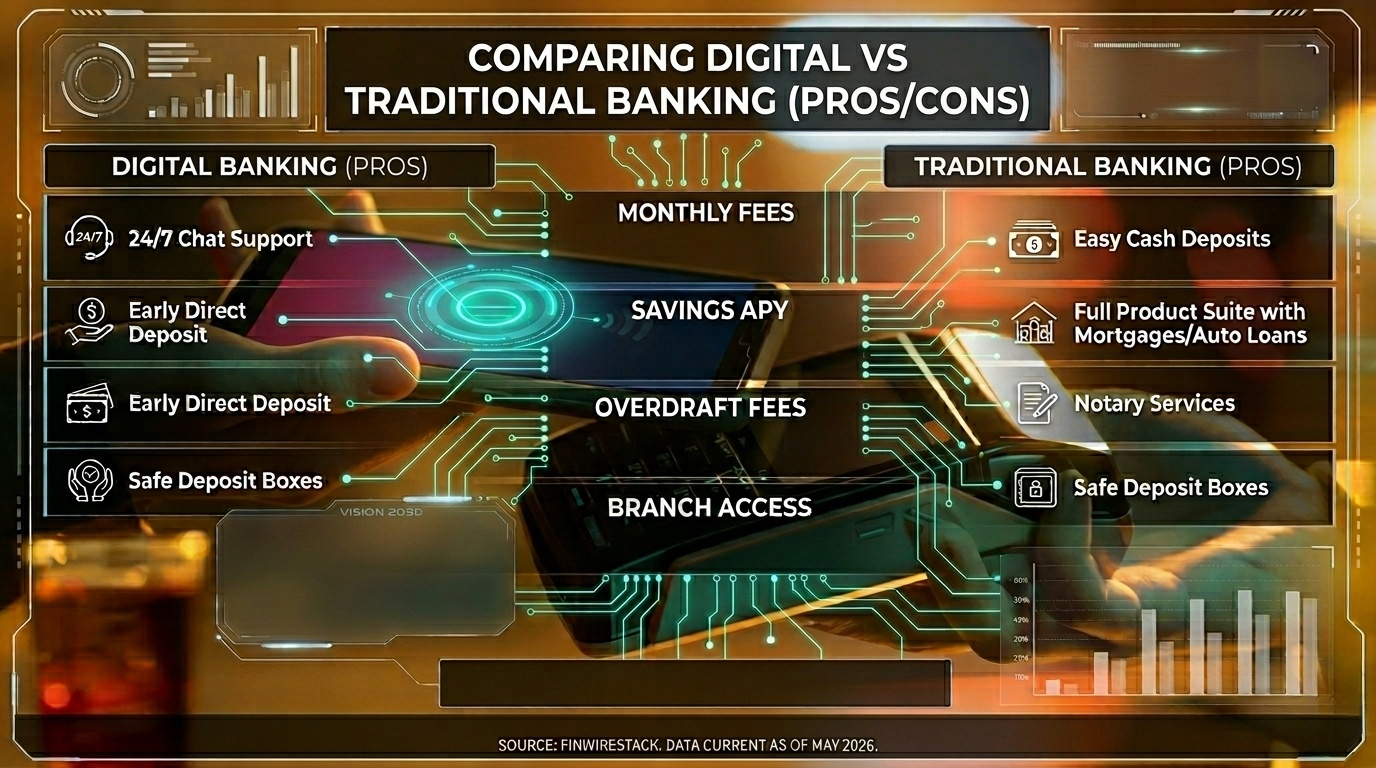
| Factor | Digital Banking | Traditional Banking |
|---|---|---|
| Monthly fees | Usually $0 | Often $5-25 (waivable with minimums) |
| Interest rates (savings) | 4.0-5.0% APY | 0.01-0.10% APY |
| ATM access | Fee-free networks (55,000+ ATMs) | Large proprietary networks |
| Branch access | None | 4,000+ branches (declining) |
| Check deposit | Mobile check deposit | Mobile + teller |
| Cash deposit | Limited (some via retail partners) | Easy (teller or ATM) |
| Customer service | Chat, phone, email | In-person, phone |
| FDIC insured | Yes (up to $250,000) | Yes (up to $250,000) |
| Account minimums | Often $0 | Often 0−500 |
| Overdraft fees | Lower or none | Higher ($35 per occurrence) |
Digital vs traditional banking pros and cons vary by individual needs.
For budgeting tools that work with both bank types, see Best Budgeting Apps for Couples.
Understanding the advantages helps consumers evaluate digital vs traditional banking pros and cons.
| Bank Type | Typical Monthly Fee | Minimum to Waive |
|---|---|---|
| Digital banks | $0 | None |
| Traditional banks | $5-25 | 500−10,000 balance or direct deposit |
Annual savings from switching: 60−300+
| Bank Type | Typical Savings APY (May 2026) |
|---|---|
| Digital banks | 4.0-5.0% |
| Traditional banks | 0.01-0.10% |
**Impact on 10,000 balance:** Digital banks earn 400-500 per year. A traditional bank earns $1-10.
Many digital banks release paychecks up to 2 days early.
| Bank | Early Direct Deposit |
|---|---|
| Chime | Up to 2 days early |
| Current | Up to 2 days early |
| Varo | Up to 2 days early |
| SoFi | Up to 2 days early |
Digital banks were built for mobile from day one. Features include:
| Fee Type | Digital Banks | Traditional Banks |
|---|---|---|
| Overdraft | Often $0 or low | $35 per occurrence |
| Foreign transaction | Often 0% | 1-3% |
| ATM fees | Reimbursed | Often charged |
| Paper statement | $0 | $0-5 |
| Account closure | $0 | $0-25 |
Some digital banks offer FDIC coverage up to $2 million through sweep networks that spread deposits across multiple partner banks.
Digital vs traditional banking pros and cons heavily favor digital on fees and rates.
For automated savings features offered by digital banks, see Automated Savings Apps That Actually Work.
No honest digital banking vs traditional banking pros and cons ignores the drawbacks.
| What You Cannot Do at Digital Banks |
|---|
| Deposit cash easily |
| Get a cashier’s check instantly |
| Meet with a banker in person |
| Use a safe deposit box |
| Get notary services |
| Digital Bank | Cash Deposit Method |
|---|---|
| Chime | Deposit at Walgreens, 7-Eleven (fee may apply) |
| Current | Deposit at CVS |
| Ally | No cash deposits (use external bank) |
| SoFi | Deposit at CVS, Walgreens, Walmart |
| Issue | Digital Banking | Traditional Banking |
|---|---|---|
| Average hold time | 5-15 minutes | 2-10 minutes |
| In-person support | None | Available |
| Complex issue resolution | Can take days | Often same-day |
Digital banks typically offer:
Traditional banks offer all of the above plus the following:
| Risk | Digital Banking | Traditional Banking |
|---|---|---|
| App outage | Cannot access funds | Can visit branch |
| Phone lost/stolen | Locked out temporarily | Can use branch with ID |
| Phishing attacks | Higher target | Still targeted |
| Internet required | Cannot bank offline | Branches available |
Digital vs traditional banking pros and cons show digital wins on fees but loses on services.
For security tips applicable to both, see KYC/AML Automation for Fintech Startups.
Traditional banks maintain advantages worth considering in digital vs traditional banking pros and cons.
| Scenario | Value of Branch Access |
|---|---|
| Complex dispute resolution | Speak to manager directly |
| Large cash deposits | Hand the teller. |
| Cashier’s check needed immediately | Get same-day |
| Lost card replacement | Get temporary card same day |
| Notary services | Often free for customers |
| Product | Traditional Banks | Digital Banks |
|---|---|---|
| Mortgages | Widely available | Limited or third-party |
| Auto loans | Widely available | Limited |
| Credit cards | Wide selection | Often one option |
| Business banking | Comprehensive | Basic |
| Wealth management | Available | Not offered |
| Brand | Years in Operation |
|---|---|
| Chase | 200+ |
| Bank of America | 100+ |
| Wells Fargo | 170+ |
| Most digital banks | 5-15 years |
| Bank | ATM Network Size |
|---|---|
| Chase | 16,000+ |
| Bank of America | 15,000+ |
| Wells Fargo | 13,000+ |
Traditional banks offer relationship managers, lines of credit, merchant services, and payroll integration that digital banks cannot match.
For business banking needs, see Fintech Compliance for Small Businesses.
Digital vs traditional banking pros and cons require honesty about traditional banking’s failures.
| Bank | National Average Savings APY (May 2026) |
|---|---|
| Chase | 0.01% |
| Bank of America | 0.01-0.04% |
| Wells Fargo | 0.01-0.15% |
A 10,000 emergency fund in a traditional bank earns 1-15% per year. The same amount in a digital bank earns $400-500.
| Bank | Checking Fee | Minimum to Waive |
|---|---|---|
| Chase Total Checking | $12 | 1,500 balance or 500 direct deposit |
| Bank of America | $12 | 1,500 balance or 250 direct deposit |
| Wells Fargo | $10 | $500 direct deposit |
| Bank | Overdraft Fee | Max per Day |
|---|---|---|
| Chase | $34 | 3 fees ($102/day) |
| Bank of America | $35 | 4 fees ($140/day) |
| Wells Fargo | $35 | 4 fees ($140/day) |
Since 2020, over 4,000 bank branches have closed. The “convenience” of branch access is disappearing.
Traditional banks often have clunkier apps, slower check deposit processing, and less real-time functionality compared to digital-native competitors.
| Cost Category | Digital Banking | Traditional Banking |
|---|---|---|
| Monthly checking fee | $0 (95% of banks) | $5-25 (65% of banks) |
| Savings APY | 4.0-5.0% | 0.01-0.10% |
| Overdraft fee | $0-15 | $35 |
| Foreign transaction fee | 0% | 1-3% |
| ATM fee (out-of-network) | Often reimbursed | $2-3 + operator fee |
| Paper statement fee | $0 | $0-5 |
| Account closure fee | $0 | $0-25 |
| Wire transfer (domestic) | $0-10 | $15-30 |
| Wire transfer (international) | $5-15 | $35-50 |
Annual cost difference for a typical customer: $200-500+ higher with traditional banking.
For budgeting these costs, see Best Budgeting Apps for Couples.
Security concerns are central to digital banking vs traditional banking pros and cons.
| Security Feature | Digital Banking | Traditional Banking |
|---|---|---|
| FDIC insurance | Yes (up to $250,000) | Yes (up to $250,000) |
| Two-factor authentication | Mandatory | Optional |
| Biometric login | Yes (fingerprint/face) | Varies |
| Real-time alerts | Standard | Often available |
| Fraud resolution | 24/7 phone support | Branch or phone |
| Zero-liability policy | Yes | Yes |
| Account takeover protection | Strong (app-based) | Strong |
| Physical security (lost card) | Lock in app instantly | Lock in app or call |
Both are safe when used properly. Digital banks offer stronger real-time controls. Traditional banks offer in-person dispute resolution.
The biggest security risk is not the bank type—it is user behavior. Weak passwords, sharing credentials, and falling for phishing scams endanger accounts at any bank.
For cybersecurity guidance, see Cybersecurity for Investors: Protecting Your Brokerage Accounts (coming soon).
| Aspect | Digital Banking | Traditional Banking |
|---|---|---|
| Phone support hours | 24/7 (most) | Limited (often 9-5) |
| Chat support | Yes (often 24/7) | Limited |
| Email support | Yes | Yes |
| In-person support | No | Yes |
| Average hold time | 5-15 minutes | 2-10 minutes |
| Complex issue resolution | 2-5 days | Same day (in-person) |
| Social media support | Often responsive | Varies |
Digital vs traditional banking pros and cons on customer service depend on your preference for speed vs. in-person resolution.
| Digital Bank | Savings APY | Monthly Fee | Early DD | Unique Feature |
|---|---|---|---|---|
| SoFi | 4.5% | $0 | Up to 2 days | Combined banking + investing |
| Ally Bank | 4.2% | $0 | None | No-fee overdraft |
| Chime | 2.0% | $0 | Up to 2 days | SpotMe overdraft protection |
| Capital One 360 | 4.25% | $0 | None | Large ATM network |
| Discover Bank | 4.3% | $0 | None | Excellent customer service |
| Traditional Bank | Monthly Fee | Min to Waive | Branch Count | Best For |
|---|---|---|---|---|
| Chase | $12 | $1,500 | 4,700+ | Nationwide access |
| Bank of America | $12 | $1,500 | 4,000+ | Rewards program |
| Wells Fargo | $10 | $500 | 4,400+ | Convenience |
| PNC | $7-15 | $500 | 2,600+ | Regional strength |
| Truist | $12 | $500 | 2,000+ | Southeastern US |
After three Fed cuts in late 2025, savings rates have stabilized at 4.0-5.0% for digital banks. Traditional bank rates remain near zero.
The FedNow Service has expanded to over 800 banks. Digital banks fully support real-time payments. Traditional banks are rolling out gradually.
The CFPB’s new overdraft rule (effective October 2025) has led traditional banks to raise other fees to compensate. Digital banks lead with low or zero overdraft fees.
Over 1,000 branches closed in Q1 2026 alone. The trend is accelerating, not slowing.
Consumers now expect 4%+ APY on savings. Traditional banks’ 0.01% rates are increasingly untenable.
Digital vs traditional banking pros and cons increasingly favor digital as branches disappear.
Yes. Digital banks are FDIC-insured (up to $250,000) and use the same security standards as traditional banks. However, you must practice good security hygiene: strong passwords, two-factor authentication, and phishing awareness.
Some digital banks allow cash deposits at retail partners (CVS, Walgreens, Walmart). Others do not accept cash deposits at all. For frequent cash depositors, traditional banking may be better.
Digital banks consistently offer the highest rates. SoFi (4.5%), Ally (4.2%), and Discover (4.3%) lead. Check each bank’s current rate before opening.
Many consumers maintain both: a digital bank for everyday spending and high-yield savings and a traditional bank for cash deposits, notary services, and in-person needs.
Traditional banks offer more comprehensive business services (merchant services, lines of credit, payroll). Digital banks are improving, but still lag in complex business needs.
Digital vs traditional banking pros and cons do not have a single winner for everyone.
| Priority | Why |
|---|---|
| Want high interest on savings | 4.0-5.0% APY vs. 0.01% |
| Hate monthly fees | $0 vs. $5-25/month |
| Rarely deposit cash | Digital cash deposit options are limited |
| Prefer mobile-first experience | Digital apps are superior |
| Earn direct deposit | Early access feature available |
| Priority | Why |
|---|---|
| Deposit cash frequently | Digital banks have limited options |
| Need in-person services | Notary, cashier’s checks, safe deposit |
| Run a small business | Traditional business banking stronger |
| Prefer face-to-face support | Branches available |
| Want full product suite | Mortgages, auto loans, credit cards |
Most Americans should use both models:
The best time to switch was yesterday. The second-best time is today.
Ready to compare banks? See our digital bank comparison or calculate your savings from switching.

Automated tax filing for digital nomads is the single most effective way to stop overpaying taxes while living abroad. Automated tax filing for digital nomads syncs your global income, tracks deductible expenses across borders, and calculates Foreign Earned Income Exclusion (FEIE) in real time.
According to a 2025 report by MBO Partners, 17.3 million American workers now identify as digital nomads — a 147% increase since 2019. Yet 68% admit to overpaying taxes because they lack proper filing systems.
Automated tax filing for digital nomads solves this problem completely by automating the entire tax preparation process for location-independent professionals.
The problem is simple: digital nomads earn income from multiple states or countries, pay taxes in different jurisdictions, and struggle to track deductible expenses across borders.
Automated tax filing for digital nomads solves these problems by:
The average digital nomad overpays by $3,200 annually due to missed deductions and incorrect filings. Automated tax filing eliminates this waste.
| Scenario | Tax Implication |
|---|---|
| Living in Thailand, working for US client | May owe US taxes + Thai taxes (depending on treaties) |
| Spending 3 months in each of 4 countries | May trigger tax residency in multiple jurisdictions |
| Earning from clients in 5 different countries | Must track withholding taxes and foreign tax credits |
| Expense Type | Easily Missed Without Automation |
|---|---|
| Co-working space memberships | ✅ Automated tools track recurring subscriptions |
| Flight and accommodation costs | ✅ AI categorizes travel expenses |
| Home office (wherever “home” is) | ✅ Geolocation helps determine eligible days |
| International banking fees | ✅ Transaction scraping captures every fee |
Digital nomads typically owe quarterly estimated taxes to the IRS if they are US citizens. Missing a payment triggers penalties up to 5% of the underpayment.
Automated tax filing for digital nomads calculates these payments in real time based on current income, then schedules or reminds you to pay.
“Automated tax filing for digital nomads” refers to software platforms that use AI to
| Capability | What It Does |
|---|---|
| Income aggregation | Pulls earnings from PayPal, Stripe, Upwork, Fiverr, and bank accounts |
| Expense categorization | Learns your spending patterns and auto-assigns tax categories |
| Deduction discovery | Flags potential write-offs based on transaction descriptions |
| Tax calculation | Estimates federal, state, and international tax obligations |
| Form generation | Populates Schedule C, Form 1116 (Foreign Tax Credit), and more |
| Filing automation | Submits returns directly to IRS and state authorities |
Unlike traditional tax software that requires manual data entry, automated systems work continuously throughout the year.
After testing 10 platforms specifically for location-independent workers, here are the top 5 automated tax filing tools for digital nomads.
Best for: US digital nomads with foreign income
TaxAct for Expats provides specialized automated tax filing for digital nomads focused on foreign tax credit optimization. It includes AI-powered foreign tax credit calculations and automatic exchange rate conversion for over 100 currencies.
Key Features:
Pros:
Cons:
Pricing: 89–199 per filing
Affiliate Link: Try TaxAct for Expats (We earn a commission if you purchase through this link.)
Best for: Complex international situations requiring CPA support
Greenback combines automated tax filing for digital nomads with human CPA review for complex international situations. The AI scans your uploaded documents and flags potential issues before your assigned accountant reviews.
Key Features:
Pros:
Cons:
Pricing: 299–1,200+ depending on complexity
Affiliate Link: Get Greenback Expat Tax Help (We earn a commission if you purchase through this link.)
Best for: Budget-conscious digital nomads with straightforward returns
MyExpatTaxes offers budget-friendly automated tax filing for digital nomads with straightforward returns. It uses AI to pre-fill forms based on your answers to a simple questionnaire. The platform is built specifically for US expats and digital nomads.
Key Features:
Pros:
Cons:
Pricing: 149–349 per filing
Affiliate Link: Try MyExpatTaxes (We earn a commission if you purchase through this link.)
Best for: Digital nomads who want maximum automation with expert review
TurboTax offers the most comprehensive automated tax filing for digital nomads with direct integration from over 500,000 financial institutions. |
It uses Intuit’s AI engine to import income and expense data directly from bank accounts, payment processors, and crypto exchanges. The “Full Service” add-on includes CPA review.
Key Features:
Pros:
Cons:
Pricing: 89–199 (Self-Employed) + $199 for Live Full Service
Affiliate Link: Start TurboTax (We earn a commission if you purchase through this link.)
Best for: Simple returns for US digital nomads with FEIE only
Expatfile delivers simple automated tax filing for digital nomads who only need FEIE filing. It uses AI to streamline the FEIE filing process. The platform asks simple questions, then auto-populates Form 2555 and related schedules.
Key Features:
Pros:
Cons:
Pricing: 129–199 per filing
Affiliate Link: Try Expatfile (We earn a commission if you purchase through this link.)
The following automated tax filing for digital nomads’ tools was tested for accuracy, ease of use, and global compatibility.
Use this decision flowchart to select the best automated tax-filing for digital nomads tool for your situation.
Step-by-Step Implementation Guide
Follow this 5-step process to implement automated tax filing for digital nomads before next tax season.
| Document | Where to Find |
|---|---|
| Passport and visa records | Personal files |
| Income statements (1099s, W-2s) | Clients, payment processors |
| Foreign bank account statements | International banks |
| Receipts for deductible expenses | Email, banking apps |
Use the decision flowchart above to select the best automated tax-filing for digital nomads tool for your situation.
| Connection Type | Tools That Support It |
|---|---|
| US bank accounts | TurboTax, TaxAct |
| PayPal, Stripe, Upwork | TurboTax, manual entry for others |
| Crypto exchanges | TurboTax |
| Foreign bank accounts | TaxAct, Greenback (manual) |
Most tools will automatically categorize 70-80% of transactions correctly. Spend 1-2 hours reviewing and correcting the remaining 20-30%. The AI learns from your corrections.
Once all data is verified, generate your return. Review all forms before submitting. E-file for fastest processing (most tools include e-filing).
Here are the most common questions about automated tax filing for digital nomads.
Yes, automated tax filing for digital nomads handles FEIE calculations and Form 2555 automatically. Where US citizens must file US taxes regardless of where they live. However, the Foreign Earned Income Exclusion (FEIE) allows you to exclude up to $126,500 (2026 figure) of foreign-earned income from US taxation.
Yes, TurboTax and TaxAct support multi-state filing. If you maintain a US mailing address but never physically work in that state, you may not owe state taxes. Consult your tool’s state guidance feature.
Most tools require manual entry or statement uploads for foreign accounts. TurboTax has the broadest international bank coverage. For other tools, expect to enter income and expense data manually.
All recommended tools support prior-year filing. Greenback and TaxAct are best for amending multiple years. Start with the most recent year, then work backward.
Yes, all recommended tools use 256-bit SSL encryption and are GDPR or equivalent-compliant. Never share your login credentials directly with any tax preparer—use secure document upload portals instead.
The average digital nomad using automated tax filing saves $3,200 annually through missed deductions and accurate FEIE/FTC calculations. The tool pays for itself many times over.
Automated tax filing for digital nomads transforms a stressful, error-prone process into a streamlined 30-minute task.
| Tool | Best For | Starting Price |
|---|---|---|
| TurboTax | Full automation | $89 |
| Greenback | Complex cases | $299 |
| TaxAct Expats | Foreign Tax Credit | $89 |
| MyExpatTaxes | Budget filers | $149 |
| Expatfile | Simple FEIE | $129 |
Ready to stop overpaying? Compare automated tax filing tools or start your return today.

Why Crypto Whitepapers Matter More Than Ever in May 2026
In May 2026, the crypto landscape has never been more dangerous—or more promising. The market stands at a delicate tipping point. Bitcoin repeatedly tugs at the $69,000 mark, and the fear and greed index has once dipped to single digits. Surface-level volatility masks a deeper transformation: the reshaping of industry fundamentals and the repricing of existing narratives.
How to read a crypto whitepaper is your first line of defense against scams and failed investments. The whitepaper is the foundational document of any cryptocurrency project. It explains the problem, solution, technology, token economics, and roadmap. A legitimate project has a transparent, well-researched whitepaper. A scam has a copied, vague, or impossibly promising document.
In April 2026, Huobi HTX, in collaboration with multiple industry organizations, including ChainCatcher, BlockBeats, Foresight News, and Odaily, released the “2026 Digital Asset Trend White Paper.” This multi-page report does not contain the usual “hundred-fold coin secrets.” Instead, it attempts to answer a fundamental question: as digital assets transition from marginal experiments to the backbone of the global financial system, how can investors navigate this new era?
The white paper’s core thesis is that digital assets are completing a transition from being “price cycle driven” to “structural trend driven.” Core assets like BTC and ETH have deeply embedded themselves into global asset allocation models and are no longer independent “niche games.”
Just days ago, the Estonian Financial Supervisory Authority issued an investor warning to Zondacrypto, the cryptocurrency exchange operator, for failing to provide the white paper for its “TeamPL” crypto token on its website. This violates Article 9(1) of the EU MiCA framework, which requires that, as long as the crypto asset is still held by the public, the white paper must be continuously available.
This enforcement action demonstrates that regulators are now actively policing white paper requirements. The days of launching tokens without proper documentation are ending.
Learning how to read a crypto whitepaper separates informed investors from those who lose money to hype. Understanding macro variables—the dollar index, U.S. Treasury yields—is now more crucial than fixating on candlestick charts alone.
For related crypto security guidance, see How to Spot a Fake Crypto Exchange: 8 Red Flags.
A whitepaper is an official document published by a cryptocurrency project’s creators. It outlines the project’s mission, the problem it aims to solve, the technology behind it, tokenomics, the roadmap, and often the team involved. Think of it as the project’s blueprint.
When analyzing how to read a crypto whitepaper, focus on these essential components:
A well-written crypto whitepaper should provide transparency and detail so that potential users and investors can assess the project’s legitimacy and value.
Every whitepaper should begin with a clear explanation of the project’s goals. Is it building a platform for developers? Is it supporting artists with decentralized royalties? Does it offer a new way to handle data or payments?
Legitimate projects explain their goals in clear, user-friendly language. If the purpose is vague or hidden behind excessive jargon, consider it a red flag.
For 2026 investors, the most relevant projects are:
The project must clearly explain why it has been created. What problem does it solve? Numerous projects are created for the sake of creation, solving problems that do not exist or are so niche that they affect only a handful of people.
In how to read a crypto whitepaper, Look for answers to:
A solid problem statement is the foundation of a meaningful crypto project. The 2026 landscape rewards projects solving specific financial infrastructure problems with measurable demand signals.
After stating the problem, the crypto whitepaper should explain how the project plans to solve it using blockchain technology. This section is typically more technical.
Critical questions to ask:
If the whitepaper cannot justify why blockchain is necessary—or uses blockchain as a buzzword without a clear use case—avoid the project.
For deeper technical analysis on how to read a crypto whitepaper, see Agentic AI Fraud Detection for Community Banks.
A critical section of any crypto whitepaper is token economics, also known as tokenomics. This determines whether the project can sustain itself long-term or will collapse under its own weight.
The more utility a token has within the ecosystem, the more valuable it becomes. Tokens should offer incentives for long-term holding, not just quick profits. Ask yourself:
In 2026, governance tokens that allow holders to vote on protocol changes and fund allocation demonstrate decentralized decision-making, enhancing community trust.
Fixed caps with gradual emissions typically indicate responsible planning. Concerning unlimited supplies warrant scrutiny. Distribution mechanisms, vesting schedules, and governance structures show whether the project prioritizes institutional participation and community alignment.
Well-designed tokenomics balance incentive structures between developers, users, and investors while maintaining network security. Evaluate whether the project generates actual revenue to support token value—beyond speculation—to distinguish serious ventures from unsustainable projects.
The 2026 trend toward real yield (actual cash flow from protocol operations) is critical. Projects that can safely move traditional finance yields—such as U.S. Treasuries, gold, and commodities—onto the chain represent certain opportunities ahead.
For budgeting and financial planning, see Best Budgeting Apps for Couples.
Even the best-looking whitepaper can hide scams. in how to read a crypto whitepaper, here are the warning signs to watch for:
If a crypto whitepaper feels rushed or unprofessional, trust your instincts and explore other options.
In March 2026, Google Quantum AI released a landmark white paper analyzing quantum computing threats to cryptocurrencies, claiming that breaking Bitcoin’s 256-bit elliptic curve cryptography could require fewer than 500,000 physical qubits—a reduction of nearly 20x.
Watch for projects claiming “quantum resistance” without technical backing. The Google paper significantly advances the engineering assessment of quantum risk but does NOT demonstrate that a CRQC (Cryptographically Relevant Quantum Computer) is close to practical deployment.
The technical architecture section validates execution capability. Consensus mechanisms determine security and efficiency trade-offs, whether through Proof of Work reliability or Proof of Stake scalability.
Questions to ask:
In how to read a crypto whitepaper, smart contract audits and clear upgradeability frameworks indicate professional development practices. Look for:
The architecture should address scalability through viable approaches like sharding, layer-2 solutions, or modular blockchain designs rather than merely claiming to solve blockchain limitations.
In 2026, Ethereum has solved 80% of the proof bottleneck through zkEVM protocol-level integration, entering the “Deca-chain L1” era. Any competing L1 must demonstrate comparable innovation.
Even the best crypto whitepaper is only as strong as the team executing it.
Strong development teams typically demonstrate deep industry experience, with key members holding 10-15+ years in relevant technical or business domains.
The crypto space is full of scammers who use fake “big names” and biographies to promote their projects. Always go the extra mile and verify their professional backgrounds.
For AI-related team evaluation, see AI Budget Trackers for Freelancers.
The roadmap section of a whitepaper outlines the project’s milestones—past, present, and future. It helps investors assess the team’s planning skills and track record.
| Question | What to Look For |
|---|---|
| Are goals realistic? | Achievable milestones, not overly ambitious |
| Have past milestones been met? | Evidence of delivery, not just promises |
| What’s scheduled for the next 6-12 months? | Specific dates, not “coming soon” |
A clear roadmap builds trust and accountability. Projects tracking toward their announced milestones across multiple years signal disciplined project management.
The 2026 whitepaper from Huobi HTX exemplifies a professional roadmap: it deeply analyzes ten core trends of the digital asset market in 2026 without making unrealistic promises about adoption or growth.
To understand how to read a crypto whitepaper in practice, let us examine the Huobi HTX “2026 Digital Asset Trends White Paper,” released in April 2026.
The whitepaper reveals that the crypto market’s “coming of age” means the following:
Learning how to read a crypto whitepaper means recognizing that professional documents like this one focus on structural analysis, not hype.
How to read a crypto whitepaper:
A crypto whitepaper is an official document that outlines a cryptocurrency project’s purpose, technology, tokenomics, and roadmap. It is important because it provides transparency and helps investors evaluate legitimacy before investing.
Look for grammatical errors, unrealistic promises, anonymous teams, lack of technical detail, and token allocation heavily favoring founders. If the whitepaper focuses more on marketing hype than providing real information, proceed with caution on how to read a crypto whitepaper.
Focus on the problem statement, solution, tokenomics (especially supply and distribution), roadmap with specific milestones, and team backgrounds.
In 2026, investors should prioritize projects addressing RWA tokenization, AI agent integration, stablecoin infrastructure, and real yield generation. The market is shifting from pure speculation to structural value.
No. Regulators like Estonia’s Financial Supervisory Authority are now issuing warnings to exchanges operating without whitepapers. A missing whitepaper violates MiCA regulations and indicates serious compliance issues.
Cross-reference names on LinkedIn, check GitHub contribution history, search for previous project track records, and verify partnerships through independent sources. How to read a crypto whitepaper.
For ongoing investment tracking after you have vetted a project, see Best Free Portfolio Trackers for Crypto and Stocks.
Learning how to read a crypto whitepaper is not just about avoiding scams. It is about identifying the projects that will define the next era of digital assets.
| Component | What to Look For |
|---|---|
| Purpose | Clear, jargon-free mission |
| Problem | Real-world issue with data support |
| Solution | Blockchain necessity justified |
| Tokenomics | Reasonable supply, fair distribution, real utility |
| Roadmap | Achievable milestones with evidence |
| Team | Verifiable credentials and track record |
| Red Flags | Vague claims, no transparency, anonymous |
The crypto market is transitioning from “comprehensive appreciation” to “survival of the fittest”—an era for professionals and long-termists. As the Huobi HTX whitepaper concludes, the digital asset market is completing its “coming of age” ceremony. The rules are gradually clarifying, players are becoming more professional, and returns no longer come from blind emotional speculation but from a deep understanding of macro trends, technological integration, and real value.
The nautical chart has been unfolded. The road ahead belongs to those who understand the underlying cards.
Ready to evaluate your next crypto investment? Bookmark this whitepaper guide or compare crypto projects using our fundamental analysis framework.