Stock investing for beginners in 2026 starts with a simple truth that most people overlook: you don’t need to be a Wall Street expert to build wealth. In fact, the world’s most successful investor, Warren Buffett, has repeatedly said that the best strategy for most people is remarkably simple.
The year 2026 presents a unique moment for new investors. The S&P 500 has delivered a 1,770% return over the past 30 years, turning $10,000 into $187,000. Meanwhile, global markets are adjusting to new realities—from AI’s transformative impact to shifting central bank policies—creating both uncertainty and opportunity.
This comprehensive guide will teach you stock investing for beginners in 2026 from the ground up. You will learn:
- Why stocks are the most powerful wealth-building tool available
- Warren Buffett’s simple, proven investment philosophy
- How to understand the stock market without getting overwhelmed
- Step-by-step instructions for opening a brokerage account
- Which index funds to buy and how to automate your investments
- The psychology of successful long-term investing
By the end, you will understand stock investing for beginners 2026 well enough to take action with confidence.
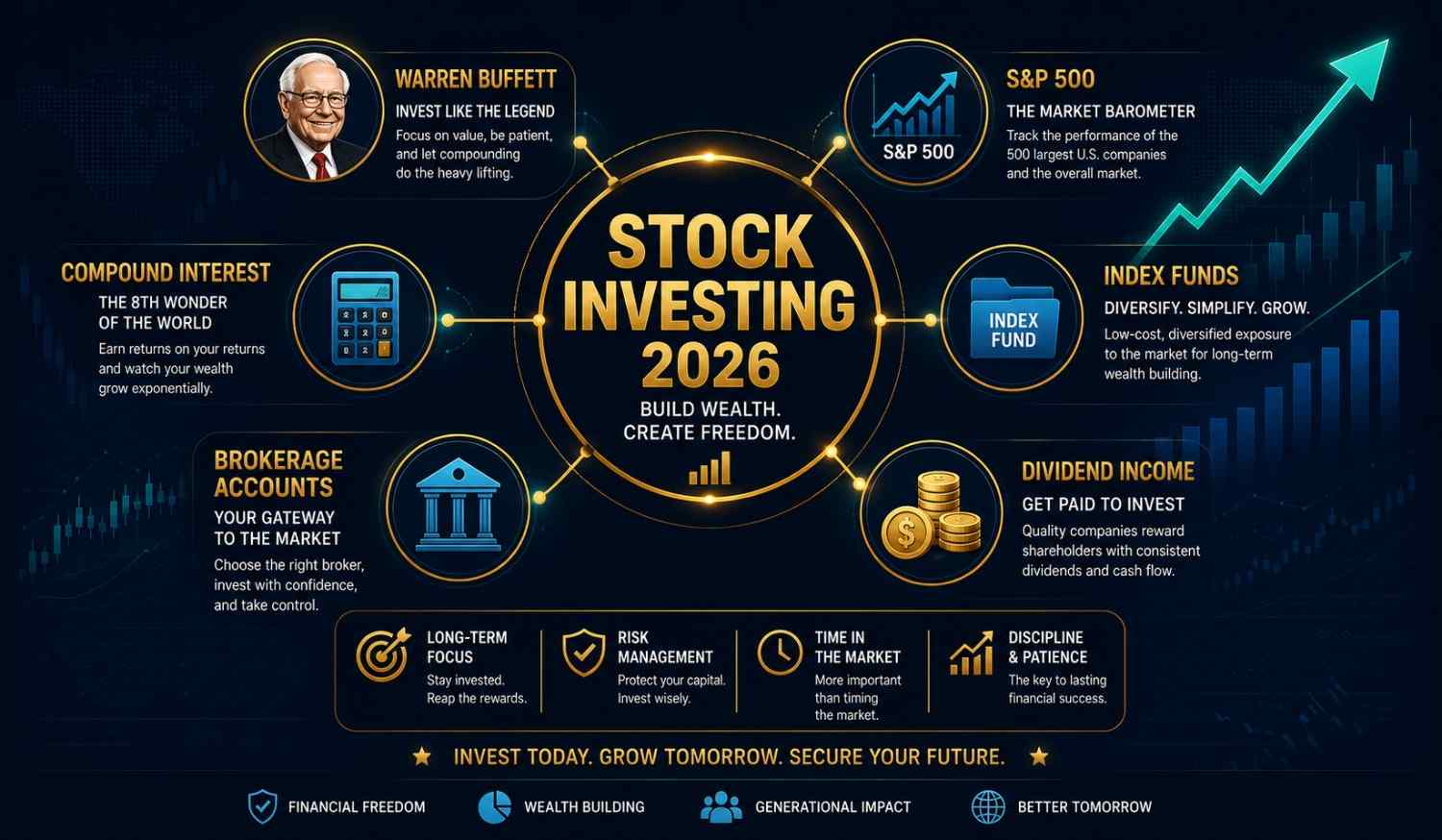
Stock investing for beginners 2026 — understanding the basics of building long-term wealth
Why Stocks Are the Ultimate Wealth-Building Tool
Understanding stock investing for beginners 2026 starts with one powerful concept: compound interest. Albert Einstein reportedly called it the eighth wonder of the world. Here is why.
The Power of Compound Interest
Imagine you invest $100 per month for 30 years. At a 10% average annual return (the historical average of the S&P 500), here is what happens:
| Investment Period | Monthly Contribution | Total Contributions | Estimated Value | Growth from Interest |
|---|---|---|---|---|
| 10 Years | $100 | $12,000 | $20,655 | $8,655 |
| 20 Years | $100 | $24,000 | $75,936 | $51,936 |
| 30 Years | $100 | $36,000 | $226,049 | $190,049 |
🎯 Real-World Example: A 25-year-old who invests $500 per month in an S&P 500 index fund could accumulate over $1 million by age 65, assuming a 10% historical average return. This is the power of stock investing for beginners in 2026—small, consistent actions lead to massive results.
Why Stocks Outperform Other Assets
| Asset Class | Historical Average Return | Risk Level |
|---|---|---|
| Stocks (S&P 500) | 9-10% | Moderate-High |
| Bonds | 4-5% | Low-Moderate |
| Savings Accounts | 0.5-3% | Very Low |
| Real Estate | 4-6% | Moderate |
| Gold | 2-4% | Moderate |
🔴 Red Highlight: Inflation is the silent wealth killer. If you keep all your money in a savings account earning 1% while inflation runs at 3%, you are losing purchasing power every year. Stocks are one of the few assets that have consistently outpaced inflation over long periods.
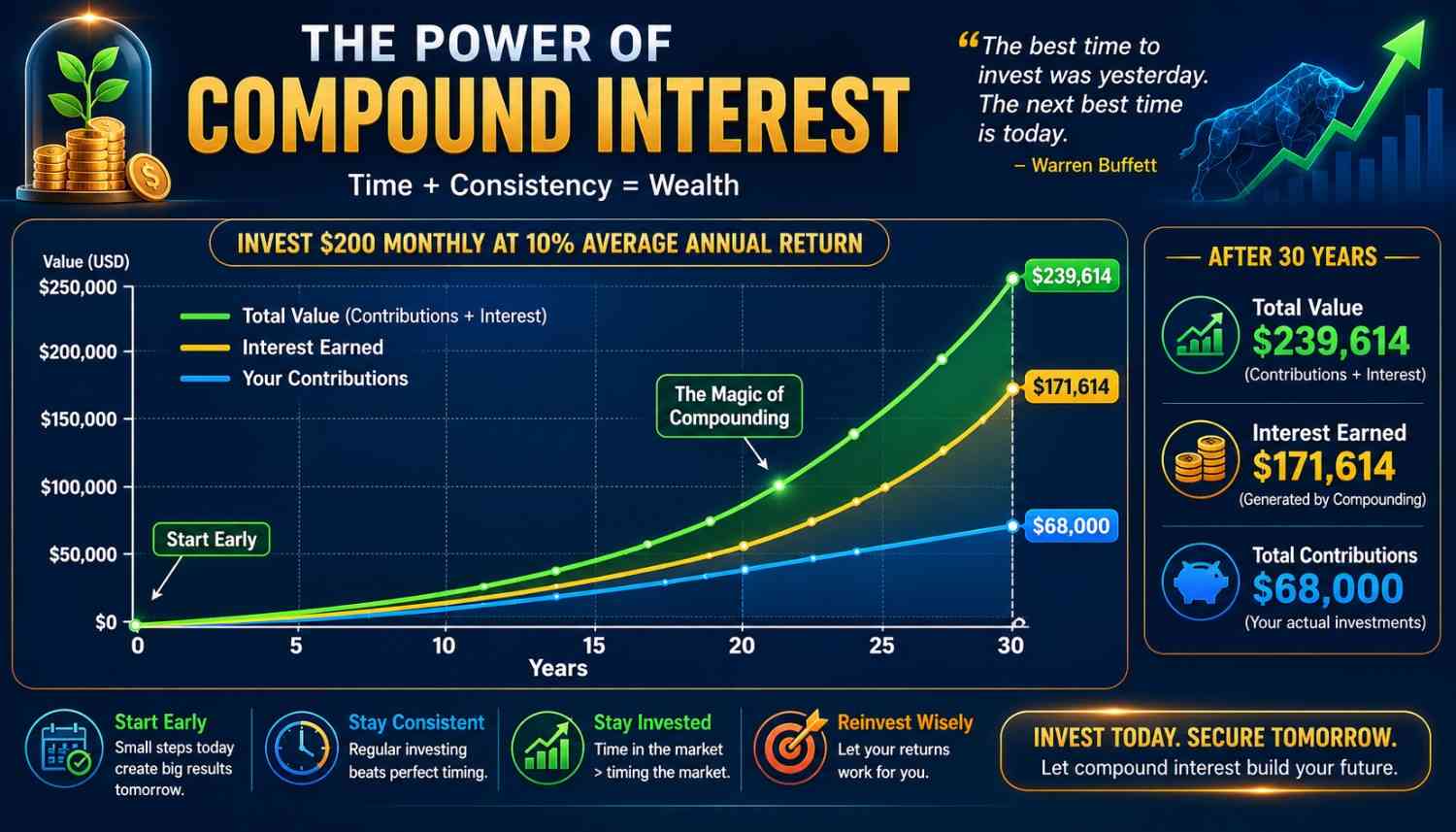
The power of compound interest—why starting early is the secret to stock investing for beginners 2026
Warren Buffett’s Simple Investment Philosophy
When learning stock investing for beginners in 2026, there is no better teacher than Warren Buffett. The CEO of Berkshire Hathaway is one of the wealthiest people in the world, and his advice for average investors is remarkably simple.
Buffett’s Core Advice
“The best thing to do is buy a low-cost S&P 500 index fund. By regularly investing in an index fund, the know-nothing investor can actually outperform most investment professionals.” — Warren Buffett
Why This Works:
- Low Cost: Index funds have expense ratios as low as 0.03%, meaning you keep almost all of your returns
- Instant Diversification: The S&P 500 gives you exposure to 500 of America’s largest companies
- Proven Track Record: The S&P 500 has returned approximately 10% annually over the long term
- No Stock Picking Required: You don’t need to research individual companies
- Less Emotion: You buy the whole market, not a single stock
Buffett’s $1 Million Bet
In 2008, Buffett bet $1 million that a low-cost S&P 500 index fund would outperform a collection of hedge funds over 10 years. By 2018, the index fund had returned 125%, while the hedge funds averaged just 36%. The index fund won by a landslide.
🟦 Blue Highlight: This bet proves that for most people, stock investing for beginners 2026 is not about finding the next Apple or Tesla. It is about owning the entire market and letting compound interest do the work.

Warren Buffett’s simple stock investing strategy for beginners
Understanding the Stock Market
Before diving into stock investing for beginners in 2026, it helps to understand what the stock market is.
What Is a Stock?
A stock represents ownership in a company. When you buy a share of stock, you are buying a tiny piece of that company. If the company grows and becomes more profitable, the value of your share typically increases.
What Is the Stock Market?
The stock market is where buyers and sellers trade stocks. The most famous stock market is the New York Stock Exchange (NYSE), which has been around since 1792. It operates Monday through Friday, 9:30 AM to 4:00 PM Eastern Time.
What Is an Index?
An index is a collection of stocks grouped together to represent a specific segment of the market. Think of it like a basket of stocks.
| Index | What It Tracks | Number of Companies |
|---|---|---|
| S&P 500 | 500 largest U.S. companies | 500 |
| Dow Jones | 30 large, established companies | 30 |
| NASDAQ | Technology-focused companies | 3,000+ |
| Russell 2000 | Smaller companies | 2,000 |
What Is an Index Fund?
An index fund is a type of mutual fund or ETF that tracks a specific index. When you buy an S&P 500 index fund, your money is spread across all 500 companies in that index. This gives you instant diversification.
What Moves Stock Prices?
Stock prices change based on supply and demand. If more people want to buy a stock than sell it, the price goes up. If more people want to sell than buy, the price goes down. Factors that influence supply and demand include:
- Company Earnings: If a company reports strong profits, investors want to buy
- Economic Data: Strong jobs reports or GDP growth often boost markets
- Interest Rates: When rates are low, stocks become more attractive
- Investor Sentiment: Fear and greed drive prices in the short term
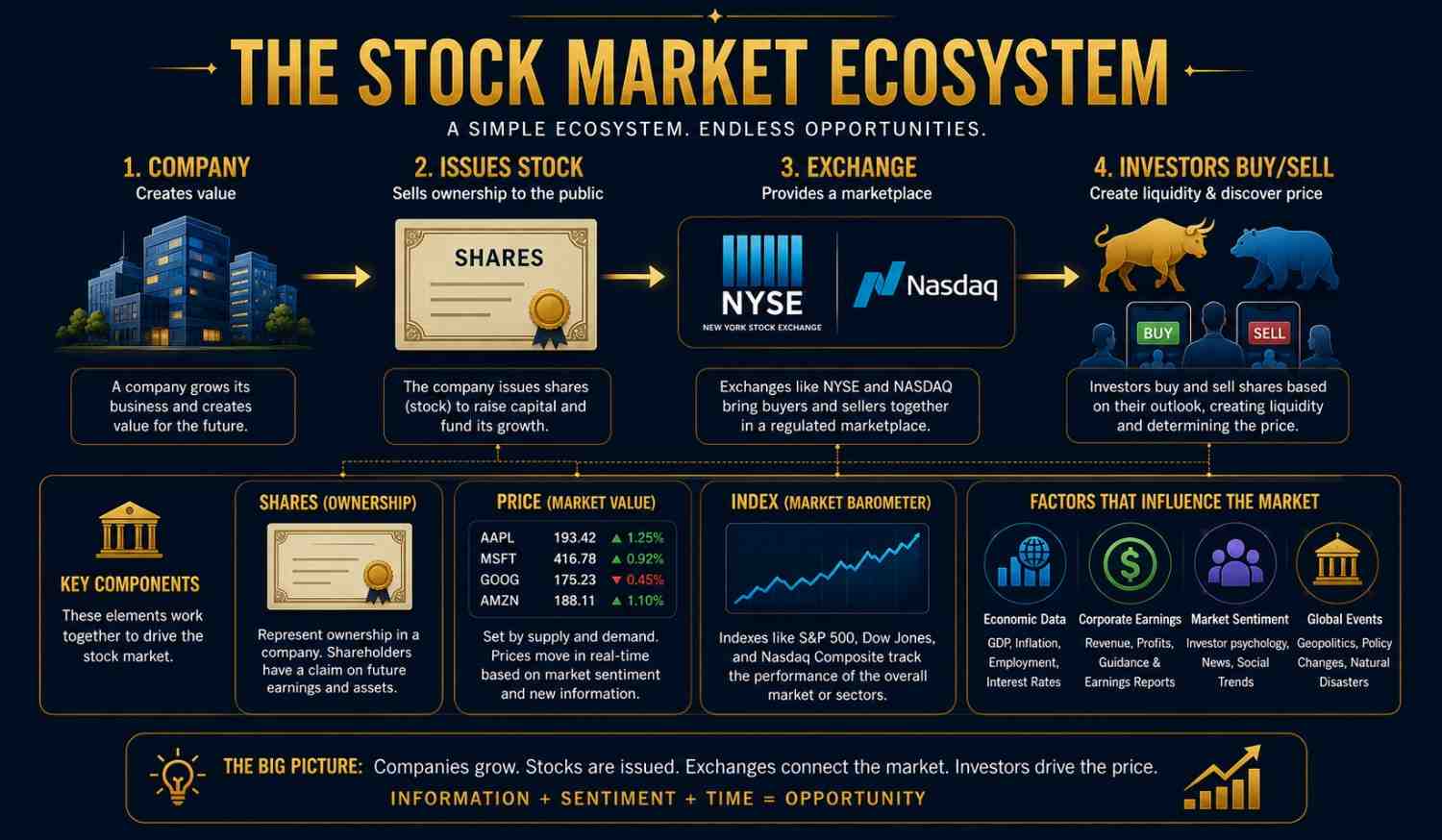
How the stock market works—essential knowledge for stock investing for beginners 2026
How to Start Investing: A Step-by-Step Guide
Here is a simple, actionable plan for stock investing for beginners in 2026.
Step 1: Choose a Brokerage Account
A brokerage account is where you buy and sell stocks and ETFs. Look for a brokerage that offers:
- Low or $0 trading commissions
- Low expense ratios on index funds
- User-friendly platform
- No account minimums
Top Brokerage Options for Beginners:
| Brokerage | Minimum Deposit | Trading Fees | Best For |
|---|---|---|---|
| Vanguard | $0 | $0 | Low-cost index funds |
| Fidelity | $0 | $0 | Comprehensive platform |
| Charles Schwab | $0 | $0 | Excellent customer service |
| Robinhood | $0 | $0 | Simple mobile interface |
| M1 Finance | $0 | $0 | Automated investing |
Step 2: Open Your Account
Opening a brokerage account is similar to opening a bank account. You will need:
- Personal information (name, address, Social Security number)
- Employment and income details
- Investment goals (retirement, general investing)
- Bank account information for funding
Most accounts can be opened in under 15 minutes.
Step 3: Choose Your Investment
For stock investing for beginners in 2026, the best choice is a low-cost S&P 500 index fund. Here are the top options:
| Fund Name | Ticker | Expense Ratio | Minimum Investment |
|---|---|---|---|
| Vanguard S&P 500 ETF | VOO | 0.03% | $0 (one share) |
| SPDR S&P 500 ETF | SPY | 0.09% | $0 (one share) |
| iShares Core S&P 500 ETF | IVV | 0.03% | $0 (one share) |
| Vanguard S&P 500 Mutual Fund | VFIAX | 0.04% | $3,000 |
| Fidelity 500 Index Fund | FXAIX | 0.015% | $0 |
💡 Pro Tip: For beginners, ETFs (Exchange-Traded Funds) like VOO are excellent because they have no minimum investment and can be bought and sold like stocks.
Step 4: Set Up Automatic Contributions
The key to successful stock investing for beginners in 2026 is consistency. Set up automatic transfers from your checking account to your brokerage account each month.
Example:
- Monthly contribution: $100-$500
- Investment: VOO (Vanguard S&P 500 ETF)
- Frequency: Monthly, automatically
Why It Works: This is called dollar-cost averaging. When the market is down, your money buys more shares. When it is up, it buys fewer. Over time, this averages out your cost.
Step 5: Adopt the Buy-and-Hold Mindset
The hardest part of stock investing for beginners in 2026 is not the mechanics—it is the psychology. When the market drops 20%, the natural instinct is to sell. But history shows that staying the course is the winning strategy.
💡 Pro Tip: If you are investing for long-term goals (retirement, down payment, college), ignore the short-term noise. The stock market has always recovered from every downturn in history.
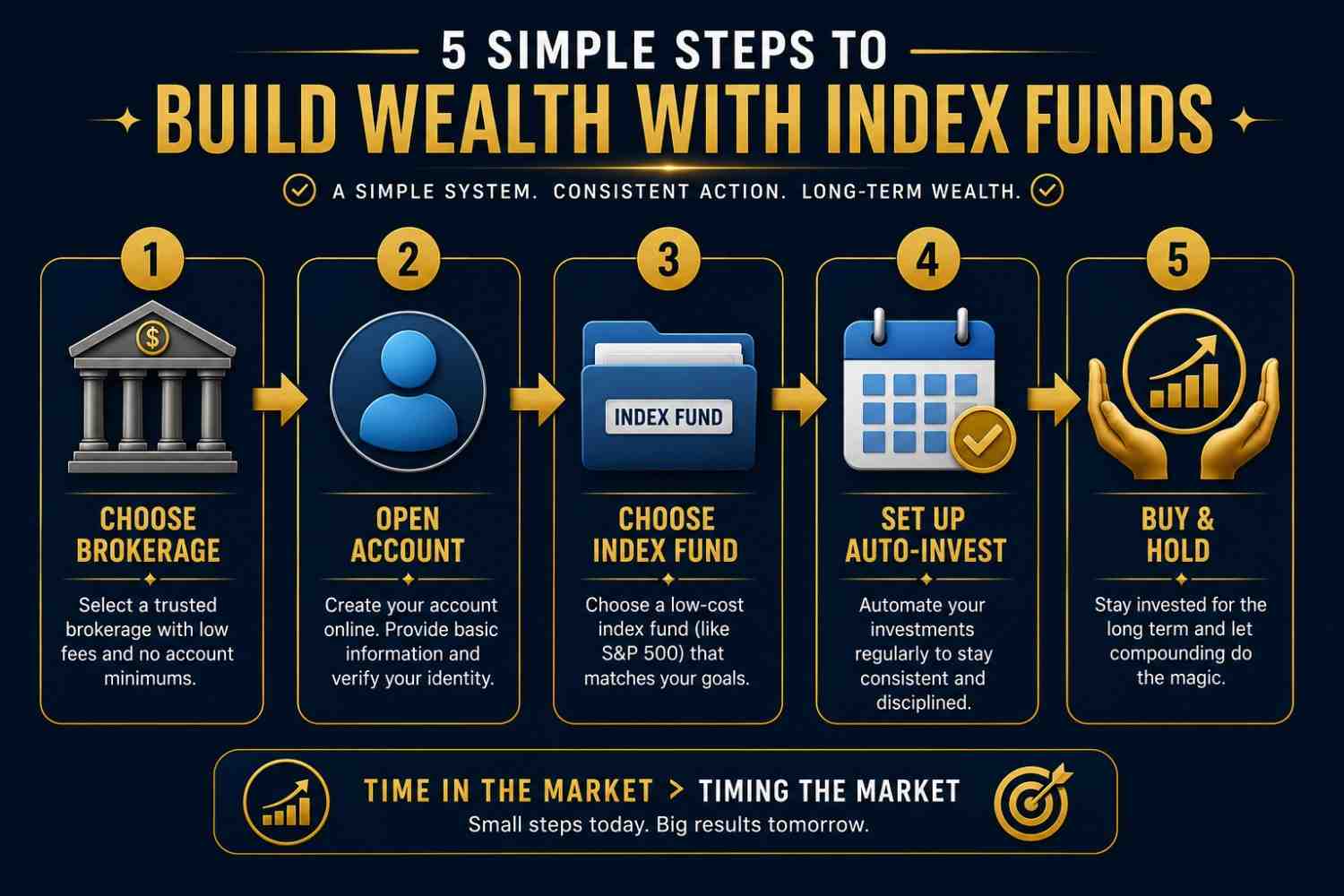
How to start stock investing in 2026 — a step-by-step guide for beginners
Investment Options Beyond the S&P 500
While the S&P 500 is the best starting point, there are other index funds worth considering as you grow your portfolio.
| Investment Option | Ticker | Expense Ratio | What It Tracks |
|---|---|---|---|
| Total Stock Market Fund | VTI | 0.03% | Entire U.S. stock market |
| Total World Stock Fund | VT | 0.07% | Global stock market |
| S&P 500 Fund | VOO | 0.03% | 500 largest U.S. companies |
| Growth Index Fund | VOOG | 0.10% | Faster-growing S&P 500 companies |
| Dividend Appreciation Fund | VIG | 0.06% | Companies with growing dividends |
How to Allocate Your Investments
For stock investing for beginners in 2026, a simple approach works best:
| Age Group | Stocks | Bonds | Cash |
|---|---|---|---|
| 20s and 30s | 90-100% | 0-10% | 0% |
| 40s and 50s | 70-80% | 20-30% | 0% |
| Near Retirement (60+) | 50-60% | 40-50% | 0-5% |
🎯 Real-World Example: A 30-year-old starting stock investing for beginners in 2026 with $200/month in VOO could have approximately $500,000 by age 60. If they wait until 40 to start, that same $200/month grows to about $180,000. Starting ten years earlier could result in over $300,000 more. This is the power of compound interest.
Common Mistakes and How to Avoid Them
| Mistake | Why It’s a Problem | How to Fix |
|---|---|---|
| Trying to Time the Market | Missing the best days can destroy returns | Stay invested consistently |
| Panic Selling | Locks in losses and misses recoveries | Ignore short-term volatility |
| Not Diversifying | Concentrated risk in one stock or sector | Use index funds |
| High Fees | Expense ratios and trading fees reduce returns | Choose low-cost index funds |
| Chasing “Hot” Stocks | Buying high and selling low | Stick to index funds |
| No Plan | Emotional decisions lead to mistakes | Set up automatic investing |
Conclusion: Your Stock Investing Journey Starts Here
Stock investing for beginners 2026 is not about getting rich overnight. It is about building wealth consistently over time through the power of compound interest and the simplicity of index funds.
Key Takeaways:
- Start now—The most important factor is time in the market
- Buy a low-cost S&P 500 index fund — Warren Buffett’s proven strategy
- Invest consistently — Set up automatic contributions
- Ignore short-term noise—focus on the long-term
- Stay invested—Don’t try to time the market
- Keep it simple—You don’t need complex strategies
- Trust the process—The market has always recovered
🎯 Final Thought: Like many people, you might feel that investing in stocks is complicated or risky. But the truth is that stock investing for beginners in 2026 is simpler than ever. By following Warren Buffett’s advice and buying a low-cost index fund, you can participate in the growth of America’s most successful companies. The key is to start—and to stay invested.
FAQ
1. How do I start stock investing with little money?
You can start with as little as $10-$100 using fractional shares. Most brokers now offer fractional share investing, allowing you to buy a portion of a share. Opening a brokerage account is free, and there is no minimum balance with most platforms. The most important factor is consistency, not the initial amount.
2. What is the best stock for beginners?
The best “stock” for beginners is actually an S&P 500 index fund like VOO. It gives you exposure to 500 of America’s largest companies with a single purchase, providing instant diversification at a very low cost (expense ratio of just 0.03%). This follows Warren Buffett’s famous advice for beginner investors.
3. How much money do I need to start stock investing?
You can start with $10-$100. Many brokers have no minimum deposit requirements and allow fractional share purchases. The most important factor is consistency, not the initial amount. Investing $100 monthly over 30 years at 10% average return grows to approximately $226,000.
4. What is the difference between stocks and index funds?
A stock represents ownership in a single company. An index fund owns many stocks at once. For example, VOO owns the 500 stocks in the S&P 500. Index funds are safer and simpler for beginners because they provide instant diversification and lower risk compared to individual stocks.
5. What is dollar-cost averaging?
Dollar-cost averaging means investing a fixed amount regularly, regardless of the price. This averages out your costs over time and removes the need to “time” the market. It is the standard strategy for most long-term investors and helps reduce the emotional stress of investing.
6. Is it safe to invest in stocks?
Stock investing carries risk, but over long periods (10+ years), the S&P 500 has never lost money. The key is to stay invested through market cycles and not panic sell during downturns. Since 1926, the S&P 500 has delivered positive returns in approximately 73% of all years.
7. How often should I check my investments?
For long-term investors, checking more than quarterly is unnecessary and can lead to emotional decisions. Checking weekly can cause unnecessary stress. The best approach is to set up automatic contributions and review your account less frequently—ideally once per quarter or annually.
8. What is Warren Buffett’s 90/10 rule?
Warren Buffett has advised that 90% of your portfolio should be in a low-cost S&P 500 index fund and 10% in short-term government bonds. This simple allocation has outperformed most actively managed funds over the long term and is considered one of the safest approaches to investing.
9. What is the difference between ETFs and mutual funds?
ETFs (Exchange-Traded Funds) trade like stocks throughout the day and typically have lower expense ratios. Mutual funds trade once per day after market close and may have higher minimum investments. For beginners, ETFs like VOO are often the better choice due to their low costs and flexibility.
10. What is a Roth IRA, and should I use one?
A Roth IRA is a tax-advantaged retirement account where you contribute after-tax money and withdraw tax-free in retirement. For 2026, the contribution limit is $7,000 ($8,000 if age 50+). It is an excellent vehicle for long-term stock investing because all growth is tax-free.
11. How do I choose between VOO, SPY, and IVV?
All three track the S&P 500. VOO has the lowest expense ratio (0.03%) and is excellent for long-term buy-and-hold investors. SPY has a slightly higher expense ratio (0.09%) but is more liquid for active traders. IVV also has a 0.03% expense ratio. For most beginners, VOO is the best choice.
12. What happens if the stock market crashes?
Market crashes are normal and happen every 5-10 years on average. Since 1926, the S&P 500 has experienced 25+ declines of 10% or more. The market has always recovered and gone on to make new highs. The worst thing you can do is panic sell. Instead, continue your automatic investments—you will be buying shares at a discount.
Further Reading
To deepen your understanding of financial markets and trading, explore these additional resources from Finwirestack:
- Forex Trading Psychology: 7 Secrets to Master Your Mindset — Master your emotions for consistent trading success.
- Risk Management Mastery: 7 Proven Strategies — Master position sizing, stop-loss strategies, and trading psychology.
- Crypto Trading 101: 2026 Ultimate Beginner’s Guide — Learn the basics of cryptocurrency trading.
External Resources (DoFollow Links)
- Vanguard: S&P 500 Index Fund — Official page for the VOO ETF.
- Fidelity: Stock Investing for Beginners — Beginner-friendly guide from a major brokerage.
- Investopedia: Index Funds — Comprehensive guide to index funds.
- Charles Schwab: How to Start Investing — Step-by-step guide for beginners.
Disclaimer: Investing in stocks involves risk. Past performance does not guarantee future results. The information provided in this article is for educational purposes only and does not constitute financial advice. Always consult a qualified financial advisor before making investment decisions.




[…] Stock Investing 2026: Buffett’s Smart Beginner Strategy — Learn Warren Buffett’s simple approach to building wealth. […]