

The data delivers a paradox that defies traditional economic logic: more Americans are financially secure than ever before, yet fewer Americans feel financially secure than ever before. According to new research published by Edward Jones and Gallup, 83% of Americans—representing approximately 216 million people—report experiencing financial stress, strain, or uncertainty. This figure has remained stubbornly high for five consecutive years, with more Americans saying their finances are getting worse rather than better.
What makes this finding remarkable is that many of these financially stressed Americans are not in crisis. They are not missing rent payments or choosing between groceries and utilities. By most objective measures, they are “fine.” Yet the gap between what is true and what is felt continues to widen, creating a crisis of confidence that affects everything from retirement planning to workplace productivity to mental health.
The 2026 TIAA Institute–GFLEC Personal Finance Index provides a critical piece of the puzzle: financial literacy in America has declined to 47%—the lowest level in the survey’s 10-year history. Those with low financial literacy are four times more likely to struggle to make ends meet and three times more likely to be financially fragile.
This article explores the intersection of these two crises: the psychology of money and the decline of financial literacy. It examines why Americans feel financially insecure even when they are doing well, how the “money dysmorphia” phenomenon is reshaping financial behavior, and what individuals and employers can do to bridge the gap between financial reality and financial perception.
Part I: The Paradox of Financial Security
The Conflicted Majority
The Edward Jones and Gallup research identifies what it calls a “conflicted middle”—51% of financially stressed Americans who are not in crisis but wouldn’t call themselves financially confident. They earn reasonable salaries, have savings, and still feel like they are one unexpected bill away from the edge.
For this group, financial security is like a jar of water that always seems half empty, no matter how much you pour in. The fear of touching what you have cancels out the safety of having it.
The study found that just 16% of U.S. adults are financially fulfilled—a state where personal finances genuinely support the life they want to have. In contrast, 32% experience consistent financial stress, characterized by straining to meet obligations, needing to make trade-offs between financial and life goals, and feeling they lack control over their financial situation.
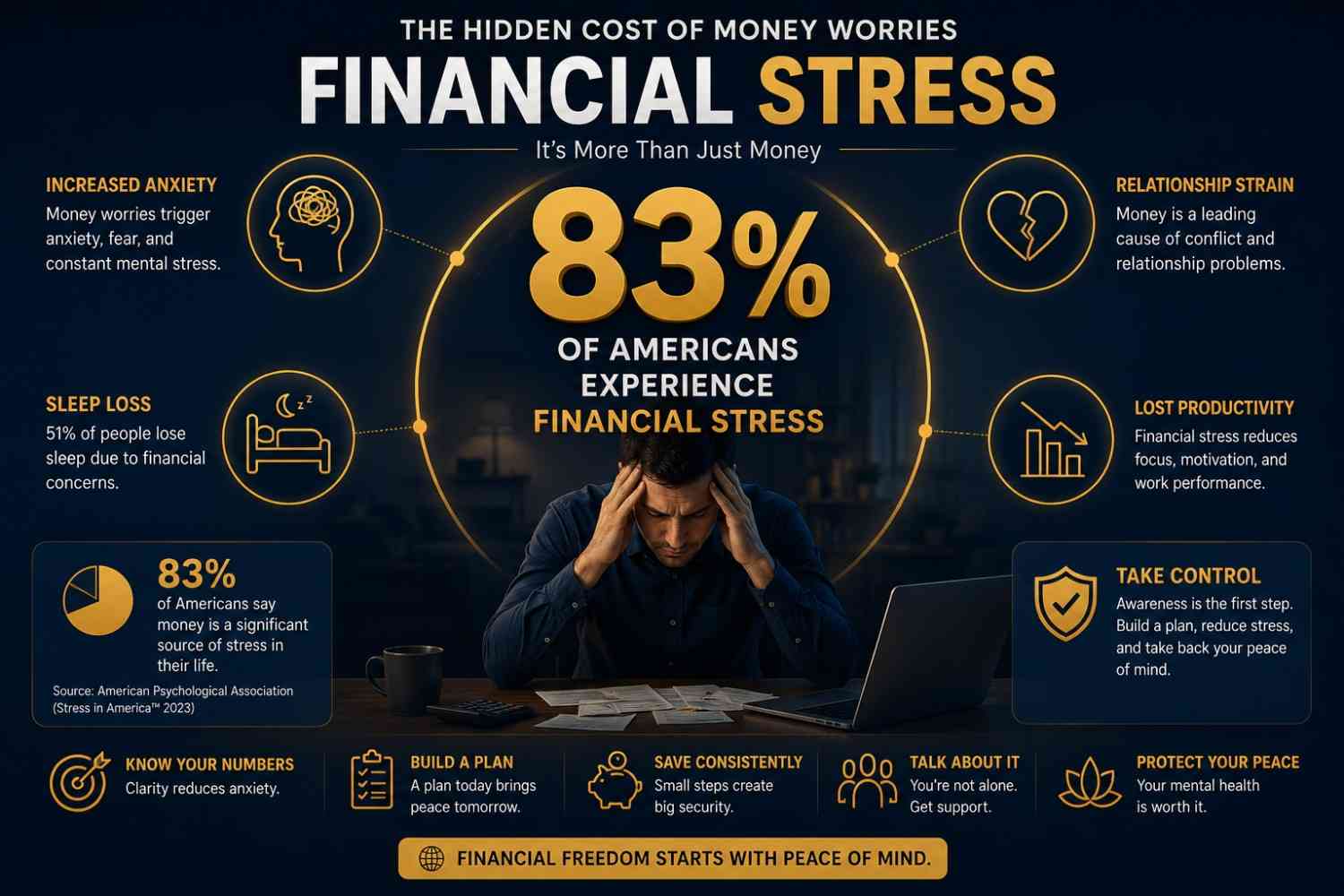
Financial fulfillment is defined as a state in which financial resources feel aligned with a person’s deepest values and highest aspiration. It reflects not only financial security but also whether money creates a sense of freedom, confidence, and forward momentum in one’s life.
Penny Pennington, a managing partner at Edward Jones, captured the stakes: “That gap between money and meaning is where real progress can be made.”
The psychology behind this has a name: locus of control. Research published in Frontiers in Psychology found that when people feel a stronger internal locus of control over their financial lives—the sense that their decisions actually shape their outcomes—they plan more, save more, and make more deliberate financial choices. The inverse is also true. When that sense of agency erodes, even people with stable incomes begin to disengage.

The Paycheck-to-Paycheck Reality
The paradox is visible in the conflicting data on paycheck-to-paycheck living. Debt.com’s 2026 Budgeting Survey found that 48% of Americans are living paycheck to paycheck—a 21-point drop from the record high of 69% in 2025 and the lowest figure since tracking began in 2022.
However, the CNBC and SurveyMonkey Quarterly Money Survey found that 63% of Americans are living paycheck to paycheck, with 90% of them having less than $500 left over each month after expenses.
The discrepancy reflects different methodologies and definitions, but the underlying story is consistent: roughly half to two-thirds of Americans are financially stretched, and the margin for error is razor-thin. Among those living paycheck to paycheck, 71% say a one-week delay in pay would cause major hardship or a critical emergency.
The coping mechanisms are desperate and costly:
- 50% delay paying bills or utilities
- 40% cut back on general spending
- 33% borrow money from friends or family
- 23% dip into savings or emergency funds
- 19% take out a loan or use a credit card
Income Is No Shield
The paradox extends well into six-figure incomes. Data from PYMNTS Intelligence shows that just over six in 10 consumers earning $100,000 to $150,000 annually live paycheck to paycheck, as do 46% earning more than $150,000. Among those earning more than $150,000 who live paycheck to paycheck, 48.6% say they do so by choice and 21% by necessity.
But the “choice” label masks a more complex reality. Lifestyle inflation, housing costs in expensive markets, and the pressure to maintain a certain standard of living can turn a six-figure income into a hand-to-mouth existence. This is the essence of what financial experts call money dysmorphia.
Part II: Understanding Money Dysmorphia
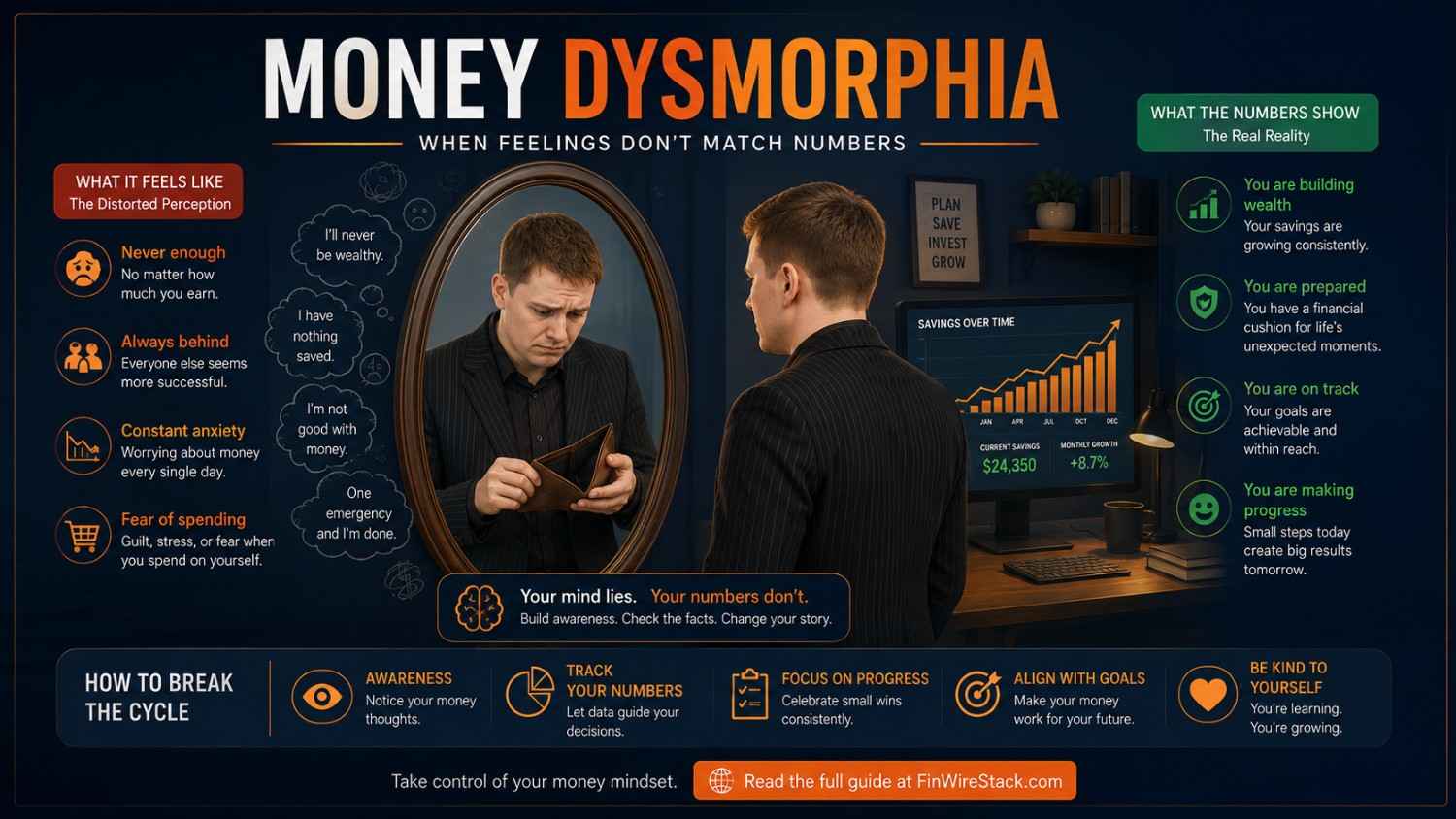
When Money Never Feels Like Enough
The term has gained significant traction, with a 136% uplift in Google searches for “money dysmorphia” between January 2024 and 2025. According to Intuit, 29% of Americans experience money dysmorphia, with the problem being particularly pronounced among younger generations, as 43% of Gen Z and 41% of millennials say they experience it, compared to 25% of Gen X and just 14% of those aged 59 or above.
Christie Cook, director of retail at Hodge Bank, explains: “With social media fuelling unrealistic comparisons and constant negative news about the Cost-of-Living crisis, it’s no surprise that many people are experiencing financial anxiety”.
The phenomenon manifests in two extreme ways:
Overspending: Some people believe they have more money than they do, leading to racking up debt on credit cards and overdrafts, potentially landing themselves in financial difficulty.
Excessive Frugality: Others become overly frugal, avoiding small expenses like going out for a meal even if they can afford it, because they feel financially insecure and worry their savings aren’t as high as they need to be.
The Roots of Financial Distortion
Money dysmorphia isn’t about the math—it’s about the psychology. Your money attitudes often stem from your upbringing: how was money handled by your family when you were a child? Who were your money role models?
Key factors that may contribute to feelings of money dysmorphia include :
- Cost-of-living crisis: We’re hearing about financial uncertainty multiple times a week in the media, which can lead to panic-saving or heightened anxiety.
- Childhood financial environment: Growing up around people who suffered financial hardship can shape attitudes into adulthood.
- Past financial trauma: If you’ve experienced bankruptcy or financial fraud in the past, it can leave you feeling more anxious about dealing with money, even if your situation is now stable.
- Social media comparison: Constant exposure to curated displays of wealth warps perception of “normal” and makes it easier to measure your situation against everyone else’s.
Danielle Desir Corbett, a personal finance expert and host of “The Thought Card” podcast, notes, “Money dysmorphia is when you have a warped or distorted view of your finances. You see your financial situation much differently from your reality.”
How to Recognize Money Dysmorphia
As a relatively new concept, money dysmorphia can go unrecognized. Common signs include:
- Persistent financial anxiety: Constant worry about money regardless of your actual situation
- Obsessively checking bank balances: Needing constant reassurance about your financial standing
- Avoiding financial discussions: Head-in-the-sand approach stemming from anxiety
- Comparison to others: Feeling sad, anxious, or stressed when seeing friends reach financial milestones
- Distorted perception of wealth: Believing you’re doing financially worse or better than reality
- Fear of financial ruin: Even when your situation is stable
- Being overly critical of financial decisions: Excessive self-judgment about spending
- Stressing over future finances: Worrying about financial scenarios that may never materialize
NerdWallet’s Elizabeth Ayoola explained, “When people have money dysmorphia, they’re likely looking at their finances more subjectively than objectively. This can manifest as saving excessively because you feel you’re behind in comparison to your peers. Likewise, it can show up as overspending because you feel you’re financially secure when that’s not the case”.
The HENRY Phenomenon
Money dysmorphia is particularly visible among so-called HENRYs—”High Earners, Not Rich Yet.” These individuals often earn strong incomes but lack the accumulated assets that traditionally define financial security because so much of their cash flow is absorbed by structurally high fixed costs, including housing, childcare, debt repayments, and the invisible lifestyle inflation that accompanies professional advancement.
As Galloway and Housel have noted, total household debt reached $18.8 trillion in the first quarter of 2026, a record that resets with each passing quarter. The federal government’s annual interest expense on the national debt now exceeds $1 trillion, nearly triple the $345 billion paid in 2020.
Morgan Housel, bestselling author of “The Psychology of Money,” framed the problem through a behavioral lens, describing borrowing as increasingly feeling less like a choice and more like a baseline requirement for participation in daily life.
The drivers of the HENRY phenomenon include:
- Lifestyle creep: As income rises, expenses rise with it
- Social media comparison: Constant exposure to curated displays of wealth warps perception of “normal.”
- Rising fixed costs: Housing, childcare, food, and medical costs have consumed disposable income
- Changing standards: A six-figure income no longer buys what it once did
Why Money Dysmorphia Matters
Money dysmorphia can cause real stress because no matter how successful you become, you feel like you don’t have enough.
By excessively saving, people with money dysmorphia can miss out on opportunities to invest and actually grow their wealth. Some people might be scared to spend money, even on the things they actually need. Others might constantly worry about their finances, regardless of what their actual situation is. They may feel anxious or guilty when making purchases, including necessary ones
“The impact goes beyond money,” notes one expert. “It can strain relationships and affect overall well-being. People can also end up depriving themselves of basic needs and joys, which can be detrimental to both mental and physical health.”
.
Part III: The Financial Literacy Connection
A Decade of Decline
The 2026 TIAA Institute–GFLEC Personal Finance Index marks a decade of tracking financial literacy among U.S. adults, and the milestone brings sobering news. Financial literacy among U.S. adults has declined to its lowest level in the survey’s history, even as the personal finance landscape grows more complex.
Americans correctly answered only 47% of the index’s 28 questions on average—a statistically significant decline from the prior year and the lowest result in the survey’s 10-year history. The share of adults with very low financial literacy has grown steadily from 20% in 2017 to 25% in 2026.
The decline is broad-based, not isolated to a single topic. Financial literacy has declined significantly in five of the eight functional knowledge areas: consuming, borrowing, earning, insuring, and comprehending risk.
The Risk Blind Spot
Comprehending risk remains the weakest knowledge area, and it is universal. Only 36% of risk-related questions were answered correctly in 2026, and this is the one functional area where performance is consistently low across all generations, showing little improvement with age.
The difficulty investors have with risk comprehension is one of the most misunderstood concepts in personal finance because it requires people to make decisions under uncertainty. On average, nearly two-thirds of responses to the survey’s risk-related questions were incorrect.
This is the financial literacy gap that most directly feeds into money dysmorphia. When people don’t understand risk—sequence of returns risk, longevity risk, inflation risk, and investment risk—they can’t accurately assess their financial situation. They don’t know whether they’re on track, and that uncertainty breeds anxiety.
The Gender Gap
The gender gap in financial literacy persists, with women scoring 6 percentage points lower than men overall across nearly all functional areas. This gap has implications for:
- Retirement preparation (women live longer, on average)
- Investment behavior (women may be less confident investing)
- Financial decision-making across households
However, Vanguard’s 2026 “How America Saves” report reveals a striking paradox: women display better savings habits overall. They are more likely to participate in workplace retirement plans, save a larger share of their income, and tend to invest more consistently than men.
Yet the average 401(k) balance among men in 2025 was $194,597, compared with $146,476 for women—about a 33% gap. The gap narrows significantly at comparable income levels, suggesting that the primary drivers are income differences and career interruptions, not saving behavior. At comparable income levels, women’s account balances were within 10% of men’s.
Women also show a stronger preference for target-date funds, which automatically adjust investments as retirement approaches. These funds account for 50% of women’s retirement assets on average, compared with 42% for men.
The Gen Z Gap
Gen Z (born 1997–2007) posted the lowest average score of any generation: just 38%. This places them nine percentage points below the national average.
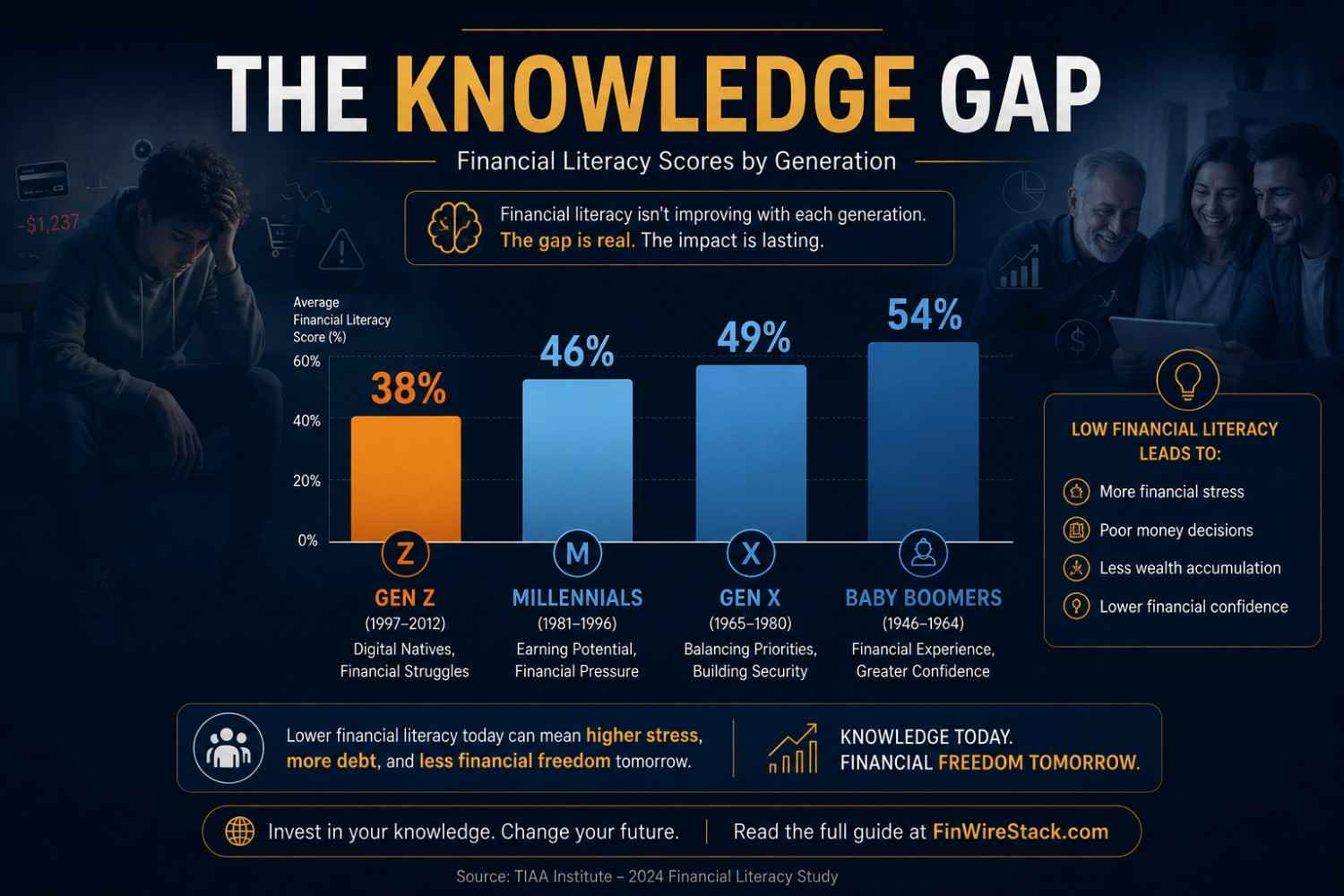
Yet Gen Z also invests most frequently, topping up their investment accounts an average of 12 times a year—more than Millennials (6 times), Gen X (4 times), and Baby Boomers (2 times). They are also the most likely to rate their ability to identify investment opportunities as “high” and their understanding of investing terms as “high.”
This creates a dangerous paradox: a generation with the lowest financial literacy is making the most investment decisions, often influenced by social media and AI tools.
Part IV: The Real-World Consequences
The Cost of Financial Stress
The consequences of financial stress extend far beyond emotional well-being. Workers with very low financial literacy spend nearly 11 hours per week dealing with money issues at work—the equivalent of more than an entire lost workday. This represents a massive productivity drain for employers and a significant source of employee anxiety.
The economic impact of low financial literacy extends beyond individual households and costs the nation billions annually through:
- Poor investment choices: Americans with low financial literacy are more likely to pay high fees, chase past performance, and make emotional investment decisions that erode returns
- High-cost borrowing: Those who don’t understand interest rates and loan terms often end up in payday loans, high-interest credit cards, and predatory lending products
- Missed opportunities: Failure to take advantage of employer 401(k) matches, tax-advantaged accounts, and other wealth-building tools leaves money on the table
The Retirement Savings Gap
Americans say they need $1.2 million to $1.46 million to retire comfortably, according to Schroders’ 2026 U.S. Retirement Survey and Northwestern Mutual’s 2026 Planning & Progress Study. However:
- 51% of workplace retirement plan participants expect to have less than $500,000 saved at retirement
- 24% expect to have less than $250,000
- Only 30% expect to reach $1 million
Vanguard’s 2026 “How America Saves” report provides the reality check. The average 401(k) balance is $167,970—a record high, driven by strong stock market performance. But the median balance—the more meaningful measure for most Americans—is just $44,115.
Run that through a standard 4% annual withdrawal rate, and the typical retiree has $1,765 per year—or $147 per month. That is not enough for rent, for medications, or, in any honest accounting, for retirement.
The Workplace Opportunity
Employers are uniquely positioned to address both financial literacy and money dysmorphia. The employer-employee relationship represents one of the most direct and trusted opportunities to deliver meaningful financial and retirement education.
Kourtney Gibson, TIAA CEO of Retirement Solutions, framed the urgency: “When knowledge gaps are this widespread, the consequences are real. They show up in retirement accounts that fall short, in Social Security decisions made without the full picture, and in financial stress that compounds over time”.
Part V: What Americans Can Do Now
Restore Your Money Reality
One thing that can help, experts say, is asking a financial professional if you’re in good shape. And if they say you are, try to really listen to them.
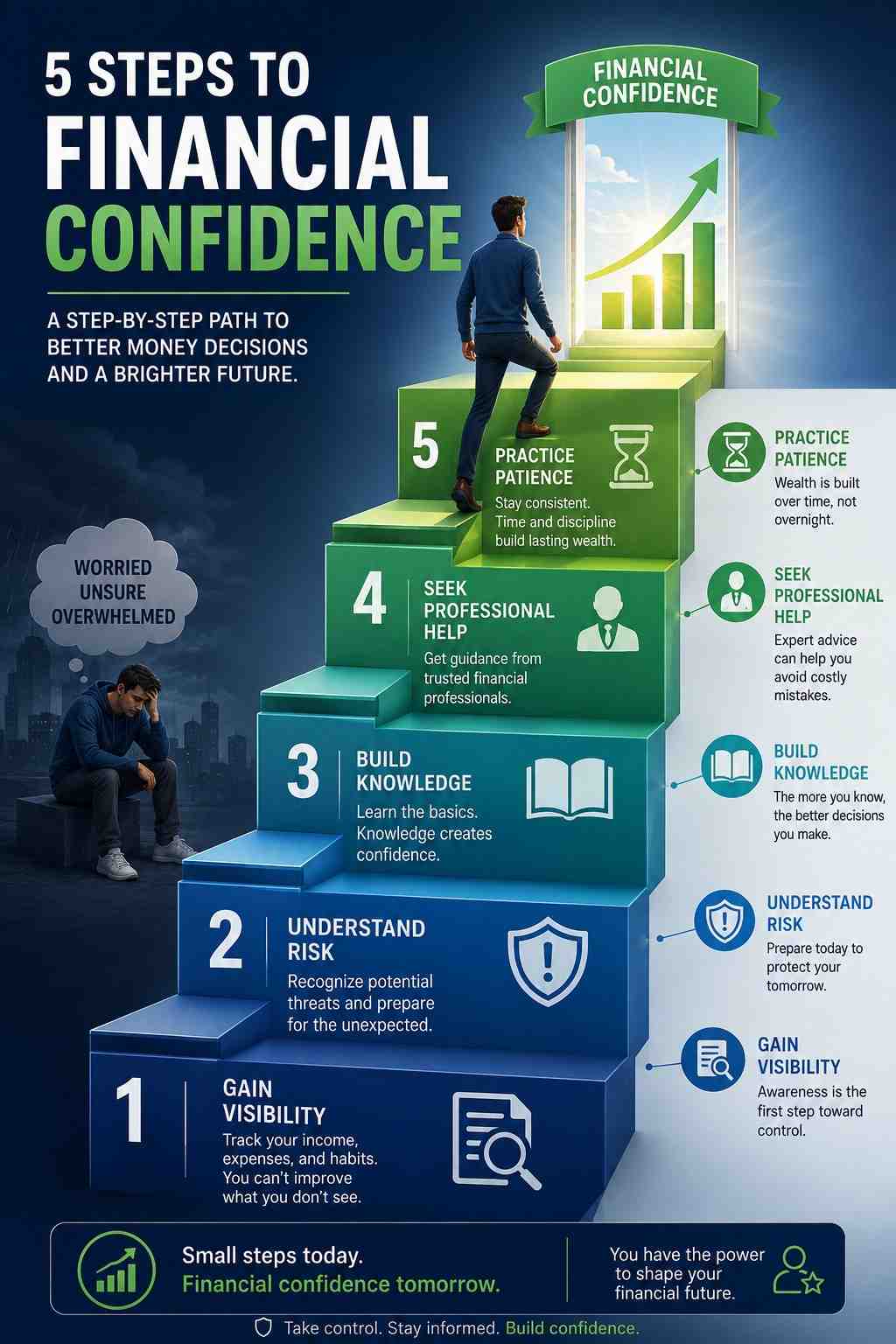
“Fifty-one percent of participants reported feeling conflicted, and that is where financial advisors can have the greatest impact,” said Dan Klug, a financial advisor with Edward Jones. “Advisors can be a fulfillment multiplier.”
Financially fulfilled adults are far more likely to have engaged a professional financial advisor (60% in the U.S. and 74% in Canada) than financially stressed adults (14% and 26%, respectively).
If you don’t have an advisor, this could be a good time to consult one. Writing down your income, expenses, savings, and debt can be a good first step.
Understand the Distinction Between Income and Wealth
One of the core misconceptions underpinning money dysmorphia is the assumption that income and wealth are interchangeable. They are not.
Income is what you earn. Wealth is what you own and what continues compounding independently over time through pensions, investments, home equity, and other appreciating assets. This distinction matters because many high earners experience their finances emotionally through monthly cash flow rather than through long-term net worth.
Prioritize Risk Comprehension
Risk comprehension is the weakest area across all generations. Americans should focus on understanding:
- Sequence of returns risk: How the timing of market fluctuations affects retirement income
- Longevity risk: How long retirement might last
- Inflation risk: How rising prices erode purchasing power
- Investment risk: Understanding volatility and how it relates to returns
This knowledge is not intuitive; it requires active study.
Build Financial Visibility
One of the most effective ways to combat money dysmorphia is to gain clarity about your financial situation. Financial confidence comes less from chasing arbitrary salary milestones and more from understanding how your entire financial system works together over time.
This means:
- Tracking all income sources and expenses
- Understanding your net worth, not just your paycheck
- Projecting your financial future under different scenarios
- Regularly reviewing progress toward goals
Leverage Available Resources
Financial education makes a measurable difference. The 2026 P-Fin Index found that those who have received financial education score 13 percentage points higher than those who have not. Among workers with higher retirement fluency, more than 80% save for retirement on a regular basis and 70% feel confident they will have enough money to live comfortably throughout retirement.
Resources to consider:
- Employer-sponsored financial wellness programs: Often include one-on-one coaching, educational workshops, and planning tools
- Nonprofit financial counseling: Organizations like the National Foundation for Credit Counseling offer free or low-cost guidance
- Online educational platforms: Khan Academy, Personal Finance, Coursera, and edX offer comprehensive courses
- Professional advisors: Fee-only fiduciary financial advisors can provide personalized guidance
Part VI: Looking Ahead to 2035
The trajectory of financial stress in America is unsustainable. If current trends continue:
- Financial literacy will continue to decline, particularly among Gen Z
- Money dysmorphia will become more widespread as social media comparison intensifies
- The retirement savings gap will widen as more Americans reach retirement age with insufficient savings
- Workplace productivity will suffer as financial stress consumes more employee time and attention
But the data also points toward a path forward. Financial education works. Those who receive it score significantly higher on financial literacy measures. Employers are uniquely positioned to deliver this education at scale. And individuals who take control of their financial knowledge can break the cycle of money dysmorphia.
Financial confidence is not a destination you arrive at—it’s a muscle you have to keep using. And most people have never been given the equipment to train it.
Conclusion: The Path Forward
The data is clear: 83% of Americans are financially stressed, yet many are objectively doing fine. The gap between what is true and what is felt is the central challenge of modern personal finance. Financial literacy is at a decade low at 47%, and those with low literacy are four times more likely to struggle and three times more likely to be financially fragile.
Financial security is an emotion before it’s ever a number. The path forward requires not just better financial products, but also better financial education and a deeper understanding of the psychology of money.
Frequently Asked Questions About the Psychology of Money
What is the psychology of money, and why does it matter?
The psychology of money refers to the emotional and behavioral aspects of how people think about, feel about, and interact with money. It matters because financial decisions are rarely purely rational—they’re influenced by upbringing, social comparison, past trauma, and cognitive biases. Understanding the psychology of money can help people make better financial decisions, reduce stress, and build lasting financial confidence.
What is money dysmorphia?
Money dysmorphia is a disconnect between how you feel about your finances and the reality of your financial situation. It can manifest as excessive anxiety and avoidance of spending even when you’re financially secure, or as overspending because you believe you have more money than you actually do. According to Intuit, 29% of Americans experience money dysmorphia, with the problem being particularly pronounced among younger generations.
How common is financial stress in America?
According to the 2026 Edward Jones and Gallup study, 83% of Americans experience financial stress, strain, or uncertainty. Just 16% of U.S. adults are financially fulfilled, meaning their finances genuinely support the life they want to have. 51% fall into a “conflicted middle”—not in crisis but not fully confident or secure either.
Why do I feel financially insecure even though I make good money?
This feeling is often caused by money dysmorphia, social media comparison, lifestyle creep, and rising fixed costs. Many high earners experience their finances through monthly cash flow rather than long-term net worth, leading to anxiety despite high incomes. Additionally, financial literacy gaps—particularly in understanding risk—can make it difficult to accurately assess your financial situation.
How can I improve my psychology of money?
Improving your psychology of money involves gaining clarity about your financial situation, understanding the distinction between income and wealth, prioritizing risk comprehension, and working with a financial professional. Financial education makes a significant difference—those who receive financial education score 13 percentage points higher on financial literacy measures.
How is social media affecting the psychology of money?
Social media magnifies money dysmorphia by making it easier to measure your situation against everyone else’s. Pre-social media, people mostly sized themselves up against neighbors or community members. Now you can compare yourself to everyone you’ve ever met—and even people you haven’t. This constant exposure to curated displays of wealth warps perception of “normal.”
About the Author
The FinWireStack Editorial Team is composed of financial researchers, writers, and former financial advisors dedicated to translating complex financial topics into actionable insights for everyday Americans. Based in Bozeman, Montana, FinWireStack focuses on helping Americans make smart money decisions in the digital age.
Sources and Further Reading
- Edward Jones and Gallup. (2026). Money and Meaning: Understanding Financial Fulfillment.
- TIAA Institute and GFLEC. (2026). A Decade of Tracking Financial Literacy in America: Findings from the 2026 TIAA Institute–GFLEC Personal Finance Index.
- Vanguard. (2026). How America Saves 2026.
- CNBC. (2026, June). Women have better retirement savings habits but lower 401(k) balances than men, Vanguard finds.
- NAPA Net. (2026, June). Financial Literacy Moving in the ‘Wrong Direction’: TIAA.
- TheStreet. (2026, May). Scott Galloway, Morgan Housel raise red flag on the American Dream.
- Hodge Bank. (2025). Understanding ‘Money Dysmorphia’ and if you have it & the psychology of money.
- Yahoo Finance. (2024). “Money Dysmorphia” Could Be Seriously Hurting Your Finances.
- Financial Planning. (2026, June). Understanding risk remains a major investor blind spot: TIAA Institute.
- FA Mag. (2026, June). Financial Well-Being Does Not Translate Into Security, Survey Shows.