
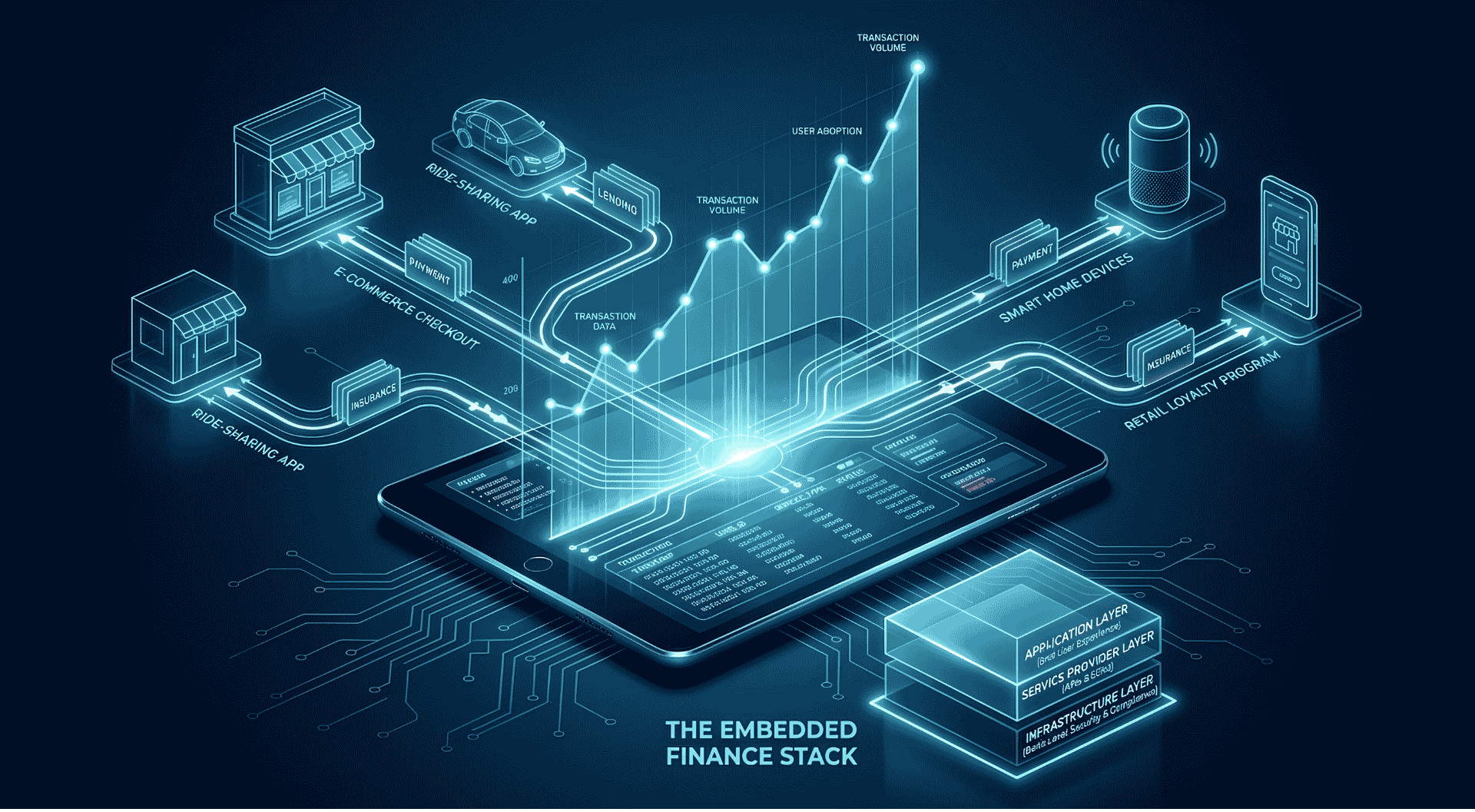
The Embedded Finance Revolution: What You Need to Know
Embedded finance explained starts with a simple observation: financial services are everywhere now, but you barely notice them.
Ten years ago, getting a loan meant visiting a bank branch. Opening a bank account required paperwork and appointments. Paying in installments meant a store credit card with high interest rates.
Today, you can buy a $1,000 mattress and pay in four interest-free installments at checkout. You can open a bank account inside your ride-share app. You can get insurance while booking a flight.
This is embedded finance explained in action.
The Definition
Embedded finance explained simply: it is the integration of financial services into non-financial applications, platforms, and ecosystems.
| Traditional Finance | Embedded Finance |
|---|---|
| Go to bank for a loan. | Loan offered at checkout |
| Download banking app | Banking inside a rideshare app |
| Visit insurance broker | Insurance during flight booking |
| Apply for credit card | Buy now, pay later at any store |
“Embedded finance explained” means financial services come to you, not the other way around.
Why This Matters Now
| Statistic | Value |
|---|---|
| Global embedded finance market size (2025) | $124 billion |
| Projected market size (2030) | $680 billion |
| Annual growth rate | 25-30% |
| Businesses using embedded finance | 65% of SaaS platforms |
| Consumers who have used embedded finance | 72% of US adults |
Understanding embedded finance explained is no longer optional for business owners or curious consumers.
For related fintech trends, see Fintech Compliance for Small Businesses.
Embedded Finance Explained: A Simple Definition
Let me give you the clearest embedded finance-explained definition possible.
The One-Sentence Definition
Embedded finance is the placement of financial products—payments, lending, insurance, banking, or investments—directly into non-financial websites, mobile apps, or business platforms.
Breaking It Down
| Component | What It Means |
|---|---|
| Financial products | Loans, payments, insurance, bank accounts, cards, investments |
| Non-financial platforms | E-commerce stores, ride-share apps, accounting software, HR platforms |
| Integration | Seamless, invisible, feels like part of the original experience |
Example: Embedded Finance vs. Traditional Finance
| Scenario | Traditional Way | Embedded Way |
|---|---|---|
| Buying a laptop | Go to bank, apply for loan, wait days, then buy | Select “Pay in 4” at checkout, approved instantly |
| Paying for ride | Enter credit card in app once | Automatic payment, no action needed |
| Insuring a rental car | Call insurance agent, get quote, buy separately | Insurance offered during rental checkout |
| Saving for retirement | Open IRA at brokerage, link a bank, and set transfers | Round-ups from daily purchases into automated savings |
Embedded finance, explained, is about removing friction. Financial services become invisible.
For seamless financial management, see Best Free Portfolio Trackers for Crypto and Stocks.
How Embedded Finance Works: The Technology Behind the Scenes
Embedded finance explained requires understanding the technology that makes it possible.
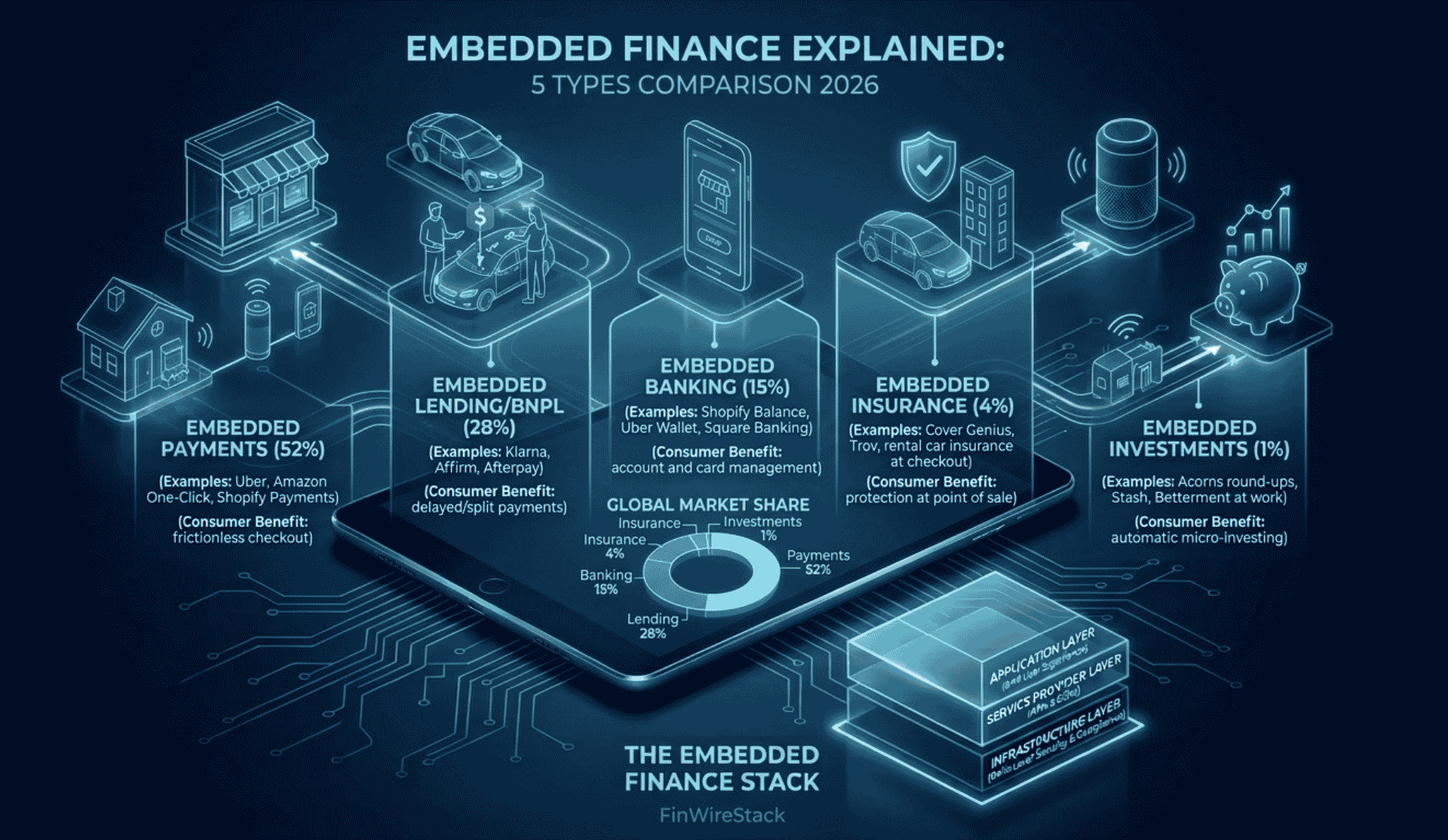
The Four-Layer Technology Stack
| Layer | What It Does | Examples |
|---|---|---|
| 1. User interface | Where customers interact | Checkout button, loan offer pop-up |
| 2. API integration | Connects platform to financial providers | Stripe, Plaid, Marqeta |
| 3. Banking infrastructure | Holds funds, processes payments | Evolve Bank, Cross River, Sutton Bank |
| 4. Regulatory compliance | KYC, AML, licensing | Automated identity verification |
How a Buy Now, Pay Later Transaction Works
| Step | What Happens | Behind the Scenes |
|---|---|---|
| 1 | The customer selects “Pay in 4” at checkout | Embedded finance API activates |
| 2 | The customer provides basic info (name, DOB, phone) | API sends to BNPL provider |
| 3 | Instant approval decision | The provider runs soft credit check |
| 4 | The customer pays first installment | API processes payment |
| 5 | The platform receives full payment upfront | Provider pays platform immediately |
| 6 | The customer pays remaining installments | The provider collects from the customer. |
All of this happens in under 10 seconds.
Key Technology Enablers
| Technology | Role in Embedded Finance |
|---|---|
| APIs (Application Programming Interfaces) | Allow platforms to connect to financial services without building banking infrastructure |
| Banking-as-a-Service (BaaS) | Platforms that provide banking infrastructure to non-banks |
| Cloud computing | Enables real-time processing and scalability |
| AI and machine learning | Powers instant credit decisions and fraud detection |
For AI applications in finance, see Agentic AI Fraud Detection for Community Banks.
Embedded Finance Explained: Real-World Examples You Already Use
Embedded finance explained becomes clear when you see examples from companies you know.
Example 1: Shopify Balance
Shopify, an e-commerce platform, now offers Shopify Balance — a business bank account integrated directly into the Shopify dashboard.
| Feature | What It Does |
|---|---|
| No-fee business account | Bank account without monthly fees |
| Shopify Card | Physical and virtual debit card |
| Instant payouts | Access sales revenue immediately |
| Cashback rewards | 1-2% back on business spending |
Shopify is not a bank. It partnered with Stripe Treasury and Evolve Bank & Trust to offer these services. This is embedded finance explained perfectly.
Example 2: Uber Wallet
Uber’s app now includes Uber Wallet—a stored balance that lets riders prepay for rides and drivers access instant earnings.
| Feature | What It Does |
|---|---|
| Rider balance | Add funds, use for rides and Uber Eats |
| Instant driver pay | Drivers cash out earnings instantly |
| Uber Pro Card | Debit card for drivers with rewards |
| Uber Credit Card | Co-branded card for rider rewards |
Example 3: Amazon Buy with Prime
Amazon now allows merchants on other websites to offer Buy with Prime, which includes Amazon’s payment and fulfillment services.
| Feature | What It Does |
|---|---|
| One-click checkout | Uses Amazon payment credentials |
| Prime delivery | Amazon handles shipping |
| Returns | Amazon customer service handles returns |
Example 4: Klarna and Affirm at Checkout
Thousands of e-commerce stores now offer Klarna, Affirm, or Afterpay at checkout.
| Feature | What It Does |
|---|---|
| Pay in 4 | Four interest-free installments |
| Pay in 30 days | Receive product, pay later |
| Monthly financing | Longer-term installment loans |
The store does not lend money. Klarna does. The store just integrates Klarna’s button.
Example 5: Square (Block) Embedded Banking
| Feature | What It Does |
|---|---|
| Square Banking | Business loans based on card processing volume |
| Square Card | Debit card with instant access to sales |
| Square Savings | Automated savings from daily sales |
For investment tracking across platforms, see Best Free Portfolio Trackers.
The 5 Main Types of Embedded Finance
“Embedded finance explained” covers five distinct categories.
Type 1: Embedded Payments
The oldest and most mature form of embedded finance.
| Example | How It Works |
|---|---|
| Uber automatic payment | Card on file, charged after each ride |
| Amazon One-Click | Saved payment credentials |
| In-app purchases | Apple Pay, Google Pay |
Type 2: Embedded Lending (Buy Now, Pay Later)
The fastest-growing segment of embedded finance.
| Example | How It Works |
|---|---|
| Klarna at checkout | Instant loan decision |
| Affirm | Installment payments |
| PayPal Pay Later | Integration into any PayPal merchant |
Type 3: Embedded Banking (Banking-as-a-Service)
Non-bank platforms offering bank accounts, cards, and transfers.
| Example | How It Works |
|---|---|
| Shopify Balance | Business banking inside Shopify |
| Uber Wallet | Stored balance for riders and drivers |
| Square Banking | Banking integrated with payment processing |
Type 4: Embedded Insurance
Insurance is offered when purchasing a non-financial product.
| Example | How It Works |
|---|---|
| Rental car insurance | Offered during rental booking |
| Travel insurance | Offered during flight or hotel booking |
| Device protection | Offered during electronics purchase |
Type 5: Embedded Investments
Investment services integrated into non-investment platforms.
| Example | How It Works |
|---|---|
| Acorns | Round-up investments from daily purchases |
| Stash | Investment accounts via budgeting app |
| Betterment at work | 401(k) integration into HR platforms |
An explanation of embedded finance across all five types shows how pervasive this trend has become.
Embedded Finance Explained: Why It Matters for Businesses
Embedded finance explained from a business perspective reveals massive opportunities.
Revenue Generation
| Revenue Source | How It Works | Typical Margin |
|---|---|---|
| Interchange fees | Earn percentage of each transaction | 1-3% |
| Interest income | Earn interest on embedded loans | 5-30% |
| Subscription fees | Charge for premium financial features | $5-15/month |
| Referral fees | Earn commission for referring to financial partners | $50-500 per customer |
Customer Retention
| Metric | Without Embedded Finance | With Embedded Finance |
|---|---|---|
| Customer retention rate | 40-60% | 70-85% |
| Average customer lifetime value | $500 | $1,200-2,000 |
| Switching costs | Low | High (customer has funds in your platform) |
Competitive Advantage
Embedded finance explained as a competitive weapon:
| Without Embedded Finance | With Embedded Finance |
|---|---|
| The customer leaves to pay elsewhere | The customer pays within your platform |
| No data on customer financial behavior | Rich spending and lending data |
| A competitor offers embedded finance | You lose customers to competitors. |
For businesses considering embedded finance, compliance is critical. See Fintech Compliance for Small Businesses.
Embedded Finance Explained: Why It Matters for Consumers
Embedded finance explained from a consumer perspective reveals convenience and cost savings.
Convenience
| Traditional | Embedded |
|---|---|
| Apply for loan at bank (days) | Instant approval at checkout (seconds) |
| Separate insurance quote process | Insurance offered during booking |
| Multiple apps for banking, payments, lending | One platform for everything |
Cost Savings
| Traditional Cost | Embedded Cost |
|---|---|
| Credit card interest (15-25% APR) | Pay in 4 (0% interest) |
| Bank account fees ($10-15/month) | Embedded banking (often free) |
| Wire transfer fees ($25-50) | Instant transfers (often free) |
Access
Embedded finance explained also democratizes access.
| Previously | Now |
|---|---|
| Need credit history for loan | BNPL uses alternative data |
| Minimum balance requirements | No minimums for embedded accounts |
| Physical bank branch required | All done on a smartphone. |
For consumers wanting to track spending across embedded finance apps, see Best Free Portfolio Trackers for Crypto and Stocks.
The Embedded Finance Market: Growth and Projections
Embedded finance explained with data shows the scale of this transformation.
Global Market Size
| Year | Market Size | Growth |
|---|---|---|
| 2020 | $22 billion | – |
| 2021 | $33 billion | +50% |
| 2022 | $48 billion | +45% |
| 2023 | $68 billion | +42% |
| 2024 | $92 billion | +35% |
| 2025 | $124 billion | +35% |
| 2030 (projected) | $680 billion | +40% annually |
By Region (2025)
| Region | Market Share | Leading Use Case |
|---|---|---|
| North America | 45% | Buy Now, Pay Later |
| Europe | 28% | Embedded banking |
| Asia-Pacific | 18% | Embedded payments |
| Rest of world | 9% | Embedded lending |
By Vertical (2025)
| Industry | Embedded Finance Penetration |
|---|---|
| E-commerce | 65% |
| SaaS platforms | 55% |
| Ride-sharing | 90% |
| Travel | 45% |
| Healthcare | 20% |
By Type (2025)
| Type | Market Share |
|---|---|
| Embedded payments | 52% |
| Embedded lending (BNPL) | 28% |
| Embedded banking | 15% |
| Embedded insurance | 4% |
| Embedded investments | 1% |
Embedded finance explained through these numbers shows explosive growth with no signs of slowing.
Embedded Finance Explained: Key Players and Platforms
Embedded finance explained requires knowing who powers the ecosystem.
Banking-as-a-Service (BaaS) Providers
These companies provide the banking infrastructure that non-banks use to offer financial services.
| Provider | Key Offering | Partner Banks |
|---|---|---|
| Stripe Treasury | API for embedded bank accounts | Evolve, Goldman Sachs |
| Marqeta | Card issuance and processing | Multiple regional banks |
| Plaid | Data connectivity and identity verification | All major banks |
| Unit | Complete BaaS platform | Multiple FDIC banks |
| Synapse | Banking and credit API | Evolve, American Bank |
| Solid | Embedded finance API | Lead Bank |
Buy Now, Pay Later Providers
| Provider | Market Share | Key Feature |
|---|---|---|
| Klarna | 25% | Pay in 30 days |
| Affirm | 22% | Longer-term financing |
| Afterpay (Block) | 20% | Pay in 4 |
| PayPal Pay Later | 18% | Integration with PayPal |
| Sezzle | 8% | Smaller ticket focus |
Embedded Banking Platforms
| Platform | Embedded Finance Feature |
|---|---|
| Shopify | Shopify Balance, Shopify Credit |
| Square | Square Banking, Square Card |
| Uber | Uber Wallet, Uber Pro Card |
| Amazon | Amazon Cash, Buy with Prime |
| DoorDash | DasherDirect (instant pay for drivers) |
Embedded Insurance Providers
| Provider | Focus |
|---|---|
| Cover Genius | Embedded insurance for travel, retail |
| Embedded Insurance (company) | White-label insurance APIs |
| Trov | On-demand device insurance |
For security considerations with these platforms, see Cybersecurity for Investors: Protecting Your Brokerage Accounts.
Challenges and Risks of Embedded Finance
Embedded finance explained must include the risks.
Regulatory Challenges
| Challenge | Impact |
|---|---|
| Licensing requirements | Non-banks must partner with licensed banks or obtain licenses |
| Compliance burden | KYC, AML, data privacy requirements apply |
| State-by-state rules | Money transmitter licenses needed in 48+ states |
| Cross-border complexity | Different rules in every country |
Consumer Protection Risks
| Risk | Example | Mitigation |
|---|---|---|
| Unclear responsibility | Who handles dispute? Platform or bank? | Clear disclosures needed |
| Data privacy | Non-bank now has financial data | Strong data agreements |
| Overlending | BNPL encourages over-spending | Affordability checks |
| Hidden fees | Late fees on BNPL can be high | Fee transparency required |
Technical Risks
| Risk | Impact |
|---|---|
| API downtime | Payments and loans unavailable |
| Security breaches | Financial data exposed |
| Integration complexity | Multiple API partners to manage |
The Dark Side of BNPL
Embedded finance explained honestly includes criticism of buy now, pay later:
| Criticism | Evidence |
|---|---|
| Encourages overspending | BNPL users spend 15-30% more |
| Late fees add up | Average late fee: $7-15 per occurrence |
| Debt accumulation | Multiple BNPL loans simultaneously |
| Younger users at risk | BNPL usage highest among 18-34-year-olds. |
For compliance solutions addressing these risks, see KYC/AML Automation for Fintech Startups.
Embedded Finance Explained: Frequently Asked Questions
Is embedded finance safe?
Yes, when offered by reputable platforms. Embedded finance uses the same banking infrastructure as traditional banks. Funds are FDIC-insured (up to $250,000) when held at partner banks. However, consumers should understand who is responsible for disputes and fraud.
How do embedded finance companies make money?
| Revenue Source | How It Works |
|---|---|
| Interchange fees | Percentage of each transaction |
| Interest income | From embedded loans |
| Subscription fees | Premium financial features |
| Referral fees | From referring to financial partners |
| Data monetization | Aggregated, anonymized spending insights |
Do I need good credit for Buy Now, Pay Later?
Many BNPL providers use soft credit checks that do not affect your credit score. Approval decisions use alternative data (purchase history, bank account activity) rather than traditional credit scores. However, late payments may eventually be reported to credit bureaus.
Which companies offer embedded banking?
| Platform | Embedded Banking Feature |
|---|---|
| Shopify | Shopify Balance (business banking) |
| Uber | Uber Wallet (stored balance) |
| Square | Square Banking (merchant banking) |
| Lyft | Lyft Direct (driver banking) |
| DoorDash | DasherDirect (driver banking) |
What is Banking-as-a-Service (BaaS)?
BaaS is the technology that enables embedded finance. BaaS providers (Stripe Treasury, Marqeta, Unit) offer APIs that allow non-banks to integrate banking services without becoming banks themselves. BaaS providers partner with regulated banks that hold customer funds and provide FDIC insurance.
Is embedded finance the future of banking?
Major financial institutions believe so. Goldman Sachs, JPMorgan Chase, and Visa have all launched embedded finance divisions. Analysts project 25-30% annual growth through 2030. Embedded finance explained suggests that within 10 years, most financial transactions will happen through non-financial platforms.
For understanding how embedded finance affects investment tracking, see Best Free Portfolio Trackers for Crypto and Stocks.
Conclusion: Why You Cannot Afford to Ignore Embedded Finance
Embedded finance explained reveals a fundamental shift in how financial services are delivered.
Quick Summary
| Type | Definition | Example |
|---|---|---|
| Embedded payments | Payments integrated into non-financial apps | Uber automatic payment |
| Embedded lending | Loans at point of sale | Klarna at checkout |
| Embedded banking | Bank accounts in non-bank apps | Shopify Balance |
| Embedded insurance | Insurance during purchase | Travel insurance during booking |
| Embedded investments | Investment services in other platforms | Acorns round-ups |
Key Takeaways for Different Audiences
| Audience | Takeaway |
|---|---|
| Consumers | You have more choices than ever. Compare embedded options against traditional banks. Be careful with BNPL—it encourages overspending. |
| Business owners | Embedded finance increases revenue, retention, and customer lifetime value. Start with embedded payments, then explore lending and banking. |
| Investors | The embedded finance market will grow from 124 billion to 680 billion by 2030. Watch BaaS providers (Stripe, Marqeta) and BNPL leaders (Klarna, Affirm). |
| Developers | APIs from Stripe, Unit, and Synapse make embedded finance accessible. Compliance is the hardest part. |
Your Action Plan
- As a consumer, review which embedded finance services you already use. Check for hidden fees. Set spending limits on BNPL.
- As a business owner, consider adding embedded payments to your checkout. Research BaaS providers. Start with payments before lending.
- As an investor, watch the BaaS and BNPL sectors. Learn which platforms have the most integrations. Monitor regulatory developments.
The financial services industry is being rebuilt around embedded finance. Embedded finance, explained, is not a trend. It is the new default.
Ready to explore embedded finance for your business? Contact FinWireStack for embedded finance consulting or compare BaaS providers.