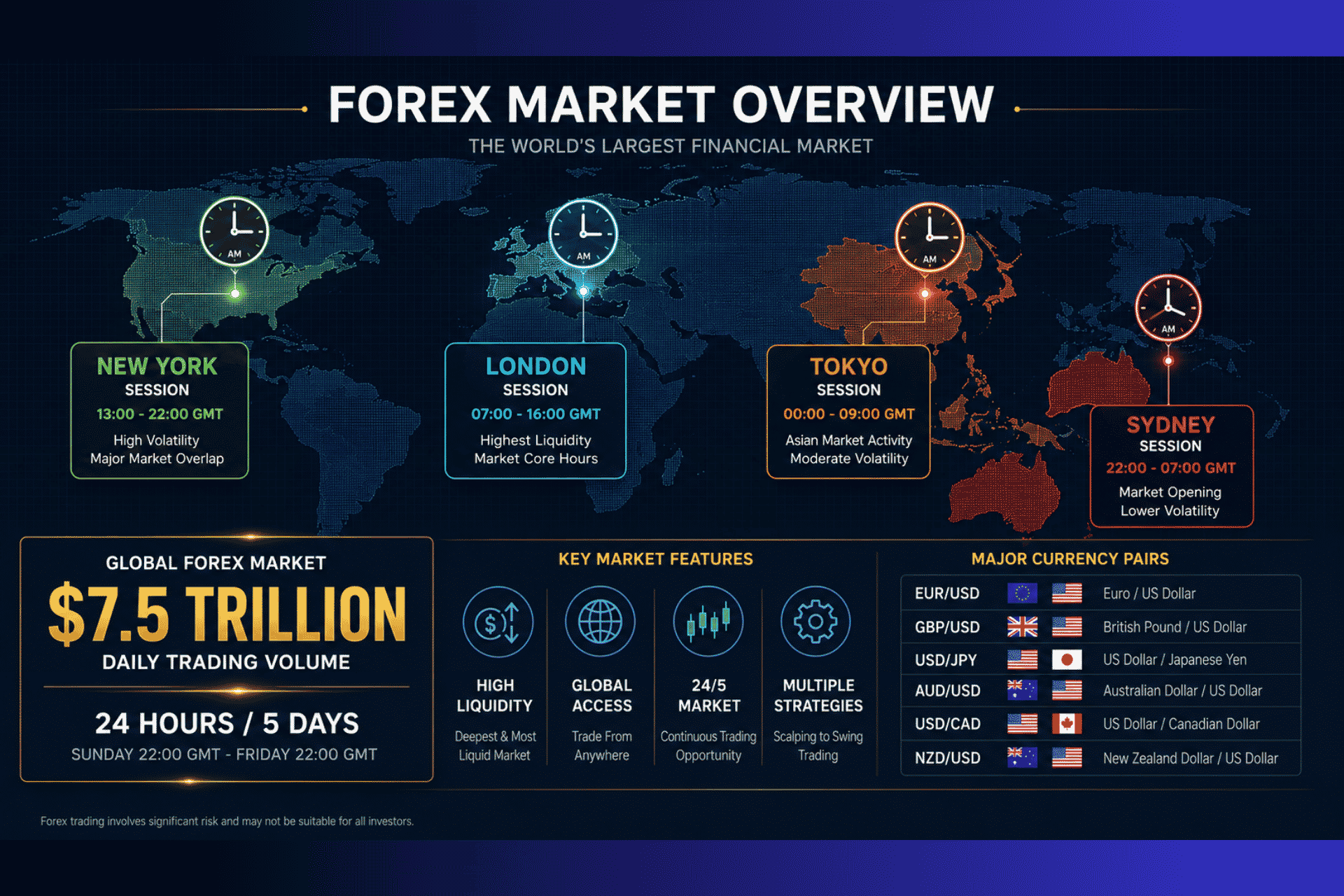
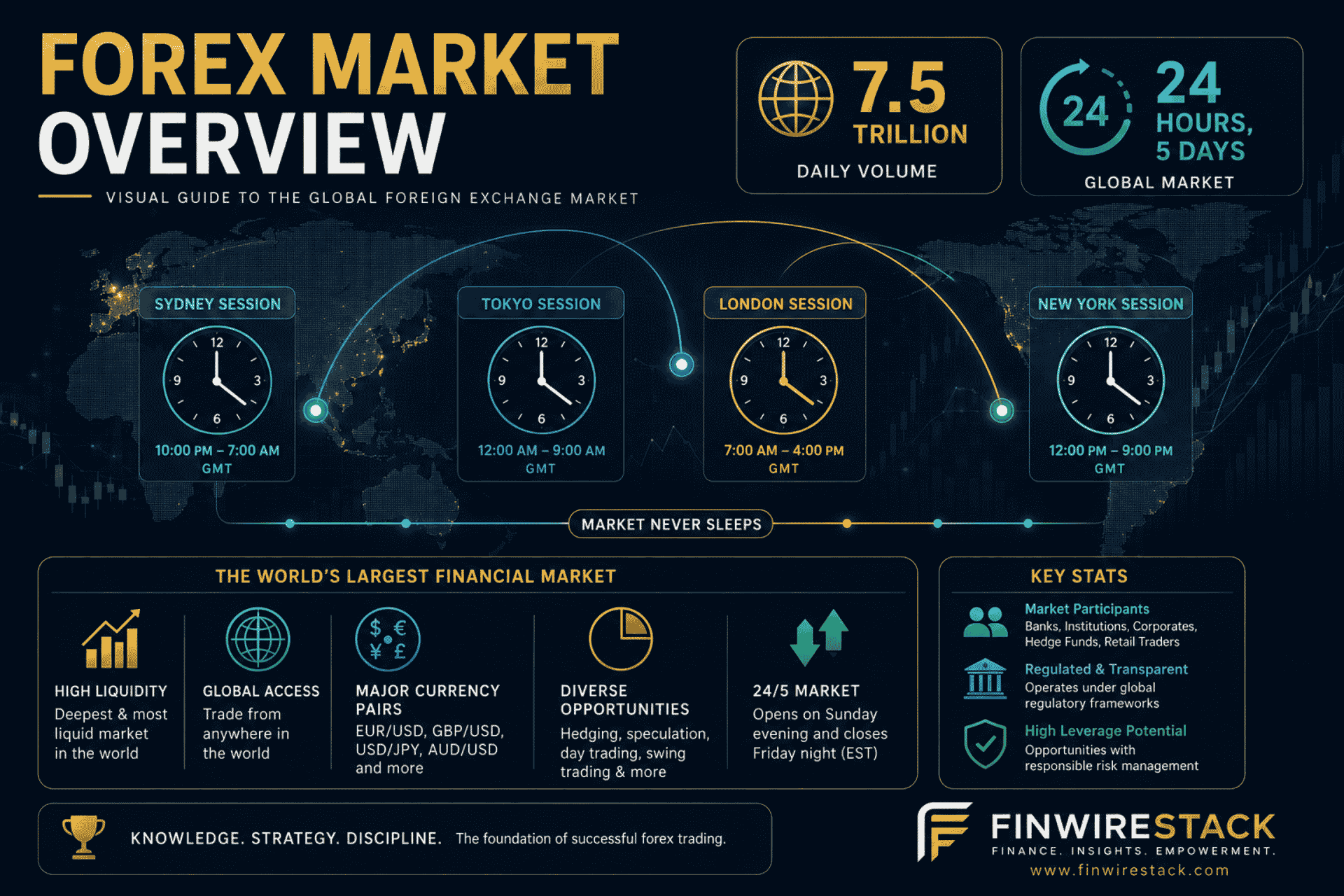
How to start trading forex is one of the most common questions asked by people entering the financial markets. The foreign exchange market is the largest financial market in the world, with daily trading volumes reaching approximately $7.5 trillion, according to the Bank for International Settlements. That scale is why major currency pairs are highly liquid and usually carry tight spreads.
But size alone doesn’t explain how to start trading forex. The reality is that jumping into trading without a structured approach is a recipe for disaster. Many beginners open an account, deposit money, and immediately start losing because they skipped the essential preparation steps.
This guide is different. It walks you through exactly how to start trading forex—from understanding the basics to choosing a broker, opening an account, practicing on a demo, and placing your first real trade. Every step includes real examples, calculations, and practical advice to help you avoid the common mistakes that wipe out beginner accounts.
What is forex trading?
Before learning how to start trading forex, you need to understand what forex trading actually is.
Forex trading is the buying and selling of currencies in pairs to profit from changes in their exchange rates. When you trade EUR/USD, you buy one currency while selling the other at the same time. Every trade is a view on how two economies move relative to each other.
🎯 Real-World Analogy: Imagine you’re traveling to Europe. You exchange US Dollars for Euros at an airport currency booth. If the exchange rate is 1.10, you get 1.10 Euros for every Dollar. Forex trading is like doing this on a massive scale—but instead of traveling, you’re speculating on whether the exchange rate will go up or down.
Key facts to know before learning how to start trading forex:
Step 1: Learn the Essential Forex Terminology
Before you can learn how to start trading forex, you must understand the five terms that drive every trade:
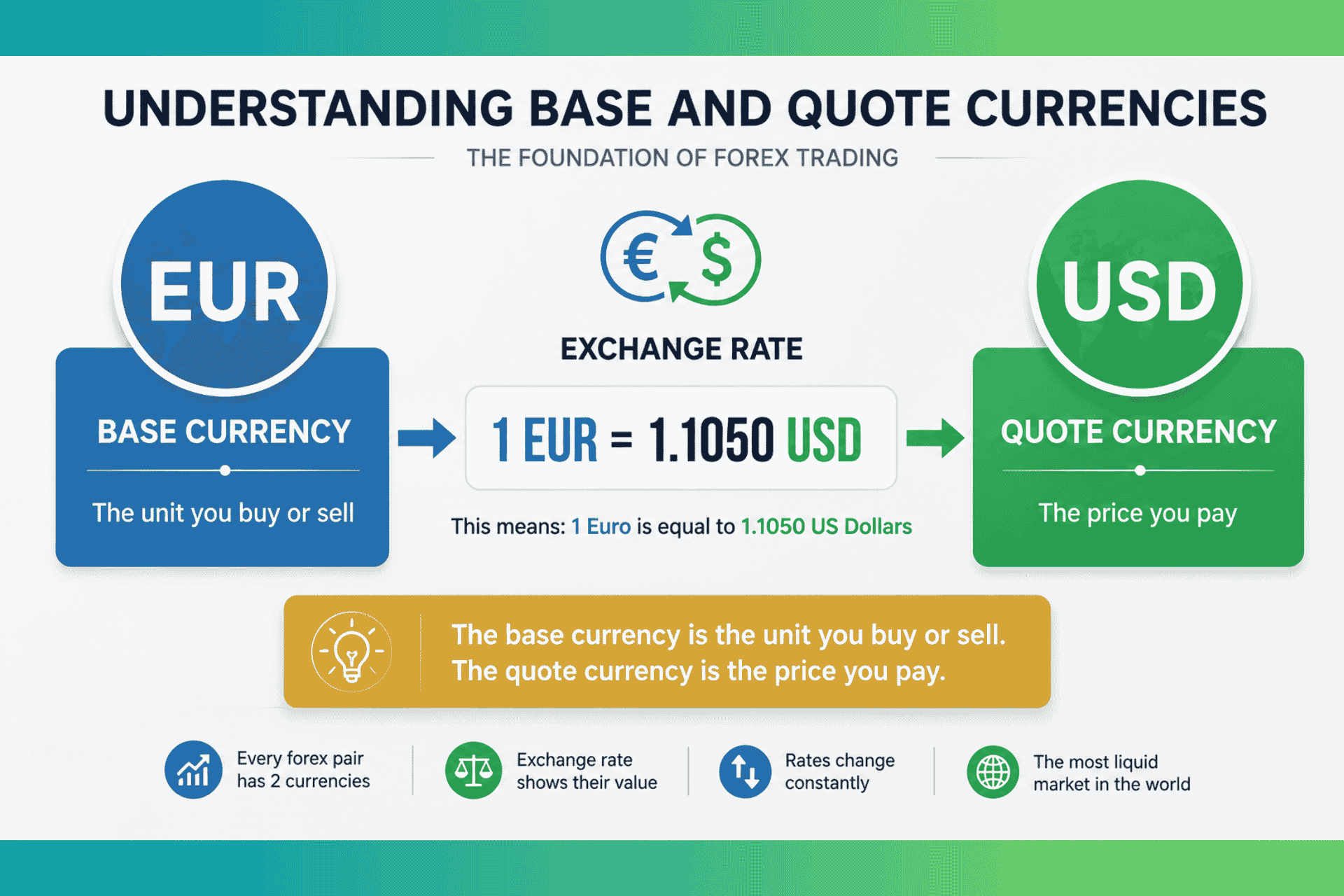
- Currency Pair — Two currencies quoted together. The first is the base currency; the second is the quote currency.
- Pip — The smallest standard price move (the fourth decimal for most pairs).
- Lot — The trade size (a micro lot is 1,000 units).
- Leverage — Borrowed capital that lets you control a larger position with less money.
- Margin — The deposit required to open a leveraged position.
🟦 Blue Highlight: Understanding these terms means you can read a quote and calculate profit, loss, and risk before you click “buy” or “sell.”
Step 2: Choose a Regulated Broker
Your broker decides your trading conditions, so regulation matters most. A regulated broker must follow strict standards around transparency, fair dealing, and the segregation of client funds.
📊 Table: What to Look For in a Broker
Why Regulation is Critical
- Protection of Funds—Regulated brokers must keep client funds in separate accounts from their business operations.
- Fair Trading Environment — Regulations prevent brokers from manipulating prices or failing to execute trades promptly.
- Transparency—Regulatory bodies require regular financial audits and disclosures.
How to Verify a Broker’s Regulation
- Check the broker’s website for license numbers.
- Cross-check on official regulatory websites like the FCA, ASIC, or CySEC.
🔴 Red Highlight: Trading with an unregulated broker exposes you to counterparty risk. If they go bankrupt or engage in fraud, your funds are not protected. This is one of the most important lessons in learning how to start trading forex.
Step 3: Open and Verify a Trading Account
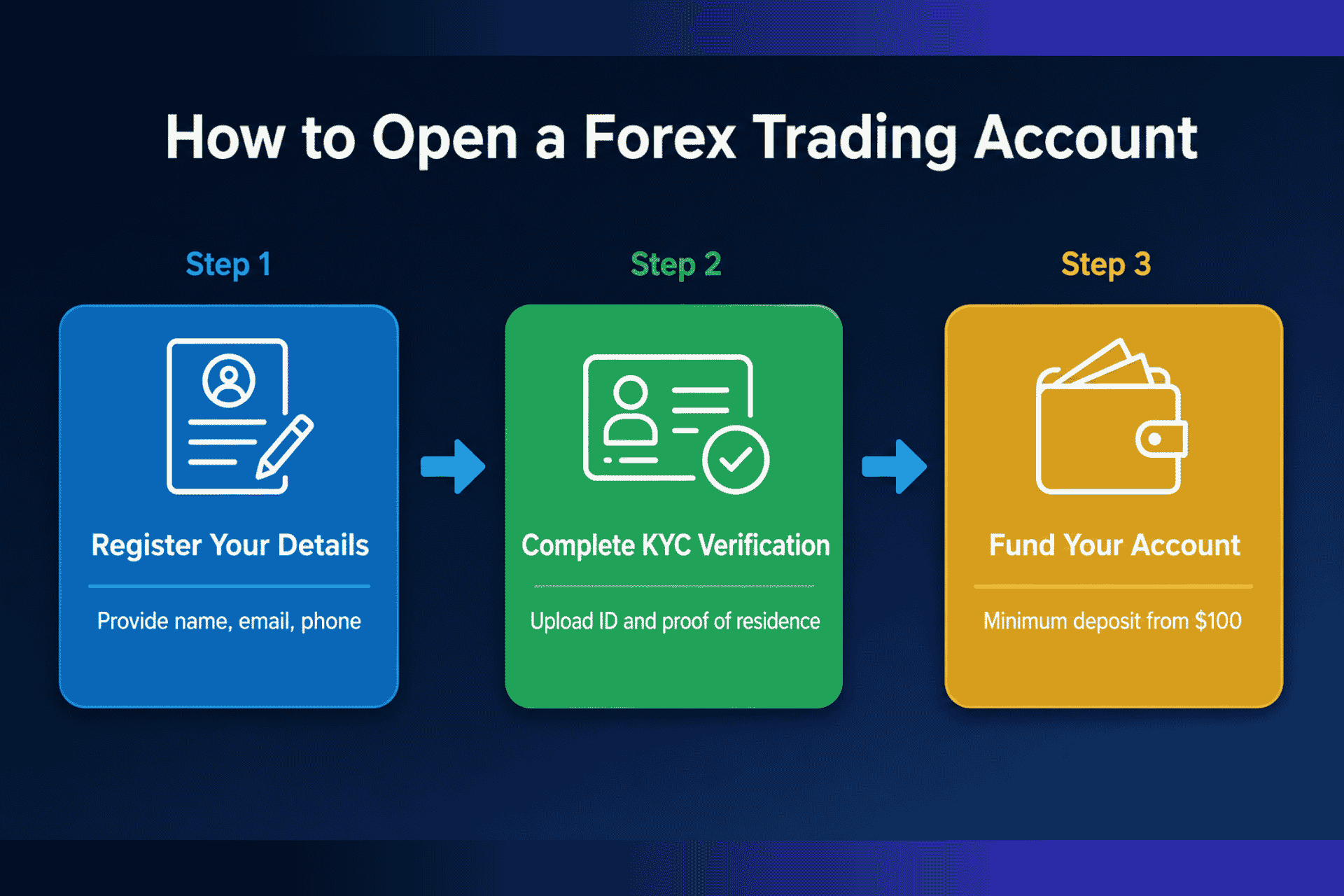
Opening an account follows three stages before you trade forex:
- Register your details — Provide your name, email, phone number, and address.
- Complete identity verification (KYC) — Upload a government-issued ID and proof of residence. This is a regulatory requirement that protects both you and the broker.
- Choose an account type—Select between a standard account (commission-free with wider spreads) or a RAW account (tighter spreads with a commission).
Minimum Deposit: Many brokers allow you to open an account from as little as USD 100. Some let you start even lower. A larger balance leaves more room to manage trades effectively.
Step 4: Practice on a Demo Account
A demo account lets you place trades with virtual funds under live market conditions. Use it to learn the platform, test how orders work, and see how price movement affects a position—without risking real money.
What to Practice on a Demo Account
Common Demo Mistakes to Avoid
- Practicing with an unrealistic virtual balance—Using $100,000 when you only plan to deposit $1,000 undermines your understanding of risk.
- Over-leveraging — Because there is no real money risk, traders tend to max out leverage. High leverage amplifies losses, not just profits.
- Ignoring spread and swap costs—Swing traders often forget about overnight fees that affect long-term positions.
- Practicing only in calm market conditions—Trading only during quiet hours creates a false sense of security.
🟦 Blue Highlight: Before you start trading forex live, stay on demo until you can open, set a stop-loss, and close a trade without hesitation. Treat it as a rehearsal, not a game. Habits formed here carry into live trading.
When to Switch from Demo to Live
Use this checklist to decide if you are ready:
- ✅ Consistent profitability — Achieved over 30 to 60 days of practice
- ✅ Risk management — Can maintain stop-losses without revenge trading
- ✅ Session definition — Committed to trading during tested sessions
- ✅ Starting small—Ready to trade with micro-lots (0.01)
Step 5: Create a Simple Trading Plan
Before you start trading forex, a trading plan is a written set of rules that defines how you approach the market before you enter a trade. It replaces impulse with structure, which is what keeps beginners consistent.
What a Beginner’s Trading Plan Should Cover
| Element | Example |
|---|---|
| Goal | “Grow account by 5% monthly.” |
| Time Commitment | “2 hours daily, London session” |
| Risk Per Trade | “1% maximum” |
| Entry Conditions | “Buy when the price breaks above the 50-day MA.” |
| Risk/Reward | “Minimum 1:2” |
| Review Process | “Weekly journal review” |
🎯 Real-World Analogy: A trading plan is like a pilot’s pre-flight checklist. You don’t take off without checking everything first. Following a plan reduces stress and helps you learn from your mistakes.
Step 6: Choose Your First Currency Pair
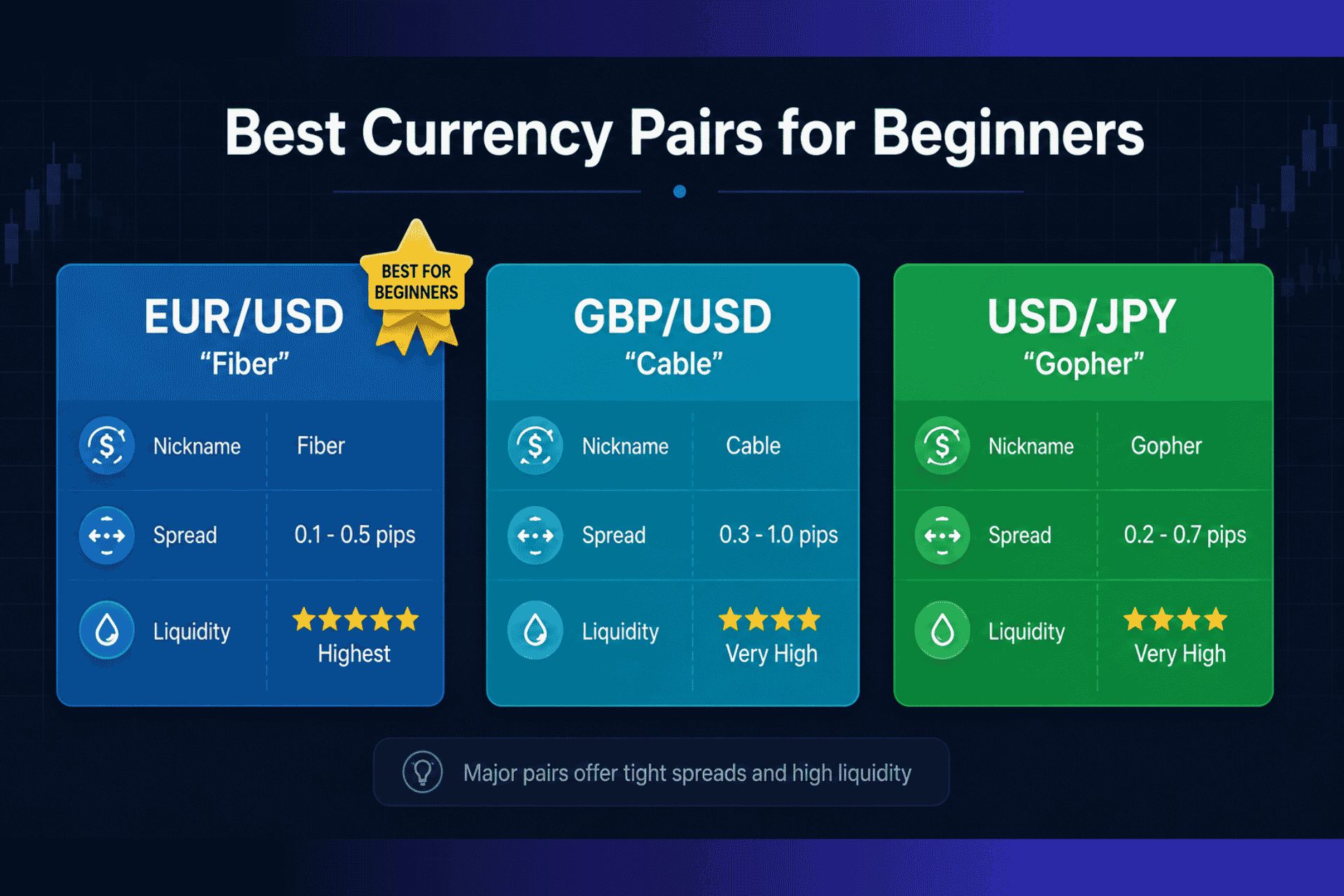
For a first trade, pick a liquid major pair such as EUR/USD . Majors offer:
- High liquidity (tight spreads)
- Lower volatility than exotic pairs
- More news and analysis available
- Lower trading costs
📊 Table: Best Currency Pairs for Beginners
| Pair | Nickname | Typical Spread | Why It’s Good for Beginners |
|---|---|---|---|
| EUR/USD | Fiber | 0.1-0.5 pips | Highest liquidity, tightest spreads |
| GBP/USD | Cable | 0.3-1.0 pips | High liquidity, clear trends |
| USD/JPY | Gopher | 0.2-0.7 pips | Active during the Asian session |
Step 7: Analyze the Market
There are two main types of analysis used in forex:
Technical Analysis
The study of past prices and patterns to predict future price movements. Common tools before one starts trading forex include:
- Moving averages (SMA, EMA)
- RSI (Relative Strength Index)
- Support and resistance levels
- Candlestick patterns
Fundamental Analysis
The study of factors that drive currency valuation. Key factors include:
- Interest rates and rate differentials
- Inflation (CPI)
- Employment data (NFP)
- GDP growth
- Central bank policies
💡 Pro Tip: Beginners often start with technical analysis because it focuses on what you can see on the chart. As you learn trading forex, you can incorporate fundamental analysis to understand why the market moves.
Step 8: Decide to Buy or Sell
Based on your analysis, decide whether to go long (buy) or short (sell).
- Buy (Long): You expect the base currency to rise against the quote currency.
- Sell (Short): You expect the base currency to fall against the quote currency.
🎯 Real-World Example
If you believe the Euro will strengthen against the US Dollar:
- You buy EUR/USD at 1.1050
- If the price rises to 1.1070, you make a 20-pip profit
- If the price falls to 1.1030, you lose 20 pips
Step 9: Set Stop-Loss and Take-Profit Orders
Risk management is what keeps you in the game long enough to improve.
Stop-Loss (SL)
A pre-set order to close a trade at a specific price to cap your loss.
🟦 Blue Highlight: Never enter a trade without a stop-loss. This is the single most important rule in learning how to start trading forex.
Take-Profit (TP)
A pre-set order to close a trade at a specific price to lock in your gains.
🧮 Risk Calculation Example
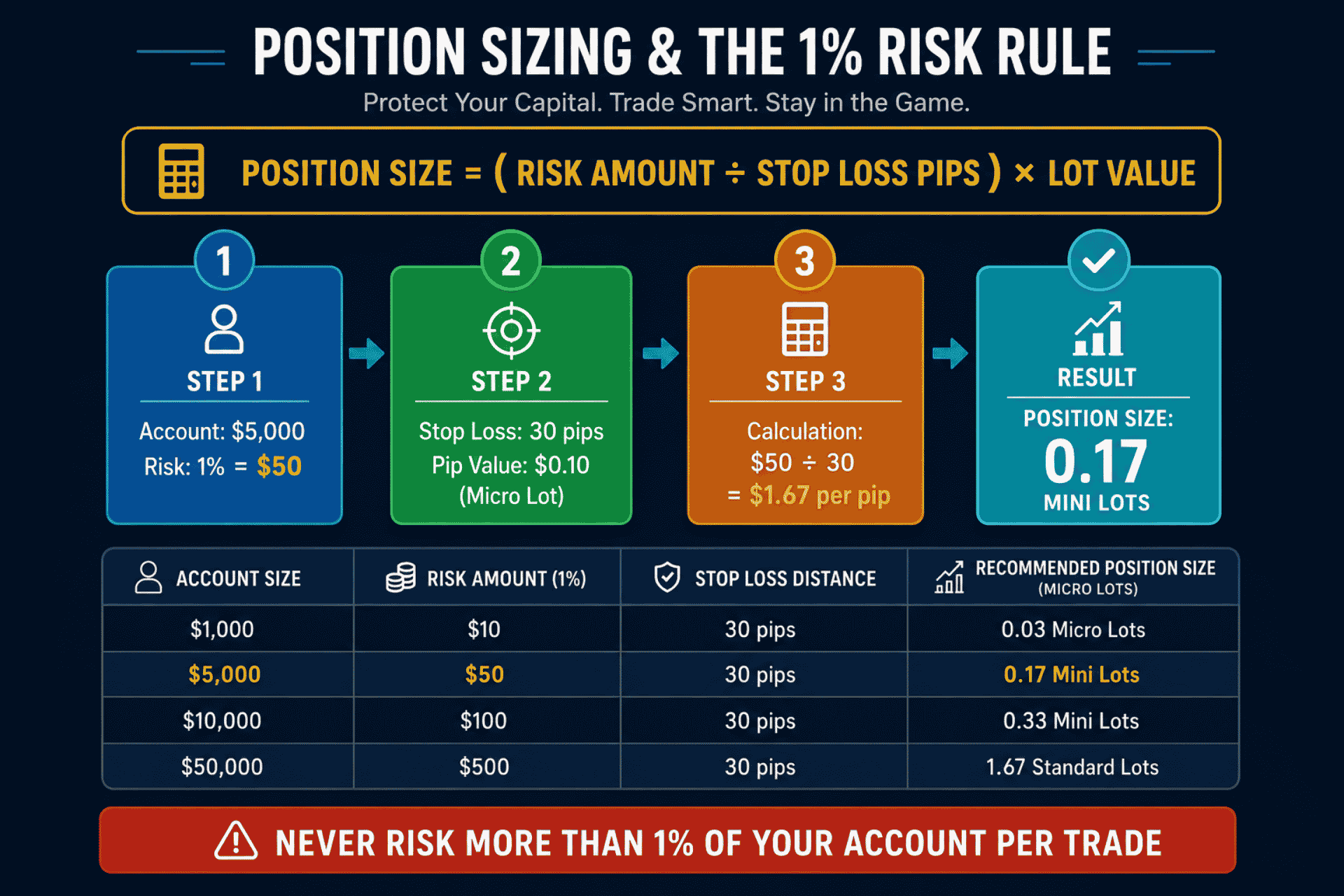
Scenario: You have a $5,000 account. You risk 1% per trade. Your stop-loss is 30 pips on EUR/USD trading a micro lot (0.01).
Step 1: Calculate risk in dollars
- 1% of $5,000 = **$50** risk
Step 2: Calculate pip value for micro lot
- 1 micro lot = 1,000 units
- Pip value = $0.10 per pip
Step 3: Calculate maximum pips to risk
- $50 risk ÷ $0.10 = 500 pips
✅ Result: With a micro lot, a 30-pip stop-loss risks just $3. This is why micro lots are perfect for beginners.
📊 Table: Stop-Loss Placement Guide
| Lot Size | Pip Value | 30-Pip Risk | 50-Pip Risk | 100-Pip Risk |
|---|---|---|---|---|
| Micro (0.01) | $0.10 | $3.00 | $5.00 | $10.00 |
| Mini (0.1) | $1.00 | $30.00 | $50.00 | $100.00 |
| Standard (1.0) | $10.00 | $300.00 | $500.00 | $1,000.00 |
🟦 Blue Highlight: Starting with micro lots keeps risk manageable while learning. This is a key lesson in how to start trading forex.
Step 10: Place Your First Trade
Now you’re ready to place your first real trade.
Step-by-Step Trade Execution
- Log in to your trading platform (MT4, MT5, or proprietary).
- Select your currency pair—For your first trade, choose a major pair.
- Decide your direction—buy or sell based on your analysis.
- Choose your order type—market order (immediate) or limit order (specific price).
- Set your position size—Use a micro lot (0.01) for your first trade.
- Set stop-loss and take-profit—Define your risk and reward before confirming.
- Confirm the trade—Review all details and click “Buy” or “Sell.”
- Monitor your position—Watch the trade but avoid overmanaging.
🎯 First Trade Example
Scenario: You are ready for your first live trade.
- Account: $1,000
- Pair: EUR/USD
- Position: Micro lot (0.01)
- Entry: Buy at 1.1050
- Stop-Loss: 1.1020 (30 pips risk)
- Take-Profit: 1.1080 (30 pips reward)
- Risk: $3.00 (1 micro lot × 30 pips × $0.10)
Result scenarios:
- Profit: Price hits 1.1080 → +$3.00
- Loss: Price hits 1.1020 → -$3.00
🟩 Green Highlight: The first live order is the one most people remember. Keeping the size small is what makes it possible to press the button at all—and to learn from the result rather than dwell on it.
Step 11: Monitor and Close Your Trade
Once you’ve opened a position, monitor it in the “open positions” section of your trading platform.
What to Monitor
- Floating P&L — Your unrealized profit or loss
- Market news — Economic events that could impact your trade
- Technical levels — Support and resistance that could signal a reversal
When to Close
- If TP is hit, your trade closes automatically — take your profit.
- If SL is hit, your trade closes automatically — accept the loss.
- If neither is hit, you can close manually when conditions change.
Step 12: Keep a Trading Journal
A trading journal is the #1 tool for improving as a trader. Record every trade with:
- Currency pair traded
- Entry and exit prices
- Reason for the trade
- Profit/loss amount
- Emotional state during the trade
- Lessons learned
Why a Journal Matters
A journal turns random trades into a learning loop. Without records, you repeat the same mistakes. With a journal, you can see patterns in your decision-making and improve systematically in this journey before you start trading forex.
Common Beginner Mistakes to Avoid
Most early losses come from avoidable behavior, not from poor analysis.
🔴 Red Highlight: The pattern we see most often is a beginner taking a small loss, feeling they have to win it back straight away, and doubling the next position—turning a minor setback into a real problem.
Forex Trading Sessions
The forex market runs 24 hours a day, five days a week, but activity is not constant. Liquidity and volatility rise and fall as the major financial centers open and close.
📊 Table: Forex Trading Sessions
💡 Pro Tip: The London–New York overlap is the busiest window—the most active time for price movements. This is when beginners should practice trading forex.
How Much Money Do You Need to Start?
The amount depends on the broker, but here are the general guidelines:
| Account Type | Minimum Deposit | Recommended for Beginners? |
|---|---|---|
| Micro Account | $50 – $100 | ✅ Best for beginners |
| Mini Account | $100 – $500 | ✅ Good with experience |
| Standard Account | $500+ | ⚠️ Higher risk while learning |
| RAW/ECN Account | $1,000+ | ❌ Not recommended for beginners |
🟦 Blue Highlight: Some brokers let you open an account from as little as USD 100 and trade micro lots (0.01), so you can start small while trading forex. A larger balance leaves more room to manage trades effectively.
FAQ
1. How do I start trading forex for beginners?
Before you start trading forex, learn how currency pairs and pips work, open an account with a regulated broker, and practice on a demo account. Then create a simple trading plan, place a small first trade with a stop-loss, and review each trade to refine your approach.
2. Is forex trading good for beginners?
Forex can suit beginners who focus on education and risk management first. The market is accessible and liquid, but leverage and volatility mean you should learn and practice before risking real capital on your journey to start trading forex.
3. How much money do I need to start forex trading?
It depends on the broker. Some let you open an account from as little as USD 100 and trade micro lots (0.01), so you can start small trading forex while learning.
4. What leverage should a beginner use?
Beginners should use 1:5 to 1:10 maximum. Never use high leverage until you have months of experience and a proven strategy while trading forex.
5. How long should I practise on a demo account?
Stay on demo until you can open, set a stop-loss, and close a trade without hesitation. Most experts recommend 30-60 days of consistent practice before going live or trading forex.
6. What is the best currency pair for beginners?
EUR/USD is the best choice for beginners. It offers the highest liquidity, tightest spreads, and the most educational resources and market analysis.
7. What is the 1% rule in forex?
Never risk more than 1% of your account on any single trade. With a $1,000 account, your maximum loss per trade is $10. This ensures you can survive a series of losing trades.
Conclusion: Your Journey Starts Here
Learning how to start trading forex is not about finding a magic strategy or getting rich overnight. It’s about building a solid foundation of knowledge, developing good habits, and managing risk consistently.
Key takeaways to remember:
- Learn the basics — Understand currency pairs, pips, leverage, and margin before you start trading forex.
- Choose a regulated broker — Protect your funds with a trustworthy partner.
- Practice on demo — Build confidence without risking real money before you start trading forex.
- Create a trading plan — Define your rules before you enter a trade or start trading forex.
- Start small—Use micro lots and low leverage while learning.
- Always use a stop-loss — Protect your capital from catastrophic losses.
- Keep a journal — Learn from every trade, win or lose.
🎯 Final Thought: The first trade is just the beginning of your journey — focus on learning and disciplined trading. The habits you build while the stakes are small are the ones you will rely on when you eventually scale up.
Further Reading
To deepen your understanding of forex trading, we recommend exploring these additional resources from Finwirestack:
- Essential Forex Trading Terminology: Ultimate Guide — Master the language of forex with 100+ terms explained with real examples.
- Technical vs Fundamental Analysis: Which Strategy is Right for You? — Discover which trading forex approach suits your personality.
- The Role of Central Banks in the Forex Market — Understand how the Fed, ECB, and BoJ move the markets.
- Risk Management for Forex Traders: Protect Your Capital—Master position sizing, stop-loss strategies, and trading forex psychology.
External Resources (DoFollow Links)
- Investopedia Forex Section — Comprehensive forex education.
- BabyPips Forex School — The most popular free forex education platform.
- FXStreet Education — Daily market analysis and educational articles.
- DailyFX Education — Trading education from a leading forex news source.
Disclaimer: Trading forex and CFDs involves significant risk of loss. It is not suitable for all investors. You should carefully consider your investment objectives in trading forex, your level of experience, and your risk appetite before trading forex. Never trade with money you cannot afford to lose. The information provided in this article is for educational purposes only and does not constitute financial advice.





[…] 7 Proven Steps to Start Trading Forex: Beginner’s Guide — Learn how to choose a broker, open an account, and place your first trade. […]
[…] 7 Proven Steps to Start Trading Forex: Beginner’s Guide — Learn how to choose a broker, open an account, and place your first trade after learning how to read forex charts. […]
[…] 7 Steps to Start Forex […]