
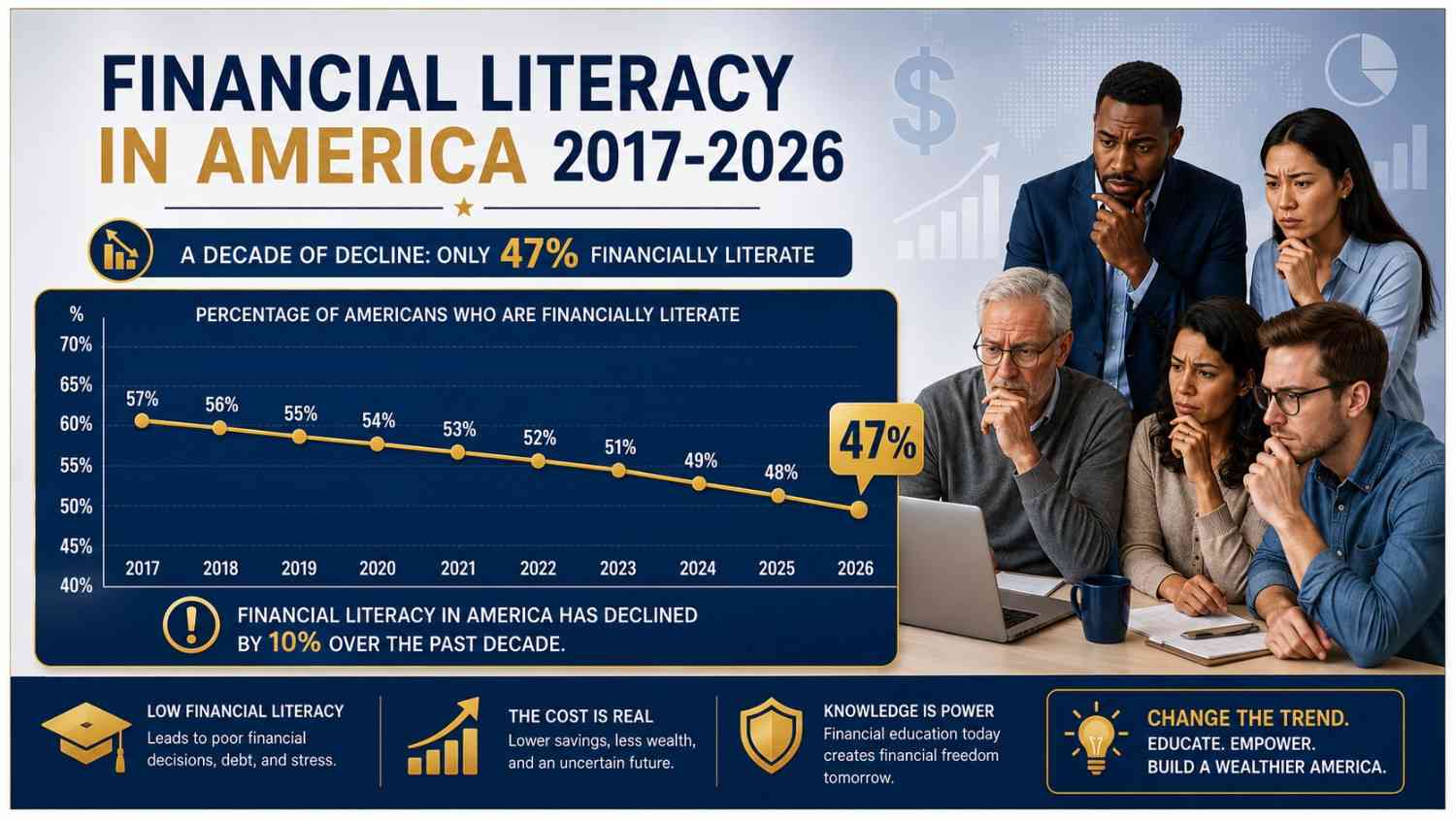
After a decade of tracking financial literacy among U.S. adults, the data has delivered an urgent verdict: Americans understand less about money today than they did ten years ago. The 2026 TIAA Institute–GFLEC Personal Finance Index (P-Fin Index) reveals that U.S. adults correctly answered only 47% of basic financial questions—the lowest result in the survey’s history.
This decline is not confined to a single demographic or topic. It spans five of eight functional knowledge areas: consuming, borrowing, earning, insuring, and comprehending risk. The gap between what Americans need to know and what they actually understand is widening at precisely the moment financial complexity is accelerating. Financial literacy in America has reached a crisis point that demands immediate attention from individuals, educators, and policymakers alike.
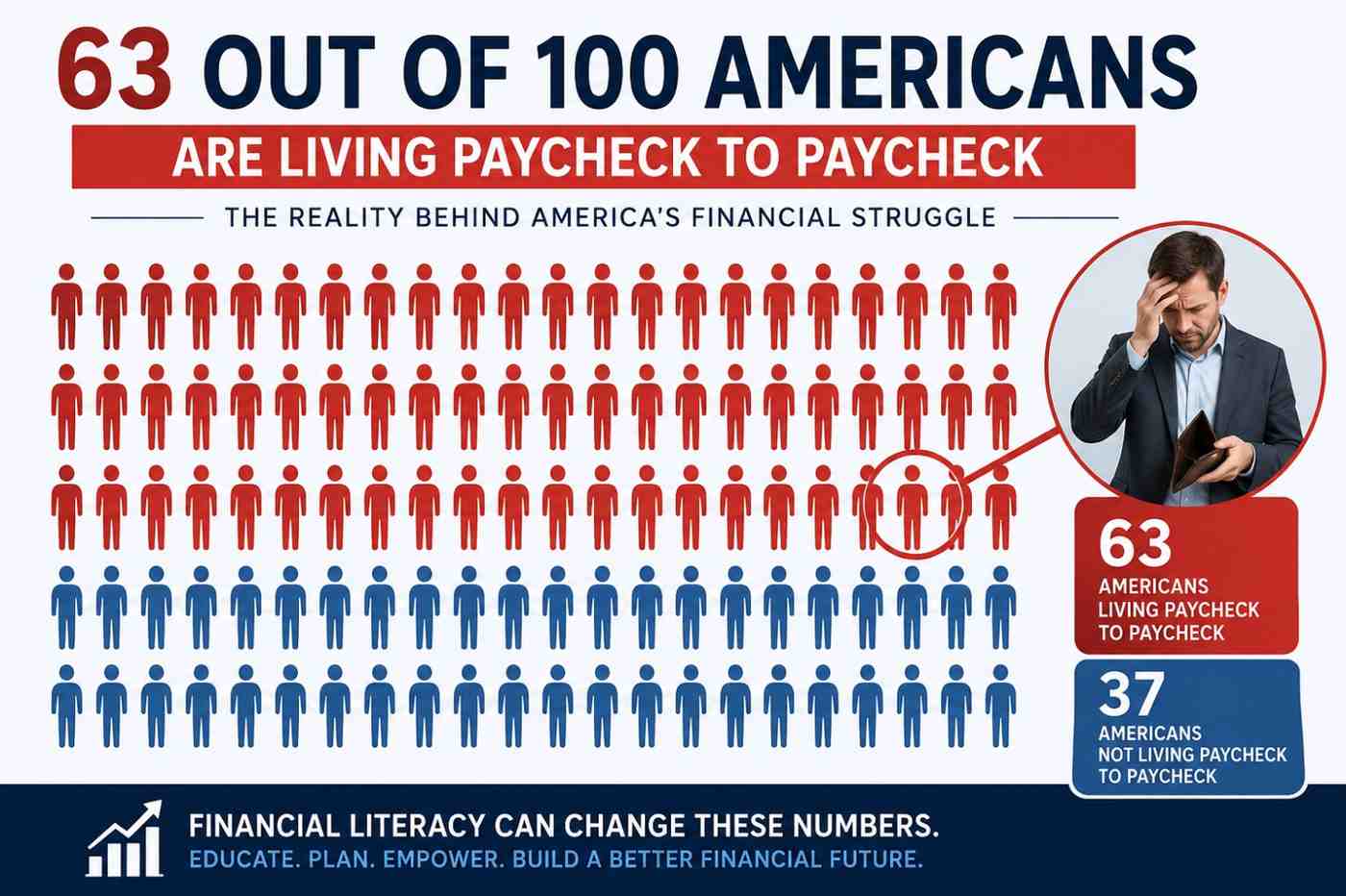
The consequences are already visible. 63% of Americans live paycheck to paycheck, with 90% of them having less than $500 left over each month after covering expenses. 51% of workplace retirement plan participants expect to have less than $500,000 saved for retirement, despite believing they need $1.2 million to retire comfortably. And perhaps most tellingly, 83% of professionals—representing approximately 216 million Americans—report experiencing financial stress, strain, or uncertainty.
This article examines the financial literacy crisis in detail, explores why understanding money matters more than ever, and provides a roadmap for Americans to take control of their financial futures in an increasingly complex economic landscape.
Part I: The Data Behind the Financial Literacy Crisis
A Decade of Decline
The P-Fin Index has tracked the same 28 questions annually for ten years, making it the most comprehensive measure of financial literacy in America. The 2026 results represent a statistically significant decline from the prior year.
The share of adults with very low financial literacy—defined as answering seven or fewer questions correctly out of 28—has grown steadily from 20% in 2017 to 25% in 2026. This means one in four Americans possesses such limited financial knowledge that they struggle to make informed decisions about earning, spending, saving, borrowing, or investing.
The decline is broad-based, not isolated to a single topic. Financial literacy in America has dropped significantly in five of the eight functional knowledge areas:
| Functional Area | What It Covers | 2026 Score |
|---|---|---|
| Comprehending Risk | Understanding financial risk, volatility, and uncertainty | 36% |
| Borrowing & Managing Debt | Interest calculations, debt costs, credit management | Below previous years |
| Insuring | Understanding insurance coverage, costs, and needs | Below previous years |
| Earning | Income basics, benefits, compensation | Below previous years |
| Consuming | Spending decisions and opportunity cost | Below previous years |
Source: 2026 TIAA Institute–GFLEC Personal Finance Index
The Risk Blind Spot
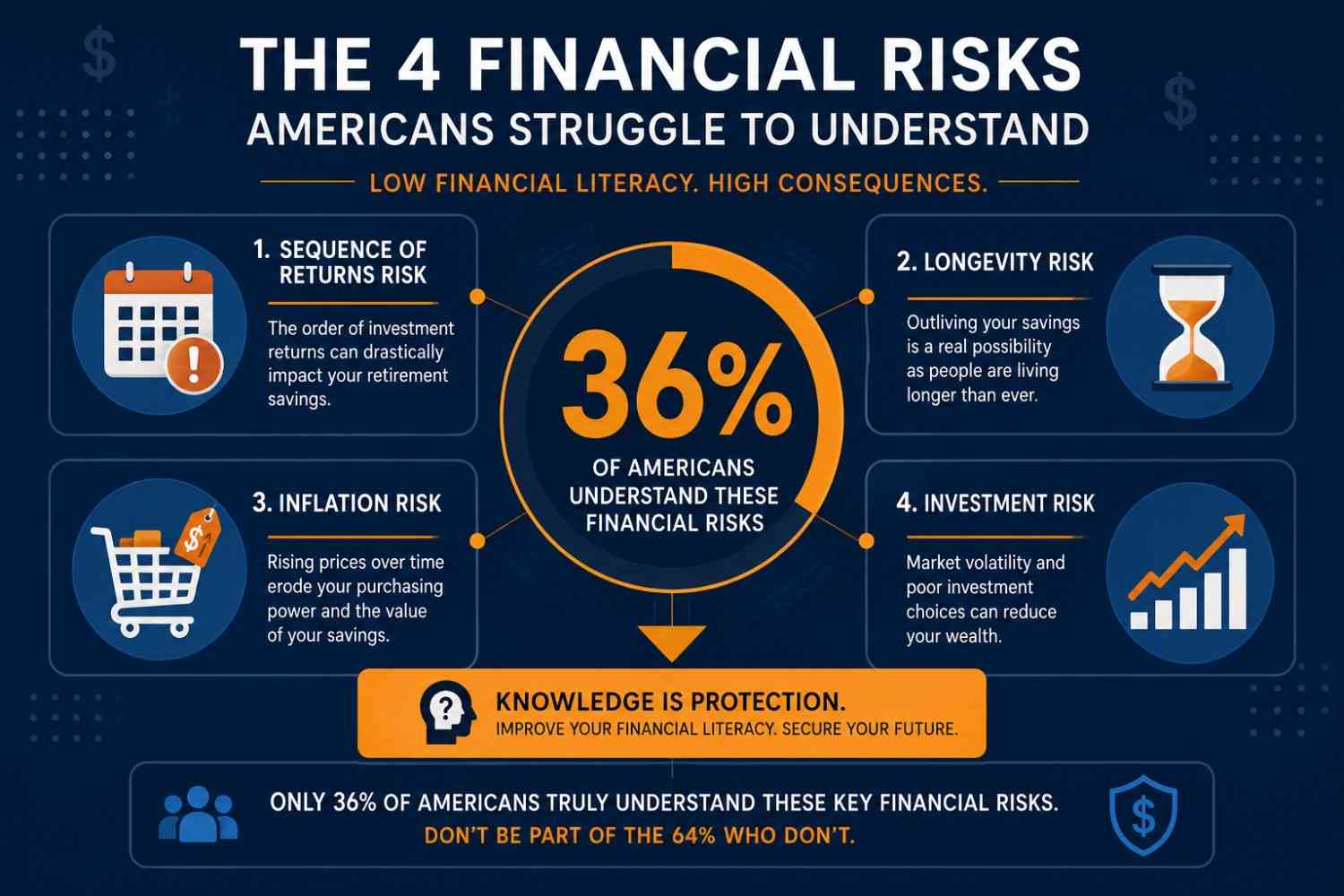
The most alarming finding is the persistent weakness in comprehending risk—the one functional area where performance shows little improvement with age. Americans correctly answered only 36% of risk-related questions in 2026.
This matters because risk comprehension underpins virtually every major financial decision:
- Sequence of returns risk: Understanding how market timing affects retirement income
- Longevity risk: Estimating how long retirement savings need to last
- Inflation risk: Recognizing how rising prices erode purchasing power
- Investment risk: Balancing potential returns against potential losses
Unlike other financial knowledge areas that build with life experience, risk comprehension remains stubbornly low across all generations. Older adults show no natural advantage over younger adults in understanding financial risk—a finding that has profound implications for retirement preparedness.
Gen Z: The Knowledge Gap of a Generation
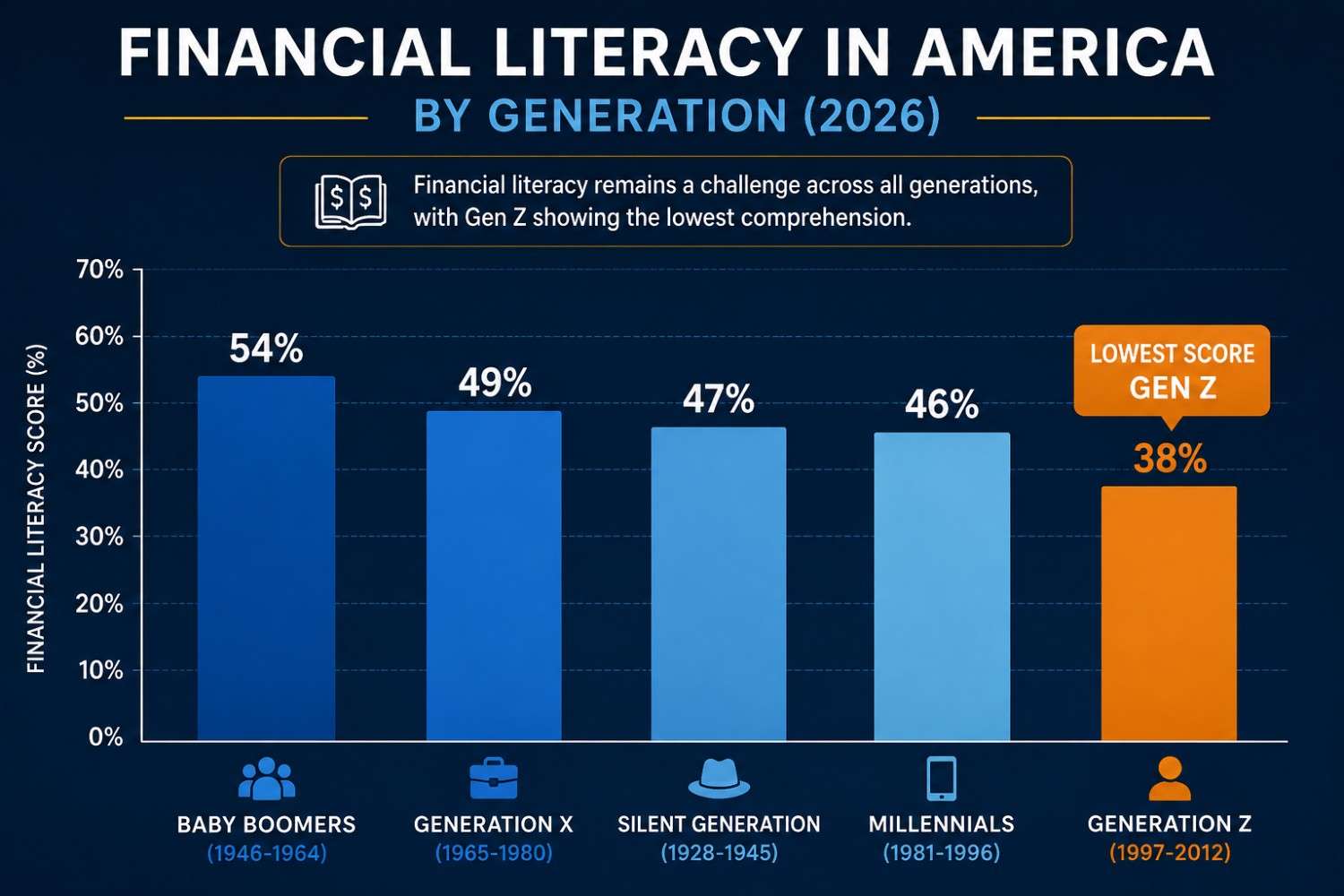
Gen Z (born 1997–2007) posted the lowest average score of any generation: just 38%. This places them nine percentage points below the national average.
The widest knowledge shortfall involves insurance literacy. Younger adults struggle to identify:
- What insurance policies actually cover
- What policies should cost
- When coverage makes financial sense
- How to compare insurance products effectively
This gap is particularly concerning given that Gen Z is entering adulthood at a time when insurance—health, auto, renters, and eventually life and disability—is more complex and expensive than ever.
The Generational Breakdown
| Generation | Average P-Fin Index Score | Performance Relative to Average |
|---|---|---|
| Baby Boomers | 54% | Highest scoring |
| Gen X | 49% | Above average |
| Silent Generation | 47% | At average |
| Millennials | 46% | Below average |
| Gen Z | 38% | Lowest scoring |
Source: 2026 TIAA Institute–GFLEC Personal Finance Index
Retirement Fluency: A Specific Crisis Within a Crisis
Beyond the general financial literacy measure, the P-Fin Index includes six questions specifically designed to assess retirement fluency. The results are alarming: adults correctly answered only about two of six questions on average.
The most significant gaps involve:
Medicare coverage: Only 27% correctly identified what Medicare covers in retirement. This means nearly three-quarters of Americans do not understand the most basic facts about their healthcare in retirement.
Long-term care: Only 28% knew the likelihood that a 65-year-old will eventually need long-term care. Without understanding this risk, Americans cannot adequately plan for one of retirement’s largest potential expenses.
Workers who answered four or more retirement fluency questions correctly are:
- Nearly twice as likely to save for retirement regularly
- More than twice as likely to have calculated how much they need to save
Part II: The Real-World Impact of Low Financial Literacy
The Paycheck-to-Paycheck Epidemic
While financial literacy surveys provide the diagnostic data, the symptoms are visible in household finances across America.
63% of Americans are living paycheck to paycheck in 2026, according to the CNBC and SurveyMonkey Quarterly Money Survey. Among those:
- 90% have less than $500 left over after monthly expenses
- 71% say a one-week delay in pay would cause major hardship or a critical emergency
- 61% have delayed major life milestones, including saving for retirement, buying homes or vehicles, or marriage
The financial margin for error is razor-thin. To cope with disruptions, paycheck-to-paycheck Americans report:
- Delaying paying bills or utilities (50%)
- Cutting back on general spending (40%)
- Borrowing money from friends or family (33%)
- Dipping into savings or emergency funds (23%)
- Taking out a loan or using a credit card (19%)
The Six-Figure Paradox
Perhaps the most counterintuitive finding is that financial stress extends well into six-figure incomes.
Nearly seven in 10 Americans earning over $135,000 annually aren’t financially fulfilled, according to Gallup research conducted for Edward Jones. Even 77% of those earning $135,000 to $174,999 and 63% of those earning over $175,000 report dissatisfaction with their financial situation.
One in five workers earning $135,000 or more feel “depressed” when thinking about their money.
The phenomenon is called “money dysmorphia” — a perception of one’s financial situation that does not match reality. Ashley Agnew, a certified financial therapist and behavioral scientist at Edward Jones, explains:
“Financial fulfillment is not just defined by income and net worth. It’s about combining the security it provides with personal alignment and a feeling of control that leads to a confident relationship with money.”
The drivers include:
- Lifestyle creep: As income rises, expenses rise with it
- Social media comparison: Constant exposure to curated displays of wealth warps perception of “normal.”
- Rising fixed costs: Housing, childcare, food, and medical costs have consumed disposable income
- Changing standards: A six-figure income no longer buys what it once did
The Retirement Savings Gap
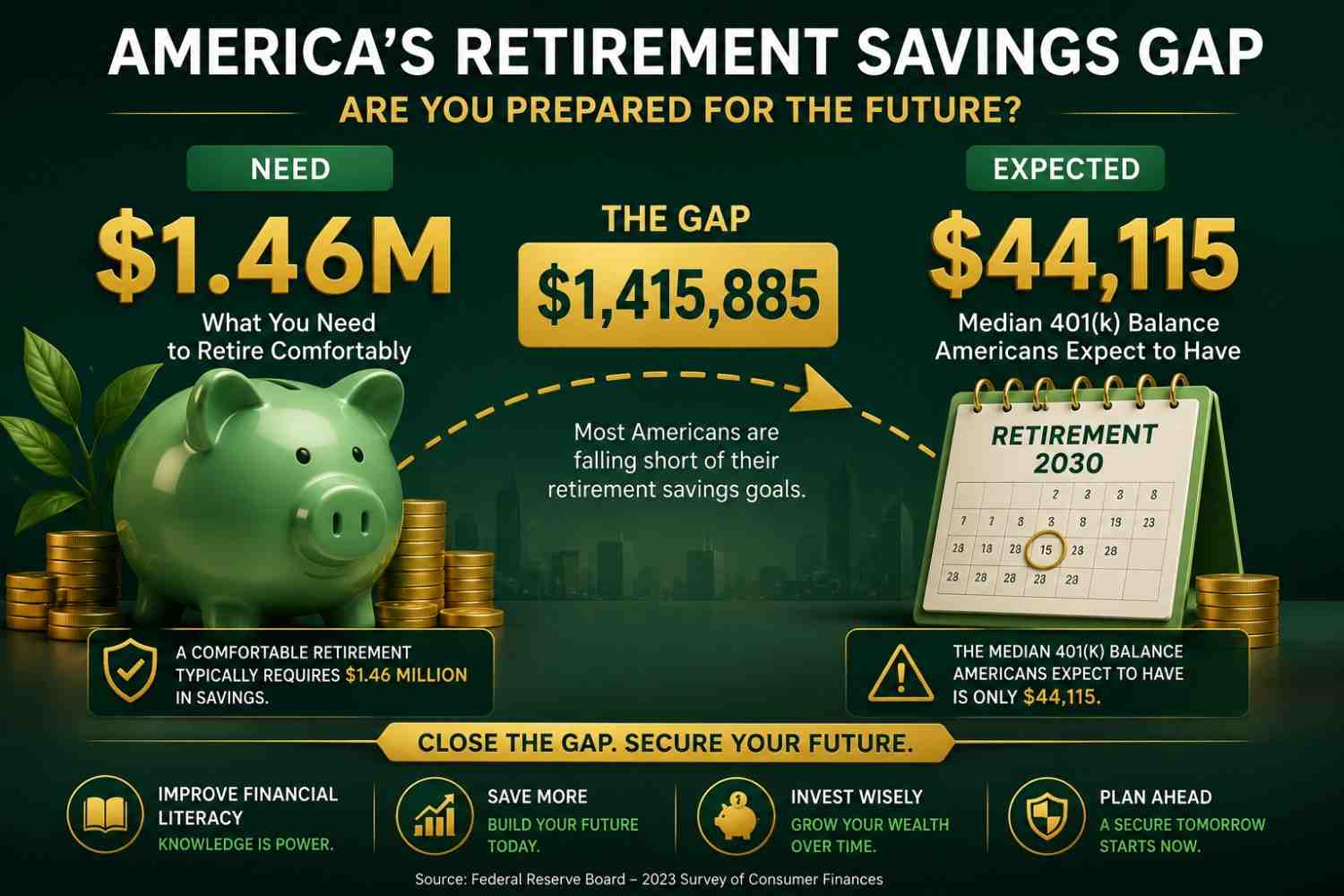
Americans say they need $1.2 million to retire comfortably, according to Schroders’ 2026 U.S. Retirement Survey. However:
- 51% of workplace retirement plan participants expect to have less than $500,000 saved at retirement
- 24% expect to have less than $250,000
- Only 30% expect to reach $1 million
These figures come from a survey of investors aged 30-79 who already participate in workplace retirement plans. The numbers would likely be worse for those without access to such plans.
The situation is compounded by competing financial pressures:
- 55% say they are unable to save 10% of their paycheck toward retirement due to competing expenses
- 69% say rising costs have put retirement out of reach for their generation
- 33% have more credit card debt than retirement savings
Northwestern Mutual’s 2026 Planning & Progress Study found even higher expectations: Americans now believe they need $1.46 million to retire comfortably—a $200,000 jump from the previous year. Nearly 46% of adults do not expect to be financially prepared for retirement.
Vanguard’s 2026 “How America Saves” report provides the reality check. The average 401(k) balance is $167,970—a record high, driven by strong stock market performance. But the median balance—the more meaningful measure for most Americans—is just $44,115.
Run that through a standard 4% annual withdrawal rate, and the typical retiree has $1,765 per year—or $147 per month. That is not enough for rent, for medications, or, in any honest accounting, for retirement.
Part III: Why Financial Literacy in America Matters More Than Ever
The Direct Link to Financial Outcomes
Low financial literacy in America is not merely an academic concern. The 2026 P-Fin Index found that those scoring low are:
- Four times more likely to struggle to make ends meet
- Three times more likely to be financially fragile
The link between knowledge and outcomes is clear. Workers with higher retirement fluency are:
- Nearly twice as likely to save for retirement regularly
- More than twice as likely to have calculated how much they need to save
The AI Factor: A New Tool or New Risk?
The 2026 P-Fin Index included, for the first time, questions about AI use in personal finance. The findings reveal both opportunity and concern:
- 19% of U.S. adults have used an AI tool (such as ChatGPT or Gemini) for personal finance information
- Only 4% use AI regularly to manage their finances
- AI use is highest among Gen Z (29%) and lowest among baby boomers (8%)
- AI use is strongly correlated with financial literacy levels
The correlation suggests that those who could benefit most from AI financial assistance are least likely to use it and may be least equipped to evaluate the quality of AI-generated financial advice.
The Gender Gap Persists
Women scored 6 percentage points lower than men overall on the P-Fin Index, with gaps persisting across nearly all functional knowledge areas. This gap has implications for:
- Retirement preparation (women live longer, on average)
- Investment behavior (women may be less confident investing)
- Financial decision-making across households
Part IV: What Americans Can Do Now to Improve Financial Literacy
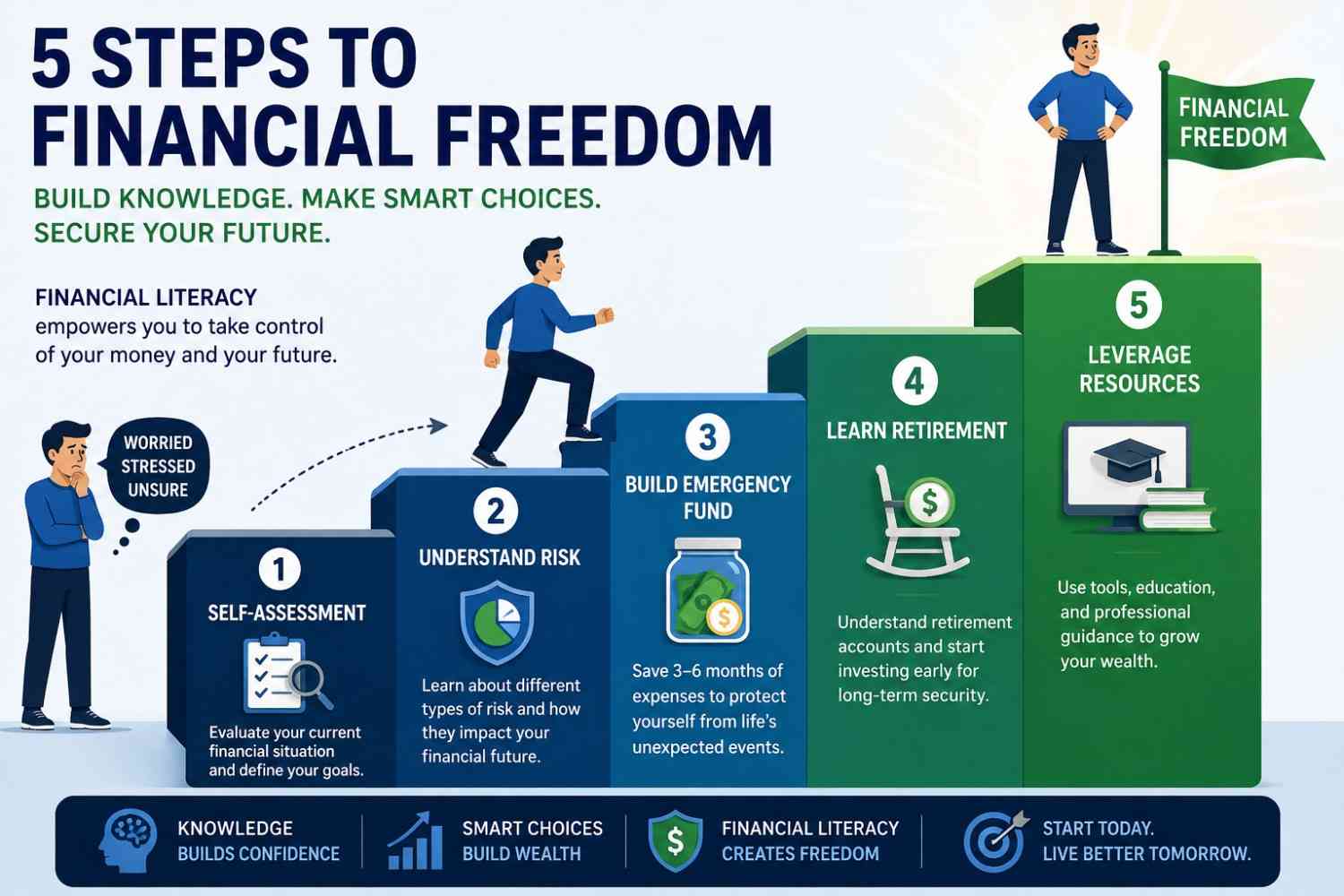
Start With a Financial Literacy Self-Assessment
The P-Fin 8 Index—an abbreviated eight-question measure developed for the 10th anniversary of the survey—is now available for public use. Taking this assessment can help Americans identify specific knowledge gaps to address.
Prioritize Risk Comprehension
Risk comprehension is the weakest area across all generations. Americans should focus on understanding:
- Sequence of returns risk: How the timing of market fluctuations affects retirement income
- Longevity risk: How long retirement might last
- Inflation risk: How rising prices erode purchasing power
- Investment risk: Understanding volatility and how it relates to returns
This knowledge is not intuitive; it requires active study.
Build a Comprehensive Emergency Fund
The ability to handle financial shocks is the foundation of financial stability. The data shows that:
- Paycheck-to-paycheck: Americans are highly vulnerable to even modest disruptions
- Emergency preparedness scores among financially stressed households are just 24.5 out of 100, compared to 85.4 for financially secure households
Focus on Retirement Fluency
Specific knowledge gaps in Medicare and long-term care are widespread. Americans should educate themselves on:
- What Medicare covers (and what it does not)
- The likelihood of needing long-term care and the costs involved
- Social Security claiming strategies
- Required Minimum Distributions (RMDs)
- Income drawdown strategies in retirement
Leverage Available Resources
Financial education makes a measurable difference. The 2026 P-Fin Index found that those who have received financial education score 13 percentage points higher than those who have not. This suggests that targeted financial education can be effective.
Part V: Looking Ahead to 2035
The 2026 data represents a decade of tracking and a moment of reckoning. Kourtney Gibson, CEO of Retirement Solutions at TIAA, framed the urgency:
“When knowledge gaps are this widespread, the consequences are real. They show up in retirement accounts that fall short, in Social Security decisions made without the full picture, and in financial stress that compounds over time. At TIAA, we believe that access to knowledge is just as important as access to a retirement plan.”
As financial products become more complex, as retirement planning requires more sophisticated understanding, and as Americans are asked to take more responsibility for their own financial security, the knowledge gap will only widen unless addressed.
Financial literacy in America must become a national priority. The data is clear: after a decade of declining financial knowledge, the time for action is now. By 2035, the consequences of inaction will be even more severe, with an aging population, rising healthcare costs, and increasing financial complexity creating a perfect storm of financial insecurity.
Frequently Asked Questions About Financial Literacy in America
What is financial literacy in America, and why does it matter?
Financial literacy in America refers to the ability of U.S. adults to understand and effectively use various financial skills, including personal financial management, budgeting, investing, and borrowing. According to the 2026 TIAA Institute–GFLEC Personal Finance Index, Americans correctly answered only 47% of basic financial questions—the lowest result in the survey’s history. Financial literacy matters because those with low financial literacy are four times more likely to struggle to make ends meet and three times more likely to be financially fragile. Without this knowledge, Americans are more likely to take on high-cost debt, fail to save for retirement, and make poor investment decisions that erode their wealth over time.
Why has financial literacy in America declined to 47%?
The decline in financial literacy in America has been attributed to several interconnected factors. First, the surge of financial information on social media—much of it inaccurate—has made it harder to distinguish good advice from bad. Matt Schulz, LendingTree’s chief consumer finance analyst, noted, Knowing what financial content to follow and trust has never been harder. Second, financial products have become increasingly complex, making it harder for consumers to make informed decisions. Third, financial education has not kept pace with these changes—only 23 states require personal finance coursework for high school graduation. Fourth, the booming stock market may have created a false sense of security, leading people to believe that risk is minimal and saving is optional.
How does low financial literacy in America affect retirement planning?
Low financial literacy in America has a devastating impact on retirement preparedness. The 2026 P-Fin Index found that adults correctly answered only two out of six retirement fluency questions on average. Specifically, only 27% understand what Medicare covers in retirement, and only 28% know the likelihood of needing long-term care. Without this knowledge, Americans cannot plan adequately for their retirement years. Workers with higher retirement fluency are nearly twice as likely to save regularly for retirement and more than twice as likely to have calculated how much they need to save. The result is a massive savings gap: Americans believe they need $1.2 million to retire comfortably, but 51% expect to have less than $500,000.
Which generations are most affected by low financial literacy in America?
The 2026 P-Fin Index reveals significant generational disparities in financial literacy in America. Gen Z (born 1997–2007) scored the lowest at just 38%, placing them nine percentage points below the national average. Millennials scored 46%, the Silent Generation scored 47%, Gen X scored 49%, and Baby Boomers scored the highest at 54%. The widest knowledge shortfall for Gen Z involves insurance literacy—understanding what insurance covers, what policies should cost, and how to compare products effectively. This is particularly concerning given that Gen Z is entering adulthood at a time when insurance is more complex and expensive than ever.
What is the connection between financial literacy and living paycheck to paycheck?
The connection between financial literacy in America and living paycheck to paycheck is strong and direct. The 2026 P-Fin Index found that those scoring low on financial literacy are four times more likely to struggle to make ends meet. Currently, 63% of Americans live paycheck to paycheck, with 90% of them having less than $500 left over each month after covering essential expenses. Low financial literacy leads to poor financial decisions—taking on high-interest debt, failing to budget, not building emergency savings, and making poor investment choices—that perpetuate the paycheck-to-paycheck cycle. Conversely, those with higher financial literacy are more likely to save, invest, and build wealth.
What is the risk blind spot in financial literacy in America?
The “risk blind spot” refers to the finding that comprehending risk is the weakest area of financial literacy in America. Americans correctly answered only 36% of risk-related questions in 2026—the lowest score across all eight functional knowledge areas. This is particularly concerning because risk comprehension underpins virtually every major financial decision. Unlike other financial knowledge areas that build with life experience, risk comprehension remains stubbornly low across all generations, showing little improvement with age. This means older adults show no natural advantage over younger adults in understanding financial risk—a finding with profound implications for retirement preparedness.
The key risks that Americans struggle to understand include:
- Sequence of returns risk: How the timing of market fluctuations affects retirement income
- Longevity risk: Estimating how long retirement savings need to last
- Inflation risk: Recognizing how rising prices erode purchasing power
- Investment risk: Balancing potential returns against potential losses
How can I improve my financial literacy in America?
Improving your financial literacy in America is achievable through several practical steps:
- Take a self-assessment: The P-Fin 8 Index—an abbreviated eight-question measure developed for the 10th anniversary of the survey—is now available for public use to identify specific knowledge gaps.
- Prioritize risk comprehension: Focus on understanding the sequence of returns, risk, longevity risk, inflation risk, and investment risk—this knowledge is not intuitive and requires active study.
- Build an emergency fund: Emergency preparedness scores among financially stressed households are just 24.5 out of 100, compared to 85.4 for financially secure households. Start with $1,000, then build to 3-6 months of expenses.
- Focus on retirement fluency: Educate yourself on Medicare coverage, long-term care needs, Social Security claiming strategies, and Required Minimum Distributions (RMDs).
- Leverage available resources: Employer-sponsored financial wellness programs, nonprofit financial counseling, and online educational platforms can all help. Those who have received financial education score 13 percentage points higher than those who have not.
How is AI affecting financial literacy in America?
The 2026 P-Fin Index included, for the first time, questions about AI use in personal finance. The findings reveal both opportunity and concern:
- 19% of U.S. adults have used an AI tool (such as ChatGPT or Gemini) for personal finance information
- Only 4% use AI regularly to manage their finances
- AI use is highest among Gen Z (29%) and lowest among baby boomers (8%)
- AI use is strongly correlated with financial literacy levels
The correlation suggests that those who could benefit most from AI financial assistance are least likely to use it and may be least equipped to evaluate the quality of AI-generated financial advice. Building foundational financial literacy in America remains essential for evaluating AI-generated guidance.
What is money dysmorphia, and how does it relate to financial literacy?
Money dysmorphia is a phenomenon where an individual’s perception of their financial situation does not match reality. It is most commonly observed among high earners who feel financially insecure despite making six-figure incomes. One in five workers earning $135,000 or more feel “depressed” when thinking about their money, and nearly seven in 10 Americans earning over $135,000 annually aren’t financially fulfilled.
The drivers of money dysmorphia include:
- Lifestyle creep: As income rises, expenses rise with it
- Social media comparison: Constant exposure to curated displays of wealth warps perception of “normal.”
- Rising fixed costs: Housing, childcare, food, and medical costs have consumed disposable income
- Changing standards: A six-figure income no longer buys what it once did
Improving financial literacy in America can help combat money dysmorphia by providing a realistic framework for evaluating one’s financial health based on facts, not feelings or comparisons.
What is the economic cost of low financial literacy in America?
The economic impact of low financial literacy in America extends beyond individual households and costs the nation billions of dollars annually through:
- Poor investment choices: Americans with low financial literacy are more likely to pay high fees, chase past performance, and make emotional investment decisions that erode returns.
- High-cost borrowing: Those who do not understand interest rates and loan terms often end up in payday loans, high-interest credit cards, and predatory lending products.
- Missed opportunities: Failure to take advantage of employer 401(k) matches, tax-advantaged accounts, and other wealth-building tools leaves money on the table.
- Increased reliance on social safety nets: When individuals cannot manage their finances, they are more likely to need government assistance, placing a burden on taxpayers.
- Lost productivity: Workers with very low financial literacy spend nearly 11 hours per week dealing with money issues at work—the equivalent of more than an entire lost workday.
Where can I find reliable resources to improve my financial literacy in America?
There are numerous reliable resources available to improve financial literacy in America:
| Resource Type | Examples |
|---|---|
| Government Sources | MyMoney.gov, Consumer Financial Protection Bureau (CFPB), SEC Investor.gov |
| Nonprofit Organizations | National Foundation for Credit Counseling (NFCC), Financial Literacy and Education Commission (FLEC) |
| Educational Platforms | Khan Academy Personal Finance, Coursera, edX |
| Financial Research | TIAA Institute, GFLEC (Global Financial Literacy Excellence Center) |
| Employer Programs | Financial wellness programs, workplace retirement plan education |
| Professional Advisors | Fee-only fiduciary financial advisors |
About the Author
The FinWireStack Editorial Team is composed of financial researchers, writers, and former financial advisors dedicated to translating complex financial topics into actionable insights for everyday Americans. Based in Bozeman, Montana, FinWireStack focuses on helping Americans make smart money decisions in the digital age.
Sources and Further Reading
- TIAA Institute and GFLEC. (2026). A Decade of Tracking Financial Literacy in America: Findings from the 2026 TIAA Institute–GFLEC Personal Finance Index.
- CNBC and SurveyMonkey. (2026, July). Quarterly Money Survey: Affordability.
- Schroders. (2026). 2026 U.S. Retirement Survey.
- Edward Jones and Gallup. (2026). Financial Fulfillment Study.
- Money Talks News. (2026, June). Odds Are Your Financial Literacy Is Low. Here’s How That Can Wreck Your Retirement.
- Debt.com. (2026, July). Budgeting Survey: Fewest Americans Living Paycheck to Paycheck in Five Years.
- Vanguard. (2026). How America Saves 2026.
- PYMNTS Intelligence. (2026, July). Why Job Security No Longer Shields Paycheck-to-Paycheck Consumers.
- NAPA Net. (2026, June). Financial Literacy Moving in the ‘Wrong Direction’: TIAA.
- Northwestern Mutual. (2026). 2026 Planning & Progress Study.
By FinWirestack






[…] 2026 TIAA Institute–GFLEC Personal Finance Index provides a critical piece of the puzzle: financial literacy in America has declined to 47%—the lowest level in the survey’s 10-year h…. Those with low financial literacy are four times more likely to struggle to make ends […]