

Forex vs. crypto trading is one of the most common questions asked by new investors entering the financial markets in 2027.
Some people are attracted to the stability and liquidity of the foreign exchange market. Others are fascinated by the rapid growth of Bitcoin, Ethereum, and thousands of digital assets that have transformed global finance over the past decade.
Both markets offer opportunities—but they also carry significant risks.
Unfortunately, social media often presents only one side of the story. Influencers showcase luxury lifestyles, extraordinary profits, and overnight success while rarely discussing volatility, emotional discipline, risk management, or the years of education required to become consistently successful.
The reality is that Forex vs. Crypto trading is not about choosing the market that promises the biggest returns. It is about selecting the market that best matches your financial goals, personality, available time, risk tolerance, and investment strategy.
By the end of this comprehensive guide, you’ll understand:
- The major differences between Forex vs Crypto Trading.
- Which market is generally more suitable for beginners.
- How artificial intelligence is changing both industries.
- Common scams and warning signs.
- Risk management strategies for each market.
- Which market may better suit different investor profiles.
Whether your goal is to trade actively, build long-term wealth, or simply understand the modern financial landscape, this guide will help you make more informed decisions.
Forex vs. Crypto Trading: What Is Forex Trading?
Forex trading is the buying and selling of national currencies through the global foreign exchange market.
Forex is the largest financial market in the world, with daily trading volume exceeding $6 trillion. Regulatory oversight is a key feature, with bodies like the U.S. Commodity Futures Trading Commission (CFTC) and the UK Financial Conduct Authority (FCA) providing frameworks for brokers.
Examples include:
- EUR/USD
- GBP/USD
- USD/JPY
- GBP/JPY
Currencies fluctuate because of:
- Interest rates
- Inflation
- GDP growth
- Employment reports
- Central bank policy
- International trade
- Political developments
The Forex market processes trillions of dollars in daily trading volume, making it the largest financial market in the world.
Its high liquidity often results in tighter spreads and efficient execution, particularly for major currency pairs.
Forex vs. Crypto Trading: What Is Crypto Trading?
Crypto trading involves buying and selling digital assets that operate on blockchain technology.
Popular cryptocurrencies include:
- Bitcoin (BTC)
- Ethereum (ETH)
- Solana (SOL)
- XRP
- Cardano (ADA)
Unlike national currencies, cryptocurrencies are decentralized and are not typically issued by central banks.
Their prices are influenced by factors such as:
- Market sentiment
- Adoption rates
- Network activity
- Regulation
- Technological developments
- Institutional investment
- Macroeconomic conditions
Crypto markets operate 24 hours a day, seven days a week, allowing continuous trading throughout the year.
Forex vs Crypto Trading: Why This Comparison Matters
Understanding Forex vs. Crypto Trading is essential because these markets behave differently, even though both involve buying and selling financial assets.
Choosing the wrong market for your personality can lead to unnecessary stress, inconsistent decision-making, and poor risk management.
For example:
- Someone who prefers structured trading sessions and lower volatility may feel more comfortable in Forex.
- Someone with a long-term outlook and an interest in blockchain innovation may prefer investing in cryptocurrencies.
- An active trader might participate in both markets but apply different strategies to each.
In Forex vs Crypto Trading, the best choice depends less on hype and more on aligning your approach with your financial goals and level of experience.
Difference #1 – Market Size
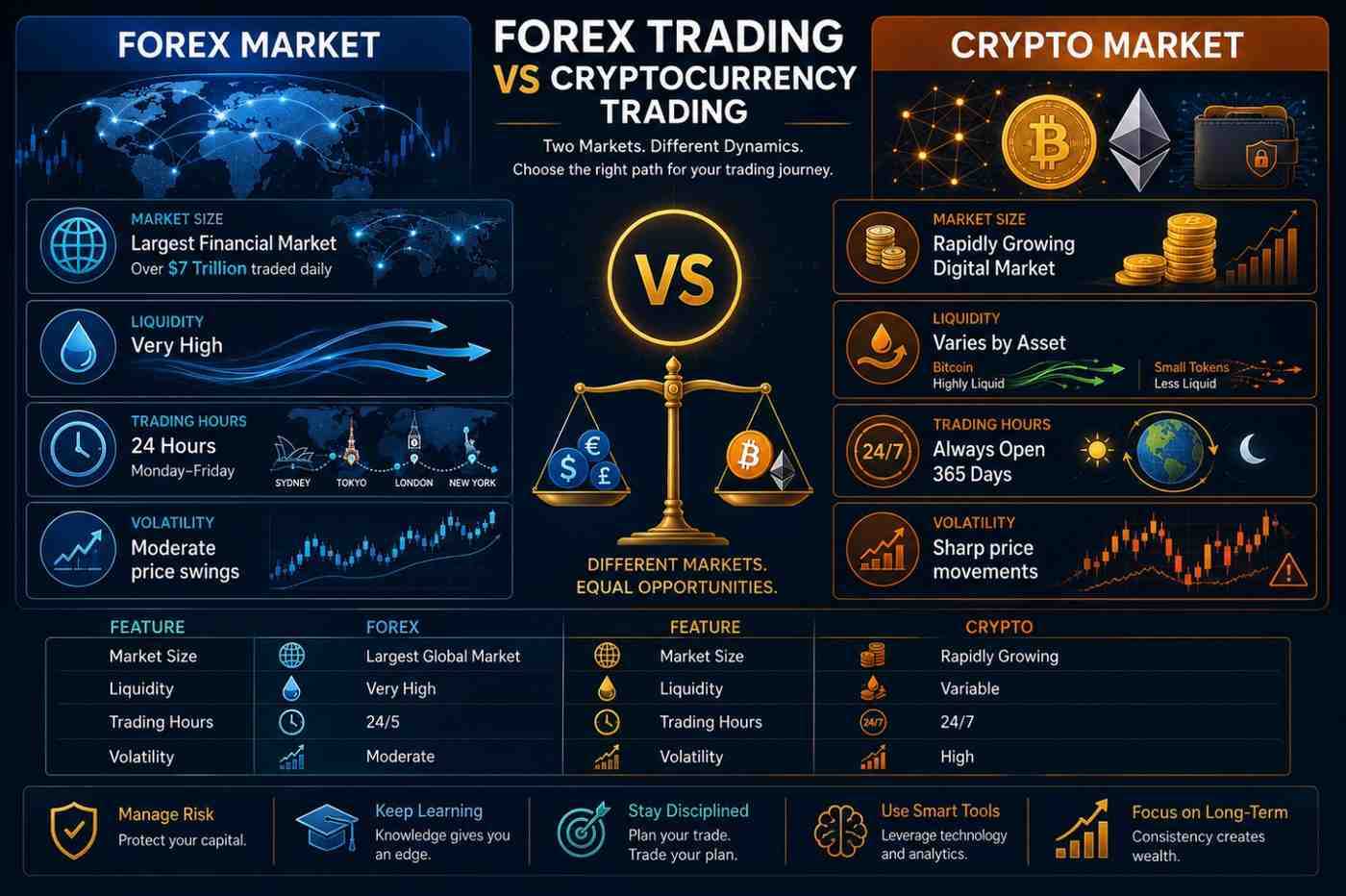
In Forex vs Crypto Trading, the Forex market is the largest financial market in the world, with daily trading activity measured in the trillions of dollars.
The cryptocurrency market, while significantly smaller, has grown rapidly and continues to evolve as institutional participation increases.
What this means for beginners
Higher liquidity in Forex generally leads to:
- More consistent pricing.
- Lower transaction costs on major pairs.
- Reduced likelihood of extreme price gaps during normal market conditions.
Crypto markets, by contrast, may experience larger price swings in shorter periods, creating both opportunities and additional risks.
Difference #2 – Liquidity
Liquidity refers to how easily an asset can be bought or sold without significantly affecting its price.
Major Forex pairs such as EUR/USD are among the most liquid instruments available.
Cryptocurrencies vary widely:
- Bitcoin and Ethereum are highly liquid.
- Smaller tokens may have much lower liquidity, increasing volatility and execution risk.
For beginners, understanding liquidity is important because it affects spreads, slippage, and the ability to enter or exit trades efficiently.
You can also read on:
- The Complete Beginner’s Guide to Forex Trading in 2027
- How to Choose a Safe Forex Broker in Forex vs. Crypto Trading
- The Complete Guide to Forex Risk Management
- Trading Psychology: Why Emotions Matter in Forex vs. Crypto Trading
- AI Tools Every Trader Should Know in Forex vs. Crypto Trading
Difference #3 – Trading Hours
One of the biggest differences in Forex vs Crypto Trading is when you can trade.
“One of the biggest differences in Forex vs Crypto Trading is the schedule. Forex trading is available for 24 hours a day, five days a week, providing a structured routine. Crypto trading, however, runs 24 hours a day, 365 days a year, offering constant access but a greater need for discipline .”
Forex Trading Hours
The Forex market operates 24 hours a day, five days a week, beginning Monday morning in Sydney and closing Friday evening in New York.
The market moves through four major sessions:
| Trading Session | Main Financial Center | Characteristics |
|---|---|---|
| Sydney | Australia | Lower volatility |
| Tokyo | Japan | Active Asian markets |
| London | United Kingdom | Highest trading volume |
| New York | United States | High liquidity and major news releases |
The overlap between the London and New York sessions generally experiences the highest liquidity and trading activity.
Crypto Trading Hours
Unlike Forex, cryptocurrency markets never close.
Trading continues:
- 24 hours per day
- 7 days per week
- 365 days a year
While continuous access creates flexibility, it also means markets can experience significant price movements overnight, during weekends, or while you’re away from your screen.
Which Is Better?
Forex offers more structured trading hours that may suit traders who prefer defined routines.
Crypto provides constant access but requires greater discipline to avoid overtrading.
Difference #4 – Volatility
Volatility measures how much prices move over a given period.
It is one of the most important considerations in Forex vs Crypto Trading.
Forex Volatility
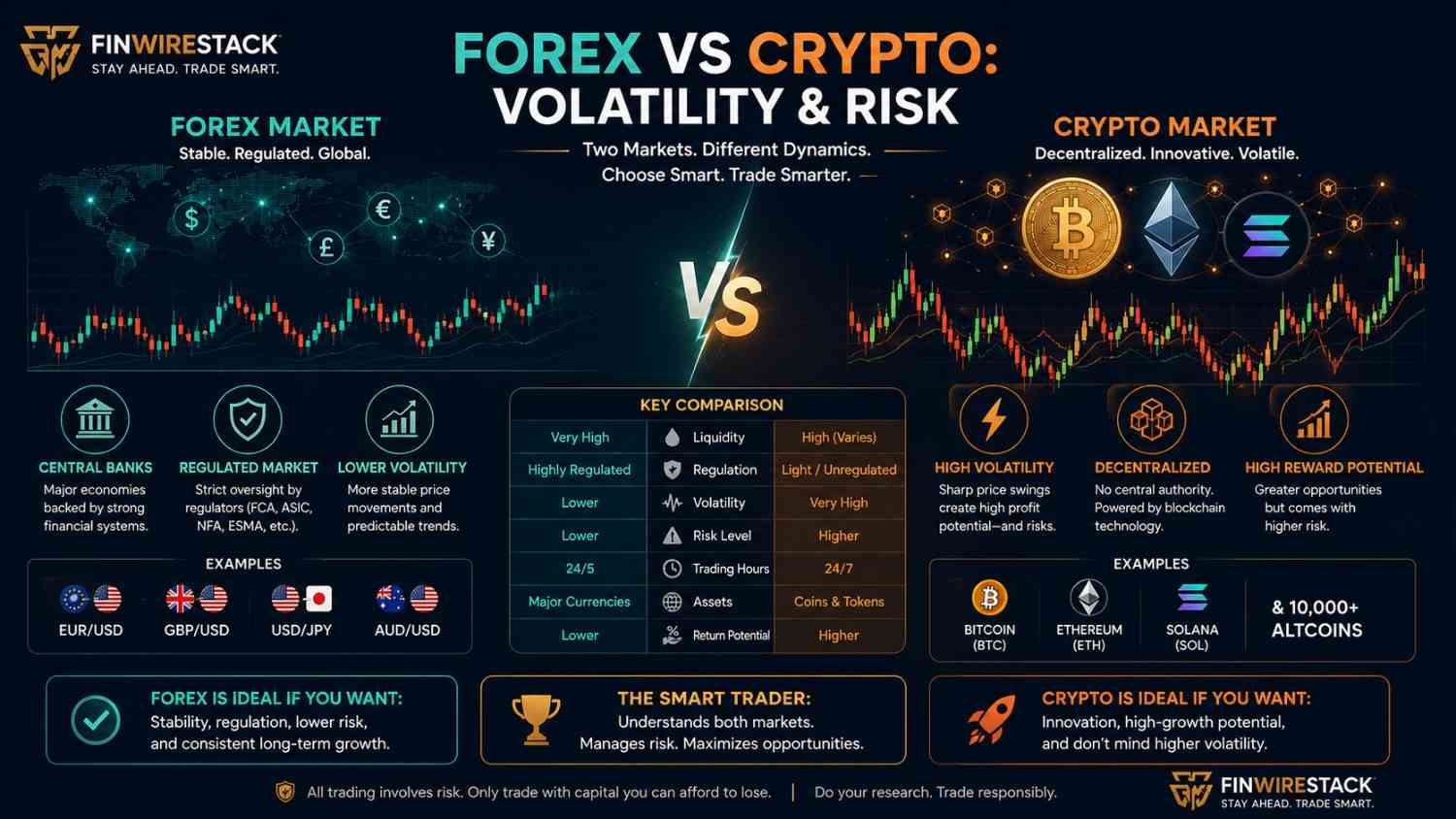
Major currency pairs generally experience smaller daily price movements.
For example:
EUR/USD may move between 50–120 pips during an average trading day.
These relatively stable movements allow traders to apply structured risk management strategies.
Crypto Volatility
Cryptocurrency prices can change dramatically within hours.
A digital asset may gain or lose 10–20% in a single day during periods of heightened market activity.
While higher volatility creates opportunities for larger returns, it also increases the potential for substantial losses.
Which Market Is Safer?
Neither market is “safe.”
However, beginners often find Forex easier to manage because price movements tend to be less extreme than those in many cryptocurrencies.
Difference #5 – Regulation
Regulation is another major distinction in Forex vs. crypto trading.
Forex
Forex brokers in many jurisdictions operate under financial regulators designed to protect investors and promote fair market practices.
Examples include:
- U.S. Commodity Futures Trading Commission (CFTC)
- National Futures Association (NFA)
- UK Financial Conduct Authority (FCA)
- Australian Securities and Investments Commission (ASIC)
Regulation often includes requirements related to:
- Client fund segregation
- Capital requirements
- Transparency
- Complaint procedures
Cryptocurrency
Regulation varies considerably across countries.
Some jurisdictions have established comprehensive frameworks for digital assets, while others continue to develop or revise regulations.
As a result, investors should carefully evaluate exchanges and understand the legal environment in their country before investing.
Difference #6 – Leverage
Leverage allows traders to control larger positions with a smaller amount of capital.
Forex
Depending on local regulations, leverage may be available, but limits differ across jurisdictions.
While leverage can increase potential returns, it also magnifies potential losses.
Crypto
Some cryptocurrency platforms also offer leveraged products.
However, because cryptocurrencies are often more volatile than major currency pairs, combining high leverage with rapid price movements can significantly increase risk.
Beginner Recommendation
Before considering leverage, develop a solid understanding of risk management and practice with conservative position sizes.
Difference #7 – Technology
Technology has transformed both markets, but in different ways.
Forex Technology
Modern Forex platforms provide:
- Advanced charting
- Economic calendars
- Market scanners
- Mobile trading apps
- Algorithmic trading support
- AI-assisted analysis
Crypto Technology
Cryptocurrency is built on blockchain technology.
Investors often interact with:
- Digital wallets
- Smart contracts
- Decentralized finance (DeFi)
- Tokenization
- Layer-2 scaling solutions
- Blockchain explorers
Learning blockchain concepts is an additional step for many new crypto investors.
Difference #8 – Market Drivers
Understanding why prices move is fundamental to Forex vs Crypto Trading.
Forex Prices Respond To
- Interest rate decisions
- Inflation
- GDP growth
- Employment reports
- Central bank speeches
- International trade
- Geopolitical developments
Crypto Prices Respond To
- Market sentiment
- Network adoption
- Blockchain upgrades
- Institutional investment
- Regulatory announcements
- Security incidents
- Supply and demand dynamics
Forex is generally driven by macroeconomics, while crypto is influenced by a combination of technology, adoption, and investor sentiment.
Difference #9 – Learning Curve
The learning process differs between the two markets.
Forex Requires Understanding
- Currency pairs
- Economic indicators
- Central banks
- Interest rates
- Technical analysis
- Risk management
Crypto Requires Understanding
- Blockchain technology
- Wallet security
- Exchanges
- Private keys
- Smart contracts
- Tokenomics
- Decentralized finance
Neither market is inherently easier, but they emphasize different knowledge areas.
Difference #10 – Long-Term Investing
Many beginners ask whether they should trade actively or invest for the long term.
Forex
Forex is primarily associated with active trading.
Long-term currency investing is less common for retail participants.
Crypto
Many investors choose long-term strategies by purchasing established cryptocurrencies and holding them over extended periods.
This approach, often called long-term investing, differs significantly from active trading.
Difference #11 – Profit Potential
Both Forex and Crypto offer profit opportunities.
However, profitability depends far more on:
- Education
- Discipline
- Risk management
- Consistency
- Emotional control
No market guarantees success.
Likewise, no market guarantees losses.
The trader’s decisions play a central role in long-term outcomes.
Difference #12 – Artificial Intelligence Is Transforming Forex vs Crypto Trading
Artificial Intelligence (AI) has become one of the biggest technological trends shaping financial markets. Whether you’re comparing Forex vs Crypto Trading, AI is changing how traders analyze data, manage risk, and make decisions.
However, it’s important to understand what AI can—and cannot—do.
AI is not a guaranteed profit machine. It cannot predict the future with certainty or eliminate the risks of trading. Instead, it acts as a powerful assistant that helps traders process information more efficiently.
How AI Is Used in Forex Trading
Professional Forex traders increasingly use AI to:
- Analyze large amounts of market data.
- Detect technical chart patterns.
- Summarize economic news.
- Monitor multiple currency pairs simultaneously.
- Identify unusual market volatility.
- Improve trading journals through performance analytics.
- Support risk management decisions.
AI can save time, but it should complement—not replace—a well-defined trading plan.
How AI Is Used in Crypto Trading
The cryptocurrency market also benefits from AI, particularly because it operates continuously.
Common applications include:
- Blockchain analytics.
- Sentiment analysis from news and social media.
- Portfolio optimization.
- Fraud detection.
- Automated trading alerts.
- Market screening across thousands of digital assets.
Because crypto markets can move rapidly, AI tools can help investors filter large volumes of information more efficiently.
A Word of Caution
Be skeptical of anyone claiming:
- “AI guarantees profits.”
- “This bot never loses.”
- “Our algorithm is 100% accurate.”
No legitimate investment tool can make such promises. Successful trading still depends on education, discipline, and sound risk management.
Difference #13 – Common Scams in Forex vs Crypto Trading
Unfortunately, both markets attract fraudsters who prey on beginners. Understanding common scams is one of the most valuable lessons in Forex vs Crypto Trading.
Fake Investment Managers
Scammers promise to trade on your behalf and guarantee extraordinary returns.
Warning signs include:
- Guaranteed profits.
- Pressure to invest immediately.
- Refusal to explain their strategy.
- Requests to send money directly to personal accounts.
Remember: no legitimate investment professional can guarantee profits.
Fake Brokers
Some websites appear to be professional trading platforms but are designed to steal deposits.
Always verify whether a broker is regulated before opening an account.
Signal Selling Scams
Some individuals sell “VIP signals” claiming exceptionally high win rates.
While educational services can provide value, be cautious of anyone advertising unrealistic success rates or luxury lifestyles as proof of expertise.
Pump-and-Dump Schemes
This scam is more common in cryptocurrencies.
Fraudsters promote a little-known token, encourage people to buy, then sell their own holdings after the price rises—leaving late buyers with heavy losses.
Phishing Attacks
Criminals create fake login pages, emails, or messages designed to steal passwords or wallet credentials.
Protect yourself by:
- Using strong passwords.
- Enabling two-factor authentication (2FA).
- Verifying website addresses before logging in.
- Never sharing private keys or recovery phrases.
Difference #14 – Risk Management
Whether you choose Forex or Crypto, risk management remains the foundation of long-term success.
Key Principles
Never Risk Money You Cannot Afford to Lose
Trading capital should be separate from funds needed for essential living expenses or emergencies.
Diversify When Appropriate
Avoid placing all your capital into a single asset or trade.
Use Stop-Loss Orders.
A stop-loss helps limit potential losses if the market moves against your position.
Keep Position Sizes Reasonable
Many experienced traders risk only a small percentage of their account on any single trade.
Continue Learning
Markets evolve continuously. Staying informed helps improve decision-making over time.
Difference #15 – Which Market Is Better for Beginners?
There is no universal answer to the Forex vs. Crypto Trading debate. The right choice depends on your goals, experience, and comfort with risk.
Forex May Be a Better Fit If You:
- Prefer structured market hours.
- Enjoy following global economic news.
- Want lower day-to-day volatility.
- Like analyzing macroeconomic trends.
- Prefer established financial markets.
Crypto May Be a Better Fit If You:
- Are interested in blockchain technology.
- Can tolerate higher volatility.
- Prefer markets that operate 24/7.
- Have a long-term interest in digital assets.
- Want to learn about decentralized finance and emerging technologies.
Some Investors Choose Both
Many experienced investors participate in both markets while applying different strategies and maintaining appropriate diversification.
The key is understanding the unique risks and opportunities of each rather than treating them as interchangeable.
Side-by-Side Comparison
| Feature | Forex Trading | Crypto Trading |
|---|---|---|
| Market Hours | 24 hours, 5 days | 24 hours, 7 days |
| Main Assets | National currencies | Digital assets |
| Typical Volatility | Moderate | Higher |
| Liquidity | Very high (major pairs) | Varies by asset |
| Primary Drivers | Economics, interest rates, central banks | Adoption, technology, sentiment, regulation |
| Regulation | Generally more established | Varies by jurisdiction |
| AI Applications | Market analysis, risk management | Analytics, blockchain data, portfolio tools |
| Beginner Learning Focus | Economics, technical analysis | Blockchain, wallets, digital security |

Real-World Example
Imagine two beginners, Sarah and David.
Sarah enjoys reading economic news, follows central bank announcements, and prefers a structured routine. She chooses Forex trading and practices on a demo account while learning risk management.
David is fascinated by blockchain technology, understands digital wallets, and is comfortable with higher volatility. He decides to invest gradually in established cryptocurrencies while continuing to educate himself about security and market dynamics.
Neither approach is inherently better. What matters is that each person selected a market aligned with their interests, goals, and risk tolerance.
Frequently Asked Questions About Forex vs. Crypto Trading
Is Forex vs. Crypto Trading better for beginners?
Forex vs. Crypto Trading depends on your experience, goals, and risk tolerance. Many beginners find Forex easier because it offers higher liquidity, more established regulation in many jurisdictions, and lower day-to-day volatility than many cryptocurrencies. However, crypto may appeal to those interested in blockchain technology and long-term digital asset investing.
Can I trade both Forex and Crypto?
Yes. Many experienced investors participate in both markets.
For example:
- Forex for active trading and short-term opportunities.
- Crypto as part of a diversified long-term investment strategy.
The key is to avoid overexposure and ensure each investment fits your overall financial plan.
Which market is more profitable?
Neither market guarantees profits.
Success depends on:
- Education
- Risk management
- Emotional discipline
- Trading strategy
- Continuous learning
A disciplined trader in either market is generally better positioned than someone chasing unrealistic returns.
Is crypto riskier than Forex?
In many cases, in Forex vs. Crypto Trading, cryptocurrencies experience greater price volatility than major Forex pairs.
Higher volatility can create larger opportunities—but also larger losses.
This is why position sizing and risk management are especially important in crypto markets.
Does AI make Forex vs. crypto trading easier?
Artificial Intelligence can improve efficiency by helping traders analyze charts, monitor news, and organize data.
However:
AI does not eliminate investment risk.
Successful traders continue to rely on:
- Independent research
- Risk management
- Experience
- Sound judgment
How much money should I start with?
Only invest money you can afford to lose.
Beginners should prioritize:
- Education
- Demo accounts (where available)
- Developing a written trading plan
- Building consistent habits
Starting small while learning is generally more sustainable than committing large sums too early.
Decision Framework: Should You Choose Forex or Crypto?
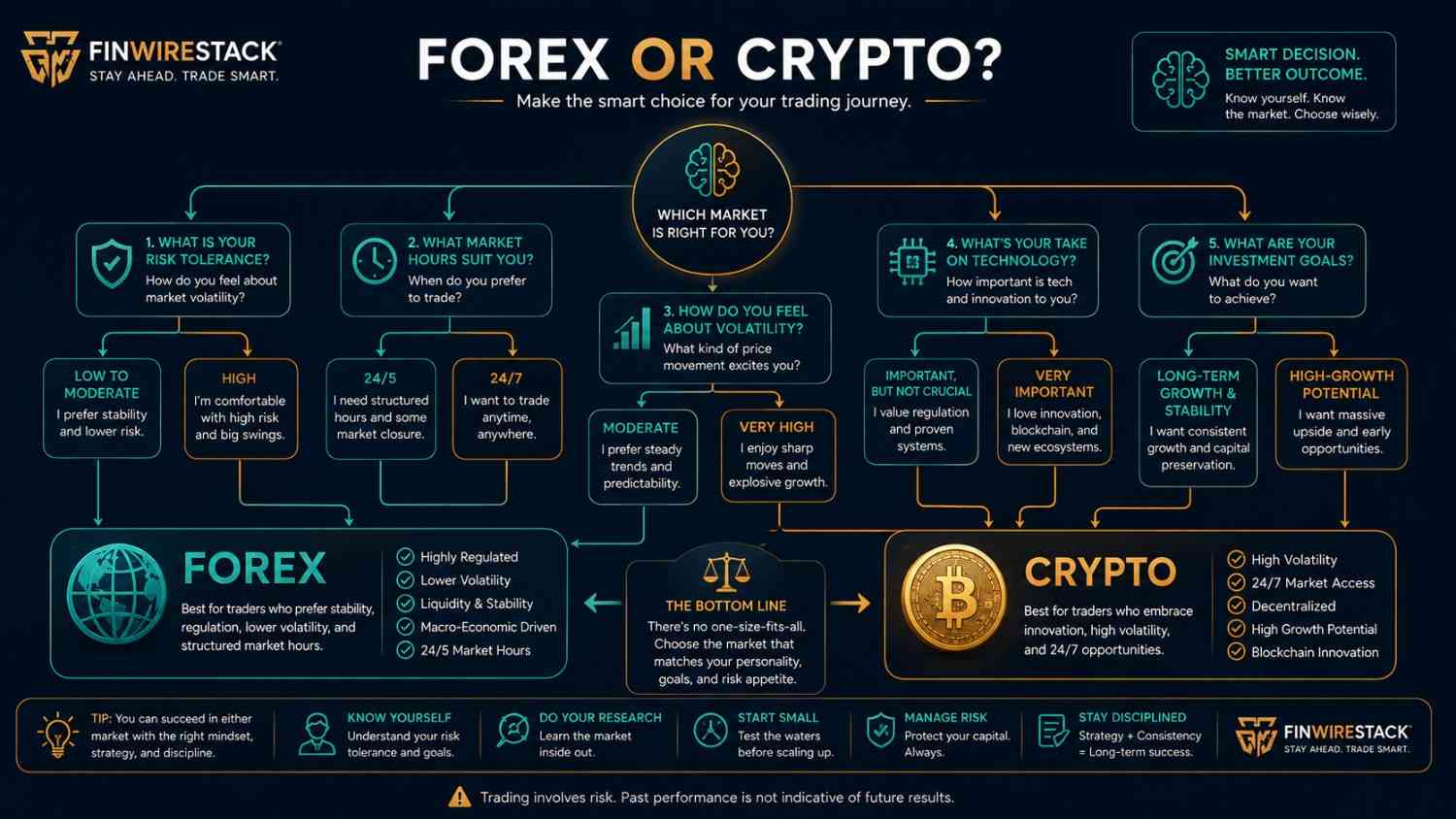
Ask yourself these questions:
Do you enjoy following global economic news?
If yes, Forex may align with your interests.
Are you fascinated by blockchain technology?
If yes, Crypto may be a better fit.
Do you prefer structured market hours?
Forex offers trading five days a week with well-defined market sessions.
Do you want a market that never closes?
Crypto trades 24 hours a day, seven days a week.
Are you comfortable with significant price swings?
If not, Forex may feel more manageable.
If you accept higher volatility in pursuit of potentially larger price movements, crypto may better match your risk tolerance.
Do you plan to become a professional trader?
Many professionals eventually understand both markets because global finance is increasingly interconnected.
Learning the strengths and weaknesses of each can broaden your perspective and create more opportunities over time.
Key Takeaways on Forex vs Crypto Trading.
When comparing Forex vs Crypto Trading, remember these important lessons:
✔ Forex is generally more liquid.
✔ Crypto typically experiences greater volatility.
✔ Both require education and disciplined risk management.
✔ AI can improve analysis but cannot guarantee profits.
✔ Scams exist in both markets.
✔ Successful investors focus on long-term skill development rather than short-term excitement.
✔ The best market is the one that aligns with your goals, knowledge, and financial circumstances.
Expert Tips for New Traders
If you’re just beginning your journey, consider these practical steps:
- Build a solid foundation by learning the basics before investing real money.
- Practice with a demo account if you’re exploring Forex.
- Start with established cryptocurrencies if you’re interested in digital assets.
- Keep a trading or investment journal.
- Stay informed through trusted financial news and educational resources.
- Never rely solely on social media influencers for financial decisions.
- Review your performance regularly and learn from both successes and mistakes.
Consistency and continuous learning often
matter more than trying to find the “perfect” strategy.
Final Thoughts
The debate surrounding Forex vs. Crypto Trading will continue as financial markets evolve.
Rather than asking which market is universally better, ask which market is better for you.
Forex provides access to the world’s largest financial market, where economic data, central bank decisions, and global events shape currency prices.
Crypto offers exposure to innovative blockchain technology and digital assets that continue to transform finance.
Both markets reward preparation.
Both markets punish poor risk management.
Both markets require patience, discipline, and ongoing education.
As AI, financial technology, and global investing continue to evolve, the individuals who succeed will be those who commit to lifelong learning rather than chasing shortcuts.
At FinWireStack, our goal is to help you become one of those informed investors.

📚 Sources and Further Reading
This guide on Forex vs. Crypto Trading was built using insights from a variety of reputable sources to ensure accuracy and depth. For further reading, please explore the links below:
- Investopedia. “Forex Market: Who Trades Currencies and Why.” https://www.investopedia.com/terms/forex/f/forex-market.asp
- Investopedia. “Cryptocurrency: What It Is and How It Works.” https://www.investopedia.com/terms/c/cryptocurrency.asp
- Commodity Futures Trading Commission (CFTC). “Customer Advisory: Beware of Foreign Exchange (Forex) Trading Frauds.” https://www.cftc.gov/LearnAndProtect/AdvisoriesAndArticles/ForexFraud/index.htm. Forex vs Crypto Trading
- U.S. Securities and Exchange Commission (SEC). “Investor Alert: Public Companies Making Cryptocurrency-Related Claims.” https://www.sec.gov/oiea/investor-alerts-and-bulletins/ib_publiccompaniescrypto
- Financial Conduct Authority (FCA). “Cryptocurrency: What You Need to Know.” https://www.fca.org.uk/consumers/cryptocurrencies. Forex vs Crypto Trading
- Bank for International Settlements (BIS). “Annual Economic Report 2024: The Future of Money and Payments.” https://www.bis.org/publ/arpdf/ar2024e.htm
- International Monetary Fund (IMF). “The Crypto Ecosystem and Financial Stability Challenges.” https://www.imf.org/en/Publications/fintech-notes/Issues/2024/01/19/The-Crypto-Ecosystem-and-Financial-Stability-Challenges-545421
- Forbes. “What Is Artificial Intelligence (AI) In Trading?” https://www.forbes.com/advisor/investing/ai-trading/. Forex vs Crypto Trading
✍️ About the Author
FinWireStack Team
FinWireStack is a dedicated platform for financial education and smart money decisions. Our mission is to empower individuals with the knowledge and tools they need to navigate complex financial markets with confidence. We focus on providing clear, actionable, and unbiased content to help you achieve your financial goals. Our team of researchers and writers is committed to demystifying finance and investing for a global audience.
📢 Share This Article
If you found this Forex vs Crypto Trading guide helpful, please consider sharing it with others who might benefit from understanding the critical differences between Forex and crypto trading.






[…] Forex vs Crypto Trading […]
[…] forex-vs-crypto-trading […]