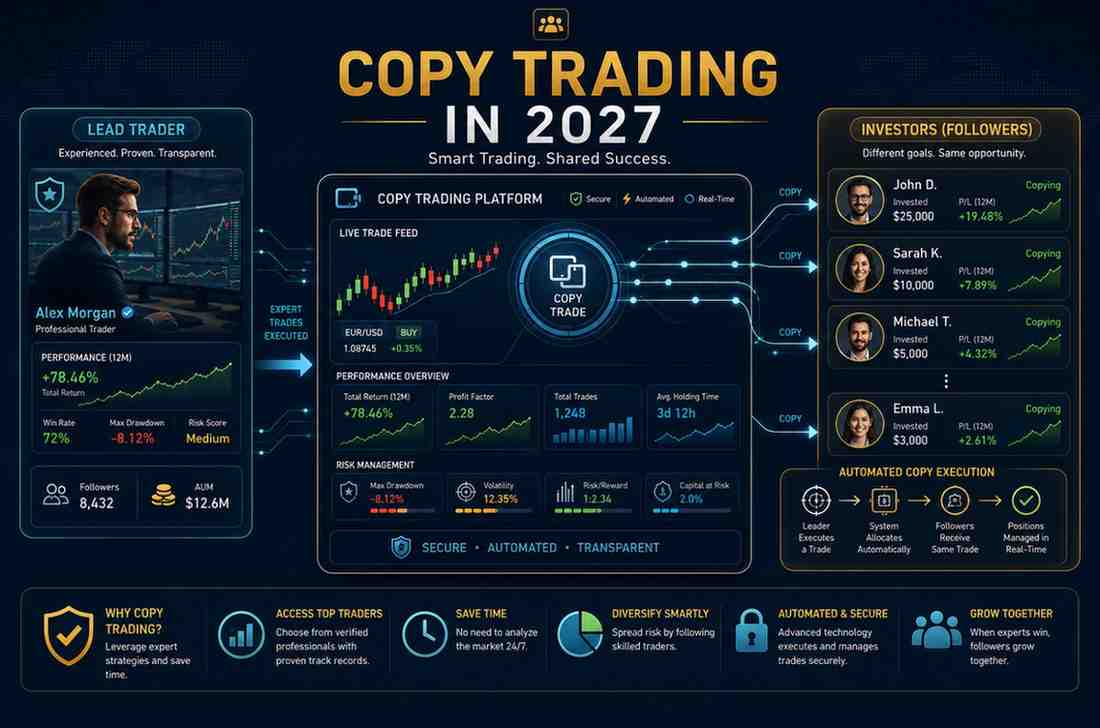
Copy trading in 2027 is becoming an increasingly important topic for retail traders who want market exposure without making every trading decision themselves. The idea sounds simple. Find a successful trader. Connect your account. Copy their trades automatically.
When they buy, your account buys. When they sell, your account sells. For a beginner struggling to understand charts, indicators, economic news, and risk management, copy trading in 2027 can look like an attractive shortcut. But there is a problem. Following a trader does not automatically mean following their success. You are also copying their losses, leverage, drawdowns, timing, strategy limitations, and potentially their mistakes.
The growth of social and mobile trading is making this distinction more important. Regulators have been paying attention to copy trading because automated copying can cross into investment or portfolio management depending on how the service is structured. The UK’s Financial Conduct Authority states that copy trading can be treated as portfolio or investment management where there is no clear manual intervention from the account holder.
That makes Copy trading in 2027 much more than a question of finding the trader with the highest return. The real question is, can you identify a trader whose strategy, risk level, transparency, and performance are compatible with your own financial goals?
What Is Copy Trading?
Copy trading in 2027 refers to using a platform or service that allows one trader’s transactions to be automatically replicated in another investor’s account. The person being followed is commonly called a:
- Signal provider
- Strategy provider
- Lead trader
- Master trader
- Trader to copy
The person following them may be called: - Copier
- Follower
- Investor
- Copy trader
The copied trade may be replicated proportionally according to the amount allocated to the strategy.
For example, suppose a trader opens a EUR/USD position using 5% of their account.
Your copy-trading platform may allocate a corresponding proportion of your designated copy-trading capital.
The exact mechanism depends on the platform.
This is important because copy trading in 2027 does not necessarily mean that you own the same portfolio or experience the same percentage return.
Execution prices, spreads, commissions, leverage, account size, and platform rules can all affect your results.
Why Copy Trading in 2027 Is Becoming More Attractive
Several trends are making Copy trading in 2027 particularly relevant.
1. Trading Is Becoming More Social
Modern trading platforms increasingly combine:
- Market data
- Social feeds
- Trader rankings
- Performance dashboards
- Community discussions
- Automated execution
This creates an environment where trading ideas can spread rapidly.
2. Mobile Trading Is Normal
A trader no longer needs a traditional desktop workstation to monitor an account. Mobile platforms allow users to:
- Follow traders
- Review performance
- Adjust allocations
- Monitor positions
- Receive notifications
- Stop copying strategies
That accessibility is one reason copy trading in 2027 could attract more inexperienced market participants.
3. AI Is Changing Trader Discovery
AI can potentially help investors analyze:
- Historical returns
- Drawdowns
- Trading frequency
- Asset exposure
- Volatility
- Risk-adjusted performance
- Correlations
This could make Copy trading in 2027 more analytical than the old approach of simply choosing the trader with the biggest percentage gain.
4. Finfluencer Culture Is Growing
How Copy Trading Will Actually Work in 2027
Social media has created a new class of financial personalities. Some provide useful educational content. Others may promote trading services, signals, or managed accounts without giving investors enough information about the risks. The FCA has specifically warned that some finfluencers promote unrealistic returns and encourage consumers to copy trades, invest in managed accounts, or purchase trading tips. Therefore, copy trading in 2027 should never be based solely on the personality of the trader.

A typical copy trading process in 2027 looks like this:
Step 1: Open an Account
You register with a platform that offers social or copy trading.
Step 2: Select a Trader
The platform normally displays information such as:
- Return
- Drawdown
- Number of followers
- Trading history
- Risk score
- Assets traded
- Trading frequency
Step 3: Allocate Capital
You decide how much money to dedicate to copying. This is critical. Your entire investment portfolio does not have to be allocated to one trader.
Step 4: Activate Copying
Once activated, new trades from the selected trader may be replicated automatically.
Step 5: Monitor Performance
You should continue monitoring the strategy. Copy trading in 2027 is not “set it and forget it.”
Step 6: Stop or Adjust
If the trader’s strategy changes or risk becomes unacceptable, you should be able to reduce allocation or stop copying, depending on the platform.
The Biggest Mistake: Choosing the Highest Return

One of the biggest mistakes in Copy trading in 2027 will be chasing the trader at the top of the leaderboard. Imagine three traders:
| Trader | Return | Maximum Drawdown | Trading Style |
|---|---|---|---|
| Trader A | +180% | -65% | Aggressive |
| Trader B | +65% | -18% | Moderate |
| Trader C | +28% | -9% | Conservative |
| Trader A looks impressive. | |||
| But a 65% drawdown can be devastating. | |||
| If your $5,000 allocation falls 65%, you are left with approximately $1,750. | |||
| Recovering from a 65% loss requires a gain of approximately 186%. | |||
| That is why Copy Trading in 2027 should focus on risk-adjusted performance rather than headline returns. |
11 Rules for Safer Copy Trading in 2027
Rule 1: Examine Maximum Drawdown
Maximum drawdown tells you how far an account or strategy has fallen from a previous peak. It is one of the most important measurements in copy trading in 2027. A trader who produces excellent returns but regularly suffers enormous drawdowns may be unsuitable for a conservative investor. Ask: How much of my capital can I tolerate losing before I stop copying?
Rule 2: Look at the Full Trading History
Do not judge Copy Trading in 2027 performance from the last 30 days. A trader can have an exceptional month because of:
- Market conditions
- One large position
- High leverage
- Concentration
- Luck
Look for a longer history where available.
Ideally, examine multiple market conditions.
Rule 3: Understand the Trader’s Strategy
Before using Copy trading in 2027, understand what the trader actually does. Ask:
- Are they scalping?
- Day trading?
- Swing trading?
- Position trading?
- Using leverage?
- Trading CFDs?
- Trading crypto?
- Holding positions overnight?
- Using automated systems?
A trader whose strategy you cannot explain is difficult to monitor responsibly.
Rule 4: Check Leverage
Leverage can dramatically change Copy trading risk in 2027. A trader may produce impressive returns because they are taking enormous positions. If the market reverses, the same leverage can produce severe losses. Never assume that a high return means a low-risk strategy.
Rule 5: Check Risk Per Trade
A trader who repeatedly risks a large percentage of capital on individual trades may eventually experience a major drawdown. This is where FinWireStack’s Risk Management Mastery: 7 Proven Strategies can complement your copy-trading research. Risk Management Mastery: 7 Proven Strategies. The same principles of position sizing, stop-loss management, and drawdown control apply when evaluating copy Trading in 2027.
Rule 6: Do Not Put Everything Into One Trader
Diversification matters. Suppose you have $10,000 available for copy trading. Putting all $10,000 behind one highly aggressive trader creates concentration risk. A more diversified structure might involve different strategies or keeping some capital outside the copy-trading system. The correct allocation depends on your circumstances and risk tolerance.
Rule 7: Investigate the Platform
Copy Trading in 2027 is only as safe as the platform holding and executing your money.
Check:
- Regulation
- Legal company name
- Client-fund arrangements
- Fees
- Withdrawal rules
- Execution model
- Complaint procedures
- Account protection
Do not assume a platform is legitimate simply because it has thousands of users.
Rule 8: Investigate the Trader
Follower count is not enough. A trader may have:
- 50,000 followers
- Attractive lifestyle content
- Expensive cars
- Luxury holidays
- Screenshots of profits
None of these prove that the strategy is sustainable.
Copy Trading in 2027 should be based on evidence, not lifestyle marketing.
Rule 9: Understand All Fees
Your actual Copy trading in 2027 return can be affected by:
- Spreads
- Commissions
- Performance fees
- Management fees
- Withdrawal fees
- Currency conversion
- Overnight financing
- Platform charges
A trader can show a strong gross return while your net return is considerably lower.
Rule 10: Set a Maximum Loss
Before activating Copy Trading in 2027, establish a personal risk limit. For example: “If this strategy reaches a 15% drawdown, I will review or stop copying.” The exact number should reflect your own risk tolerance and the strategy involved. The important principle is having a predefined rule.
Rule 11: Be Prepared to Stop
Stopping a losing strategy is not failure. Continuing to copy because you hope the trader will recover can turn a manageable loss into a much larger one. Copy Trading in 2027 requires the same discipline as direct trading.
Can Copy Trading in 2027 Actually Make Money?
Yes, it can produce profits. But that does not mean it is easy. The outcome depends on:
- Trader selection
- Market conditions
- Risk management
- Costs
- Execution
- Capital allocation
- Strategy consistency
- Your decision to stop or continue
The key question is not:
“Can copy trading in 2027 make money?”
It is:
“Can I identify and manage a strategy whose risk is acceptable to me?”
A profitable trader can experience a losing period.
A trader with an excellent historical record can change strategy.
A strategy that worked in one market environment may fail in another.
Therefore, Copy Trading in 2027 should be treated as an investment process rather than a guaranteed-income system.
Copy Trading in 2027 and Forex
Forex is one of the markets where copy trading has become particularly popular. A Forex copy trader may follow trading strategies:
- EUR/USD
- GBP/USD
- USD/JPY
- USD/CHF
- AUD/USD
- Gold
- Major indices
The advantage is convenience.
The danger is leverage.
A Forex strategy can appear highly profitable during a strong trend and then experience a rapid drawdown when market conditions change.
If you are considering Forex copy trading, understanding how to read Forex charts can still be valuable even when someone else makes the trading decisions. How to Read Forex Charts: Beginner’s Guide
You do not need to become a professional analyst.
But you should understand enough to know what the trader is doing with your money.
Copy Trading in 2027 and Cryptocurrency
Crypto copy trading presents a different risk profile. Cryptocurrency markets can operate around the clock and may experience sharp price movements. A trader who performs well during a strong crypto bull market may have a very different result during a prolonged decline. Crypto copy trading also introduces platform, custody, and regulatory considerations. That means copy trading in 2027 should not be evaluated solely by the trader’s percentage return. You should also understand:
- Which assets are being traded
- Whether leverage is used
- Where assets are held
- What happens during extreme volatility
- What fees apply
- What happens if the platform becomes unavailable
Copy Trading in 2027 vs. Trading Yourself
| Factor | Copy Trading in 2027 | Trading Yourself |
| Decision-making | Shared/delegated | You decide. |
| Time requirement | Lower | Higher |
| Learning opportunity | Moderate | High |
| Control | Partial | Full |
| Risk | Depends on provider | Depends on you |
| Emotional pressure | Potentially lower | Potentially higher |
| Skill requirement | Trader selection | Market analysis + execution |
| Monitoring | Still required | Required |
| Fees | Platform + trading costs | Trading costs |
| Neither approach is automatically superior. | ||
| Copy Trading in 2027 may suit someone who does not have the time or expertise to execute every trade. | ||
| Direct trading may suit someone who wants complete control and is willing to develop the required skills. |
Copy Trading in 2027 Is Not Passive Investing
This distinction matters. Passive investing generally involves buying diversified assets and holding them for a long period. Copy trading in 2027 is usually much more active. The trader may:
- Open positions frequently
- Change exposure
- Increase leverage
- Close trades quickly
- Change strategy
Therefore, copying someone does not transform an active trading strategy into passive investing.
The Finfluencer Problem
Social media is likely to remain a major driver of Copy Trading in 2027. A trader can build a large audience by displaying:
- Luxury cars
- Profitable trades
- Trading screens
- Expensive watches
- Travel
- High account balances
The problem is that social media usually shows the highlights.
You rarely see: - Losing months
- Margin calls
- Failed strategies
- Drawdowns
- Hidden costs
- Withdrawals
- Personal financial losses
The FCA has already raised concerns about finfluencers and unrealistic return claims connected with copy trading and managed accounts.
Copy Trading in 2027 should therefore separate the trader’s marketing identity from their verified trading record.
How AI Could Change Copy Trading in 2027
AI could make copy trading in 2027 significantly more sophisticated. Instead of simply ranking traders by return, AI systems could potentially compare:
- Risk-adjusted returns
- Drawdown patterns
- Correlations
- Position concentration
- Trading frequency
- Volatility exposure
- Market regime performance
- Strategy changes
- Behavioral patterns
This could help investors identify whether two traders are actually diversified or simply making similar bets.
AI may also help detect sudden changes in a trader’s behavior.
For example:
A trader historically risks 1% per position.
Suddenly, they begin risking 8%.
An intelligent monitoring system could flag the change.
This direction fits into the broader evolution toward AI-assisted investing and autonomous financial tools.
FinWireStack’s AI Trading Agents 2027 article explores how autonomous AI systems could increasingly participate in market research, decision-making, and execution. AI Trading Agents 2027
However, AI does not eliminate the fundamental risk of following another person’s strategy.
It simply gives investors more tools for evaluating that strategy.
A Copy Trading in 2027 Scoring System
Before choosing a trader, consider scoring them across several categories.
| Category | Weight |
| Long-term track record | 20% |
| Maximum drawdown | 20% |
| Risk management | 15% |
| Strategy transparency | 15% |
| Consistency | 10% |
| Leverage | 10% |
| Fees | 5% |
| Platform/regulatory quality | 5% |
| Do not interpret the percentages as a universal formula. | |
| They are simply a framework for thinking beyond headline returns. | |
| The goal of Copy Trading in 2027 is not to identify the trader who made the most money last month. | |
| It is to identify the strategy that offers a reasonable combination of potential return, risk and transparency. |
7 Questions to Ask Before Copying a Trader
Before starting Copy Trading in 2027, ask:
1. How long has the trader been active?
A few profitable weeks are not enough evidence.
2. What is the maximum historical drawdown?
This helps you understand potential downside.
3. How much leverage does the trader use?
High leverage can transform normal volatility into severe losses.
4. What assets does the trader trade?
Know what you are actually exposed to.
5. How much do fees reduce my return?
Focus on net results rather than advertised returns.
6. What happens if I stop copying?
Understand how open positions are handled.
7. Is the platform properly regulated?
Verify this independently. These questions can dramatically improve the quality of your Copy Trading in 2027 decision.
Common Copy Trading Mistakes
Chasing Last Year’s Winner
A trader who performed exceptionally well in the past may not repeat that performance.
Ignoring Drawdown
Return without drawdown analysis is incomplete.
Copying Too Many Traders
Owning ten strategies does not necessarily create diversification. They may all trade the same assets.
Using Money You Cannot Afford to Lose
Copy trading remains exposed to market risk.
Trusting Social Media
Popularity is not proof.
Ignoring Fees
Costs compound over time.
Never Checking the Account
Automatic execution does not mean automatic supervision.
Increasing Allocation After a Winning Streak
A winning streak can create false confidence.
Copying High-Leverage Strategies
Large returns may simply reflect large risk.
Expecting Monthly Income
Trading performance is not a salary.
Is Copy Trading in 2027 Good for Beginners?
Copy trading in 2027 can be useful for beginners as an educational tool, but beginners should not confuse convenience with safety. A new trader can observe:
- How professionals enter trades
- How they manage positions
- How they react to market changes
- How frequently they trade
- How drawdowns develop
But the beginner should also study the underlying principles.
A person who blindly copies another trader may never learn how markets work.
A person who combines copy trading with education can use the experience as a learning laboratory.
A Safer Beginner Framework for Copy Trading in 2027
A beginner could approach copy trading in 2027 using five stages:
Stage 1 — Learn:
Understand basic market terminology, leverage, spreads, and risk.
Stage 2 — Observe:
Track several traders without committing capital.
Stage 3—Compare:
Analyze returns, drawdown, leverage, and strategy.
Stage 4 — Start Small:
If you decide to proceed, use an amount appropriate to your risk tolerance.
Stage 5 — Review:
Monitor performance and determine whether the strategy still fits your objectives.
This is much more disciplined than choosing a trader because their profile displays the highest return.
What Regulators Are Telling Investors
Regulatory attention to copy trading is increasing. The FCA explains that copy trading may fall within portfolio or investment management requirements when investors automatically follow another person’s trades without meaningful manual intervention.
ESMA has also issued supervisory guidance covering copy-trading services, including requirements and expectations around marketing communications, costs, suitability, appropriateness, remuneration and the qualifications of traders whose trades are copied. This matters because Copy Trading in 2027 is not simply a social-media trend.
It intersects with investor protection, financial promotion, suitability, and regulation. The FCA has separately warned that consumers are sometimes encouraged by finfluencers to copy trades or invest in managed accounts based on unrealistic return claims.
What Could Go Wrong With Copy Trading in 2027?
Consider this scenario. You allocate $2,000 to a trader. The trader has generated a 90% return over the previous year. You assume the strategy is reliable. Three months later, the trader experiences a 30% drawdown. You panic and stop copying. Two weeks later, the strategy recovers. The trader finishes the year profitably. You still lose money because your timing was different. This is an important lesson.

Copy Trading in 2027 does not guarantee that your result will match the trader’s displayed result. Differences can arise from:
- Entry price
- Execution
- Slippage
- Fees
- Allocation
- Timing
- Account size
- When you start copying
- When you stop copying
The Biggest Psychological Trap
The biggest psychological danger in copy trading in 2027 may be giving up responsibility. When you make your own trade, you know the decision belongs to you. When another trader makes it, you may blame them. That can create a dangerous cycle: Profit → Increase allocation → Loss → Blame trader → Switch trader → Repeat. The solution is to treat every copied position as your own financial exposure. You are still responsible for deciding how much capital to allocate.
Final Verdict: Can You Make Money With Copy Trading in 2027?
Yes, copy trading in 2027 can potentially make money. But it is not a guaranteed income strategy. It is not a shortcut around risk. It is not a substitute for financial education. And it should never be treated as a magic button that turns another person’s trading history into your future profits. The strongest approach to copy trading in 2027 is selective, analytical, and risk-controlled. Look beyond returns. Study drawdown. Understand leverage. Check fees. Investigate the platform.
Verify the trader. Watch for strategy changes. Set your own risk limits. And never allow a social media personality to make your financial decisions for you. The future of copy trading in 2027 will likely be more automated, more personalized, and increasingly AI-supported.
That could make it easier to identify good traders. It could also make bad traders better at marketing themselves. The investor’s advantage will therefore come from one skill above all: knowing how to separate evidence from hype.
Copy Trading in 2027 Checklist

Before activating a strategy, ask yourself:
☐ I understand how the strategy works.
☐ I have reviewed the trader’s history.
☐ I have checked the maximum drawdown.
☐ I understand the leverage used.
☐ I know what assets are traded.
☐ I understand every major fee.
☐ I have verified the platform.
☐ I have checked the regulatory position.
☐ I have set my maximum acceptable loss.
☐ I am not relying on social media popularity.
☐ I am not chasing the highest recent return.
☐ I understand that past performance does not guarantee future results.
☐ I can afford to lose the capital allocated.
☐ I will continue monitoring the strategy.
If several answers are “no,” you are not ready to start copy trading in 2027.
Frequently Asked Questions
Is copy trading in 2027 profitable?
Copy trading in 2027 can be profitable, but profitability is not guaranteed. Results depend on trader selection, strategy, risk management, market conditions, costs, and execution.
Is copy trading in 2027 safe for beginners?
Copy trading in 2027 can reduce the amount of direct trade execution a beginner needs to perform, but it does not remove market risk. Beginners should understand leverage, drawdown, and fees before allocating money.
What is the biggest risk of copy trading in 2027?
The biggest risk is assuming that a trader’s historical performance will automatically become your future performance. Drawdowns, leverage, fees, execution, and timing can create very different results.
Can AI improve copy trading in 2027?
AI may improve trader discovery, risk analysis, portfolio monitoring, and strategy comparison. However, AI cannot guarantee future returns or eliminate market risk.
Should I copy the trader with the highest return?
No. A high return can come with extremely high risk. Examine maximum drawdown, leverage, consistency, and risk-adjusted performance before choosing a trader.
Can I lose all my money through copy trading?
Depending on the product, leverage, platform, and strategy, substantial or even total losses may be possible. Always understand the specific risks before investing.
Is copy trading the same as investing?
No. Many copy-trading strategies are active trading strategies rather than long-term passive investments.
How much money should I use for copy trading?
There is no universal amount that is appropriate for everyone. The amount should reflect your financial circumstances, risk tolerance, and ability to withstand losses.
Conclusion
Copy trading in 2027 could become one of the most accessible ways for retail investors to participate in active trading. But accessibility is not the same as safety. The platforms may become smarter. AI may make trader analysis faster. Mobile apps may make execution easier. Social networks may make successful traders more visible.
None of these developments changes the fundamental rule: You are still responsible for the risk attached to the money you allocate.
If you approach copy trading in 2027 by chasing profits, you may end up copying risk you do not understand. If you approach copy trading in 2027 by studying performance, drawdown, leverage, fees, regulation, and strategy consistency, you have a much stronger foundation for making an informed decision.
The goal is not to find someone who never loses. That person does not exist. The goal is to find a strategy whose risks you understand, whose performance you can evaluate, and whose potential losses you can genuinely afford.
Copy trading can copy a strategy. It cannot copy certainty.
Disclaimer: This article is for educational and informational purposes only and does not constitute financial, investment, tax, or legal advice. Trading and investing involve substantial risk, and past performance does not guarantee future results. Always conduct independent research and consider your financial circumstances and risk tolerance before allocating capital.
Sources
Financial Conduct Authority (FCA): Copy Trading—regulatory treatment and investor information. FCA Copy Trading Guidance.
Financial Conduct Authority (FCA): FCA warns investors in CFDs risk losing out on protections.
European Securities and Markets Authority (ESMA): Supervisory guidance for copy trading services. ESMA Copy Trading Guidance.
European Securities and Markets Authority (ESMA): Risks from social-media-driven trading. ESMA Social Trading Risk Warning.
U.S. Securities and Exchange Commission / Investor.gov: Social Sentiment Investing Tools. Investor.gov Social Sentiment Investing Tools.