
If you have never invested before, the financial world can feel intimidating.
You hear people talking about stocks, ETFs, index funds, 401(k)s, Roth IRAs, mutual funds, dividends, capital gains, and compound interest.
Then you hear another name repeatedly:
Fidelity Investments.
But what exactly is Fidelity?
Is Fidelity a bank?
Is Fidelity a stock?
Is Fidelity an investment fund?
Can you buy stocks through Fidelity?
How much money do you need?
And, most importantly, how does a complete beginner actually use Fidelity Investments to start building wealth?
This guide answers those questions from the ground up.
By the end, you should understand what Fidelity is, what it offers, how the different accounts work, what you can invest in, what the major risks are, and what a sensible beginner investing journey could look like.
Important: Fidelity is not an investment itself. Fidelity is a financial-services company and investment platform through which eligible customers can access different financial products.
What Is Fidelity Investments?
Fidelity Investments is one of the major financial services companies serving U.S. investors.
Through its platforms, Fidelity provides access to investment accounts, stocks, ETFs, mutual funds, bonds, retirement accounts, managed investing, and other financial services. Fidelity’s current account lineup includes brokerage accounts, retirement accounts, managed solutions, cash-management products, crypto offerings, and accounts for children and education.
Think of Fidelity as a financial supermarket.
You do not go to Fidelity simply to “buy Fidelity.”
Instead, you open an appropriate account and then decide which investments belong inside that account.
For example:
Fidelity account → ETF → stocks inside the ETF
or
Fidelity IRA → mutual fund → diversified portfolio
or
Fidelity brokerage account → individual stocks
This distinction is fundamental for beginners.
Fidelity Investments in Simple Terms
Imagine you want to build a house.
You need:
- A place to build
- Building materials
- Tools
- A construction plan
Your Fidelity account is similar to the place where your investments are held.
Your stocks, ETFs, bonds and mutual funds are the building materials.
Your investment strategy is the construction plan.
Fidelity provides the platform and tools.
You still need to decide what you are building.
Why Is Fidelity Investments Getting So Much Attention?
The interest surrounding Fidelity fits into several major changes happening in U.S. investing.
AI and Technology
Artificial intelligence has become a major investment theme.
Fidelity’s own 2026 research identifies AI infrastructure as a major economic force and points to potential opportunities across semiconductor companies, utilities, energy, and other businesses supporting AI infrastructure.
Low-Cost Investing
Investors increasingly focus on fees because even small recurring costs can significantly affect long-term returns.
Fidelity currently advertises $0 online commissions for U.S. stocks and ETFs and offers zero-expense-ratio index mutual funds.
Fractional Investing
Fidelity allows eligible investors to purchase fractional shares, with its brokerage materials stating that investors can start with as little as $1.
Retirement Investing
Americans continue to use retirement accounts such as 401(k)s and IRAs to build long-term wealth.
For 2026, the IRS says the annual IRA contribution limit is $7,500, with an additional $1,100 catch-up contribution for eligible investors aged 50 and above.
Crypto
Fidelity has also expanded into digital assets.
Its current crypto offerings includes Bitcoin, Ethereum, Fidelity Digital Dollar, Litecoin, and Solana, and Fidelity also offers crypto-related exchange-traded products.
These trends help explain why understanding Fidelity Investments is increasingly relevant to people learning about modern U.S. investing.
How Does Fidelity Investments Actually Work?
The process is surprisingly simple.
Step 1: Choose an Account
You first decide what type of account you need.
Step 2: Deposit Money
You transfer money into the account.
Step 3: Select Investments
You choose stocks, ETFs, mutual funds, bonds or another eligible investment.
Step 4: Place the Investment
You purchase the investment.
Step 5: Monitor and Rebalance
You review your portfolio periodically and make adjustments when appropriate.
The biggest beginner mistake is believing that depositing money into Fidelity automatically means you are invested.
It does not.
Cash sitting inside an account is different from money invested in a security.
The Most Important Fidelity Accounts Beginners Should Understand

1. Fidelity Brokerage Account
The standard brokerage account is one of the easiest places to start learning.
Fidelity describes its brokerage account as a multi-feature account that can provide access to stocks, ETFs, options, bonds, mutual funds, and other investments. It currently has no account minimum and allows investing from $1 through fractional shares.
Best For
A brokerage account can make sense for someone who wants:
- Flexible investing
- No retirement-account restrictions
- Stock investing
- ETF investing
- Long-term wealth building
- Access to taxable investments
The major disadvantage is taxation.
Investment income and realized capital gains can create tax obligations.
2. Traditional IRA
A Traditional IRA is designed primarily for retirement investing.
Depending on your circumstances, contributions may qualify for tax deductions, and investments generally grow tax-deferred.
However, withdrawal rules and tax consequences apply.
2026 IRA Contribution Limit
For 2026, the combined IRA contribution limit is:
$7,500 if under age 50
$8,600 if age 50 or older
The additional amount represents the catch-up contribution.
Always check the current IRS rules before making retirement contributions.
3. Roth IRA
A Roth IRA is another important retirement account.
The major attraction is the potential for tax-free qualified withdrawals.
However, eligibility and contribution rules apply.
For 2026, the IRS rules allow eligible individuals to contribute up to the applicable IRA limit, but higher-income taxpayers may face reduced or eliminated direct Roth IRA contribution eligibility. Fidelity’s current 2026 guidance lists income thresholds for Roth IRA eligibility.
Why Beginners Should Understand Roth IRAs
Suppose a young investor contributes consistently for decades.
The combination of:
contributions + investment growth + compounding + tax advantages
can become extremely powerful.
The right choice depends on your income, tax situation, retirement expectations, and eligibility.
But a Roth IRA is not automatically “better” than a Traditional IRA.
4. 401(k)
A 401(k) is generally an employer-sponsored retirement plan.
If your employer offers a 401(k), this deserves attention before opening additional investment accounts.
Why?
Because some employers provide a matching contribution.
For example, if an employer matches part of your contribution, not taking advantage of the available match can mean leaving part of your compensation unused.
Fidelity provides retirement-plan services to employers and employees, although the exact investments and rules available depend on the particular employer plan.
5. Fidelity Go
Not everyone wants to choose investments manually.
That is where a robo-advisor can become useful.
Fidelity Go is Fidelity’s automated investing service.
Fidelity states that Fidelity Go is available to U.S. residents aged 18 and above, and there is no minimum initial investment; once the account reaches $10, Fidelity begins investing according to the selected strategy.
This can be attractive to someone who says:
“I want to invest, but I don’t know which investments to select.”
Instead of manually selecting every security, the investor provides information about their goals and risk preferences, and the automated service manages the portfolio within its framework.
What Can You Buy Through Fidelity?

This is where things become interesting.
Stocks
You can purchase shares of individual publicly traded companies.
For example, you might buy shares of companies operating in:
- Technology
- Healthcare
- Financial services
- Energy
- Consumer products
- Industrials
But individual stocks carry company-specific risk.
If the company performs poorly, the stock can fall significantly.
ETFs
An ETF is a basket of investments traded on an exchange.
Instead of purchasing 500 individual companies, you can buy an ETF designed to track a broad market index.
This can provide diversification with a single transaction.
Fidelity offers a broad range of ETFs and provides research tools for evaluating them.
Why Beginners Often Prefer ETFs
ETFs can provide:
Diversification
Convenience
Transparency
Low costs
Simple portfolio construction
But not every ETF is diversified.
Some ETFs concentrate heavily on one industry, theme, or asset.
Always investigate what is actually inside an ETF.
Fidelity Index Funds
Index funds attempt to track a particular market index.
One of Fidelity’s most well-known index funds is the Fidelity 500 Index Fund (FXAIX), which seeks to track the S&P 500.
The fund currently has an extremely low expense ratio, and current market reporting places its expense ratio at 0.015%.
This illustrates one reason index investing has become so popular.
Instead of trying to identify the next winning company, the investor obtains exposure to a broad group of companies.
Important
Low fees do not eliminate market risk.
An S&P 500 index fund can still decline substantially during a market downturn.
Fidelity Mutual Funds
Mutual funds pool money from multiple investors and invest according to a defined strategy.
Fidelity has a large mutual-fund lineup covering different objectives.
These can include:
- U.S. equities
- International equities
- Bonds
- Target-date funds
- Sector funds
- Growth funds
- Income funds
- Index funds
The important question is not
“Is this a Fidelity fund?”
The important questions are:
“What does this fund own?”
“What does it charge?”
“What is its objective?”
“What risks does it take?”
Fidelity Bonds and CDs
Investing does not have to mean buying stocks.
Fidelity also provides access to fixed-income investments such as bonds and CDs.
These can play a role in portfolios designed around:
- Income
- Capital preservation
- Diversification
- Retirement planning
- Lower equity exposure
Fidelity currently lists $1 per bond or CD for secondary-market trading and free online trading for U.S. Treasuries, subject to applicable conditions and rules.
Fidelity Crypto
This is one of the most important modern developments to understand.
Fidelity now offers cryptocurrency exposure through multiple structures.
These include:
Fidelity Crypto
Crypto ETPs
Crypto IRA options
Its current direct crypto offering includes Bitcoin, Ethereum, Fidelity Digital Dollar, Litecoin, and Solana.
Fidelity also offers crypto funds such as FBTC, FETH and FSOL, which provide exposure to Bitcoin, Ether, and Solana through exchange-traded products.
But Crypto Is Different
Fidelity itself warns that cryptocurrency is highly volatile and may become illiquid.
Investors can lose their entire investment.
Crypto should therefore not automatically become the foundation of a beginner’s portfolio.
Fidelity Fractional Shares Explained
Suppose a stock costs $500 per share.
You only have $50.
With fractional investing, you may be able to purchase a portion of that share rather than waiting until you have $500.
Fidelity states that its brokerage account supports fractional shares and allows investors to get started with as little as $1.
This is particularly important for younger investors.
You no longer necessarily need thousands of dollars to begin building a diversified investment habit.
How Much Money Do You Need to Start With Fidelity?
This is one of the most common questions for beginners.
The answer is
You do not necessarily need a large amount.
Fidelity’s standard brokerage account currently has no account minimum, and its fractional-share system allows eligible investors to start investing with $1.
But there is a difference between:
minimum required to start
and
amount needed to achieve a meaningful financial goal.
Starting with $1 teaches you how the platform works.
Building meaningful wealth requires consistent contributions over time.
Fidelity Fees: What Beginners Should Watch
One reason Fidelity attracts investors is its low-cost structure.
Fidelity currently advertises:
- $0 online commissions for U.S. stocks
- $0 online commissions for ETFs
- $0 account fees for its standard brokerage account
- Zero-expense-ratio index mutual funds
However, “$0 commission” does not mean every possible transaction is free.
Other costs can include:
- Options contract fees
- Certain mutual-fund transaction fees
- Bond/CD charges
- Advisory fees
- Fund expense ratios
- Margin interest
- Other specialized service fees
Always examine the current fee schedule before investing.
The Difference Between Commission and Expense Ratio
Beginners often confuse these.
Commission
A commission is a charge associated with executing a transaction.
Expense Ratio
An expense ratio represents the annual operating expenses of a fund as a percentage of assets.
Imagine you invest $10,000 in a fund with a 0.10% expense ratio.
That is approximately
$10 per year
before considering changes in the investment value.
The lower the expense ratio, the less of the investment return is consumed by fund expenses, all else equal.
This is one reason low-cost index investing is such a major theme among long-term investors.
What Is the Best Fidelity Investment for a Beginner?
There is no universal “best Fidelity Investments.”
The right investment depends on:
- Age
- Income
- Financial goals
- Time horizon
- Risk tolerance
- Tax situation
- Existing investments
- Emergency savings
- Debt
However, a beginner interested in long-term investing might investigate broad-market index funds or diversified ETFs before jumping into speculative individual stocks.
A Simple Beginner Framework
A hypothetical long-term investor might think in terms of:
Core portfolio
Broad-market diversified investments.
Growth allocation
Potentially higher-growth assets.
Defensive allocation
Bonds or cash-like investments depending on objectives.
Speculative allocation
Only money the investor can genuinely afford to lose.
The exact percentages should not be copied blindly from another investor.
Fidelity Investments and the AI Boom
AI is one of the biggest investment themes influencing U.S. markets in 2026.
Fidelity’s own research describes AI infrastructure spending as a major driver of U.S. economic activity and highlights potential opportunities in semiconductor companies, utilities, energy, and other infrastructure providers.
But there is an important lesson here.
Do Not Confuse a Trend With a Strategy
AI may be a powerful long-term technological transformation.
That does not mean every AI-related stock will rise.
Some companies may:
- Become market leaders
- Lose market share
- Fail to monetize AI
- Become overvalued
- Face intense competition
A beginner should therefore investigate the business and valuation, not simply buy something because it contains the word “AI.”
Fidelity Investments and the U.S. Stock Market in 2026
Fidelity’s recent market analysis says U.S. information technology and growth stocks rebounded strongly during the second quarter of 2026, while international equities also showed broad strength.
That creates an important diversification lesson.
You do not necessarily need to put everything into U.S. technology stocks simply because they are performing strongly.
Markets rotate.
Leadership changes.
Economic conditions change.
Interest rates change.
Investor expectations change.
A diversified portfolio is designed around the possibility that you will be wrong about which asset class performs best next.
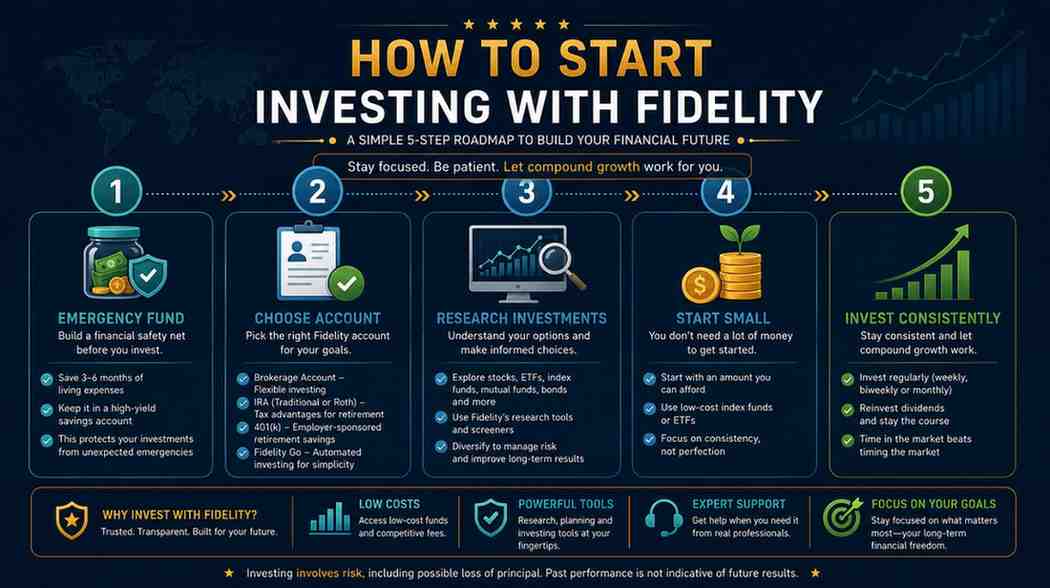
How a Beginner Could Start Investing With Fidelity
Let’s make this practical.
Step 1: Build an Emergency Fund
Before investing aggressively, consider whether you have sufficient emergency savings.
Do not invest money that you may need next month for rent, food, or an emergency.
Step 2: Eliminate Dangerous High-Interest Debt
Credit card debt with extremely high interest can work against your investment strategy.
Suppose your investment earns 8% over a particular period while your credit card balance costs you 25%.
The mathematics may not favor investing before dealing with the expensive debt.
Step 3: Define Your Goal
Ask:
Why am I investing?
Maybe your goal is:
- Retirement
- Buying a home
- Children’s education
- Financial independence
- Long-term wealth
- Building an investment portfolio
Your goal determines your time horizon.
Step 4: Choose the Correct Account
Consider whether you need:
Brokerage account
Traditional IRA
Roth IRA
401(k)
Fidelity Go
or another specialized account.
Step 5: Choose Your Investment
Do not buy anything until you understand:
- What it owns
- How it makes money
- What it costs
- How risky it is
- How diversified it is
- What your expected holding period is
Step 6: Start Small
You do not need to begin with $10,000.
The objective at the beginning is to build:
knowledge + discipline + consistency.
Step 7: Automate Contributions
Suppose someone invests $100 every month.
They are not attempting to predict every market movement.
They are building a habit.
Over years, the combination of regular contributions and compounding can become meaningful.
What Is Compound Growth?
Suppose you invest money and earn returns.
Those returns remain invested.
Then future returns can potentially be earned on:
your original money + previous investment gains.
That is compounding.
For illustration, if an investor contributed $200 per month and achieved a hypothetical 8% annual return compounded monthly, the account could grow to roughly $117,800 after 20 years.
The investor would have contributed:
$48,000
The remainder would represent investment growth.
But remember:
8% is a hypothetical assumption, not a guaranteed Fidelity return.
Real investment returns vary.
Fidelity Investments vs. Buying Stocks Directly
This is another misconception about Fidelity Investments.
When you use Fidelity, you are not necessarily buying “Fidelity stock.”
You are using Fidelity as the platform through which you can purchase investments.
For example:
Fidelity account
↓
Fidelity 500 Index Fund
↓
Portfolio of large U.S. companies
Or:
Fidelity account
↓
Individual company stock
↓
One company
The risk profile is very different.
Fidelity vs. a Bank Account
A bank account and investment account serve different purposes.
Bank/Savings Account
Usually designed for:
- Cash storage
- Spending
- Emergency funds
- Short-term goals
Investment Account
Designed for:
- Long-term growth
- Stocks
- ETFs
- Bonds
- Mutual funds
- Other investments
Investment values can rise and fall.
Cash accounts are generally much more stable.
Therefore, you should not treat an investment account as though it were a guaranteed savings account.
Can Someone in Africa Open a Fidelity Investments Account?
This is extremely important for FinWireStack’s international readership.
If you currently reside in Africa and do not already have a Fidelity relationship, you generally cannot open a new Fidelity account as an African resident.
Fidelity’s own international-customer guidance states that it does not open accounts for new customers residing outside the United States.
This means an African reader should not attempt to bypass Fidelity’s residency requirements using false information or another person’s U.S. address.
Instead, international investors should investigate brokers and investment platforms that legally accept residents of their country.
This distinction is critical because availability of U.S. investments and availability of a particular U.S. broker are two different things.
Who Is Fidelity Investments Best Suited For?
Fidelity can be particularly attractive for eligible U.S. investors who want:
- Long-term investing
- Retirement planning
- Stocks
- ETFs
- Index funds
- Mutual funds
- Fractional shares
- Automated investing
- Research tools
- Low-cost investing
- One financial platform
It can serve both beginners and experienced investors.
Who Should Be Careful?
Fidelity may not be appropriate for someone who:
- Wants guaranteed returns
- Does not understand investment risk
- Wants to day-trade without a strategy
- Uses excessive margin
- Buys stocks based entirely on social media hype
- Does not understand taxes
- Invests emergency savings
- Cannot tolerate temporary losses
A reputable platform cannot protect you from a poor investment decision.
Common Fidelity Investing Mistakes Beginners Make
Mistake 1: Buying Whatever Is Trending
A stock appearing repeatedly on TikTok, YouTube, or Google Trends is not automatically a good investment.
Mistake 2: Confusing Fidelity With an Investment
Fidelity is the platform.
The investment is what you purchase through it.
Mistake 3: Investing Without an Emergency Fund
A market downturn can become devastating if you are forced to sell investments to pay an unexpected bill.
Mistake 4: Chasing AI Stocks
AI is a powerful trend, but not every AI company will succeed.
Mistake 5: Ignoring Fees
Small costs can compound over decades.
Mistake 6: Using Margin Too Early
Borrowing money to invest can magnify losses.
Mistake 7: Checking Your Portfolio Every Five Minutes
Long-term investing is generally different from short-term trading.
Fidelity Investments vs. Trading
This distinction deserves special attention for FinWireStack readers.
Investing generally focuses on building wealth over years or decades.
Trading focuses more heavily on shorter-term price movements.
Someone can use Fidelity for both investing and trading, but the mindset is different.
Investing
Goal: Long-term wealth
Typical holding period: Years/decades
Focus: Fundamentals, diversification, asset allocation
Trading
Goal: Profit from price movements
Typical holding period: Minutes to months
Focus: Market behavior, execution, risk management
If you are interested in trading automation, see Algorithmic Trading in 2027.
What About Fidelity Investments Crypto?
Crypto is becoming increasingly integrated into mainstream investment platforms.
Fidelity now allows eligible U.S. customers to access direct cryptocurrency through Fidelity Crypto and crypto exposure through exchange-traded products.
However, crypto should not be confused with traditional diversified investing.
Fidelity explicitly warns that crypto is highly volatile and investors can lose their entire investment.
A beginner should therefore understand the difference between:
Diversified index exposure
and
single-asset cryptocurrency exposure.
A Beginner’s Fidelity Investments Checklist
Before making your first investment, ask yourself:
Financial Preparation
☐ Do I have emergency savings?
☐ Have I addressed high-interest debt?
☐ Do I know my investment objective?
Account Selection
☐ Do I need a brokerage account?
☐ Should I investigate an IRA?
☐ Do I have access to an employer 401(k)?
Investment Selection
☐ Do I understand what I am buying?
☐ Is it diversified?
☐ What does it cost?
☐ What are the risks?
Long-Term Plan
☐ How much can I invest monthly?
☐ How long will I invest?
☐ What will I do during a market crash?
☐ Will I continue investing consistently?
The 2026 Fidelity Investments Trends Beginners Should Watch

Based on Fidelity’s current research and product direction, several themes deserve attention.
AI Infrastructure
AI is expanding demand for computing power, data centers, semiconductors, and electricity infrastructure. Fidelity identifies these areas as potential investment opportunities while also emphasizing the importance of valuation and risk.
Low-Cost Index Investing
Index funds and ETFs remain central to many long-term portfolios.
Fractional Investing
The ability to invest with smaller amounts makes market access easier for beginners.
Automated Investing
Robo-advisors such as Fidelity Go can help investors who prefer an automated approach.
Crypto Integration
Fidelity’s expansion into direct crypto and crypto ETPs shows how digital assets are increasingly being integrated into mainstream investment platforms.
Retirement Tax Planning
IRA contribution limits and tax rules remain important considerations for American investors.
Is Fidelity Investments Safe?
Fidelity is an established U.S. financial-services company, but “safe platform” does not mean “your investments cannot lose money.”
Your investment can decline.
A stock can go to zero.
An ETF can fall.
A cryptocurrency can experience extreme losses.
Safety therefore has two dimensions:
Platform and custody protections
versus
Investment risk.
Never confuse the two.
Fidelity Investments’ brokerage entities identify their applicable regulatory and SIPC membership information, but investors should understand exactly which product they own and what protections apply to it.
This becomes particularly important with cryptocurrency because Fidelity states that crypto investments do not receive the same regulatory protections applicable to registered securities.
The Beginner’s Best Way to Think About Fidelity Investments
Don’t ask:
“Which Fidelity Investments will make me rich?”
Ask:
“Which Fidelity Investments account and investment structure best fit my financial goal, risk tolerance, and time horizon?”
That single change in mindset can dramatically improve the quality of your investment decisions.
Final Takeaway
Fidelity Investments is not a single investment.
It is a large financial-services platform that gives eligible investors access to a wide range of accounts and investments.
A beginner can use Fidelity Investments to access:
- Stocks
- ETFs
- Index funds
- Mutual funds
- Bonds
- CDs
- Retirement accounts
- Fractional shares
- Automated investing
- Cryptocurrency
Its current direction also reflects some of the biggest themes shaping U.S. investing in 2026: AI, technology, low-cost investing, automation, retirement planning, and digital assets.
But the platform does not determine whether you make money.
Your financial plan, strategy, risk management, time horizon, and behavior matter far more.
For a beginner, the most sensible progression in Fidelity Investments is:
Learn → Build an emergency fund → Understand accounts → Choose diversified investments → Invest consistently → Control costs → Avoid unnecessary speculation → Review periodically.
And if you are outside the United States, remember the crucial eligibility issue: Fidelity currently says it does not open accounts for new customers who reside outside the U.S.
So for a Kenyan investor, the educational lesson is still highly valuable—but the practical next step is to identify a regulated investment platform that legally accepts Kenyan residents rather than attempting to circumvent Fidelity’s eligibility requirements.
Frequently Asked Questions on Fidelity Investments.
Is Fidelity Investments a bank?
Fidelity Investments is primarily a financial services and investment company. It provides brokerage, retirement, investment-management, cash-management, and other financial products.
Is Fidelity good for beginners?
It can be. Fidelity provides educational resources, fractional shares, low-cost investment options, and both self-directed and automated investing services.
How much money do I need to start investing with Fidelity Investments?
Fidelity’s standard brokerage account currently has no account minimum, and eligible investors can use fractional shares to invest with as little as $1.
Can I buy ETFs through Fidelity?
Yes. Fidelity provides access to ETFs and offers its own ETF lineup as well as other investment choices.
Can I buy Bitcoin through Fidelity?
Eligible U.S. customers can access Bitcoin and other cryptocurrencies through Fidelity Crypto. Fidelity also offers crypto ETPs through brokerage accounts.
Can Africans open an account in Fidelity Investments?
Fidelity states that it does not open accounts for new customers residing outside the United States.
What is the difference between Fidelity and an ETF?
Fidelity is a financial-services platform. An ETF is an investment product that you can potentially purchase through Fidelity.
What is FXAIX?
FXAIX is the Fidelity 500 Index Fund, which seeks to track the S&P 500. It is one of Fidelity’s best-known index funds.
Does Fidelity guarantee investment returns?
No. Investments can lose value, and past performance does not guarantee future results.
Recommended Official Resources on Fidelity Investments
Fidelity Investments: Fidelity Investments official website
Fidelity Brokerage Account: The Fidelity Account
Fidelity Investment Accounts: Fidelity account and product directory
Fidelity Fees: Fidelity pricing and fees
Fidelity ETFs: Investing in ETFs at Fidelity
Learn more about investments here:
Algorithmic Trading in 2027 in Relation to Fidelity Investments.
AI Trading Bots: Real vs Scams in Relation to Fidelity Investments.
AI vs Human Traders 2030 in Relation to Fidelity Investments.
Copy Trading in 2027 in Relation to Fidelity Investments.
AI Investment Platforms in 2027 in Relation to Fidelity Investments.