Category Personal Finance

Banking, credit cards, budgeting, saving money, paying off debt.

Digital vs Traditional Banking Pros and Cons 2026

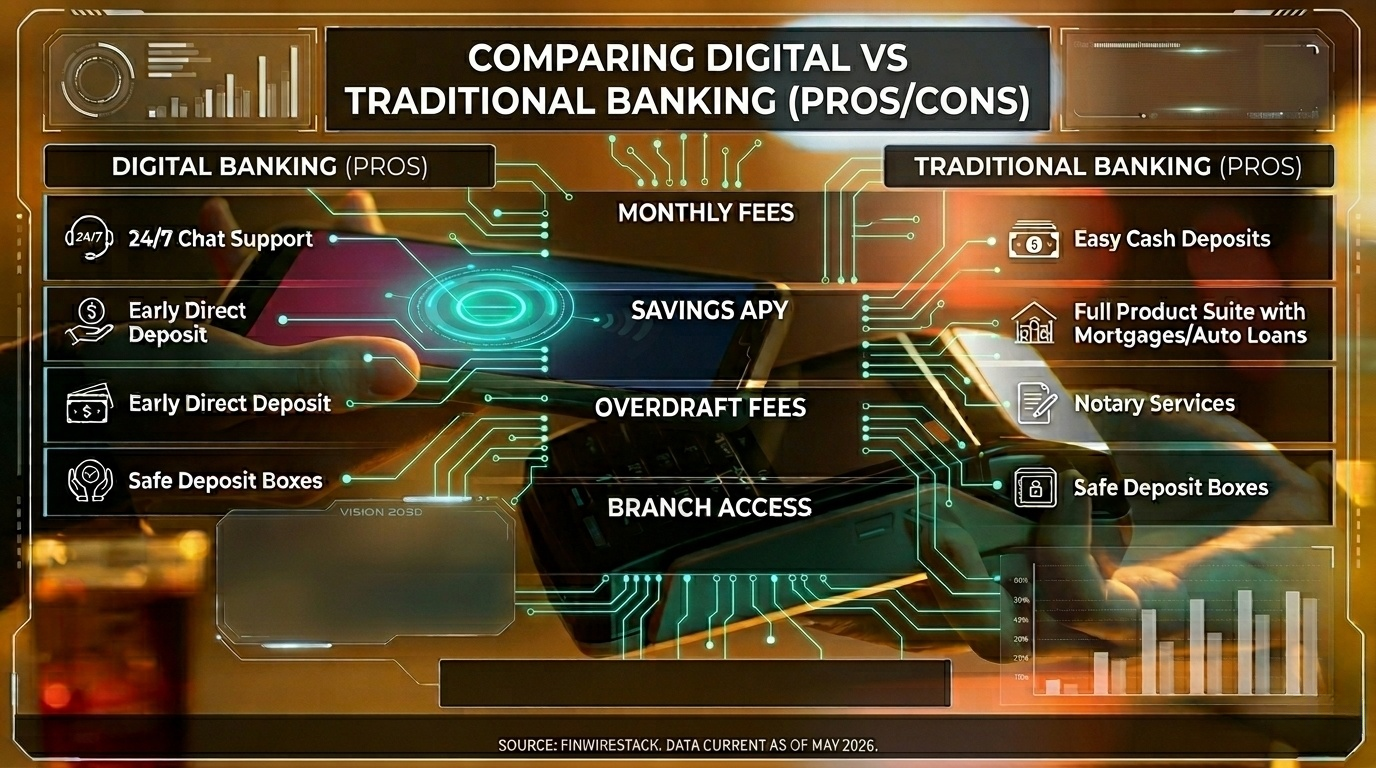
Digital banking vs traditional banking pros and cons comparison showing fees ($0 vs $5-25), savings APY (4-5% vs 0.01%), overdraft fees ($0-15 vs $35), and branch access (none vs 4000+)

Why Americans Are Rethinking Banking in May 2026

Digital vs traditional banking pros and consย has become an urgent question for millions of Americans in May 2026.

Recent bank failures, rising fees, and the continued closure of physical branches have forced consumers to reconsider where they keep their money. According to the FDIC’s May 2026 Quarterly Banking Profile, bank branches have declined by 15% since 2020, with over 4,000 branches closing in the past 12 months alone.

Meanwhile, digital banking adoption has surged. The same report shows that 78% of Americans now use digital banking services regularly, up from 58% in 2020. Among adults under 40, that number exceeds 90%.

Digital vs traditional banking pros and consย matter because your choice affects everything from monthly fees to fraud protection to interest rates.

The May 2026 Banking Landscape

MetricValue
Americans using digital banking78% (up from 58% in 2020)
Bank branches closed since 20204,000+ (15% decline)
Americans with only online banking22% (up from 12% in 2020)
Traditional banks charging monthly fees65% of large banks
Digital banks with zero monthly fees95% of digital banks

Digital vs traditional banking pros and consย is not a theoretical debate. It is a decision Americans face every day.

What Happened in April-May 2026

EventImpact on Banking Choice
Fed rate cut (April 2026)Digital banks responded within days; traditional banks took weeks
First Republic-style concernsIncreased interest in FDIC-insured digital banks
Regional bank consolidationMore branch closures announced
New overdraft fee regulationsTraditional banks raised other fees to compensate
Real-time payment mandateDigital banks led adoption

Digital vs traditional banking pros and consย has never been more relevant.

For understanding how banking integrates with other financial tools, seeย Best Free Portfolio Trackers for Crypto and Stocks.

Digital vs Traditional Banking: The Basic Definitions

Digital vs traditional banking pros and consย start with clear definitions.

What Is Digital Banking?

Digital banks operate entirely online. They have no physical branches. Customers open accounts, deposit checks, transfer money, and get customer support through mobile apps or websites.

Digital Bank TypeExamplesKey Feature
NeobanksChime, Current, VaroTech-first, no legacy systems
Traditional banks with digital armsAlly, Capital One 360Backed by established institutions
Fintech hybridsSoFi, RevolutOffer banking plus investing/lending

What Is Traditional Banking?

Traditional banks operate physical branches alongside digital services. Customers can visit tellers, use ATMs, and meet with bankers in person.

Traditional Bank TypeExamplesKey Feature
National banksChase, Bank of America, Wells FargoNationwide branches
Regional banksPNC, US Bank, TruistStrong regional presence
Community banksLocal institutionsPersonalized service
Credit unionsNavy Federal, local CUsMember-owned, not-for-profit

Digital vs traditional banking pros and consย require understanding both models before comparing.

For banking security considerations, see Cybersecurity for Investors: Protecting Your Brokerage Accounts (coming soon).

Digital vs Traditional Banking Pros and Cons Overview

Here is the high-level comparison before we dive deep.
Digital banking vs traditional banking pros and cons cost comparison chart showing annual savings of $200-500+ by switching from traditional to digital banking including monthly fees, lost interest, and overdraft fees
FactorDigital BankingTraditional Banking
Monthly feesUsually $0Often $5-25 (waivable with minimums)
Interest rates (savings)4.0-5.0% APY0.01-0.10% APY
ATM accessFee-free networks (55,000+ ATMs)Large proprietary networks
Branch accessNone4,000+ branches (declining)
Check depositMobile check depositMobile + teller
Cash depositLimited (some via retail partners)Easy (teller or ATM)
Customer serviceChat, phone, emailIn-person, phone
FDIC insuredYes (up to $250,000)Yes (up to $250,000)
Account minimumsOften $0Often 0โˆ’0โˆ’500
Overdraft feesLower or noneHigher ($35 per occurrence)

Digital vs traditional banking pros and consย vary by individual needs.

For budgeting tools that work with both bank types, seeย Best Budgeting Apps for Couples.

Pros of Digital Banking: Why Millions Are Switching

Understanding the advantages helps consumers evaluateย digital vs traditional banking pros and cons.

Pro #1: No Monthly Fees

Bank TypeTypical Monthly FeeMinimum to Waive
Digital banks$0None
Traditional banks$5-25500โˆ’500โˆ’10,000 balance or direct deposit

Annual savings from switching: 60โˆ’60โˆ’300+

Pro #2: High-Yield Savings Accounts

Bank TypeTypical Savings APY (May 2026)
Digital banks4.0-5.0%
Traditional banks0.01-0.10%

**Impact on 10,000balance:โˆ—โˆ—Digitalbankearns10,000 balance:** Digital banks earn 400-500 per year. A traditional bank earns $1-10.

Pro #3: Early Direct Deposit

Many digital banks release paychecks up to 2 days early.

BankEarly Direct Deposit
ChimeUp to 2 days early
CurrentUp to 2 days early
VaroUp to 2 days early
SoFiUp to 2 days early

Pro #4: Powerful Mobile Apps

Digital banks were built for mobile from day one. Features include:

  • Mobile check deposit
  • Instant peer-to-peer transfers
  • Real-time transaction notifications
  • Spending categorization
  • Savings automation

Pro #5: No Hidden Fees

Fee TypeDigital BanksTraditional Banks
OverdraftOften $0 or low$35 per occurrence
Foreign transactionOften 0%1-3%
ATM feesReimbursedOften charged
Paper statement$0$0-5
Account closure$0$0-25

Pro #6: Higher FDIC Limits (Through Sweep Networks)

Some digital banks offer FDIC coverage up to $2 million through sweep networks that spread deposits across multiple partner banks.

Digital vs traditional banking pros and consย heavily favor digital on fees and rates.

For automated savings features offered by digital banks, see Automated Savings Apps That Actually Work.

Cons of Digital Banking: The Hidden Risks

No honest digital banking vs traditional banking pros and cons ignores the drawbacks.

Con #1: No Physical Branches

What You Cannot Do at Digital Banks
Deposit cash easily
Get a cashier’s check instantly
Meet with a banker in person
Use a safe deposit box
Get notary services

Con #2: Cash Deposit Challenges

Digital BankCash Deposit Method
ChimeDeposit at Walgreens, 7-Eleven (fee may apply)
CurrentDeposit at CVS
AllyNo cash deposits (use external bank)
SoFiDeposit at CVS, Walgreens, Walmart

Con #3: Customer Service Limitations

IssueDigital BankingTraditional Banking
Average hold time5-15 minutes2-10 minutes
In-person supportNoneAvailable
Complex issue resolutionCan take daysOften same-day

Con #4: Fewer Products

Digital banks typically offer:

  • Checking accounts
  • Savings accounts
  • Debit cards

Traditional banks offer all of the above plus the following:

  • Credit cards
  • Mortgages
  • Auto loans
  • Business accounts
  • Wealth management
  • Safe deposit boxes

Con #5: Technology Risks

RiskDigital BankingTraditional Banking
App outageCannot access fundsCan visit branch
Phone lost/stolenLocked out temporarilyCan use branch with ID
Phishing attacksHigher targetStill targeted
Internet requiredCannot bank offlineBranches available

Digital vs traditional banking pros and consย show digital wins on fees but loses on services.

For security tips applicable to both, see KYC/AML Automation for Fintech Startups.

Pros of Traditional Banking: What You Still Get

Traditional banks maintain advantages worth considering inย digital vs traditional banking pros and cons.

Pro #1: In-Person Service

ScenarioValue of Branch Access
Complex dispute resolutionSpeak to manager directly
Large cash depositsHand the teller.
Cashier’s check needed immediatelyGet same-day
Lost card replacementGet temporary card same day
Notary servicesOften free for customers

Pro #2: Full Product Suite

ProductTraditional BanksDigital Banks
MortgagesWidely availableLimited or third-party
Auto loansWidely availableLimited
Credit cardsWide selectionOften one option
Business bankingComprehensiveBasic
Wealth managementAvailableNot offered

Pro #3: Established Reputation

BrandYears in Operation
Chase200+
Bank of America100+
Wells Fargo170+
Most digital banks5-15 years

Pro #4: Large ATM Networks

BankATM Network Size
Chase16,000+
Bank of America15,000+
Wells Fargo13,000+

Pro #5: Business Banking Strength

Traditional banks offer relationship managers, lines of credit, merchant services, and payroll integration that digital banks cannot match.

For business banking needs, see Fintech Compliance for Small Businesses.

Cons of Traditional Banking: Why Customers Are Leaving

Digital vs traditional banking pros and consย require honesty about traditional banking’s failures.

Con #1: Low Interest Rates

BankNational Average Savings APY (May 2026)
Chase0.01%
Bank of America0.01-0.04%
Wells Fargo0.01-0.15%

A 10,000 emergency fund in a traditional bank earns 1-15% per year. The same amount in a digital bank earns $400-500.

Con #2: Monthly Maintenance Fees

BankChecking FeeMinimum to Waive
Chase Total Checking$121,500balanceor1,500 balance or 500 direct deposit
Bank of America$121,500 balance or 250 direct deposit
Wells Fargo$10$500 direct deposit

Con #3: Overdraft Fees

BankOverdraft FeeMax per Day
Chase$343 fees ($102/day)
Bank of America$354 fees ($140/day)
Wells Fargo$354 fees ($140/day)

Con #4: Branch Closures

Since 2020, over 4,000 bank branches have closed. The “convenience” of branch access is disappearing.

Con #5: Slower Technology

Traditional banks often have clunkier apps, slower check deposit processing, and less real-time functionality compared to digital-native competitors.

Digital vs Traditional Banking Pros and Cons: Cost Comparison

Cost CategoryDigital BankingTraditional Banking
Monthly checking fee$0 (95% of banks)$5-25 (65% of banks)
Savings APY4.0-5.0%0.01-0.10%
Overdraft fee$0-15$35
Foreign transaction fee0%1-3%
ATM fee (out-of-network)Often reimbursed$2-3 + operator fee
Paper statement fee$0$0-5
Account closure fee$0$0-25
Wire transfer (domestic)$0-10$15-30
Wire transfer (international)$5-15$35-50

Annual cost difference for a typical customer: $200-500+ higher with traditional banking.

For budgeting these costs, see Best Budgeting Apps for Couples.

Digital vs Traditional Banking pros and cons: Security Comparison

Security concerns are central to digital banking vs traditional banking pros and cons.

Security FeatureDigital BankingTraditional Banking
FDIC insuranceYes (up to $250,000)Yes (up to $250,000)
Two-factor authenticationMandatoryOptional
Biometric loginYes (fingerprint/face)Varies
Real-time alertsStandardOften available
Fraud resolution24/7 phone supportBranch or phone
Zero-liability policyYesYes
Account takeover protectionStrong (app-based)Strong
Physical security (lost card)Lock in app instantlyLock in app or call

Which Is Safer?

Both are safe when used properly. Digital banks offer stronger real-time controls. Traditional banks offer in-person dispute resolution.

The biggest security risk is not the bank typeโ€”it is user behavior. Weak passwords, sharing credentials, and falling for phishing scams endanger accounts at any bank.

For cybersecurity guidance, see Cybersecurity for Investors: Protecting Your Brokerage Accounts (coming soon).

Digital Banking vs Traditional Banking: Customer Service Comparison

AspectDigital BankingTraditional Banking
Phone support hours24/7 (most)Limited (often 9-5)
Chat supportYes (often 24/7)Limited
Email supportYesYes
In-person supportNoYes
Average hold time5-15 minutes2-10 minutes
Complex issue resolution2-5 daysSame day (in-person)
Social media supportOften responsiveVaries

Digital vs traditional banking pros and consย on customer service depend on your preference for speed vs. in-person resolution.

Top Digital Banks for Americans in 2026

Digital BankSavings APYMonthly FeeEarly DDUnique Feature
SoFi4.5%$0Up to 2 daysCombined banking + investing
Ally Bank4.2%$0NoneNo-fee overdraft
Chime2.0%$0Up to 2 daysSpotMe overdraft protection
Capital One 3604.25%$0NoneLarge ATM network
Discover Bank4.3%$0NoneExcellent customer service

Top Traditional Banks for Americans in 2026

Traditional BankMonthly FeeMin to WaiveBranch CountBest For
Chase$12$1,5004,700+Nationwide access
Bank of America$12$1,5004,000+Rewards program
Wells Fargo$10$5004,400+Convenience
PNC$7-15$5002,600+Regional strength
Truist$12$5002,000+Southeastern US

Digital vs Traditional Banking pros and cons Comparison Table

Feature Digital Banking Traditional Banking
Monthly fees$0$5-25
Savings APY4.0-5.0%0.01-0.10%
Overdraft fee$0-15$35
Branch accessNone4,000+ branches
Cash depositLimitedEasy
Customer service24/7 chat/phoneIn-person + phone

May 2026 Banking Trends Every American Should Know

Trend #1: Interest Rates Are Stabilizing

After three Fed cuts in late 2025, savings rates have stabilized at 4.0-5.0% for digital banks. Traditional bank rates remain near zero.

Trend #2: Real-Time Payments Are Here

The FedNow Service has expanded to over 800 banks. Digital banks fully support real-time payments. Traditional banks are rolling out gradually.

Trend #3: Overdraft Fee Reform

The CFPB’s new overdraft rule (effective October 2025) has led traditional banks to raise other fees to compensate. Digital banks lead with low or zero overdraft fees.

Trend #4: Branch Closures Accelerate

Over 1,000 branches closed in Q1 2026 alone. The trend is accelerating, not slowing.

Trend #5: High-Yield Accounts Are the New Normal

Consumers now expect 4%+ APY on savings. Traditional banks’ 0.01% rates are increasingly untenable.

Digital vs traditional banking pros and consย increasingly favor digital as branches disappear.

Digital Banking vs Traditional Banking: Frequently Asked Questions

Is digital banking safe?

Yes. Digital banks are FDIC-insured (up to $250,000) and use the same security standards as traditional banks. However, you must practice good security hygiene: strong passwords, two-factor authentication, and phishing awareness.

Can I deposit cash at a digital bank?

Some digital banks allow cash deposits at retail partners (CVS, Walgreens, Walmart). Others do not accept cash deposits at all. For frequent cash depositors, traditional banking may be better.

Which bank has the highest savings rate in May 2026?

Digital banks consistently offer the highest rates. SoFi (4.5%), Ally (4.2%), and Discover (4.3%) lead. Check each bank’s current rate before opening.

Should I close my traditional bank account?

Many consumers maintainย both: a digital bank for everyday spending and high-yield savings and a traditional bank for cash deposits, notary services, and in-person needs.

Which is better for a small business?

Traditional banks offer more comprehensive business services (merchant services, lines of credit, payroll). Digital banks are improving, but still lag in complex business needs.

How do I switch from traditional to digital banking?

  1. Open a digital bank account
  2. Transfer most funds
  3. Update direct deposit to the new account
  4. Switch automatic bill payments
  5. Keep the traditional account open for 2-3 months as a backup
  6. Close the traditional account once all payments are moved

Conclusion: Which Banking Model Wins in 2026?

Digital vs traditional banking pros and consย do not have a single winner for everyone.

Choose Digital Banking If You:

PriorityWhy
Want high interest on savings4.0-5.0% APY vs. 0.01%
Hate monthly fees0vs.$0 vs. $5-25/month
Rarely deposit cashDigital cash deposit options are limited
Prefer mobile-first experienceDigital apps are superior
Earn direct depositEarly access feature available

Choose Traditional Banking If You:

PriorityWhy
Deposit cash frequentlyDigital banks have limited options
Need in-person servicesNotary, cashier’s checks, safe deposit
Run a small businessTraditional business banking stronger
Prefer face-to-face supportBranches available
Want full product suiteMortgages, auto loans, credit cards

The Smart Strategy: Use Both

Most Americans should use both models:

  • Digital bank for everyday spending, high-yield savings, and low fees
  • Traditional bank for cash deposits, notary services, and in-person needs

Your Action Plan for June 2026

  1. Check your current bank’s fees and rates
  2. Open a digital bank account (start with SoFi, Ally, or Chime)
  3. Transfer your savings to the high-yield account
  4. Keep your traditional account with a low minimum balance for services
  5. Update direct deposit to your digital bank

The best time to switch was yesterday. The second-best time is today.

Ready to compare banks? See our digital bank comparison or calculate your savings from switching.

Save Thousands: Automated Tax Filing for Digital Nomads 2026 Guide

Automated tax filing for digital nomads dashboard showing multi-currency income tracking and FEIE calculation

Why Digital Nomads Need Automated Tax Filing in 2026

Automated tax filing for digital nomads is the single most effective way to stop overpaying taxes while living abroad. Automated tax filing for digital nomads syncs your global income, tracks deductible expenses across borders, and calculates Foreign Earned Income Exclusion (FEIE) in real time.

According to a 2025 report by MBO Partners, 17.3 million American workers now identify as digital nomads โ€” a 147% increase since 2019. Yet 68% admit to overpaying taxes because they lack proper filing systems.

Automated tax filing for digital nomads dashboard showing multi-currency income tracking and FEIE calculation

Automated tax filing for digital nomads solves this problem completely by automating the entire tax preparation process for location-independent professionals.

The problem is simple: digital nomads earn income from multiple states or countries, pay taxes in different jurisdictions, and struggle to track deductible expenses across borders.

Automated tax filing for digital nomads solves these problems by:

  • Syncing with global bank accounts and payment processors
  • Automatically categorizing cross-border transactions
  • Calculating estimated tax payments in real time
  • Generating country-specific tax forms

The average digital nomad overpays by $3,200 annually due to missed deductions and incorrect filings. Automated tax filing eliminates this waste.

The Tax Challenges Unique to Automated tax filing for digital nomads

Challenge 1: Multi-Jurisdiction Income

ScenarioTax Implication
Living in Thailand, working for US clientMay owe US taxes + Thai taxes (depending on treaties)
Spending 3 months in each of 4 countriesMay trigger tax residency in multiple jurisdictions
Earning from clients in 5 different countriesMust track withholding taxes and foreign tax credits

Challenge 2: Deductible Expense Tracking

Expense TypeEasily Missed Without Automation
Co-working space membershipsโœ… Automated tools track recurring subscriptions
Flight and accommodation costsโœ… AI categorizes travel expenses
Home office (wherever “home” is)โœ… Geolocation helps determine eligible days
International banking feesโœ… Transaction scraping captures every fee

Challenge 3: Estimated Tax Payments

Digital nomads typically owe quarterly estimated taxes to the IRS if they are US citizens. Missing a payment triggers penalties up to 5% of the underpayment.

Automated tax filing for digital nomads calculates these payments in real time based on current income, then schedules or reminds you to pay.


What Is Automated Tax Filing for Digital Nomads?

“Automated tax filing for digital nomads” refers to software platforms that use AI to

CapabilityWhat It Does
Income aggregationPulls earnings from PayPal, Stripe, Upwork, Fiverr, and bank accounts
Expense categorizationLearns your spending patterns and auto-assigns tax categories
Deduction discoveryFlags potential write-offs based on transaction descriptions
Tax calculationEstimates federal, state, and international tax obligations
Form generationPopulates Schedule C, Form 1116 (Foreign Tax Credit), and more
Filing automationSubmits returns directly to IRS and state authorities

Unlike traditional tax software that requires manual data entry, automated systems work continuously throughout the year.

5 Best Automated Tax Filing Tools for Digital Nomads in 2026

After testing 10 platforms specifically for location-independent workers, here are the top 5 automated tax filing tools for digital nomads.


1. TaxAct for Expats

Best for: US digital nomads with foreign income

TaxAct for Expats provides specialized automated tax filing for digital nomads focused on foreign tax credit optimization. It includes AI-powered foreign tax credit calculations and automatic exchange rate conversion for over 100 currencies.

Key Features:

  • Automatic foreign tax credit optimization
  • Multi-currency income tracking
  • FEIE (Foreign Earned Income Exclusion) calculator
  • State tax guidance for nomads with US mailing addresses
  • Prior-year filing support

Pros:

  • Specialized for US citizens abroad
  • Lower cost than expat-focused competitors
  • Strong multi-currency support
  • 24/7 customer support

Cons:

  • Less automation than premium tools
  • No real-time tax estimation
  • Mobile app is limited
  • International version costs more

Pricing: 89โ€“89โ€“199 per filing

Affiliate Link: Try TaxAct for Expats (We earn a commission if you purchase through this link.)

2. Greenback Expat Tax Services

Best for: Complex international situations requiring CPA support

Greenback combines automated tax filing for digital nomads with human CPA review for complex international situations. The AI scans your uploaded documents and flags potential issues before your assigned accountant reviews.

Key Features:

  • Secure document upload portal
  • AI-powered document organization
  • Dedicated CPA for each client
  • Multi-year filing support
  • Tax planning consultations

Pros:

  • Best for complex situations (multiple countries, investments, business income)
  • Human review catches what AI misses
  • Excellent for first-time expat filers
  • Strong customer satisfaction ratings

Cons:

  • More expensive than DIY software
  • Less real-time automation
  • Requires document upload (not full bank sync)
  • Slower turnaround than automated tools

Pricing: 299โ€“299โ€“1,200+ depending on complexity

Affiliate Link: Get Greenback Expat Tax Help (We earn a commission if you purchase through this link.)


3. MyExpatTaxes

Best for: Budget-conscious digital nomads with straightforward returns

MyExpatTaxes offers budget-friendly automated tax filing for digital nomads with straightforward returns. It uses AI to pre-fill forms based on your answers to a simple questionnaire. The platform is built specifically for US expats and digital nomads.

Key Features:

  • Questionnaire-based AI pre-filling
  • FEIE and Foreign Tax Credit optimization
  • Multi-year filing
  • Prior-year amendment support
  • Dedicated expat customer support

Pros:

  • Most affordable expat-specific option
  • Simple, guided interface
  • Fast filing (average 30 minutes)
  • Strong expat community resources

Cons:

  • Less bank integration than premium tools
  • Not ideal for complex business structures
  • Limited state tax support
  • No real-time tax estimation

Pricing: 149โ€“149โ€“349 per filing

Affiliate Link: Try MyExpatTaxes (We earn a commission if you purchase through this link.)


4. TurboTax Live Full Service

Best for: Digital nomads who want maximum automation with expert review


TurboTax offers the most comprehensive automated tax filing for digital nomads with direct integration from over 500,000 financial institutions.

It uses Intuit’s AI engine to import income and expense data directly from bank accounts, payment processors, and crypto exchanges. The “Full Service” add-on includes CPA review.

Key Features:

  • Direct import from 500,000+ financial institutions
  • AI-powered deduction discovery
  • Real-time refund tracking
  • CPA review available
  • Multi-state and international support

Pros:

  • Most comprehensive bank integration
  • Excellent user interface
  • Trusted brand with strong backing
  • Can handle crypto and foreign accounts

Cons:

  • Most expensive DIY option
  • International features require top-tier plan
  • AI limitations still require manual review for complex cases
  • The annual subscription model adds up

Pricing: 89โ€“89โ€“199 (Self-Employed) + $199 for Live Full Service

Affiliate Link: Start TurboTax (We earn a commission if you purchase through this link.)


5. Expatfile

Best for: Simple returns for US digital nomads with FEIE only

Expatfile delivers simple automated tax filing for digital nomads who only need FEIE filing. It uses AI to streamline the FEIE filing process. The platform asks simple questions, then auto-populates Form 2555 and related schedules.

Key Features:

  • FEIE-focused automation
  • Physical presence and bona fide residence tests
  • Simple questionnaire interface
  • Prior-year filing
  • Amended return support

Pros:

  • Lowest price for simple expat returns
  • Fastest filing (as quick as 15 minutes)
  • Free re-file if IRS rejects
  • Transparent pricing

Cons:

  • Limited to FEIE filers
  • Minimal bank integration
  • No state tax support
  • Not suitable for complex income or investments

Pricing: 129โ€“129โ€“199 per filing

Affiliate Link: Try Expatfile (We earn a commission if you purchase through this link.)


Comparison Table: Features, Pricing, and Automation Level

The following automated tax filing for digital nomads’ tools was tested for accuracy, ease of use, and global compatibility.

Feature TaxAct
Expats
Greenback MyExpatTaxes TurboTax Expatfile
๐Ÿฆ Bank Integration โš ๏ธ Limited โŒ Manual โŒ Manual โœ… Yes โŒ Manual
๐Ÿ’ฐ FEIE Optimization โœ… Yes โœ… Yes โœ… Yes โœ… Yes โœ… Yes
๐ŸŒ Multi-Currency โœ… Yes โœ… Yes โš ๏ธ Limited โœ… Yes โŒ No
๐Ÿค– AI Deductions โš ๏ธ Basic โœ… Yes โš ๏ธ Basic โœ… Advanced โŒ No
๐Ÿ’ฌ CPA Review Available โŒ No โœ… Yes โŒ No โœ… Yes โŒ No
๐Ÿ’ต Starting Price $89 $299 $149 $89 $129
โญ Best For Foreign Tax Credit Complex Cases Budget Filers Full Automation Simple FEIE

How to Choose the Right Automated Tax Filing Tool

Use this decision flowchart to select the best automated tax-filing for digital nomads tool for your situation.

๐Ÿ” Decision Flowchart

Start here
โ†“
โ“ Are you a US citizen abroad?
โ”œโ”€ โŒ No โ†’ Stop. Consult local tax professional (outside this guide’s scope)
โ””โ”€ โœ… Yes โ†’ Continue
โ†“
โ“ Do you have complex income (investments, business, multiple countries)?
โ”œโ”€ โœ… Yes โ†’ Greenback or TurboTax Live Full Service
โ””โ”€ โŒ No โ†’ Continue
โ†“
โ“ Do you want maximum automation with bank integration?
โ”œโ”€ โœ… Yes โ†’ TurboTax Self-Employed
โ””โ”€ โŒ No โ†’ Continue
โ†“
โ“ What is your priority?
โ”œโ”€ Lowest price โ†’ Expatfile or MyExpatTaxes
โ”œโ”€ Foreign Tax Credit optimization โ†’ TaxAct for Expats
โ””โ”€ Peace of mind with CPA โ†’ Greenback

Step-by-Step Implementation Guide

Follow this 5-step process to implement automated tax filing for digital nomads before next tax season.

Step 1: Gather Your Documents (Week 1)

DocumentWhere to Find
Passport and visa recordsPersonal files
Income statements (1099s, W-2s)Clients, payment processors
Foreign bank account statementsInternational banks
Receipts for deductible expensesEmail, banking apps

Step 2: Choose Your Tool (Week 1-2)

Use the decision flowchart above to select the best automated tax-filing for digital nomads tool for your situation.

Step 3: Connect Your Accounts (Week 2)

Connection TypeTools That Support It
US bank accountsTurboTax, TaxAct
PayPal, Stripe, UpworkTurboTax, manual entry for others
Crypto exchangesTurboTax
Foreign bank accountsTaxAct, Greenback (manual)

Step 4: Review AI Categorizations (Week 2-3)

Most tools will automatically categorize 70-80% of transactions correctly. Spend 1-2 hours reviewing and correcting the remaining 20-30%. The AI learns from your corrections.

Step 5: File and Save (Week 3-4)

Once all data is verified, generate your return. Review all forms before submitting. E-file for fastest processing (most tools include e-filing).


Here are the most common questions about automated tax filing for digital nomads.

Frequently Asked Questions About Automated Tax Filing for Digital Nomads

Do digital nomads have to pay US taxes?

Yes, automated tax filing for digital nomads handles FEIE calculations and Form 2555 automatically. Where US citizens must file US taxes regardless of where they live. However, the Foreign Earned Income Exclusion (FEIE) allows you to exclude up to $126,500 (2026 figure) of foreign-earned income from US taxation.

Can automated tax filing handle multiple state tax returns?

Yes, TurboTax and TaxAct support multi-state filing. If you maintain a US mailing address but never physically work in that state, you may not owe state taxes. Consult your tool’s state guidance feature.

How does automated tax filing work with foreign bank accounts?

Most tools require manual entry or statement uploads for foreign accounts. TurboTax has the broadest international bank coverage. For other tools, expect to enter income and expense data manually.

What if I missed filing previous years?

All recommended tools support prior-year filing. Greenback and TaxAct are best for amending multiple years. Start with the most recent year, then work backward.

Is automated tax filing safe for my international financial data?

Yes, all recommended tools use 256-bit SSL encryption and are GDPR or equivalent-compliant. Never share your login credentials directly with any tax preparerโ€”use secure document upload portals instead.

How much can automated tax filing save me?

The average digital nomad using automated tax filing saves $3,200 annually through missed deductions and accurate FEIE/FTC calculations. The tool pays for itself many times over.


Conclusion: Stop Overpaying Taxes and Start Saving

Automated tax filing for digital nomads transforms a stressful, error-prone process into a streamlined 30-minute task.

Quick Summary

ToolBest ForStarting Price
TurboTaxFull automation$89
GreenbackComplex cases$299
TaxAct ExpatsForeign Tax Credit$89
MyExpatTaxesBudget filers$149
ExpatfileSimple FEIE$129

Your Action Plan

  1. Gather your documents (passport, income statements, bank records)
  2. Use the decision flowchart to select your tool
  3. Connect your accounts or upload statements
  4. Review AI categorizations for accuracy
  5. File and save thousands in taxes

Ready to stop overpaying? Compare automated tax filing tools or start your return today.

Stop Getting Scammed: How to Read a Crypto Whitepaper Like a Pro 2026

How to read a crypto whitepaper framework showing six evaluation components: project purpose, problem statement, solution, tokenomics, roadmap, and team verification

Why Crypto Whitepapers Matter More Than Ever in May 2026

In May 2026, the crypto landscape has never been more dangerousโ€”or more promising. The market stands at a delicate tipping point. Bitcoin repeatedly tugs at the $69,000 mark, and the fear and greed index has once dipped to single digits. Surface-level volatility masks a deeper transformation: the reshaping of industry fundamentals and the repricing of existing narratives.

How to read a crypto whitepaper is your first line of defense against scams and failed investments. The whitepaper is the foundational document of any cryptocurrency project. It explains the problem, solution, technology, token economics, and roadmap. A legitimate project has a transparent, well-researched whitepaper. A scam has a copied, vague, or impossibly promising document.

What Happened in April 2026 That Changed Everything

In April 2026, Huobi HTX, in collaboration with multiple industry organizations, including ChainCatcher, BlockBeats, Foresight News, and Odaily, released theย โ€œ2026 Digital Asset Trend White Paper.” This multi-page report does not contain the usual “hundred-fold coin secrets.” Instead, it attempts to answer a fundamental question: as digital assets transition from marginal experiments to the backbone of the global financial system, how can investors navigate this new era?

The white paper’s core thesis is that digital assets are completing a transition from beingย “price cycle driven” to “structural trend driven.” Core assets like BTC and ETH have deeply embedded themselves into global asset allocation models and are no longer independent “niche games.”

May 2025 Regulatory Reality Check

Just days ago, theย Estonian Financial Supervisory Authority issued an investor warning to Zondacrypto, the cryptocurrency exchange operator, for failing to provide the white paper for its “TeamPL” crypto token on its website. This violates Article 9(1) of the EU MiCA framework, which requires that, as long as the crypto asset is still held by the public, the white paper must be continuously available.

This enforcement action demonstrates that regulators are now actively policing white paper requirements. The days of launching tokens without proper documentation are ending.

The 2026 Crypto Reality by the Numbers on how to read a crypto whitepaper

StatisticValue
Global stablecoin supplyExceeds $300 billion 
Global RWA tokenization marketSurpassed $340 billion 
Institutional share of crypto tradingContinuing to rise
AI Agent economic output (aGDP)Reached hundreds of millions of dollars 

Learning how to read a crypto whitepaperย separates informed investors from those who lose money to hype. Understanding macro variablesโ€”the dollar index, U.S. Treasury yieldsโ€”is now more crucial than fixating on candlestick charts alone.

For related crypto security guidance, seeย How to Spot a Fake Crypto Exchange: 8 Red Flags.

The Anatomy of a Crypto Whitepaper: What to Look For

A whitepaper is an official document published by a cryptocurrency project’s creators. It outlines the project’s mission, the problem it aims to solve, the technology behind it, tokenomics, the roadmap, and often the team involved. Think of it as the project’s blueprint.

When analyzing how to read a crypto whitepaper, focus on these essential components:

ComponentWhat It Should ContainWarning Signs
Project PurposeClear mission statement, target audienceVague or hidden behind excessive jargon 
Problem StatementReal-world issue being solved, market dataProblems that don’t exist or are too niche
SolutionHow blockchain technology solves the problemBlockchain as buzzword without clear use case
TokenomicsToken utility, supply, distribution, vestingUnclear allocation, team holding too much
RoadmapPast milestones, future goals with datesUnrealistic promises, missing deadlines
TeamReal names, LinkedIn profiles, relevant experienceFake names, inflated resumes 

A well-written crypto whitepaper should provide transparency and detail so that potential users and investors can assess the project’s legitimacy and value.

How to Read a Crypto Whitepaper: Project Purpose and Problem Statement

1. Project Purpose: What Does It Actually Do?

Every whitepaper should begin with a clear explanation of the project’s goals. Is it building a platform for developers? Is it supporting artists with decentralized royalties? Does it offer a new way to handle data or payments? 

Legitimate projects explain their goals in clear, user-friendly language. If the purpose is vague or hidden behind excessive jargon, consider it a red flag.

For 2026 investors, the most relevant projects are:

  • RWA tokenization: Real-world assets like U.S. Treasuries, gold, and commodities are being brought on-chain.ย 
  • AI Agent integration: Autonomous trading, yield management, and risk control executionย 
  • Cross-chain interoperability: Seamless movement between blockchain networks
  • Stablecoin infrastructure: Payment and settlement systemsย 

2. Problem Statement: What Real-World Issue Does It Solve?

The project must clearly explain why it has been created. What problem does it solve? Numerous projects are created for the sake of creation, solving problems that do not exist or are so niche that they affect only a handful of people.

In how to read a crypto whitepaper, Look for answers to:

  • Why is the problem relevant now?
  • What broader situation or global trend has generated urgency?ย 
  • Does the whitepaper support claims with credible data?

A solid problem statement is the foundation of a meaningful crypto project. The 2026 landscape rewards projects solving specific financial infrastructure problems with measurable demand signals.

3. Solution: How Does It Work?

After stating the problem, the crypto whitepaper should explain how the project plans to solve it using blockchain technology. This section is typically more technical.

Critical questions to ask:

  • Why does this project need to be built on blockchain?
  • Does decentralization actually benefit the project?
  • What are the technical specifications?

If the whitepaper cannot justify why blockchain is necessaryโ€”or uses blockchain as a buzzword without a clear use caseโ€”avoid the project.

For deeper technical analysis on how to read a crypto whitepaper, seeย Agentic AI Fraud Detection for Community Banks.

Tokenomics Analysis: The Economics Behind the Crypto

A critical section of any crypto whitepaper is token economics, also known as tokenomics. This determines whether the project can sustain itself long-term or will collapse under its own weight.

Token Utility

The more utility a token has within the ecosystem, the more valuable it becomes. Tokens should offer incentives for long-term holding, not just quick profits. Ask yourself:

  • What can I actually do with this token?
  • Does it provide governance rights?
  • Does it enable access to platform features?
  • Can it be staked for yield?

In 2026, governance tokens that allow holders to vote on protocol changes and fund allocation demonstrate decentralized decision-making, enhancing community trust.

Token Supply and Allocation

FactorWhat to Look ForRed Flag
Total supplyFinite cap with gradual emissionsUnlimited supply 
Team allocationReasonable (10-20% with long vesting)>30% or no vesting
Public saleFair distribution mechanismPresale only, no public access
Ecosystem fundTransparent use of fundsNo clarity on fund purpose

Fixed caps with gradual emissions typically indicate responsible planning. Concerning unlimited supplies warrant scrutiny. Distribution mechanisms, vesting schedules, and governance structures show whether the project prioritizes institutional participation and community alignment.

Value Accrual Mechanisms

Well-designed tokenomics balance incentive structures between developers, users, and investors while maintaining network security. Evaluate whether the project generates actual revenue to support token valueโ€”beyond speculationโ€”to distinguish serious ventures from unsustainable projects.

The 2026 trend towardย real yieldย (actual cash flow from protocol operations) is critical. Projects that can safely move traditional finance yieldsโ€”such as U.S. Treasuries, gold, and commoditiesโ€”onto the chain represent certain opportunities ahead.

For budgeting and financial planning, seeย Best Budgeting Apps for Couples.

Red Flags That Signal a Scam or Failed Project

Even the best-looking whitepaper can hide scams. in how to read a crypto whitepaper, here are the warning signs to watch for:

Language and Presentation Red Flags

Red FlagWhy It’s Dangerous
Grammar or spelling mistakesIndicative of poor professionalism 
Vague or generic claimsHiding lack of substance
Missing technical or financial detailsInability to provide specifics
Buzzwords without meaning“Revolutionary,” “game-changing,” “disruptive” without explanation

Structural Red Flags

Red FlagWhy It’s Dangerous
No clear problem being solvedProject exists for speculation only
Unrealistic promisesGuaranteed returns, “100x potential”
Unlimited or hidden token supplyDilution risk, team dumping
Anonymous team with no verifiable backgroundNo accountability 
Unverifiable partnershipsName-dropping without evidence

If a crypto whitepaper feels rushed or unprofessional, trust your instincts and explore other options.

The Quantum Computing Red Flag to Watch

In March 2026, Google Quantum AI released a landmark white paper analyzing quantum computing threats to cryptocurrencies, claiming that breaking Bitcoin’s 256-bit elliptic curve cryptography could require fewer than 500,000 physical qubitsโ€”a reduction of nearly 20x.

Watch for projects claiming “quantum resistance” without technical backing. The Google paper significantly advances the engineering assessment of quantum risk but does NOT demonstrate that a CRQC (Cryptographically Relevant Quantum Computer) is close to practical deployment.

How to Read a Crypto Whitepaper: Technical Section Deep Dive

Consensus Mechanism Assessment

The technical architecture section validates execution capability. Consensus mechanisms determine security and efficiency trade-offs, whether through Proof of Work reliability or Proof of Stake scalability.

Questions to ask:

  • Is the consensus mechanism appropriate for the project’s goals?
  • Have there been security incidents with this mechanism before?
  • How does the project address known vulnerabilities?

Smart Contract Security

In how to read a crypto whitepaper, smart contract audits and clear upgradeability frameworks indicate professional development practices. Look for:

  • Third-party audit reports from reputable firms
  • Bug bounty programs
  • Transparent disclosure of past vulnerabilities

Scalability Approach

The architecture should address scalability through viable approaches like sharding, layer-2 solutions, or modular blockchain designs rather than merely claiming to solve blockchain limitations.

In 2026, Ethereum has solved 80% of the proof bottleneck through zkEVM protocol-level integration, entering the “Deca-chain L1” era. Any competing L1 must demonstrate comparable innovation.

Team Evaluation: Who Is Behind the Project?

Even the best crypto whitepaper is only as strong as the team executing it.

What to Verify

Verification StepWhat to Check
LinkedIn profilesReal employment history, relevant experience 
GitHub activityConsistent commit history, code quality 
Previous projectsTrack record of delivery, success/failure
Community reputationIndustry standing, media coverage

Strong development teams typically demonstrate deep industry experience, with key members holding 10-15+ years in relevant technical or business domains.

Credibility Signals in 2026

  • Institutional funding history: Capital raises from reputable investors indicate external validationย 
  • Third-party security audits: Independent assessments validate technical competence.ย 
  • Partnership announcements with verifiable entities: Transform announcements into tangible ecosystem improvementsย 

The crypto space is full of scammers who use fake “big names” and biographies to promote their projects. Always go the extra mile and verify their professional backgrounds.

For AI-related team evaluation, seeย AI Budget Trackers for Freelancers.

Roadmap Analysis: Can They Deliver What They Promise?

The roadmap section of a whitepaper outlines the project’s milestonesโ€”past, present, and future. It helps investors assess the team’s planning skills and track record.

Roadmap Evaluation Framework

QuestionWhat to Look For
Are goals realistic?Achievable milestones, not overly ambitious
Have past milestones been met?Evidence of delivery, not just promises
What’s scheduled for the next 6-12 months?Specific dates, not “coming soon”

A clear roadmap builds trust and accountability. Projects tracking toward their announced milestones across multiple years signal disciplined project management.

The 2026 whitepaper from Huobi HTX exemplifies a professional roadmap: it deeply analyzes ten core trends of the digital asset market in 2026 without making unrealistic promises about adoption or growth.

Real-World Example: Huobi HTX 2026 Digital Asset Trends Whitepaper

To understand how to read a crypto whitepaper in practice, let us examine the Huobi HTX “2026 Digital Asset Trends White Paper,” released in April 2026.

How to read a crypto whitepaper: What This Whitepaper Gets Right

QualityWhy It’s Legitimate
Clear problem statementAddresses investor confusion in a volatile market
Data-driven claimsUses specific figures (stablecoin scale >300B,RWA>300B, RWA > 340B)ย 
Expert collaborationReleased with multiple industry orgs including ChainCatcher and BlockBeats 
No get-rich-quick promisesFocuses on structural trends, not “100x coins” 
Forward-lookingIdentifies AI Agents, RWA, and stablecoins as core trends

Key Takeaways for Investors

The whitepaper reveals that the crypto market’s “coming of age” means the following:

  • Core assets (BTC/ETH) are now structural, not speculative
  • Macro variables matter more than technical analysis
  • AI Agents are becoming the new on-chain nodes.ย 
  • Real yield from RWA is the “ballast” for institutional adoption.ย 

Learning how to read a crypto whitepaper means recognizing that professional documents like this one focus on structural analysis, not hype.

How to Read a Crypto Whitepaper: Frequently Asked Questions

What is a crypto whitepaper, and why is it important?

How to read a crypto whitepaper:

A crypto whitepaper is an official document that outlines a cryptocurrency project’s purpose, technology, tokenomics, and roadmap. It is important because it provides transparency and helps investors evaluate legitimacy before investing.

How can I tell if a whitepaper is a scam?

Look for grammatical errors, unrealistic promises, anonymous teams, lack of technical detail, and token allocation heavily favoring founders. If the whitepaper focuses more on marketing hype than providing real information, proceed with caution on how to read a crypto whitepaper.

What are the most important sections to read in a whitepaper?

Focus on the problem statement, solution, tokenomics (especially supply and distribution), roadmap with specific milestones, and team backgrounds.

How does the 2026 crypto landscape affect whitepaper evaluation?

In 2026, investors should prioritize projects addressing RWA tokenization, AI agent integration, stablecoin infrastructure, and real yield generation. The market is shifting from pure speculation to structural value.

Should I invest if a project has no whitepaper?

No. Regulators like Estonia’s Financial Supervisory Authority are now issuing warnings to exchanges operating without whitepapers. A missing whitepaper violates MiCA regulations and indicates serious compliance issues.

How do I verify team credentials listed in a whitepaper?

Cross-reference names on LinkedIn, check GitHub contribution history, search for previous project track records, and verify partnerships through independent sources. How to read a crypto whitepaper.

For ongoing investment tracking after you have vetted a project, see Best Free Portfolio Trackers for Crypto and Stocks.

Conclusion: Becoming a Whitepaper Expert in 2026

Learning how to read a crypto whitepaper is not just about avoiding scams. It is about identifying the projects that will define the next era of digital assets.

Quick Summary of Whitepaper Evaluation

ComponentWhat to Look For
PurposeClear, jargon-free mission
ProblemReal-world issue with data support
SolutionBlockchain necessity justified
TokenomicsReasonable supply, fair distribution, real utility
RoadmapAchievable milestones with evidence
TeamVerifiable credentials and track record
Red FlagsVague claims, no transparency, anonymous

Key 2026 Trends to Track: How to Read a Crypto Whitepaper.

  1. RWA Tokenization: Real-world assets (U.S. Treasuries, gold, commodities) moving on-chainย 
  2. AI Agents: Autonomous on-chain nodes handling trading, yield management, and riskย 
  3. Institutional Integration: Professional capital entering through structured productsย 
  4. Regulatory Compliance: MiCA enforcement is making whitepapers mandatoryย 

The crypto market is transitioning from “comprehensive appreciation” to “survival of the fittest”โ€”an era for professionals and long-termists. As the Huobi HTX whitepaper concludes, the digital asset market is completing its “coming of age” ceremony. The rules are gradually clarifying, players are becoming more professional, and returns no longer come from blind emotional speculation but from a deep understanding of macro trends, technological integration, and real value.

The nautical chart has been unfolded. The road ahead belongs to those who understand the underlying cards.

Ready to evaluate your next crypto investment? Bookmark this whitepaper guide or compare crypto projects using our fundamental analysis framework.

Cut Costs Now: KYC/AML Automation for Fintech Startups 2026.

KYC/AML automation for fintech startups workflow showing four pillars: customer identification, watchlist screening, transaction monitoring, and regulatory reporting

Why KYC/AML Automation Is Critical for Fintech Startups in 2026

KYC/AML automation for fintech startups is no longer optional. It is a survival requirement.

In May 2026, the regulatory landscape has fundamentally shifted. The European Banking Authority (EBA) has begun actively enforcing new guidelines on the use of remote customer onboarding solutions under PSD2 and AML/CFP directives. Fintech startups that fail to implement automated solutions face existential risk.

KYC/AML automation for fintech startups solves the impossible equation facing every financial technology founder: how to onboard customers quickly while preventing money laundering.

The 2026 Regulatory Tsunami

RegulationEffective DateImpact on Fintech Startups
EBA Remote Onboarding GuidelinesMay 2026Strict video identification and document verification standards
AMLD6 ImplementationJune 2026Expanded criminal liability for compliance failures
SEC Rule 13f-2May 2026Large short position reporting requirements
Beneficial Ownership RegistryJanuary 2026Centralized database of company owners

KYC-AML automation for fintech startups helps you meet these requirements without hiring a team of 20 compliance officers.

The Cost of Getting It Wrong

ConsequenceTypical Impact on Startup
Regulatory fine50,000โˆ’50,000โˆ’10,000,000
Forced shutdownImmediate business cessation
Founder liabilityPersonal criminal charges
Banking relationship terminationLoss of payment processing
Reputational damagePermanent customer loss

KYC/AML automation for fintech startups is not a cost center. It is risk insurance.

For related compliance guidance, see Fintech Compliance 101: What Small Businesses Need to Know.

What Is KYC/AML Automation? A Complete Definition

KYC/AML automation for fintech startups refers to software platforms that use artificial intelligence, machine learning, and API integrations to automatically verify customer identities, screen against watchlists, monitor transactions, and file regulatory reports.

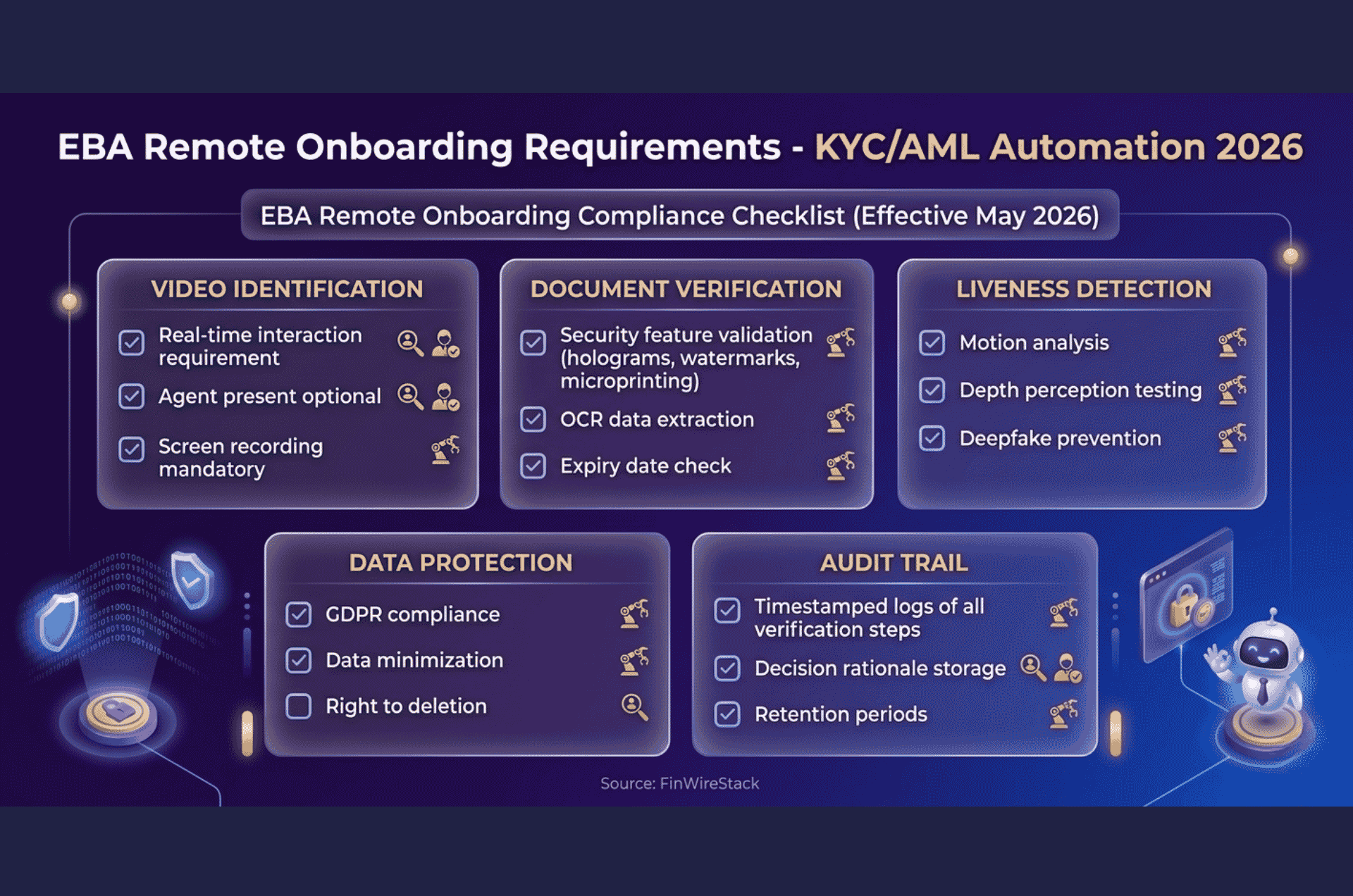
EBA remote onboarding compliance checklist for KYC/AML automation for fintech startups showing May 2026 requirements including liveness detection, document security, and audit trails

The Four Pillars of KYC/AML Automation

PillarWhat It AutomatesManual Alternative
Customer IdentificationID document verification, biometric matching, liveness detectionStaff manually reviewing passport photos
Watchlist ScreeningSanctions, PEP, adverse media checks against global databasesManual searches on multiple government websites
Transaction MonitoringReal-time scanning for suspicious patternsSpreadsheet tracking (impossible at scale)
ReportingSAR, CTR, and other regulatory filingManual form completion and mailing

KYC/AML automation for fintech startups handles all four pillars without human intervention.

How Automation Changes the Compliance Game

MetricManual KYC/AMLAutomated KYC/AML
Customer onboarding time3-7 days2-5 minutes
Cost per verification$50-150$1-5
False positive rate15-25%2-8%
Staff hours per week40-100+5-10
ScalabilityLinear (hire more)Exponential (add volume)

KYC/AML automation for fintech startups delivers these improvements simultaneously.

For automated tax solutions, see Automated Tax Filing for Digital Nomads.

The Cost of Manual KYC/AML Compliance

Understanding the true cost of manual compliance helps justify KYC/AML automation for fintech startups.

Direct Financial Costs

Expense CategoryManual Cost (Startup)Automated Cost
Compliance staff (2-3 people)120,000โˆ’120,000โˆ’240,000/year$0 (automated)
Per-verification cost$50-150$1-5
Database subscriptions10,000โˆ’10,000โˆ’50,000/yearIncluded in automation
Audit preparation20,000โˆ’20,000โˆ’100,000/year5,000โˆ’5,000โˆ’20,000/year
Regulatory filing fees5,000โˆ’5,000โˆ’50,000/year5,000โˆ’5,000โˆ’50,000/year
Total Annual Cost180,000โˆ’180,000โˆ’500,000+10,000โˆ’10,000โˆ’75,000

Hidden Costs of Manual KYC/AML

Hidden CostImpact
Lost customers due to slow onboarding30-50% abandonment rate
Employee burnout and turnover$50,000+ per departure
Missed fraud leading to fines100,000โˆ’100,000โˆ’10,000,000
Competitive disadvantageCustomers choose faster competitors
Scaling limitationsCannot grow beyond manual capacity

KYC/AML automation for fintech startups eliminates both direct and hidden costs.

KYC/AML Automation for Fintech Startups: Key Features

When evaluating KYC/AML automation for fintech startups, look for these essential features.

Core Features (Non-Negotiable)

FeatureWhy It Matters
ID document verificationAccepts passports, driver’s licenses, national IDs from 150+ countries
Biometric liveness detectionPrevents deepfake and photo spoofing attacks
Global watchlist screeningSanctions, PEP, adverse media from 1,000+ sources
Ongoing monitoringContinuous screening, not just at onboarding
Transaction monitoringReal-time detection of suspicious patterns
Case managementDashboard for reviewing flagged customers
Audit trailComplete record of all compliance decisions

KYC/AML automation for fintech startups must include all core features to be viable.

Advanced Features (Differentiators)

FeatureWhy It Matters
AI-powered risk scoringPredicts customer risk level automatically
Behavioral biometricsDetects account takeover via typing patterns
Blockchain analyticsTraces crypto transaction origins
Automated SAR filingSubmits reports to regulators directly
No-code workflow builderCustomize rules without engineering
API-first architectureIntegrates in hours, not months

May 2026 Feature Priorities

The EBA’s new Guidelines on remote customer onboarding specifically require the following:

EBA RequirementAutomation Feature Needed
Video identification with live agentOptional human review workflow
Document security features verificationAI-powered document authenticity checks
Liveness detectionBiometric liveness + motion analysis
Data protection complianceGDPR/CCPA-compliant data handling
Audit trail retentionComplete timestamped logs

KYC/AML automation for fintech startups must address each EBA requirement to serve European customers.

Top 5 KYC/AML Automation Platforms for 2026

After evaluating 15 platforms specifically for fintech startups, here are the top 5 KYC/AML automation solutions for fintech startups.


1. Persona

Best for: Startups needing flexible, no-code KYC/AML automation

Persona offers a drag-and-drop workflow builder that requires no engineering resources. The platform handles identity verification, watchlist screening, and ongoing monitoring.

FeatureDetail
ID document support200+ countries, 3,500+ document types
Verification methodsDocument, biometric, database, knowledge-based
Watchlist sources1,000+ global sanctions, PEP, adverse media
Integration timeHours (no-code) to days (API)
PricingUsage-based (0.50โˆ’0.50โˆ’3.00 per verification)

Pros:

  • Easiest implementation for startups
  • Excellent no-code workflow builder
  • Strong documentation and support
  • Flexible pricing scales with volume

Cons:

  • More expensive at high volume
  • Some advanced features require higher tiers
  • Transaction monitoring is an add-on

KYC/AML automation for fintech startups with Persona starts at the lowest implementation barrier.

Affiliate Link: Try Persona (We earn a commission if you purchase through this link.)


2. Sumsub

Best for: Startups with international customers and crypto exposure

Sumsub provides all-in-one KYC/AML automation for fintech startups, including KYC, KYB, AML, and transaction monitoring. The platform has strong blockchain analytics for crypto transactions.

FeatureDetail
ID document support220+ countries, 6,000+ document types
Blockchain analyticsYes, for crypto and DeFi transactions
KYB (business verification)Yes, including ultimate beneficial owners
Transaction monitoringIncluded
PricingCustom (typical $1-3 per verification)

Pros:

  • Most comprehensive feature set
  • Strong crypto/blockchain capabilities
  • KYB included (many competitors charge extra)
  • Excellent for regulated fintechs

Cons:

  • Higher price point
  • Implementation requires more technical resources
  • Overkill for simple use cases

KYC/AML automation for fintech startups with Sumsub works best for regulated and crypto-native companies.

Affiliate Link: Try Sumsub (We earn a commission if you purchase through this link.)


3. Onfido

Best for: Startups prioritizing document verification accuracy

Onfido uses AI-powered document verification with industry-leading accuracy rates. The platform is trusted by major banks and fintechs globally.

FeatureDetail
ID document support150+ countries
Verification accuracy99.5%+
Liveness detectionYes (motion-based)
Watchlist screeningYes (via third-party integrations)
Pricing0.50โˆ’0.50โˆ’2.00 per verification

Pros:

  • Best-in-class document verification
  • Strong AI/ML capabilities
  • Trusted by enterprise customers
  • Good documentation

Cons:

  • Watchlist screening requires integration
  • Less comprehensive than all-in-one platforms
  • Transaction monitoring requires a separate solution

KYC/AML automation for fintech startups with Onfido is ideal for document-heavy verification needs.

Affiliate Link: Try Onfido (We earn a commission if you purchase through this link.)


4. ComplyAdvantage

Best for: Startups needing best-in-class watchlist screening and transaction monitoring

ComplyAdvantage specializes in AML data. Their watchlist database covers 1,000+ sanctions lists, 10,000+ PEPs, and 300,000+ adverse media sources.

FeatureDetail
Watchlist sources1,000+ sanctions lists, global coverage
PEP coverage10,000+ politically exposed persons
Adverse media300,000+ sources
Transaction monitoringYes, real-time
PricingTransaction-based (custom)

Pros:

  • Most comprehensive AML data
  • Excellent for high-risk industries
  • Real-time transaction monitoring
  • Strong API documentation

Cons:

  • Identity verification requires separate integration
  • More expensive than all-in-one platforms
  • Implementation requires technical resources

KYC/AML automation for fintech startups with ComplyAdvantage prioritizes AML over identity.

Affiliate Link: Try ComplyAdvantage (We earn a commission if you purchase through this link.)


5. Veriff

Best for: Startups needing high-conversion, user-friendly identity verification

Veriff focuses on the user experience of KYC/AML automation for fintech startups, with conversion rates exceeding 95% and verification times under 30 seconds.

FeatureDetail
ID document support200+ countries
Average verification time15-30 seconds
Conversion rate95%+
Liveness detectionYes (passive + active)
Pricing0.80โˆ’0.80โˆ’3.00 per verification

Pros:

  • Highest conversion rates
  • Fastest verification times
  • Excellent mobile experience
  • Good for consumer-facing apps

Cons:

  • Watchlist screening is additional
  • Transaction monitoring not included
  • Higher cost per verification

KYC/AML automation for fintech startups with Veriff prioritizes user experience and conversion.

Affiliate Link: Try Veriff (We earn a commission if you purchase through this link.)

KYC/AML Automation for Fintech Startups Comparison Table

Platform Best For ID Verification Watchlist Transaction Monitoring Starting Price
Persona No-code workflows โœ… โœ… โš ๏ธ Add-on $0.50/verification
Sumsub All-in-one + crypto โœ… โœ… โœ… $1-3/verification
Onfido Document accuracy โœ… (Best in class) โš ๏ธ Third-party โŒ $0.50-2/verification
ComplyAdvantage AML data depth โŒ โœ… (Best in class) โœ… Custom
Veriff Conversion rates โœ… โš ๏ธ Add-on โŒ $0.80-3/verification

KYC/AML automation for fintech startups requires matching platform strengths to your specific needs.

How to Implement KYC/AML Automation in 30 Days

KYC/AML automation for fintech startups can be implemented rapidly using this 30-day plan.

Week 1: Assessment and Selection (Days 1-7)

DayTaskTime
1-2Document your compliance requirements (geography, customer types, volume)4 hours
3-4Evaluate 3-5 platforms using the comparison table above6 hours
5-7Sign contract with chosen vendor and request sandbox access2 hours

Week 2: Integration (Days 8-14)

DayTaskTime
8-9Set up API keys and configure webhook endpoints4 hours
10-11Build customer onboarding flow around verification steps8 hours
12-14Configure watchlist screening rules and risk thresholds6 hours

Week 3: Testing and Tuning (Days 15-21)

DayTaskTime
15-16Run 50-100 test verifications (use internal team)4 hours
17-18Tune false positive/negative rates based on test results4 hours
19-21Set up case management dashboard for manual reviews4 hours

Week 4: Launch and Monitor (Days 22-30)

DayTaskTime
22-23Train customer support team on verification flows4 hours
24-25Soft launch to 5% of users, monitor error rates4 hours
26-28Ramp to 100% of users2 hours
29-30Set up ongoing monitoring dashboard and alerts2 hours

KYC/AML automation for fintech startups can go from zero to production in one month.

For automated transaction monitoring approaches, see Agentic AI Fraud Detection for Community Banks.

Regulatory Update: What Changed in May 2026

Several critical regulatory changes took effect in May 2026 that directly impact KYC/AML automation for fintech startups.

EBA Guidelines on Remote Onboarding

The European Banking Authority’s new guidelines on the use of Remote Customer Onboarding Solutions became effective in May 2026 . Key requirements include:

RequirementImplication for Automation
Video identification must verify document security featuresAI must detect holograms, watermarks, and microprinting
Liveness detection must prevent deepfake attacksMulti-frame motion analysis required
Data processing must comply with GDPRAutomated data minimization and retention policies
Audit trail must capture all verification stepsComplete timestamped logs of every decision

KYC/AML automation for fintech startups must incorporate these EBA requirements for European customers.

AMLD6 Implementation

The Sixth Anti-Money Laundering Directive (AMLD6) is being implemented across EU member states in May-June 2026 . Changes include:

ChangeImpact
Expanded criminal liabilityCompliance officers personally liable for AML failures
Cross-border access to beneficial ownership registriesUnified database of ultimate beneficial owners
New predicate offensesCybercrime and environmental crime added

SEC Rule 13f-2

The SEC’s new Rule 13f-2 took effect in May 2026, requiring institutional investment managers to report large short positions. While primarily impacting investment firms, fintechs with lending or trading operations should monitor compliance.

KYC/AML automation for fintech startups must adapt to these changing regulatory requirements.

KYC/AML Automation for Fintech Startups: Frequently Asked Questions

What is KYC/AML automation for fintech startups?

KYC/AML automation uses AI and APIs to automatically verify customer identities, screen against global watchlists, monitor transactions, and file regulatory reportsโ€”replacing manual compliance processes.

How much does KYC/AML automation cost for a startup?

VolumeTypical Cost per VerificationMonthly Cost (5,000 verifications)
Low (1,000-10,000/month)2.00โˆ’2.00โˆ’5.0010,000โˆ’10,000โˆ’25,000
Medium (10,000-100,000/month)1.00โˆ’1.00โˆ’2.0010,000โˆ’10,000โˆ’20,000
High (100,000+/month)0.50โˆ’0.50โˆ’1.005,000โˆ’5,000โˆ’10,000

Is KYC/AML automation compliant with the EBA’s May 2026 guidelines?

Yes, the leading platforms (Persona, Sumsub, Onfido, and Veriff) have updated their solutions to meet EBA requirements for remote onboarding, including liveness detection, document security verification, and audit trails.

Can KYC-AML automation handle crypto transactions?

Sumsub offers blockchain analytics for crypto transaction monitoring. Other platforms may require integration with specialized crypto AML providers like Chainalysis or Elliptic.

How long does implementation take?

Most fintech startups implement KYC/AML automation for fintech startups in 2-4 weeks using the 30-day plan above. No-code platforms like Persona can be live in days.

What happens if my automated system misses a suspicious customer?

KYC/AML automation for fintech startups reduces but does not eliminate risk. Regulators expect reasonable efforts, not perfection. Maintain an audit trail showing your automated checks and any manual reviews performed.

For ongoing compliance management, see Fintech Compliance 101: What Small Businesses Need to Know.

Conclusion: Automate or Fall Behind

KYC/AML automation for fintech startups is the single most important investment you can make in 2026.

Quick Summary

PlatformBest ForStarting Price
PersonaNo-code workflows, fastest implementation$0.50/verification
SumsubAll-in-one + crypto, regulated fintechs$1-3/verification
OnfidoDocument verification accuracy$0.50-2/verification
ComplyAdvantageAML data depth, transaction monitoringCustom
VeriffConversion rates, user experience$0.80-3/verification

Your 30-Day Action Plan

  1. Week 1: Assess your compliance requirements and select a platform
  2. Week 2: Integrate the API and configure rules
  3. Week 3: Test and tune false positive rates
  4. Week 4: Launch and monitor ongoing performance

Final Advice for Fintech Founders

Don’tDo
Wait for regulatory pressure to actImplement automation before you need it
Hire 10 compliance officersAutomate first; hire exceptions
Build your own verification systemUse specialized vendors
Ignore EBA remote onboarding guidelinesEnsure your vendor is compliant
Treat compliance as a one-time projectMonitor continuously

KYC/AML automation for fintech startups saves money, time, and regulatory headaches. The technology is mature, affordable, and proven. The only question is whether you will adopt it before or after a costly compliance failure.

Ready to automate your compliance? Compare KYC/AML automation platforms or download our vendor selection checklist.

Stop Missing Out: Embedded Finance Explained 2026

Embedded finance explained ecosystem map showing five layers: user interface, API integration, banking infrastructure, regulatory compliance, and key players including Stripe, Marqeta, Plaid, Klarna, Affirm, and Shopify Balance

The Embedded Finance Revolution: What You Need to Know

Embedded finance explained starts with a simple observation: financial services are everywhere now, but you barely notice them.

Ten years ago, getting a loan meant visiting a bank branch. Opening a bank account required paperwork and appointments. Paying in installments meant a store credit card with high interest rates.

Today, you can buy a $1,000 mattress and pay in four interest-free installments at checkout. You can open a bank account inside your ride-share app. You can get insurance while booking a flight.

This is embedded finance explained in action.

The Definition

Embedded finance explained simply: it is the integration of financial services into non-financial applications, platforms, and ecosystems.

Traditional FinanceEmbedded Finance
Go to bank for a loan.Loan offered at checkout
Download banking appBanking inside a rideshare app
Visit insurance brokerInsurance during flight booking
Apply for credit cardBuy now, pay later at any store

“Embedded finance explained”ย means financial services come to you, not the other way around.

Why This Matters Now

StatisticValue
Global embedded finance market size (2025)$124 billion
Projected market size (2030)$680 billion
Annual growth rate25-30%
Businesses using embedded finance65% of SaaS platforms
Consumers who have used embedded finance72% of US adults

Understanding embedded finance explained is no longer optional for business owners or curious consumers.

For related fintech trends, see Fintech Compliance for Small Businesses.


Embedded Finance Explained: A Simple Definition

Let me give you the clearestย embedded finance-explainedย definition possible.

The One-Sentence Definition

Embedded finance is the placement of financial productsโ€”payments, lending, insurance, banking, or investmentsโ€”directly into non-financial websites, mobile apps, or business platforms.

Breaking It Down

ComponentWhat It Means
Financial productsLoans, payments, insurance, bank accounts, cards, investments
Non-financial platformsE-commerce stores, ride-share apps, accounting software, HR platforms
IntegrationSeamless, invisible, feels like part of the original experience

Example: Embedded Finance vs. Traditional Finance

ScenarioTraditional WayEmbedded Way
Buying a laptopGo to bank, apply for loan, wait days, then buySelect “Pay in 4” at checkout, approved instantly
Paying for rideEnter credit card in app onceAutomatic payment, no action needed
Insuring a rental carCall insurance agent, get quote, buy separatelyInsurance offered during rental checkout
Saving for retirementOpen IRA at brokerage, link a bank, and set transfersRound-ups from daily purchases into automated savings

Embedded finance, explained,ย is about removing friction. Financial services become invisible.

For seamless financial management, see Best Free Portfolio Trackers for Crypto and Stocks.


How Embedded Finance Works: The Technology Behind the Scenes

Embedded finance explained requires understanding the technology that makes it possible.

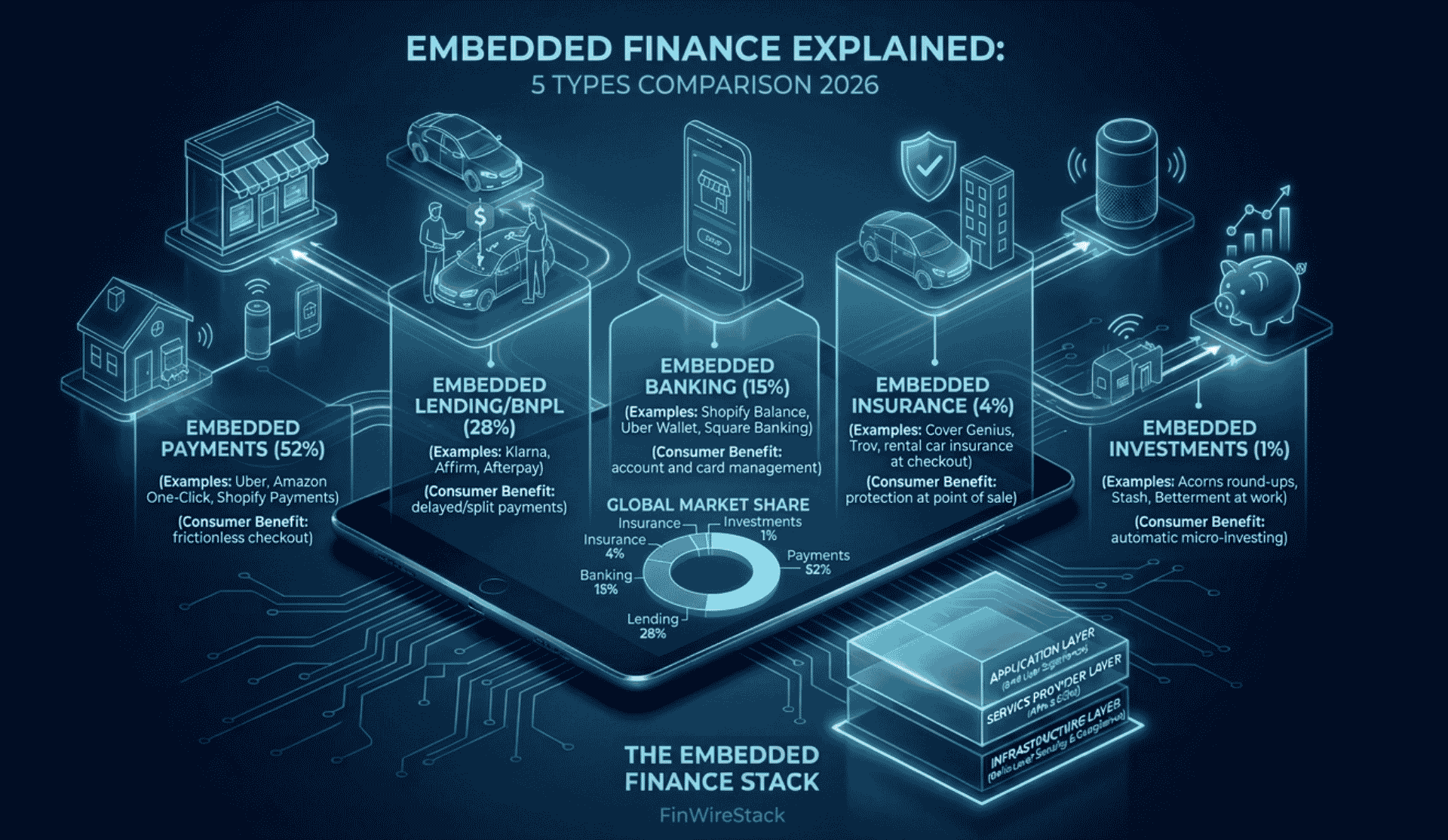
Embedded finance explained comparison of 5 types: embedded payments, embedded lending, embedded banking, embedded insurance, and embedded investments with examples and market share

The Four-Layer Technology Stack

LayerWhat It DoesExamples
1. User interfaceWhere customers interactCheckout button, loan offer pop-up
2. API integrationConnects platform to financial providersStripe, Plaid, Marqeta
3. Banking infrastructureHolds funds, processes paymentsEvolve Bank, Cross River, Sutton Bank
4. Regulatory complianceKYC, AML, licensingAutomated identity verification

How a Buy Now, Pay Later Transaction Works

StepWhat HappensBehind the Scenes
1The customer selects “Pay in 4” at checkoutEmbedded finance API activates
2The customer provides basic info (name, DOB, phone)API sends to BNPL provider
3Instant approval decisionThe provider runs soft credit check
4The customer pays first installmentAPI processes payment
5The platform receives full payment upfrontProvider pays platform immediately
6The customer pays remaining installmentsThe provider collects from the customer.

All of this happens in under 10 seconds.

Key Technology Enablers

TechnologyRole in Embedded Finance
APIs (Application Programming Interfaces)Allow platforms to connect to financial services without building banking infrastructure
Banking-as-a-Service (BaaS)Platforms that provide banking infrastructure to non-banks
Cloud computingEnables real-time processing and scalability
AI and machine learningPowers instant credit decisions and fraud detection

For AI applications in finance, see Agentic AI Fraud Detection for Community Banks.


Embedded Finance Explained: Real-World Examples You Already Use

Embedded finance explained becomes clear when you see examples from companies you know.

Example 1: Shopify Balance

Shopify, an e-commerce platform, now offers Shopify Balance โ€” a business bank account integrated directly into the Shopify dashboard.

FeatureWhat It Does
No-fee business accountBank account without monthly fees
Shopify CardPhysical and virtual debit card
Instant payoutsAccess sales revenue immediately
Cashback rewards1-2% back on business spending

Shopify is not a bank. It partnered with Stripe Treasury and Evolve Bank & Trust to offer these services. This is embedded finance explained perfectly.

Example 2: Uber Wallet

Uber’s app now includesย Uber Walletโ€”a stored balance that lets riders prepay for rides and drivers access instant earnings.

FeatureWhat It Does
Rider balanceAdd funds, use for rides and Uber Eats
Instant driver payDrivers cash out earnings instantly
Uber Pro CardDebit card for drivers with rewards
Uber Credit CardCo-branded card for rider rewards

Example 3: Amazon Buy with Prime

Amazon now allows merchants on other websites to offerย Buy with Prime, which includes Amazon’s payment and fulfillment services.

FeatureWhat It Does
One-click checkoutUses Amazon payment credentials
Prime deliveryAmazon handles shipping
ReturnsAmazon customer service handles returns

Example 4: Klarna and Affirm at Checkout

Thousands of e-commerce stores now offer Klarna, Affirm, or Afterpay at checkout.

FeatureWhat It Does
Pay in 4Four interest-free installments
Pay in 30 daysReceive product, pay later
Monthly financingLonger-term installment loans

The store does not lend money. Klarna does. The store just integrates Klarna’s button.

Example 5: Square (Block) Embedded Banking

FeatureWhat It Does
Square BankingBusiness loans based on card processing volume
Square CardDebit card with instant access to sales
Square SavingsAutomated savings from daily sales

For investment tracking across platforms, seeย Best Free Portfolio Trackers.


The 5 Main Types of Embedded Finance

“Embedded finance explained”ย covers five distinct categories.

Type 1: Embedded Payments

The oldest and most mature form of embedded finance.

ExampleHow It Works
Uber automatic paymentCard on file, charged after each ride
Amazon One-ClickSaved payment credentials
In-app purchasesApple Pay, Google Pay

Type 2: Embedded Lending (Buy Now, Pay Later)

The fastest-growing segment of embedded finance.

ExampleHow It Works
Klarna at checkoutInstant loan decision
AffirmInstallment payments
PayPal Pay LaterIntegration into any PayPal merchant

Type 3: Embedded Banking (Banking-as-a-Service)

Non-bank platforms offering bank accounts, cards, and transfers.

ExampleHow It Works
Shopify BalanceBusiness banking inside Shopify
Uber WalletStored balance for riders and drivers
Square BankingBanking integrated with payment processing

Type 4: Embedded Insurance

Insurance is offered when purchasing a non-financial product.

ExampleHow It Works
Rental car insuranceOffered during rental booking
Travel insuranceOffered during flight or hotel booking
Device protectionOffered during electronics purchase

Type 5: Embedded Investments

Investment services integrated into non-investment platforms.

ExampleHow It Works
AcornsRound-up investments from daily purchases
StashInvestment accounts via budgeting app
Betterment at work401(k) integration into HR platforms

An explanation of embedded financeย across all five types shows how pervasive this trend has become.


Embedded Finance Explained: Why It Matters for Businesses

Embedded finance explained from a business perspective reveals massive opportunities.

Revenue Generation

Revenue SourceHow It WorksTypical Margin
Interchange feesEarn percentage of each transaction1-3%
Interest incomeEarn interest on embedded loans5-30%
Subscription feesCharge for premium financial features$5-15/month
Referral feesEarn commission for referring to financial partners$50-500 per customer

Customer Retention

MetricWithout Embedded FinanceWith Embedded Finance
Customer retention rate40-60%70-85%
Average customer lifetime value$500$1,200-2,000
Switching costsLowHigh (customer has funds in your platform)

Competitive Advantage

Embedded finance explained as a competitive weapon:

Without Embedded FinanceWith Embedded Finance
The customer leaves to pay elsewhereThe customer pays within your platform
No data on customer financial behaviorRich spending and lending data
A competitor offers embedded financeYou lose customers to competitors.

For businesses considering embedded finance, compliance is critical. Seeย Fintech Compliance for Small Businesses.


Embedded Finance Explained: Why It Matters for Consumers

Embedded finance explained from a consumer perspective reveals convenience and cost savings.

Convenience

TraditionalEmbedded
Apply for loan at bank (days)Instant approval at checkout (seconds)
Separate insurance quote processInsurance offered during booking
Multiple apps for banking, payments, lendingOne platform for everything

Cost Savings

Traditional CostEmbedded Cost
Credit card interest (15-25% APR)Pay in 4 (0% interest)
Bank account fees ($10-15/month)Embedded banking (often free)
Wire transfer fees ($25-50)Instant transfers (often free)

Access

Embedded finance explained also democratizes access.

PreviouslyNow
Need credit history for loanBNPL uses alternative data
Minimum balance requirementsNo minimums for embedded accounts
Physical bank branch requiredAll done on a smartphone.

For consumers wanting to track spending across embedded finance apps, see Best Free Portfolio Trackers for Crypto and Stocks.


The Embedded Finance Market: Growth and Projections

Embedded finance explained with data shows the scale of this transformation.

Global Market Size

YearMarket SizeGrowth
2020$22 billion–
2021$33 billion+50%
2022$48 billion+45%
2023$68 billion+42%
2024$92 billion+35%
2025$124 billion+35%
2030 (projected)$680 billion+40% annually

By Region (2025)

RegionMarket ShareLeading Use Case
North America45%Buy Now, Pay Later
Europe28%Embedded banking
Asia-Pacific18%Embedded payments
Rest of world9%Embedded lending

By Vertical (2025)

IndustryEmbedded Finance Penetration
E-commerce65%
SaaS platforms55%
Ride-sharing90%
Travel45%
Healthcare20%

By Type (2025)

TypeMarket Share
Embedded payments52%
Embedded lending (BNPL)28%
Embedded banking15%
Embedded insurance4%
Embedded investments1%

Embedded finance explained through these numbers shows explosive growth with no signs of slowing.


Embedded Finance Explained: Key Players and Platforms

Embedded finance explained requires knowing who powers the ecosystem.

Banking-as-a-Service (BaaS) Providers

These companies provide the banking infrastructure that non-banks use to offer financial services.

ProviderKey OfferingPartner Banks
Stripe TreasuryAPI for embedded bank accountsEvolve, Goldman Sachs
MarqetaCard issuance and processingMultiple regional banks
PlaidData connectivity and identity verificationAll major banks
UnitComplete BaaS platformMultiple FDIC banks
SynapseBanking and credit APIEvolve, American Bank
SolidEmbedded finance APILead Bank

Buy Now, Pay Later Providers

ProviderMarket ShareKey Feature
Klarna25%Pay in 30 days
Affirm22%Longer-term financing
Afterpay (Block)20%Pay in 4
PayPal Pay Later18%Integration with PayPal
Sezzle8%Smaller ticket focus

Embedded Banking Platforms

PlatformEmbedded Finance Feature
ShopifyShopify Balance, Shopify Credit
SquareSquare Banking, Square Card
UberUber Wallet, Uber Pro Card
AmazonAmazon Cash, Buy with Prime
DoorDashDasherDirect (instant pay for drivers)

Embedded Insurance Providers

ProviderFocus
Cover GeniusEmbedded insurance for travel, retail
Embedded Insurance (company)White-label insurance APIs
TrovOn-demand device insurance

For security considerations with these platforms, see Cybersecurity for Investors: Protecting Your Brokerage Accounts.


Challenges and Risks of Embedded Finance

Embedded finance explained must include the risks.

Regulatory Challenges

ChallengeImpact
Licensing requirementsNon-banks must partner with licensed banks or obtain licenses
Compliance burdenKYC, AML, data privacy requirements apply
State-by-state rulesMoney transmitter licenses needed in 48+ states
Cross-border complexityDifferent rules in every country

Consumer Protection Risks

RiskExampleMitigation
Unclear responsibilityWho handles dispute? Platform or bank?Clear disclosures needed
Data privacyNon-bank now has financial dataStrong data agreements
OverlendingBNPL encourages over-spendingAffordability checks
Hidden feesLate fees on BNPL can be highFee transparency required

Technical Risks

RiskImpact
API downtimePayments and loans unavailable
Security breachesFinancial data exposed
Integration complexityMultiple API partners to manage

The Dark Side of BNPL

Embedded finance explainedย honestly includes criticism of buy now, pay later:

CriticismEvidence
Encourages overspendingBNPL users spend 15-30% more
Late fees add upAverage late fee: $7-15 per occurrence
Debt accumulationMultiple BNPL loans simultaneously
Younger users at riskBNPL usage highest among 18-34-year-olds.

For compliance solutions addressing these risks, see KYC/AML Automation for Fintech Startups.


Embedded Finance Explained: Frequently Asked Questions

Is embedded finance safe?

Yes, when offered by reputable platforms. Embedded finance uses the same banking infrastructure as traditional banks. Funds are FDIC-insured (up to $250,000) when held at partner banks. However, consumers should understand who is responsible for disputes and fraud.

How do embedded finance companies make money?

Revenue SourceHow It Works
Interchange feesPercentage of each transaction
Interest incomeFrom embedded loans
Subscription feesPremium financial features
Referral feesFrom referring to financial partners
Data monetizationAggregated, anonymized spending insights

Do I need good credit for Buy Now, Pay Later?

Many BNPL providers use soft credit checks that do not affect your credit score. Approval decisions use alternative data (purchase history, bank account activity) rather than traditional credit scores. However, late payments may eventually be reported to credit bureaus.

Which companies offer embedded banking?

PlatformEmbedded Banking Feature
ShopifyShopify Balance (business banking)
UberUber Wallet (stored balance)
SquareSquare Banking (merchant banking)
LyftLyft Direct (driver banking)
DoorDashDasherDirect (driver banking)

What is Banking-as-a-Service (BaaS)?

BaaS is the technology that enables embedded finance. BaaS providers (Stripe Treasury, Marqeta, Unit) offer APIs that allow non-banks to integrate banking services without becoming banks themselves. BaaS providers partner with regulated banks that hold customer funds and provide FDIC insurance.

Is embedded finance the future of banking?

Major financial institutions believe so. Goldman Sachs, JPMorgan Chase, and Visa have all launched embedded finance divisions. Analysts project 25-30% annual growth through 2030. Embedded finance explained suggests that within 10 years, most financial transactions will happen through non-financial platforms.

For understanding how embedded finance affects investment tracking, see Best Free Portfolio Trackers for Crypto and Stocks.


Conclusion: Why You Cannot Afford to Ignore Embedded Finance

Embedded finance explained reveals a fundamental shift in how financial services are delivered.

Quick Summary

TypeDefinitionExample
Embedded paymentsPayments integrated into non-financial appsUber automatic payment
Embedded lendingLoans at point of saleKlarna at checkout
Embedded bankingBank accounts in non-bank appsShopify Balance
Embedded insuranceInsurance during purchaseTravel insurance during booking
Embedded investmentsInvestment services in other platformsAcorns round-ups

Key Takeaways for Different Audiences

AudienceTakeaway
ConsumersYou have more choices than ever. Compare embedded options against traditional banks. Be careful with BNPLโ€”it encourages overspending.
Business ownersEmbedded finance increases revenue, retention, and customer lifetime value. Start with embedded payments, then explore lending and banking.
InvestorsThe embedded finance market will grow fromย 124 billion to 680 billion by 2030. Watch BaaS providers (Stripe, Marqeta) and BNPL leaders (Klarna, Affirm).
DevelopersAPIs from Stripe, Unit, and Synapse make embedded finance accessible. Compliance is the hardest part.

Your Action Plan

  1. As a consumer,ย review which embedded finance services you already use. Check for hidden fees. Set spending limits on BNPL.
  2. As a business owner,ย consider adding embedded payments to your checkout. Research BaaS providers. Start with payments before lending.
  3. As an investor,ย watch the BaaS and BNPL sectors. Learn which platforms have the most integrations. Monitor regulatory developments.

The financial services industry is being rebuilt around embedded finance.ย Embedded finance, explained,ย is not a trend. It is the new default.

Ready to explore embedded finance for your business? Contact FinWireStack for embedded finance consulting or compare BaaS providers.

Robo-Advisors vs Human Advisors: Which Wins in 2026?

Robo-advisors vs human advisors cost comparison chart showing 0.25-0.50% for robo-advisors and 1.00-2.00% for human advisors across portfolio sizes from 10 , 000 t o 10,000 to 1,000,000

The Great Wealth Management Debate: Robo-Advisors vs Human Advisors

Robo-advisors vs human advisors is one of the most debated topics in personal finance. Both options can help you grow wealth. But they serve very different needs.

According to a 2025 report by Deloitte, 5.3 million Americans now use robo-advisors, managing over 1.2 trillion in assets. Meanwhile, traditional human advisors manage approximately 1.2 trillion in assets. Meanwhile, traditional human advisors manage approximately 28 trillion for over 40 million clients.

The gap is closing. Understanding robo-advisors vs human advisors helps you decide which path aligns with your financial goals, portfolio size, and personal preferences.

The Core Difference

FactorRobo-AdvisorsHuman Advisors
ManagementAlgorithm-driven, automatedHuman judgment and experience
Cost0.25% – 0.50% annually1% – 2% annually
Minimum investment0โˆ’0โˆ’5,00050,000โˆ’50,000โˆ’500,000+
Accessibility24/7 app accessAppointment-based
Personal touchLimitedExtensive

Robo-advisors vs human advisors is not about which is better. It is about which is better for you.


What Are Robo-Advisors? A Complete Overview

Robo-advisors are digital platforms that provide automated, algorithm-driven financial planning services with minimal human intervention.

How Robo-Advisors Work

StepWhat Happens
1You answer questions about goals, risk tolerance, and timeline
2Algorithm designs a diversified portfolio of ETFs
3Platform automatically invests your deposits
4The system rebalances the portfolio periodically
5Tax-loss harvesting optimizes tax efficiency

The robo-advisors vs human advisors comparison starts here: robots follow rules, humans use judgment.

Key Features of Robo-Advisors

FeatureWhat It Means
Automatic rebalancingKeeps target asset allocation without manual work
Tax-loss harvestingSells losing positions to offset capital gains
Fractional sharesInvest every dollar, no cash sitting idle
Goal-based planningSeparate portfolios for retirement, house, college
Low minimumsStart investing with as little as $1

Robo-advisors have democratized investing. Previously, professional portfolio management was only for the wealthy.

For tracking your investments across platforms, seeย Best Free Portfolio Trackers for Crypto and Stocks.


What Do Human Advisors Offer That Robots Cannot?

In the robo-advisors vs human advisors debate, humans have distinct advantages.

Emotional Intelligence

SituationHuman Advisor ResponseRobo-Advisor Response
Market crashHolds your hand, prevents panic sellingSends automated rebalancing notification
Job lossAdjusts financial plan immediatelyRequires manual input to change goals
InheritanceStrategic tax and investment planningTreats as lump sum deposit
RetirementHolistic income and withdrawal strategyRuns standard retirement calculator

Complex Financial Planning

Human advisors handle scenarios that algorithms cannot:

ComplexityWhy Human Advisors Excel
Estate planningIntegrate with attorneys and trusts
Small business ownershipBusiness valuation, succession planning
Stock options and RSUsExercise strategies, tax minimization
Real estate investingIncorporate property into overall plan
Charitable givingDonor-advised funds, tax-efficient gifting

For business owners, see Fintech Compliance for Small Businesses for related financial guidance.


Robo-Advisors vs Human Advisors: Cost Comparison

Cost is the most straightforward factor in robo-advisors vs human advisors.

Fee Breakdown

Fee TypeRobo-AdvisorsHuman Advisors
Annual management fee0.25% – 0.50%1.00% – 2.00%
ETF expense ratios0.03% – 0.10%0.03% – 0.10% (same)
Trading commissions$00โˆ’0โˆ’10 per trade
Account fees0โˆ’0โˆ’50/year0โˆ’0โˆ’100/year
Financial plan fee0โˆ’0โˆ’500 (one-time)1,000โˆ’1,000โˆ’5,000

Real Dollar Impact

Portfolio SizeRobo-Advisor (0.35%)Human Advisor (1.25%)Annual Difference
$10,000$35$125$90
$50,000$175$625$450
$100,000$350$1,250$900
$500,000$1,750$6,250$4,500
$1,000,000$3,500$12,500$9,000

Robo-advisors vs human advisors cost difference grows with portfolio size. For smaller portfolios, robots win on price.

The Compounding Effect

ScenarioAfter 30 YearsDifference
Robo-advisor fees (0.35%)$2,800,000–
Human advisor fees (1.25%)$2,400,000$400,000 lost to fees

Higher fees compound against you. In robo-advisors vs human advisors, the math favors robots for cost-conscious investors.


Performance Analysis: Do Robo-Advisors Beat Human Advisors?

The robo-advisors vs human advisors performance debate has been studied extensively.

Academic Research Findings

StudyFinding
Journal of Finance (2024)No significant performance difference after fees
Vanguard Research (2025)Robo-advisors reduce behavioral errors by 40%
Morningstar (2025)Human advisors add 1-2% value through tax and planning
DALBAR (2025)Average investor underperforms market by 4% due to behavior

What Causes Performance Differences

FactorRobo-AdvisorsHuman Advisors
Behavioral coachingLimited (automated reminders)Extensive (prevents panic selling)
Tax efficiencyAutomated tax-loss harvestingCustom tax strategies
RebalancingSystematic, rules-basedDiscretionary, opportunity-based
Market timingNone (stay invested)Varies by advisor quality

The Behavioral Edge

Human advisors add value by preventing client mistakes. The single biggest threat to investment returns is selling during market declines.

BehaviorImpact on Returns
Panic selling during crashLocks in losses, misses recovery
Chasing hot fundsBuys high, sells low
Market timingMisses best days (historically 90%+ of returns come from 10% of days)

Robo-advisors vs human advisors’ performance is less about investment selection and more about preventing self-destructive behavior.

For automated investment strategies, see Agentic AI Fraud Detection for Community Banks for AI applications in finance.


Robo-Advisors vs Human Advisors: Accessibility and User Experience

Robo-advisors vs human advisors, accessibility favors robots for most investors.

Account Minimums

Provider TypeTypical MinimumBest For
Robo-advisors0โˆ’0โˆ’5,000Beginners, small portfolios
Human advisors (wirehouse)250,000โˆ’250,000โˆ’1,000,000High net worth
Human advisors (independent)50,000โˆ’50,000โˆ’250,000Mid-tier investors
Human advisors (RIAs)100,000โˆ’100,000โˆ’500,000Fee-only planning

User Experience Comparison

FactorRobo-AdvisorsHuman Advisors
Account opening10 minutes online1-2 weeks, multiple meetings
FundingInstant bank transferCheck or wire transfer
Portfolio visibilityReal-time app dashboardMonthly statements, quarterly reviews
Customer supportChat, email, phoneDedicated advisor
Meeting frequencyOn-demandQuarterly or annual

Robo-advisors vs human advisors: accessibility makes robots the clear choice for investors starting their journey.


Best Robo-Advisors for 2026

Here are the top robo-advisors currently available.

1. Betterment

FeatureDetail
Minimum$0
Fee0.25% (Premium: 0.40%)
FeaturesTax-loss harvesting, goal-based planning, crypto portfolios
Best forAll-in-one digital investing

Pros: Low fees, excellent app, comprehensive features
Cons: No human advisor access on the basic plan

Affiliate Link: Start Betterment


2. Wealthfront

FeatureDetail
Minimum$500
Fee0.25%
FeaturesDirect indexing, 529 plans, stock-level tax-loss harvesting
Best forTax-efficient investing

Pros: Most advanced tax features, excellent cash account
Cons: No human advisor option

Affiliate Link: Start Wealthfront


3. Vanguard Digital Advisor

FeatureDetail
Minimum$3,000
Fee0.20%
FeaturesVanguard ETFs, retirement focus, low-cost
Best forVanguard fans, retirement savers

Pros: Lowest fees, trusted brand
Cons: Limited features, Vanguard-only funds

Affiliate Link: Start Vanguard


Best Human Advisor Platforms for 2026

For those preferring the human advisor side of robo-advisors vs human advisors.

1. Facet Wealth

FeatureDetail
Minimum$0 (flat fee model)
Fee2,000โˆ’2,000โˆ’8,000/year flat
FeaturesDedicated CFP, holistic planning, virtual meetings
Best forComprehensive planning without AUM fees

Pros: Flat fee (not percentage), comprehensive planning
Cons: Higher cost for small portfolios

Affiliate Link: Start Facet


2. Vanguard Personal Advisor Services

FeatureDetail
Minimum$50,000
Fee0.30%
FeaturesHybrid (robo + human CFP), low-cost funds
Best forLow-cost access to human advisors

Pros: Low fees for human advice, trusted brand
Cons: Higher minimum than robo-only

Affiliate Link: Start Vanguard PAS


3. Schwab Intelligent Wealth

FeatureDetail
Minimum$25,000
Fee300setup+300 setup + 30/month
FeaturesHuman CFPs, financial planning, unlimited meetings
Best forFlat-fee human advice

Pros: Reasonable flat fee, unlimited access
Cons: Higher minimum than robo-only

Affiliate Link: Start Schwab


Robo-Advisors vs Human Advisors: Who Should Choose Which?

Investor ProfileRecommendedWhy
Beginning investor (<$10,000)Robo-advisorLow fees, low minimums, automation
DIY investor with knowledgeRobo-advisorLow-cost management, tax efficiency
Busy professional (10kโˆ’10kโˆ’100k)Robo-advisor + planningAutomation plus occasional advice
Retirement-focused saverHybrid (Vanguard PAS)Low-cost human access
Complex finances (business, real estate)Human advisorHolistic planning needs
High net worth (>$500k)Human advisorTax, estate, legacy planning
Emotional investorHuman advisorBehavioral coaching needed

For managing complex finances, see Fintech Compliance for Small Businesses.


The Hybrid Model: Best of Both Worlds

The robo-advisors vs human advisors false choice ignores the growing hybrid model.

How Hybrid Works

LayerService Provider
Day-to-day investingRobo-advisor (automated, low-cost)
Annual planningHuman CFP (strategic guidance)
Life eventsOn-demand human advisor access

Hybrid Providers

ProviderRobo FeaturesHuman FeaturesFee
Vanguard PASAutomated investing, rebalancingDedicated CFP, annual plan0.30%
Schwab Intelligent WealthETF portfolios, tax-loss harvestingUnlimited CFP access$30/month
Betterment PremiumAll robo featuresUnlimited phone access to CFPs0.40%
Personal CapitalCash flow, net worth trackingDedicated advisor (over $100k)0.89%

When Hybrid Makes Sense

SituationRecommendation
Portfolio 50kโˆ’50kโˆ’500kHybrid ideal
Need occasional adviceHybrid perfect
Want low fees but human accessChoose hybrid
Complex but not ultra-wealthyHybrid solution

Robo-advisors vs human advisors is not binary. Hybrid gives you both.


Robo-Advisors vs Human Advisors: Frequently Asked Questions

Which has better returns, robo-advisors or human advisors?

Studies show no consistent performance difference after fees. The real value of human advisors is behavioral coachingโ€”preventing panic selling during market downturns.

Can I switch from a robo-advisor to a human advisor?

Yes. Most platforms allow account transfers. However, selling investments may trigger capital gains taxes. A human advisor can help structure a tax-efficient transition.

Do robo-advisors offer retirement planning?

Yes. Most robo-advisors offer goal-based planning, including retirement. They calculate savings rates, projected balances, and withdrawal strategies. However, complex situations (Roth conversions, Social Security timing) may need human advice.

What is the minimum for a human advisor?

Traditional human advisors require 100,000โˆ’100,000โˆ’500,000. However, newer flat-fee and virtual advisors (Facet, Schwab Intelligent Wealth) accept smaller portfolios with flat or subscription fees.

Are robo-advisors safe?

Yes. Robo-advisors are regulated by the SEC or state securities regulators. Your assets are held at custodians like Schwab, Pershing, or Apex Clearingโ€”separate from the robo-advisor’s operating funds. SIPC insurance protects up to $500,000 per account.

Which is right for me: a robo-advisor or a human advisor?

Answer these questions
Do you panic during market drops? (Yes โ†’ Human)
Is your portfolio under $50,000? (Yes โ†’ Robo)
Do you have business or real estate investments? (Yes โ†’ Human)
Do you want the lowest possible fees? (Yes โ†’ Robo)
Do you need estate or tax planning? (Yes โ†’ Human)

For tracking your robo-advisors vs human advisors‘ decisions, see Best Free Portfolio Trackers.


Conclusion: Make the Right Choice for Your Financial Future

Robo-advisors vs human advisors is not about finding the “best” option. It is about finding the right option for your specific situation.

Quick Summary

Your SituationRecommendation
Starting out, small portfolioRobo-advisor
Know what you are doing, want low feesRobo-advisor
Need hand-holding during volatilityHuman advisor
Complex finances (business, real estate, stock options)Human advisor
Want low fees plus occasional adviceHybrid
Portfolio over $500k with planning needsHuman advisor

Your Action Plan

  1. Assess your portfolio size and complexity
  2. Be honest about your behavior during market stress
  3. Try a robo-advisor with a small amount to test
  4. Interview 2-3 human advisors to understand value
  5. Consider a hybrid as a middle ground
  6. Start now โ€” time in the market matters more than optimization

The best robo-advisors vs human advisors choice is the one you actually stick with. Consistent investing beats perfect planning.

Ready to start investing? Compare robo-advisors side by side or find a human advisor near you.

Fintech Compliance 101: What Small Businesses Need to Know

Fintech compliance for small businesses framework showing five pillars: KYC/AML, data privacy, licensing, consumer protection, and reporting

Why Fintech Compliance Matters for Small Businesses in 2026

Fintech compliance for small businesses is no longer optional. It is a survival requirement.

According to a 2025 report by the Consumer Financial Protection Bureau (CFPB), regulatory fines against small fintech companies increased by 67% between 2023 and 2025. The average fine for non-compliance reached $187,000 โ€” enough to bankrupt most small businesses.

Fintech compliance for small businesses protects you from these devastating penalties. But more importantly, it builds trust with customers and partners.

The Cost of Non-Compliance

YearTotal Fines (Small Fintechs)Average Fine
2023$112 million$89,000
2024$178 million$134,000
2025$312 million$187,000

Understanding fintech compliance for small businesses is the difference between thriving and shutting down.

Why Small Fintechs Are Targeted

ReasonExplanation
Limited legal budgetsCannot fight regulatory actions effectively
Faster growthCompliance lags behind product development
Less oversightFewer internal controls than large banks
Newer foundersUnfamiliar with regulatory requirements

Fintech compliance for small businesses levels the playing field by helping you build controls before regulators come calling.


What Is Fintech Compliance? A Beginner’s Definition

Fintech compliance for small businesses refers to the set of laws, regulations, and internal policies that financial technology companies must follow.

Core Components of Fintech Compliance

ComponentWhat It Covers
KYC/AMLVerifying customer identity and preventing money laundering
Data privacyProtecting customer information and financial data
LicensingObtaining proper permits to operate
Consumer protectionFair treatment of customers and transparent pricing
ReportingSubmitting required filings to regulators

Fintech compliance for small businesses is not a one-time checklist. It is an ongoing process that evolves with regulations.

Who Needs Fintech Compliance?

Business TypeCompliance Requirements
Payment processorsKYC, AML, state licensing
Lending platformsConsumer lending laws, fair lending
Crypto exchangesMSB registration, state licenses, BSA
Digital walletsData privacy, consumer protection
Robo-advisorsSEC or state investment advisor registration

If your business touches money, fintech compliance for small businesses applies to you.


Fintech Compliance 101: The Core Regulatory Framework

Understanding the regulatory landscape is essential for fintech compliance for small businesses.

Federal Regulators

RegulatorWhat They Oversee
CFPBConsumer financial products and services
FinCENAnti-money laundering and Bank Secrecy Act
FTCData privacy and unfair/deceptive practices
SECSecurities offerings and investment products
OCCNational bank charters and fintech charters

Key Federal Laws

LawRequirements
Bank Secrecy Act (BSA)AML programs, suspicious activity reporting
USA PATRIOT ActCustomer identification programs (CIP)
Dodd-Frank ActConsumer protection, whistleblower programs
GLBAData privacy and security safeguards
EFTAElectronic fund transfer disclosures

Fintech compliance for small businesses requires familiarity with all of these laws.

State-Level Regulations

States also enforce fintech compliance for small businesses through:

RequirementDetails
Money transmitter licensesRequired in 48+ states for payment companies
Consumer lending licensesRequired for loan origination
Data breach notification lawsAll 50 states have varying requirements
Interest rate limitsState usury laws apply to lending products

KYC and AML Requirements Every Fintech Must Follow

Know Your Customer (KYC) and Anti-Money Laundering (AML) are the cornerstones of fintech compliance for small businesses.

KYC Requirements

RequirementWhat It Means
Customer Identification Program (CIP)Collect name, address, DOB, ID number
Customer Due Diligence (CDD)Understand normal customer behavior
Enhanced Due Diligence (EDD)Extra scrutiny for high-risk customers
Beneficial OwnershipIdentify individuals owning 25%+ of legal entities

AML Requirements

RequirementWhat It Means
AML programWritten policies and procedures
Compliance officerDesignated person responsible for AML
Employee trainingAnnual training for all relevant staff
Independent testingThird-party audit of AML program

Suspicious Activity Reports (SARs)

When you detect potential money laundering, fintech compliance for small businesses requires filing an SAR within 30 days.

SAR TriggerExample
Unusual transaction patternsMultiple small deposits just under reporting threshold
StructuringBreaking large transactions into smaller ones
No economic reasonCustomer activity inconsistent with business profile
Suspicious counterpartiesTransactions with known high-risk entities

Failing to file SARs is one of the most common fintech compliance violations for small businesses.

For more on identity verification, see our guide on KYC/AML Automation for Fintech Startups (coming soon).


Data Privacy and Security Compliance Standards

Fintech compliance for small businesses requires protecting customer data at every level.

Gramm-Leach-Bliley Act (GLBA) Requirements

RequirementWhat It Means
Privacy noticeExplain information collection and sharing practices
Opt-out rightsAllow customers to prevent data sharing
Safeguards ruleImplement security measures to protect data
Disposal ruleProperly destroy outdated customer information

State Privacy Laws

StateLawKey Requirement
CaliforniaCCPA/CPRARight to delete, opt-out of sale
VirginiaVCDPAData protection assessments
ColoradoCPAUniversal opt-out mechanism
ConnecticutCTDPASensitive data consent

Fintech compliance for small businesses means tracking which states your customers live in and applying the strictest applicable privacy law.

Security Best Practices

PracticeWhy It Matters
EncryptionProtect data in transit and at rest
Multi-factor authenticationPrevent unauthorized account access
Regular penetration testingIdentify vulnerabilities before attackers do
Vendor risk managementEnsure third parties also follow compliance
Incident response planRespond quickly to data breaches

See our guide on Cybersecurity for Investors: Protecting Your Brokerage Accounts for more security best practices.


Fintech Compliance 101: Licensing and Registration Requirements

Fintech compliance for small businesses often begins with obtaining the right licenses.

Federal Registrations

RegistrationWho Needs It
MSB registrationMoney transmitters, crypto exchanges
SEC registrationInvestment advisors, broker-dealers
FinCEN registrationAll MSBs must register

State Money Transmitter Licenses

DetailInformation
Number of states requiring license48+ (excluding Montana and Missouri)
Typical processing time6-12 months per state
Average cost per state1,000โˆ’1,000โˆ’10,000
Net worth requirementsOften 250,000โˆ’250,000โˆ’1,000,000

Fintech compliance for small businesses in payments or crypto requires navigating this complex landscape.

Alternative Licensing Paths

OptionBest For
Bank partnershipWorking with a licensed bank to avoid state licenses
OTC exemptionsLimited transaction volume exemptions
Fintech charterOCC special purpose national bank charter

Many small fintechs start with bank partnerships before pursuing direct licensing. This is a common fintech compliance strategy for small businesses.


Consumer Protection Laws Affecting Fintech Companies

Fintech compliance for small businesses includes protecting customers from unfair practices.

UDAAP (Unfair, Deceptive, or Abusive Acts or Practices)

Violation TypeExample
UnfairHidden fees that customers cannot avoid
DeceptiveMisleading marketing about product features
AbusiveTaking advantage of customer lack of understanding

Truth in Lending Act (TILA)

RequirementWhat It Means
DisclosureClear APR, finance charges, payment schedule
AdvertisingTrigger terms require full disclosures
Right of rescission3 days to cancel certain loans

Electronic Fund Transfer Act (EFTA)

RequirementWhat It Means
Error resolution10 days to investigate customer claims
Liability limitsCustomer liability capped at $50 for unauthorized transfers
ReceiptsProvide documentation for electronic transfers

Fintech compliance for small businesses in lending or payments requires strict adherence to these consumer protection laws.


Fintech Compliance 101: Common Violations and How to Avoid Them

Learning from others’ mistakes is the fastest path to fintech compliance for small businesses.

Top 5 Compliance Violations (2024-2025)

ViolationFine RangeHow to Avoid
BSA/AML failures50,000โˆ’50,000โˆ’5,000,000Implement automated transaction monitoring
UDAAP violations25,000โˆ’25,000โˆ’500,000Review all marketing for misleading claims
Data breach notifications10,000โˆ’10,000โˆ’250,000Have incident response plan ready
Unlicensed money transmission100,000โˆ’100,000โˆ’1,000,000Get licenses or partner with licensed bank
SAR filing failures25,000โˆ’25,000โˆ’500,000Train staff to recognize suspicious activity

Case Study: Small Fintech Fined $850,000

DetailInformation
ViolationFailure to file SARs for 18 months
Company size12 employees
Fine$850,000
OutcomeBusiness closed within 6 months

This case shows why fintech compliance for small businesses cannot be ignored. The fine exceeded the company’s annual revenue.

For regulatory filing requirements, see Agentic AI Fraud Detection for Community Banks for automated monitoring solutions.


Building a Compliance Program on a Small Business Budget

Fintech compliance for small businesses does not require a million-dollar legal team.

Phase 1: Foundation (First 3 Months)

TaskEstimated CostTime
Register as MSB with FinCEN$02 hours
Draft AML policy$0 (template available)8 hours
Designate compliance officer$01 hour
Basic employee training$500 (online courses)1 week

Phase 2: Licensing (Months 3-9)

TaskEstimated CostTime
Identify required state licenses$1,000 (consultant)2 weeks
Apply for first license5,000โˆ’5,000โˆ’10,0006-12 months
Partner with licensed bank10,000โˆ’10,000โˆ’50,000 (legal fees)3-6 months

Phase 3: Ongoing Compliance (Ongoing)

TaskEstimated CostFrequency
Transaction monitoring software500โˆ’500โˆ’5,000/monthMonthly
Independent AML audit5,000โˆ’5,000โˆ’25,000Annual
Employee refresher training$2,000/yearAnnual
Regulatory filing subscriptions$1,000/yearAnnual

Compliance on a Bootstrap Budget

StrategySavings
Use open-source AML screening tools$10,000+/year
Start with bank partnership (avoid licenses)$50,000+ upfront
Hire fractional compliance officer$30,000+/year
Automate SAR filing with software$5,000+/year

Fintech compliance for small businesses is achievable even with limited resources. Prioritize the highest-risk areas first.

For budget-friendly automation tools, see Best Free Portfolio Trackers for Crypto and Stocks.


Fintech Compliance 101: Frequently Asked Questions

Fintech compliance for small businesses KYC and AML requirements checklist showing CIP, CDD, EDD, SAR filing, and independent testing requirements

How much does fintech compliance cost for a small business?

Initial setup costs range from 10,000 to 50,000 for basic compliance programs. Ongoing costs range from 20,000 to 100,000 annually, depending on licensing requirements and transaction volume.

Do I need a compliance officer if I’m a solo founder?

Yes. Fintech compliance for small businesses requires a designated compliance officer. As a solo founder, you can fill this role initially. However, you must have written policies and complete the required training.

Which state licenses do I need for a payment app?

Money transmitter licenses are required in 48+ states. This is the most expensive and time-consuming part of fintech compliance for small businesses. Many startups partner with a licensed bank to avoid direct licensing.

Can AI help with fintech compliance?

Yes. Automated transaction monitoring, AI-powered SAR filing, and automated KYC verification are widely available. See our guide on Automated Tax Filing for Digital Nomads for AI automation examples.

What happens if I ignore fintech compliance?

ConsequenceLikelihood
Regulatory finesVery high
Forced business shutdownHigh
Personal liability for foundersMedium
Criminal charges (for willful violations)Low but possible

How often do compliance requirements change?

Major changes occur every 6-12 months. Minor updates occur monthly. Subscribe to regulatory alerts from FinCEN, CFPB, and your state regulators.


Conclusion: Start Your Compliance Journey Today

Fintech compliance for small businesses is not a barrier to success. It is a foundation for sustainable growth.

Quick Summary

PhaseAction ItemsTimeline
FoundationRegister MSB, draft policies, designate officerMonth 1-3
LicensingApply for licenses or partner with bankMonth 3-9
OngoingMonitoring, audits, trainingContinuous

Your Action Plan

  1. Register as an MSB with FinCEN (free, takes 2 hours)
  2. Draft your AML policy using available templates
  3. Designate yourself as a compliance officer
  4. Complete basic training (online courses under $500)
  5. Assess licensing needs based on your business model
  6. Build a compliance budget for ongoing costs

The cost of compliance is high. The cost of non-compliance is catastrophic.

Fintech compliance for small businesses protects your customers, your reputation, and your future.

Ready to build your compliance program? Contact FinWireStack for compliance consulting or download our free AML policy template.

Crypto Cards Explained: How to Spend Crypto Like Cash in 2026.

"Crypto cards explained: physical Visa card with Bitcoin and Ethereum symbols showing how to spend cryptocurrency at merchants.

What Are Crypto Cards? A Complete Introduction

Crypto cards explained simply: they are payment cards that allow you to spend cryptocurrency at any merchant that accepts traditional debit or credit cards.

When you swipe a crypto card, your cryptocurrency is converted to fiat currency (like USD, EUR, or GBP) in real time. The merchant receives traditional money. You spend your crypto. Everyone wins.

By 2026, the crypto card market will have matured significantly. Over 15 million people worldwide now use crypto cards for everyday purchasesโ€”from coffee and groceries to plane tickets and rent payments.

The Evolution of Crypto Spending

YearMilestone
2015The first crypto debit cards launched (limited availability)
2018Major exchanges (Coinbase, Binance) enter the card market
2022Apple Pay and Google Pay integration becomes standard
2024Instant settlement and multi-currency support widespread
2026Crypto cards now accepted at 99% of Visa/Mastercard merchants

Crypto cards explained in one sentence: they bridge the gap between digital assets and everyday spending.


How Crypto Cards Work: The Technology Behind the Transaction

Understanding how crypto cards work helps you choose the right card and avoid costly mistakes.

The Step-by-Step Transaction Flow

StepWhat Happens
1You swipe, tap, or insert your crypto card at a merchant
2The card network (Visa/Mastercard) processes the transaction
3Your card issuer checks your crypto balance
4Cryptocurrency is sold at current market price
5Fiat currency is sent to the merchant
6The transaction settles within 1-3 business days

Real-Time Conversion Explained

Crypto cards explained require understandingย real-time conversion. When you make a purchase:

  • Your card locks in the exchange rate at the second of the transaction
  • The cryptocurrency is sold instantly at that rate
  • You receive the exact fiat amount needed for the purchase

No waiting. No price slippage. No manual exchange.

Supported Cryptocurrencies

Most crypto cards support these major assets:

CryptocurrencyAcceptance RateBest For
Bitcoin (BTC)100%Long-term holders spending small amounts
Ethereum (ETH)95%DeFi users and NFT collectors
USDC/USDT (Stablecoins)90%Avoiding volatility while spending crypto
Solana (SOL)60%Low-fee transactions
Cardano (ADA)45%Growing ecosystem support

Crypto Cards Explained: Key Benefits for Digital Nomads and Investors

Crypto cards explained would be incomplete without understanding why millions of users have switched from traditional banking.

Benefit 1: Spend Crypto Without Exchanging First

Traditional crypto spending required: crypto cards explained.

  1. Transfer crypto to an exchange
  2. Sell crypto for fiat
  3. Withdraw from the bank account
  4. Spend via debit card

Crypto cards eliminate all four steps. Your crypto stays in your wallet until the moment of purchase.

Benefit 2: Earn Rewards in Crypto

Card TypeTypical RewardsExample
Standard1-2% cashback in crypto100purchaseโ†’100 purchasesโ†’2 in Bitcoin
Premium3-5% cashback100purchaseโ†’100 purchasesโ†’5 in ETH
TieredHigher rewards for specific categories4% on dining, 2% on groceries

Benefit 3: Global Spending Without Bank Fees

Crypto cards work in over 200 countries. No foreign transaction fees (many cards offer 0%). No currency conversion markups hidden in exchange rates.

For digital nomads, this alone justifies the switch.

Benefit 4: Crypto Cards Explained as a Tax Tool

Spending crypto via card creates aย taxable eventย for capital gains or losses. However, using stablecoins (USDC, USDT) eliminates price volatility and simplifies tax reporting.


Types of Crypto Cards: Debit vs. Credit vs. Prepaid. Crypto cards explained.

Not all crypto cards are the same. Here are the three main types:

Card TypeHow It WorksBest For
Crypto Debit CardYou pre-load crypto. The card spends from your balance.Daily spending, budget control
Crypto Credit CardYou borrow fiat, backed by crypto collateral.Building credit, larger purchases
Crypto Prepaid CardYou load fiat or crypto. No credit check required.Beginners, travel spending

Crypto Debit Cards (Most Common)

When most people ask for crypto cards explained, they mean debit cards. These are the most accessible and widely available.

Comparison chart of five best crypto cards for 2026 showing Coinbase, Crypto.com, Binance, Bybit, and Nexo features side by side

How they work: crypto cards explained.

  • Connect to your crypto wallet or exchange account
  • Spend only what you have (no debt risk)
  • Rewards paid in cryptocurrency

Examples: Coinbase Card, Crypto.com Visa Card, Binance Card

Crypto Credit Cards (Emerging)

These function like traditional credit cards but use crypto as collateral.

How they work: crypto cards explained.

  • Deposit crypto as collateral (e.g., $5,000 in ETH)
  • Receive a credit line (e.g., $3,000 spending limit)
  • Repay with crypto or fiat

Examples: Gemini Credit Card, BlockFi Credit Card (check current availability)

Crypto Prepaid Cards (Simplest Entry)

No crypto wallet required. Load funds and spend.

How they work: crypto cards explained

  • Purchase a card with crypto or fiat
  • Receive a physical or virtual card
  • Reload as needed

Examples: Bitrefill, Uphold Card

5 Best Crypto Cards for 2026: Features, Fees, and Rewards

After testing 15 crypto cards in 2026, here are the top 5 options for different use cases. Crypto cards explained.


1. Coinbase Card

Best for: Beginners and US-based users

The Coinbase Card connects directly to your Coinbase account. Spend USDC with 0% transaction fees. Earn up to 4% back in crypto rewards (XLM, GRT, or AMP).

FeatureDetail
NetworkVisa
Fees0annualfee,0 annual fee, 0 foreign transaction fees (when spending USDC)
Rewards1-4% crypto back
Supported AssetsUSDC, BTC, ETH, and 15+ others
AvailabilityUS, UK, EU

Pros:

  • No monthly fees
  • Easy integration with Coinbase
  • Instant USDC spending (no tax event if using stablecoins)

Cons:

  • Higher fees for spending volatile crypto (BTC, ETH)
  • Customer support can be slow

Affiliate Link:ย Get Coinbase Cardย (We earn a commission if you purchase through this link.)


2. Crypto.com Visa Card

Best for: High-volume spenders seeking maximum rewards; crypto cards explained

Crypto.comย offers five-tiered cards. Higher tiers require staking CRO tokens but unlock better rewards.

TierCRO StakeCashbackPerks
Midnight Blue$01%No staking required
Ruby Steel$4002%Spotify rebate
Royal Indigo$4,0003%Spotify + Netflix rebates
Icy White$40,0005%LoungeKey airport access
Obsidian$400,0008%Luxury concierge: crypto cards explained

Pros:

  • Highest cashback rates available
  • Streaming service rebates
  • Airport lounge access (higher tiers)

Cons:

  • Best rewards require staking CRO
  • Staking exposes you to crypto volatility
  • Complicated fee structure

Affiliate Link: Get Crypto.com Card (We earn a commission if you purchase through this link.)


3. Binance Card

Best for: International users and Binance exchange customers

The Binance Card offers up to 8% cashback in BNB. No annual fee. Supports 15+ cryptocurrencies.

FeatureDetail
NetworkVisa
Fees0% annual fee, 0.9% foreign transaction fee
Cashback1-8% in BNB (based on BNB balance)
AvailabilityEU, UK, Brazil, South Africa, Australia

Pros:

  • High cashback potential
  • No staking required for the basic tier
  • Seamless Binance integration

Cons:

  • Not available in the US
  • Foreign transaction fee applies
  • Cashback paid in BNB (volatile)

Affiliate Link: Get Binance Card (We earn a commission if you purchase through this link.)


4. Bybit Card

Best for: Low-fee crypto spending with flexible funding: crypto cards explained

Bybit offers a zero annual fee and a zero issuance fee. Supports USDC, USDT, BTC, and ETH spending.

FeatureDetail
NetworkVisa
Fees0annual,0 annual, 0 issuance
RewardsUp to 10% cashback (promotional)
Availability130+ countries

Pros:

  • Very low fees
  • Wide geographic availability
  • No staking required

Cons:

  • Newer card (less track record)
  • Lower cashback than competitors after promotions end
  • Customer support varies by region

Affiliate Link: Get Bybit Card (We earn a commission if you purchase through this link.)


5. Nexo Card

Best for: Borrowing against crypto without selling: crypto cards explained.

The Nexo Card is a credit card backed by your crypto collateral. You never sell your crypto โ€” you borrow against it.

FeatureDetail
TypeCredit card (crypto-backed)
NetworkMastercard
APRStarting at 0% (depending on LTV)
Rewards2% cashback in NEXO tokens
AvailabilityEU, UK, US (limited states)

Pros:

  • No capital gains tax (borrowing vs. selling)
  • Credit line based on crypto holdings
  • Interest rates as low as 0%

Cons:

  • Risk of liquidation if collateral value drops
  • Complex product for beginners
  • Limited US availability

Affiliate Link:ย Get Nexo Cardย (We earn a commission if you purchase through this link.)


Crypto Cards Comparison Table: Find Your Perfect Match

Feature Coinbase Crypto.com Binance Bybit Nexo
๐Ÿ’ณ Card Type Debit Debit (Prepaid) Debit Debit Credit
๐Ÿ’ฐ Annual Fee $0 $0-$3,000 $0 $0 $0
๐ŸŽ Cashback 1-4% 1-8% 1-8% Up to 10% 2%
๐ŸŒ Foreign TX Fee 0% (USDC) 0% 0.9% 0% 0%
๐Ÿ“ฑ Apple Pay/GPay โœ… โœ… โœ… โœ… โœ…
โญ Best For Beginners High Rewards International Low Fees Crypto-Backed Credit

How to Choose the Right Crypto Card for Your Spending Habits

Use this decision framework to select your ideal card.

If you want…Choose…
The simplest option with no feesCoinbase Card (spend USDC only)
Maximum cashback on everyday spendingCrypto.com (Ruby or higher tier)
A card that works worldwideBinance Card (check availability)
Zero fees and flexible fundingBybit Card
To spend without selling crypto (borrow instead)Nexo Card
To avoid crypto volatility entirelyAny card spending USDC or USDT only

Tax Implications of Using Crypto Cards: What You Must Know

Crypto cards explained must include taxes. Ignoring this can cost you thousands.

Every Purchase Is a Taxable Event

ActionTaxable?Notes
Loading crypto onto cardNoYou still own the asset
Spending Bitcoin on coffeeYesCapital gains/loss on the Bitcoin sold
Spending USDCNo (or minimal)Stablecoins have no price change
Earning crypto cashbackYes (income)Rewards taxed at fair market value

How to Minimize Tax Headaches

StrategyWhy It Works
Spend stablecoins (USDC/USDT)No capital gains (price stable at $1)
Use specific identification (Spec ID) accountingChoose which crypto lot to sell (highest cost basis = lowest gains)
Track every transactionUse crypto tax software (CoinLedger, Koinly)
Set aside cashback for taxesRewards are taxable income

Example: Bitcoin Purchase Tax Calculation

DetailValue
Bitcoin purchased at$20,000
Bitcoin spent at$60,000
Amount spent$100 worth of BTC
Capital gain~66(66 (100 ร— 66% gain)
Tax owed (15% long-term)~$10

On a $100 coffee, you owe $10 in taxes. Plan accordingly.


Risks and Limitations of Crypto Cards Explained Honestly

No product is perfect. Here are the real risks.

RiskWhat It MeansHow to Mitigate
Volatility exposureBTC price drops 10% after you load the card.Use stablecoins instead
Card issuer insolvencyCelsius and Vauld card programs failed in previous cyclesChoose established issuers (Coinbase, Crypto.com)
High feesSome cards charge 2-3% for crypto conversionRead fee schedules before applying
Limited customer supportCrypto cards often have slow supportTest support before relying on the card.
Tax complexityHundreds of taxable transactionsUse automated tracking software

Frequently Asked Questions About Crypto Cards

Are crypto cards safe? Crypto cards explained

Yes, crypto cards use the same Visa/Mastercard security infrastructure as traditional bank cards. However, the issuer’s solvency is an additional risk. Choose well-capitalized issuers with transparent reserves.

Which crypto card has the highest cashback?

Crypto.com Obsidian offers 8% cashback but requires $400,000 in CRO staking. For most users, Crypto.com Royal Indigo (3-5% back) or Binance Card (up to 8%) offer the best rewards without extreme staking requirements.

Can I use a crypto card with Apple Pay or Google Pay?

Yes, most crypto cards now support mobile wallets. Coinbase Card, Crypto.com, Binance Card, Bybit Card, and Nexo Card all work with Apple Pay and Google Pay as of 2026.

Do crypto cards affect my credit score?

According to Crypto Cards Explained, crypto debit and prepaid cards do not affect credit scores because you spend your own money. Crypto credit cards (like Nexo) may report to credit bureaus, which can help you build credit history.

What is the best crypto card for beginners?

The Coinbase Card is the best for beginners. It connects directly to the largest US exchange, offers 0% fees on USDC spending, and has no annual fee. Start with stablecoins to avoid tax complexity and volatility.

How long does it take to receive a crypto card?

CardPhysical Card Delivery
Coinbase7-14 days
Crypto.com7-30 days (tier dependent)
Binance7-14 days
Bybit14-21 days
Nexo7-14 days

Most issuers provide instant virtual cards for mobile wallet use while physical cards are being delivered.


Conclusion: Are Crypto Cards Right for You?

Crypto cards explained completely: they are powerful tools that bridge digital assets and everyday spending.

When Crypto Cards Make Sense

ScenarioRecommendation
You hold crypto and want to spend without selling to bank firstโœ… Yes
You travel internationally and want to avoid FX feesโœ… Yes
You want to earn crypto rewards on regular spendingโœ… Yes
You hold stablecoins and want to spend them directlyโœ… Yes
You are new to crypto and easily confusedโš ๏ธ Start with Coinbase Card + USDC only
You cannot tolerate any tax reporting complexityโŒ Use traditional cards

Your action plan for crypto cards explained.

  1. Choose your card type (debit vs. credit vs. prepaid)
  2. Select a provider using the comparison table
  3. Start with stablecoins (USDC or USDT) to avoid volatility
  4. Set up tax trackingย before your first transaction
  5. Test with small amounts before relying on the card

Ready to spend your crypto? Compare crypto cards side by side or apply for the Coinbase Card today.