

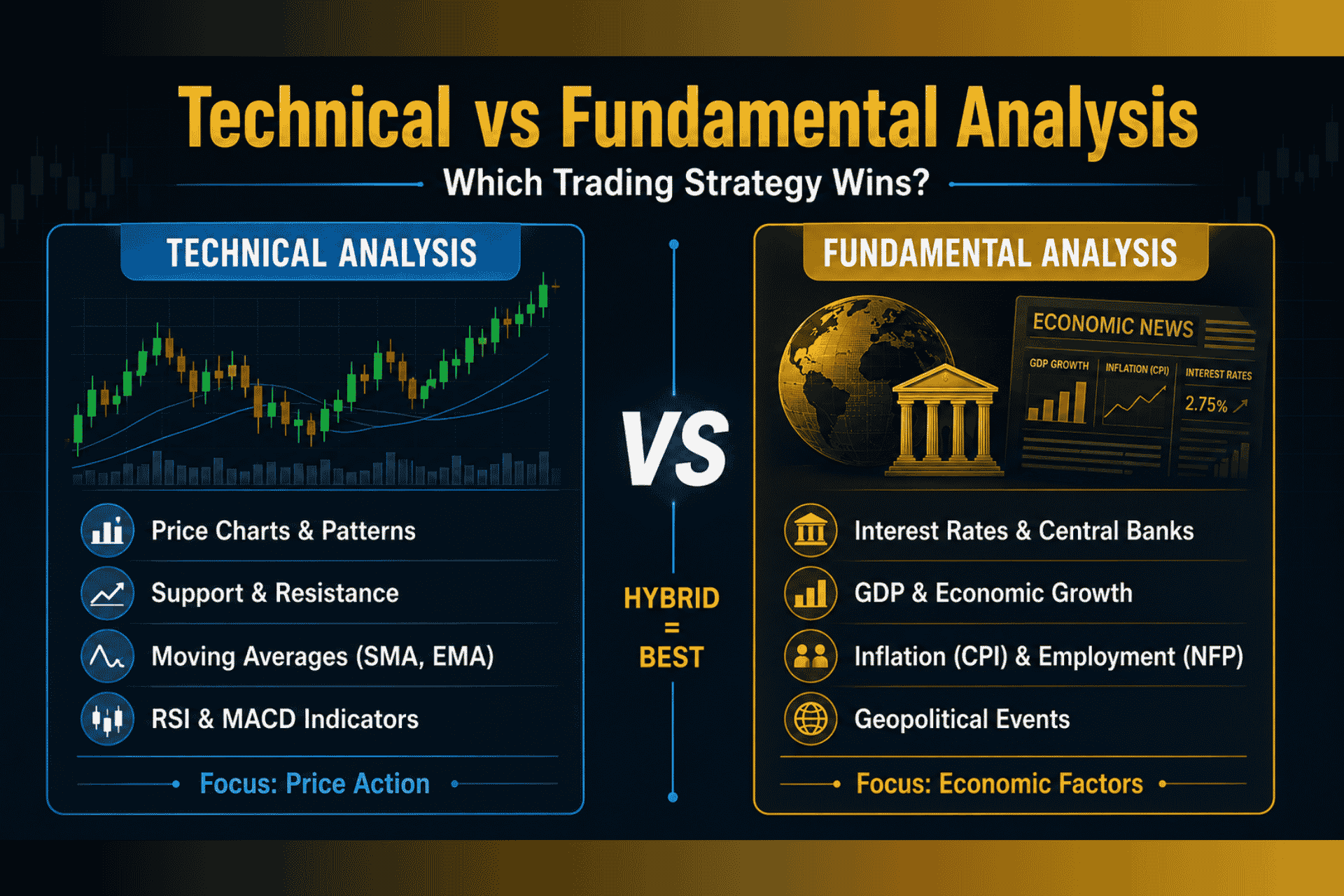
Technical vs fundamental analysis is one of the oldest debates in trading. Walk into any trading room, and you will find passionate advocates on both sides. Technical traders stare at charts, believing all market information is reflected in price. Fundamental traders study economic data, convinced that currency values are driven by interest rates, inflation, and growth.
But here’s the truth: technical vs fundamental analysis isn’t about choosing a winner. It’s about understanding which approach fits your personality, time horizon, and trading goals.
This guide breaks down both technical vs fundamental analysis methods with real examples, clear comparisons, and practical advice. You will learn:
- What each approach actually involves
- The pros and cons of each method
- Which approach suits different trading styles
- How professionals combine both for better results
By the end, you will understand technical vs fundamental analysis well enough to decide which path—or combination—is right for you.
What is technical analysis?
Technical analysis is the study of price action and market behavior using charts and indicators. It operates on three core assumptions:
- Market discounts everything—all known information (economic, political, psychological) is already reflected in the price.
- Price moves in trends — Once a trend is established, it tends to continue until it reverses.
- History repeats itself—market patterns and trader behavior repeat over time.
Technical traders don’t care why the price moved. They care about what the price is doing right now and what it might do next based on historical patterns.
Key Tools for Technical Analysis
1. Price Charts (Candlestick, Line, Bar)
The foundation of technical vs fundamental analysis when using charts. Candlestick charts show open, high, low, and close prices for each time period.
🎯 Real-World Analogy: A candlestick chart is like a weather map. It shows what happened (rain or sun) but doesn’t tell you why. You just use it to predict tomorrow’s weather.
2. Support and Resistance
- Support: A price level where buying pressure is strong enough to prevent further declines.
- Resistance: A price level where selling pressure is strong enough to prevent further rises.
3. Moving Averages (SMA, EMA)
- SMA (Simple Moving Average): Average price over a specific number of periods.
- EMA (Exponential Moving Average): Gives more weight to recent prices, reacting faster to changes.
4. RSI (Relative Strength Index)
A momentum oscillator measuring the speed of price changes:
- Above 70: Overbought (potential decline)
- Below 30: Oversold (potential rise)
5. MACD (Moving Average Convergence Divergence)
Shows the relationship between two moving averages to identify momentum shifts.
6. Candlestick Patterns
Specific formations suggesting reversals or continuations:
- Doji: Indecision
- Hammer: Bullish reversal
- Engulfing Pattern: Major shift in momentum
- Shooting Star: Bearish reversal
📊 Table: Technical Analysis Tools Summary
| Tool | Purpose | Signal |
|---|---|---|
| Support/Resistance | Identify price levels | Breakout or bounce |
| Moving Averages | Determine trend direction | Crossovers signal entries |
| RSI | Measure momentum | Overbought/oversold conditions |
| MACD | Identify momentum shifts | Crossover of signal line |
| Candlestick Patterns | Predict reversals | Specific pattern formations |
What is fundamental analysis?
Fundamental analysis examines the economic, financial, and political factors that drive currency values. It assumes that currencies have intrinsic values based on the health of their underlying economies.
Fundamental traders ask: “What is happening in this country’s economy, and how will that affect its currency?”
Key Factors in Fundamental Analysis
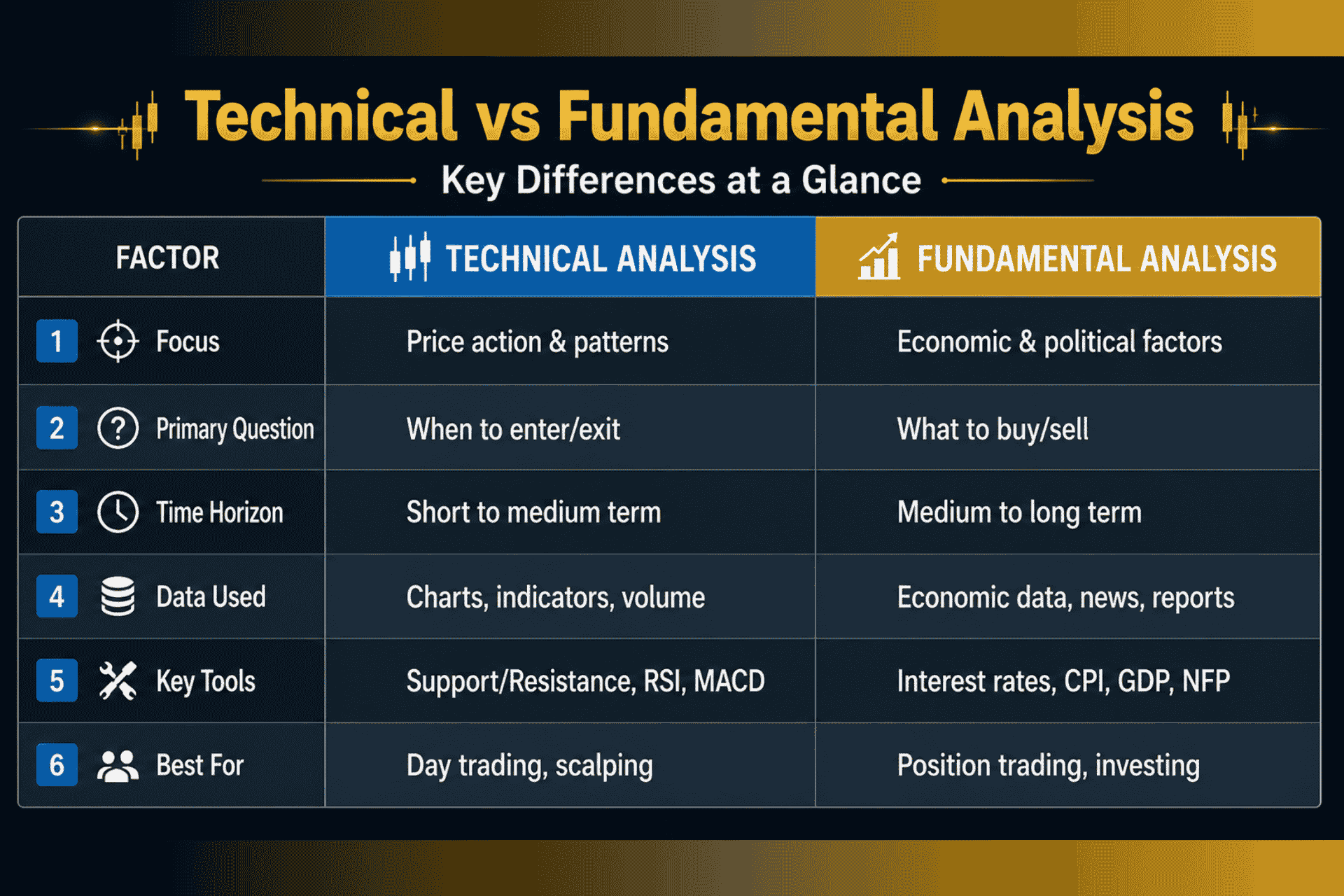
1. Interest Rates and Central Bank Policy
The most important driver of currency values. Higher interest rates attract foreign investment, strengthening the currency.
🎯 Real-World Analogy: Think of interest rates like the “price of money.” When the price is high, everyone wants to “buy” that currency to get a better return. When the price is low, demand drops.
2. Inflation (CPI)
- Rising inflation: May force central banks to raise rates (strengthens currency)
- Falling inflation: May lead to rate cuts (weakens currency)
3. Employment Data (NFP)
US Non-farm Payrolls is the biggest monthly event for USD pairs. Strong employment = stronger currency.
4. GDP (Gross Domestic Product)
Measures economic growth. Strong GDP = strong currency.
5. PMI (Purchasing Managers’ Index)
Survey-based indicator of economic health:
- Above 50: Expansion
- Below 50: Contraction
6. Geopolitical Events
Wars, elections, trade disputes, and political instability impact currency values.
📊 Table: Fundamental Analysis Factors
| Factor | What It Measures | Currency Impact |
|---|---|---|
| Interest Rates | Cost of borrowing | Higher rates = stronger currency |
| CPI/Inflation | Price growth | Rising inflation = rates expected to rise |
| NFP/Employment | Labor market health | Strong jobs = stronger currency |
| GDP | Economic growth | Strong growth = stronger currency |
| PMI | Business sentiment | Above 50 = expansion (strengthens currency) |
| Geopolitics | Stability/risk | Risk events = safe-haven flows |
Technical vs Fundamental Analysis: The Key Differences
Understanding technical vs fundamental analysis means recognizing their fundamental differences:
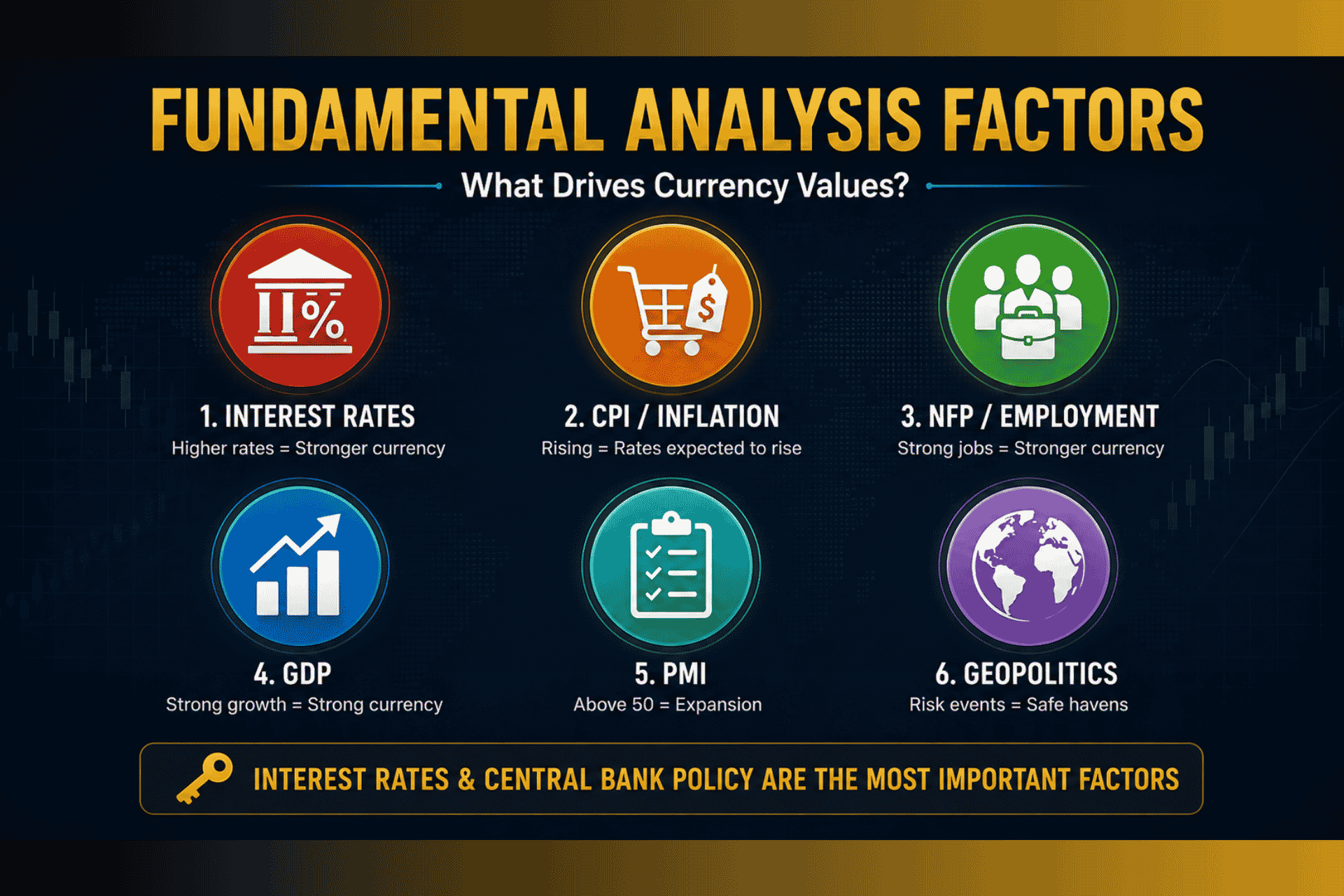
📊 Table: Technical vs Fundamental Analysis Comparison
| Factor | Technical Analysis | Fundamental Analysis |
|---|---|---|
| Focus | Price action and patterns | Economic and political factors |
| Primary Question | When to enter/exit | What to buy/sell |
| Time Horizon | Short to medium term | Medium to long term |
| Data Used | Charts, indicators, volume | Economic data, news, reports |
| Key Tools | Support/resistance, RSI, MACD, moving averages | Interest rates, CPI, GDP, NFP, central bank policy |
| Approach | Price discounts everything | Price may not reflect true value |
| Decision Making | Pattern recognition | Economic analysis |
| Best For | Day trading, scalping, swing trading | Position trading, long-term investing |
🧮 Real Example: Technical vs Fundamental Analysis in Action
Let’s look at how technical vs fundamental analysis would approach the same trade differently.
Scenario: EUR/USD is trading at 1.1050.
Technical Analysis View:
- The price is approaching a resistance level at 1.1100 (price has been rejected here three times)
- RSI is at 72 (overbought)
- A shooting star candlestick pattern formed yesterday
Technical Decision: Wait for a confirmed breakout above 1.1100, or short with a stop-loss above resistance.
Fundamental Analysis View:
- ECB is expected to cut interest rates next week (bearish for EUR)
- US Non-Farm Payrolls came in stronger than expected (bullish for USD)
- Eurozone inflation is falling (bearish for EUR)
Fundamental Decision: Short EUR/USD in anticipation of a rate cut.
Which Approach is Better?
The answer to technical vs fundamental analysis depends on who you are, not just what the market does.
When Technical Analysis Excels
| Scenario | Why Technical Works |
|---|---|
| Short-term trading | Price patterns matter more than long-term fundamentals |
| High volatility | Quick reactions to price changes |
| No news available | Charts provide all the information you need |
| Scalping/Day trading | Requires quick decisions based on price action |
When Fundamental Analysis Excels
| Scenario | Why Fundamental Works |
|---|---|
| Long-term investing | Economic trends determine long-term currency values |
| Major events | Central bank decisions, elections, trade policies |
| Understanding why | Helps you interpret market moves |
| Position trading | Holding for weeks or months requires fundamental conviction |
📊 Table: Which Approach Fits Your Personality?
| Your Personality | Best Analysis Approach |
|---|---|
| Detail-oriented, patient, enjoys research | Fundamental Analysis |
| Decisive, quick-thinking, loves patterns | Technical Analysis |
| Dislikes complex economics | Technical Analysis |
| Wants to understand “why” | Fundamental Analysis |
| Has limited trading time | Technical Analysis |
| Enjoys following news and data | Fundamental Analysis |
| Likes seeing immediate results | Technical Analysis |
| Thinks long-term | Fundamental Analysis |
The Hybrid Approach: Best of Both Worlds
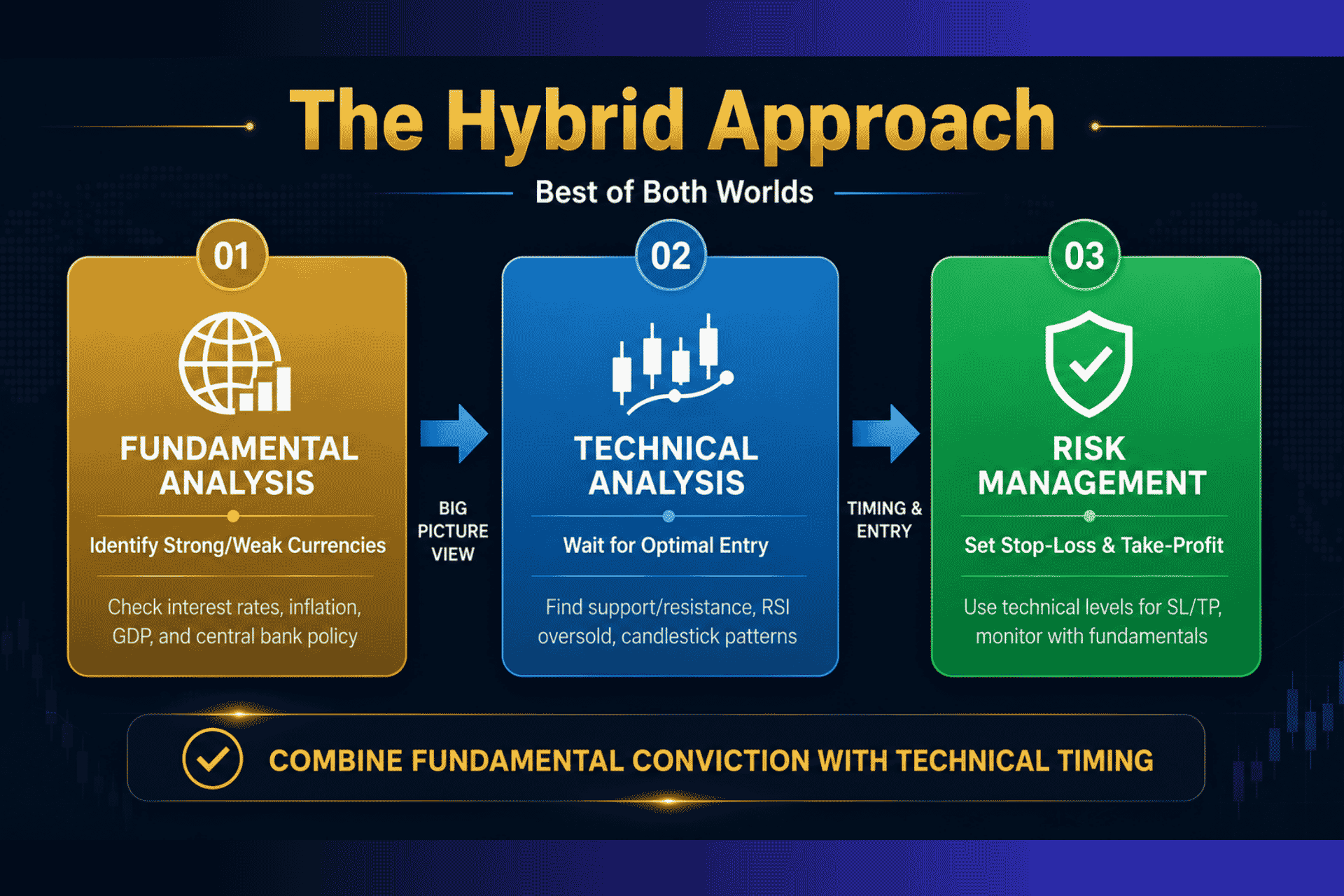
Most successful traders use a hybrid approach, combining technical vs fundamental analysis rather than choosing one.
How Professionals Combine Both
- Fundamental analysis to identify the trend
- Which currencies are fundamentally strong/weak?
- Which central banks are hawkish/dovish?
- What is the overall economic outlook?
- Technical analysis to time the entry
- Where are support and resistance levels?
- What do indicators say about momentum?
- Where is the best risk/reward entry point?
🎯 Real-World Hybrid Example
Scenario: You believe the US Dollar will strengthen based on fundamentals (strong NFP data, hawkish Fed). You want to trade USD/JPY.
Fundamental Step: Confirm the USD is fundamentally strong relative to JPY (BoJ remains dovish). This is your “big picture” view.
Technical Step: Wait for:
- Price to pull back to a support level
- RSI to drop below 30 (oversold)
- A bullish candlestick pattern to confirm entry
Decision: You buy USD/JPY at 145.00 with a stop-loss below support at 144.50. Your fundamental view gives you conviction; your technical tools give you an entry.
📊 Table: Hybrid Strategy Workflow
| Step | Action | Tool Used |
|---|---|---|
| 1 | Identify strong/weak currencies | Fundamental Analysis |
| 2 | Determine overall trend | Fundamental + Technical |
| 3 | Wait for optimal entry | Technical Analysis |
| 4 | Set stop-loss and take-profit | Technical Analysis (support/resistance) |
| 5 | Monitor trade | Technical Analysis |
| 6 | Exit based on news or target | Fundamental + Technical |
Which Approach Should Beginners Start With?
For new traders learning technical vs fundamental analysis, the best answer is:
Start with Technical Analysis
Reason 1: Technical analysis has a shorter learning curve. You can learn the basics of support/resistance, moving averages, and candlestick patterns in a few weeks.
Reason 2: It gives you immediate feedback. You place a trade, you see the result. This helps you learn faster.
Reason 3: It works for shorter timeframes. Beginners often start with day trading or swing trading, where technical analysis is more relevant.
Add Fundamental Analysis Gradually
Reason 1: Understanding economics takes time. It’s not something you master overnight.
Reason 2: Fundamentals matter for position trading. As you hold trades longer, economic factors become more important.
Reason 3: It helps you avoid trading against central banks. Knowing what the Fed, ECB, or BoJ is planning can save you from costly mistakes.
Common Mistakes in Both Approaches
Technical Analysis Mistakes
| Mistake | Why It’s a Problem | How to Fix |
|---|---|---|
| Using too many indicators | Analysis paralysis | Stick to 2-3 core indicators |
| Ignoring the big picture | Missing major trends | Check weekly/monthly charts |
| Over-optimizing | Curve fitting | Test strategies on different timeframes |
| Ignoring fundamentals | Trading against central banks | Check the economic calendar |
Fundamental Analysis Mistakes
| Mistake | Why It’s a Problem | How to Fix |
|---|---|---|
| Trading news too aggressively | Market reactions are unpredictable | Wait for confirmation |
| Ignoring technical levels | Poor entries and exits | Use technicals for timing |
| Outdated information | Markets react quickly | Use real-time data |
| Confirmation bias | Only seeing what you want to see | Consider contrary opinions |
📊 Comparison Table: Technical vs Fundamental Analysis
| Factor | Technical Analysis | Fundamental Analysis |
|---|---|---|
| Best Timeframe | Short-term (minutes to weeks) | Long-term (weeks to months) |
| Learning Curve | Moderate | Steep |
| Data Availability | Immediate (real-time charts) | Delayed (economic reports) |
| Objectivity | High (clear signals) | Low (subjective interpretation) |
| Market Awareness | Price-focused | Economics-focused |
| Risk Management | Clear (stop-loss levels) | Subjective (economic changes) |
Conclusion
The debate of technical vs fundamental analysis doesn’t have a single winner—and it shouldn’t. Both approaches have strengths and weaknesses.
Technical Analysis is best for:
- Short-term trading
- Entering and exiting positions
- Managing risk with clear levels
Fundamental Analysis is best for:
- Long-term trends
- Understanding why markets move
- Trading around major events
The Hybrid Approach is best for
- Professional traders
- Position traders
- Anyone who wants a complete picture
For Beginners: Start with technical analysis. It’s more accessible and gives immediate feedback. Add fundamental analysis gradually as you gain experience and start holding trades for longer periods.
The key is not to ask “which is better?” but “which is better for me?”
FAQ
1. Which is better, technical or fundamental analysis?
Neither is universally better. Technical analysis excels at timing entries and exits for short-term trades. Fundamental analysis is better for identifying long-term trends and understanding why markets move. The best approach depends on your trading style, time horizon, and personality.
2. Can I use both technical and fundamental analysis?
Yes! Most professional traders use a hybrid approach. Use fundamental analysis to identify which currencies are fundamentally strong/weak, then use technical analysis to time your entries and exits with good risk/reward ratios.
3. Which analysis method is easier for beginners?
Technical analysis typically has a shorter learning curve. You can learn the basics of support, resistance, moving averages, and candlestick patterns relatively quickly. Fundamental analysis requires understanding economics, which takes longer to master.
4. Does technical analysis work in forex?
Yes, technical analysis works well in forex because the forex market is highly liquid and moves in identifiable trends and patterns. Major currency pairs like EUR/USD and GBP/USD have enough volume to make technical levels meaningful.
5. What is the most important factor in fundamental analysis?
Interest rates and central bank policy are the most powerful drivers of currency values. Rate differentials between countries determine carry trade flows and long-term currency direction.
6. How long does it take to learn technical analysis?
The basics can be learned in 2-4 weeks of consistent study. However, mastering technical analysis and developing consistent profitability takes months or years of practice. Start simple, master a few tools, and expand gradually.
7. Do professional traders use fundamental or technical analysis?
Most professionals use a combination of both. Hedge funds, banks, and institutional traders have dedicated analysts for fundamental research and technical traders for execution. The hybrid approach is the industry standard.
Further Reading
To deepen your understanding of forex trading, we recommend exploring these additional resources from Finwirestack:
- 7 Proven Steps to Start Trading Forex: Beginner’s Guide — Learn how to choose a broker, open an account, and place your first trade.
- Essential Forex Trading Terminology: Ultimate Guide — Master the language of forex with 100+ terms explained with real examples.
- The Role of Central Banks in the Forex Market — Understand how the Fed, ECB, and BoJ move the markets.
- Risk Management for Forex Traders: Protect Your Capital — Master position sizing, stop-loss strategies, and trading psychology.
External Resources (DoFollow Links)
- Investopedia: Technical vs Fundamental Analysis — Comprehensive comparison of both methods.
- BabyPips: Technical vs Fundamental Analysis—A beginner-friendly explanation from the most popular forex education platform.
- FXStreet: Technical Analysis — Daily technical analysis articles and market insights.
- DailyFX: Fundamental Analysis — Economic data analysis and central bank coverage.
Disclaimer: Trading forex and CFDs involves significant risk of loss. It is not suitable for all investors. You should carefully consider your investment objectives, level of experience, and risk appetite before trading. Never trade with money you cannot afford to lose. The information provided in this article is for educational purposes only and does not constitute financial advice.






[…] Technical vs Fundamental Analysis: Which Strategy Wins? — Discover which trading approach suits your personality. […]
[…] Technical vs Fundamental Analysis: Which Strategy Wins? — Discover which trading approach suits your personality, especially when learning how to read forex charts. […]
[…] Article Link: Technical vs Fundamental Analysis: Which Strategy Wins? […]