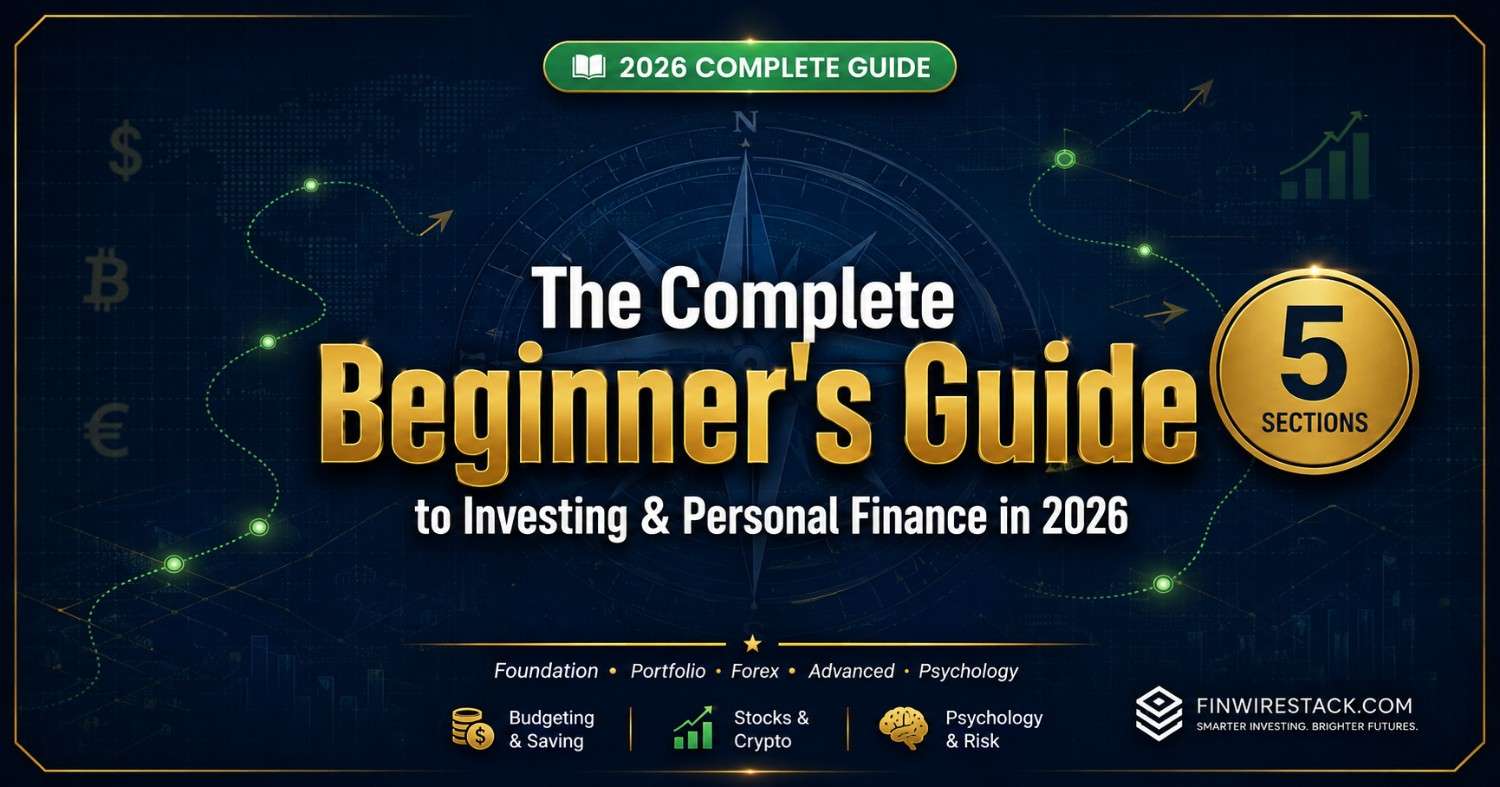
The complete beginner’s guide to investing and personal finance is your roadmap to financial freedom. Whether you’re just starting your career, looking to build wealth, or planning for retirement, understanding the fundamentals of money management is the first step toward achieving your financial goals.
This comprehensive guide brings together Finwirestack’s entire educational series into one complete learning path. From budgeting and saving to trading and investing, everything you need to know is organized here in a logical, easy-to-follow structure. You will learn:
- How to build a strong financial foundation through budgeting and saving
- The difference between trading and investing, and which is right for you
- How to start investing in stocks, cryptocurrencies, and forex
- Advanced strategies and psychology for consistent success
By the end, you will have a complete understanding of the complete beginner’s guide to investing and personal finance, and be ready to take control of your financial future.

The complete beginner’s guide to investing and personal finance — your roadmap to financial freedom
Section 1: Building Your Financial Foundation
Before you can invest or trade, you need a solid financial foundation. This section covers the essentials of personal finance—the building blocks that support all your future financial decisions.
Personal Finance 2026: Smart Money Management in the Digital Age
Article Link: Personal Finance 2026: Smart Money Management Guide
Why It Matters: Mastering personal finance is the first step toward financial freedom. This guide covers everything you need to know about budgeting, saving, investing, and debt management in the digital age.
Key Takeaways from This Article:
| Topic | Key Insight |
|---|---|
| Emergency Fund | Save 3-6 months of essential expenses |
| 50/30/20 Rule | 50% needs, 30% wants, 20% savings/debt |
| AI-Powered Tools | Use technology for proactive money management |
| Debt Management | Pay off high-interest debt first (avalanche method) |
| Retirement Accounts | Maximize tax-advantaged accounts (401k, IRA) |
🎯 Action Step: If you haven’t already, create a budget using the 50/30/20 rule. Track your spending for one month to understand where your money is going.
Section 2: Choosing Your Investment Path
Once your foundation is solid, it’s time to decide how to grow your wealth. This section helps you understand the key differences between investment approaches and choose the path that aligns with your goals.
Crypto vs Stocks: Which Market Is Right for You in 2026?
Article Link: Crypto vs Stocks: 2026 Ultimate Smart Guide
Why It Matters: The choice between crypto and stocks is one of the most debated questions in personal finance. This guide helps you understand the differences in volatility, regulation, returns, and accessibility.
Key Takeaways from This Article:
| Factor | Crypto | Stocks |
|---|---|---|
| Trading Hours | 24/7 | Weekdays, limited hours |
| Volatility | 50-80%+ annual swings | 15-25% annual swings |
| Regulation | Limited | SEC regulated |
| Historical Returns | Explosive but inconsistent | ~10% average annually |
| Best For | High risk tolerance | Long-term wealth building |
🎯 Action Step: Consider your risk tolerance and financial goals. If you prefer stability, lean toward stocks. If you have a higher risk appetite and believe in blockchain technology, consider a crypto allocation.
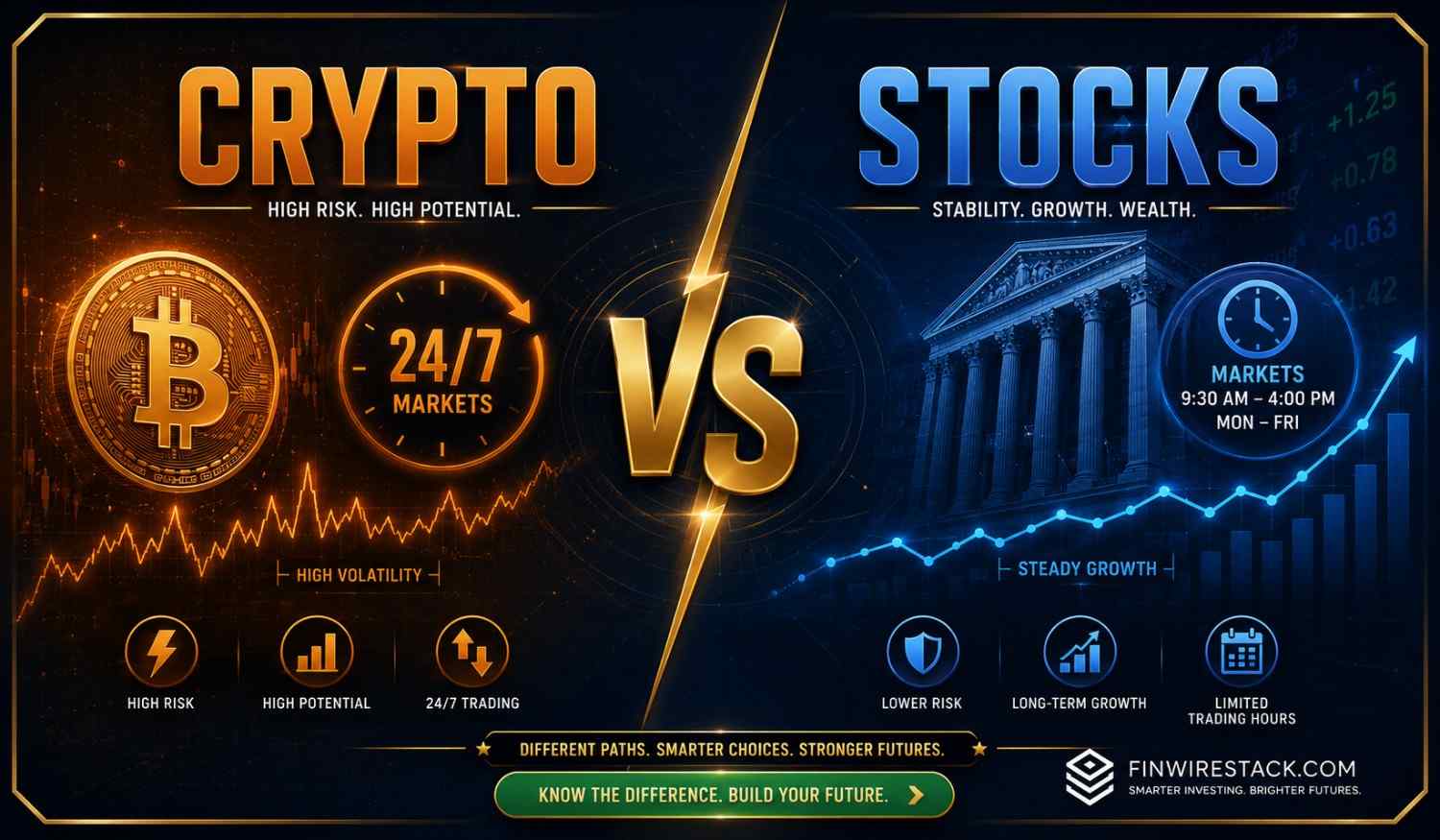
Caption: Figure 2: Crypto vs. Stocks—understanding the key differences
Trading vs. Investing: Which Strategy Is Right for You in 2026?
Article Link: Trading vs Investing: 2026 Ultimate Smart Guide
Why It Matters: Understanding the difference between trading and investing is fundamental to your financial success. This guide helps you choose the approach that fits your personality, time commitment, and goals.
Key Takeaways from This Article:
| Factor | Trading | Investing |
|---|---|---|
| Time Horizon | Short-term (seconds to weeks) | Long-term (years to decades) |
| Risk Profile | Higher | Lower |
| Time Commitment | High (active) | Low (passive) |
| Tax Implications | Higher rates | Lower capital gains rates |
| Success Rate | 1-4% profitable | 90%+ profitable over 20 years |
🎯 Action Step: Be honest about your time commitment and risk tolerance. If you have limited time and prefer stability, investing is likely your best path. If you have time to monitor markets and can handle volatility, trading might be an option.
Section 3: Building Your Investment Portfolio
Now that you’ve chosen your path, it’s time to learn how to actually invest in the assets you’ve selected. This section covers the practical steps for getting started.
Crypto Trading 101: 2026 Ultimate Beginner’s Guide
Article Link: Crypto Trading 101: 2026 Ultimate Beginner’s Guide
Why It Matters: Cryptocurrency has evolved into a mature asset class with institutional participation and clearer regulations. This guide covers everything you need to know to start trading crypto.
Key Takeaways from This Article:
| Topic | Key Insight |
|---|---|
| Trading Pairs | Base currency vs quote currency (e.g., BTC/USDT) |
| Exchanges | Choose regulated platforms like Coinbase, Binance, Kraken |
| Wallets | Use cold storage for significant holdings |
| DCA Strategy | Invest fixed amounts regularly |
| Risk Management | Use stop-loss orders and the 1% rule |
🎯 Action Step: Choose a regulated exchange, complete KYC verification, and start with a small amount in a major coin like Bitcoin or Ethereum. Practice on a demo account if available.

Investment options comparison — stocks, crypto, and forex
Stock Investing 2026: Buffett’s Smart Beginner Strategy
Article Link: Stock Investing 2026: Buffett’s Smart Beginner Strategy
Why It Matters: Warren Buffett’s simple investment philosophy has made him one of the wealthiest people in the world. His advice for beginners is remarkably straightforward: buy a low-cost S&P 500 index fund and hold for the long term.
Key Takeaways from This Article:
| Topic | Key Insight |
|---|---|
| Warren Buffett’s Advice | Buy a low-cost S&P 500 index fund (like VOO) |
| Compound Interest | $100/month for 30 years = $226,000 at 10% average return |
| Brokerage Selection | Choose Vanguard, Fidelity, or Schwab |
| Automatic Investing | Set up monthly contributions |
| Buy-and-Hold | Stay invested through market cycles |
🎯 Action Step: Open a brokerage account if you haven’t already. Choose a low-cost S&P 500 index fund like VOO, and set up automatic monthly contributions.
Section 4: Mastering Forex Trading
For those interested in the largest financial market in the world, this section covers everything from basic terminology to advanced strategies.
Essential Forex Trading Terminology: Ultimate Guide
Article Link: Essential Forex Trading Terminology: Ultimate Guide
Why It Matters: Understanding forex terminology is essential for successful trading. This comprehensive glossary covers pips, leverage, margin, slang, and technical indicators used by professional traders.
Key Terms to Know:
| Term | Definition |
|---|---|
| Pip | Standard unit of price movement (0.0001 for most pairs) |
| Leverage | Borrowed capital to increase position size |
| Margin | Collateral required to open a leveraged position |
| Spread | Difference between bid and ask prices |
| Stop-Loss | Pre-set order to cap your loss |
| Take-Profit | Pre-set order to lock in your gains |
🎯 Action Step: Bookmark the glossary and reference it whenever you encounter an unfamiliar term. Practice on a demo account to apply your knowledge.
7 Proven Steps to Start Trading Forex
Article Link: 7 Proven Steps to Start Trading Forex
Why It Matters: This step-by-step guide walks you through the entire process of starting your forex trading journey—from choosing a broker to placing your first trade.
The 7 Steps:
- Learn the essentials — Understand currency pairs, pips, leverage, and margin
- Choose a regulated broker — Protect your funds with a trustworthy partner
- Open and verify your account — Complete the KYC process
- Practice on a demo account — Build confidence without risking real money
- Create a trading plan — Define your rules before you enter a trade
- Choose your first currency pair — Start with major pairs like EUR/USD
- Place your first trade — Use micro lots and low leverage
🎯 Action Step: If you’re interested in forex trading, follow these seven steps in order. Don’t skip the demo phase.
Technical vs Fundamental Analysis: Which Strategy Wins?
Article Link: Technical vs Fundamental Analysis: Which Strategy Wins?
Why It Matters: Understanding the difference between technical and fundamental analysis is crucial for making informed trading decisions.
Key Takeaways:
| Factor | Technical Analysis | Fundamental Analysis |
|---|---|---|
| Focus | Price action and patterns | Economic and political factors |
| Primary Question | When to enter/exit | What to buy/sell |
| Time Horizon | Short to medium term | Medium to long term |
| Tools | Charts, indicators, volume | Interest rates, GDP, NFP |
| Best For | Day trading, scalping | Position trading, investing |
🎯 Action Step: Start with technical analysis if you’re a beginner—it has a shorter learning curve. Add fundamental analysis gradually as you gain experience.
The Role of Central Banks in the Forex Market
Article Link: The Role of Central Banks in the Forex Market
Why It Matters: Central banks are the single most powerful force in the forex market. Understanding how they operate gives you a significant trading edge.
5 Powerful Ways Central Banks Move Markets:
- Interest Rate Decisions — Higher rates = stronger currency
- Quantitative Easing — QE typically weakens a currency
- Forward Guidance — Words move markets powerfully
- Direct Intervention — Central banks can buy/sell currency
- Verbal Intervention — Statements can influence prices
🎯 Action Step: Follow central bank announcements and economic calendars. Pay attention to forward guidance and press conferences.
Section 5: Advanced Strategies and Psychology
To achieve consistent success in trading, you need more than just technical knowledge. This section covers advanced strategies and the psychological discipline required for long-term success.
Advanced Forex Strategies: 15 Proven Institutional Techniques
Article Link: Advanced Forex Strategies: 15 Proven Institutional Techniques
Why It Matters: Advanced strategies elevate your trading from retail gambling to professional execution. This guide reveals the techniques used by institutional traders.
Key Advanced Strategies:
| Strategy | Description |
|---|---|
| Smart Money Concepts | Market structure, order blocks, fair value gaps |
| Algorithmic Trading | Automated execution with precision |
| Hedging | Protect positions with offsetting trades |
| Ichimoku Clouds | Read trend, momentum, and support/resistance |
| Carry Trade | Borrow in low-rate currencies, invest in high-rate currencies |
🎯 Action Step: Master one advanced strategy at a time. Start with Smart Money Concepts (SMC) before exploring algorithmic trading.
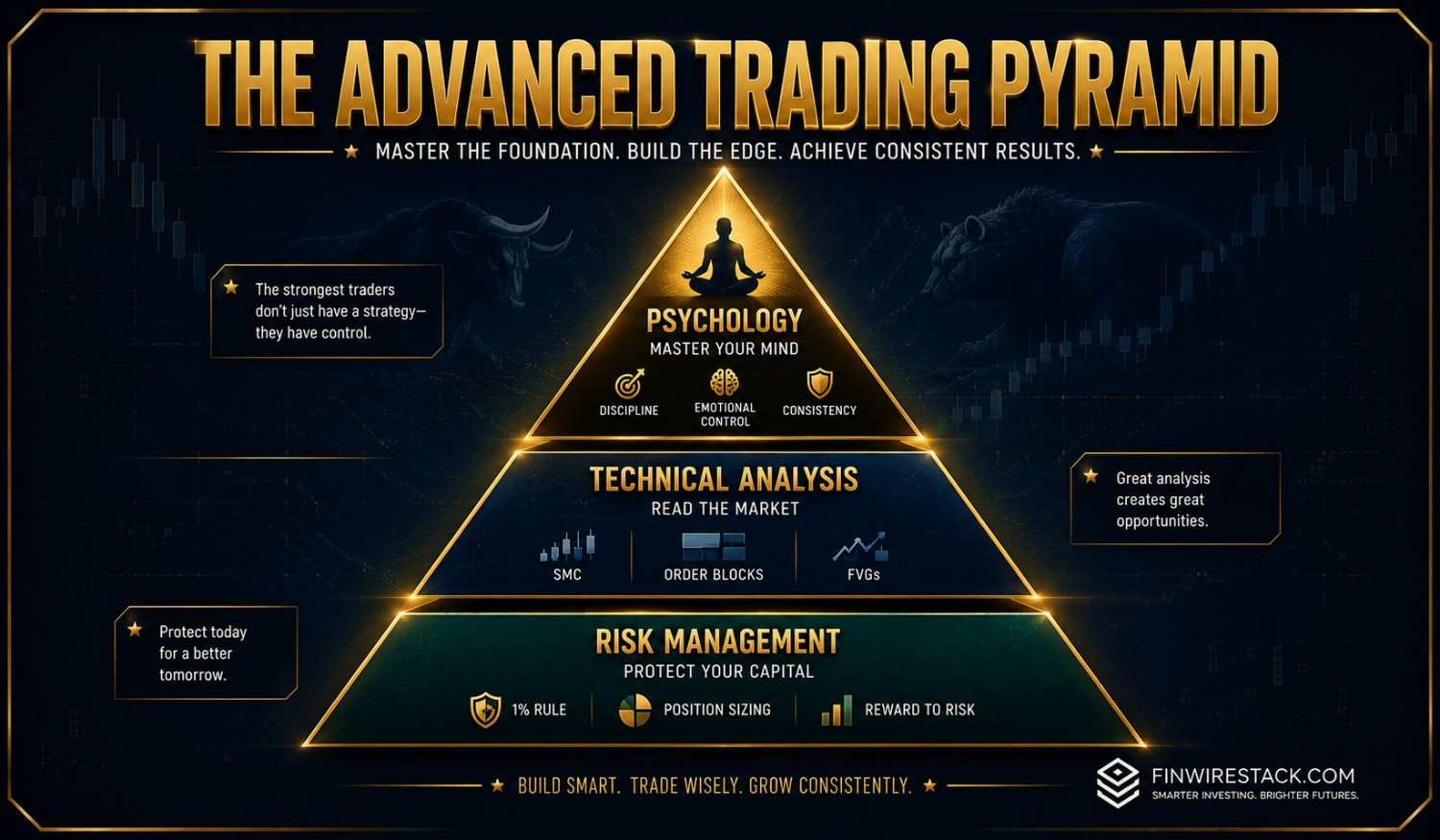
Advanced trading framework — institutional-grade techniques
Forex Trading Psychology: 7 Secrets to Master Your Mindset
Article Link: Forex Trading Psychology: 7 Secrets to Master Your Mindset
Why It Matters: Trading psychology is the single most important factor separating successful traders from those who consistently lose money.
The 7 Secrets to Master Your Mindset:
- Control Greed — Don’t overtrade or use excessive leverage
- Manage Fear — Use stop-loss orders and stick to your plan
- Replace Hope — Accept losses as part of trading
- Avoid Anger — Take breaks after losses
- Stay Grounded — Balance confidence with realism
- Be Patient — Wait for proper setups
- Overcome FOMO — Stick to your strategy
🎯 Action Step: Keep a trading journal. Record every trade, including your emotional state. Review it weekly to identify patterns.
Risk Management Mastery: 7 Proven Strategies
Article Link: Risk Management Mastery: 7 Proven Strategies
Why It Matters: Risk management is the foundation of consistent profitability. Without it, even the best strategy will eventually fail.
The 7 Proven Strategies:
- The 1% Rule — Never risk more than 1% of your account per trade
- Position Sizing — Calculate your position size before every trade
- Stop-Loss Placement — Always use a stop-loss order
- Risk-Reward Ratio — Target a minimum of 1:2
- Diversification — Trade different pairs and strategies
- Trading Psychology — Control your emotions
- Trading Journal — Record, review, and learn from every trade
🎯 Action Step: Calculate your position size using the formula: Position Size = (Risk Amount ÷ Stop Loss Distance) × Pip Value. Never risk more than 1% of your account.
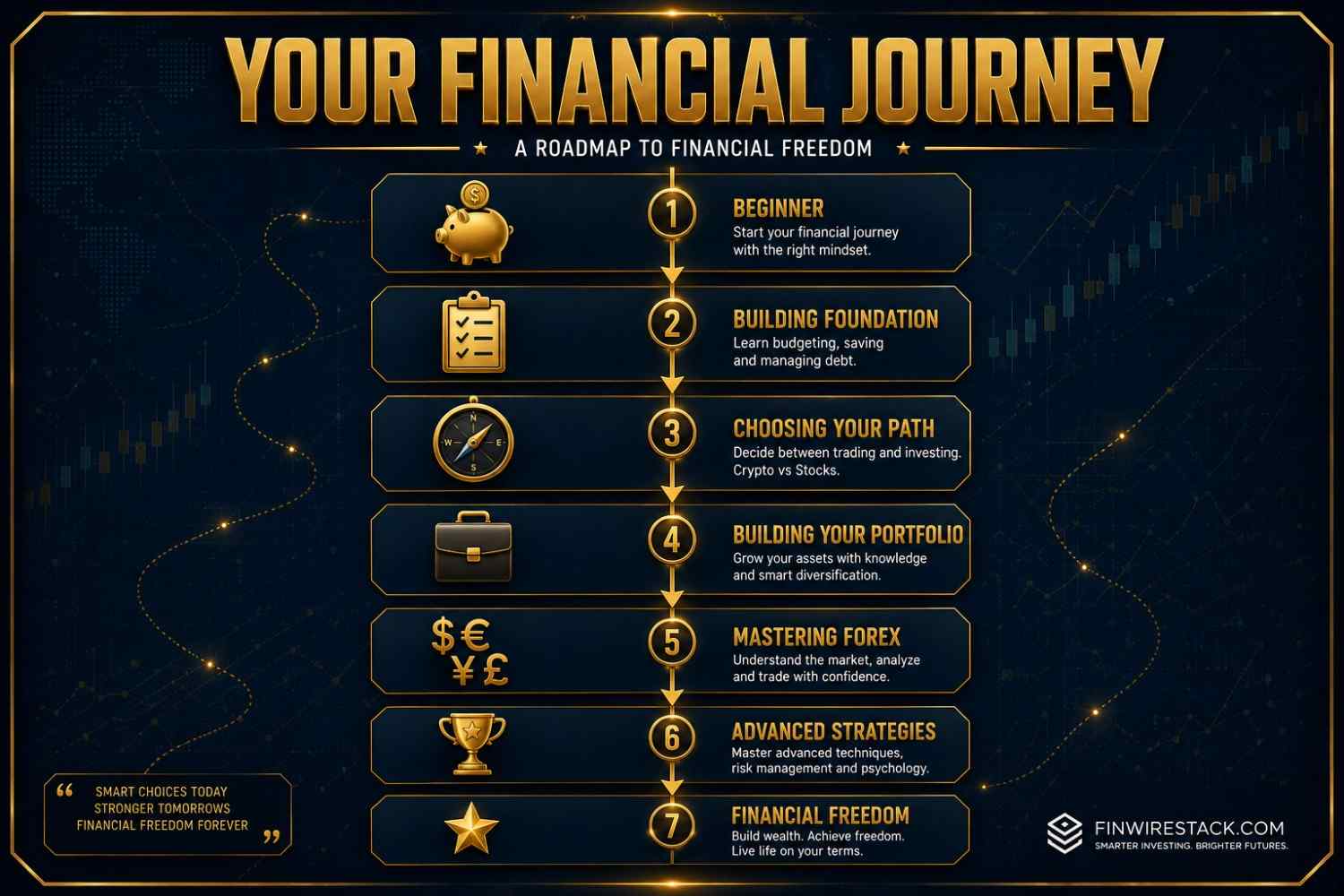
Caption: Figure 5: The complete learning path — from beginner to advanced
Conclusion: Your Financial Journey Starts Here
The complete beginner’s guide to investing and personal finance is your roadmap to financial freedom. You now have access to a comprehensive educational series covering everything from budgeting and saving to advanced trading strategies.
Your Learning Path Summary
| Phase | Focus | Key Articles |
|---|---|---|
| 1: Foundation | Budgeting, saving, and debt management | Personal Finance 2026 |
| 2: Choose Your Path | Crypto vs Stocks, Trading vs Investing | Crypto vs Stocks, Trading vs Investing |
| 3: Building Your Portfolio | Crypto and stock investing | Crypto Trading 101, Stock Investing 2026 |
| 4: Mastering Forex | Forex basics, analysis, central banks | Terminology, Analysis, Central Banks |
| 5: Advanced Strategies | Institutional techniques, psychology, risk | Advanced Strategies, Psychology, Risk Management |
Quick Reference Guide
| If You Want To… | Start Here |
|---|---|
| Build a budget and save money | Personal Finance 2026 |
| Understand crypto vs stocks | Crypto vs Stocks |
| Choose between trading and investing | Trading vs Investing |
| Learn crypto trading basics | Crypto Trading 101 |
| Start stock investing | Stock Investing 2026 |
| Learn forex terminology | Forex Terminology |
| Start trading forex | 7 Steps to Start Forex |
| Understand analysis methods | Technical vs Fundamental |
| Learn about the central bank’s impact | Central Banks |
| Master advanced strategies | Advanced Forex Strategies |
| Improve trading psychology | Forex Psychology |
| Manage risk effectively | Risk Management |
🎯 Final Thought: Financial freedom isn’t about getting rich overnight. It’s about building good habits, making informed decisions, and staying consistent over time. The best time to start was yesterday. The second-best time is today.
FAQ
1. What is the first step in the complete beginner’s guide to investing?
The first step is to build a strong financial foundation by creating a budget, establishing an emergency fund, and paying off high-interest debt. Start with the Personal Finance 2026 guide to master these essentials.
2. How do I choose between crypto and stocks?
Consider your risk tolerance, time horizon, and financial goals. If you prefer stability, lean toward stocks. If you have a higher risk appetite and believe in blockchain technology, consider a crypto allocation. The Crypto vs Stocks guide provides a detailed comparison.
3. What is the difference between trading and investing?
Trading is short-term (seconds to weeks) and aims to profit from price fluctuations. Investing is long-term (years to decades) and aims to build wealth through compounding. The Trading vs Investing guide explains the key differences.
4. What is the best investment for beginners?
For beginners, a low-cost S&P 500 index fund like VOO is the best starting point. It provides instant diversification across 500 companies with very low costs (0.03% expense ratio). This follows Warren Buffett’s advice for beginners.
5. How much money do I need to start investing?
You can start with as little as $10-$100. Most brokers offer fractional share investing with no minimum balance requirements. The most important factor is consistency, not the initial amount.
6. Is crypto trading suitable for beginners?
Crypto trading can be suitable for beginners who are willing to learn the technology, accept extreme volatility (50-80% swings), and limit exposure to 5-10% of their portfolio. Start with major coins like Bitcoin and Ethereum.
7. What is the 1% rule in trading?
The 1% rule means you never risk more than 1-2% of your trading capital on any single position. This risk management principle protects your account from significant damage after a losing trade.
8. How long does it take to learn forex trading?
The basics can be learned in 2-4 weeks of consistent study. However, mastering trading and developing consistent profitability takes months or years of practice. Start with a demo account and progress gradually.
9. Do I need to use all the strategies in this guide?
No. Start with the fundamentals and gradually add strategies as you gain experience. The most important thing is to find an approach that fits your personality, time commitment, and risk tolerance.
10. Can I combine trading and investing?
Yes! Many experienced investors maintain a hybrid approach—keeping 80% of their capital in long-term investments and using the remaining 20% for active trading opportunities. This provides diversification and flexibility.
Further Reading
To continue your financial education, explore these additional articles from Finwirestack:
- Personal Finance 2026: Smart Money Management Guide — Master budgeting, saving, and debt management.
- Crypto vs Stocks: 2026 Ultimate Smart Guide — Choose the right market for your goals.
- Trading vs Investing: 2026 Ultimate Smart Guide — Understand the key differences and choose your strategy.
- Advanced Forex Strategies: 15 Proven Institutional Techniques — Elevate your trading with professional techniques.
External Resources (DoFollow Links)
- CFPB: Budgeting Guide — Official U.S. government guide to budgeting.
- Investor.gov: Compound Interest — Official guide to the power of compound interest.
- FINRA: Day Trading Risks — Official regulatory guidance on day trading risks.
Disclaimer: Investing and trading involve risk. Past performance does not guarantee future results. The information provided in this article is for educational purposes only and does not constitute financial advice. Always consult a qualified financial advisor before making investment decisions.