
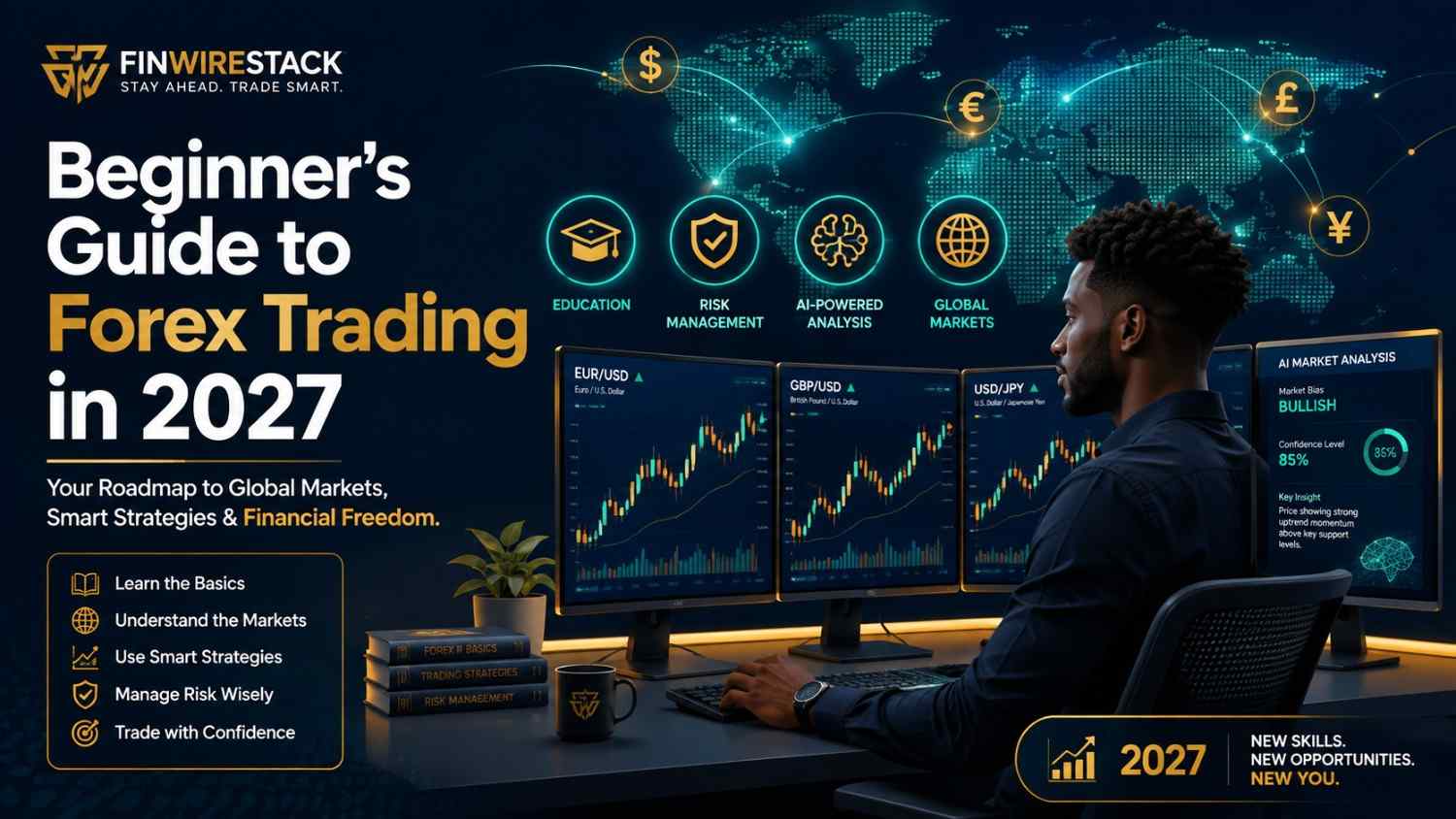
Every day, more than $7 trillion changes hands in the global foreign exchange (Forex) market, making it the largest and most liquid financial market in the world. Unlike stock exchanges that operate during limited hours, Forex trading runs almost continuously from Monday to Friday, connecting banks, businesses, governments, institutions, and individual traders across continents.
As we move into 2027, Forex trading has become more accessible than ever before. A smartphone, a reliable internet connection, and a small amount of starting capital are often all that’s needed to begin learning. At the same time, advances in artificial intelligence, mobile trading platforms, and educational resources have lowered many of the traditional barriers to entry.
However, easier access has also brought new challenges. Social media is filled with promises of instant wealth, luxury lifestyles, and so-called “secret” trading strategies. Influencers frequently showcase expensive cars, designer watches, and screenshots of profitable trades while rarely discussing the years of learning, disciplined risk management, or inevitable losses that accompany professional trading.
The reality is that successful Forex trading is not about luck or finding a magical indicator. It is about developing a structured process, managing risk carefully, understanding market behavior, and continually improving your decision-making.
This guide is designed to help you build that foundation.
Whether you are a university student exploring a new skill, a professional seeking an additional source of income, or someone looking to understand global financial markets, this article will walk you through the essential concepts you need to know before placing your first trade.
By the end of this guide, you will understand:
- How the Forex market works
- Why currencies rise and fall
- How professional traders manage risk
- Common beginner mistakes and how to avoid them
- The role of artificial intelligence in modern trading
- How to build a realistic path toward becoming a disciplined trader
Most importantly, you’ll learn why preserving your capital and continuously developing your knowledge are far more important than chasing quick profits.
What Is Forex Trading?
Forex, short for Foreign Exchange, is the process of buying one currency while simultaneously selling another. Every Forex trade involves a pair of currencies because you are always exchanging one currency for another.
For example:
- EUR/USD (Euro against the U.S. Dollar)
- GBP/USD (British Pound against the U.S. Dollar)
- USD/JPY (U.S. Dollar against the Japanese Yen)
If you believe the Euro will strengthen against the U.S. Dollar, you might buy the EUR/USD pair. If your analysis is correct and the Euro increases in value relative to the Dollar, you can close the trade at a profit. Conversely, if the Euro weakens, your trade may incur a loss.
Unlike investing in a company’s stock, Forex trading focuses on the relative value between two national currencies. These values change constantly due to economic data, interest rates, geopolitical events, inflation, employment reports, and shifts in market sentiment.
Because the Forex market operates globally, it provides opportunities across different time zones and economic cycles. This global nature also makes it highly liquid, allowing traders to enter and exit positions efficiently under normal market conditions.
Why Forex Trading Is Growing Faster Than Ever
Several trends are driving increased interest in Forex trading as we approach 2027.
Technology has transformed accessibility. Modern trading platforms offer intuitive interfaces, educational tools, demo accounts, and mobile apps that make learning easier than ever.
Artificial intelligence is changing market analysis. AI-powered tools can help traders identify patterns, summarize economic news, and support decision-making. While AI cannot guarantee profitable trades, it can improve efficiency when used responsibly.
Financial literacy is becoming more important. As inflation, changing job markets, and economic uncertainty affect households worldwide, more people are seeking to understand investing, saving, and managing risk. Forex trading often becomes part of a broader financial education journey.
Remote work and digital careers have expanded. Many individuals are looking for flexible ways to supplement their income or develop skills that can be applied from almost anywhere with an internet connection.
Despite these opportunities, it’s essential to remember that Forex trading carries significant risk. Sustainable success comes from education, preparation, and disciplined execution—not from shortcuts or unrealistic expectations.
How the Forex Market Works
Unlike stock markets that rely on centralized exchanges, the Forex market operates through a decentralized global network of banks, financial institutions, corporations, governments, and retail brokers.
This decentralized structure allows trading to continue nearly 24 hours a day during the business week as financial centers around the world open and close in sequence.
The four major trading sessions are
| Session | Major Financial Center | Typical Characteristics |
|---|---|---|
| Sydney | Australia | Lower volatility, start of trading week |
| Tokyo | Japan | Strong activity in Asian currency pairs |
| London | United Kingdom | Highest trading volume and liquidity |
| New York | United States | High volatility, overlaps with London |
One of the most active periods occurs during the overlap between the London and New York sessions, when liquidity is typically highest and major economic announcements are often released.
Understanding these trading sessions helps traders recognize when markets may experience increased activity, tighter spreads, or greater price movement.
Understanding Currency Pairs
In Forex Trading, every Forex transaction involves two currencies. This relationship is called a currency pair, and learning how to read these pairs is one of the first skills every trader should master.
A currency pair has two parts:
Base Currency – the first currency listed.
Quote Currency – the second currency listed.
For example:
EUR/USD = 1.1800
- Base Currency = Euro (EUR)
- Quote Currency = US Dollar (USD)
This quote means 1 Euro equals 1.18 US Dollars.
If you believe the Euro will strengthen against the Dollar, you buy EUR/USD.
If you believe the Euro will weaken, you sell EUR/USD.
Professional traders aren’t predicting whether one currency is “good” or “bad.” They’re estimating whether one economy will perform better or worse relative to another.
Major Forex Trading Currency Pairs
The most traded currencies in the world are known as the Majors.
| Currency Pair | Nickname | Why Traders Like It |
|---|---|---|
| EUR/USD | Fiber | Highest liquidity, lower spreads |
| GBP/USD | Cable | Strong price movements |
| USD/JPY | Ninja | Influenced by Bank of Japan policies |
| USD/CHF | Swissy | Often viewed as a safe-haven pair |
| AUD/USD | Aussie | Influenced by commodity prices |
| NZD/USD | Kiwi | Agricultural exports influence price. |
| USD/CAD | Loonie | Strong relationship with oil prices |
For beginners, focusing on one or two major pairs is often more effective than trying to monitor dozens of markets simultaneously.
Understanding Pips, Lots, and Leverage
Before placing your first trade, you must understand the language of Forex and various Forex trading terminologies.
What Is a Pip?
A pip is the smallest standard movement in most currency pairs.
For most currencies:
EUR/USD

1.1050

moves to

1.1051

=

1 pip
Although a single pip may appear insignificant, profits and losses accumulate quickly depending on your position size.
What Is a Lot?
A lot represents the size of your trade.
| Lot Type | Units |
|---|---|
| Standard Lot | 100,000 |
| Mini Lot | 10,000 |
| Micro Lot | 1,000 |
| Nano Lot | 100 |
Most beginners should trade micro lots while learning.
Many professional traders spent years trading small positions before increasing their exposure.
What Is Leverage?
Leverage allows traders to control larger positions using relatively small amounts of capital.
Example:
Without leverage
$1,000 buys approximately $1,000 worth of currency.
With 1:100 leverage
$1,000 controls $100,000.
Sounds exciting…
But here’s the catch.
Leverage magnifies losses just as quickly as profits.
Many beginners lose entire accounts because they focus on how much they can make instead of how much they can lose.
Professional traders view leverage as a tool—not free money.
What Moves the Forex Market?
Currencies don’t move randomly.
They respond to information.
The biggest drivers include:
1. Interest Rates
Central banks such as the Federal Reserve, European Central Bank, and Bank of England influence currency values through interest rate decisions.
Higher interest rates generally strengthen a currency because investors seek higher returns.
2. Inflation
High inflation reduces purchasing power.
Countries with stable inflation often attract more investment, supporting stronger currencies.
3. Employment Data
Reports such as the U.S. Non-Farm Payrolls (NFP) frequently create significant market movement.
Higher employment usually signals economic strength.
4. GDP Growth
Growing economies typically support stronger currencies because businesses expand and investor confidence rises.
5. Political Stability
Elections, wars, sanctions, and government policy changes can rapidly influence exchange rates.
6. Market Sentiment
Sometimes prices move simply because traders expect them to.
Markets are driven not only by facts but also by expectations.
The 10 Biggest Myths About Forex Trading
Social media has created unrealistic expectations around trading.
Let’s separate fact from fiction.
Myth 1
Forex is a Get-Rich-Quick Scheme.
Reality:
Professional traders think in years—not days.
Building consistent profitability often requires hundreds or thousands of hours of study and practice.
Myth 2
More Trades Mean More Money
Reality:
Professional traders often trade less than beginners.
Quality beats quantity.
Myth 3
You Need Thousands of Dollars
Reality:
Many brokers allow beginners to open demo accounts and small live accounts.
Education matters more than account size.
Myth 4
AI Will Make Me Rich
Reality:
Artificial Intelligence helps analyze information.
It cannot predict the future.
Successful traders still make final decisions.
Myth 5
One Indicator Is Enough
Reality:
No indicator works perfectly.
Professional traders combine:
- Price action
- Market structure
- Risk management
- Economic analysis
- Trading psychology
Myth 6
Trading Every Day Is Necessary
Reality:
Sometimes the best trade is no trade.
Patience is a competitive advantage.
Myth 7
Copy Trading Guarantees Success
Reality:
Blindly copying others without understanding their strategy creates dependency.
Learn first.
Copy later—if at all.
Myth 8
Losing Trades Means Failure
Reality:
Every professional trader experiences losses.
The goal isn’t to avoid losses.
The goal is to manage them.
Myth 9
Bigger Leverage Equals Bigger Success
Reality:
It usually equals bigger losses.
Myth 10
Forex Is Gambling
Reality:
Gambling depends on luck.
Professional trading depends on probability, discipline, and risk management.
Why Most Beginner Traders Lose Money
Studies and broker disclosures consistently show that a large proportion of retail traders lose money over time. While the exact percentage varies by broker and market conditions, the underlying reasons are remarkably consistent.
The encouraging news is that most of these mistakes are preventable.
1. Overleveraging
This is the fastest way to destroy an account.
Example:
A trader deposits
$500
Uses 1:500 leverage
Places an oversized trade
A small adverse price movement wipes out the account.
Professional traders rarely risk their entire account on one position.
2. No Trading Plan
Many beginners enter trades based on emotion.
Questions every trade should answer include:
- Why am I entering?
- Where is my stop-loss?
- What is my target?
- How much am I risking?
- What market condition am I trading?
If these questions aren’t answered before entering a trade, the decision is likely based on impulse rather than analysis.
3. Poor Risk Management
One successful trade does not make a profitable trader.
Consistent traders focus on protecting capital.
A widely used guideline is to risk only a small percentage of your account on any single trade, allowing room to recover from inevitable losses without devastating your portfolio.
4. Chasing the Market
Fear of missing out (FOMO) causes traders to enter positions after significant price moves.
Professionals wait for setups that match their plan rather than reacting emotionally to market excitement.
5. Ignoring Trading Psychology
Fear.
Greed.
Revenge trading.
Overconfidence.
Impatience.
These emotions influence decision-making far more than most beginners realize. Developing emotional discipline is just as important as learning technical analysis.
Choosing the Right Forex Broker
Selecting a broker is one of the most important decisions you’ll make as a new trader. A reputable broker provides a secure trading environment, transparent pricing, and reliable customer support.
When evaluating brokers, consider the following:
Regulation
Choose brokers regulated by respected financial authorities. Regulation helps ensure that firms meet standards for client fund protection, transparency, and operational practices.
Trading Costs
Compare spreads, commissions, and overnight financing charges. Lower costs can make a meaningful difference over hundreds of trades.
Platform Quality
Look for platforms that are stable, user-friendly, and offer features such as charting tools, watchlists, alerts, and mobile access.
Demo Account
A demo account lets you practice with virtual funds before risking real money. This is an essential step for beginners.
Educational Resources
Many quality brokers provide webinars, articles, market analysis, and video tutorials that support ongoing learning.
Customer Support
Responsive customer service can be invaluable, especially when you’re learning or if technical issues arise.

Risk Management—The Secret That Keeps Professional Traders in the Game
If there is one lesson every beginner should remember, it is this:
Successful traders don’t focus first on making money—they focus on protecting it.
One of the biggest misconceptions in Forex is that successful traders win nearly every trade. In reality, many consistently profitable traders win only 50–60% of their trades. What sets them apart is that they manage losses carefully and let profitable trades grow.
Think of your trading account as a business. Every trade is a business decision. If one bad decision could bankrupt the business, then the business isn’t being managed responsibly.
Professional traders understand that losses are part of the process. Their goal is not to avoid losing trades but to ensure that no single loss significantly damages their capital.
The 1% Rule
One widely respected principle among experienced traders is the 1% Rule.
Instead of risking a large portion of your account on a single trade, you limit your potential loss to approximately 1% of your trading capital.
Example
Trading Account
$2,000
Maximum Risk Per Trade
1% = $20
If the trade reaches your stop-loss, you lose only $20.
This disciplined approach allows you to withstand a series of losing trades without destroying your account.
Compare this with risking 20% of your account on each trade. Just a few losses could wipe out months—or even years—of hard-earned capital.
Why Most Traders Blow Their Accounts
Most failed trading accounts don’t disappear because of one bad trade.
They disappear because of repeated poor decisions.
Common examples include:
- Trading without a stop-loss.
- Increasing position size after a loss to “win it back.”
- Taking trades out of boredom.
- Chasing fast-moving markets.
- Ignoring their trading plan.
- Using excessive leverage.
These behaviors are emotional rather than strategic.
Professional traders develop routines that reduce emotional decision-making.
Stop-Loss Orders: Your Insurance Policy
A stop-loss is a predefined price level where your trade automatically closes if the market moves against you.
Many beginners avoid using stop-loss orders because they believe the market will “come back.”
Sometimes it does.
Many times, it doesn’t.
A stop-loss protects your account from catastrophic losses and removes emotion from the decision to exit a losing trade.
Rather than viewing a stop-loss as admitting defeat, think of it as paying an insurance premium to protect your financial future.
Take-Profit Orders: Knowing When Enough Is Enough
Greed can be just as dangerous as fear.
Many traders see profits accumulating and refuse to close the trade, hoping for even larger gains. Markets can reverse quickly, turning profitable positions into losses.
In Forex Trading, a take-profit order allows you to lock in gains automatically when your target is reached.
Successful trading is built on consistency—not squeezing every possible dollar from every trade.
Risk-to-Reward Ratio
Before entering any trade, ask yourself:
“Is the potential reward worth the risk?”
Many professionals look for opportunities where the expected reward is at least twice the potential loss.
For example:
- Risk: $50
- Potential Reward: $100
This creates a 2:1 Risk-to-Reward Ratio.
Even if only half of your trades are successful, favorable risk-to-reward ratios can support long-term profitability.
Position Sizing: The Most Overlooked Skill
Two traders can enter the same trade and experience very different outcomes depending on how much capital they commit.
Position sizing determines how much of your account is exposed to risk.
It should never be based on:
- Excitement
- Confidence
- Gut feelings
- Social media advice
Instead, it should be calculated using:
- Account size
- Stop-loss distance
- Acceptable percentage risk
- Market volatility
This disciplined approach helps keep emotions in check and supports long-term consistency.

Five Beginner Trading Strategies That Actually Work
One of the biggest mistakes beginners make is believing there is a “perfect strategy.”
There isn’t.
Successful traders choose strategies that match their personalities, available time, and risk tolerance.
Let’s look at five approaches that beginners can realistically learn.
1. Trend Following
This is one of the simplest strategies.
The idea is straightforward:
- Buy when prices are generally moving upward.
- Sell when prices are generally moving downward.
Rather than trying to predict reversals, trend followers move with the market’s dominant direction.
2. Support and Resistance Forex Trading
Markets often pause or reverse around key price levels.
Support represents areas where buying interest has historically emerged.
Resistance represents areas where selling pressure has historically increased.
Understanding these zones helps traders identify logical entry and exit points.
3. Breakout Trading
Sometimes markets remain within a range before making significant moves.
Breakout traders wait for price to move decisively beyond established support or resistance levels, often accompanied by increased trading activity.
Patience is critical. False breakouts are common, and waiting for confirmation can reduce unnecessary losses.
4. Swing Trading
Not everyone has time to monitor markets throughout the day.
Swing traders hold positions for several days—or even weeks—capturing larger price movements rather than small intraday fluctuations.
This approach may suit professionals and students who cannot trade full-time.
5. News-Based Trading
Major economic announcements can cause sharp market movements.
Examples include:
- Interest rate decisions
- Inflation reports
- Employment statistics
- GDP releases
- Central bank speeches
While these events can create opportunities, they also increase volatility. Beginners should approach news trading cautiously and avoid entering positions without a clear plan.
Which Strategy Should Beginners Choose?
Rather than trying all five at once, focus on mastering one approach.
Consistency and repetition build skill.
Switching strategies every week often leads to confusion rather than improvement.
Artificial Intelligence Is Changing Forex Trading
Artificial Intelligence has become one of the biggest technological shifts in modern finance.
However, many misconceptions surround its capabilities.
AI is not a machine that guarantees profits.
Instead, it serves as a powerful assistant that can help traders analyze information more efficiently.
Examples include:
- Summarizing economic news.
- Identifying chart patterns.
- Screening multiple currency pairs.
- Detecting unusual volatility.
- Backtesting trading ideas.
- Organizing trading journals.
- Supporting decision-making with data.
The most successful traders use AI to improve their workflow—not replace their judgment.
Human oversight remains essential because markets are influenced by unexpected events, changing sentiment, and geopolitical developments that no algorithm can predict perfectly.
The Future of Forex Trading
As we approach 2027 and beyond, several trends are likely to shape the industry:
- AI-assisted market analysis
- Machine learning for risk assessment
- Increased automation of routine tasks
- Enhanced mobile trading platforms
- Greater access to educational resources
- Improved cybersecurity for financial platforms
Despite technological advances, the core principles of successful trading remain unchanged:
- Discipline
- Risk management
- Continuous learning
- Patience
- Emotional control
Technology evolves, but sound decision-making remains timeless.

Creating Your First Forex Trading Plan
If there is one habit that separates professional traders from gamblers, it is having a written trading plan.
A Forex trading plan is more than a list of rules—it is your personal operating manual. It helps you make consistent decisions, avoid emotional reactions, and evaluate your performance over time.
Before placing your first live trade, write down answers to the following questions:
1. What Is My Goal?
Be specific. Instead of saying, “I want to make money,” define measurable objectives.
Examples include:
- Learn Forex trading fundamentals within 30 days.
- Complete 100 demo trades before risking real money.
- Maintain consistent discipline rather than chasing profits.
- Build a repeatable trading routine.
Focus on developing skills first. Profits are a by-product of good habits.
2. Which Markets Will I Trade?
Avoid trying to follow dozens of currency pairs.
Choose one or two major pairs, such as:
- EUR/USD
- GBP/USD
- USD/JPY
Learning the personality and behavior of a few markets is more valuable than constantly switching between many.
3. Which Timeframe Fits My Lifestyle?
Not everyone can spend hours watching charts.
Choose a timeframe that aligns with your schedule:
| Trading Style | Typical Holding Period | Best For |
|---|---|---|
| Scalping | Minutes | Full-time experienced traders |
| Day Trading | Minutes to hours | Active traders |
| Swing Trading | Days to weeks | Professionals and students |
| Position Trading | Weeks to months | Long-term investors |
Many beginners find swing trading easier because it reduces emotional decision-making and constant screen time.
4. What Are My Entry Rules?
Every trade should meet predefined criteria.
For example:
- The market trend is clearly upward.
- Price retests support.
- Confirmation from price action.
- The risk-to-reward ratio is at least 2:1.
- The economic calendar shows no major news during the entry.
If the setup does not meet your rules, don’t trade.
5. What Are My Exit Rules?
Know your exit before entering.
Decide:
- Stop-loss location
- Take-profit level
- Maximum daily loss
- Maximum weekly loss
Professional traders plan their exits first—not after emotions take over.
6. Keep a Forex Trading Journal
Every trade should be recorded.
Include:
- Date
- Currency pair
- Entry price
- Exit price
- Risk percentage
- Profit or loss
- Screenshot
- Why you entered
- What you learned
Your journal becomes one of your most valuable learning tools.
A 30-Day Beginner Forex Trading Learning Roadmap
One of the biggest mistakes beginners make is rushing into live Forex trading.
Instead, use the first month to build a strong foundation.
Week 1: Learn the Basics
- Understand Forex Trading terminology.
- Learn currency pairs.
- Explore trading sessions.
- Read about leverage and margin.
- Study pips and lot sizes.
Goal: Build vocabulary and confidence.
Week 2: Technical Analysis
- Support and resistance.
- Trend identification.
- Candlestick patterns.
- Market structure.
- Risk-to-reward concepts.
Goal: Learn how markets move.
Week 3: Demo Forex Trading
Open a demo account.
Practice:
- Entries
- Exits
- Stop-loss placement
- Position sizing
- Journaling
Goal: Develop consistency without financial risk.
Week 4: Build Your Forex Trading Plan
Now combine everything you’ve learned.
Create:
- Your strategy
- Trading checklist
- Daily routine
- Weekly review process
- Monthly improvement goals
Only after demonstrating consistent discipline on a demo account should you consider trading with real capital.
Forex Trading Checklist
Before every trade, ask yourself:
☐ Does this trade match my plan?
☐ Have I identified the trend?
☐ Is my stop-loss placed correctly?
☐ Is my position size appropriate?
☐ Is my risk less than 1%?
☐ Is there high-impact economic news approaching?
☐ Does the reward justify the risk?
☐ Am I Forex Trading logically—not emotionally?
If any answer is “No,” reconsider the trade.
Frequently Asked Questions
Is Forex trading good for beginners?
Yes, provided beginners invest time in education, practice with a demo account, understand risk management, and avoid unrealistic expectations. Forex trading should be approached as a long-term skill rather than a shortcut to wealth.
How much money do I need to start Forex trading?
Many brokers allow small account sizes, but the amount you start with should be money you can afford to lose. It’s generally advisable to begin with a demo account before trading live.
Can I become rich through Forex trading?
Forex trading has the potential to generate income, but it also carries substantial risk. Sustainable success usually comes from years of learning, disciplined risk management, and consistent execution—not quick profits.
Is AI replacing Forex traders?
No. AI is becoming an increasingly useful tool for market analysis, research, and workflow automation, but human judgment remains essential. AI should support decision-making, not replace it.
Which currency pair should beginners trade?
Many beginners start with highly liquid major pairs such as EUR/USD because they often have tighter spreads and abundant educational resources.
How long does it take to become profitable?
There is no universal timeline. Progress depends on your education, discipline, practice, and ability to manage risk. Focus on developing consistent habits rather than setting unrealistic deadlines.
Final Thoughts in Forex Trading.
Forex trading offers an opportunity to learn about global markets, economics, and disciplined decision-making. Yet success does not come from chasing shortcuts or copying social media personalities.
It comes from understanding the market, protecting your capital, following a structured plan, and continuously improving your skills.
The traders who succeed over the long term are not necessarily the smartest or the luckiest. They are often the most disciplined.
Remember these core principles:
- Education before execution.
- Risk management before profit.
- Consistency before complexity.
- Patience before action.
- Long-term growth before short-term excitement.
If you build your trading journey on these foundations, you’ll be far better prepared to navigate the opportunities and challenges of the Forex Trading market in 2027 and beyond.
Continue Your Learning Journey
At FinWireStack, our mission is to help readers build lasting financial knowledge—not just Forex Trading skills.
Continue exploring:
- Forex Trading Psychology: Mastering Fear and Greed
- How to Choose a Safe Forex Broker
- Understanding Risk Management
- AI Tools Every Trader Should Know
- Crypto Investing for Beginners
- The Biggest Forex Trading Scams and How to Avoid Them
Each article is designed to help you become a more informed, disciplined, and confident participant in today’s evolving financial markets.

Your Next Step Starts Here
The Forex Trading market will continue to evolve, but the principles of discipline, education, and risk management remain timeless. The journey of a thousand pips begins with a single, well-planned trade. Now that you have the foundational knowledge, the real work—and the real opportunity—begins with your commitment to continuous learning and disciplined practice.
Ready to put this knowledge into action?
- Step 1: [Download our Free Forex Trading Plan Template] to structure your approach.
- Step 2: Share this guide with a friend who is also starting their Forex Trading journey.
- Step 3: Leave a comment below—what’s the single most important lesson you’re taking away from this guide?
About the Author
Humphrey N. is a financial analyst and trader with over 15 years of experience in the global currency markets. They are a regular contributor to FinWireStack, specializing in making complex financial concepts accessible for beginner and intermediate investors. Their focus is on sustainable, risk-aware Forex trading strategies and the psychology behind successful decision-making.
References and Further Reading
To ensure the accuracy and credibility of the information presented in this guide, we have drawn upon the following authoritative sources. We encourage you to explore them for a deeper understanding of the Forex Trading market.
- Bank for International Settlements (BIS): For official data on global Forex market size and turnover statistics. The BIS Triennial Central Bank Survey is the primary source for the $7 trillion+ daily volume figure.
- Financial Conduct Authority (FCA) & Commodity Futures Trading Commission (CFTC): For information on retail trader loss rates and the importance of broker regulation. These regulatory bodies provide critical disclosures that highlight the risks involved.
- Investopedia: For clear, accessible definitions of core trading concepts like pips, lots, leverage, and risk-to-reward ratios.
- BabyPips: For an excellent, structured curriculum on Forex trading fundamentals, which is widely recommended for beginners.
- Central Bank Websites (e.g., Federal Reserve, European Central Bank): For primary-source data on interest rates, monetary policy statements, and economic reports that directly influence currency values.
Disclaimer: The information provided in this article is for educational and informational purposes only and does not constitute financial advice. Forex trading carries a high level of risk and may not be suitable for all investors. You should carefully consider your investment objectives, level of experience, and risk appetite before deciding to trade. Past performance is not indicative of future results. FinWireStack is not a financial advisor and recommends you consult with a qualified professional before making any investment decisions.






[…] The Complete Beginner’s Guide to Forex Trading in 2027 […]
[…] is why risk controls must be designed before automation.For beginners, FinWireStack’s complete beginner’s guide to Forex trading provides the foundational concepts that should come before sophisticated […]
[…] The Complete Beginner’s Guide to Forex Trading in 2027 […]