
Why Investors Need to Be More Careful
AI Investment Scams 2027 is a must-focus target, but before then, artificial intelligence is changing investing and trading faster than many investors expected. AI can analyze information, summarize financial reports, monitor markets, assist with portfolio management, and increasingly automate parts of the investment process. But there is a darker side. The same technology that can help legitimate investors can also help fraudsters create more convincing investment scams. That is why AI investment scams in 2027 should be on every trader’s and investor’s radar.
Fraudsters can use artificial intelligence to create professional-looking websites, generate fake testimonials, produce realistic videos, imitate voices, create convincing social-media profiles, and automate conversations with potential victims. The result is a dangerous combination: advanced technology + financial hype + human emotion.
Regulators are already paying attention. In July 2026, the U.S. Securities and Exchange Commission announced a new Retail Fraud Working Group designed to identify and combat fraud targeting everyday investors, including offering fraud, market manipulation, and misconduct affecting retail investors.
The UK’s Financial Conduct Authority has also warned that AI could amplify fraud and cyber risks as financial services become increasingly automated and personalized. Its 2026 review looks specifically toward how AI could reshape retail financial services through 2030. For investors, the message is simple: The more convincing AI becomes, the more important verification becomes.
What Are AI Investment Scams?
AI investment scams are fraudulent schemes that use artificial intelligence, AI-related branding, or claims about automated intelligence to convince people to invest money. The scam may involve:
- AI trading bots
- Automated Forex systems
- Cryptocurrency trading platforms
- AI-powered investment apps
- Fake portfolio-management services
- Fake robo-advisors
- AI-generated investment signals
- Cryptocurrency arbitrage platforms
- Fake AI companies
- Fake investment advisers
The technology itself may be real, partially real, or completely fabricated.
What matters is the deception.
A scammer does not necessarily need to build sophisticated AI.
They only need to convince you that sophisticated AI exists behind the platform.
That distinction can save investors thousands of dollars.
Why AI Investment Scams Could Increase Toward 2030
The financial industry is moving toward increasingly autonomous AI systems. The FCA’s 2026 Mills Review describes a future in which AI systems become more autonomous, adaptive, and interconnected, potentially acting on behalf of consumers. That creates enormous opportunities. It also creates an attractive environment for criminals. A scammer can now claim, “Our AI trades automatically.” “Our algorithm predicts market movements.” “Our proprietary model never sleeps.” “Our AI has institutional-level intelligence. To an inexperienced investor, these statements can sound technologically sophisticated. But sophistication in language is not evidence of legitimacy.
How AI Trading Scams Work
Most AI trading scams follow a predictable psychological process.
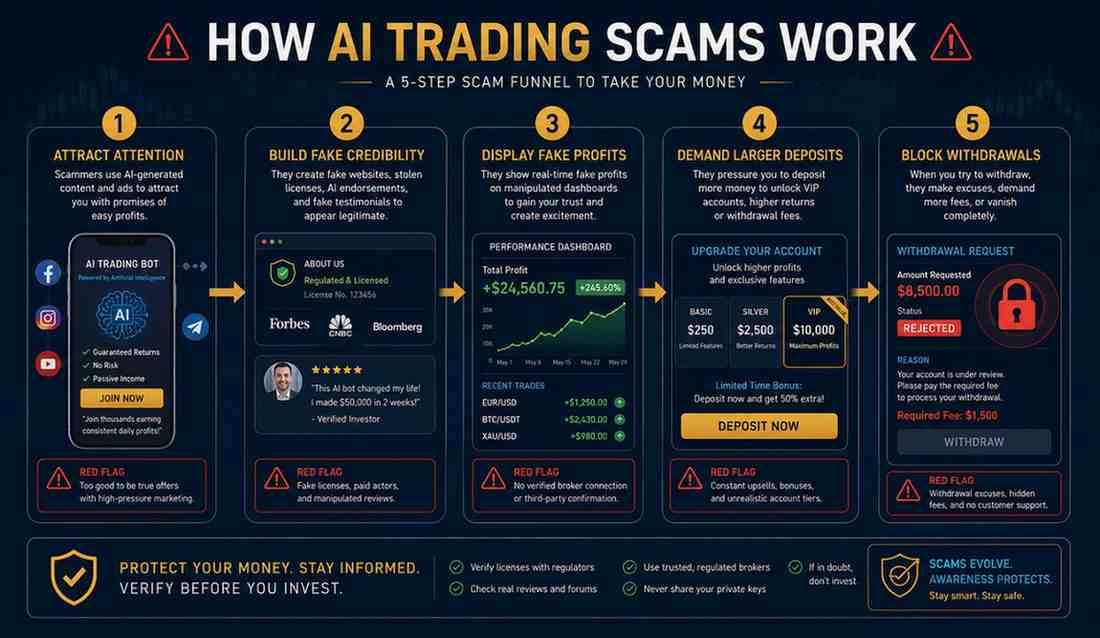
Step 1: Attract Attention
The scammer advertises a revolutionary AI investment opportunity. The advertisement may appear on:
- YouTube
- TikTok
- Telegram
- X
- Investment forums
- Search engines
The message usually focuses on wealth rather than technology.
Step 2: Create Credibility
The scammer builds a professional-looking website. It may include:
- Company logos
- Fake awards
- Fake reviews
- Fake executives
- Fake offices
- Fake trading statistics
- Fake regulatory information
- Professional charts
Step 3: Demonstrate Fake Profits
The victim is shown an account balance increasing rapidly. For example: Deposit: $500. Displayed balance: $1,850. The investor believes the AI is working. But the balance may simply be numbers displayed on a fraudulent website.
Step 4: Encourage a Larger Deposit
Once trust has been established, the scammer encourages the investor to deposit more. The language may become increasingly urgent: “Your AI account has qualified for our institutional strategy.” “Deposit $5,000 to unlock higher returns.” “You have only 24 hours.”
Step 5: Create a Withdrawal Problem
When the investor attempts to withdraw money, the scammer may demand:
- Tax
- Withdrawal fee
- Verification fee
- Compliance fee
- Liquidity fee
- Insurance fee
- Account upgrade
- VIP membership
This is often where the scam becomes obvious.
The investor may pay another fee hoping to recover the original funds.
Step 6: Disappear
Eventually:
- The website stops responding.
- The account manager disappears.
- WhatsApp messages stop.
- Telegram groups are deleted.
- The website goes offline.
- The victim discovers the company was never legitimate.
15 AI Investment Scam Red Flags

1. Guaranteed Profits
This is one of the biggest warning signs. No legitimate AI system can guarantee that financial markets will produce a specific return. Markets contain uncertainty. Even highly sophisticated quantitative strategies experience losing periods. The CFTC specifically warns that AI cannot predict the future or sudden market changes and cautions investors about trading bots promising unreasonable or guaranteed returns. Be extremely skeptical of statements such as “Guaranteed 10% every month.” “100% winning trades.” “Zero-loss AI.” “Risk-free trading.” These are marketing claims—not evidence.
2. Unrealistic Win Rates
A platform claiming a 95%, 98%, or 100% win rate should immediately trigger additional investigation. A high win rate alone does not prove a strategy is profitable. A system could win many small trades and lose one enormous trade. What matters is the complete performance record, including:
- Maximum drawdown
- Average loss
- Average win
- Risk per trade
- Trading costs
- Slippage
- Losing periods
- Long-term performance
3. Fake AI Trading Screenshots
Scammers can create impressive trading dashboards. A website may display, AI Accuracy: 98.7%, Today’s Profit: +$8,742. Total Return: +327%. But a screenshot proves nothing. Ask whether the performance can be independently verified.
4. AI Celebrity Deepfakes
This is becoming particularly dangerous. A scammer may use AI-generated video or audio to make a famous person appear to recommend an investment. The video can look remarkably realistic. The person may appear to say:” I personally use this AI trading system.” Do not assume a video is authentic simply because you recognize the face or voice. Financial fraudsters are increasingly using AI-generated images and videos to create fake credibility. Regulators have warned about investment scams involving fabricated identities and manipulated media.
5. Fake Testimonials
A fraudulent platform may display dozens of testimonials: “I made $20,000 in two weeks!” “The AI changed my life!” “I retired at 32!” These testimonials may be:
- AI-generated
- Copied from another website
- Fabricated
- Paid endorsements
- Using fake identities
Never treat testimonials as audited evidence.
6. Pressure to Deposit Immediately
Legitimate investment decisions should not require panic. Scammers use urgency because urgency reduces critical thinking. Watch for:
- “Last opportunity”
- “Only 10 accounts available”
- “Deposit today”
- “Bonus expires tonight”
- “Institutional access closes tomorrow.”
- “Market opportunity guaranteed”
If someone is pressuring you to transfer money before you have verified the company, stop.
7. Anonymous “Account Managers”
You should know who is handling your money. Be cautious when communication happens exclusively through:
- Telegram
- Facebook Messenger
- Personal Gmail accounts
- Anonymous social media accounts
A professional investment business should provide verifiable corporate information.
8. No Verifiable Regulation
This is critical. A company may display: “Regulated,””Licensed,” “SEC Approved,” “FCA Registered,” But a logo on a website proves nothing. Go directly to the regulator’s official database and search for the company. Do not rely on a screenshot of a certificate. Do not rely on a registration number typed into the website. Verify it independently.
9. Fake Regulatory Certificates
Some scammers create documents that look official. The document may contain:
- Regulatory logos
- License numbers
- Signatures
- Stamps
- Government-looking designs
Always verify the registration independently through the regulator.
10. Withdrawal Fees That Keep Increasing
This is one of the most important signs of an investment scam. You request a withdrawal. The company says, “Pay the tax first.” You pay. Then: “You need a compliance certificate. You pay. Then: “Your account must be upgraded. You pay again. Then, liquidity verification is required.
The process never ends. A legitimate platform may have genuine withdrawal charges or taxes depending on the jurisdiction and product, but an endless chain of surprise payments should be treated as a major warning sign. FinWireStack’s Crypto Withdrawal Fees: 7 Ways to Spot & Stop Losing Money explains several related withdrawal-scam patterns, including fake tax, compliance, and VIP fees.
11. Crypto-Only Deposits
Cryptocurrency itself is not a scam. But scammers often prefer irreversible payment methods. If a platform insists that you deposit only through cryptocurrency, especially to an unknown wallet, investigate carefully. The CFTC and SEC have warned investors about fraudulent digital-asset trading websites that may promise high guaranteed returns and then stop communicating after receiving funds.
12. Recently Created Website
A sophisticated website does not necessarily mean an established company. Check:
- Domain age
- Company registration
- Physical address
- Regulatory status
- Independent reviews
- Historical web presence
The CFTC specifically recommends researching the history of a trading website and checking domain registration information before trusting an AI trading platform.
13. “Proprietary AI” With No Explanation
Some companies claim, “Our secret AI algorithm cannot lose.” When asked how it works, they provide no meaningful explanation. A company does not have to reveal its entire trading strategy. But legitimate businesses should still be able to explain:
- What the system does
- What assets it trades
- How risks are controlled
- What fees apply
- What historical limitations exist
- Who operates the company
“Secret AI” should never be treated as proof of superior technology.
14. Referral Bonuses for Recruiting Investors
Be careful when the main way to earn money appears to be recruiting other people. A platform that emphasizes, “Invite three friends and earn more.” “Build your investment team.” The phrase “Earn commissions from every deposit” may warrant additional scrutiny. The CFTC has documented fraudulent schemes involving supposed automated trading programs where referral incentives were part of the structure.
15. AI Is Used as the Main Selling Point
This may be the most subtle red flag. A scammer may use “AI” everywhere: AI-powered, AI-driven, AI quantum trading, AI predictive engine, AI wealth accelerator, and AI neural trading. But none of these phrases prove that a legitimate investment system exists. Ask a much simpler question: What exactly is the company selling? If the answer remains vague, do not invest.
AI Investment Scams vs. Legitimate AI Investing
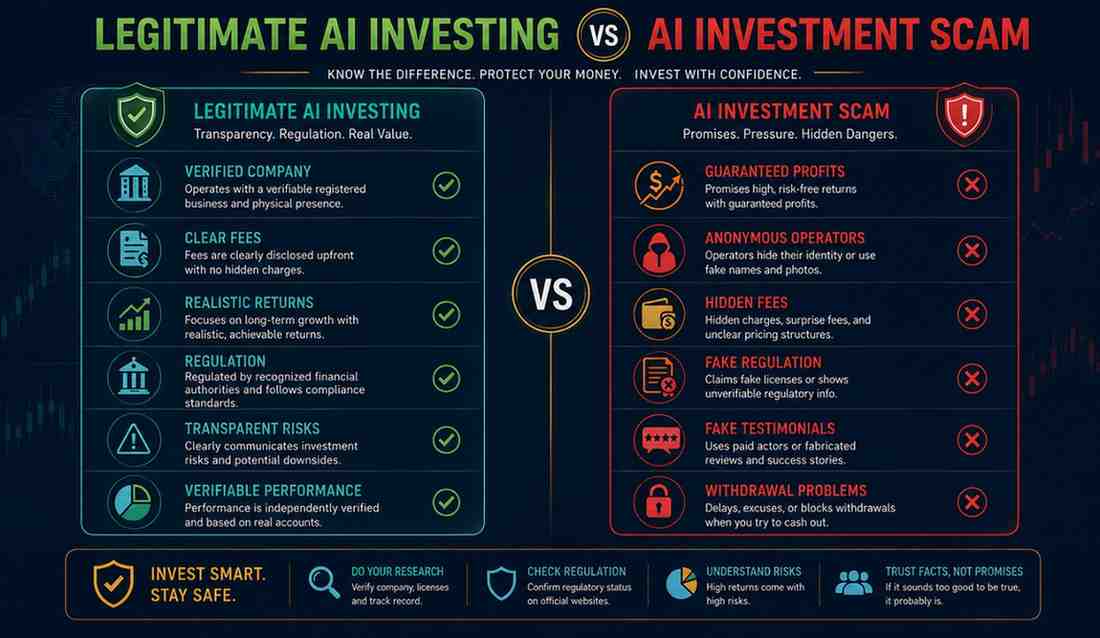
Not every AI-powered investment product is fraudulent. The difference is verification.
| Feature | Potentially Legitimate AI Service | High-Risk Scam Signal |
|---|---|---|
| Regulation | Can be independently verified | Vague or fake |
| Returns | No guarantees | Guaranteed profits |
| Performance | Transparent methodology | Screenshots only |
| Fees | Clearly disclosed | Hidden or constantly changing |
| Withdrawals | Clear process | Repeated surprise fees |
| Company | Verifiable identity | Anonymous operators |
| Risk | Clearly explained | “No risk” |
| Marketing | Balanced | Extreme wealth claims |
| Customer support | Verifiable business channels | Anonymous messaging accounts |
| AI claims | Specific use case | Vague technological buzzwords |
How to Verify an AI Trading Platform
Do not start with the platform’s website. Start outside the platform.
Step 1: Identify the Legal Company
Find:
- Legal name
- Registered address
- Company number
- Directors or responsible executives
- Official website
Step 2: Verify Regulation
Use the regulator’s own database. Do not use a link supplied only by the investment company. For U.S.-related investment services, investors can begin with official SEC resources. For derivatives and certain commodities-related activities, the CFTC provides investor education and warnings. For UK financial services, check the FCA’s official register.
Step 3: Search for Warnings
Search the company name together with: “scam,” “fraud warning”, complaint, withdrawal, regulator. Do not rely on one review website.
Step 4: Check the Domain
Look at how long the website has existed. A newly created website making billion-dollar institutional claims deserves extra scrutiny.
Step 5: Test the Withdrawal Process
If possible, understand the withdrawal rules before depositing significant money. Read the terms. Look for:
- Minimum withdrawals
- Fees
- Processing times
- Verification requirements
- Account restrictions
Step 6: Check the Business Model
Ask: How does this company make money? If the answer is unclear, that is a problem.
How AI Deepfakes Are Changing Investment Fraud
One of the biggest changes investors should expect toward 2027 is the growing sophistication of synthetic media. A scammer can potentially create:
- Fake CEO videos
- Fake celebrity endorsements
- Fake financial-news broadcasts
- Fake interviews
- Fake investor testimonials
- Fake voice calls
- Fake screenshots
This makes visual evidence less reliable.
A video is no longer enough.
A voice is no longer enough.
A screenshot is no longer enough.
Verification must move toward independent evidence.
The New Investor Rule: Trust, But Verify
The old rule was, “Do your research.” The new rule should be, “Verify the source of the research.” If someone sends you an investment opportunity through WhatsApp, do not click the provided link and immediately deposit. Instead: Find the official company website yourself. Find the regulator yourself. Find the company’s legal identity yourself. Find independent information yourself. This creates separation between the claim and the evidence.
Why Social Media Makes AI Investment Scams More Dangerous
Social media allows scams to spread at extraordinary speed. A fraudulent platform can create:
- A polished Instagram account
- Thousands of followers
- Fake engagement
- AI-generated testimonials
- Influencer-style videos
- Paid advertisements
- Private Telegram groups
The appearance of popularity can therefore be manufactured.
Follower count is not proof of legitimacy.
Likes are not proof of regulation.
Testimonials are not audited performance.
And a viral video is not financial evidence.
The SEC’s 2026 Retail Fraud Working Group specifically reflects regulators’ increased focus on protecting everyday investors from fraud and misconduct.
AI Investment Scams Target Both Beginners and Experienced Investors
It would be easy to assume that only beginners fall for investment scams. That is incorrect. Experienced investors can also become victims because sophisticated scams exploit:
- Overconfidence
- Fear of missing out
- Greed
- Confirmation bias
- Authority bias
- Social proof
A person may understand markets extremely well and still make one dangerous assumption:
“I know enough to recognize a scam.”
That confidence can become a vulnerability.
The Psychology Behind AI Investment Scams
Greed
The scam promises extraordinary returns.
Fear
The investor fears missing the opportunity.
Authority
The scam uses professional-looking people, logos, and terminology.
Social Proof
Fake testimonials suggest that everyone else is making money.
Urgency
The investor is told to act immediately.
Commitment
After depositing money, the investor becomes psychologically motivated to recover it. This is why scammers may continue requesting additional payments even after the victim realizes something is wrong.
What To Do If You Suspect an AI Investment Scam
Stop sending money. Do not pay another “withdrawal fee” simply because someone promises that it will unlock your funds. Save evidence:
- Screenshots
- Emails
- Phone numbers
- Website addresses
- Wallet addresses
- Transaction IDs
- Bank details
- Names used by the company
- Social media profiles
- Chat histories
Contact the relevant financial regulator, payment provider, bank, or law-enforcement agency as appropriate.
Do not allow embarrassment to prevent you from reporting the fraud.
Early reporting can help protect other investors.
What To Do Before Your Next AI Investment

Use this checklist:
☐ I know the legal name of the company.
☐ I can verify its registration.
☐ I can independently verify its regulatory status.
☐ I understand exactly what I am investing in.
☐ I understand how the company makes money.
☐ I understand every fee.
☐ I understand the withdrawal process.
☐ I have checked the company’s history.
☐ I have not relied solely on social-media testimonials.
☐ I have not trusted an AI-generated video as proof.
☐ Nobody is guaranteeing my returns.
☐ Nobody is pressuring me to deposit immediately.
☐ I am not investing money I cannot afford to lose.
☐ I have independently verified the platform.
☐ I understand the risks of the underlying asset.
If several boxes remain unchecked, stop and investigate before sending money.
AI Trading Bots: What Investors Should Actually Expect
AI trading bots can be useful tools. But investors should understand what they can and cannot do. A legitimate AI trading system may:
- Analyze large amounts of data
- Identify potential patterns
- Automate repetitive tasks
- Generate trade signals
- Execute predefined strategies
- Monitor positions
- Assist with risk management
It cannot guarantee that the market will behave as expected.
The CFTC explicitly warns that AI cannot predict the future or sudden market changes.
That statement should become a basic rule for anyone evaluating AI trading software.
The Difference Between AI Automation and AI Fraud
AI automation attempts to solve a real problem. AI fraud attempts to sell a fantasy. AI automation says. Here is what the system does, here are the risks, and here are the costs. AI fraud says: Our secret AI guarantees profits.” AI automation acknowledges uncertainty. AI fraud hides uncertainty. AI automation provides controls. AI fraud demands trust. AI automation can be tested. AI fraud relies on promises. That difference is more important than how impressive the technology looks.
What Regulators Are Saying About AI and Finance
The direction of regulation is becoming increasingly important. The FCA’s 2026 Mills Review says AI could transform retail financial services by 2030 while also amplifying fraud, cybersecurity risks, consumer harm, and market concentration.
The SEC created its Retail Fraud Working Group in July 2026 to strengthen efforts against fraud targeting retail investors. The CFTC has specifically warned that scammers are exploiting interest in AI to promote automated trading algorithms and crypto-related schemes with unrealistic return claims.
These developments suggest that investors should expect AI-related financial fraud to remain an important issue as technology becomes more accessible.
What AI Investment Scams Could Look Like by 2030
The next generation of investment scams may become more personalized. Instead of sending the same message to thousands of people, a scammer could potentially use AI to tailor the pitch to individual targets. For example: Investor profile: Beginner Forex trader.
Scammer’s AI: Detects interest in Forex. Message: “Our AI Forex system is designed specifically for new traders.” Another investor may receive: Our institutional AI portfolio system is designed for experienced investors. The scam adapts to the victim. That is why future investor protection will require more than simply recognizing spelling mistakes or poor website design. Scams may become professionally produced.
The 5-Second Rule for AI Investment Opportunities
When you see a new investment opportunity, do not ask, “How much could I make?” Ask:”What could make me lose my money?” Then ask:
- Who operates this?
- Who regulates it?
- Where is my money held?
- How can I withdraw?
- How does the company make money?
- What happens if the strategy loses?
- Can I independently verify its claims?
If the answers are unclear, do not deposit.
Final Verdict: AI Investment Scams 2027 Require a New Kind of Investor
AI investment scams 2027 will not necessarily look like the scams of the past. They may be more polished. They may use convincing AI-generated videos. They may have sophisticated websites. They may communicate through realistic AI assistants.
They may display impressive trading dashboards. They may even appear to have thousands of satisfied customers. But technology does not change the basic principle of fraud. Someone is still trying to convince you to give them money without providing legitimate value in return. The safest response is not fear. It is verification. Do not reject legitimate AI simply because scams exist.
Instead, learn to distinguish AI technology from AI marketing and AI innovation from AI deception. As financial technology moves toward increasingly autonomous systems between 2027 and 2030, investors who understand verification, regulation, risk, and cybersecurity will have a significant advantage. The most important AI investment skill may therefore not be knowing how to use an AI trading bot. It may be knowing when not to trust one.
Frequently Asked Questions About AI Investment Scams 2027
What are AI investment scams?
AI investment scams are fraudulent investment schemes that use artificial intelligence claims, AI-powered tools, automated trading bots, or AI-generated content to convince people to invest money.
Are AI trading bots scams?
No. AI trading bots are not inherently scams. Some legitimate automated trading technologies exist. The danger comes from fraudulent providers that use AI claims to promise unrealistic or guaranteed returns.
Can AI guarantee investment profits?
No legitimate AI system can guarantee that financial markets will produce a specific return. Market conditions can change unexpectedly, and all trading strategies carry risk.
How can I identify a fake AI trading platform?
Look for guaranteed profits, unrealistic win rates, unclear regulation, anonymous operators, pressure to deposit, fake testimonials, unexplained fees, and withdrawal problems.
Are AI celebrity investment videos real?
Not necessarily. AI-generated video and audio can imitate real people. Always verify an investment recommendation through an independent official source.
Why do AI investment scams ask for withdrawal fees?
Fraudulent platforms may invent taxes, compliance fees, account upgrades, or other charges to extract additional money from victims after they attempt to withdraw.
Can experienced traders fall for AI scams?
Yes. Scammers can exploit overconfidence, urgency, social proof, and fear of missing out. Market knowledge does not automatically provide immunity from fraud.
What should I do if I have already deposited money into a suspected scam?
Stop sending additional money, preserve all evidence, and contact your bank, payment provider, relevant regulator, or law-enforcement authority as appropriate. Be especially cautious of anyone promising to recover your funds for another upfront payment.
Conclusion
AI is likely to become a major part of investing and trading over the next decade. That creates genuine opportunities. It also creates new opportunities for fraud. AI investment scams 2027 therefore represent a problem investors cannot afford to ignore. The technology may become more convincing. The websites may become more professional.
The fake videos may become more realistic. The automated conversations may become more persuasive. But the solution remains surprisingly simple: Verify before you trust. Check the company. Check the regulator. Check the business model. Check the withdrawal rules.
Check the evidence. And never allow the words “AI-powered” to replace proper due diligence. AI can analyze markets. AI can automate processes. AI can assist investors. But AI cannot remove financial risk—and no legitimate technology can guarantee that markets will always move in your favor.
Disclaimer: This article is for educational and informational purposes only and does not constitute financial, investment, trading, tax, or legal advice. Investment and trading involve significant risks, including loss of capital. Always independently verify investment providers, regulatory status, and financial claims before committing funds.
Sources
Financial Conduct Authority (FCA): The Mills Review — Long-Term Impact of AI on Retail Financial Services
Financial Conduct Authority (FCA): FCA Landmark Review on AI and Retail Financial Services
U.S. Securities and Exchange Commission (SEC): SEC Retail Fraud Working Group
Commodity Futures Trading Commission (CFTC): AI Won’t Turn Trading Bots Into Money Machines
SEC / Investor.gov: Artificial Intelligence Investment Fraud
SEC / Investor.gov: Protect Your Money
CFTC: AI Scam Advisory