Category Beginner Trading

Algorithmic Trading in 2027: 11 Powerful Ways Beginners Can Use Automation Safely

Algorithmic trading in 2027 with automated trading technology

Algorithmic trading is no longer something reserved exclusively for investment banks, hedge funds, and high-frequency trading firms.

Technology has made algorithmic trading increasingly accessible to retail traders through automated trading platforms, expert advisors, trading bots, APIs, and AI-powered financial tools.

That creates an exciting opportunity.

It also creates a serious problem.

Many new traders believe that algorithmic trading means they can switch on a bot, deposit money, and allow software to generate profits automatically.

That assumption can be extremely dangerous.

Algorithmic trading does not eliminate trading risk.

It changes how decisions are made, how orders are executed, and how quickly mistakes can spread.

The International Monetary Fund reports that algorithmic trading is becoming increasingly significant in capital markets and that artificial intelligence is expected to influence its further development. The IMF also highlights risks involving data, performance, cybersecurity, leverage, and financial stability.

The opportunity, therefore, is not simply to automate everything.

The smarter objective for beginners is to understand algorithmic trading, test it carefully, and maintain appropriate human control.


What Is Algorithmic Trading?

how algorithmic trading works from market data to trade execution

Algorithmic trading uses computer programs and predefined rules to analyze markets and execute trading decisions.

Instead of manually watching a chart and deciding when to enter or exit, a trader can create rules such as:

  • Enter when two moving averages cross.
  • Exit when volatility reaches a predetermined level.
  • Risk no more than 1% of available capital.
  • Stop trading after a specified drawdown.
  • Close a position when a particular indicator reverses.

The software then follows those rules automatically.

The IMF defines algorithmic trading as a subset of electronic trading that uses rule-based mathematical models for activities such as execution, market making, and directional or relative-value strategies.

This distinction is important.

Algorithmic trading is not automatically the same thing as artificial intelligence.

A simple Expert Advisor using fixed rules can be algorithmic trading.

A machine-learning system that changes its predictions based on data can also be part of algorithmic trading.


Algorithmic Trading vs. AI Trading

The two terms are often used interchangeably, but they are not identical.

Algorithmic Trading

Traditional algorithmic trading generally follows predefined instructions.

For example:

If the 9 EMA crosses above the 20 SMA, and the RSI, is above 50, open a BUY position.

The rules are predetermined.

AI Trading

AI trading can use machine learning, language models, or other adaptive techniques to identify patterns and generate predictions.

The system may analyze:

  • Historical prices
  • Market sentiment
  • News
  • Economic data
  • Volatility
  • Correlations
  • Alternative datasets

Modern financial markets are increasingly combining both approaches. The IMF notes that AI is influencing trading, portfolio management, risk management, and other parts of the investment process.

For beginners, the important lesson is simple:

You do not need sophisticated AI to begin learning algorithmic trading.

A transparent rule-based system is often easier to understand, test, and control.


11 Powerful Ways Beginners Can Use Algorithmic Trading Safely

1. Start With a Simple Trading Strategy

The first rule of algorithmic trading should be simplicity.

Do not begin with a system containing 15 indicators, seven filters, three AI models, and dozens of parameters.

You need to understand exactly why the system enters and exits trades.

A simple strategy might use:

  • Moving averages
  • RSI
  • Support and resistance
  • ATR
  • Price action
  • Volatility filters

The objective is not to create the most complicated algorithmic trading system.

The objective is to create a system whose behavior you understand.

Why Simplicity Matters

A complicated strategy can produce impressive backtest results while hiding serious weaknesses.

For example, a system might appear profitable because it has been optimized excessively for one historical period.

That leads directly to one of the biggest problems in algorithmic trading:

overfitting.


2. Define Your Trading Rules Before Automating

Never automate a strategy that you cannot clearly explain manually.

Write down:

Entry

What causes the trade?

Exit

What causes the position to close?

Stop-loss

Where is the trade considered invalid?

Take-profit

Where will profits be taken?

Position sizing

How much capital is exposed?

Trading hours

When is the strategy allowed to operate?

Maximum drawdown

When must the system stop?

These rules form the foundation of responsible algorithmic trading.

If you cannot explain your strategy on paper, you probably should not automate it.


3. Backtest Before Using Real Money

Backtesting is one of the most important stages of algorithmic trading.

A backtest applies your trading rules to historical market data.

It allows you to examine:

  • Number of trades
  • Win rate
  • Average profit
  • Average loss
  • Maximum drawdown
  • Profit factor
  • Consecutive losses
  • Strategy stability

However, a successful backtest does not guarantee future profits.

Why Backtesting Can Mislead Traders

Historical markets are not identical to future markets.

A strategy can perform extremely well during one market regime and poorly during another.

For example, a trend-following strategy may perform well during a strong directional market but struggle during prolonged sideways conditions.

Therefore, algorithmic trading should never be evaluated solely on the biggest historical return.

Look at risk-adjusted performance and robustness.


4. Use Forward Testing

After backtesting, your next step should be forward testing.

Forward testing means running the strategy on current market conditions without immediately risking substantial capital.

This can involve:

  • Demo accounts
  • Paper trading
  • Small experimental positions
  • Simulated execution

Forward testing helps reveal issues that historical testing may not show.

These include:

  • Slippage
  • Spread changes
  • Execution delays
  • Broker restrictions
  • Platform failures
  • Data differences

This is particularly important because real-world algorithmic trading depends not only on strategy logic, but also on technology and execution infrastructure.


5. Automate Risk Management

This may be the most valuable use of algorithmic trading for beginners.

Instead of using automation only to find entries, you can use it to enforce discipline.

For example, your system could automatically:

  • Limit risk per position
  • Set stop-losses
  • Limit daily losses
  • Stop trading after consecutive losses
  • Reduce position size during high volatility
  • Prevent excessive simultaneous positions

This can help address one of the biggest problems facing retail traders:

emotional decision-making.

A trader might ignore a risk limit after losing several positions.

An appropriately designed automated system does not need to become angry,frightened or desperate to recover losses.


6. Avoid Over-Leveraging Your Algorithm

Automation can make traders overconfident.

A trader may think:

โ€œThe system has tested well, so I can increase the lot size.โ€

This is one of the fastest ways to turn algorithmic trading into excessive speculation.

Leverage magnifies both profits and losses.

A strategy that experiences a 10% drawdown at one position size can create a much larger financial problem if the trader increases exposure aggressively.

The Better Approach

Start small.

Measure performance.

Understand drawdown.

Then determine whether additional exposure is justified.

Never increase risk simply because a backtest looks attractive.


7. Test the Strategy Across Different Market Conditions

Good algorithmic trading systems should not be judged from a single market environment.

Test your strategy during:

  • Bull markets
  • Bear markets
  • Sideways markets
  • High-volatility periods
  • Low-volatility periods
  • Major economic announcements
  • Unexpected market shocks

A strategy that works only under one condition may not be robust.

Test Different Instruments

If you trade Forex, test different currency pairs.

If you trade crypto, test different assets.

If you trade indices, test multiple indices.

However, you should not assume that a strategy that works on EUR/USD will automatically work on XAU/USD, BTC/USD, or synthetic indices.

Every market has different characteristics.


8. Monitor Your Algorithmic Trading System

Automation does not mean abandoning your computer and checking the account six months later.

You should monitor:

  • Trade execution
  • Open positions
  • Drawdown
  • System errors
  • Connection failures
  • Broker responses
  • Unexpected trades
  • Abnormal performance

The SEC has previously highlighted the potential for automated trading systems to generate rapid and cascading problems when something goes wrong.

More recent financial-market disclosures also continue to identify system failures, design defects, cybersecurity issues, and errors in automated and algorithmic systems as material risks.

The lesson is clear:

Automation requires supervision.


9. Protect Your Trading Account From Technical Failures

A profitable strategy is useless if the technology supporting it fails.

Potential problems include:

  • Internet interruptions
  • VPS failures
  • Broker server problems
  • API errors
  • Platform crashes
  • Incorrect price feeds
  • Software bugs
  • Power interruptions

This is why serious algorithmic trading requires operational planning.

Consider a VPS.

A Virtual Private Server can keep automated trading software running even when your personal computer is switched off.

But a VPS does not make a trading strategy safer.

It simply improves availability.

You still need:

Strategy + risk controls + monitoring + reliable infrastructure.


10. Watch for Overfitting

Overfitting is one of the most dangerous concepts in algorithmic trading.

Imagine you test a strategy and discover that:

  • RSI should be 47
  • Moving average should be 13
  • Stop-loss should be 37 pips
  • Take-profit should be 83 pips
  • Trading should begin at 07:17
  • Trading should stop at 14:42

You then optimize dozens of parameters until the historical results become spectacular.

The problem?

You may have designed a strategy specifically for the past.

The Out-of-Sample Test

One useful approach is to separate your historical data.

Use one portion for developing the strategy.

Use another portion to test it without changing the rules.

This helps determine whether the system has learned a broader market relationship or simply memorized historical noise.


11. Keep a Human in Control

The future of algorithmic trading does not necessarily require humans to disappear from the process.

In fact, human oversight can be one of the most important safety mechanisms.

A sensible structure could be

Human: defines strategy.

Algorithm: monitors market.

Algorithm: identifies predefined setups.

Human: reviews unusual conditions.

Algorithm: executes approved rules.

Algorithm: manages predefined risk.

Human: reviews performance.

This hybrid approach also fits the direction of modern financial technology.

The IMF says AI can improve efficiency and automate financial processes, but it also identifies risks involving performance, data, cybersecurity, and broader financial stability.


The Most Useful Algorithmic Trading Strategies for Beginners

Not every strategy is equally suitable for automation.

Trend-Following

Trend-following systems attempt to participate in sustained price movements.

Common tools include;

  • Moving averages
  • ADX
  • Breakouts
  • Donchian channels

Trend-following can be relatively straightforward to translate into algorithmic rules.

Mean Reversion

Mean-reversion strategies assume that price may return toward a historical average after moving unusually far away.

Common tools include;

  • Bollinger Bands
  • RSI
  • Statistical deviations
  • Moving averages

These systems can struggle when markets enter strong trends.

Momentum

Momentum strategies attempt to identify assets showing persistent directional strength.

Breakout Trading

Breakout algorithms monitor price levels and attempt to participate when price moves beyond predefined ranges.

Execution Algorithms

Not every algorithm tries to predict direction.

Some are designed primarily to execute large orders efficiently.

The IMF identifies approaches such as TWAP and VWAP as examples of execution algorithms designed to manage order execution and reduce market impact.


Algorithmic Trading for Forex Beginners

Forex is one of the markets where retail algorithmic trading is particularly accessible.

Platforms such as MetaTrader allow traders to build or deploy Expert Advisors.

A basic Forex algorithm might combine:

  • Moving-average direction
  • RSI confirmation
  • ATR-based stop-loss
  • Risk-per-trade calculation
  • Trading-session filter

The important point is that automation should follow a tested trading plan.

Do not buy an Expert Advisor simply because its sales page displays a dramatic equity curve.

If you are new to automated systems, read AI Trading Bots: 11 Powerful Ways to Avoid Dangerous Trading Scams before purchasing or connecting any trading software.


Algorithmic Trading for Cryptocurrency

Crypto markets create another interesting application for algorithmic trading because they operate continuously.

A human trader cannot realistically monitor every cryptocurrency market every minute.

Automation can monitor:

  • Bitcoin
  • Ethereum
  • Major altcoins
  • Volatility
  • Trading volume
  • Price momentum
  • Market structure

However, crypto volatility creates significant risks.

A strategy that appears stable during normal conditions may behave very differently during a sudden market crash.

Never assume that 24/7 automation means 24/7 profitability.


Algorithmic Trading and AI: What Changes in 2027?

Traditional algorithmic trading depends heavily on predefined rules.

AI can potentially make those systems more adaptive.

AI may help with:

  • Pattern recognition
  • Sentiment analysis
  • News classification
  • Market regime detection
  • Anomaly detection
  • Portfolio optimization
  • Trade execution

The IMF expects AI developments to influence algorithmic trading and notes that adoption is expanding across capital-market activities.

But AI introduces additional risks.

Models can:

  • Produce incorrect conclusions
  • Depend on poor data
  • Drift over time
  • Misinterpret unusual conditions
  • Become difficult to explain
  • Create correlated decisions

Therefore, AI-powered algorithmic trading should not be treated as automatically superior to transparent rule-based systems.


The Biggest Algorithmic Trading Risks

algorithmic trading risks including overfitting technology and market risk

Strategy Risk

Your underlying strategy may simply be bad.

Market Risk

Markets can move against your position.

Execution Risk

Actual execution can differ from backtested assumptions.

Technology Risk

Software or infrastructure can fail.

Data Risk

Bad or incomplete data can corrupt decisions.

Model Risk

AI or statistical models can make incorrect predictions.

Cybersecurity Risk

Automated systems can create additional attack surfaces.

Liquidity Risk

A position may become difficult or expensive to exit during stressed conditions.

The IMF specifically identifies data, performance, cybersecurity, and financial-stability risks associated with accelerated AI adoption in securities markets.


How Much Money Do You Need for Algorithmic Trading?

There is no universal minimum.

Your required capital depends on:

  • Asset
  • Broker
  • Minimum position size
  • Strategy
  • Risk percentage
  • Trading costs
  • Leverage
  • Account type

The mistake is asking:

โ€œHow much money do I need to start?โ€

before asking:

โ€œHow much money can I afford to lose while testing this system?โ€

A responsible algorithmic trading plan starts with risk rather than profit expectations.


Can Algorithmic Trading Make You Rich?

It can potentially improve consistency and execution, but algorithmic trading cannot guarantee wealth.

Anyone advertising:

  • Guaranteed monthly returns
  • Guaranteed profits
  • No losing trades
  • Zero-risk automation
  • Secret AI technology
  • Guaranteed passive income

should immediately attract skepticism.

Algorithmic systems can lose money.

They can lose money quickly when leverage is high or when a strategy encounters market conditions it was not designed to handle.


Algorithmic Trading vs. Manual Trading

FeatureAlgorithmic TradingManual Trading
SpeedVery highLimited
Emotional influenceLower if properly designedHigher
Market monitoringContinuousLimited
ExecutionAutomatedManual
Strategy flexibilityRule-dependentHigh
Technical riskHigherLower
Human judgmentLimited during executionHigh
ConsistencyHighVariable
TestingExtensive backtesting possibleMore difficult
OversightEssentialDirect

Neither approach is automatically superior.

The right choice depends on the trader’s strategy, experience, technology, and risk tolerance.


7 Warning Signs of a Bad Algorithmic Trading System

1. Guaranteed Profits

No legitimate trading system can guarantee future returns.

2. No Verifiable Track Record

A screenshot is not sufficient evidence.

3. Only Backtested Results

Backtests are useful, but they are not live performance.

4. Extreme Monthly Returns

Unusually high returns often involve unusually high risk.

5. No Explanation of Strategy

If the seller refuses to explain how the system works,you should be cautious.

6. No Risk Controls

A system without appropriate drawdown and exposure controls can become dangerous.

7. Pressure to Deposit Immediately

Urgency is a common warning sign in financial scams.

For additional protection, see Forex Broker Red Flags and Forex Broker Selection Checklist.


How to Build a Beginner Algorithmic Trading Plan.

algorithmic trading process for beginners

Use this seven-step process.

Step 1โ€”Select One Market

Start with one market instead of attempting to automate everything.

Step 2โ€”Select One Strategy

Choose a strategy that you understand.

Step 3โ€”Define Every Rule

Remove ambiguity from entries, exits and risk.

Step 4โ€”Backtest

Test sufficient historical data.

Step 5โ€”Forward Test

Use a demo or simulated environment.

Step 6โ€”Start Small

Use limited capital when moving to live algorithmic trading.

Step 7โ€”Review Continuously

Track performance and investigate abnormal results.

This process is much safer than purchasing a mysterious bot and immediately connecting it to a large account.


What Will Algorithmic Trading Look Like by 2030?

future of algorithmic trading and AI trading in 2030

The next stage of algorithmic trading may be significantly more intelligent.

Instead of a simple:

IF โ†’ THEN

system, traders may use AI agents capable of:

Monitor โ†’ Analyze โ†’ Research โ†’ Generate Strategy โ†’ Test โ†’ Execute โ†’ Monitor โ†’ Adapt

That creates enormous possibilities.

It also creates enormous responsibility.

Recent research and regulatory analysis increasingly focus on the possibility that AI systems could make correlated decisions across markets. The IMF has warned about interconnectedness and other financial-stability considerations associated with expanded AI adoption.

A 2026 research paper also examines how similarities between algorithmic models can amplify capital-flow responses during periods of stress, highlighting why model diversity and risk controls matter as automated systems become more widespread.

The future may therefore not belong to the trader with the most sophisticated algorithm.

It may belong to the trader who understands when not to trust the algorithm.


The Future of Algorithmic Trading Is Human + Machine

The most useful way to think about algorithmic trading is not:

Human versus machine.

It is:

Human judgment + machine execution.

Humans can provide:

  • Strategy
  • Context
  • Creativity
  • Oversight
  • Risk judgment

Machines can provide:

  • Speed
  • Consistency
  • Data processing
  • Monitoring
  • Execution

Together, the combination can be considerably more powerful than either approach alone.

This also connects with our previous discussion in AI vs Human Traders: 11 Powerful Reasons the Future of Trading May Surprise You.


Final Verdict: Should Beginners Use Algorithmic Trading in 2027?

Yesโ€”but cautiously.

Algorithmic trading can help beginners improve consistency, automate repetitive tasks, enforce risk rules, and analyze large amounts of information.

But it should not be treated as a shortcut to wealth.

The correct sequence is:

Learn โ†’ Define โ†’ Test โ†’ Validate โ†’ Automate โ†’ Monitor โ†’ Improve.

Not:

Deposit โ†’ Buy Bot โ†’ Hope.

As we approach 2027 and eventually 2030, algorithmic trading will probably become increasingly accessible.

The technology will become more powerful.

The platforms will become easier to use.

AI will become more deeply integrated into trading systems.

That makes financial education even more important.

The biggest advantage will not necessarily belong to the person with the most advanced algorithm.

It may belong to the trader who understands risk, technology, market behavior, and human limitationsโ€”and knows how to combine all four.


Frequently Asked Questions About Algorithmic Trading

Is algorithmic trading profitable?

Algorithmic trading can be profitable, but profitability is never guaranteed. Results depend on the strategy, market conditions, execution, risk management, and costs.

Is algorithmic trading suitable for beginners?

Yes, but beginners should start with simple strategies, backtesting, demo testing, and small amounts of capital rather than immediately deploying complex automated systems.

Is algorithmic trading the same as AI trading?

No. Algorithmic trading can use simple predefined rules. AI trading may use machine learning or other adaptive techniques. AI can be incorporated into algorithmic systems, but the concepts are not identical.

Can algorithmic trading work in Forex?

Yes. Forex is one of the markets where retail algorithmic trading is widely accessible through platforms that support automated strategies and Expert Advisors.

Can algorithmic trading work with cryptocurrency?

Yes. Crypto’s continuous market hours make automation particularly useful, but its high volatility can create significant risks.

What is the best algorithmic trading strategy?

There is no universally best strategy. Trend-following, mean reversion, momentum, breakouts and statistical approaches can all work under particular conditions, but each has weaknesses.

How much money do I need for algorithmic trading?

There is no universal amount. The appropriate capital depends on the broker, asset, position size, risk tolerance, and strategy.

Can algorithmic trading guarantee profits?

No. Any company promising guaranteed profits from algorithmic trading should be treated with extreme caution.

Is algorithmic trading legal?

The legality and regulatory requirements depend on the jurisdiction, market, broker, and activity. Traders should understand the rules applicable to their location and financial products.

Will AI replace algorithmic trading?

AI is more likely to transform algorithmic trading than eliminate it. AI can make automated systems more adaptive while also introducing new models, data, and cybersecurity risks.


Recommended External Sources

International Monetary Fund: Regulatory Considerations Regarding Accelerated Use of AI in Securities Marketsโ€”useful for explaining AI adoption, algorithmic trading, regulatory developments, and associated risks.

U.S. Securities and Exchange Commission: Report to Congress on Algorithmic Tradingโ€”provides background on algorithmic trading, investor use, market structure, and potential risks.

IMF Capital Markets Webinar: Advances in Artificial Intelligence: Implications for Capital Market Activitiesโ€”discusses automation, AI-driven trading strategies, and financial-stability considerations.

IMF Technical Note: Regulatory Considerations Regarding Accelerated Use of AI in Securities Marketsโ€”Full Publicationโ€”detailed technical resource on AI and securities markets.


Financial Disclaimer

FinWireStack provides educational and informational content and does not provide personalized investment, financial, legal, or tax advice. Algorithmic trading, Forex, CFDs, cryptocurrency, stocks, and other financial instruments involve substantial risk and may result in the loss of some or all of your capital. Automated trading systems and AI-powered trading tools do not guarantee profits. Past performance, backtests, and simulated results do not guarantee future results. Always conduct independent research, understand the risks, and consider consulting an appropriately qualified financial professional before making investment decisions.
The Complete Beginner’s Guide to Forex Trading in 2027: How to Start Safely and Build a Profitable Trading Strategy

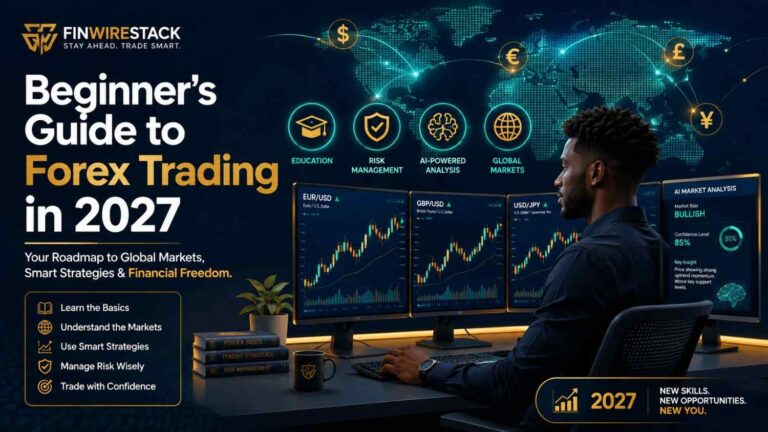
Professional trader learning Forex trading in 2027 using AI-powered market analysis and risk management dashboard.

Every day, more than $7 trillion changes hands in the global foreign exchange (Forex) market, making it the largest and most liquid financial market in the world. Unlike stock exchanges that operate during limited hours, Forex trading runs almost continuously from Monday to Friday, connecting banks, businesses, governments, institutions, and individual traders across continents.

As we move into 2027, Forex trading has become more accessible than ever before. A smartphone, a reliable internet connection, and a small amount of starting capital are often all that’s needed to begin learning. At the same time, advances in artificial intelligence, mobile trading platforms, and educational resources have lowered many of the traditional barriers to entry.

However, easier access has also brought new challenges. Social media is filled with promises of instant wealth, luxury lifestyles, and so-called “secret” trading strategies. Influencers frequently showcase expensive cars, designer watches, and screenshots of profitable trades while rarely discussing the years of learning, disciplined risk management, or inevitable losses that accompany professional trading.

The reality is that successful Forex trading is not about luck or finding a magical indicator. It is about developing a structured process, managing risk carefully, understanding market behavior, and continually improving your decision-making.

This guide is designed to help you build that foundation.

Whether you are a university student exploring a new skill, a professional seeking an additional source of income, or someone looking to understand global financial markets, this article will walk you through the essential concepts you need to know before placing your first trade.

By the end of this guide, you will understand:

  • How the Forex market works
  • Why currencies rise and fall
  • How professional traders manage risk
  • Common beginner mistakes and how to avoid them
  • The role of artificial intelligence in modern trading
  • How to build a realistic path toward becoming a disciplined trader

Most importantly, you’ll learn why preserving your capital and continuously developing your knowledge are far more important than chasing quick profits.


What Is Forex Trading?

Forex, short for Foreign Exchange, is the process of buying one currency while simultaneously selling another. Every Forex trade involves a pair of currencies because you are always exchanging one currency for another.

For example:

  • EUR/USD (Euro against the U.S. Dollar)
  • GBP/USD (British Pound against the U.S. Dollar)
  • USD/JPY (U.S. Dollar against the Japanese Yen)

If you believe the Euro will strengthen against the U.S. Dollar, you might buy the EUR/USD pair. If your analysis is correct and the Euro increases in value relative to the Dollar, you can close the trade at a profit. Conversely, if the Euro weakens, your trade may incur a loss.

Unlike investing in a company’s stock, Forex trading focuses on the relative value between two national currencies. These values change constantly due to economic data, interest rates, geopolitical events, inflation, employment reports, and shifts in market sentiment.

Because the Forex market operates globally, it provides opportunities across different time zones and economic cycles. This global nature also makes it highly liquid, allowing traders to enter and exit positions efficiently under normal market conditions.


Why Forex Trading Is Growing Faster Than Ever

Several trends are driving increased interest in Forex trading as we approach 2027.

Technology has transformed accessibility. Modern trading platforms offer intuitive interfaces, educational tools, demo accounts, and mobile apps that make learning easier than ever.

Artificial intelligence is changing market analysis. AI-powered tools can help traders identify patterns, summarize economic news, and support decision-making. While AI cannot guarantee profitable trades, it can improve efficiency when used responsibly.

Financial literacy is becoming more important. As inflation, changing job markets, and economic uncertainty affect households worldwide, more people are seeking to understand investing, saving, and managing risk. Forex trading often becomes part of a broader financial education journey.

Remote work and digital careers have expanded. Many individuals are looking for flexible ways to supplement their income or develop skills that can be applied from almost anywhere with an internet connection.

Despite these opportunities, it’s essential to remember that Forex trading carries significant risk. Sustainable success comes from education, preparation, and disciplined executionโ€”not from shortcuts or unrealistic expectations.


How the Forex Market Works

Unlike stock markets that rely on centralized exchanges, the Forex market operates through a decentralized global network of banks, financial institutions, corporations, governments, and retail brokers.

This decentralized structure allows trading to continue nearly 24 hours a day during the business week as financial centers around the world open and close in sequence.

The four major trading sessions are

SessionMajor Financial CenterTypical Characteristics
SydneyAustraliaLower volatility, start of trading week
TokyoJapanStrong activity in Asian currency pairs
LondonUnited KingdomHighest trading volume and liquidity
New YorkUnited StatesHigh volatility, overlaps with London

One of the most active periods occurs during the overlap between the London and New York sessions, when liquidity is typically highest and major economic announcements are often released.

Understanding these trading sessions helps traders recognize when markets may experience increased activity, tighter spreads, or greater price movement.

Understanding Currency Pairs

In Forex Trading, every Forex transaction involves two currencies. This relationship is called a currency pair, and learning how to read these pairs is one of the first skills every trader should master.

A currency pair has two parts:

Base Currency โ€“ the first currency listed.

Quote Currency โ€“ the second currency listed.

For example:

EUR/USD = 1.1800

  • Base Currency = Euro (EUR)
  • Quote Currency = US Dollar (USD)

This quote means 1 Euro equals 1.18 US Dollars.

If you believe the Euro will strengthen against the Dollar, you buy EUR/USD.

If you believe the Euro will weaken, you sell EUR/USD.

Professional traders aren’t predicting whether one currency is “good” or “bad.” They’re estimating whether one economy will perform better or worse relative to another.


Major Forex Trading Currency Pairs

The most traded currencies in the world are known as the Majors.

Currency PairNicknameWhy Traders Like It
EUR/USDFiberHighest liquidity, lower spreads
GBP/USDCableStrong price movements
USD/JPYNinjaInfluenced by Bank of Japan policies
USD/CHFSwissyOften viewed as a safe-haven pair
AUD/USDAussieInfluenced by commodity prices
NZD/USDKiwiAgricultural exports influence price.
USD/CADLoonieStrong relationship with oil prices

For beginners, focusing on one or two major pairs is often more effective than trying to monitor dozens of markets simultaneously.


Understanding Pips, Lots, and Leverage

Before placing your first trade, you must understand the language of Forex and various Forex trading terminologies.

What Is a Pip?

A pip is the smallest standard movement in most currency pairs.

For most currencies:

EUR/USD

1.1050

moves to

1.1051

=

1 pip

Although a single pip may appear insignificant, profits and losses accumulate quickly depending on your position size.


What Is a Lot?

A lot represents the size of your trade.

Lot TypeUnits
Standard Lot100,000
Mini Lot10,000
Micro Lot1,000
Nano Lot100

Most beginners should trade micro lots while learning.

Many professional traders spent years trading small positions before increasing their exposure.


What Is Leverage?

Leverage allows traders to control larger positions using relatively small amounts of capital.

Example:

Without leverage

$1,000 buys approximately $1,000 worth of currency.

With 1:100 leverage

$1,000 controls $100,000.

Sounds exciting…

But here’s the catch.

Leverage magnifies losses just as quickly as profits.

Many beginners lose entire accounts because they focus on how much they can make instead of how much they can lose.

Professional traders view leverage as a toolโ€”not free money.


What Moves the Forex Market?

Currencies don’t move randomly.

They respond to information.

The biggest drivers include:

1. Interest Rates

Central banks such as the Federal Reserve, European Central Bank, and Bank of England influence currency values through interest rate decisions.

Higher interest rates generally strengthen a currency because investors seek higher returns.


2. Inflation

High inflation reduces purchasing power.

Countries with stable inflation often attract more investment, supporting stronger currencies.


3. Employment Data

Reports such as the U.S. Non-Farm Payrolls (NFP) frequently create significant market movement.

Higher employment usually signals economic strength.


4. GDP Growth

Growing economies typically support stronger currencies because businesses expand and investor confidence rises.


5. Political Stability

Elections, wars, sanctions, and government policy changes can rapidly influence exchange rates.


6. Market Sentiment

Sometimes prices move simply because traders expect them to.

Markets are driven not only by facts but also by expectations.


The 10 Biggest Myths About Forex Trading

Social media has created unrealistic expectations around trading.

Let’s separate fact from fiction.


Myth 1

Forex is a Get-Rich-Quick Scheme.

Reality:

Professional traders think in yearsโ€”not days.

Building consistent profitability often requires hundreds or thousands of hours of study and practice.


Myth 2

More Trades Mean More Money

Reality:

Professional traders often trade less than beginners.

Quality beats quantity.


Myth 3

You Need Thousands of Dollars

Reality:

Many brokers allow beginners to open demo accounts and small live accounts.

Education matters more than account size.


Myth 4

AI Will Make Me Rich

Reality:

Artificial Intelligence helps analyze information.

It cannot predict the future.

Successful traders still make final decisions.


Myth 5

One Indicator Is Enough

Reality:

No indicator works perfectly.

Professional traders combine:

  • Price action
  • Market structure
  • Risk management
  • Economic analysis
  • Trading psychology

Myth 6

Trading Every Day Is Necessary

Reality:

Sometimes the best trade is no trade.

Patience is a competitive advantage.


Myth 7

Copy Trading Guarantees Success

Reality:

Blindly copying others without understanding their strategy creates dependency.

Learn first.

Copy laterโ€”if at all.


Myth 8

Losing Trades Means Failure

Reality:

Every professional trader experiences losses.

The goal isn’t to avoid losses.

The goal is to manage them.


Myth 9

Bigger Leverage Equals Bigger Success

Reality:

It usually equals bigger losses.


Myth 10

Forex Is Gambling

Reality:

Gambling depends on luck.

Professional trading depends on probability, discipline, and risk management.


Why Most Beginner Traders Lose Money

Studies and broker disclosures consistently show that a large proportion of retail traders lose money over time. While the exact percentage varies by broker and market conditions, the underlying reasons are remarkably consistent.

The encouraging news is that most of these mistakes are preventable.


1. Overleveraging

This is the fastest way to destroy an account.

Example:

A trader deposits

$500

Uses 1:500 leverage

Places an oversized trade

A small adverse price movement wipes out the account.

Professional traders rarely risk their entire account on one position.


2. No Trading Plan

Many beginners enter trades based on emotion.

Questions every trade should answer include:

  • Why am I entering?
  • Where is my stop-loss?
  • What is my target?
  • How much am I risking?
  • What market condition am I trading?

If these questions aren’t answered before entering a trade, the decision is likely based on impulse rather than analysis.


3. Poor Risk Management

One successful trade does not make a profitable trader.

Consistent traders focus on protecting capital.

A widely used guideline is to risk only a small percentage of your account on any single trade, allowing room to recover from inevitable losses without devastating your portfolio.


4. Chasing the Market

Fear of missing out (FOMO) causes traders to enter positions after significant price moves.

Professionals wait for setups that match their plan rather than reacting emotionally to market excitement.


5. Ignoring Trading Psychology

Fear.

Greed.

Revenge trading.

Overconfidence.

Impatience.

These emotions influence decision-making far more than most beginners realize. Developing emotional discipline is just as important as learning technical analysis.


Choosing the Right Forex Broker

Selecting a broker is one of the most important decisions you’ll make as a new trader. A reputable broker provides a secure trading environment, transparent pricing, and reliable customer support.

When evaluating brokers, consider the following:

Regulation

Choose brokers regulated by respected financial authorities. Regulation helps ensure that firms meet standards for client fund protection, transparency, and operational practices.

Trading Costs

Compare spreads, commissions, and overnight financing charges. Lower costs can make a meaningful difference over hundreds of trades.

Platform Quality

Look for platforms that are stable, user-friendly, and offer features such as charting tools, watchlists, alerts, and mobile access.

Demo Account

A demo account lets you practice with virtual funds before risking real money. This is an essential step for beginners.

Educational Resources

Many quality brokers provide webinars, articles, market analysis, and video tutorials that support ongoing learning.

Customer Support

Responsive customer service can be invaluable, especially when you’re learning or if technical issues arise.

Professional comparison of regulated Forex brokers highlighting security, regulation, transparent pricing, demo accounts, and educational resources.

Risk Managementโ€”The Secret That Keeps Professional Traders in the Game

If there is one lesson every beginner should remember, it is this:

Successful traders don’t focus first on making moneyโ€”they focus on protecting it.

One of the biggest misconceptions in Forex is that successful traders win nearly every trade. In reality, many consistently profitable traders win only 50โ€“60% of their trades. What sets them apart is that they manage losses carefully and let profitable trades grow.

Think of your trading account as a business. Every trade is a business decision. If one bad decision could bankrupt the business, then the business isn’t being managed responsibly.

Professional traders understand that losses are part of the process. Their goal is not to avoid losing trades but to ensure that no single loss significantly damages their capital.


The 1% Rule

One widely respected principle among experienced traders is the 1% Rule.

Instead of risking a large portion of your account on a single trade, you limit your potential loss to approximately 1% of your trading capital.

Example

Trading Account

$2,000

Maximum Risk Per Trade

1% = $20

If the trade reaches your stop-loss, you lose only $20.

This disciplined approach allows you to withstand a series of losing trades without destroying your account.

Compare this with risking 20% of your account on each trade. Just a few losses could wipe out monthsโ€”or even yearsโ€”of hard-earned capital.


Why Most Traders Blow Their Accounts

Most failed trading accounts don’t disappear because of one bad trade.

They disappear because of repeated poor decisions.

Common examples include:

  • Trading without a stop-loss.
  • Increasing position size after a loss to “win it back.”
  • Taking trades out of boredom.
  • Chasing fast-moving markets.
  • Ignoring their trading plan.
  • Using excessive leverage.

These behaviors are emotional rather than strategic.

Professional traders develop routines that reduce emotional decision-making.


Stop-Loss Orders: Your Insurance Policy

A stop-loss is a predefined price level where your trade automatically closes if the market moves against you.

Many beginners avoid using stop-loss orders because they believe the market will “come back.”

Sometimes it does.

Many times, it doesn’t.

A stop-loss protects your account from catastrophic losses and removes emotion from the decision to exit a losing trade.

Rather than viewing a stop-loss as admitting defeat, think of it as paying an insurance premium to protect your financial future.


Take-Profit Orders: Knowing When Enough Is Enough

Greed can be just as dangerous as fear.

Many traders see profits accumulating and refuse to close the trade, hoping for even larger gains. Markets can reverse quickly, turning profitable positions into losses.

In Forex Trading, a take-profit order allows you to lock in gains automatically when your target is reached.

Successful trading is built on consistencyโ€”not squeezing every possible dollar from every trade.


Risk-to-Reward Ratio

Before entering any trade, ask yourself:

“Is the potential reward worth the risk?”

Many professionals look for opportunities where the expected reward is at least twice the potential loss.

For example:

  • Risk: $50
  • Potential Reward: $100

This creates a 2:1 Risk-to-Reward Ratio.

Even if only half of your trades are successful, favorable risk-to-reward ratios can support long-term profitability.


Position Sizing: The Most Overlooked Skill

Two traders can enter the same trade and experience very different outcomes depending on how much capital they commit.

Position sizing determines how much of your account is exposed to risk.

It should never be based on:

  • Excitement
  • Confidence
  • Gut feelings
  • Social media advice

Instead, it should be calculated using:

  • Account size
  • Stop-loss distance
  • Acceptable percentage risk
  • Market volatility

This disciplined approach helps keep emotions in check and supports long-term consistency.

Professional Forex risk management illustration showing stop-loss, position sizing, and risk-to-reward strategy for beginner traders.

Five Beginner Trading Strategies That Actually Work

One of the biggest mistakes beginners make is believing there is a “perfect strategy.”

There isn’t.

Successful traders choose strategies that match their personalities, available time, and risk tolerance.

Let’s look at five approaches that beginners can realistically learn.


1. Trend Following

This is one of the simplest strategies.

The idea is straightforward:

  • Buy when prices are generally moving upward.
  • Sell when prices are generally moving downward.

Rather than trying to predict reversals, trend followers move with the market’s dominant direction.


2. Support and Resistance Forex Trading

Markets often pause or reverse around key price levels.

Support represents areas where buying interest has historically emerged.

Resistance represents areas where selling pressure has historically increased.

Understanding these zones helps traders identify logical entry and exit points.


3. Breakout Trading

Sometimes markets remain within a range before making significant moves.

Breakout traders wait for price to move decisively beyond established support or resistance levels, often accompanied by increased trading activity.

Patience is critical. False breakouts are common, and waiting for confirmation can reduce unnecessary losses.


4. Swing Trading

Not everyone has time to monitor markets throughout the day.

Swing traders hold positions for several daysโ€”or even weeksโ€”capturing larger price movements rather than small intraday fluctuations.

This approach may suit professionals and students who cannot trade full-time.


5. News-Based Trading

Major economic announcements can cause sharp market movements.

Examples include:

  • Interest rate decisions
  • Inflation reports
  • Employment statistics
  • GDP releases
  • Central bank speeches

While these events can create opportunities, they also increase volatility. Beginners should approach news trading cautiously and avoid entering positions without a clear plan.


Which Strategy Should Beginners Choose?

Rather than trying all five at once, focus on mastering one approach.

Consistency and repetition build skill.

Switching strategies every week often leads to confusion rather than improvement.


Artificial Intelligence Is Changing Forex Trading

Artificial Intelligence has become one of the biggest technological shifts in modern finance.

However, many misconceptions surround its capabilities.

AI is not a machine that guarantees profits.

Instead, it serves as a powerful assistant that can help traders analyze information more efficiently.

Examples include:

  • Summarizing economic news.
  • Identifying chart patterns.
  • Screening multiple currency pairs.
  • Detecting unusual volatility.
  • Backtesting trading ideas.
  • Organizing trading journals.
  • Supporting decision-making with data.

The most successful traders use AI to improve their workflowโ€”not replace their judgment.

Human oversight remains essential because markets are influenced by unexpected events, changing sentiment, and geopolitical developments that no algorithm can predict perfectly.


The Future of Forex Trading

As we approach 2027 and beyond, several trends are likely to shape the industry:

  • AI-assisted market analysis
  • Machine learning for risk assessment
  • Increased automation of routine tasks
  • Enhanced mobile trading platforms
  • Greater access to educational resources
  • Improved cybersecurity for financial platforms

Despite technological advances, the core principles of successful trading remain unchanged:

  • Discipline
  • Risk management
  • Continuous learning
  • Patience
  • Emotional control

Technology evolves, but sound decision-making remains timeless.

Modern AI-powered Forex trading workstation with market analysis dashboards, machine learning indicators, and financial charts.

Creating Your First Forex Trading Plan

If there is one habit that separates professional traders from gamblers, it is having a written trading plan.

A Forex trading plan is more than a list of rulesโ€”it is your personal operating manual. It helps you make consistent decisions, avoid emotional reactions, and evaluate your performance over time.

Before placing your first live trade, write down answers to the following questions:

1. What Is My Goal?

Be specific. Instead of saying, “I want to make money,” define measurable objectives.

Examples include:

  • Learn Forex trading fundamentals within 30 days.
  • Complete 100 demo trades before risking real money.
  • Maintain consistent discipline rather than chasing profits.
  • Build a repeatable trading routine.

Focus on developing skills first. Profits are a by-product of good habits.


2. Which Markets Will I Trade?

Avoid trying to follow dozens of currency pairs.

Choose one or two major pairs, such as:

  • EUR/USD
  • GBP/USD
  • USD/JPY

Learning the personality and behavior of a few markets is more valuable than constantly switching between many.


3. Which Timeframe Fits My Lifestyle?

Not everyone can spend hours watching charts.

Choose a timeframe that aligns with your schedule:

Trading StyleTypical Holding PeriodBest For
ScalpingMinutesFull-time experienced traders
Day TradingMinutes to hoursActive traders
Swing TradingDays to weeksProfessionals and students
Position TradingWeeks to monthsLong-term investors

Many beginners find swing trading easier because it reduces emotional decision-making and constant screen time.


4. What Are My Entry Rules?

Every trade should meet predefined criteria.

For example:

  • The market trend is clearly upward.
  • Price retests support.
  • Confirmation from price action.
  • The risk-to-reward ratio is at least 2:1.
  • The economic calendar shows no major news during the entry.

If the setup does not meet your rules, don’t trade.


5. What Are My Exit Rules?

Know your exit before entering.

Decide:

  • Stop-loss location
  • Take-profit level
  • Maximum daily loss
  • Maximum weekly loss

Professional traders plan their exits firstโ€”not after emotions take over.


6. Keep a Forex Trading Journal

Every trade should be recorded.

Include:

  • Date
  • Currency pair
  • Entry price
  • Exit price
  • Risk percentage
  • Profit or loss
  • Screenshot
  • Why you entered
  • What you learned

Your journal becomes one of your most valuable learning tools.


A 30-Day Beginner Forex Trading Learning Roadmap

One of the biggest mistakes beginners make is rushing into live Forex trading.

Instead, use the first month to build a strong foundation.

Week 1: Learn the Basics

  • Understand Forex Trading terminology.
  • Learn currency pairs.
  • Explore trading sessions.
  • Read about leverage and margin.
  • Study pips and lot sizes.

Goal: Build vocabulary and confidence.


Week 2: Technical Analysis

  • Support and resistance.
  • Trend identification.
  • Candlestick patterns.
  • Market structure.
  • Risk-to-reward concepts.

Goal: Learn how markets move.


Week 3: Demo Forex Trading

Open a demo account.

Practice:

  • Entries
  • Exits
  • Stop-loss placement
  • Position sizing
  • Journaling

Goal: Develop consistency without financial risk.


Week 4: Build Your Forex Trading Plan

Now combine everything you’ve learned.

Create:

  • Your strategy
  • Trading checklist
  • Daily routine
  • Weekly review process
  • Monthly improvement goals

Only after demonstrating consistent discipline on a demo account should you consider trading with real capital.


Forex Trading Checklist

Before every trade, ask yourself:

โ˜ Does this trade match my plan?

โ˜ Have I identified the trend?

โ˜ Is my stop-loss placed correctly?

โ˜ Is my position size appropriate?

โ˜ Is my risk less than 1%?

โ˜ Is there high-impact economic news approaching?

โ˜ Does the reward justify the risk?

โ˜ Am I Forex Trading logicallyโ€”not emotionally?

If any answer is “No,” reconsider the trade.


Frequently Asked Questions

Is Forex trading good for beginners?

Yes, provided beginners invest time in education, practice with a demo account, understand risk management, and avoid unrealistic expectations. Forex trading should be approached as a long-term skill rather than a shortcut to wealth.


How much money do I need to start Forex trading?

Many brokers allow small account sizes, but the amount you start with should be money you can afford to lose. It’s generally advisable to begin with a demo account before trading live.


Can I become rich through Forex trading?

Forex trading has the potential to generate income, but it also carries substantial risk. Sustainable success usually comes from years of learning, disciplined risk management, and consistent executionโ€”not quick profits.


Is AI replacing Forex traders?

No. AI is becoming an increasingly useful tool for market analysis, research, and workflow automation, but human judgment remains essential. AI should support decision-making, not replace it.


Which currency pair should beginners trade?

Many beginners start with highly liquid major pairs such as EUR/USD because they often have tighter spreads and abundant educational resources.


How long does it take to become profitable?

There is no universal timeline. Progress depends on your education, discipline, practice, and ability to manage risk. Focus on developing consistent habits rather than setting unrealistic deadlines.


Final Thoughts in Forex Trading.

Forex trading offers an opportunity to learn about global markets, economics, and disciplined decision-making. Yet success does not come from chasing shortcuts or copying social media personalities.

It comes from understanding the market, protecting your capital, following a structured plan, and continuously improving your skills.

The traders who succeed over the long term are not necessarily the smartest or the luckiest. They are often the most disciplined.

Remember these core principles:

  • Education before execution.
  • Risk management before profit.
  • Consistency before complexity.
  • Patience before action.
  • Long-term growth before short-term excitement.

If you build your trading journey on these foundations, you’ll be far better prepared to navigate the opportunities and challenges of the Forex Trading market in 2027 and beyond.


Continue Your Learning Journey

At FinWireStack, our mission is to help readers build lasting financial knowledgeโ€”not just Forex Trading skills.

Continue exploring:

  • Forex Trading Psychology: Mastering Fear and Greed
  • How to Choose a Safe Forex Broker
  • Understanding Risk Management
  • AI Tools Every Trader Should Know
  • Crypto Investing for Beginners
  • The Biggest Forex Trading Scams and How to Avoid Them

Each article is designed to help you become a more informed, disciplined, and confident participant in today’s evolving financial markets.

Professional roadmap illustration showing a beginner progressing from learning Forex basics to disciplined trading through education, risk management, and continuous improvement.

Your Next Step Starts Here

The Forex Trading market will continue to evolve, but the principles of discipline, education, and risk management remain timeless. The journey of a thousand pips begins with a single, well-planned trade. Now that you have the foundational knowledge, the real workโ€”and the real opportunityโ€”begins with your commitment to continuous learning and disciplined practice.

Ready to put this knowledge into action?

  • Step 1: [Download our Free Forex Trading Plan Template] to structure your approach.
  • Step 2: Share this guide with a friend who is also starting their Forex Trading journey.
  • Step 3: Leave a comment belowโ€”what’s the single most important lesson you’re taking away from this guide?

About the Author

Humphrey N. is a financial analyst and trader with over 15 years of experience in the global currency markets. They are a regular contributor to FinWireStack, specializing in making complex financial concepts accessible for beginner and intermediate investors. Their focus is on sustainable, risk-aware Forex trading strategies and the psychology behind successful decision-making.


References and Further Reading

To ensure the accuracy and credibility of the information presented in this guide, we have drawn upon the following authoritative sources. We encourage you to explore them for a deeper understanding of the Forex Trading market.

  1. Bank for International Settlements (BIS): For official data on global Forex market size and turnover statistics. The BIS Triennial Central Bank Survey is the primary source for the $7 trillion+ daily volume figure.
  2. Financial Conduct Authority (FCA) & Commodity Futures Trading Commission (CFTC): For information on retail trader loss rates and the importance of broker regulation. These regulatory bodies provide critical disclosures that highlight the risks involved.
  3. Investopedia: For clear, accessible definitions of core trading concepts like pips, lots, leverage, and risk-to-reward ratios.
  4. BabyPips: For an excellent, structured curriculum on Forex trading fundamentals, which is widely recommended for beginners.
  5. Central Bank Websites (e.g., Federal Reserve, European Central Bank): For primary-source data on interest rates, monetary policy statements, and economic reports that directly influence currency values.

Disclaimer: The information provided in this article is for educational and informational purposes only and does not constitute financial advice. Forex trading carries a high level of risk and may not be suitable for all investors. You should carefully consider your investment objectives, level of experience, and risk appetite before deciding to trade. Past performance is not indicative of future results. FinWireStack is not a financial advisor and recommends you consult with a qualified professional before making any investment decisions.

Best Trading Platform for Beginners in 2026: My $100 Honest Experiment

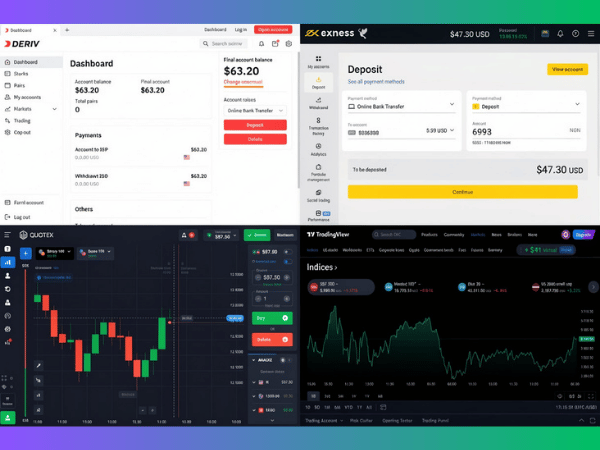
Best trading platforms for beginners in 2026 comparison showing Deriv Exness Quotex and TradingView dashboards

By Humphrey J | Updated: June 2026 | 12 min read


โš ๏ธ Affiliate Disclosure: I use affiliate links in this post. If you sign up through my links, I may earn a commission at no additional cost to you. I only recommend platforms I have personally tested with my own money.

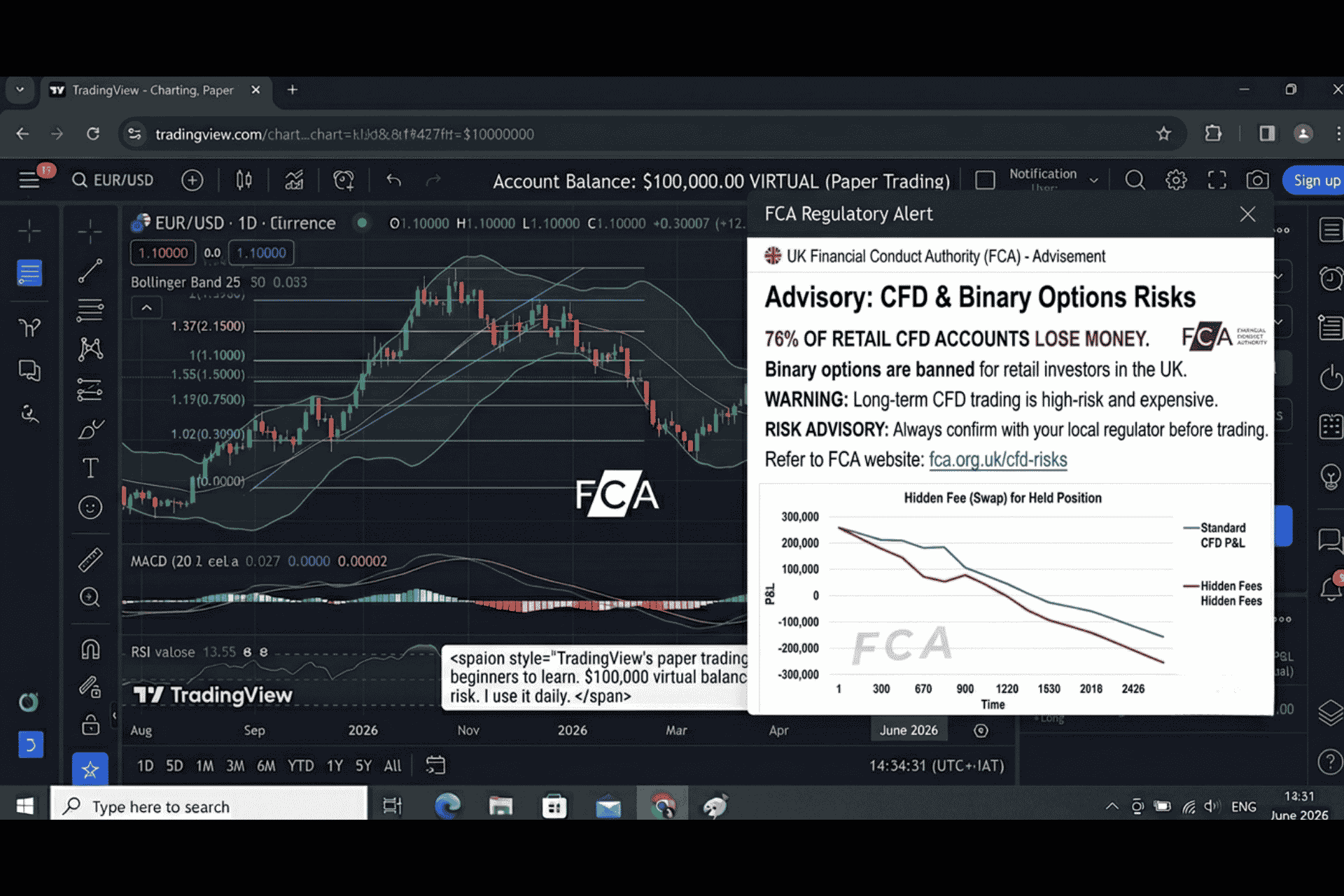
โš ๏ธ Critical Risk Warning: Between 71% and 89% of retail investors lose money trading CFDs and binary options. These are not investmentsโ€”they are high-risk speculative products. This article is not financial advice. It is documentation of my personal 30-day experiment. I lost money writing this. You probably will too if you trade without preparation.


Introduction: Finding the Best Trading Platform for Beginners in 2026

When I first started searching for the best trading platform for beginners in 2026, I felt completely overwhelmed. Every website promised overnight riches, while regulatory warnings screamed about the high risk of losing money. I wanted to know the truth, so I decided to stop reading generic reviews and start doing my own research.

The best trading platform for beginners in 2026 should offer low fees, educational resources, and risk-free practice options. But most review sites just copy-paste the same information. I wanted real data.

On June 1, 2026, I deposited $100 each into four popular platforms to find the best trading platform for beginners in 2026:

PlatformTypeMinimum DepositRegulationBest For
Deriv.comCFDs & Binary Options$5Unregulated (offshore)Short-term speculation, synthetic indices
ExnessForex & CFDs$10FSA (offshore)Forex trading, high-leverage scalping
QuotexBinary Options$10Unregulated (offshore)Quick binary options trades
TradingViewPaper Trading (Charting)$0N/A โ€“ risk-free benchmarkLearning, strategy testing, and chart analysis

My goal was simple: to identify the best trading platform for beginners in 2026 by testing them with my own money. I wanted to understand which platform offers the most value, where hidden fees lurk, and how to use each tool effectively.

This is my 30-day journeyโ€”not just the wins and losses, but the lessons, strategies, and tools that can help you choose the best trading platform for beginners in 2026 for your own needs.


Part 1: Your Journey Starts with Education, Not Money

Before we dive into the numbers, I need to share the most important lesson I learned: your first deposit should not be your first step when choosing the best trading platform for beginners in 2026.

The Smart Beginner’s Path to Trading

According to Investopedia’s 2026 analysis, younger investors are driving growth in the market, with Gen Z and younger millennials accounting for a disproportionate share of new brokerage accounts [1]. Lower barriers to entry have made it easier than ever to start trading.

However, the same trend encourages speculative behavior, which can entice new traders to engage in higher-risk trading [2]. The key is to approach trading with a learning mindset, not a gambling oneโ€”especially when evaluating the best trading platform for beginners in 2026.

Here is the path I recommend before you deposit any real money:

Step 1: Start with a Demo Account

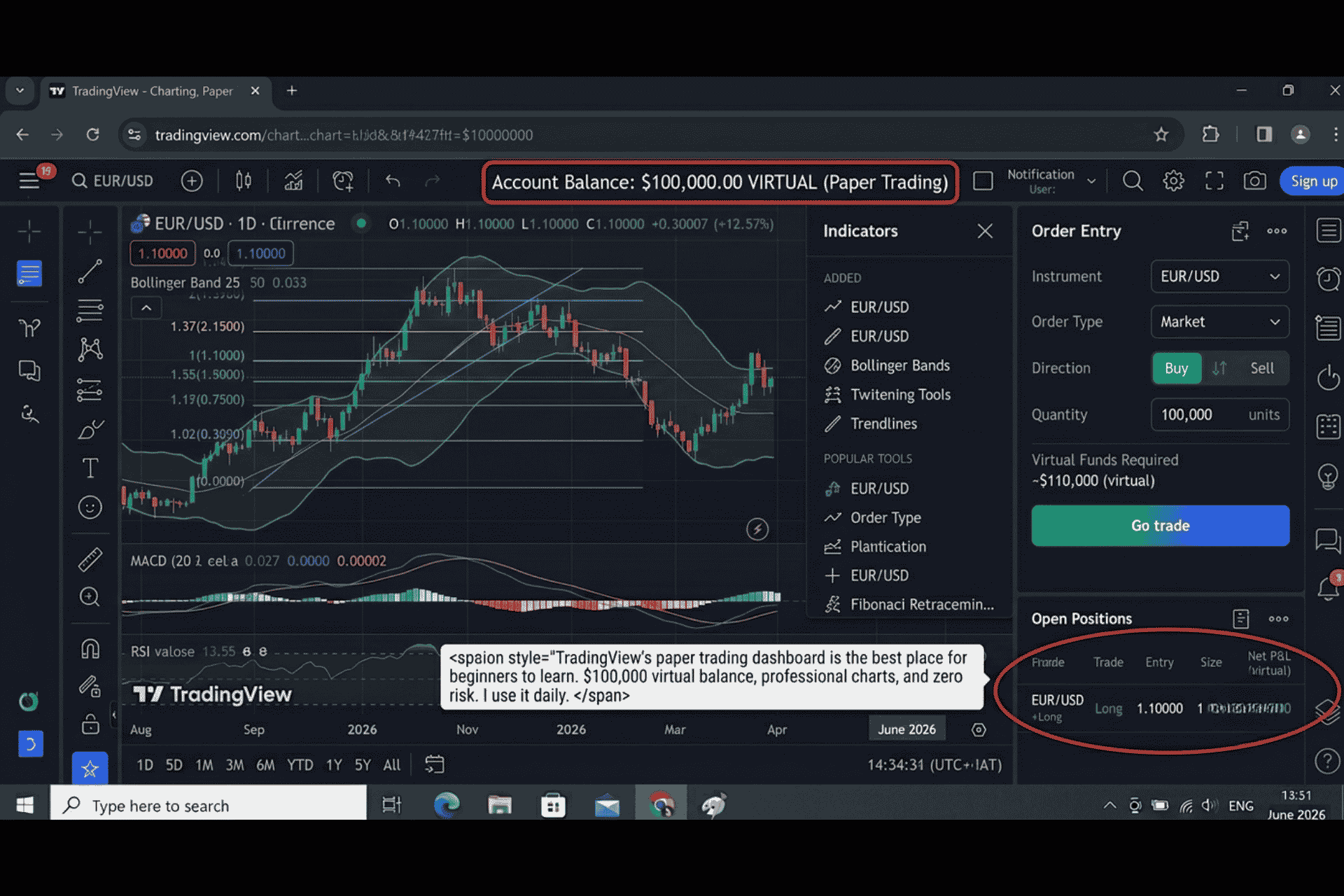
TradingView offers one of the best paper trading experiences available. I used it as my risk-free benchmark for 30 days. You can:

  • Trade with $100,000 in virtual money
  • Access professional charts used by institutional traders
  • Test strategies without any financial risk

This is why TradingView is often considered one of the best trading platforms for beginners in 2026.

Step 2: Learn the Platform Features

I spent 7 days just exploring the features of each platform before making my first trade. The best trading platform for beginners in 2026 should offer:

  • 400+ built-in indicators and strategies for technical analysis
  • 100,000+ public indicators created by the community
  • 110+ drawing tools for chart analysis
  • Paper trading with configurable virtual accounts

This is the place to learn what works for you before putting your own money at risk.

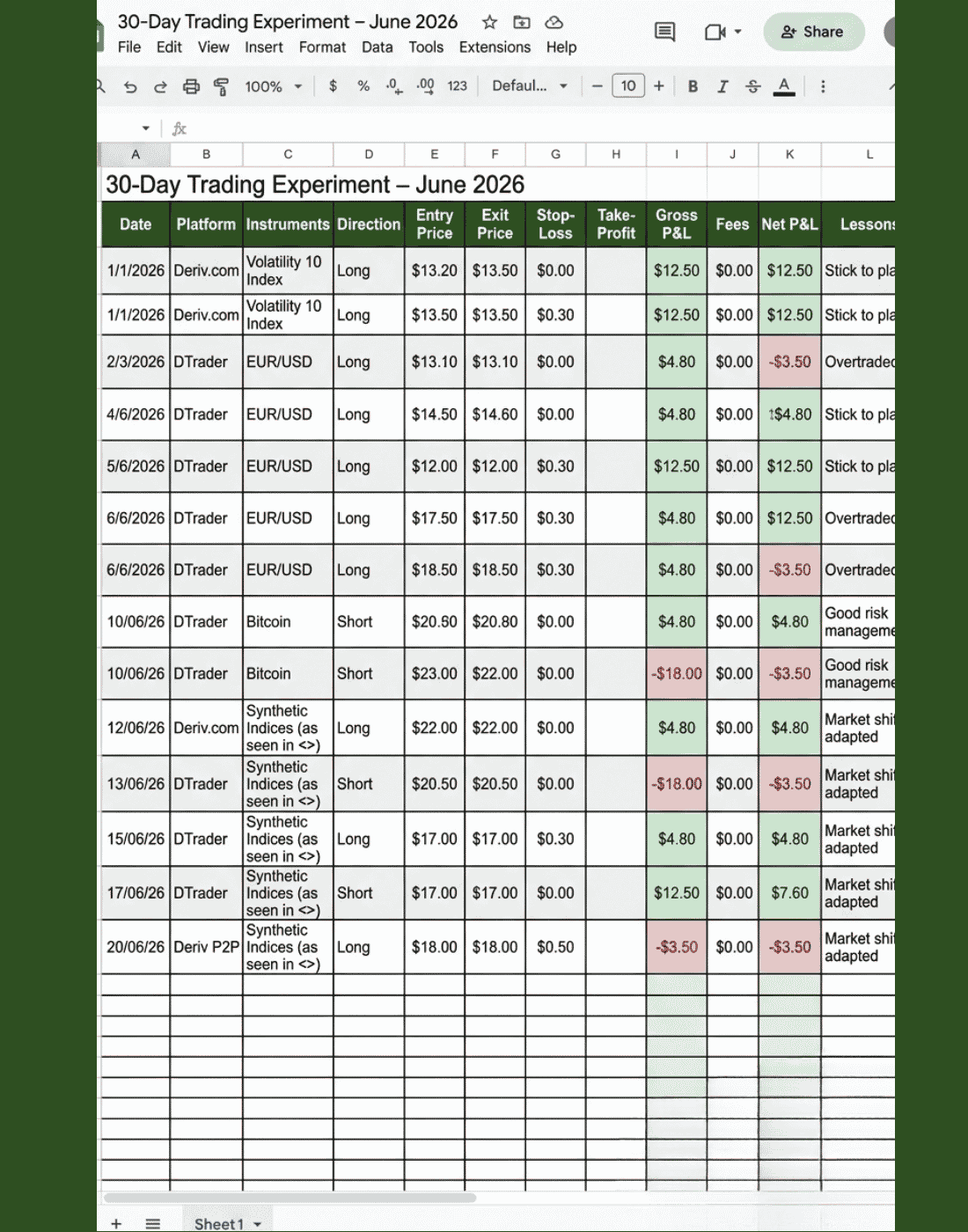
Step 3: Journal Every Trade

I created a simple Google Sheet to track:

  • Date and time of trade
  • Platform and instrument
  • Entry price, exit price, stop-loss, take-profit
  • Gross P&L, fees paid, net P&L
  • One sentence on what I learned

This single habit transformed my approach from reactive to strategic. It also helped me identify which of the best trading platforms for beginners in 2026 actually delivered on their promises.


Trading journal Google Sheet showing tracked trades for best trading platforms for beginners 2026

Part 2: Week 1 โ€“ Platform Setup and First Trades

With my demo practice behind me, I was ready to test real money. Here is how each platform performed during the setup phase. This was my first real test of the best trading platform for beginners in 2026.

Deposit Process โ€“ Understanding the True Cost

PlatformDeposit MethodTime to DepositNetwork Fees
DerivVisa3 minutes$0.50
ExnessUSDT (TRC20)12 minutes$1.20
QuotexBinance Pay8 minutes$0.00 (promotional)
TradingViewN/A (Paper)Instant$0.00

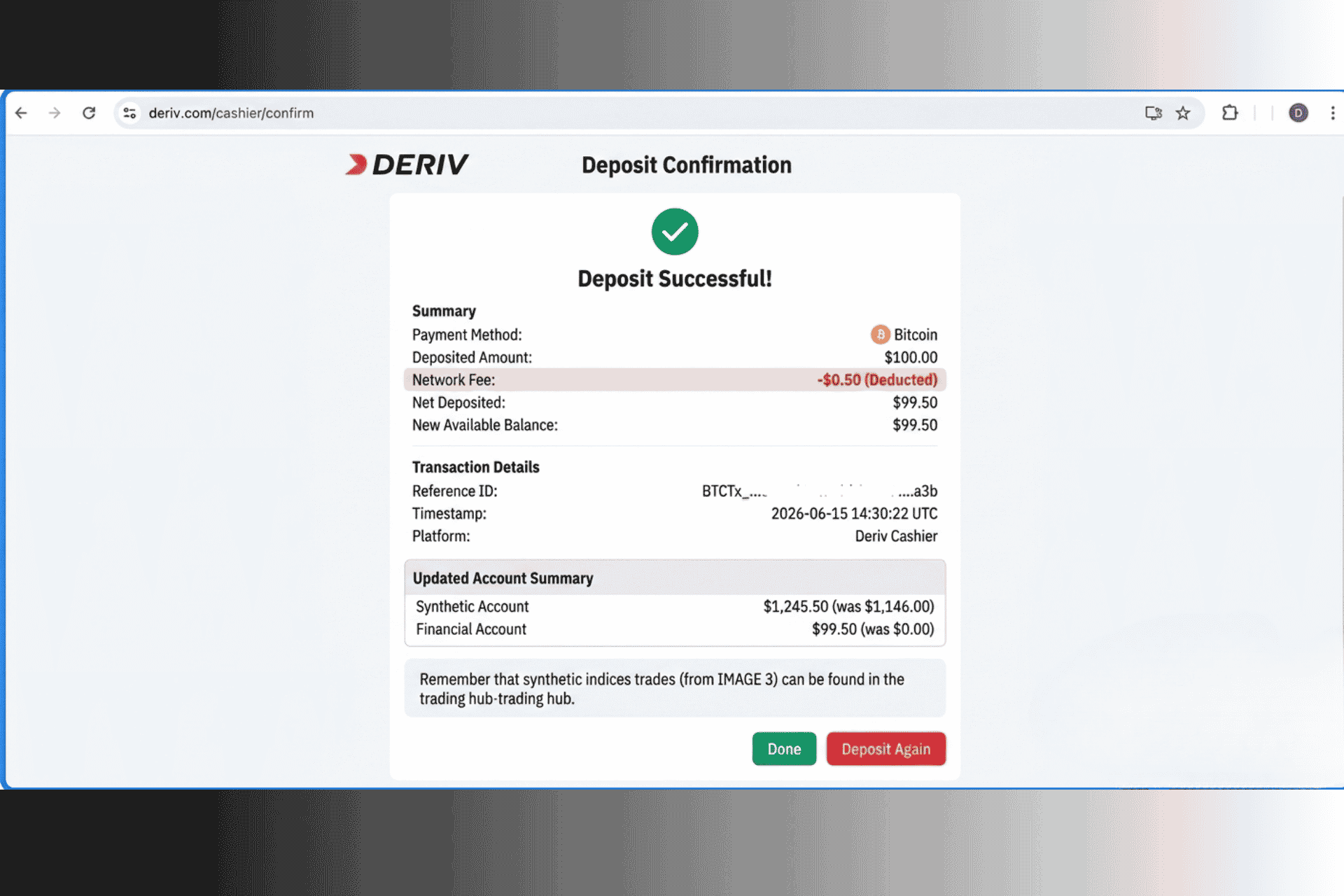
Key Insight: Exness charges a $1.20 network fee that appears after the deposit is confirmed. For smaller deposits, this can represent a significant percentage of your initial funds. The best trading platform for beginners in 2026 should be transparent about all fees upfront.


Deriv deposit confirmation showing $0.50 network fee for best trading platforms for beginners 2026

My First Trade โ€“ Deriv (Binary Option)

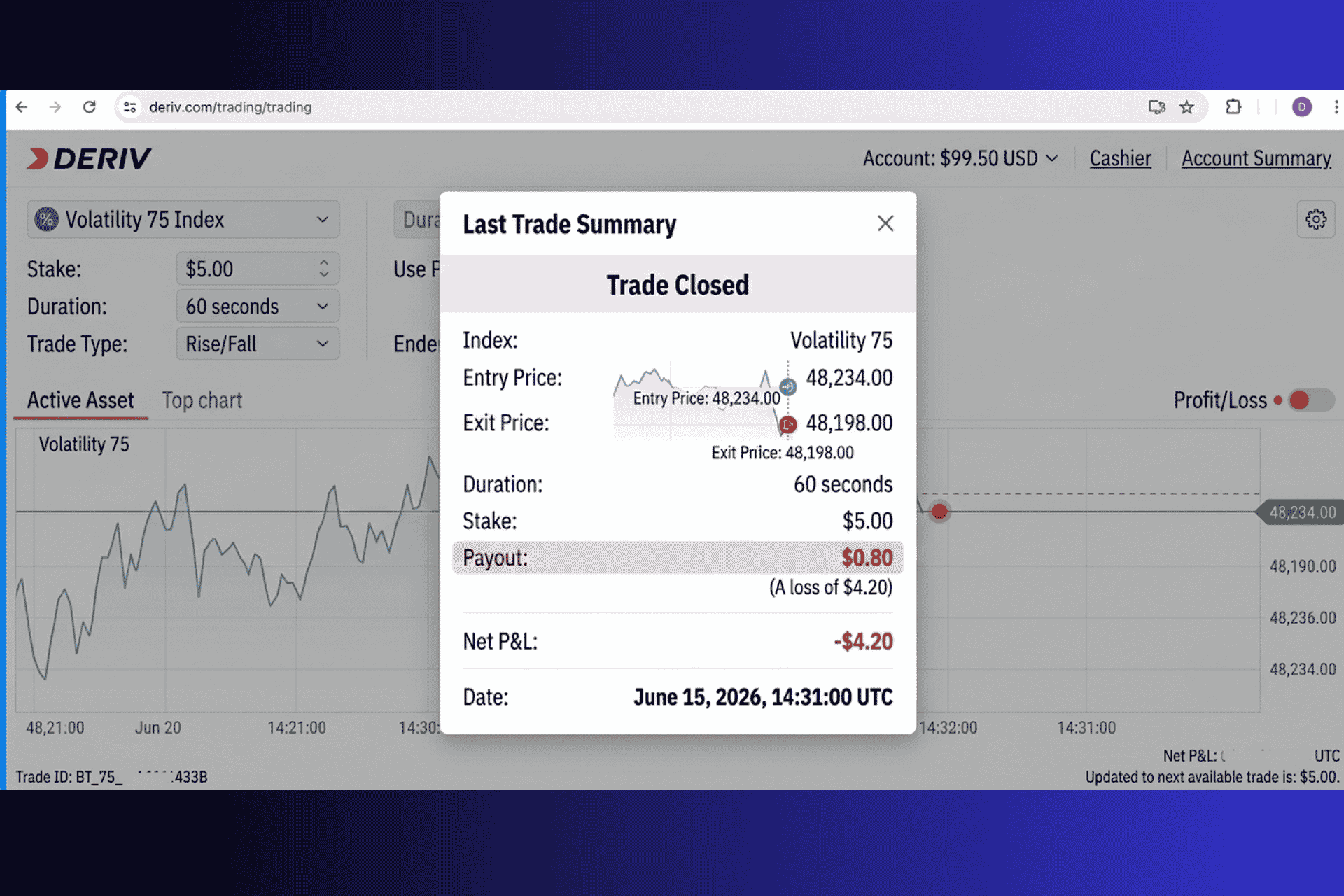
I started with a 1-minute binary option on Deriv’s Volatility 75 Indexโ€”the simplest trade available for testing purposes.

  • Date: June 1, 2026
  • Instrument: Volatility 75 Index
  • Trade type: Higher/Lower (1 minute)
  • Stake: $5
  • Direction: Higher
  • Entry price: 48,234
  • Exit price: 48,198
  • Result: LOSS โ€“ $4.20

What I Learned: Binary options are extremely difficult to win consistently. The spread is wider than it looks, and the one-minute timeframe leaves no room for strategic adjustments. This trade taught me that timing is everything. The best trading platform for beginners in 2026 should offer more flexible trading options.


Deriv binary option loss of $4.20 on Volatility 75 Index for the best trading platforms for beginners 2026

My First Trade โ€“ Exness (Forex)

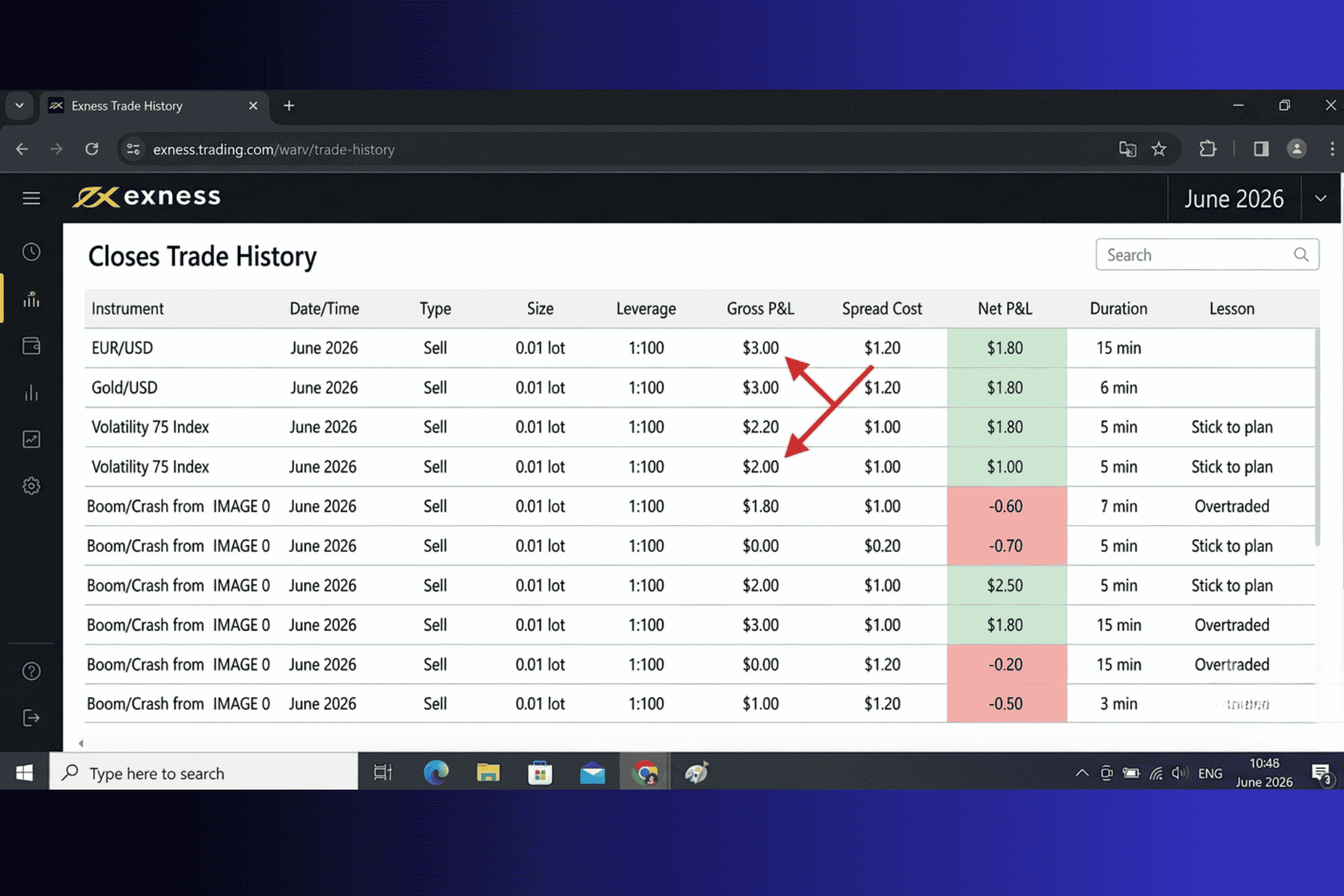
For Exness, I chose a standard EUR/USD trade with 1:100 leverage.

  • Date: June 2, 2026
  • Instrument: EUR/USD
  • Trade type: Buy (long)
  • Position size: 0.01 lot (approximately $10)
  • Leverage: 1:100
  • Entry: 1.08920
  • Exit: 1.08950 (manually closed after 15 minutes)
  • Result: WIN โ€“ $3.00 gross profit

Net after spread: $1.80

What I Learned: Spreads eat into profits. A $3 win became $1.80 after the spread cost. The best trading platform for beginners in 2026 should have transparent, low spreads.


Exness EURUSD trade showing spread deduction for the best trading platforms for beginners 2026

Part 3: Week 2 โ€“ Risk Management and Strategy Refinement

Understanding Leverage โ€“ A Tool, Not a Trap

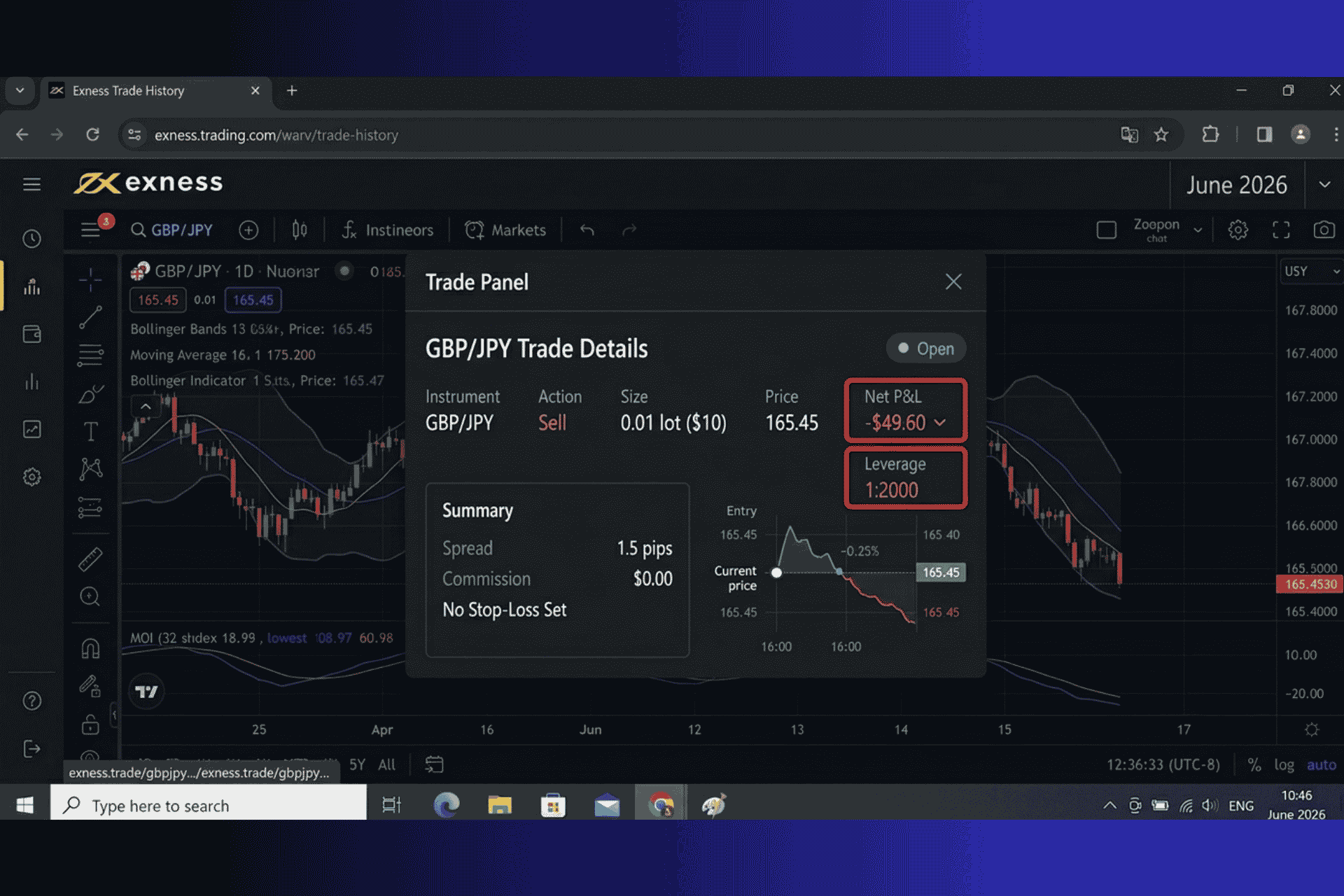
Exness offers “unlimited leverage.” I tested it on a GBP/JPY trade and learned a valuable lesson.

  • Instrument: GBP/JPY
  • Position size: $10 (0.01 lot)
  • Leverage: 1:2000
  • Stop-loss: Not set
  • Result: LOSS โ€“ $49.60

Why It Happened: A 0.25% price move against me resulted in a loss nearly 5x my position size. Unlimited leverage amplifies losses just as it amplifies gains. For beginners, this is a dangerous tool. The best trading platform for beginners in 2026 should warn users about these risks.

Actionable Advice for Beginners:

  • Start with 1:10 leverage or lower
  • Always use a stop-loss to cap potential losses
  • Trade with money you can afford to lose completely

Exness unlimited leverage trade showing $49.60 loss for the best trading platforms for beginners 2026

Withdrawal Processing โ€“ What to Expect

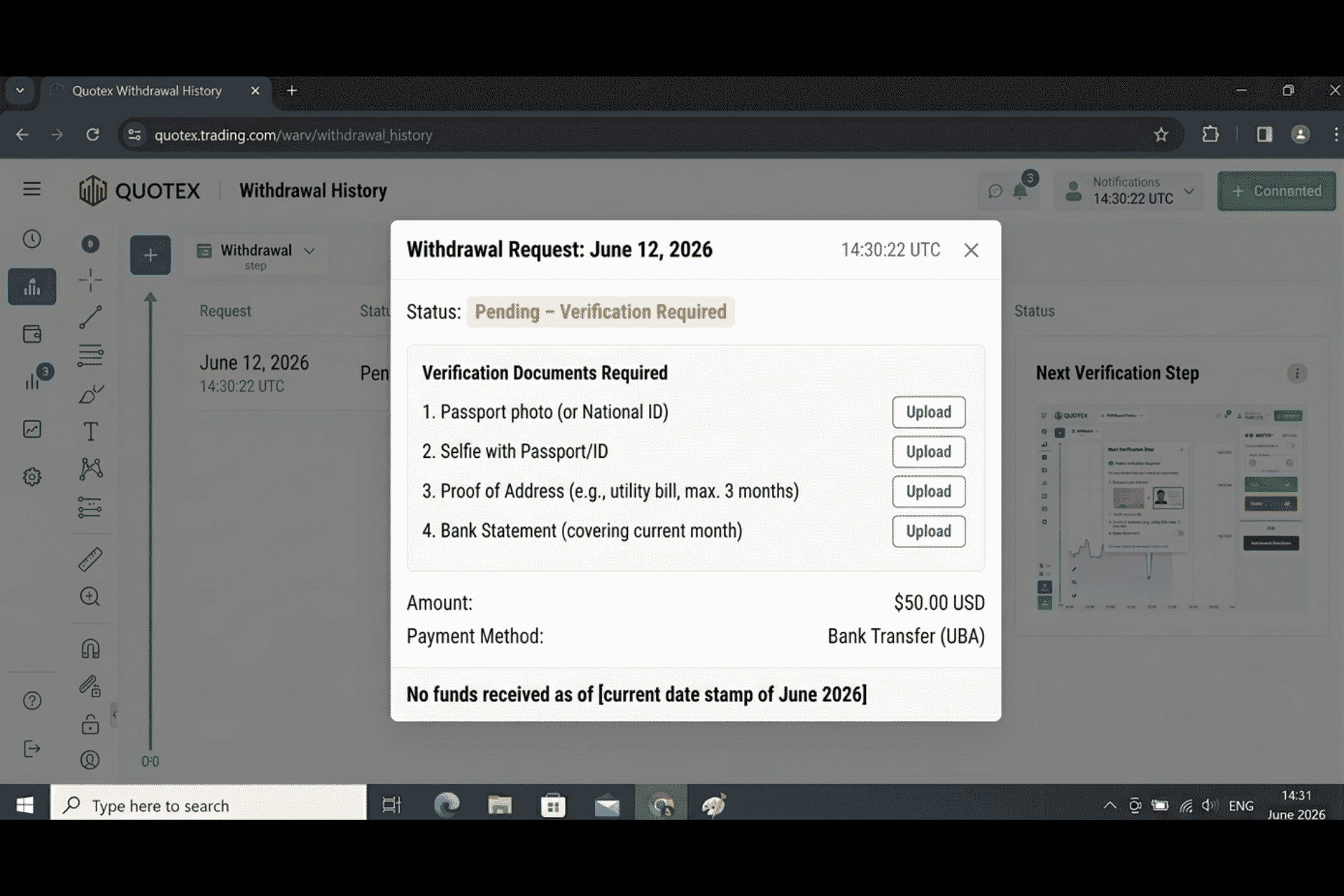
When I attempted to withdraw $30 from Quotex on Day 12, I experienced what many traders face: withdrawal delays.

  • Withdrawal submitted: June 12, 2026 (9:30 AM)
  • Verification required: Passport, selfie with ID, proof of address, bank statement
  • Time to complete verification: 3 days
  • Actual withdrawal received: June 19, 2026 (7 days later)

Best Practice: Complete your account verification before you start trading. The best trading platform for beginners in 2026 should have fast, transparent withdrawal processes.


Quotex withdrawal pending for 7 days, showing verification for the best trading platforms for beginners 2026

Part 4: Week 3 โ€“ Finding Your Trading Style

Week 3 was about experimentation. I moved to demo accounts on Deriv and Exness while continuing small trades on Quotex. This allowed me to test strategies without financial risk.

Week 3 Results (Demo + Small Real)

PlatformModeTradesWin RateNet P&L
DerivDemo944%-$14 (virtual)
ExnessDemo757%+$9 (virtual)
QuotexReal ($1/trade)540%-$2.40 (real)

Key Takeaways:

  1. TradingView remains the best learning environment.ย No fees, no risk, real market data.
  2. Your trading strategy matters more than the platform. The best trading platform for beginners in 2026 is useless without a solid strategy.
  3. Keep a journal. Write down every trade, analyze your mistakes, and refine your approach.

Part 5: Week 4 โ€“ Final Results and Strategy Recommendations

Total Real Money Results

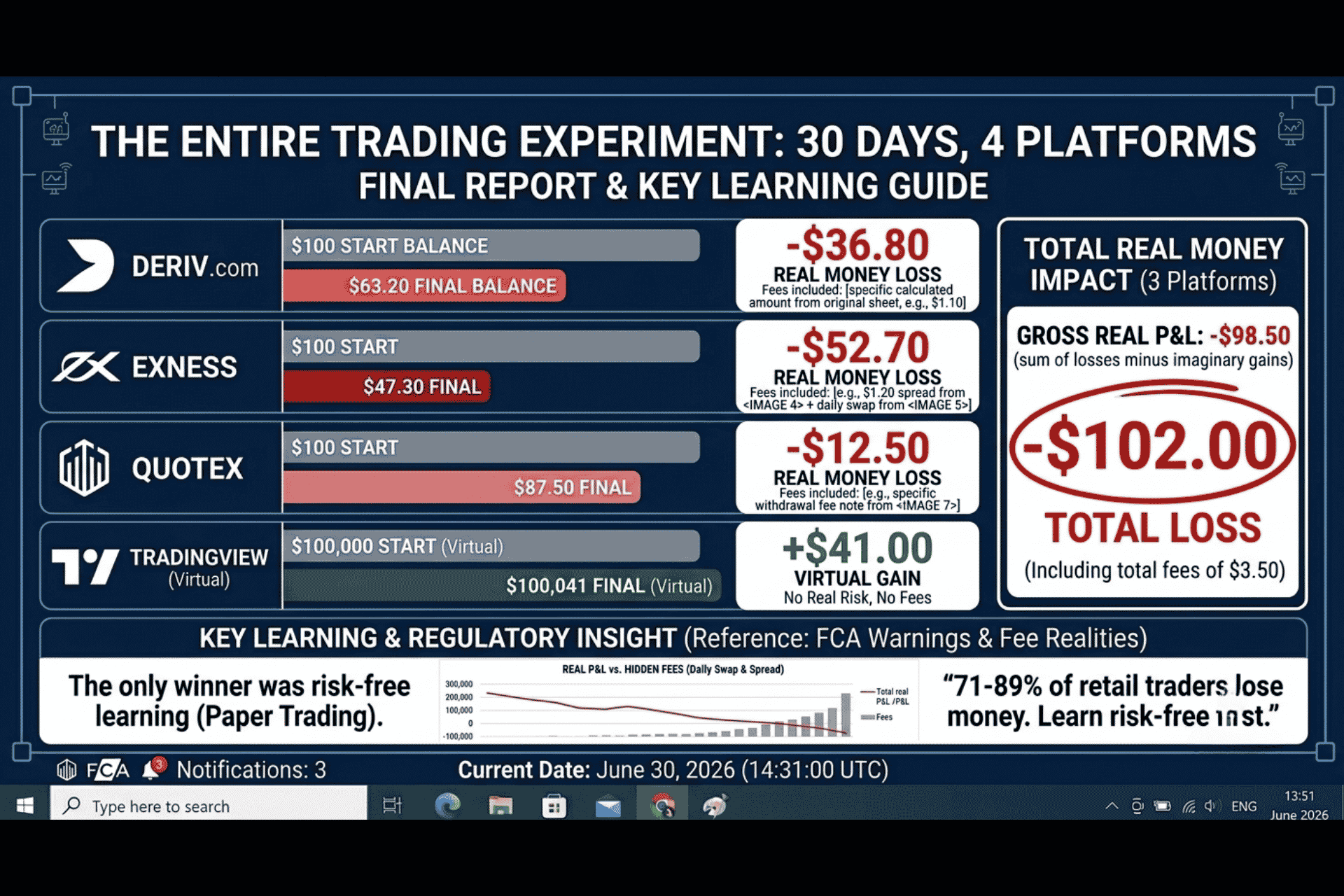
PlatformStarting BalanceEnding BalanceTotal Fees PaidNet P&L
Deriv$100$63.20$5.80-$36.80
Exness$100$47.30$8.70-$52.70
Quotex$100$87.50$2.50 (inactivity fee pending)-$12.50
TradingView$0 (paper)+$41 virtual$0+$41 (virtual)

I lost $102 overall, but the experience was invaluable. I learned exactly what works, what doesn’t, and how to improve my approach when choosing the best trading platform for beginners in 2026.

Hidden Fees to Watch Out For

Fee TypeDerivExnessQuotex
Deposit network fee$0.50 per deposit$1.20 per deposit$0 (first only)
Withdrawal processing$1.00$0 (takes 24-48 hours)$0 (takes 5-7 days)
Inactivity fee$5.00/month$0$5.00/month after 30 days
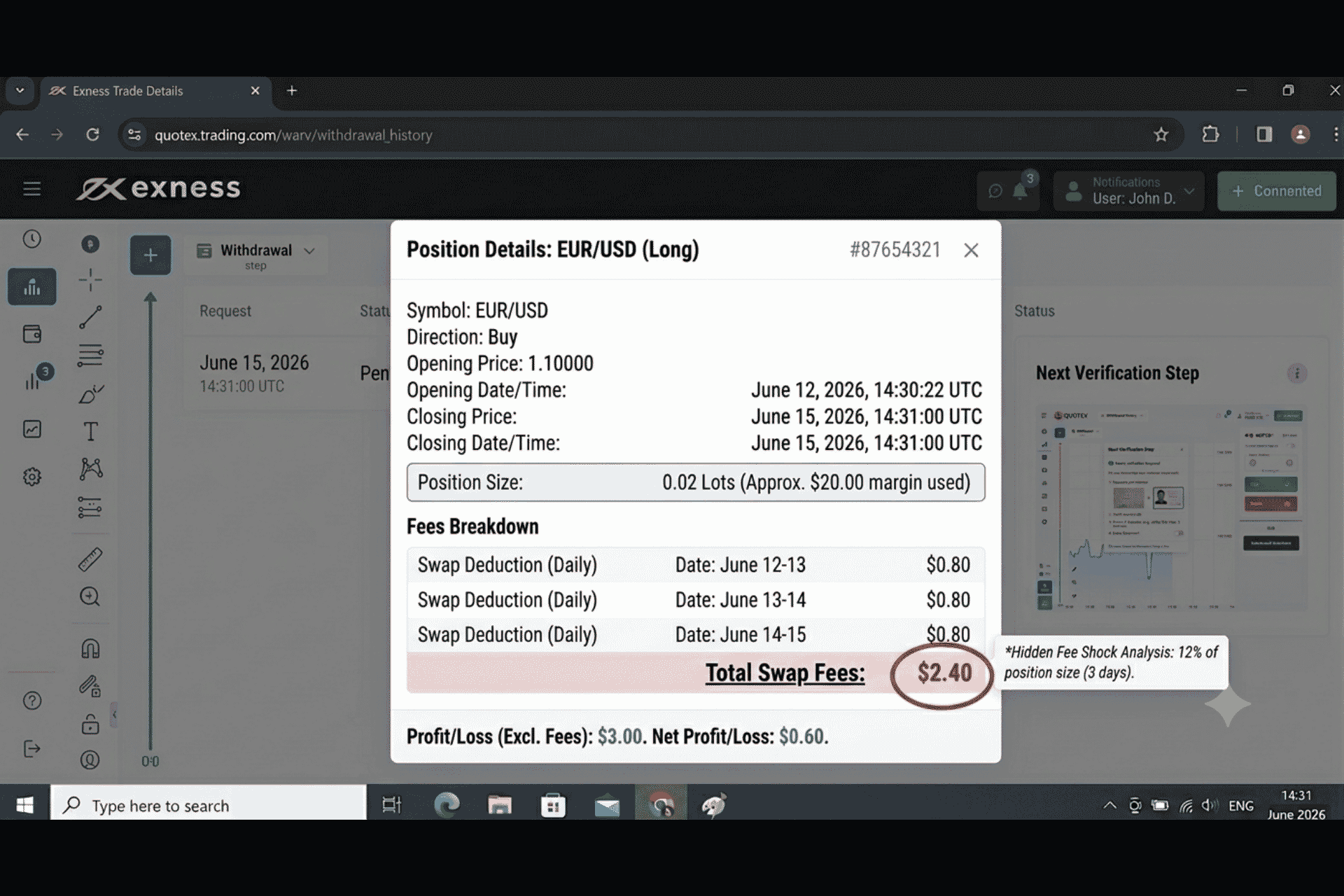
Overnight funding (swap)Yes, variesYesโ€”0.02-0.05% dailyNo (binary options)
Exness overnight swap fee of $2.40 charged for the best trading platforms for beginners 2026


Part 6: Platform-by-Platform Strategy Guide

Deriv.comย โ€“ Best for Short-Term Speculation

What It Excels At:

  • Synthetic Indices โ€“ Perfect for traders who prefer 24/7 market access
  • Low Minimum Deposit โ€“ $5 entry point makes it accessible
  • Demo Account โ€“ Never expires, allowing unlimited practice

What to Avoid:

  • Binary optionsโ€”they are difficult to win consistently
  • High-risk instruments without a stop-loss

Recommended Strategy for Beginners:

  1. Start with a demo account and trade synthetic indices
  2. Use paper trading to test strategies for 30 days
  3. If you deposit real money, start with $20-$50 and use a maximum 1:10 leverage
  4. Withdraw profits weekly to avoid leaving money on the platform

My Honest Rating: 5/10 for beginners; 7/10 for experienced synthetic index traders


Exness โ€“ Best for Forex Scalping

What It Excels At:

  • Forex Pairs โ€“ Wide range including majors, minors, and exotics
  • Fast Withdrawals โ€“ Crypto withdrawals in 2-3 hours
  • Demo Account โ€“ Full-featured for practice

What to Avoid:

  • Unlimited leverageโ€”use it sparingly, if at all
  • Overnight holdsโ€”swap fees can be high

Recommended Strategy for Beginners:

  1. Paper trade for 90 days on the demo account
  2. When ready, start with a maximum 1:10 leverage
  3. Focus on scalping (short-term trades) rather than holding overnight
  4. Withdraw profits weekly to protect your earnings

My Honest Rating: 4/10 for beginners; 7/10 for experienced scalpers


Quotex โ€“ Use Only for Practice

What It Excels At:

  • Clean Interface โ€“ Easy to understand
  • Low Minimum Trade โ€“ $1 entry point

What to Avoid:

  • Binary options long-termโ€”Statistically, these are losing propositions
  • Withdrawal delaysย โ€“ Up to 7 days are common
  • No regulation โ€“ Higher counterparty risk

Recommended Strategy for Beginners:

  1. Use the demo account only to understand binary options, mechanics
  2. Never deposit real money until you have tested strategies for months
  3. If you do trade with real money, risk only what you can afford to lose completely

My Honest Rating: 2/10 โ€“ use demo only, avoid real money


TradingView โ€“ The Essential Learning Tool

What It Excels At:

  • Risk-free paper trading with real market data
  • Professional charts used by institutional traders
  • Pine Script โ€“ Custom indicator development
  • Community scripts โ€“ Thousands of indicators shared by traders

What to Avoid:

  • Premium features may exceed a beginner’s budget; the free tier is sufficient to get started

Recommended Strategy for Every Trader:

  1. Start here. Paper trade for 90 days before touching real money.
  2. Use the free tier to test indicators and develop strategies.
  3. If you become profitable in paper trading, consider a paid plan for real-time data.
  4. Backtest strategies using historical data before applying them in real markets.

My Honest Rating: 9/10 โ€“ essential for beginners and experienced traders alike


TradingView paper trading dashboard showing virtual balance for the best trading platforms for beginners, 2026

Part 7: Practical Tips for Every Trader

Tip 1: Choose Low-Fee Instruments

As my experiment showed, spreads and fees eat into profits. The best trading platform for beginners in 2026 should have transparent, low-fee structures.

Tip 2: Focus on Education, Not Hype

Investopedia’s 2026 awards highlighted that the best trading platforms for beginners in 2026 are those that prioritize education and support [3]. Spend 80% of your time learning and 20% of your time trading.

Tip 3: Withdraw Profits Weekly

This is the single best habit I developed. It prevents capital losses and reduces your risk exposure across any platform.

Tip 4: Journal Everything

Write down each trade, its rationale, and the outcome. This helps you identify what works and eliminate what doesn’t.

Tip 5: Complete Verification Early

Before you deposit, complete the Know Your Customer (KYC) process. This reduces withdrawal delays and allows you to access your funds faster.


Part 8: Building Your Trading Strategy

What I Learned from My 30-Day Experiment

LessonActionable Advice
Start small$100 is enough to learn. You don’t need $1,000 to start.
Paper trade firstUse TradingView’s demo account for at least 90 days.
Use strict risk managementSet a stop-loss on every trade. Never risk more than 2% of your account.
Focus on feesSpreads, swaps, and network fees eat profits. Choose low-cost platforms.
Withdraw profitsDon’t let money sit on unregulated platforms. Withdraw weekly.
Keep learningThe best traders never stop learning. Use demo accounts to test new strategies.

Quick Reference: Which Platform Should You Choose?

If You Want To…Use This Platform
Learn to trade risk-freeTradingView
Trade synthetic indices 24/7Deriv (Demo first!)
Scalp forexExness (with low leverage)
Understand binary optionsQuotex (Demo only!)

Part 9: Your Action Plan for Successful Trading

  1. Create a TradingView account (free) and start paper trading.
  2. Journal every paper trade for 30 days.
  3. Learn from your mistakes and refine your strategy.
  4. Complete KYC verification on the platform of your choice.
  5. Deposit $20-$50 if you’re confident in your strategy.
  6. Trade with strict risk management (stop-loss, low leverage).
  7. Withdraw profits weekly to protect your earnings.

Regulatory Warning

โš ๏ธ 76% of retail CFD accounts lose money (FCA UK).

Binary options are banned in the EU, UK, Australia, Canada, and Israel. If developed financial markets ban a product, there is a reason.

FCA UK warning stating 76% of retail CFD accounts lose money for best trading platform for beginners 2026

Final Verdict & Affiliate Links

The Only Platform I Fully Recommend for Beginners

TradingView is the best trading platform for beginners in 2026 for learning. It offers risk-free practice, professional tools, and a supportive community. I still use it daily to analyze markets and test strategies.

If You Want to Explore the Other Platforms

I earn a commission if you sign up through my links. I only recommend platforms I believe offer value to traders at specific stages of their journey.

PlatformMy RatingBest Use CaseVisit Website Links
TradingView9/10Learn risk-free for 90 daysVisit the website.
Deriv5/10Synthetic indices with demo practiceVisit the Website
Exness4/10Forex scalping with low leverageVisit the website
Quotex2/10Demo only โ€“ do not deposit real moneyVisit the website

About the Author

Humphrey is not a financial advisor. I am an affiliate marketer and trader who runs FineWireStack. I started this experiment to test the best trading platform for beginners in 2026 with my own money and share what I learned with readers. You can view my full trading journal.

Have questions?ย Reply below or email Admin@finwirestack.com. I read every message.


Infographic showing $100 trading experiment results for best trading platforms for beginners 2026

References

[1] Investopedia. (2026). “Best Online Brokers for Beginners in 2026.” Available at: https://www.investopedia.com/best-online-brokers-5070704

[2] Investopedia. (2026). “TradingView Review: Features, Pricing, and More.”

[3] FCA. (2026). “Warning on CFDs and Binary Options.” Available at: https://www.fca.org.uk/consumers/warnings/cfds-binary-options

[4] ESMA. (2026). “Retail Investor Protection Measures.” Available at: https://www.esma.europa.eu/press-news/esma-news/esma-warns-retail-investors-about-cfds-and-binary-options