
Central Banks & Forex: 5 Ways They Move Markets
Central banks and forex share one of the most powerful relationships in global finance. When a central bank speaks, the entire currency market listens. When it acts, prices can move hundreds of pips in minutes.
But here’s what many traders don’t fully understand: central banks and forex are connected through predictable mechanisms—interest rates, quantitative easing, forward guidance, and direct intervention. These aren’t mysterious forces. They are tools that central banks use deliberately, and traders who understand them can position themselves ahead of major moves.
This guide breaks down exactly how central banks and forex interact. You will learn:
- What central banks are and why they matter
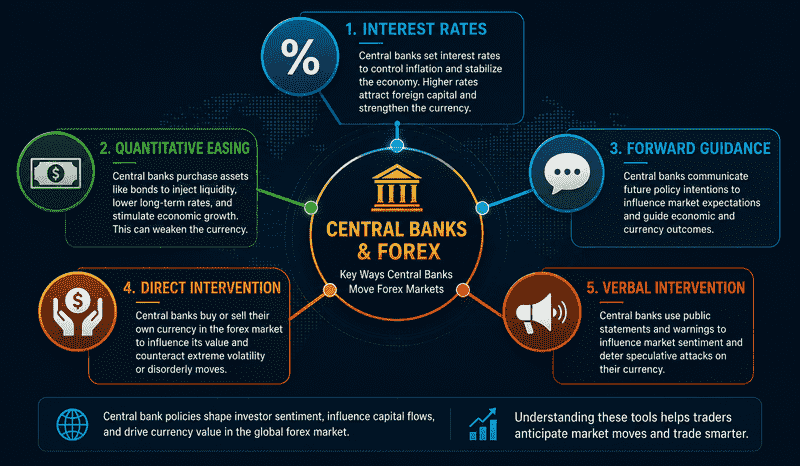
- The 5 most powerful ways central banks move currencies
- How to interpret central bank communications
- Real trading strategies for central bank events
- Common mistakes traders make and how to avoid them
By the end, you will understand the central banks and forex relationship well enough to trade with conviction around major policy announcements.
What Are Central Banks?
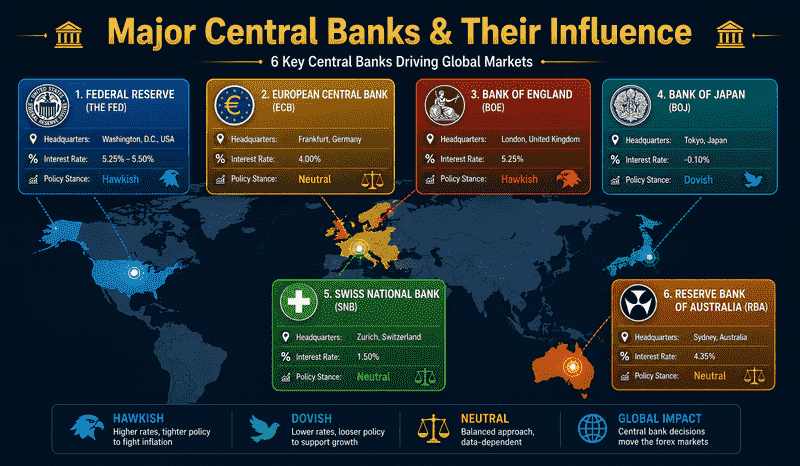
A central bank is the primary regulatory authority for a country’s currency and monetary system. It controls the money supply, manages interest rates, and oversees the stability of financial institutions. Central banks also act as the lender of last resort in times of financial distress, providing liquidity to market participants when needed.
🎯 Real-World Analogy: Think of a central bank as the “pilot” of a country’s economy. Just as a pilot adjusts altitude, speed, and direction to keep the plane stable, a central bank adjusts interest rates, money supply, and policy to keep the economy stable.
The World’s Most Influential Central Banks
| Central Bank | Country/Region | Currency | Key Focus |
|---|---|---|---|
| Federal Reserve (Fed) | United States | USD | Maximum employment, stable prices |
| European Central Bank (ECB) | Eurozone | EUR | Price stability, economic growth |
| Bank of England (BoE) | United Kingdom | GBP | Price stability, financial stability |
| Bank of Japan (BoJ) | Japan | JPY | Price stability, economic growth |
| Swiss National Bank (SNB) | Switzerland | CHF | Price stability, exchange rate stability |
| Reserve Bank of Australia (RBA) | Australia | AUD | Price stability, full employment |
Why Central Banks Matter for Forex Traders
Central banks are the single most important force in the forex market. Their decisions affect:
- Interest rates — The primary driver of currency values
- Money supply — Affects inflation and purchasing power
- Market sentiment — Forward guidance shapes expectations
- Currency interventions — Direct buying/selling of currencies
🟦 Blue Highlight: Understanding central banks and forex is not optional for serious traders. Central bank decisions account for some of the largest and most predictable moves in the currency markets.
Way #1: Interest Rate Decisions
Interest rates are the most powerful tool in the central banks and forex relationship. By adjusting benchmark rates, central banks influence borrowing costs, money supply, and ultimately, currency values.
How Interest Rates Affect Currency Value
| Action | Effect on Currency | Why It Happens |
|---|---|---|
| Rate Increase (Hawkish) | ✅ Currency Strengthens | Higher rates attract foreign investment seeking better returns |
| Rate Decrease (Dovish) | ❌ Currency Weakens | Lower rates reduce investment appeal, encouraging capital outflows |
| Rate Hold (Neutral) | ⚠️ Minimal Impact | The market had already priced in expectations |
🎯 Real-World Example
Scenario: The Federal Reserve raises interest rates from 4.50% to 4.75%.
Step 1: Market Reaction
- USD/JPY jumps 100 pips immediately
- EUR/USD drops 80 pips
- US Treasury yields rise
Step 2: Why It Happened
- Higher rates = higher yield on US bonds
- Investors buy USD to purchase US bonds
- Increased demand = stronger USD
Step 3: Trader Decision
- A trader who anticipated the hike would have bought USD/JPY before the announcement
- Profit potential: 100+ pips
🔴 Red Highlight: Trading interest rate decisions requires caution. Markets often “price in” expected moves before the announcement. The biggest moves happen when the actual decision differs from expectations.
Way #2: Quantitative Easing (QE) and Asset Purchases
Quantitative easing is an unconventional monetary policy where central banks buy government securities or other assets to inject liquidity into financial markets and lower long-term interest rates.
How QE Affects Currency Value
| QE Action | Effect on Currency | Mechanism |
|---|---|---|
| Expanding QE | ❌ Currency Weakens | Increases the money supply, devaluing the currency |
| Reducing QE (Tapering) | ✅ Currency Strengthens | Reduces money supply, supporting the currency |
| Ending QE | ✅ Currency Strengthens | Removes liquidity, potentially increasing yields |
🎯 Real-World Example: Bank of Japan
The Bank of Japan has been a textbook example of central banks and forex interaction through QE.
Situation: The BoJ has been conducting massive QE programs for years to combat deflation.
Impact on JPY:
- Increased money supply = weaker JPY
- USD/JPY rose from 100 to 150+ over several years
- Each QE expansion announcement caused the JPY to drop
Lesson: Understanding central banks and forex means understanding that QE is fundamentally bearish for a currency in the long term.
Way #3: Forward Guidance
Forward guidance is the communication central banks use to signal their future policy intentions. This is one of the most powerful and subtle aspects of the central banks and forex relationship.
Types of Forward Guidance
| Type | Example | Market Impact |
|---|---|---|
| Explicit | “We expect to raise rates in 6 months.” | Immediate currency strengthening |
| Conditional | “We will raise rates if inflation persists.” | Market prices in conditional scenarios |
| Vague | “We are watching inflation closely.” | The market speculates on high volatility |
| Dovish | “We see risks to the downside.” | Currency weakens |
| Hawkish | “We are prepared to act if needed.” | Currency strengthens |
🎯 Real-World Example: The Fed’s “Dot Plot”
The Federal Reserve publishes a “dot plot” showing each policymaker’s interest rate expectations.
What It Reveals:
- If dots move higher → USD strengthens
- If dots move lower → USD weakens
- If dots are unchanged → minimal impact
🟦 Blue Highlight: Forward guidance often moves markets more than the actual policy change. A hawkish comment can strengthen a currency weeks before any rate hike actually occurs.
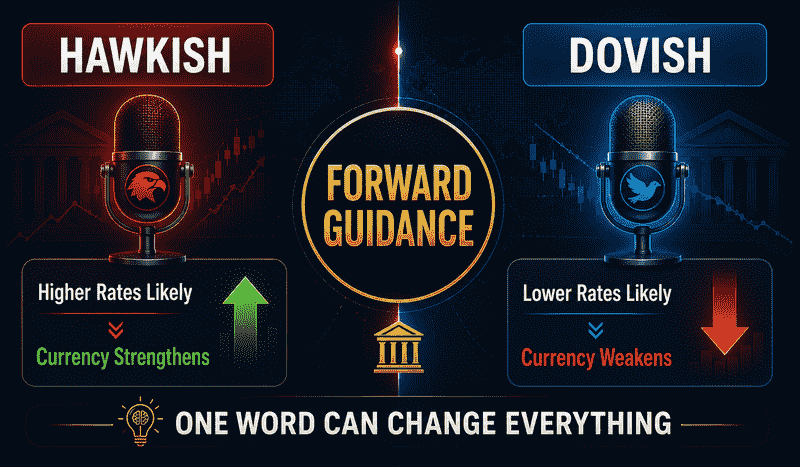
Figure 3: How central bank communication moves forex markets
Way #4: Direct Currency Intervention
Direct intervention is the most aggressive tool in the central banks’ and foreign exchange relationship. Central banks actively buy or sell their own currency in the open market to influence its value.
Types of Direct Intervention
| Type | Action | Effect |
|---|---|---|
| Sterilized Intervention | Buy/sell currency without changing the money supply | Temporary price impact |
| Unsterilized Intervention | Buy/sell currency while adjusting money supply | Permanent price impact |
| Coordinated Intervention | Multiple central banks act together | Stronger, longer-lasting impact |
🎯 Real-World Example: Swiss National Bank
The Swiss National Bank is famous for direct intervention in the central banks and forex relationship.
The Scenario:
- CHF was too strong, hurting Swiss exports
- SNB aggressively bought foreign currencies to weaken the CHF
The Result:
- USD/CHF moved from 0.85 to 1.00+ during intervention periods
- Traders who followed the SNB’s actions could profit
⚠️ Orange Warning: Direct intervention can create sharp, unpredictable moves. Always use stop losses when trading around intervention scenarios.
Way #5: Verbal Intervention
Verbal intervention is the practice of central bank officials making public statements designed to influence currency values without actually trading.
How Verbal Intervention Works
| Statement Type | Market Impact | Example |
|---|---|---|
| “We are concerned.” | Traders expect action | Currency moves in the desired direction |
| “We are watching closely.” | Heightened vigilance | Reduced volatility as traders wait |
| “We are prepared to act.” | Strongest signal | Immediate market reaction |
🎯 Real-World Example: ECB Verbal Intervention
European Central Bank officials are known for using verbal intervention to manage the Euro’s value.
The Scenario:
- EUR/USD was trading at 1.20 (too strong for ECB preference)
- ECB President stated: “The exchange rate is increasingly important for our policy decisions.”
The Result:
- The market interpreted as “weaker EUR wanted”
- EUR/USD dropped 50 pips instantly
🟦 Blue Highlight: Words matter as much as actions in the central banks and forex relationship. A single word change in a statement can move markets by 100+ pips.
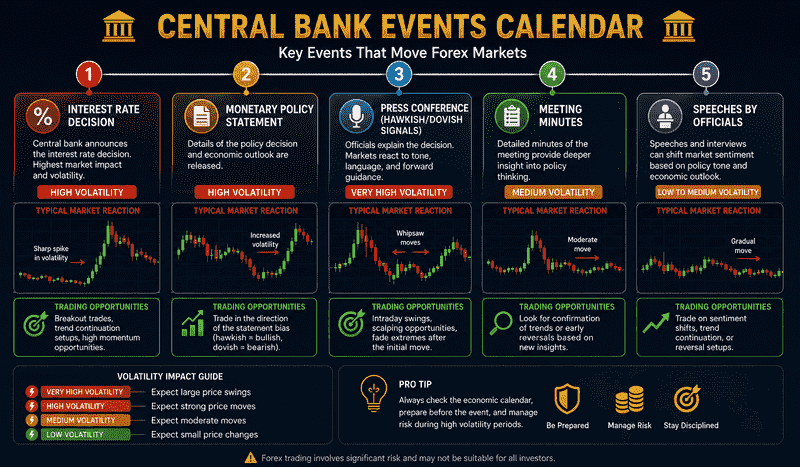
Figure 4: How to trade around central bank events
Trading Central Bank Events
Understanding central banks and forex is one thing. Trading around central bank events is another. Here is a practical approach:
Step 1: Know the Calendar
| Event | Frequency | Impact |
|---|---|---|
| Interest Rate Decision | Monthly or Quarterly | Highest impact |
| Monetary Policy Statement | Same day as rate decision | High impact |
| Press Conference | 30-60 min after the decision | High impact |
| Meeting Minutes | 2-4 weeks after meeting | Moderate impact |
| Central Bank Speeches | Various | Moderate-to-high impact |
Step 2: Understand Market Expectations
Before any central bank event, ask:
- What is the consensus forecast?
- What is the market pricing in?
- What would surprise the market?
Step 3: Prepare Your Strategy
| Scenario | Strategy |
|---|---|
| Hawkish Surprise | Buy the currency |
| Dovish Surprise | Sell the currency |
| No Change | Trade the press conference instead |
| Neutral | Wait for the reaction, then follow the momentum |
Step 4: Manage Risk
🟦 Blue Highlight: Central bank events are the highest volatility periods in forex. Always use wider stop-losses to avoid being stopped out by temporary spikes.
Common Mistakes When Trading Central Banks
| Mistake | Why It’s a Problem | How to Fix |
|---|---|---|
| Trading the rumor | The market already priced it in | Focus on the “surprise.” |
| Ignoring the press conference | The statement tells half the story | Wait for full communication |
| No stop-loss | One bad event can wipe you out | Always use SL |
| Trading too big | Leverage + volatility = disaster | Use smaller position sizes |
| Chasing the move | Often too late | Wait for a pullback |
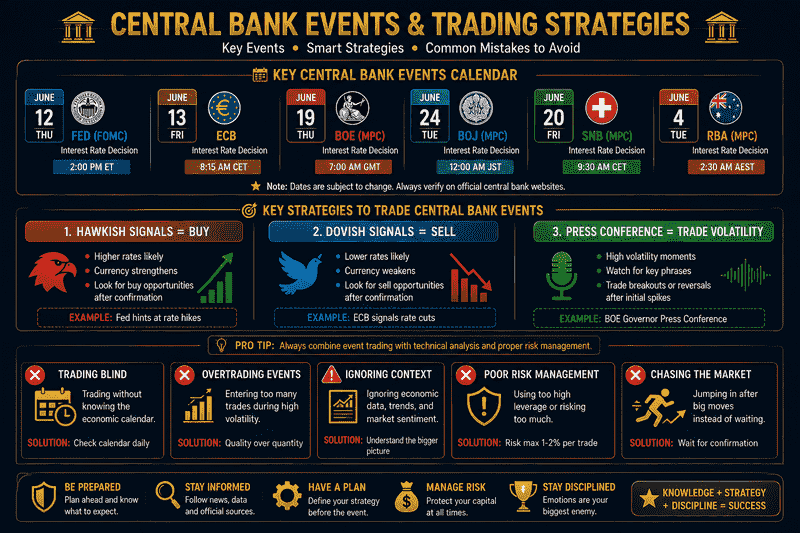
Figure 5: Central bank trading strategy summary — what every forex trader should know
Conclusion: The Power of Central Banks in Forex
The relationship between central banks and forex is the single most important dynamic in the currency markets. Understanding how central banks think, communicate, and act gives you a powerful edge.
Key Takeaways:
- Interest rates are the primary driver—higher rates = stronger currency
- Quantitative easing weakens currencies—more money in circulation = less value
- Forward guidance moves markets—What central banks say matters as much as what they do
- Direct intervention can be powerful—but it’s often temporary
- Verbal intervention is common—words can move prices
🎯 Final Thought: The most successful traders don’t just react to central bank announcements—they anticipate them. By understanding central banks and forex, you can position yourself ahead of major moves rather than chasing them after they happen.
FAQ
1. Which central bank has the biggest impact on forex?
The US Federal Reserve has the largest impact because the US Dollar is the world’s primary reserve currency and is involved in over 80% of all forex transactions.
2. How do interest rates affect currency values?
Higher interest rates attract foreign investment seeking better returns, increasing demand for the currency. Lower rates reduce investment appeal, decreasing demand.
3. What is forward guidance, and why does it matter?
Forward guidance is central bank communication about future policy intentions. It matters because traders react to expectations, often moving markets before the actual policy change.
4. Can central banks control currency values?
Central banks can influence currency values through interest rates, QE, and direct intervention. However, they cannot control them completely—market forces are ultimately the final arbiters.
5. What is the difference between hawkish and dovish?
Hawkish means favoring higher interest rates to control inflation (strengthens currency). Dovish means favoring lower rates to stimulate growth (weakens currency).
6. When should I trade around central bank events?
Trade around high-impact events like interest rate decisions and press conferences. Avoid trading immediately before announcements, as volatility can be extreme.
7. What is the safest way to trade central bank events?
Use smaller position sizes and wider stop-losses, and wait for the initial volatility spike to settle before entering. Focus on the press conference, not just the rate decision.
Further Reading
To deepen your understanding of forex trading, we recommend exploring these additional resources from Finwirestack:
- 7 Proven Steps to Start Trading Forex: Beginner’s Guide — Learn how to choose a broker, open an account, and place your first trade.
- Essential Forex Trading Terminology: Ultimate Guide — Master the language of forex with 100+ terms explained with real examples.
- Technical vs Fundamental Analysis: Which Strategy Wins? — Discover which trading approach suits your personality.
- Risk Management for Forex Traders: Protect Your Capital — Master position sizing, stop-loss strategies, and trading psychology.
External Resources (DoFollow Links)
- Federal Reserve Official Website — Official source for US monetary policy.
- European Central Bank Official Website — Official source for Eurozone monetary policy.
- Bank of England Official Website — Official source for UK monetary policy.
- Trading Economics: Central Bank Rates — Real-time central bank interest rate data.
Disclaimer: Trading forex and CFDs involves significant risk of loss. It is not suitable for all investors. You should carefully consider your investment objectives, level of experience, and risk appetite before trading. Never trade with money you cannot afford to lose. The information provided in this article is for educational purposes only and does not constitute financial advice.






[…] Central Banks & Forex: 5 Powerful Ways They Move Markets — Understand how the Fed, ECB, and BoJ move the markets. […]
[…] Article Link: The Role of Central Banks in the Forex Market […]